15000 bài tập tách từ đề thi thử môn Tiếng Anh có đáp án (Phần 49)
68 câu hỏi
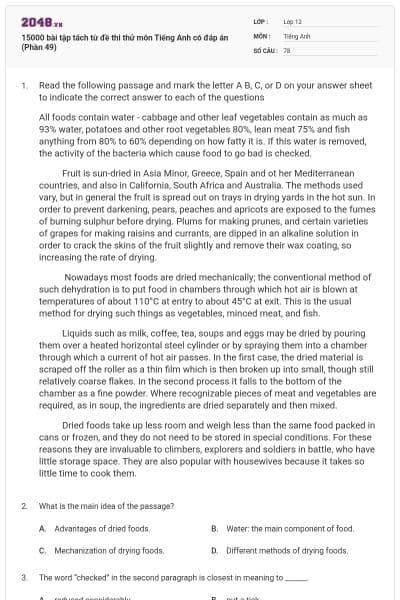
Read the following passage and mark the letter A B, C, or D on your answer sheet to indicate the correct answer to each of the questions
All foods contain water - cabbage and other leaf vegetables contain as much as 93% water, potatoes and other root vegetables 80%, lean meat 75% and fish anything from 80% to 60% depending on how fatty it is. If this water is removed, the activity of the bacteria which cause food to go bad is checked.
Fruit is sun-dried in Asia Minor, Greece, Spain and ot her Mediterranean countries, and also in California, South Africa and Australia. The methods used vary, but in general the fruit is spread out on trays in drying yards in the hot sun. In order to prevent darkening, pears, peaches and apricots are exposed to the fumes of burning sulphur before drying. Plums for making prunes, and certain varieties of grapes for making raisins and currants, are dipped in an alkaline solution in order to crack the skins of the fruit slightly and remove their wax coating, so increasing the rate of drying.
Nowadays most foods are dried mechanically; the conventional method of such dehydration is to put food in chambers through which hot air is blown at temperatures of about 110°C at entry to about 45°C at exit. This is the usual method for drying such things as vegetables, minced meat, and fish.
Liquids such as milk, coffee, tea, soups and eggs may be dried by pouring them over a heated horizontal steel cylinder or by spraying them into a chamber through which a current of hot air passes. In the first case, the dried material is scraped off the roller as a thin film which is then broken up into small, though still relatively coarse flakes. In the second process it falls to the bottom of the chamber as a fine powder. Where recognizable pieces of meat and vegetables are required, as in soup, the ingredients are dried separately and then mixed.
Dried foods take up less room and weigh less than the same food packed in cans or frozen, and they do not need to be stored in special conditions. For these reasons they are invaluable to climbers, explorers and soldiers in battle, who have little storage space. They are also popular with housewives because it takes so little time to cook them.
What is the main idea of the passage?
Advantages of dried foods.
Water: the main component of food.
Mechanization of drying foods.
Different methods of drying foods.
Đáp án D
Kiến thức: Đọc hiểu
Giải thích:
Ý chính của đoạn văn là gì?
A: Những ích lợi của thực phẩm khô C: Sự cơ khí hóa trong việc làm khô thực phẩm B: Nước: thành phần chính của thực phẩm D: Các phương pháp làm khô thực phẩm.
Trong bài có nhắc đến các phương pháp làm khô thực phẩm như "sun-dried", "expose to sulphur fumes", "put in chambers", ....
Đáp án:D
The word “checked” in the second paragraph is closest in meaning to ______.
reduced considerably
put a tick
examined carefully
motivated to develop
Đáp án A
Kiến thức: Đọc hiểu
Giải thích:
Chữ "checked" ở đoạn thứ hai có nghĩa gần nhất với ______.
A: được giảm đáng kể C: được kiểm tra kỹ lưỡng
B: được đánh dấu tick. D: được kích thích phát triển
If this water is removed, the activity of the bacteria which cause food to go bad is checked. Nếu nước bị loại bỏ thì hoạt động của vi khuẩn gây hư hại thực phẩm sẽ được giảm thiểu đáng kể.
Đáp án:A
In the process of drying certain kinds of fruits, sulphur fumes help ______
remove their wax coating
kill off bacteria
maintain their color
crack their skin
Đáp án C
Kiến thức: Đọc hiểu
Giải thích:
Trong quá trình sấy một số loại trái cây nhất định, khói lưu huỳnh sẽ giúp ______.
A. loại bỏ lớp phủ sáp của chúng C. duy trì màu sắc của chúng
B. diệt vi khuẩn D. làm nứt vỏ của chúng
Thông tin: In order to prevent darkening, pears, peaches and apricots are exposed to the fumes of burning sulphur before drying.
Ta có cụm từ "prevent darkening" (không để bị thâm đen) = "maintain their color" (giữ nguyên màu sắc)
Đáp án:C
Nowadays the common method for drying vegetables and minced meat is ______.
spreading them out on trays in drying yards
putting them in chambers and blowing hot air through
dipping them in an alkaline solution
pouring them over a heated horizontal steel cylinder
Đáp án B
Kiến thức: Đọc hiểu
Giải thích:
Ngày nay, phương pháp phổ biến để sấy rau và thịt băm là ______.
A. phun chúng trên khay trong sân phơi
B. đưa chúng vào buồng và thổi không khí nóng qua
C. nhúng chúng trong dung dịch kiềm
D. đổ chúng qua một xy lanh thép ngang nóng
Thông tin: Nowadays most foods are dried mechanically; the conventional method of such dehydration is to put food in chambers through which hot air is blown at temperatures of about 110°C at entry to about 45°C at exit.
Đáp án:B
What does the word “which” in the fourth paragraph refer to?
Vegetables
Foods
Things
Chambers
Đáp án D
Kiến thức: Đọc hiểu
Giải thích:
Từ "which" trong đoạn 4 nói đến cái gì?
A. Rau C. Những thứ
B. Thực phẩm D. Buồng sấy
Đại từ quan hệ "which" dùng để thay thế cho danh từ đứng trước nó là "chambers": Nowadays most foods are dried mechanically; the conventional method of such dehydration is to put food in chambers through which hot air is blown at temperatures of about 110°C at entry to about 45°C at exit.
Đáp án:D
The final product of the process of drying liquids that uses the first method will be ______.
small flakes
fine powder
dried soup
recognizable pieces
Đáp án A
Kiến thức: Đọc hiểu
Giải thích:
Sản phẩm cuối cùng của quá trình sấy chất lỏng sử dụng phương pháp đầu tiên sẽ là ______.
A. các mảnh nhỏ C. súp khô
B. bột mịn D. các mảnh dễ nhận biết
Thông tin: In the first case, the dried material is scraped off the roller as a thin film which is then broken up into small, though still relatively coarse flakes.
Đáp án:A
According to the passage, dried foods are most useful for ______.
explorers who are underweight
soldiers who are not in battle
people who are on the move
housewives who have little storage space
Đáp án C
Kiến thức: Đọc hiểu
Giải thích:
Theo đoạn văn, thực phẩm khô hữu ích nhất cho ______.
A. những nhà thám hiểm thiếu cân B. những người lính không tham chiến
C. những người bận rộn D. các bà nội trợ có ít không gian để trữ đồ
Thông tin: Dried foods take up less room and weigh less than the same food packed in cans or frozen, and they do not need to be stored in special conditions. For these reasons they are invaluable to climbers, explorers and soldiers in battle, who have little storage space. They are also popular with housewives because it takes so little time to cook them.
Ta có cụm "to be on the move" hoặc "to be on the go" nghĩa là vô cùng bận rộn. Do đó đáp án C là hợp lí nhất. ("People who are on the move" bao gồm"climbers", "soldiers in battle" and "housewives".)
Đáp án:C
This passage is mainly ______.
argumentative
analytical
informative
fictional
Đáp án C
Kiến thức: Đọc hiểu
Giải thích:
Đoạn văn này chủ yếu là ______.
A: tranh luận C: cung cấp thông tin
B: phân tích D: hư cấu, viễn tưởng
Đáp án:C
Dịch bài đọc số 86:
Tất cả các loại thực phẩm đều chứa nước - bắp cải và các loại rau ăn lá khác có chứa 93% nước, khoai tây và rau củ ăn rễ khác chứa 80%, thịt nạc 75% và cá từ 80% đến 60% tuỳ theo chất béo. Nếu nước bị loại bỏ thì hoạt động của vi khuẩn gây hư hại thực phẩm sẽ được giảm thiểu đáng kể.
Trái cây được sấy khô ở Châu Á, Hy Lạp, Tây Ban Nha và các nước Địa Trung Hải, cũng như ở California, Nam Phi và Úc. Phương thức được sử dụng khác nhau, nhưng nhìn chung, trái cây được trải ra trên khay trong sân phơi nắng. Để ngăn bị thâm đen, lê, đào và mơ sẽ tiếp xúc với khói của lưu huỳnh đốt cháy trước khi sấy khô. Mận để làm mận khô và một số loại nho để làm nho khô và quả lý chua, được nhúng vào dung dịch kiềm để nứt vỏ và loại bỏ lớp phủ sáp, do đó làm tăng tốc độ sấy.
Ngày nay hầu hết các thực phẩm đều được làm khô bằng máy móc; phương pháp loại bỏ nước thông thường là đưa thức ăn vào trong buồng thông qua đó không khí nóng được thổi ở nhiệt độ khoảng 110 ° C ở lối vào tới khoảng 45 ° C ở lối ra. Đây là phương pháp thông thường để làm khô những thứ như rau, thịt băm, và cá.
Các chất lỏng như sữa, cà phê, chè, súp và trứng có thể được làm khô bằng cách đổ chúng lên trên một xi lanh thép ngang nóng hoặc bằng cách phun chúng vào trong buồng mà qua đó một luồng không khí nóng đi qua. Trong trường hợp đầu tiên, vật liệu khô được loại bỏ khỏi con lăn như một màng mỏng sau đó được chia thành các mảnh nhỏ, mặc dù vẫn còn thô. Trong quá trình thứ hai nó rơi xuống đáy của buồng như một miếng bột. Nơi có thể nhận thịt và rau là cần thiết, như trong súp, các thành phần được sấy khô riêng biệt và sau đó trộn lẫn.
Thực phẩm khô chiếm ít chỗ hơn và nhẹ hơn so với cùng một thực phẩm đóng gói trong lon hoặc đông lạnh, và chúng không cần phải được bảo quản trong điều kiện đặc biệt. Vì những lý do này, chúng rất có giá rị đối với các nhà leo núi, thám hiểm và binh lính trong trận chiến, những người có ít chỗ trữ đồ. Chúng cũng phổ biến với các bà nội trợ bởi vì cần rất ít thời gian để nấu chúng.
Read the following passage and mark the letter A B, C, or D on your answer sheet to indicate the correct answer to each of the questions
Very few people, groups, or governments oppose globalization in its entirety. Instead, critics of globalization believe aspects of the way globalization operates should be changed. The debate over globalization is about what the best rules are for governing the global economy so that its advantages can grow while its problems can be solved.
On one side of this debate are those who stress the benefits of removing barriers to international trade and investment, allowing capital to be allocated more efficiently and giving consumers greater freedom of choice. With free-market globalization, investment funds can move unimpeded from the rich countries to the developing countries. Consumers can benefit from cheaper products because reduced taxes make goods produced at low cost from faraway places cheaper to buy. Producers of goods gain by selling to a wider market. More competition keeps sellers on their toes and allows ideas and new technology to spread and benefit others.
On the other side of the debate are critics who see neo-liberal policies as producing greater poverty, inequality, social conflict, cultural destruction, and environmental damage. They say that the most developed nations – the United States, Germany, and Japan – succeeded not because of free trade but because of protectionism and subsidies. They argue that the more recently successful economies of South Korea, Taiwan, and China all had strong state-led development strategies that did not follow neo-liberalism. These critics think that government encouragement of “infant industries” – that is, industries that are just beginning to develop – enables a country to become internationally competitive.
Furthermore, those who criticize the Washington Consensus suggest that the inflow and outflow of money from speculative investors must be limited to prevent bubbles. These bubbles are characterized by the rapid inflow of foreign funds that bid up domestic stock markets and property values. When the economy cannot sustain such expectation, the bubbles burst as investors panic and pull their money out of the country.
Protests by what is called the anti-globalization movement are seldom directed against globalization itself but rather against abuses that harm the rights of workers and the environment. The question raised by nongovernmental organizations and protesters at WTO and IMF gatherings is whether globalization will result in a rise of living standards or a race to the bottom as competition takes the form of lowering living standards and undermining environmental regulations.
One of the key problems of the 21st century will be determining to what extent markets should be regulated to promote fair competition, honest dealing, and fair distribution of public goods on a global scale.
Supporters of free-market globalization point out that
investment will be allocated only to rich countries
taxes that are paid on goods will be increased
there will be less competition among producers
consumers can benefit from cheaper products
Đáp án D
Kiến thức: Đọc hiểu
Giải thích:
Những người ủng hộ toàn cầu hoá thị trường tự do chỉ ra rằng
A. đầu tư sẽ chỉ được phân bổ cho các nước giàu
B. các loại thuế được thanh toán trên hàng hoá sẽ được tăng lên
C. sẽ có sự cạnh tranh giữa các nhà sản xuất
D. người tiêu dùng có thể hưởng lợi từ các sản phẩm rẻ hơn
Thông tin: On one side of this debate are those who stress the benefits of removing barriers to international trade and investment, allowing capital to be allocated more efficiently and giving consumers greater freedom of choice. […]Consumers can benefit from cheaper products because reduced taxes make goods produced at low cost from faraway places cheaper to buy.
Đáp án:D
The word “allocated” in the passage mostly means
distributed
solved
removed
offered
Đáp án A
Kiến thức: Đọc hiểu
Giải thích:
Từ “allocated” trong đoạn văn chủ yếu nghĩa là
A. phân phối C. loại bỏ
B. được giải quyết D. được cung cấp
“allocated” = distributed: phân bổ, phân phối
Đáp án:A
The phrase “keeps sellers on their toes” in the passage mostly means
prevents sellers from selling new products
forces sellers to go bare-footed
makes sellers responsive to any changes
allows sellers to stand on their own feet
Đáp án C
Kiến thức: Đọc hiểu
Giải thích:
Cụm từ “keeps sellers on their toes” trong đoạn văn có nghĩa là
A. ngăn cản người bán bán sản phẩm mới
B. buộc người bán phải đi chân trần
C. làm cho người bán đáp ứng nhanh nhạy với mọi thay đổi
D. cho phép người bán đứng vững trên đôi chân của mình
“keeps sellers on their toes”: làm cho người bán đáp ứng nhanh nhạy với mọi thay đổi
More competition keeps sellers on their toes and allows ideas and new technology to spread and benefit others.
Nhiều cạnh tranh hơn khiến người bán phản ứng nhanh nhạy với những thay đổi và cho phép những ý tưởng và công nghệ mới lan rộng và mang lại lợi ích.
Đáp án: C
According to critics of globalization, several developed countries have become rich because of
their help to developing countries
their neo-liberal policies
their protectionism and subsidies
their prevention of bubbles
Đáp án C
Kiến thức: Đọc hiểu
Giải thích:
Theo các nhà phê bình về toàn cầu hoá, một số nước phát triển đã trở nên giàu có vì
A. sự giúp đỡ của họ đối với các nước đang phát triển
B. các chính sách tự do của họ
C. bảo hộ và trợ cấp của họ
D. ngăn ngừa bong bóng tiền tệ
Thông tin: On the other side of the debate are critics who see neo-liberal policies as producing greater poverty, inequality, social conflict, cultural destruction, and environmental damage. They say that the most developed nations – the United States, Germany, and Japan – succeeded not because of free trade but because of protectionism and subsidies.
Đáp án:C
The word “undermining” in the passage mostly means
making less effective
obeying
observing
making more effective
: Đáp án A
Kiến thức: Đọc hiểu
Giải thích:
Chữ “undermining” trong đoạn văn có nghĩa là
A. làm kém hiệu quả hơn C. quan sát
B. vâng lời D. làm cho hiệu quả hơn
“undermining” = making less effective: làm kém hiệu quả hơn
…whether globalization will result in a rise of living standards or a race to the bottom as competition takes the form of lowering living standards and undermining environmental regulations.
… liệu sự toàn cầu hóa có làm tăng mức sống hoặc cuộc chạy đua đến mức đáy như một sự cạnh tranh có hạ thấp mức sống và làm các quy định về môi trường kém hiệu quả hay không. Đáp án:A
Which of the following is NOT mentioned in the passage?
Critics believe the way globalization operates should be changed.
The anti-globalization movement was set up to end globalization.
Hardly anyone disapproves of globalization in its entirety.
Some Asian countries had strong state-led economic strategies.
Đáp án B
Kiến thức: Đọc hiểu
Giải thích: Điều nào KHÔNG được đề cập trong đoạn văn?
A. Các nhà phê bình tin rằng cách hoạt động của toàn cầu hóa cần được thay đổi.
B. Phong trào chống toàn cầu hóa được thành lập để chấm dứt toàn cầu hoá.
C. Hầu như không ai phủ nhận hoàn toàn toàn cầu hóa.
D. Một số nước châu Á có chiến lược kinh tế mạnh mẽ do nhà nước lãnh đạo.
Thông tin:
- Instead, critics of globalization believe aspects of the way globalization operates should be changed.
- Very few people, groups, or governments oppose globalization in its entirety.
- They argue that the more recently successful economies of South Korea, Taiwan, and China all had strong state-led development strategies that did not follow neo-liberalism.
Chỉ có đáp án B không được đề cập đến.
Đáp án:B
The debate over globalization is about how
to spread ideas and strategies for globalization
to govern the global economy for
to use neo-liberal policies for the benefit of the rich countries
to terminate globalization in its entirety
Đáp án B
Kiến thức: Đọc hiểu
Giải thích:
Cuộc tranh luận về toàn cầu hóa là về cách
A. để truyền bá ý tưởng và chiến lược cho toàn cầu hóa
B. quản trị nền kinh tế toàn cầu vì lợi ích của cộng đồng
C. sử dụng các chính sách tự do vì lợi ích của các nước giàu
D. chấm dứt toàn cầu hóa hoàn toàn
Thông tin: The debate over globalization is about what the best rules are for governing the global economy so that its advantages can grow while its problems can be solved.
Đáp án:B
Dịch bài đọc số 87:
Rất ít người, nhóm hay các chính phủ phản đối hoàn toàn toàn cầu hóa. Thay vào đó, các nhà phê bình về toàn cầu hóa tin rằng các khía cạnh của cách hoạt động toàn cầu hóa nên được thay đổi. Cuộc tranh luận về toàn cầu hóa là về những quy tắc tốt nhất để điều hành nền kinh tế toàn cầu để những lợi ích của nó có thể phát triển trong khi những vấn đề của nó có thể được giải quyết.
Một mặt của cuộc tranh luận này là những người nhấn mạnh lợi ích của việc xoá bỏ các rào cản đối với thương mại và đầu tư quốc tế, cho phép phân bổ vốn một cách hiệu quả hơn và tạo cho người tiêu dùng quyền tự do lựa chọn hơn. Với toàn cầu hoá thị trường tự do, các quỹ đầu tư có thể di chuyển không bị cản trở từ các nước giàu sang các nước đang phát triển. Người tiêu dùng có thể hưởng lợi từ các sản phẩm rẻ hơn vì thuế giảm khiến hàng hoá được sản xuất với chi phí thấp từ những nơi xa xôi rẻ hơn để mua. Các nhà sản xuất hàng hoá kiếm tiền bằng cách bán cho một thị trường rộng lớn hơn. Nhiều cạnh tranh hơn khiến người bán phản ứng nhanh nhạy với những thay đổi và cho phép những ý tưởng và công nghệ mới lan rộng và mang lại lợi ích.
Ở phía bên kia của cuộc tranh luận là những người chỉ trích các chính sách tự do như là tạo ra nhiều đói nghèo, bất bình đ ng, xung đột xã hội, phá huỷ văn hoá và thiệt hại về môi trường. Họ nói rằng các nước phát triển nhất là Hoa Kỳ, Đức và Nhật Bản thành công không phải vì tự do thương mại mà là do chủ nghĩa bảo hộ và trợ cấp. Họ lập luận rằng các nền kinh tế thành công gần đây như Hàn Quốc, Đài Loan và Trung Quốc đều có những chiến lược phát triển mạnh mẽ do nhà nước lãnh đạo không theo chính sách tự do. Những nhà phê bình cho rằng chính phủ khuyến khích các "ngành công nghiệp sơ sinh" - tức là các ngành công nghiệp đang bắt đầu phát triển - cho phép một quốc gia trở nên cạnh tranh về mặt quốc tế.
Hơn nữa, những người chỉ trích Washington Consensus cho thấy dòng tiền vào và ra của tiền từ các nhà đầu tư phải được hạn chế để ngăn ngừa bong bóng tiền tệ. Những bong bóng này được đặc trưng bởi dòng vốn chảy vào của các quỹ nước ngoài tràn ngập thị trường chứng khoán trong nước và giá trị tài sản. Khi nền kinh tế không thể duy trì kỳ vọng như vậy, các bong bóng bùng nổ khi các nhà đầu tư hoảng sợ và kéo tiền ra khỏi đất nước.
Các cuộc biểu tình bằng cái được gọi là phong trào chống toàn cầu hóa ít khi chỉ đạo chống lại chính sách toàn cầu hóa mà là chống lại các hành vi lạm dụng gây hại cho quyền của người lao động và môi trường. Câu hỏi của các tổ chức phi chính phủ và những người biểu tình tại các cuộc họp của WTO và IMF là liệu sự toàn cầu hóa có làm tăng mức sống hoặc cuộc chạy đua đến mức đáy như một sự cạnh tranh có hạ thấp mức sống và làm các quy định về môi trường kém hiệu quả hay không. Một trong những vấn đề chính của thế kỷ 21 là xác định mức độ cạnh tranh của các thị trường phải được quy định để thúc đẩy cạnh tranh công bằng, buôn bán trung thực và phân phối công bằng các hàng hoá công trên phạm vi toàn cầu.
Read the following passage and mark A, B, C, or D to indicate the correct answer to each of the blanks.
Over the next 20 to 50 years, it will become harder to tell the (581) _______ between the human and the machine. All, body part will be replaceable. Computers will function like the human brain with the ability to recognize feelings and respond in a feeling way. They will then produce fake people. We will then be able to create a machine duplicate of ourselves (582) _______ we will appear to be alive long after we are dead. Maybe a few decades later, a way will be found to transfer our spirit, including our memories and thoughts, to the new body. Then we can choose to live for as long as we want. It might be expensive. When it becomes possible to do a spirit transfer, they will find (583) _______ to do them automatically. So we will be able to reside within whichever duplicate we want, whenever we want.
Miniature robots will be built (584) _______ through your blood stream and repair damage. Also, larger robots will be used when you are sick. When you have an upset stomach, you will swallow a very small cherry tasting robot which will travel through your stomach taking video of the mess. It will be set up like a video game, so you can control the exploring and the selection of images. Then you can replay the video to help a doctor (585) _______ your illness, or to prove to your employer that you really, were sick.
change
difference
appearance
variety
Đáp án B
Kiến thức: từ vựng
Giải thích:
A. change (n): sự thay đổi B. difference (n): sự khác biệt
C. appearance (n): sự xuất hiện D. variety (n): sự đa dạng
because
soon
but
so
Đáp án D
Kiến thức: từ vựng
Giải thích:
because: bởi vì soon: sớm
but: nhưng so: vì vậy
over
out
down
up
Đáp án B
Kiến thức: từ vựng
Giải thích: to find out: tìm ra
Question 584: Đáp án C
Kiến thức: từ vựng
Giải thích: Giữa hai động từ thường có giới từ “to”.
travelling
to be travelled
to travel
travel
Đáp án D
Kiến thức: từ vựng
Giải thích:
A. watch (v): quan sát B. observe (v): xem
C. notice (v): chú ý D. diagnose (v): chu n đoán (bệnh)
Dịch bài đọc số 88:
Trong 20-50 năm tới, nói về sự khác biệt giữa con người và máy móc sẽ trở nên khó khăn hơn. Tất cả bộ phận cơ thể sẽ được thay thế. Máy tính sẽ hoạt động giống như bộ não con người có khả năng nhận ra những cảm xúc và trả lời bằng cảm xúc. Tiếp đó máy tính sẽ sản xuất ra người giả. Sau đó, chúng ta sẽ có thể tạo ra một bản sao thiết bị của chính mình vì vậy chúng ta sẽ xuất hiện trong trạng thái sống lâu hơn sau khi chúng ta chết. Có lẽ một vài thập kỷ sau đó, sẽ tìm thấy cách để dịch chuyển linh hồn của chúng ta, bao gồm những kỷ niệm và những suy nghĩ, đến cơ thể mới của chúng ta. Sau đó chúng ta có thể chọn sống bao lâu chúng ta muốn. Có thể nó sẽ đắt tiền. Khi có thể chuyển linh hồn, họ sẽ tìm ra cách để làm cho chúng tự động. Vì vậy, chúng ta sẽ có thể cư trú trong bất cứ bản sao chúng ta muốn, bất cứ khi nào chúng tôi muốn.
Robot thu nhỏ sẽ được tạo dựng để di chuyển thông qua dòng máu của bạn và chữa lành các tổn thương. Ngoài ra, robot lớn hơn sẽ được sử dụng khi bạn đang bị bệnh. Khi bạn đau bụng, bạn sẽ nuốt một robot có vị anh đào và nó sẽ đi di chuyển thông qua dạ dày của bạn để thu hình. Nó sẽ được thiết lập như một trò chơi ghi hình, vì vậy bạn có thể kiểm soát sự khám phá và việc lựa chọn các hình ảnh. Sau đó bạn có thể xem lại đoạn băng để giúp bác sĩ ch n đoán bệnh tật của bạn, hoặc để chứng minh cho ông chủ của bạn rằng bạn thực sự, bị ốm.
Then you can replay the video to help a doctor (585) _______ your illness, or to prove to your employer that you really, were sick.
watch
observe
notice
diagnose
Đáp án A
Kiến thức: đọc hiểu
Tạm dịch: Đoạn văn này chủ yếu thảo luận về vấn đề gì?
A. Cấu trúc lục địa và lớp vỏ.
B. Sự trôi dạt và phân chia lục địa.
C. Phân tích khoa học về vỏ lục địa.
D. Các định nghĩa khác nhau của thuật ngữ "lục địa".
Thông tin: Continents and ocean basins represent the largest identifiable bodies on Earth... The analysis of compression and tension in the earth's crust has determined that continental structures are composed of layers that underlie continental shelves… Although each continent has its special features, all consist of various combinations of components that include shields, moutain belts, intracratonic basins, margins, volcanic plateaus, and blockvaulted belts… Mountain belts are elongated narrow zones that have a characteristic folded sedimentary organization of layers.
Read the following passage and mark the letter A, B, C, or D on your answer sheet to indicate the correct answer to each of the questions.
Continents and ocean basins represent the largest identifiable bodies on Earth. On the solid portions of the planet, the second most prominent features are flat plains, elavated plateaus, and large moutain ranges. In geography, the term "continent" refers to the surface of continuous landmasses that together comprise about 29.2% of the planet's surface. On the other hand, another definition is prevalent in the general use of the term that deals with extensive mainlands, such as Europe or Asia, that actually represent one very large landmass. Although all continents are bounded by the water bodies or high mountain ranges, isolated mainlands, such as Greenland and India-Pakistan areas are called subcontinents. In some circles, the distinction between continents and large islands lies almost exclusively in the size of a particular landmass.
The analysis of compression and tension in the earth's crust has determined that continental structures are composed of layers that underlie continental shelves. A great deal of disagreement among geologists surrounds the issue of exactly how many layers underlie each landmass because of their distintive mineral and chemical composition. It's also quite possible that the ocean floor rests on top of unknown continents that have not yet been explored. The continental crust is believed to have been forrmed by means of a chemical reaction when lighter materials separated from heavier ones, thus settling at various levels within the crust. Assisted by the measurements of the specifics within crust formations by means of monitoring earthquakes, geologists can speculate that a chemical split occured to form the atmosphere, sea water and the crust before it solidified many centuries ago.
Although each continent has its special features, all consist of various combinations of components that include shields, moutain belts, intracratonic basins, margins, volcanic plateaus, and blockvaulted belts. The basic differences among continents lie in the proportion and the composition of these features relative to the continent size. Climatic zones have a crucial effect on the weathering and formation of the surface features, soil erosion, soil deposition, land formation, vegetation, and human activities.
Mountain belts are elongated narrow zones that have a characteristic folded sedimentary organization of layers. They are typically produced during substabtial crustal movements, which generate faulting and moutain building. When continental margins collide, the rise of a marginal edge leads to the formation of large moutain ranges, as explained by the plate tectonic theory. This process also accounts for the occurrence of mountain belts in ocean basins and produces evidence for the ongoing continental plate evolution.
What does this passage mainly discuss?
Continental structure and crust.
Continental drift and division.
Scientific analyses of continental crusts.
Various definitions of the term "continent".
Đáp án A
Kiến thức: đọc hiểu
Tạm dịch: Theo đoạn văn này, các nhà khoa học xác định các lục địa như thế nào?
A. Là một khối lượng đất lớn không chia tách. B. Là các vùng đất rộng lớn.
C. Là thành phần bề mặt và các dãy núi. D. Là cấu trúc có thể nhận diện lớn nhất.
Thông tin: In geography, the term "continent" refers to the surface of continuous landmasses that together comprise about 29.2% of the planet's surface.
According to tha passage, how do scientists define continents?
As masses of land without divisions.
As extensive bodies of land.
As surficial compositions and ranges.
As the largest identifiable features.
Đáp án D
Kiến thức: đọc hiểu, từ vựng
Giải thích: to bound (v): vạch biên giơ i
to cover: bao phủ to convene: nhóm họp
to dominate: thống trị to delimit: phân biên giới
The word "bounded" is closest in meaning to
covered
convened
dominated
delimited
Đáp án D
Kiến thức: đọc hiểu
Tạm dịch: Tác giả trong đoạn văn ngụ ý rằng sự bất đồng giữa các nhà khoa học dựa trên thực tế là _____.
A. Các lục địa chịu sức ép và lực nén.
B. Các lục địa có nhiều lớp bên dưới lớp vỏ.
C. Các lục địa có nhiều thềm và mặt phẳng.
D. Các lục địa có vật chất hoá học khác nhau.
Thông tin: A great deal of disagreement among geologists surrounds the issue of exactly how many layers underlie each landmass because of their distincive mineral and chemical composition.
The author in the passage implies that the disagreement among scientists is based on the fact that __________.
Continents undergo compression and experience tension.
Continents have various underlying layers of crust.
Each continent has several planes and shelves.
Continents have different chemical makeup.
Đáp án B
Kiến thức: đọc hiểu
Tạm dịch: Theo đoạn văn, sự khác biệt trong cấu trúc lục địa là gì?
A. Các cấu trúc riêng biệt của các yếu tố của chúng.
B. Tỷ lệ các thành phần chính và kích thước tương đối của chúng.
C. Các vùng khí hậu và ảnh hưởng của chúng đến các cấu trúc bề mặt.
D. Kích thước tỷ lệ của các lục địa với nhau.
Thông tin: The basic differences among continents lie in the proportion and the composition of these features relative to the continent size.
According to the passage, what are the differences in the structure of continents?
The distinctive features of their elements.
Ratios of major components and their comparative size.
Climatic zones and their effect on the surface features.
The proportional size of continents to one another.
Đáp án D
Kiến thức: đọc hiểu
Tạm dịch: Cụm từ “This process” đề cập đến _____.
A. Sự gia tăng của ranh giới. B. Các dãy núi.
C. Lý thuyết kiến tạo mảng. D. Sự va chạm lục địa.
Thông tin: When continental margins collide, the rise of a marginal edge leads to the formation of large moutain ranges, as explained by the plate tectonic theory. This process also accounts for the occurrence of mountain belts in ocean basins and produces evidence for the ongoing continental plate evolution.
The phrase "This process" refers to _.
The rise of margins
Mountain ranges
Plate tectonic theory
Continental collision
Đáp án A
Kiến thức: đọc hiểu
Giải thích: evidence (n): bằng chứng
A. confirmation (n): xác nhận B. eventuality (n): sự ngẫu nhiên
C. challenge (n): thử thách D. exemplification (n): minh họa
=> confirmation = evidence
Dịch bài đọc số 89:
Các lục địa và các lưu vực đại dương đại diện cho bộ phậm có thể nhận dạng lớn nhất trên trái đất. Trên phần rắn của trái đất, các cấu trúc nổi bật thứ hai là đồng bằng, cao nguyên, và dãy núi lớn. Trong địa lý, thuật ngữ "lục địa" đề cập đến bề mặt của các liên lục địa liên tục chiếm khoảng 29,2% bề mặt của hành tinh. Mặt khác, một định nghĩa khác phổ biến trong việc sử dụng chung thuật ngữ liên quan đến các lục địa rộng lớn, chẳng hạn như châu Âu hoặc châu Á, thực sự đại diện cho một vùng đất rất lớn. Mặc dù tất cả các lục địa bị bao phủ bởi các vùng nước hoặc các dãy núi cao, các lục địa bị cô lập, chẳng hạn như vùng Greenland và Ấn Độ- Pakistan, được gọi là tiểu lục địa. Trong một số vòng tròn, sự phân biệt giữa các lục địa và các hòn đảo lớn hầu như chỉ có quy mô của một vùng đất cụ thể.
Việc phân tích sức ép và sức nén trong lớp vỏ trái đất đã xác định rằng cấu trúc lục địa bao gồm các lớp nằm dưới lớp thềm lục địa. Rất nhiều bất đồng giữa các nhà địa chất xung quanh vấn đề xác định chính xác có bao nhiêu lớp nền tảng cho từng vùng đất do khoáng chất và thành phần hóa học riêng biệt của chúng. Cũng có thể là đại dương nằm trên những lục địa chưa biết chưa được khám phá. Lớp vỏ lục địa được cho là đã bị tràn ngập bởi phản ứng hóa học khi các vật liệu nhẹ tách ra khỏi các lớp nặng hơn, do đó lắng xuống các mức độ khác nhau trong lớp vỏ. Các nhà địa chất học có thể suy đoán rằng một sự phân tách hóa học xảy ra để tạo thành bầu khí quyển, nước biển và vỏ trái đất trước khi nó đông lại nhiều thế kỷ trước.
Mặc dù mỗi châu lục có các đặc điểm đặc biệt, tất cả đều bao gồm các kết hợp các thành phần bao gồm khiên, đai cao su, các lưu vực intracratonic, lề, cao nguyên núi lửa, và các đai bị chặn. Sự khác biệt cơ bản giữa các châu lục nằm trong tỷ lệ và thành phần của các đặc tính này liên quan đến kích cỡ lục địa. Các vùng khí hậu có ảnh hưởng quan trọng đến thời tiết và sự hình thành các đặc tính bề mặt, xói mòn đất, lắng đọng đất, hình thành đất đai, thực vật và các hoạt động của con người.
Vành đai núi trải dài qua các vùng rộng lớn có các tổ hợp trầm tích đặc trưng của lớp. Chúng thường được sản xuất trong quá trình chuyển động vỏ trái đất, gây ra sự xây dựng đứt gãy và xây dựng. Khi biên giới lục địa va chạm, sự gia tăng của cạnh biên tạo ra các dãy núi lớn như đã giải thích bởi lý thuyết kiến tạo mảng. Quá trình này cũng giải thích cho sự xuất hiện của các vành đai núi trong các lưu vực đại dương và tạo ra bằng chứng cho sự phát triển của lục địa đang diễn ra.
The word "evidence" in the last line is closest in meaning to _____.
confirmation
eventuality
challenge
exemplification
Đáp án D
Kiến thức: đọc hiểu
Tạm dịch: Theo tác giả, ngày nay học sinh khác với những người mà cô biết trước đây ở chỗ ____________.
A. không học giỏi bằng B. rất sẵn sàng cho việc học đại học
C. chịu trách nhiệm cho công việc của họ D. không trưởng thành bằng
Thông tin: But students now are less mature and often not ready for the reponsibility of being in college.
Read the following passage and mark the letter A, B, C, or D on your answer sheet to indicate the correct answer to each of the questions.
In many experience, freshmen today are different from those I knew when I started as a counselor and professor 2 years ago. College has always been demanding both academically and socially. But students now are less mature and often not ready for the reponsibility of being in college.
It is really too easy to point the finger at parents who protect their children from life’s obstacle. Parents, who handle every difficulty and every other responsibility for their children writing admission essays to picking college courses, certainly may contribute to their children’s lack of coping strategies. But we can look even more broadly to the social trends of today.
How many people do you know who are on medication to prevent anxiety or depression? The number of students who arrive at college already medicated for unwanted emotions has increased dramatically in the past 10 years. We, as a society, don’t want to “feel” anything unpleasant and we certainly don’t want our children to “suffer”.
The resulting problem is that by not experiencing negative emotions, one does not learn the necessary skills to tolerate and negotiate adversity. As a psychologist, I am well aware of the fact that some individuals suffer from depression and anxiety and can benefit from treatment, but I question the growing number of medicated adolescents today.
Our world is more stressful in general because of the current economic and political realities, but I don’t believe that the college experience itself is more intense today than that of the past 10 years. What I do think is that many students are often not prepared to be young “adults” with all the responsibilities of life.
What does this mean for college faculty and staff? We are required to assist in the basic parenting of these students – the student who complains that the professor didn’t remind her of the due date for an assignment that was clearly listed on the syllabus and the student who cheats on an assignment in spite of careful instructions about plagiarism.
As college professors, we have to explain what it means to be an independent college student before we can even begin to teach. As parents and teachers we should expect young people to meet challenges. To encourage them in this direction, we have to step back and let them fail and pick themselves up and move forward. This approach needs to begin at an early age so that college can actually be a passage to independent adulthood.
According to the writer, students today are different from those she knew in that they are ___________.
not so academic
too ready for college
responsible for their work
not as mature
Đáp án D
Kiến thức: đọc hiểu
Tạm dịch: Theo tác giả, ngày nay học sinh khác với những người mà cô biết trước đây ở chỗ ____________.
A. không học giỏi bằng B. rất sẵn sàng cho việc học đại học
C. chịu trách nhiệm cho công việc của họ D. không trưởng thành bằng
Thông tin: But students now are less mature and often not ready for the reponsibility of being in college.
The word “handle” in paragraph 2 mostly means .
point at
deal with
gain benefits from
lend a hand to
Đáp án B
Kiến thức: đọc hiểu, từ vựng
Tạm dịch: handle (v): xử lý
A. point at: chỉ B. deal with: giải quyết
C. gain benefits from: hưởng lợi từ D. lend a hand to: giúp đỡ ai
=> deal with = handle
According to the writer, students’ difficulties to cope with college life are partly due to _________.
the absence of parents’ protection
the over – parenting from parents
the lack of parental support
the lack of financial support
Đáp án B
Kiến thức: đọc hiểu
Tạm dịch: Theo nhà văn, những khó khăn của sinh viên đối với cuộc sống đại học một phần là do __________.
A. không có sự bảo vệ của cha mẹ B. sự làm quá từ cha mẹ
C. thiếu sự hỗ trợ của cha mẹ D. thiếu sự hỗ trợ tài chính
Thông tin: Parents, who handle every difficulty and every other responsibility for their children writing admission essays to picking college courses, certainly may contribute to their children’s lack of coping strategies.
The phrase “on medication” in paragraph 3 is similar in meaning to ___________.
studying medicine at college
receiving medical treatment
suffering anxiety or depression
doing medical research
Đáp án B
Kiến thức: đọc hiểu, từ vựng
Tạm dịch: to be on medication: sử dụng thuốc
A. nghiên cứu y học tại trường đại học B. nhận điều trị y tế
C. lo lắng hoặc trầm cảm D. làm nghiên cứu y khoa
Which of the following is NOT TRUE according to the passage?
Our world is more stressful because of the current economic and political situation.
Our society certainly doesn’t want our children to experience unpleasant things.
The college experience itself is more intense today than that of the past 10 years.
College faculty and staff are required to help in the parenting of problematic students.
Đáp án C
Kiến thức: đọc hiểu
Tạm dịch: Câu nào dưới đây KHÔNG đúng theo đoạn văn?
A. Thế giới của chúng ta căng thẳng hơn vì tình hình kinh tế và chính trị hiện nay.
B. Xã hội của chúng ta chắc chắn không muốn con cái của chúng ta trải qua những điều khó chịu.
C. Trải nghiệm ở đại học ngày nay căng thẳng hơn so với 10 năm trước.
D. Các giảng viên và nhân viên trường cao đẳng cần phải giúp đỡ trong việc nuôi dạy con cái những học sinh có vấn đề.
Thông tin: Our world is more stressful in general because of the current economic and political realities, but I don’t believe that the college experience itself is more intense today than that of the past 10 years.
Students who are not well – prepared to be young “adults” with all the responsibilities of life will need ______.
to be assigned more housework from adults
to be encouraged to meet challenges
daily coaching from their teachers
to be given more social responsibilities
Đáp án B
Kiến thức: đọc hiểu
Tạm dịch: Những sinh viên không được chu n bị tốt để trở thành những “người lớn” với tất cả các trách nhiệm
của cuộc sống sẽ cần ______.
A. được giao thêm việc nhà từ người lớn
B. được khuyến khích để gặp những thách thức
C. được giáo dục hàng ngày từ giáo viên của họ
D. được trao thêm nhiều trách nhiệm xã hội
Thông tin: As parents and teachers we should expect young people to meet challenges.
According to the writer, failure in life and less support from parents will ______.
help students to learn to stand on their own feet
defeat students from the very beginning
allow students to learn the first lesson in their lives
discourage students and let them down forever
Đáp án A
Kiến thức: đọc hiểu
Tạm dịch: Theo nhà văn, thất bại trong cuộc sống và sự hỗ trợ ít hơn từ cha mẹ sẽ ______.
A. giúp học sinh học cách tự đứng vững trên đôi chân của mình
B. đánh bại học sinh ngay từ đầu
C. cho phép học sinh học bài học đầu tiên trong cuộc sống của chúng
D. làm nản chí học sinh và đánh gục họ mãi mãi
Thông tin: To encourage them in this direction, we have to step back and let them fail and pick themselves up and move forward. This approach needs to begin at an early age so that college can actually be a passage to independent adulthood.
What is probably the writer’s attitude in the passage?
Indifferent
Critical
Praising
Humorous
Đáp án B
Kiến thức: đọc hiểu
Tạm dịch: Thái độ của người viết trong đoạn văn là gì?
A. Không quan tâm B. Phê phán
C. Khen ngợi D. Hài hước
Thông tin: It is really too easy to point the finger at parents who protect their children from life’s obstacle. Parents, who handle every difficulty and every other responsibility for their children writing admission essays to picking college courses, certainly may contribute to their children’s lack of coping strategies.
Dịch bài đọc số 90:
Theo nhiều kinh nghiệm, tân sinh viên ngày nay khác với những gì tôi biết khi tôi bắt đầu làm cố vấn và giáo sư cách đây 2 năm. Trường cao đẳng luôn luôn đòi hỏi học vấn và xã hội. Nhưng bây giờ sinh viên ít trưởng thành hơn và thường không sẵn sàng cho việc chịu trách nhiệm về việc học ở trường đại học.
Thật là quá dễ dàng để chỉ ngón tay vào các bậc cha mẹ bảo vệ con mình khỏi trở ngại của cuộc sống. Cha mẹ, người xử lý mọi khó khăn và mọi trách nhiệm khác cho con của mình khi viết bài tiểu luận nhập học để chọn các khóa học đại học, chắc chắn có thể góp phần làm cho trẻ thiếu các chiến lược đối mặt với khó khăn. Nhưng chúng ta có thể nhìn sâu hơn vào xu hướng xã hội của ngày hôm nay.
Bạn biết bao nhiêu người đang dùng thuốc để tránh lo lắng hoặc trầm cảm? Số sinh viên đến trường đã dùng thuốc vì những cảm xúc không mong muốn đã tăng đáng kể trong 10 năm qua. Chúng ta, như một xã hội, không muốn "cảm thấy" bất cứ điều gì khó chịu và chúng ta chắc chắn không muốn con cái chúng ta "chịu đựng".
Kết quả là do không trải qua những cảm xúc tiêu cực, người ta không học các kỹ năng cần thiết để dung thứ và vượt qua nghịch cảnh. Là một nhà tâm lý học, tôi nhận thức được thực tế là một số cá nhân bị trầm cảm và lo lắng và có thể được hưởng lợi từ điều trị, nhưng tôi đặt câu hỏi về số lượng ngày càng tăng của thanh thiếu niên đang dùng thuốc hôm nay.
Thế giới của chúng ta nói chung căng thẳng hơn vì những thực tế kinh tế và chính trị hiện nay, nhưng tôi không tin rằng ngày nay sinh viên chịu đựng sự căng thẳng ở trường đại học ngày nay lớn hơn so với 10 năm trước. Những gì tôi nghĩ là nhiều sinh viên thường không được chu n bị để trở thành "người lớn" với tất cả các trách nhiệm của cuộc sống.
Điều này có nghĩa gì đối với giảng viên và viên chức ở đại học? Chúng ta buộc phải hỗ trợ việc nuôi dạy cơ bản cho những học sinh này – những người than phiền rằng vị giáo sư đã không nhắc nhở cô về thời hạn cho bài tập được liệt kê rõ ràng trong chương trình học và những người lừa dối làm bài tập mặc dù hướng dẫn c n thận về đạo văn.
Là các giáo sư đại học, chúng ta phải giải thích ý nghĩa của một sinh viên đại học độc lập là gì trước khi chúng ta có thể bắt đầu giảng dạy. Là cha mẹ và giáo viên, chúng ta nên mong đợi những người trẻ tuổi gặp những thách thức. Để khuyến khích họ theo hướng này, chúng ta phải lùi lại và để cho họ thất bại, tự đứng lên và tiến lên phía trước. Cách tiếp cận này cần phải bắt đầu từ khi còn nhỏ để trường đại học có thể thực sự là một sự chuyển tiếp sang tuổi trưởng thành độc lập.
Mark the letter A, B, C, or D on your answer sheet to indicate the correct answer that best fits the blank space in the following passage.
21st CENTURY TEACHERS: INEVITABLE CHANGES
21st century teachers need to serve as a guide or mentor for their students, not as the all- knowing sage providing them with everything they need. Nowadays, with so much access (601) ______ resources of all kinds, children invariably know more than teachers on different topics, step ahead of the technology. Teachers need to be empowered as facilitators for learning, so that they can empower their students in (602) ______. This shift is great news for teachers. Instead of struggling to give kids all the information in areas (603) ______they know little about, teachers can support students as they make their own steps into different fields. It’s about preparing them to go beyond their seniors, ensuring they have the skills to do it, and assisting them along the way.
(604) ______, teachers need to be forward-thinking, curious and flexible. They must be learners: learning new teaching methods, and learning alongside their students. Simply asking questions like “What will my students need dozens of years from now?” or “How can I help give them those skills?” can change teachers' (605) ______, make them a leader, and bring about changes in the classroom, school and community.
to
with
for
in
Đáp án A
Kiến thức: Cụm từ, đọc hiểu
Giải thích:
Ta có cụm “access to sth”: tiếp cận, đến gần với
sight
use
line
turn
Đáp án D
Kiến thức: Cụm từ, đọc hiểu
Giải thích:
in sight: trong tầm nhìn in use: sử dụng, trong sử dụng
in line + with: phù hợp với in turn: lân lượt
what
that
where
whom
Đáp án B
Kiến thức: Mệnh đề quan hệ, đọc hiểu
Giải thích:
Ở đây ta dùng mệnh đề quan hệ “that” để thay thế cho “areas” ở phía trước
Các đáp án còn lại đều không thể làm mệnh đề phù hợp trong trường hợp này
For instance
Therefore
In practice
Otherwise
Đáp án B
Kiến thức: Từ vựng, đọc hiểu
Giải thích:
For instance: ví dụ Therefore: do đó
In practice: trong thực tế Otherwise: mặt khác, nếu không
Simply asking questions like “What will my students need dozens of years from now?” or “How can I help give them those skills?” can change teachers' (605) ______, make them a leader, and bring about changes in the classroom, school and community.
knowledge
prejudice
mindset
judgement
Đáp án C
Kiến thức: Từ vựng, đọc hiểu
Giải thích:
knowledge (n): kiến thức prejudice (n): thiên kiến; thành kiến
mindset (n): suy nghĩ, tư duy judgement (n): sự đánh giá, ý kiến
Dịch bài đọc số 91:
Giáo viên của thế kỷ 21 cần phải là người hướng dẫn hoặc cố vấn cho học sinh của mình, chứ không phải là những người hiền triết có thể cung cấp cho họ tất cả những gì họ cần. Ngày nay, với quá nhiều nguồn tài nguyên các loại, trẻ em luôn biết nhiều hơn giáo viên về các chủ đề khác nhau, đi trước công nghệ. Giáo viên cần được trao quyền làm người hướng dẫn cho việc học, để họ có thể lân lượt trao quyền cho học sinh của họ.
Sự thay đổi này là một tin tuyệt vời đối với giáo viên. Thay vì cố gắng cung cấp cho trẻ tất cả thông tin trong những lĩnh vực mà các em biết rất ít, giáo viên có thể hỗ trợ học sinh khi các em tự mình bước vào các lĩnh vực khác nhau. Đó là chuẩn bị cho họ vượt xa hơn thế hệ trước, đảm bảo họ có những kỹ năng để làm điều đó, và hỗ trợ họ trên đường đi.
Do đó, giáo viên cần phải có tư tưởng tiến bộ, ham hiểu biết và linh hoạt. Họ phải là người học: học các phương pháp giảng dạy mới, và học cùng với học sinh của họ. Đơn giản chỉ cần đặt câu hỏi như "Học sinh của tôi sẽ cần sau hàng chục năm từ bây giờ?" Hoặc "Làm cách nào tôi có thể cho chúng những kỹ năng đó?" có thể thay đổi tư duy của giáo viên, làm cho họ trở thành lãnh đạo và mang lại những thay đổi trong lớp học, trường học và cộng đồng.
Read the following passage and mark the letter A, B, C, or D on your answer sheet to indicate the correct answer to each of the questions
For centuries, time was measured by the position of the sun with the use of sundials. Noon was recognized when the sun was the highest in the sky, and cities would set their clock by this apparent solar time, even though some cities would often be on a slightly different time. Daylight Saving Time (DST), sometimes called summer time, was instituted to make better use of daylight. Thus, clocks are set forward one hour in the spring to move an hour of daylight from the morning to the evening and then set back one hour in the fall to return to normal daylight.
Benjamin Franklin first conceived the idea of daylight saving during his tenure as an American delegate in Paris in 1984 and wrote about it extensively in his essay, "An Economical Project." It is said that Franklin awoke early one morning and was surprised to see the sunlight at such an hour. Always the economist, Franklin believed the practice of moving the time could save on the use of candlelight, as candles were expensive at the time.
In England, builder William Willett (1857–1915) became a strong supporter for Daylight Saving Time upon noticing blinds of many houses were closed on an early sunny morning. Willet believed everyone, including himself, would appreciate longer hours of light in the evenings. In 1909, Sir Robert Pearce introduced a bill in the House of Commons to make it obligatory to adjust the clocks. A bill was drafted and introduced into Parliament several times but met with great opposition, mostly from farmers. Eventually, in 1925, it was decided that summer time should begin on the day following the third Saturday in April and close after the first Saturday in October.
The U.S. Congress passed the Standard Time Act of 1918 to establish standard time and preserve and set Daylight Saving Time across the continent. This act also devised five time zones throughout the United States: Eastern, Central, Mountain, Pacific, and Alaska. The first time zone was set on "the mean astronomical time of the seventy-fifth degree of longitude west from Greenwich" (England). In 1919, this act was repealed.
President Roosevelt established year-round Daylight Saving Time (also called War Time) from 1942–1945. However, after this period, each state adopted its own DST, which proved to be disconcerting to television and radio broadcasting and transportation. In 1966, President Lyndon Johnson created the Department of Transportation and signed the Uniform Time Act. As a result, the Department of Transportation was given the responsibility for the time laws. During the oil embargo and energy crisis of the 1970s, President Richard Nixon extended DST through the Daylight Saving Time Energy Act of 1973 to conserve energy further. This law was modified in 1986, and Daylight Saving Time was reset to begin on the first Sunday in April (to spring ahead) and end on the last Sunday in October (to fall back).
The word “it” in paragraph 2 refers to
Franklin’s idea of daylight saving
Franklin's first conception
Franklin’s first official tenure
Franklin’s delegation
Đáp án A
Kiến thức: Đọc hiểu
Giải thích:
Từ "it" trong đoạn 2 đề cập đến
A. ý tưởng của Franklin về tiết kiệm ánh sáng ban ngày
B. sự nhận thức đầu tiên của Franklin
C. nhiệm kỳ chính thức đầu tiên của Franklin
D. phái đoàn của Franklin
“it” đề cập đến “the idea” trước đó: Benjamin Franklin first conceived the idea of daylight saving during his tenure as an American delegate in Paris in 1984 and wrote about it extensively in his essay, "An Economical Project."
The word “obligatory” in paragraph 3 is closest in meaning to
imperative
approved
deficient
peculiar
Đáp án A
Kiến thức: Đọc hiểu
Giải thích:
Từ "obligatory" ở đoạn 3 có ý nghĩa gần nhất với
A. bắt buộc B. được chấp thuận
C. thiếu hụt D. kỳ cục
"obligatory" = imperative
Who opposed the bill that was introduced in the House of Commons in the early 1900s?
Sir Robert Pearce
television and radio broadcasting companies
farmers
the U.S. Congress
Đáp án C
Kiến thức: Đọc hiểu
Giải thích:
Ai phản đối dự luật được đưa ra trong Hạ viện vào đầu những năm 1900?
A. Sir Robert Pearce B. các công ty phát thanh và truyền hình
C. nông dân D. Quốc hội Mỹ
Thông tin: A bill was drafted and introduced into Parliament several times but met with great opposition, mostly from farmers.
The word “devised” in paragraph 4 is closest in meaning to
divided
invented
ordered
adapted
Đáp án B
Kiến thức: Đọc hiểu
Giải thích:
Từ “devised” trong đoạn 4 gần nhất có nghĩa là
A. chia ra B. phát minh ra
C. ra lệnh D. thích nghi
“devised” = invented
This act also devised five time zones throughout the United States: Eastern, Central, Mountain, Pacific, and Alaska.
Hành động này cũng đã lập ra năm múi giờ trên khắp Hoa Kỳ: Đông, Trung Bộ, miền núi, Thái Bình Dương và Alaska.
Which of the following statements is true of the U.S. Department of Transportation?
It was created by President Richard Nixon.
It set standards for DST throughout the world.
It constructed the Uniform Time Act.
It oversees all time laws in the United States.
Đáp án D
Kiến thức: Đọc hiểu
Giải thích:
Khẳng định nào sau đây là đúng về Sở Giao thông Vận tải Hoa Kỳ?
A. Nó được tạo ra bởi Tổng thống Richard Nixon.
B. Nó thiết lập các tiêu chuẩn cho DST khắp thế giới.
C. Nó xây dựng Đạo luật Thống nhất Thời gian.
D. Nó giám sát tất cả các luật thời gian ở Hoa Kỳ.
Thông tin: As a result, the Department of Transportation was given the responsibility for the time laws.
The Daylight Saving Time Energy Act of 1973 was responsible for
extending Daylight Saving Time in the interest of energy conservation
preserving and setting Daylight Saving Time across the continent
instituting five time zones in the United State
conserving energy by giving the Department of Transportation authority over time laws
Đáp án A
Kiến thức: Đọc hiểu
Giải thích:
Đạo luật về Tiết kiệm ánh sáng ban ngày năm 1973 chịu trách nhiệm
A. mở rộng Giờ tiết kiệm ánh sáng vì lợi ích của việc bảo tồn năng lượng
B. bảo quản và thiết lập Giờ tiết kiệm ánh sáng trên lục địa
C. thiết lập năm múi giờ tại Hoa Kỳ
D. bảo tồn năng lượng bằng cách trao cho cơ quan Sở Giao thông Vận tải quản lý luật thời gian
Thông tin: During the oil embargo and energy crisis of the 1970s, President Richard Nixon extended DST through the Daylight Saving Time Energy Act of 1973 to conserve energy further.
Which of the following would be the best title for this passage?
Lyndon Johnson and the Uniform Time Act
The History and Rationale of Daylight Saving Time
The U.S. Department of Transportation and Daylight Saving Time
Daylight Saving Time in the United States
Đáp án D
Kiến thức: Đọc hiểu
Giải thích:
Câu nào sau đây sẽ là tiêu đề tốt nhất cho đoạn văn này?
A. Lyndon Johnson và Đạo Luật về thống nhất thời gian
B. Lịch sử và lý do của Giờ tiết kiệm ánh sáng
C. Bộ Giao thông vận tải Hoa Kỳ và Giờ tiết kiệm ánh sáng
D. Giờ tiết kiệm ánh sáng tại Hoa Kỳ
Dịch bài đọc số 92:
Trong nhiều thế kỷ, thời gian được đo bằng vị trí của mặt trời với việc sử dụng đồng hồ mặt trời. Buổi trưa được nhận biết khi mặt trời ở cao nhất trên bầu trời, và các thành phố sẽ đặt đồng hồ vào thời điểm mặt trời rõ ràng này, mặc dù một số thành phố thường có thời gian khác nhau một chút. Giờ Tiết kiệm Ánh sáng (DST), đôi khi được gọi là thời gian mùa hè, được thiết lập để sử dụng tốt hơn ánh sáng ban ngày. Do đó, đồng hồ được thiết lập chạy nhanh một giờ vào mùa xuân để di chuyển một giờ ánh sáng ban ngày từ buổi sáng đến buổi tối và sau đó đặt quay lại một giờ vào mùa thu để trở về ánh sáng ban ngày bình thường.
Benjamin Franklin lần đầu tiên hình thành ý tưởng tiết kiệm ánh sáng ban ngày trong nhiệm kỳ của mình như một đại biểu người Mỹ ở Paris vào năm 1984 và đã viết về nó rất nhiều trong bài viết của mình, "Một dự án kinh tế". Người ta nói rằng Franklin dậy sớm vào một buổi sáng và ngạc nhiên khi thấy ánh sáng mặt trời tại một giờ như vậy. Luôn luôn là nhà kinh tế học, Franklin tin rằng việc thực hiện việc di chuyển thời gian có thể tiết kiệm được việc sử dụng nến, vì nến rất đắt vào thời đó.
Tại Anh, người thợ xây dựng William Willett (1857-1915) đã trở thành người ủng hộ mạnh mẽ Giờ Tiết kiệm Ánh sáng khi nhận thấy mành cuốn của nhiều ngôi nhà đóng kín vào một buổi sáng nắng sớm. Willet tin rằng tất cả mọi người, kể cả chính mình, sẽ đánh giá cao những giờ ánh sáng vào buổi tối. Năm 1909, Sir Robert Pearce đã giới thiệu một dự luật trong Hạ viện để bắt buộc phải điều chỉnh đồng hồ. Một dự luật đã được soạn thảo và đưa vào Nghị viện nhiều lần nhưng đã gặp phải sự phản đối lớn, chủ yếu từ nông dân. Cuối cùng, vào năm 1925, người ta quyết định rằng thời gian mùa hè nên bắt đầu vào ngày sau ngày thứ 7 thứ ba của tháng 4 và kết thúc sau ngày thứ 7 đầu tiên của tháng 10.
Quốc hội Hoa Kỳ đã thông qua Đạo luật Thời gian Chuẩn năm 1918 để thiết lập thời gian chuẩn và bảo toàn và đặt Giờ Tiết kiệm Ánh sáng trên khắp lục địa. Hành động này cũng đã lập ra năm múi giờ trên khắp Hoa Kỳ: Đông, Trung Bộ, miền núi, Thái Bình Dương và Alaska. Múi thời gian đầu tiên được đặt vào "thời gian thiên văn trung bình ở độ cao 70 độ kinh Tây từ Greenwich" (Anh). Năm 1919, hành động này đã bị bãi bỏ.
Tổng thống Roosevelt đã thiết lập Giờ Tiết kiệm Ánh sáng quanh năm (còn gọi là War Time) từ năm 1942- 1945. Tuy nhiên, sau thời kỳ này, mỗi tiểu bang đã thông qua DST của riêng mình, điều này gây lúng túng đối với phát thanh truyền hình và phát thanh. Năm 1966, Tổng thống Lyndon Johnson đã thành lập Bộ Giao thông vận tải và ký kết Đạo luật Thống nhất Thời gian. Do đó, Sở Giao thông vận tải đã được giao trách nhiệm về luật thời gian. Trong thời kỳ cấm vận dầu mỏ và khủng hoảng năng lượng những năm 1970, Tổng thống Richard Nixon đã mở rộng DST thông qua Đạo luật về Tiết kiệm ánh sáng ban ngày năm 1973 để tiết kiệm năng lượng hơn nữa. Luật này được sửa đổi vào năm 1986, và Giờ Tiết kiệm Ánh sáng được đặt lại bắt đầu vào Chủ Nhật đầu tiên vào tháng Tư (đến mùa xuân sắp tới) và kết thúc vào Chủ Nhật cuối cùng vào tháng Mười (mùa thu trước đó).
Read the following passage, and mark the letter A, B, C, or D on your answer sheet to indicate the correct answer to each of the following questions.
SHAYNE’S DREAMS COME TRUE - BUT WILL THEY BE SHATTERED?
It is a week before The X Factor live tour when I meet the winner of the series, Shayne Ward. “It has been mental,” he says, referring to the past six months of his life. “I've just been talking to Louis Walsh on the phone. Louis Walsh!” Walsh, a top record producer and The X Factor judge, now manages Shayne’s career. “I was talking to Simon Cowell (a celebrity record producer) yesterday!” He shakes his head in amazement. And these people are telling me they're excited about working with me. “I can't get my head round it.”
Shayne is about as natural as any pop star arriving in the public arena can be. “I just can’t accept where I am now” he says sincerely. “It doesn't feel real. To me, this is just a job.” “What do you think being famous feels like?” I ask him. “I'm not sure, to be honest. Different from this?” he laughs, with only a hint of nerves. Since winning The X Factor, Shayne's success has been phenomenal. His debut single took just three days to reach the number one spot. On tour, he's going to play to audiences of 10,000 on average. He has already brought the house down at a gig in his home city. “I walked out after that performance and just thought, “I’m dreaming!”” Shayne is one of a family of seven children. Times were hard, but he has never wished or a different childhood. Although he thought about going to college, he ended up leaving school at sixteen, just to help his mother pay the rent. He set out on his reality show journey shortly afterwards. When he told he friends he had an audition for The X Factor, none of them really believed him. “I thought I’d go fot it because my family wanted me to, but I never really believed that I would win.”
Naturally, Ward is a fan of reality TV talent shows. “They're brilliant, because people who want recording contracts try for years and get nowhere. Then these competitions come along the people at home decide whether they like the singers or not. So its not just a few people at a record company deciding who gets a chance.” But the previous winner of The X Factor only had one hit. He hasn't been heard of since then. Is Shayne Ward going to be another talent show flop?
A lot of people feel cynical about reality TV show winners and their chances of continuing success. Audiences usually lose interest in them as soon as the show has finished. In fact, contestants on shows like Big Brother are given severe warnings from the show’s producers beforehand, basically telling them “you will not be liked”. Talent shows like The X Factor have to offer contestants a kind of stardom though, and something they can think of as a career, months afterwards at least.
The word “mental” in the first paragraph is closest in meaning to
psychiatric
physical
crazy
mind-bending
Đáp án C
Kiến thức: Đọc hiểu
Giải thích:
Từ “mental” trong đoạn đầu tiên có ý nghĩa gần nhất với
A. bệnh tâm thần B. vật chất
C. điên rồ D. uốn cong
“mental” = crazy: “It has been mental,” he says, referring to the past six months of his life.
"Nó thật điên rồ!," anh nói, đề cập đến sáu tháng qua của cuộc đời anh.
The word “it” in the first paragraph refers to
the tour
the experience
the phone call
the show
Đáp án C
Kiến thức: Đọc hiểu
Giải thích:
Từ "it" trong đoạn đầu đề cập đến
A. tour B. kinh nghiệm
C. cuộc gọi điện thoại D. chương trình
“it” được đề cập chính là các cuộc gọi điện thoại
“I've just been talking to Louis Walsh on the phone. Louis Walsh!” […] “I was talking to Simon Cowell (a celebrity record producer) yesterday!” He shakes his head in amazement. And these people are telling me they're excited about working with me. “I can't get my head round it.”
Which of the following statement is TRUE about Shayne Ward?
He is certain how well known he is.
He finds his present situation unacceptable.
He is confused about the nature of fame.
He thinks his job isn’t particularly glamorous.
Đáp án D
Kiến thức: Đọc hiểu
Giải thích:
Câu nào dưới đây là đúng về Shayne Ward?
A. Anh chắc chắn anh nổi tiếng như thế nào.
B. Anh thấy tình hình hiện tại không thể chấp nhận.
C. Anh nhầm lẫn về bản chất của sự nổi tiếng.
D. Anh cho rằng công việc của anh không phải đặc biệt hấp dẫn.
Thông tin: “I just can’t accept where I am now” he says sincerely. “It doesn't feel real. To me, this is just a job.”
After performing in his home city, Shayne felt
overwhelmed
embarrassed
disappointed
relieved
Đáp án A
Kiến thức: Đọc hiểu
Giải thích:
Sau khi biểu diễn tại thành phố quê hương của mình, Shayne cảm thấy
A. choáng ngợp B. xấu hổ
C. thất vọng D. nhẹ nhõm
Thông tin: He has already brought the house down at a gig in his home city. “I walked out after that performance and just thought, “I’m dreaming!””
After leaving school at the age of sixteen, Shayne
set off on a trip
gave up performing
got himself a job
applied to a college
Đáp án C
Kiến thức: Đọc hiểu
Giải thích:
Sau khi bỏ học lúc 16 tuổi, Shayne
A. bắt đầu một chuyến đi B. từ bỏ biểu diễn
C. nhận một công việc D. nộp đơn ở một trường đại học
Thông tin: Although he thought about going to college, he ended up leaving school at sixteen, just to help his mother pay the rent.
The word “flop” in the passage is closest in meaning to
someone who is unpopular
someone who is unsuccessful
someone who isn’t ambitious
someone who lacks character
Đáp án B
Kiến thức: Đọc hiểu
Giải thích:
Từ "flop" trong đoạn văn gần nhất có ý nghĩa
A. một người không được ưa chuộng B. một người không thành công
C. một người không tham vọng D. một người thiếu nghị lực
"flop" = một người không thành công
According to the passage, who decide the winner of a reality TV talent show?
audiences
contestants
previous winners
record companies
Đáp án A
Kiến thức: Đọc hiểu
Giải thích:
Theo đoạn văn, ai quyết định người chiến thắng của chương trình tài năng truyền hình thực tế?
A. khán giả B. thí sinh
C. người chiến thắng trước D. công ty thu âm
Thông tin: Then these competitions come along the people at home decide whether they like the singers or not. So its not just a few people at a record company deciding who gets a chance.
What does the writer suggest about reality talent show winners?
They are treated badly by producers.
Their fame is short-lived.
Audiences never really like them.
They don’t expect to be popular.
Đáp án B
Kiến thức: Đọc hiểu
Giải thích:
Nhà văn gợi ý gì về những người chiến thắng cuộc thi tài năng thực tế?
A. Họ bị đối xử tồi tệ bởi nhà sản xuất. B. Sự nổi tiếng của họ rất ngắn ngủi.
C. Khán giả không bao giờ thực sự thích họ. D. Họ không mong đợi được nổi tiếng.
Thông tin:
- But the previous winner of The X Factor only had one hit. He hasn't been heard of since then.
- A lot of people feel cynical about reality TV show winners and their chances of continuing success. Audiences usually lose interest in them as soon as the show has finished.
Dịch bài đọc số 93:
Đó là một tuần trước khi The X Factor live tour, tôi gặp người chiến thắng, Shayne Ward. "Nó thật điên rồ!," anh nói, đề cập đến sáu tháng qua của cuộc đời anh. "Tôi vừa nói chuyện với Louis Walsh qua điện thoại. Louis Walsh!" Walsh, nhà sản xuất thu âm hàng đầu và là giám khảo của The X Factor, hiện quản lý công việc của Shayne. "Tôi đã nói chuyện với Simon Cowell (một nhà sản xuất thu âm nổi tiếng) hôm qua!" Anh lắc đầu đầy ngạc nhiên. Và những người này đang nói với tôi rằng họ rất vui khi làm việc với tôi. "Tôi thật không thể hiểu được."
Shayne giống như bao ngôi sao nhạc pop khác khi đến đấu trường công chúng. "Tôi không thể chấp nhận nơi tôi đang ở hiện tại" anh nói một cách chân thành. "Điều này cảm giác không thật. Với tôi, đây chỉ là công việc thôi." " Bạn nghĩ thế nào là nổi tiếng?" Tôi hỏi anh ấy. "Nói thật là tôi không chắc chắn. Khác với chuyện này?" Anh cười, với một chút căng thẳng. Kể từ khi chiến thắng The X Factor, thành công của Shayne đã trở nên phi thường. Single đầu tay của anh chỉ mất ba ngày để đạt vị trí số một. Trong chuyến lưu diễn, anh sẽ chơi nhạc cho trung bình khoảng 10.000 khán giả. Anh ấy đã khiến mọi người vỗ tay nhiệt liệt với một buổi biểu diễn tại thành phố quê hương mình. "Tôi đã bước ra ngoài buổi biểu diễn đó và nghĩ, "Tôi đang mơ!""
Shayne là một trong gia đình có 7 con. Đời sống khó khăn, nhưng anh chưa bao giờ ước muốn một thời thơ ấu khác. Mặc dù nghĩ về việc đi học đại học, nhưng cuối cùng anh đã bỏ học ở tuổi mười sáu, để giúp mẹ trả tiền thuê. Anh đã thực hiện chuyến đi thực tế của mình ngay sau đó. Khi anh nói với bạn bè, anh đã thử giọng cho The X Factor, không ai trong số họ thực sự tin anh. "Tôi nghĩ tôi sẽ đến đó vì gia đình tôi muốn thế, nhưng tôi không bao giờ thực sự tin rằng tôi sẽ giành chiến thắng."
Đương nhiên, Ward là một fan hâm mộ của chương trình tài năng truyền hình thực tế. "Họ xuất sắc, bởi vì những người muốn thu âm hợp đồng cố gắng trong nhiều năm và không đến đâu cả. Sau đó các cuộc thi diễn ra, mọi người ngồi ở nhà quyết định liệu họ có thích ca sĩ này hay không. Vì vậy, không chỉ một vài người tại một công ty thu âm quyết định ai sẽ có cơ hội." Nhưng người chiến thắng trước đây của The X Factor chỉ có một cú hit. Không ai nghe về anh ta kể từ đó. Shayne Ward có phải sẽ là một người thất bại trong chương trình tài năng?
Rất nhiều người cảm thấy hoài nghi về những người chiến thắng chương trình truyền hình thực tế và cơ hội tiếp tục thành công của họ. Khán giả thường mất hứng thú với họ ngay khi chương trình kết thúc. Trên thực tế, các thí sinh trong các chương trình như Big Brother đã được cảnh báo nghiêm túc từ các nhà sản xuất trước đó, về cơ bản nói với họ rằng "bạn sẽ không được thích". Dù vậy, chương trình tài năng như X Factor phải cho thí sinh một cương vị là ngôi sao, và một cái gì đó họ có thể nghĩ như là một sự nghiệp, ít nhất vài tháng sau đó.
Read the following passage and mark the letter A, B, C, or D on your answer sheet to indicate the correct answer to each of the questions
Millions of people tune into the weather forecast each evening on television. Most of them imagine that the presenter does little more than arrive at the studio a few minutes before the broadcast, read the weather, and then go home. In fact, this image is far from the truth. The two-minute bulletin which we all rely on when we need to know tomorrow's weather is the result of a hard day's work by the presenter, who is actually a highlyqualified meteorologist. Every morning after arriving at the TV studios, the first task of the day is to collect the latest data from the National Meteorological Office. This office provides up-to-the-minute information about weather conditions throughout the day, both in Britain and around the world. The information is very detailed and includes predictions, satellite and radar pictures, as well as more technical data. After gathering all the relevant material from this office, the forecaster has to translate the scientific terminology and maps into images and words which viewers can easily understand. The final broadcast is then carefully planned. It is prepared in the same way as other programmes. The presenter decides what to say and in what order to say it. Next a "story board" is drawn up which lays out the script word for word. What makes a weather fore-cast more complicated than other programmes are the maps and electronic images which are required. The computer has to be programmed so that the pictures appear in the cor-rect order during the bulletin.
The time allocated for each broadcast can also alter. This is because the weather re-port is screened after the news, which can vary in length. The weather forecaster doesn't always know how much time is available, which means that he/she has to be thoroughly prepared so that the material can be adapted to the time available. Another related complication is that the weather forecast has to be a live broadcast; it cannot be pre-recorded. Live shows are very nerve-racking for the presenter because almost anything can go wrong. Perhaps the most worrying aspect for every weather fore-caster is getting the following day's predictions wrong. Unfortunately for them, this is not an unusual occurrence; the weather is not always possible to predict accurately. The weather is a national obsession in Britain, perhaps because it is so changeable. It’s the national talking point, and most people watch at least one day bulletin. It can be mortifying for a weather man or woman who has predicted rain for the morning to wake up to brilliant sunshine. This day, a weather forecaster’s job is even more complicated because they are relied upon to predict other environmental conditions. For example, in the summer the weather forecast has to include reports on ultraviolet radiation intensity to help people avoid sunburn. The job of a weather forecaster is certainly far more complicated than just pointing at a map and describing weather conditions. It's a job for professionals who can cope with stressful and demanding conditions.
What perception do most people have of weather forecasters?
They have many qualifications.
They do a hard day’s work at the studio.
They work very short hours.
They always tell the truth.
C
Kiến thức: Đọc hiểu
Giải thích: Nhận thức của hầu hết mọi người về người dự báo thời tiết?
A. Họ có nhiều bằng cấp.
B. Họ làm việc vất vả trong một ngày tại phòng thu.
C. Họ làm việc trong vài giờ ngắn.
D. Họ luôn luôn nói sự thật.
Thông tin: Most of them imagine that the presenter does little more than arrive at the studio a few minutes before the broadcast, read the weather, and then go home.
Đáp án:C
Meteorologists get their information from
the TV studio.
the country’s main weather centre.
satellite and radar information.
their office.
B
Kiến thức: Đọc hiểu
Giải thích: Các nhà khí tượng học lấy thông tin từ
A. phòng thu TV. C. thông tin vệ tinh và radar.
B. trung tâm thời tiết chính của đất nước. D. văn phòng của họ.
Thông tin: Every morning after arriving at the TV studios, the first task of the day is to collect the latest data from the National Meteorological Office. This office provides up-to-the-minute information about weather conditions throughout the day, both in Britain and around the world.
Đáp án:B
Creating a weather forecast is complex because
maps have to be drawn.
a lot of data has to be interpreted
radar pictures are technical.
the information includes unreliable predictions.
B
Kiến thức: Đọc hiểu
Giải thích: Tạo một dự báo thời tiết rất phức tạp vì
A. các bản đồ phải được vẽ.
B. rất nhiều dữ liệu cần phải được giải thích.
C. hình ảnh radar rất kỹ thuật.
D. thông tin bao gồm các dự đoán không đáng tin cậy.
Thông tin: After gathering all the relevant material from this office, the forecaster has to translate the scientific terminology and maps into images and words which viewers can easily understand.
Đáp án:B
The computer has to be carefully programmed
so that the visuals are sequenced correctly.
so that the script is visible to the presenter.
because the script has to be written on a story board.
because electronic maps are used.
A
Kiến thức: Đọc hiểu
Giải thích: Máy tính phải được lập trình cẩn thận
A. để các hình ảnh được sắp xếp một cách chính xác.
B. để kịch bản được hiển thị cho người dẫn chương trình
C. bởi vì kịch bản phải được viết trên bảng câu chuyện.
D. bởi vì bản đồ điện tử được sử dụng.
Thông tin: The computer has to be programmed so that the pictures appear in the cor-rect order during the bulletin.
Đáp án:A
Weather forecasters have to know the material well because
the broadcast is pre-recorded
the forecast may be incorporated into the news broadcast.
the content of the report may have to change.
the length of the report may have to change.
D
Kiến thức: Đọc hiểu
Giải thích: Người dự báo thời tiết phải biết về tư liệu rất tốt vì
A. phát sóng được ghi lại trước.
B. dự báo có thể được đưa vào phát sóng tin tức.
C. nội dung của tin tức có thể phải thay đổi.
D. chiều dài của tin tức có thể phải thay đổi.
Thông tin: This is because the weather re-port is screened after the news, which can vary in length. The weather forecaster doesn't always know how much time is available, which means that he/she has to be thoroughly prepared so that the material can be adapted to the time available.
Đáp án:D
What does “this” in paragraph 2 refer to?
The weather forecaster’s worry.
Reading the weather live.
Giving a forecast that doesn't come true.
An accurate prediction
C
Kiến thức: Đọc hiểu
Giải thích: "This" trong đoạn 2 nói đến cái gì?
A. Sự lo lắng của những người dự báo thời tiết. C. Đưa ra một dự báo không đúng.
B. Đọc bản tin thời tiết trực tiếp. D. Một dự đoán chính xác
“this” đề cập đến “giving a forecast that doesn't come true”
Perhaps the most worrying aspect for every weather fore-caster is getting the following day's predictions wrong. Unfortunately for them, this is not an unusual occurrence (Có lẽ khía cạnh đáng lo nhất đối với mỗi người dự báo thời tiết là dự đoán sai về ngày hôm sau. Thật không may cho họ, đây không phải là một điều bất thường)
Đáp án:C
In Britain, people’s attitude to the weather
is not changeable.
makes it a top discussion topic.
depends on the prediction being for a sunny or rainy day.
is a national problem.
D
Kiến thức: Đọc hiểu
Giải thích: Ở Anh, thái độ của người dân với thời tiết
A. không thay đổi.
B. làm cho nó trở thành một chủ đề thảo luận hàng đầu.
C. phụ thuộc vào dự báo một ngày nắng hay mưa.
D. là một vấn đề quốc gia.
Thông tin: The weather is a national obsession in Britain, perhaps because it is so changeable. It’s the national talking point, and most people watch at least one day bulletin. Đáp án:D
Nowadays, weather forecasters have to
do experiments to determine the pollen count.
simply point at map and describe weather conditions
cope with professionals.
be able to cope under pressure
D
Kiến thức: Đọc hiểu
Giải thích: Ngày nay, các nhà dự báo thời tiết phải
A. làm thí nghiệm để xác định số lượng phấn hoa.
B. chỉ cần chỉ vào bản đồ và mô tả điều kiện thời tiết
C. đối phó với các chuyên gia.
D. có thể chịu được áp lực
Thông tin: The job of a weather forecaster is certainly far more complicated than just pointing at a map and describing weather conditions. It's a job for professionals who can cope with stressful and demanding conditions.
Đáp án:D
Dịch bài đọc số 94:
Hàng triệu người xem dự báo thời tiết mỗi tối trên truyền hình. Hầu hết họ tưởng rằng người dẫn chương trình làm rất ít, chỉ đến phòng thu một vài phút trước khi phát sóng, đọc thời tiết, và sau đó về nhà. Thực tế, việc này không đúng sự thật. Bản tin 2 phút mà tất cả chúng ta đều dựa vào khi chúng ta cần biết thời tiết ngày mai là kết quả của một ngày làm việc bận rộn bởi người dẫn chương trình, người thực sự là một nhà khí tượng học có trình độ cao. Mỗi buổi sáng sau khi đến phòng thu truyền hình, nhiệm vụ đầu tiên của ngày là thu thập dữ liệu mới nhất từ Cục Khí tượng Quốc gia. Văn phòng này cung cấp thông tin cập nhật về điều kiện thời tiết trong ngày, cả ở Anh và trên toàn thế giới. Thông tin rất chi tiết và bao gồm các dự đoán, hình ảnh vệ tinh và radar, cũng như các dữ liệu kỹ thuật khác. Sau khi thu thập tất cả các tài liệu liên quan từ văn phòng này, người dự báo phải dịch các thuật ngữ khoa học và bản đồ thành hình ảnh và từ ngữ mà người xem có thể dễ dàng hiểu được. Chương trình phát sóng cuối cùng được lên kế hoạch cẩn thận. Nó được chuẩn bị theo cách giống như các chương trình khác. Người thuyết trình quyết định phải nói gì và nói theo thứ tự nào. Tiếp theo là một "bảng câu chuyện" được soạn thảo để đưa ra kịch bản từng từ một. Điều làm cho dự báo thời tiết phức tạp hơn các chương trình khác là bản đồ và hình ảnh điện tử được yêu cầu. Máy tính phải được lập trình để các hình ảnh xuất hiện theo đúng thứ tự trong bản tin.
Thời gian dành cho mỗi chương trình phát sóng cũng có thể thay đổi. Điều này là do báo cáo thời tiết được phát sóng sau tin tức - có thể thay đổi về chiều dài. Người dự báo thời tiết không phải lúc nào cũng biết có bao nhiêu thời gian, có nghĩa là người đó phải được chuẩn bị kỹ lưỡng để tư liệu có thể được điều chỉnh theo thời gian sẵn có. Một rắc rối liên quan khác là dự báo thời tiết phải phát sóng trực tiếp; nó không thể được ghi lại trước. Các chương trình trực tiếp rất gây căng thẳng người dẫn chương trình bởi vì hầu hết mọi thứ có thể sai. Có lẽ khía cạnh đáng lo nhất đối với mỗi người dự báo thời tiết là dự đoán sai về ngày hôm sau. Thật không may cho họ, đây không phải là một điều bất thường; thời tiết không phải lúc nào cũng có thể dự đoán một cách chính xác. Thời tiết là nỗi ám ảnh quốc gia ở Anh, có lẽ vì nó có thể thay đổi. Đó là chủ đề nói chuyện quốc gia, và hầu hết mọi người xem ít nhất một bản tin ngày. Nó có thể làm cho một người dự báo thời tiết dự đoán mưa vào buổi sáng thức dậy với ánh nắng rực rỡ.
Ngày nay, công việc dự báo thời tiết phức tạp hơn bởi vì họ dựa vào để dự đoán các điều kiện môi trường khác. Ví dụ, vào mùa hè, dự báo thời tiết phải bao gồm các báo cáo về cường độ bức xạ tia cực tím để giúp mọi người tránh bị cháy nắng. Công việc của một người dự báo thời tiết chắc chắn là phức tạp hơn rất nhiều so với việc chỉ vào một tấm bản đồ và mô tả các điều kiện thời tiết. Đó là một công việc dành cho các chuyên gia, những người có thể chịu được môi trường làm việc căng thẳng và đòi hỏi.
Read the following passage and mark the letter A, B, C or D on your answer sheet to indicate the best option for each of the blanks.
YOGA
Yoga is one of the most ancient forms of exercise, originating in India 5000 years ago. Yoga has taken several years to become recognised world-wide, although recently, much more attention has been (629)______ to it because of the ways in which it can benefit health. Yoga can be practised by anyone, at any age, in any physical condition, depending on physical needs. For example, athletes and dancers can practise it to (630)______ their energy and to improve stamina; executives to give a much needed (631)______ to their overworked minds; children to improve their memory and concentration. It's a good idea to (632)______ with a doctor first if you've suffered from any type of injury. None of the exercises should (633)______ you any pain, but it's best to start slowly at first. The best time to practise is either in the morning or in the evening. Beginners find it easier in the evening when the body is more supple.
put
paid
allowed
provided
B
Kiến thức: Cụm từ, đọc hiểu
Giải thích:
Ta có cụm “pay attention to…”: chú ý, chú tâm đến
Đáp án:B
receive
return
realize
restore
D
Kiến thức: Từ vựng, đọc hiểu
Giải thích:
receive (v): nhận realize (v): nhận ra
return (v): quay về, trở lại restore (v): phục hồi
Đáp án:D
interruption
pause
interval
break
D
Kiến thức: Từ vựng, đọc hiểu
Giải thích:
interruption (n): sự làm gián đoạn; sự đứt quãng interval (n): khoảng, quãng
pause (n): sự tạm nghỉ, sự tạm ngừng break (n): giờ nghỉ, giờ giải lao
Đáp án:D
see
check
control
call
B
Kiến thức: Từ vựng, đọc hiểu
Giải thích:
see (v): nhìn thấy control (v): kiểm soát, điều khiển
check (v): kiểm tra call (v): gọi
Đáp án:B
make
do
cause
result
C
Kiến thức: Từ vựng, đọc hiểu
Giải thích:
make (v): tạo, làm cho cause (v): gây ra, khiến cho
do (v): làm, thực hiện result (v): để lại kết quả, có kết quả
Đáp án:C
Dịch bài đọc số 95:
Yoga là một trong những hình thức tập thể dục cổ xưa nhất, có nguồn gốc từ Ấn Độ cách đây 5000 năm. Yoga đã mất nhiều năm để trở nên được công nhận trên toàn thế giới, mặc dù gần đây, nhiều sự chú ý dành cho nó bởi những cách nó có thể có lợi cho sức khỏe. Yoga có thể được thực hiện bởi bất cứ ai, ở mọi lứa tuổi, trong bất kỳ điều kiện thể chất, tùy thuộc vào nhu cầu cơ thể. Ví dụ: vận động viên và vũ công có thể luyện tập nó để khôi phục năng lượng và nâng cao sức chịu đựng; các nhà quản lý giải lao khi làm việc quá sức; trẻ em cải thiện trí nhớ và sự tập trung.
Tốt nhất nên kiểm tra với bác sĩ nếu bạn đã từng bị thương tích. Không bài tập nào gây ra cho bạn đau đớn, nhưng tốt nhất nên bắt đầu một cách chậm rãi. Thời gian tốt nhất để luyện tập là vào buổi sáng hoặc buổi tối. Người mới bắt đầu cảm thấy dễ hơn vào buổi tối khi cơ thể mềm dẻo hơn.
Bạn có thích hoạt động này không?