15000 bài tập tách từ đề thi thử môn Tiếng Anh có đáp án (Phần 44)
67 câu hỏi
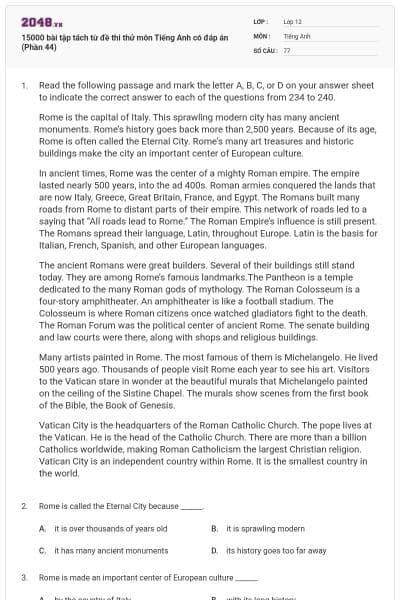
Read the following passage and mark the letter A, B, C, or D on your answer sheet to indicate the correct answer to each of the questions from 234 to 240.
Rome is the capital of Italy. This sprawling modern city has many ancient monuments. Rome’s history goes back more than 2,500 years. Because of its age, Rome is often called the Eternal City. Rome’s many art treasures and historic buildings make the city an important center of European culture.
In ancient times, Rome was the center of a mighty Roman empire. The empire lasted nearly 500 years, into the ad 400s. Roman armies conquered the lands that are now Italy, Greece, Great Britain, France, and Egypt. The Romans built many roads from Rome to distant parts of their empire. This network of roads led to a saying that “All roads lead to Rome.” The Roman Empire’s influence is still present. The Romans spread their language, Latin, throughout Europe. Latin is the basis for Italian, French, Spanish, and other European languages.
The ancient Romans were great builders. Several of their buildings still stand today. They are among Rome’s famous landmarks.The Pantheon is a temple dedicated to the many Roman gods of mythology. The Roman Colosseum is a four-story amphitheater. An amphitheater is like a football stadium. The Colosseum is where Roman citizens once watched gladiators fight to the death. The Roman Forum was the political center of ancient Rome. The senate building and law courts were there, along with shops and religious buildings.
Many artists painted in Rome. The most famous of them is Michelangelo. He lived 500 years ago. Thousands of people visit Rome each year to see his art. Visitors to the Vatican stare in wonder at the beautiful murals that Michelangelo painted on the ceiling of the Sistine Chapel. The murals show scenes from the first book of the Bible, the Book of Genesis.
Vatican City is the headquarters of the Roman Catholic Church. The pope lives at the Vatican. He is the head of the Catholic Church. There are more than a billion Catholics worldwide, making Roman Catholicism the largest Christian religion. Vatican City is an independent country within Rome. It is the smallest country in the world.
Rome is called the Eternal City because ______.
it is over thousands of years old
it is sprawling modern
it has many ancient monuments
its history goes too far away
Đáp án A
Kiến thức: Đọc hiểu
Giải thích:
Rome được gọi là thành phố vĩnh hằng vì ______.
A. có hàng ngàn năm tuổi C. nó có nhiều di tích cổ
B. nó hiện đại dải rộng D. lịch sử của nó đi quá xa
Thông tin: Rome’s history goes back more than 2,500 years. Because of its age, Rome is often called the Eternal City.
Rome is made an important center of European culture ______.
by the country of Italy
with its long history
by its art treasures and historic buildings
for its many ancient monuments
Đáp án C
Kiến thức: Đọc hiểu
Giải thích:
Rome là một trung tâm quan trọng của văn hoá châu Âu ______.
A. bởi đất nước Ý C. bởi kho báu nghệ thuật và tòa nhà lịch sử của nó
B. với lịch sử lâu đời của nó D. bởi nhiều di tích cổ
Thông tin: Rome’s many art treasures and historic buildings make the city an important center of European culture.
The word “mighty” in paragraph 2 is closest in meaning to ______.
powerful
great
strong
wealthy
Đáp án A
Kiến thức: Đọc hiểu
Giải thích:
Từ "mighty" trong đoạn 2 có ý nghĩa gần nhất với ______.
A. mạnh mẽ C. mạnh
B. tuyệt vời D. giàu có
"mighty" = powerful: hùng mạnh, mạnh mẽ
In ancient times, Rome was the center of a mighty Roman empire.
Trong thời cổ đại, Rome là trung tâm của một đế quốc La Mã hùng mạnh.
The author mentions the Pantheon, the Roman Colosseum, and the Roman Forum as ______.
great builders
famous landmarks
gods of mythology
Roman citizens
Đáp án B
Kiến thức: Đọc hiểu
Giải thích:
Tác giả đề cập đến Pantheon, Đấu trường La Mã và Diễn đàn La Mã là ______.
A. những nhà xây dựng vĩ đại B. các địa danh nổi tiếng
C. vị thần trong thần thoại D. công dân La mã
Thông tin: Several of their buildings still stand today. They are among Rome’s famous landmarks.
It can be inferred from paragraph 2 that ______.
the Pantheon is a famous landmark building in modern Rome
Roman citizens watched gladiators fight to the death in the Colosseum
important political decisions were made in the Roman Forum
the Roman Colosseum is an amphitheater with four floors
Đáp án D
Kiến thức: Đọc hiểu
Giải thích:
Có thể suy luận từ đoạn 2 rằng ______.
A. Pantheon là một tòa nhà nổi tiếng ở Roma hiện đại
B. Công dân La Mã xem các đấu sĩ chống lại cái chết ở Colosseum
C. Các quyết định chính trị quan trọng đã được thực hiện tại Diễn đàn La Mã
D. Đấu trường La Mã là một giảng đường với bốn tầng
Thông tin: The Roman Colosseum is a four-story amphitheater.
The word “murals” in paragraph 4 is closest in meaning to ______.
Bible books
walls
paintings
Bible stories
Đáp án C
Kiến thức: Đọc hiểu
Giải thích:
Từ "murals" trong đoạn 4 gần nhất có nghĩa là ______.
A. Sách Kinh Thánh C. tranh
B. tường D. Câu chuyện trong Kinh thánh
"murals" = paintings: các bức tranh
The murals show scenes from the first book of the Bible, the Book of Genesis.
Những bức tranh tường cho thấy các cảnh từ cuốn sách đầu tiên của Kinh thánh, Sách Sáng thế.
According to the passage, what is NOT true about Vatican City?
It is the headquarters of the Roman Catholic Church.
It is the largest Christian religion area in the world.
It is an independent country within Rome.
It is where the head of the Catholic Church lives.
Đáp án B
Kiến thức: Đọc hiểu
Giải thích:
Theo đoạn văn, những gì không đúng về thành phố Vatican?
A. Đó là trụ sở chính của Giáo hội Công giáo La Mã.
B. Đây là khu vực tôn giáo Kitô giáo lớn nhất trên thế giới.
C. Đó là một quốc gia độc lập bên trong Rome.
D. Đó là nơi người đứng đầu của Giáo hội Công giáo sống.
Thông tin:
- There are more than a billion Catholics worldwide, making Roman Catholicism the largest Christian religion.
- It is the smallest country in the world.
Dịch bài đọc số 36:
Rome là thủ đô của Ý. Thành phố hiện đại trải rộng này có nhiều di tích cổ. Lịch sử của Rome đã có từ hơn 2.500 năm. Vì tuổi của nó, Rome thường được gọi là Thành phố Vĩnh cửu. Nhiều kho báu nghệ thuật của Rome và các tòa nhà lịch sử làm cho thành phố trở thành một trung tâm quan trọng của văn hoá châu Âu.
Trong thời cổ đại, Rome là trung tâm của một đế quốc La Mã hùng mạnh. Đế chế kéo dài gần 500 năm, đến những năm 400 sau công nguyên. Quân đội La Mã chinh phục các vùng đất hiện nay là Ý, Hy Lạp, Anh, Pháp và Ai Cập. Người La Mã đã xây dựng nhiều con đường từ Rome đến các phần xa xôi của đế chế của họ. Mạng lưới đường xá này dẫn tới câu nói rằng "Tất cả các con đường dẫn đến Rome." Ảnh hưởng của Đế chế La Mã vẫn còn hiện diện. Người La mã đã truyền bá ngôn ngữ của họ, tiếng Latin, khắp Châu Âu. Tiếng Latin là nền tảng cho tiếng Ý, tiếng Pháp, tiếng Tây Ban Nha, và các ngôn ngữ châu Âu khác.
Người La Mã cổ đại là những nhà xây dựng vĩ đại. Một số tòa nhà của họ vẫn còn ngày hôm nay. Đây là một trong những địa danh nổi tiếng của Rome. Pantheon là một đền thờ dành cho các vị thần La Mã cổ đại. Đấu trường La Mã là một tháp giảng đường bốn tầng. Một giảng đường cũng giống như một sân vận động bóng đá.
Đấu trường La Mã là nơi các công dân La Mã đã từng xem đấu sĩ chiến đấu với cái chết. Diễn đàn La Mã là trung tâm chính trị của Rome cổ đại. Tòa nhà viện trợ và các tòa án pháp luật ở đó, cùng với các cửa hàng và các tòa nhà tôn giáo.
Nhiều họa sĩ vẽ ở Rome. Nổi tiếng nhất là Michelangelo. Ông đã sống cách đây 500 năm. Hàng ngàn người ghé thăm Rome mỗi năm để xem nghệ thuật của ông. Du khách đến Vatican nhìn vào những bức tranh sơn dầu tuyệt đẹp mà Michelangelo vẽ trên trần Nhà nguyện Sistine. Những bức tranh tường cho thấy các cảnh từ cuốn sách đầu tiên của Kinh thánh, Sách Sáng thế.
Vatican City là trụ sở của Nhà thờ Công giáo La Mã. Đức giáo hoàng sống tại Vatican. Ngài là người đứng đầu của Giáo hội Công giáo. Có hơn một tỷ người Công giáo khắp thế giới, làm cho Đạo Thiên Chúa giáo La Mã là tôn giáo lớn nhất của Kitô giáo. Vatican City là một quốc gia độc lập bên trong Rome. Đây là quốc gia nhỏ nhất trên thế giới.
Read the following passage and mark the letter A, B, C or D on your answer sheet to indicate the correct word or phrase that best fits each of the numbered blanks.
On April 3, 1972, a man came out of the Hilton hotel in Manhattan and started walking down the street. He stopped, (241)______ his hand with a strange object in it, put it to his ear and started to talk into it. This was the beginning of mobile phone (242)_______, more than 30 years ago. That man was Motorola's project manager, Martin Cooper, who was (243)______ his 34th birthday that day. The strange object was the first mobile phone, which was nicknamed "the shoe" because of its unusual (244)_______. Mr. Cooper had gone to New York to introduce the new phone. The first call he made was to his rival, Joe Engel at AT&T's research centre. Engel was responsible for the development of the radiophones for cars. "I called him and said that I was talking on a real mobile phone (245)_____ I was holding in my hand," said Cooper. "I don't remember what he said in reply, but I'm sure he wasn't happy." The quality of the call was very good, because although New York had only one base station at that time, it was being used by only one user - Martin Cooper.
pulled
raised
lifted
rose
Đáp án B
Kiến thức: Từ vựng, đọc hiểu
Giải thích:
pull (v): lôi, kéo, giật raise (v): nâng lên, đưa lên, giơ lên
lift (v): nâng lên, nhấc lên rise (v): dâng lên, tăng lên
Phân biệt giữa rise và raise: Sau rise không có tân ngữ; còn sau raise có tân ngữ
past
times
history
story
Đáp án C
Kiến thức: Từ vựng, đọc hiểu
Giải thích:
past (n): quá khứ; dĩ vãng time (n): thời, thời gian
history (n): lịch sử story (n): câu chuyện
making
driving
expecting
celebrating
Đáp án D
Kiến thức: Từ vựng, đọc hiểu
Giải thích:
make (v): làm, tạo ra drive (v): lái xe
expect (v): mong đợi celebrate (v): kỷ niệm, tổ chức ăn mừng
kind
shape
type
symbol
Đáp án B
Kiến thức: Từ vựng, đọc hiểu
Giải thích:
kind (n): loại, hạng, thứ shape (n): hình dáng
type (n): loại, thứ, kiểu symbol (n): biểu tượng, kí hiệu
that
when
as
how
Đáp án A
Kiến thức: Từ vựng, đọc hiểu
Giải thích:
that: mệnh đề quan hệ, thay thế được cho cả người và vật
when: khi mà as: như là, bởi vì
how: như thế nào, thế nào
Dịch bài đọc số 37:
Vào ngày 3 tháng 4 năm 1972, một người đàn ông bước ra khỏi khách sạn Hilton ở Manhattan và bắt đầu đi bộ xuống phố. Ông dừng lại, giơ tay lên với một vật lạ trong tay, đặt nó vào tai và bắt đầu nói chuyện với nó. Đây là sự khởi đầu của lịch sử điện thoại di động, cách đây hơn 30 năm. Người đó là người quản lý dự án của Motorola, Martin Cooper, người đang tổ chức sinh nhật thứ 34 của mình vào ngày hôm đó. Vật lạ đó là điện
thoại di động đầu tiên, được đặt biệt danh là "chiếc giày" vì hình dạng bất thường của nó. Ông Cooper đã tới New York để giới thiệu điện thoại mới. Cuộc gọi đầu tiên ông là với đối thủ của ông, Joe Engel tại trung tâm nghiên cứu của AT&T. Engel chịu trách nhiệm phát triển các thiết bị phát thanh cho ôtô. "Tôi gọi cho anh ta và nói rằng tôi đang nói chuyện bằng một chiếc điện thoại di động thực sự mà tôi đang cầm trong tay", Cooper nói. "Tôi không nhớ anh ta trả lời những gì, nhưng tôi chắc chắn anh ta không vui." Chất lượng cuộc gọi rất tốt, bởi vì mặc dù New York chỉ có một trạm cơ sở vào thời điểm đó, nó chỉ được sử dụng bởi một người - Martin Cooper.
Read the following passage and mark the letter A, B, C or D on your answer sheet to indicate the correct answer to each of the questions.
Most of the early houses built in America were suited to farm life, as it was not until cities became manufacturing centers that colonists could survive without farming as their major occupation. Among the earliest farmhouses in America were those built in Plymouth Colony. Generally they consisted of one large rectangular room on the ground floor, called a hall or great room and having a fireplace built into one of the walls, and a loft overhead. Sometimes a lean-to was attached alongside the house to store objects such as spinning wheels, firewood, barrels, and tubs. The furnishings in the great room were sparse and crudely built. Tabletops and chest boards were split or roughly sawed and often smoothed only on one side. Benches took the place of chairs, and the table usually had a trestle base so it could be dismantled when extra space was required. One or two beds and a six-board chest were located in one corner of the room. The fireplace was used for heat and light, and a bench often placed nearby for children and elders, in the area called the inglenook.
The original houses in Plymouth Colony were erected within a tall fence for fortification. However, by 1630 Plymouth Colony had 250 inhabitants, most living outside the enclosure. By 1640, settlements had been built some distance from the original site. Villages began to emerge throughout Massachusetts and farmhouses were less crudely built. Windows brought light into homes and the furnishings and décor were more sophisticated.
As more diversified groups of immigrants settled the country, a greater variety of farmhouses appeared, from Swedish long-style houses in the Delaware Valley to saltbox houses in Connecticut, Dutch-Flemish stone farmhouses in New York, and clapboard farmhouses in Pennsylvania. From Georgian characteristics to Greek revival elements, farmhouses of varied architectural styles and building functions populated the landscape of the new frontier.
The main idea of the passage is
The history of the American farmhouse
Where immigrants settled in America
life in Plymouth Colony
How to build an American farmhouse
Đáp án A
Kiến thức: Đọc hiểu
Giải thích:
Ý tưởng chính của đoạn văn là
A. Lịch sử của các ngôi nhà trên trang trại Mỹ
B. Người nhập cư định cư tại đâu ở Mỹ
C. Làm thế nào để xây dựng một ngôi nhà trên trang trại Mỹ
D. Cuộc sống ở Plymouth Colony
Which of the following is not mentioned as part of the furnishings in farmhouses?
Rocking chair
Bench
Trestle- based table
Six - board chest
Đáp án A
Kiến thức: Đọc hiểu
Giải thích:
Cái nào sau đây không được đề cập đến như là một phần của nội thất trong các ngôi nhà trên trang trại?
A. Ghế tựa bằng đá B. Ghế dài
C. Bàn dựa trên một cái mễ D. Bục sáu tấm
Thông tin: Benches took the place of chairs, and the table usually had a trestle base so it could be dismantled when extra space was required. One or two beds and a six-board chest were located in one corner of the room.
According to the passage the earliest farmhouses were built in
Delaware Valley
Massachusetts
Connecticut
Pennsylvania
Đáp án B
Kiến thức: Đọc hiểu
Giải thích:
Theo đoạn văn, những ngôi nhà trên trang trại đầu tiên được xây dựng ở
A. thung lũng Delaware B. Massachusetts
C. Connecticut D. Pennsylvania
Thông tin: Among the earliest farmhouses in America were those built in Plymouth Colony. […] The original houses in Plymouth Colony were erected within a tall fence for fortification. […] Villages began to emerge throughout Massachusetts and farmhouses were less crudely built.
The word "it" in paragraph 1 refers to
trestle base
space
table
chest board
Đáp án C
Kiến thức: Đọc hiểu
Giải thích:
Từ "nó" trong đoạn 1 đề cập đến
A. chân mễ B. không gian
C. cái bàn D. tấm ván
the table usually had a trestle base so it could be dismantled when extra space was required.
bàn thường có một cái chân mễ (để kê phản) để nó có thể được tháo dỡ khi cần thêm không gian.
It can be inferred from the passage that
the major occupation in Plymouth Colony was carpentry
sophisticated tools were available to the early immigrants
cloth was important from England
the extended family lived together in the farmhouse
Đáp án D
Kiến thức: Đọc hiểu
Giải thích:
Có thể suy luận từ đoạn văn rằng
A. nghề nghiệp chính ở Plymouth Colony là nghề mộc
B. các công cụ tinh vi có sẵn cho những người nhập cư đầu tiên
C. vải rất quan trọng đến từ Anh
D. gia đình đông người sống cùng nhau trong ngôi nhà trên trang trại
Thông tin: Generally they consisted of one large rectangular room on the ground floor, called a hall or great room and having a fireplace built into one of the walls, and a loft overhead. […] The fireplace was used for heat and light, and a bench often placed nearby for children and elders, in the area called the inglenook.
The passage was most probably written by a specialist in American
urban planning
farming
architecture
immigration
Đáp án C
Kiến thức: Đọc hiểu
Giải thích:
Đoạn văn có lẽ được viết bởi một chuyên gia ở lĩnh vực ____ Mỹ
A. quy hoạch đô thị B. canh tác trồng trọt
C. kiến trúc D. sự nhập cư
The word “emerge” in paragraph 2 could best be replaced with
proceed
settle
come out
appear
Đáp án D
Kiến thức: Đọc hiểu
Giải thích:
Từ “emerge” trong đoạn 2 có thể được thay thế tốt nhất bằng
A. tiến hành B. giải quyết
C. giới thiệu, hiện ra D. xuất hiện
“emerge” = appear: nổi lên, xuất hiện
Villages began to emerge throughout Massachusetts and farmhouses were less crudely built.
Các làng bắt đầu nổi lên khắp tiểu bang Massachusetts và các nhà trên trang trại đã được xây dựng ít thô kệch hơn.
Dịch bài đọc số 38:
Hầu hết các ngôi nhà được xây dựng ở Mỹ đều phù hợp với đời sống nông trại, cho đến khi các thành phố trở thành các trung tâm sản xuất mà người thực dân vẫn có thể sống sót mà không có nông nghiệp như là nghề chính. Trong số những ngôi nhà trên trang trại đầu tiên ở Mỹ là những ngôi nhà được xây dựng ở Plymouth Colony. Nói chung chúng bao gồm một phòng hình chữ nhật lớn ở tầng trệt, được gọi là hội trường hoặc phòng lớn và có lò sưởi được dựng trong một trong những bức tường, và một cái gác xép trên cao. Đôi khi một chái nhà được gắn bên cạnh nhà để chứa đồ vật như bánh xe quay, củi, thùng, và chậu bồn. Đồ đạc trong phòng lớn thưa thớt và được dựng một cách thô kệch. Các tấm lót và bảng ván đã được cắt hoặc xẻ thô và thường chỉ được làm mịn ở một bên. Ghế dài thay thế cho ghế tựa, và bàn thường có một cái chân mễ (để kê phản) để nó có thể được tháo dỡ khi cần thêm không gian. Một hoặc hai giường và một cái bục sáu tấm được đặt ở một góc phòng. Lò sưởi được sử dụng để sưởi ấm và lấy ánh sáng, và một băng ghế dài được đặt gần đó cho trẻ em và người cao tuổi, trong khu vực được gọi ngách lò sưởi.
Những ngôi nhà đầu tiên ở Plymouth Colony được dựng lên trong hàng rào cao để thêm vững chắc. Tuy nhiên, vào năm 1630 Plymouth Colony đã có 250 cư dân, hầu hết sống ngoài khu vực được rào lại. Đến năm 1640, các khu định cư đã được xây dựng cách một khoảng cách từ địa điểm ban đầu. Các làng bắt đầu nổi lên khắp tiểu bang Massachusetts và các nhà trên trang trại đã được xây dựng ít thô kệch hơn. Cửa sổ mang ánh sáng vào nhà, đồ đạc và trang trí tinh vi hơn.
Khi nhiều nhóm người nhập cư định cư ở nước này, nhiều ngôi nhà trên trang trại đã xuất hiện, từ các ngôi nhà kiểu dáng dài Thụy Điển ở Thung lũng Delaware đến các nhà theo kiểu saltbox tại Connecticut, các nhà trên trang trại bằng đá Hà Lan ở New York và các ngôi nhà trên trang trại kiểu ván tường ở Pennsylvania. Từ các đặc tính của Gruzia đến các yếu tố phục hưng của Hy Lạp, các ngôi nhà trên trang trại có phong cách kiến trúc đa dạng và các chức năng xây dựng đã tạo ra cảnh quan của biên giới mới.
Read the following passage and mark the letter A, B, C or D on your answer sheet to indicate the correct answer to each of the questions.
The first two decades of this century were dominated by the microbe hunters. These hunters had tracked down one after another of the microbes responsible for the most dreaded scourges of many centuries: tuberculosis, cholera, diphtheria. But there remained some terrible diseases for which no microbe could be incriminated: scurvy, pellagra, rickets, beriberi. Then it was discovered that these diseases were caused by the lack of vitamins, a trace substance in the diet. The diseases could be prevented or cured by consuming foods that contained the vitamins. And so in the decades of the 1920's and 1930's, nutrition became a science and the vitamin hunters replaced the microbe hunters.
In the 1940's and 1950's, biochemists strived to learn why each of the vitamins was essential for health. They discovered that key enzymes in metabolism depend on one or another of the vitamins as coenzymes to perform the chemistry that provides cells with energy for growth and function. Now, these enzyme hunters occupied center stage.
You are aware that the enzyme hunters have been replaced by a new breed of hunters who are tracking genes - the blueprints for each of the enzymes - and are discovering the defective genes that cause inherited diseases - diabetes, cystic fibrosis. These gene hunters, or genetic engineers, use recombinant DNA technology to identify and clone genes and introduce them into bacterial cells and plants to create factories for the massive production of hormones and vaccines for medicine and for better crops for agriculture. Biotechnology has become a multibilliondollar industry.
In view of the inexorable progress in science, we can expect that the gene hunters will be replaced in the spotlight. When and by whom? Which kind of hunter will dominate the scene in the last decade of our waning century and in the early decades of the next? I wonder whether the hunters who will occupy the spotlight will be neurobiologists who apply the techniques of the enzyme and gene hunters to the funtions of the brain. What to call them? The head hunters. I will return to them later.
What is the main topic of the passage?
The microbe hunters.
The potential of genetic engineering.
The progress of modern medical research
The discovery of enzymes.
Đáp án C
Kiến thức: Đọc hiểu
Giải thích:
Chủ đề chính của đoạn văn là gì?
A. Những người truy lùng vi khuẩn. B. Tiềm năng của kỹ thuật di truyền.
C. Sự tiến bộ của nghiên cứu y học hiện đại. D. Sự phát hiện của enzym.
The word “incriminated’ in the first paragraph is closest in meaning to
blamed
eliminated
investigated
produced
Đáp án A
Kiến thức: Đọc hiểu
Giải thích:
Từ "incriminated" trong đoạn đầu tiên gần nghĩa nhất với
A. đổ lỗi B. loại bỏ
C. điều tra D. sản xuất
"incriminated" = blamed: buộc tội, đổ lỗi
But there remained some terrible diseases for which no microbe could be incriminated: scurvy, pellagra, rickets, beriberi.
Nhưng vẫn còn một số căn bệnh khủng khiếp mà không có vi khuẩn nào có thể bị buộc tội: bệnh scorbut, nứt da, còi xương, tê phù.
Which of the following can be cured by a change in diet?
Tuberculosis
Cholera
Cystique fibroses
Pell Agra
Đáp án D
Kiến thức: Đọc hiểu
Giải thích:
Bệnh nào sau đây có thể được chữa khỏi bằng cách thay đổi chế độ ăn uống?
A. Bệnh lao B. Bệnh tả
C. Xơ thực bì D. Bệnh nứt da
Thông tin: But there remained some terrible diseases for which no microbe could be incriminated: scurvy, pellagra, rickets, beriberi. Then it was discovered that these diseases were caused by the lack of vitamins, a trace substance in the diet. The diseases could be prevented or cured by consuming foods that contained the vitamins.
The word “strived” in the second paragraph is closest in meaning to
studied
tried
experimented
failed
Đáp án B
Kiến thức: Đọc hiểu
Giải thích:
Từ "strived" trong đoạn thứ hai có ý nghĩa gần nhất với
A. nghiên cứu B. cố gắng
C. thử nghiệm D. không thành công
"strived" = tried: cố gắng
In the 1940's and 1950's, biochemists strived to learn why each of the vitamins was essential for health.
Trong những năm 1940 và 1950, các nhà sinh hóa học đã cố gắng tìm hiểu lý do tại sao mỗi loại vitamin này thiết yếu cho sức khoẻ.
How do vitamins influence health?
They protect the body from microbes
They are broken down by cells to produce energy
They keep food from spoiling
They are necessary for some enzymes to function
Đáp án D
Kiến thức: Đọc hiểu
Giải thích:
Vitamin ảnh hưởng đến sức khoẻ như thế nào?
A. Chúng bảo vệ cơ thể khỏi vi khuẩn
B. Chúng được chia nhỏ bởi các tế bào để sinh ra năng lượng
C. Chúng giữ thức ăn không bị hư hỏng
D. Chúng cần thiết để một số enzyme hoạt động
Thông tin: They discovered that key enzymes in metabolism depend on one or another of the vitamins as coenzymes to perform the chemistry that provides cells with energy for growth and function.
The phrase “occupy the spotlight” in the last paragraph is closest in meaning to
go to furthest
lighten to load
conquer territory
receive the most attention
Đáp án D
Kiến thức: Đọc hiểu
Giải thích:
Cụm từ "occupy the spotlight" trong đoạn cuối cùng gần nhất có nghĩa là
A. đi xa nhất B. thắp sáng để nạp điện
C. chinh phục lãnh thổ D. nhận được sự chú ý nhất
"occupy the spotlight": chiếm tiêu điểm, nhận được sự chú ý nhất
I wonder whether the hunters who will occupy the spotlight will be neurobiologists who apply the techniques of the enzyme and gene hunters to the funtions of the brain.
Tôi tự hỏi liệu những người truy lùng sẽ chiếm được sự chú ý có phải sẽ là những nhà nghiên cứu thần kinh học áp dụng các kỹ thuật của enzym và những người truy lùng gen vào các hoạt động của não.
The author implies that the most important medical research topic of the future will be
the functions of the brain
inherited diseases
the operation of vitamins
the structure of genes
Đáp án A
Kiến thức: Đọc hiểu
Giải thích:
Tác giả ngụ ý rằng đề tài nghiên cứu y khoa quan trọng nhất trong tương lai sẽ là
A. các chức năng của não B. bệnh di truyền
C. hoạt động của vitamin D. cấu trúc của các gen
Thông tin: Which kind of hunter will dominate the scene in the last decade of our waning century and in the early decades of the next? I wonder whether the hunters who will occupy the spotlight will be neurobiologists who apply the techniques of the enzyme and gene hunters to the funtions of the brain.
With which of the following statements would the author be most likely to agree?
Most diseases are caused by defective genes
The focus of medical research will change in the next two decades.
Medical research throughout the twentieth century has been dominated by microbe hunters.
Medical breakthroughs often depend on luck.
Đáp án B
Kiến thức: Đọc hiểu
Giải thích:
Tác giả có thể đồng ý với phát biểu nào sau đây?
A. Hầu hết các bệnh là do các gen khiếm khuyết
B. Trọng tâm nghiên cứu y học sẽ thay đổi trong hai thập niên tới.
C. Nghiên cứu y khoa trong suốt thế kỷ XX đã bị chi phối bởi những người truy lùng vi khuẩn.
D. Các đột phá y học thường phụ thuộc vào vận may.
Thông tin: In view of the inexorable progress in science, we can expect that the gene hunters will be replaced in the spotlight. When and by whom? Which kind of hunter will dominate the scene in the last decade of our waning century and in the early decades of the next?
Dịch bài đọc số 39:
Hai thập niên đầu của thế kỷ này được chi phối bởi những người truy lùng vi khuẩn. Những người này đã theo dõi từng con một trong số những vi khuẩn gây ra những tai hoạ đáng sợ nhất trong nhiều thế kỷ: lao, tả, bạch hầu. Nhưng vẫn còn một số căn bệnh khủng khiếp mà không có vi khuẩn nào có thể bị buộc tội: bệnh scorbut, nứt da, còi xương, tê phù. Sau đó người ta phát hiện ra rằng những bệnh này là do thiếu vitamin, một chất trong chế độ ăn uống. Các bệnh này có thể được ngăn ngừa hoặc chữa trị bằng cách ăn các thực phẩm có chứa vitamin. Và như vậy trong những thập kỷ của những năm 1920 và 1930, dinh dưỡng trở thành một ngành khoa học và những những người truy lùng vitamin thay thế những những người truy lùng vi khuẩn.
Trong những năm 1940 và 1950, các nhà sinh hóa học đã cố gắng tìm hiểu lý do tại sao mỗi loại vitamin này thiết yếu cho sức khoẻ. Họ phát hiện ra rằng các enzym chủ chốt trong quá trình trao đổi chất phụ thuộc vào một hay nhiều vitamin như coenzyme để thực hiện hóa học cung cấp cho tế bào năng lượng cho sự phát triển và chức năng. Hiện nay, những người truy lùng enzym này giữ giai đoạn trung tâm.
Bạn biết rằng những người truy lùng enzym đã được thay thế bằng một loại người truy lùng mới đang theo dõi các gen - các hình thái cho từng enzym - và khám phá ra các gen khiếm khuyết gây ra các bệnh di truyền - tiểu đường, xơ nang. Những người truy lùng gen này, hay các kỹ sư di truyền, sử dụng công nghệ DNA tái tổ hợp để xác định và nhân bản các gen và đưa chúng vào các tế bào và thực vật của vi khuẩn để tạo ra các nhà máy để sản xuất ra hormone và vắc-xin cho dược phẩm và cho các loại cây trồng tốt hơn cho nông nghiệp. Công nghệ sinh học đã trở thành một ngành công nghiệp hàng tỷ đôla.
Theo quan điểm của tiến bộ không thể lay chuyển trong khoa học, chúng ta có thể mong đợi rằng những người truy lùng gen sẽ được thay thế trong sự chú ý của công chúng. Khi nào và bởi ai? Loại người truy lùng nào sẽ thống lĩnh hiện trạng trong thập niên cuối của thế kỷ đang suy yếu của chúng ta và trong những thập niên đầu của thế kỷ kế tiếp? Tôi tự hỏi liệu những người truy lùng sẽ chiếm được sự chú ý có phải sẽ là những nhà nghiên cứu thần kinh học áp dụng các kỹ thuật của enzym và những người truy lùng gen vào các hoạt động của não. Gọi họ là gì? Những người truy lùng cái đầu. Tôi sẽ quay lại với họ sau.
Read the following passage and mark the letter A, B, C, or D to indicate the word that best
fits each of the blanks.
HOLIDAYS
We've just come back exhausted after a two-week holiday in France. We were really stupid. On the last day we drove non-stop from Marseille to Calais- we should have(261)_____ our journey in Lyon or Paris. As if that wasn't enough, the sea was so rough in the English Channel that the (262) _____ took three hours instead of one and a half. Next year we've decided we're going on a cheap (263) _____ holiday to Italy. It sounds marvellous- the cost of the flight, the hotel and all our meals are (264) _____ in the price. While we're in Rome we'll be going on a guided tour of the Coliseum. The last time I was in Italy, I was on a business trip - I can't say I saw many of the famous tourist (265) _____ on that occasion
stopped
paused
broken
interrupted
Đáp án D
Kiến thức: Từ vựng
Giải thích:
Stop (v): dừng Pause (v): tạm ngừng
Break (v): phá vỡ, làm hỏng Interrupt (v): ngắt quãng
Tạm dịch:
On the last day we drove non-stop from Marseille to Calais- we should have(261)_____ our journey in Lyon or Paris.
Vào ngày cuối cùng chúng tôi lái xe thẳng từ Marseille đến Calais - chúng tôi đã nên bỏ cuộc hành trình của chúng tôi ở Lyon hay Paris.
expedition
crossig
cruise
passage
Đáp án B
Kiến thức: Từ vựng
Giải thích:
Expedition (n): chuyến thám hiểm Crossing (n): sự vượt qua
Cruise (n): cuộc đi chơi ở biển Passage (n): đoạn văn
Tạm dịch:
As if that wasn't enough, the sea was so rough in the English Channel that the (262) _____ took three hours instead of one and a half.
Như thể điều đó là không đủ, biển quá khắc nghiệt chỗ con kênh nướ Anh đến nỗi phải mất 3 tiếng thay vì tiếng rưỡi để vượt qua.
party
package
overall
inclusive
Đáp án B
Kiến thức: Từ vựng
Giải thích:
Package holiday: kì nghỉ trọn gói
Tạm dịch:
Next year we've decided we're going on a cheap (263) _____ holiday to Italy.
Năm tới chúng tôi quyết định sẽ có một kì nghỉ trọn gói giá rẻ ở Ý.
included
involved
contained
combined
Đáp án A
Kiến thức: Từ vựng
Giải thích:
Include (v): bao gồm Involve (v): liên quan
Contain (v): chứa Combine (v): kết hợp
Tạm dịch:
It sounds marvellous- the cost of the flight, the hotel and all our meals are (264) _____ in the price.
Nghe có vẻ huyền bí - chi phí của chuyến bay, khách sạn và tất cả các bữa ăn của chúng tôi được bao gồm trong giá.
The last time I was in Italy, I was on a business trip - I can't say I saw many of the famous tourist (265) _____ on that occasion
views
visit
scenes
sights
Đáp án D
Kiến thức: Từ vựng
Giải thích:
View (n): sự ngắm nhìn, xem Visit (n): chuyến viếng thăm
Scene (n): cảnh vật Sight (n): cảnh ( cảnh đẹp)
Tạm dịch:
The last time I was in Italy, I was on a business trip - I can't say I saw many of the famous tourist (265) _____ on that occasion
Lần cuối cùng tôi ở Ý là đợt đi công tác - tôi không thể nói tôi đã nhìn thấy nhiều cảnh tham quan nổi tiếng trong dịp đó
Dịch bài đọc số 40
Chúng tôi vừa mới hồi sức sau kì nghỉ 2 tuần ở Ohaps. Chúng tôi thật sự rất ngốc. Vào ngày cuối cùng , chúng tôi lái xe thẳng từ Marseille đến Calais - chúng tôi đã nên bỏ cuộc hành trình của chúng tôi ở Lyon hay Paris. Như thể điều đó là không đủ, biển quá khắc nghiệt chỗ con kênh nướ Anh đến nỗi phải mất 3 tiếng thay vì tiếng rưỡi để vượt qua. Năm tới chúng tôi quyết định sẽ có một kì nghỉ trọn gói giá rẻ ở Ý.
Nghe có vẻ huyền bí - chi phí của chuyến bay, khách sạn và tất cả các bữa ăn của chúng tôi được bao gồm trong giá. Khi đến Ronem chúng tôi sẽ đi du lịch theo đoàn đến Coliseum. Lần cuối cùng tôi ở Ý là đợt đi công tác - tôi không thể nói tôi đã nhìn thấy nhiều cảnh tham quan nổi tiếng trong dịp đó.
Read the passage and mark A, B, C or D to indicate the correct answer to each of the questions.
We find that bright children are rarely held back by mixed-ability teaching. On the contrary, both their knowledge and experience are enriched. We feel that there are many disadvantages in streaming pupils. It does not take into account the fact that children develop at different rates. It can have a bad effect on both the bright and the not-so-bright child. After all, it can be quite discouraging to be at the bottom of the top grade!
Besides, it is rather unreal to grade people just according to their intellectual ability. This is only one aspect of their total personality. We are concerned to develop the abilities of all our pupils to the full, not just their academic ability. We also value personal qualities and social skills, and we find that mixed-ability teaching contributes to all these aspects of learning.
In our classroom, we work in various ways. The pupils often work in groups; this gives them the opportunity to learn to co-operate, to share, and to develop leadership skills. They also learn how to cope with the personal problems as well as learning how to think, to make decisions, to analyze and evaluate, to communicate effectively. The pupils learn from each other as well as from the teachers.
Sometimes the pupils work in pairs; sometimes the work on individual tasks and assignments, they can do this at their own speed. They also have some formal class teaching when this is appropriate. We encourage our pupils to use the library, and we teach them the skills they need in order to do this effectively. An advanced pupil can do advanced works; it does not matter what age the child is. We expect our pupils to do their best, not their least, and we give them every encouragement to attain this goal.
The phrase "held back" in paragraph 1 means_________.
made to lag behind
prevented from advancing
forced to study in lower classes
made to remain in the same classes
Đáp án B
Kiến thức: Đọc hiểu
Giải thích:
Cụm từ "held back" trong đoạn 1 có nghĩa là _________.
A. làm chậm lại B. ngăn cản tiến bộ
C. buộc phải học ở các lớp thấp hơn D. được giữ ở cùng một lớp
Hold back: thụt lùi, ngăn cản phát triển
=> held back = prevented from advancing
Dẫn chứng: We find that bright children are rarely held back by mixed-ability teaching.
The author argues that a teacher’s chief concern should be the development of the pupils’
intellectual abilities
learning ability and communicative skills
personal and social skills
total personality
Đáp án D
Kiến thức: Đọc hiểu
Giải thích:
Tác giả cho rằng mối quan tâm hàng đầu của giáo viên là sự phát triển của _________
A. khả năng trí tuệ B. khả năng học tập và kỹ năng giao tiếp
C. kỹ năng cá nhân và kĩ năng xã hội D. tổng thể cá nhân
Dẫn chứng: Besides, it is rather unreal to grade people just according to their intellectual ability. This is only one aspect of their total personality. We are concerned to develop the abilities of all our pupils to the full, not just their academic ability. We also value personal qualities and social skills, and we find that mixed-ability teaching contributes to all these aspects of learning.
Which of the following is NOT mentioned in the passage?
Pupils also learn how to participate in teaching activities
Group work gives pupils the opportunity to learn to work together with others
Pupils also learn to develop their reasoning ability
Group work provides the pupils with the opportunity to learn to be capable organizers
Đáp án A
Kiến thức: Đọc hiểu
Giải thích:
Câu nào dưới đây KHÔNG được đề cập trong đoạn văn?
A. Học sinh cũng học cách tham gia vào các hoạt động giảng dạy
B. Hoạt động theo nhóm giúp học sinh có cơ hội học cách làm việc cùng với người khác
C. Học sinh học để phát triển khả năng suy luận của mình
D. Các hoạt động của nhóm làm cho học sinh có cơ hội học cách trở thành người lãnh đạo có năng lực
The author’s purpose of writing this passage is to ______.
offer advice on the proper use of the school library
argue for teaching bright and not-so-bright pupils in the same class
recommend pair work and group work classroom activities
emphasize the importance of appropriate formal classroom teaching
Đáp án D
Kiến thức: Đọc hiểu
Giải thích:
Mục đích của tác giả là viết bài viết này là ______.
A. đưa ra lời khuyên về việc sử dụng đúng thư viện trường
B. tranh luận để dạy học sinh thông mi nh và không thông minh trong cùng lớp
C. giới thiệu các hoạt động trong lớp và làm việc nhóm
D. nhấn mạnh tầm quan trọng của cách dạy học thích hợp
According to the passage, which of the following is NOT true?
There is no fixed method in teaching pupils to develop themselves to the full
Development of pupils as individuals is not the aim of group work
It’s not good for a bright child to find out that he performs worst in a mixed-ability clas
Pupils cannot develop in the best way if they are streamed into classes of different intellectual abilities
Đáp án B
Kiến thức: Đọc hiểu
Giải thích:
Theo đoạn văn, điều sau đây KHÔNG đúng?
A. Không có phương pháp cố định trong việc dạy học sinh phát triển bản thân
B. Sự phát triển của học sinh theo cá nhân không phải là mục tiêu của làm việc theo nhóm
C. Không tốt cho một đứa trẻ thông minh khi bị cho là kém nhất trong 1 lớp học đa năng
D. Học sinh không thể phát triển theo cách tốt nhất nếu chúng được đưa vào các lớp có phân theo khả năng trí tuệ khác nhau
Dẫn chứng: The pupils often work in groups; this gives them the opportunity to learn to co-operate, to share, and to develop leadership skills. They also learn how to cope with the personal problems as well as
According to the passage, which of the following is an advantage of mixed-ability teaching?
A pupil can be at the bottom of a class
Pupils as individuals always have the opportunities to work on their own
Formal class teaching is the important way to give pupils essential skills such as those to be used in the library.
Pupils can be hindered from an all-round development
Đáp án B
Kiến thức: Đọc hiểu
Giải thích:
Theo đoạn văn, điều nào sau đây là một lợi thế của giảng dạy theo phương pháp đa năng?
A. Một học sinh có thể xếp dưới cùng của một lớp học
B. Học sinh học theo cá nhân có cơ hội tự mình làm việc.
C. Giảng dạy chính thức theo lớp là một cách quan trọng để cung cấp cho học sinh những kỹ năng cần thiết như những kỹ năng được sử dụng trong thư viện.
D. Học sinh có thể bị cản trở bởi sự phát triển toàn diện
Dẫn chứng: Sometimes the pupils work in pairs; sometimes the work on individual tasks and assignments, they can do this at their own speed.
According to the passage, “streaming pupils” ______
is the act of putting pupils into class according to their academic abilities
aims at enriching both their knowledge and experience
is quite discouraging
will help the pupils learn best
Đáp án A
Giải thích:
Theo đoạn văn, "streaming pupils" ______
A. là việc đưa học sinh vào lớp theo khả năng học tập
B. nhằm mục đích làm giàu cả kiến thức và kĩ năng
C. khá nản lòng
D. sẽ giúp học sinh học tốt nhất
Dẫn chứng: We find that bright children are rarely held back by mixed-ability teaching. On the contrary, both their knowledge and experience are enriched. We feel that there are many disadvantages in streaming pupils. It does not take into account the fact that children develop at different rates. It can have a bad effect on both the bright and the not-so-bright child. After all, it can be quite discouraging to be at the bottom of the top grade!
According to the author, mixed-ability teaching is more preferable because _______
children can learn to work with each other to solve personal problems
it doesn’t have disadvantages as in streaming pupils
its aim at developing the children’s total personality
formal class teaching is appropriate
Đáp án C
Kiến thức: Đọc hiểu
Giải thích:
Theo tác giả, phương pháp giảng dạy đa năng là thích hợp hơn bởi vì _______
A. học sinh có thể học cách làm việc với nhau để giải quyết các vấn đề cá nhân
B. không có bất lợi như trong học sinh học theo kiểu phân mức độ
C. Mục đích của nó là phát triển khả năng tổng thể của trẻ
D. Dạy học chính quy là thích hợp
Dịch bài đọc số 41
Chúng tôi thấy rằng trẻ em thông minh hiếm khi được thụt lùi bởi phương pháp giảng dạy đa năng. Ngược lại, cả kiến thức lẫn kĩ năng của chúng đều tăng. Chúng tôi thấy có rất nhiều bất lợi trong việc xếp loại học sinh. Không tính đến thực tế là trẻ em phát triển ở các mức độ khác nhau. Nó có thể có ảnh hưởng xấu đến cả đứa trẻ thông minh và đứa trẻ kém thông minh. Sau tất cả, có thể khá chán nản khi bị xếp cuối cùng trong 1 lớp giỏi.
Bên cạnh đó, không thực tế khi xếp loại người chỉ theo khả năng trí tuệ của họ. Đây chỉ là một khía cạnh của tính cách tổng thể của họ. Chúng tôi quan tâm đển việc phát triển khả năng của tất cả học sinh của chúng tôi với đầy đủ các phương diện, không chỉ khả năng học tập của họ. Chúng tôi cũng đánh giá phẩm chất cá nhân và các kỹ năng xã hội, và chúng tôi nhận thấy rằng phương pháp giảng dạy đa năng đã đóng góp thành công vào tất cả các khía cạnh của học tập.
Trong lớp học của chúng tôi, chúng tôi làm việc theo nhiều cách khác nhau. Các em học sinh thường làm việc theo nhóm; điều này cho phép các em có cơ hội học cách hợp tác, chia sẻ và phát triển kỹ năng lãnh đạo. Họ cũng học cách đối phó với các vấn đề cá nhân cũng như học cách suy nghĩ, ra quyết định, phân tích và đánh giá để giao tiếp hiệu quả. Học sinh học lẫn nhau cũng như học từ giáo viên.
Đôi khi học sinh làm việc theo cặp; đôi khi làm các nhiệm vụ cá nhân và bài tập, họ có thể làm điều này với tốc độ riêng của họ. Họ cũng có một số lớp học chính quy khi điều nếu thích hợp. Chúng tôi khuyến khích học sinh của chúng tôi sử dụng thư viện, và chúng tôi dạy cho họ những kỹ năng mà họ cần để có thể làm việc này hiệu quả. Một học sinh tiên tiến có thể làm các công việc tiên tiến; nó không quan trọng tuổi của đứa trẻ. Chúng tôi hy vọng học sinh của mình sẽ làm hết sức mình, không phải là cố gắng ít nhất có thể , và chúng tôi cho họ mọi động lực để đạt được mục tiêu này.
Read the passage and mark A, B, C or D to indicate the correct answer to each of the questions.
Jupiter is the largest and most massive planet and is fifth in order of distance from the sun. It is well placed for observation for several months in every year and on average is the brightest of the planets apart from Venus, though for relatively brief periods Mars may outshine it. Jupiter’s less than 10 hour rotation period gives it the shortest day in the solar system in so far as the principal planets are concerned. There are no true seasons on Jupiter because the axial inclination to the perpendicular of the orbital plane is only just over 3°-less than that for any other planet.
The most famous mark on Jupiter is the Great Red Spot. It has shown variations in both intensity and color, and at times it has been invisible, but it always returns after a few years. At its greatest extent it may be 40,000 kilometers long and 14,000 kilometers wide, so its surface area is greater than that of Earth. Though the latitude of the Red Spot varies little, it drifts about in longitude. Over the past century the total longitudinal drift has amounted to approximately 1200°. The latitude is generally very close to -22°. It was once thought that the Red Spot might be a solid or semisolid body floating in Jupiter’s outer gas. However, the Pioneer and Voyager results have refuted that idea and proven the Red Spot to be a phenomenon of Jovian meteorology. Its longevity may well due to its exceptional size, but there are signs that it is decreasing in size, and it may not be permanent. Several smaller red spots have been seen occasionally but have not lasted.
It can be inferred from the passage
a day on Earth is shorter than a day on Jupiter
there are other structures on Jupiter that has the same size as the Great Red Spot
there are times when Great Red Spot cannot be observed from the earth
the Great Red Spot is the only structure on Jupiter
Đáp án C
Kiến thức: Đọc hiểu
Giải thích:
Có thể suy luận từ đoạn văn
A. một ngày trên trái đất ngắn hơn một ngày trên sao Mộc
B. có các cấu trúc khác trên sao Mộc kích thước bằng với Điểm Đỏ.
C. có những khi không thể nhìn thấy Điểm Đỏ ở mặt đất
D. Điểm Đỏ lớn là cấu trúc duy nhất trên sao Mộc
Dẫn chứng: The most famous mark on Jupiter is the Great Red Spot. It has shown variations in both intensity and color, and at times it has been invisible, but it always returns after a few years
According to the passage, which planet typically shines the most brightly?
Earth
Jupiter
Venus
Mars
Đáp án C
Kiến thức: Đọc hiểu
Giải thích:
Theo đoạn văn, hành tinh nào thường tỏa sáng nhất?
A. Trái Đất B. sao Mộc C. Venus D. sao Hỏa
Dẫn chứng: It is well placed for observation for several months in every year and on average is the brightest of the planets apart from Venus, t
According to the passage, the Great Red Spot________.
has different colors
is as big as the earth
is a solid structure floating in the air
has increased its size over the years
Đáp án A
Kiến thức: Đọc hiểu
Giải thích:
Theo đoạn văn, Điểm Đỏ ________
A. có màu sắc khác nhau B. lớn như trái đất
C. là một cấu trúc rắn nổi trong không khí D. tăng kích thước qua nhiều năm
Dẫn chứng: The most famous mark on Jupiter is the Great Red Spot. It has shown variations in both intensity and color, and at times it has been invisible, but it always returns after a few years.
The word “it” in paragraph 2 refers to ________.
Jupiter
The Great Red Spot
intensity
color
Đáp án B
Kiến thức: Đọc hiểu
Giải thích:
Từ "it" trong đoạn 2 đề cập đến ________.
A. Sao Mộc B. Điểm Đỏ C. Cường độ D. Màu
Dẫn chứng: The most famous mark on Jupiter is the Great Red Spot. It has shown variations in both intensity and color, and at times it has been invisible, but it always returns after a few years.
The word “exceptional” in paragraph 2 mostly means _______
extreme
sustainable
temporary
infrequent
Đáp án D
Kiến thức: Đọc hiểu
Giải thích:
Từ "exceptional" ở đoạn2 chủ yếu có nghĩa là _______
A. cực đoan B. bền vững C. tạm thời D. không bình thường
Exceptional (a): hiếm có, không bình thường
=> exceptional = infrequent
Dẫn chứng: Its longevity may well due to its exceptional size, but there are signs that it is decreasing in size, and it may not be permanent.
According to the passge, which of the following is NOT true?
Jupiter is bigger than all the other planest in the solar system.
A day in Jupiter is nearly 10 hours long.
The Red Great Spot moves more vertically than horizontally.
Scientists have proof showing that smaller red spots are increasing their size to become other Great Red Spots.
Đáp án D
Kiến thức: Đọc hiểu
Giải thích:
Theođoạn văn, điều sau đây KHÔNG đúng?
A. Mộc tinh lớn hơn tất cả các hành tinh khác trong hệ mặt trời.
B. Một ngày ở sao Mộc kéo dài gần 10 giờ.
C. Điểm Đỏ di chuyển nhiều theo chiều dọc hơn chiều ngang.
D. Các nhà khoa học có bằng chứng cho thấy các đốm đỏ nhỏ hơn đang gia tăng kích thước của chúng để trở thành các Điểm Đỏ khác.
Dẫn chứng: Several smaller red spots have been seen occasionally but have not lasted.
The passage was probably taken from________
an art journal
a geology magazine
a high school textbook
an archaeology book
Đáp án B
Kiến thức: Đọc hiểu
Giải thích:
Đoạn văn có thể được lấy từ ________
A. một tạp chí nghệ thuật B. một tạp chí địa chất
C. một sách giáo khoa trung học D. một cuốn khảo cổ học.
Dịch bài đọc số 42
Sao Mộc là hành tinh lớn nhất và đứng thứ năm theo thứ tự khoảng cách từ mặt trời. Nó được quan sát trong vài tháng mỗi năm và trung bình là hành tinh sáng nhất nếu không tính Venus, mặc dù trong một thời gian tương đối ngắn Sao Hỏa sáng hơn nó. Thời gian quay vòng chưa tới 10 giờ của sao Mộc làm cho nó trở thành hành tinh có ngày ngắn nhất trong hệ mặt trời so với các hành tinh chính. Không có mùa thật sự trên sao Mộc vì độ nghiêng dọc theo trục vuông góc của mặt phẳng quỹ đạo chỉ hơn 3 độ- ít hơnso với bất kỳ hành tinh nào khác.
Đặc điểm nổi bật nhất trên sao Mộc là Điểm Đỏ. Nó đã cho thấy các biến thể về cường độ và màu sắc, và đôi khi nó vô hình, nhưng nó luôn luôn trở lại sau một vài năm. Ở mức độ lớn nhất, nó có thể dài 40.000 km và rộng 14.000 km, vì vậy diện tích bề mặt của nó lớn hơn Trái Đất. Mặc dù vĩ độ của Điểm Đỏ rất khác nhau, nhưng nó có thể về dưới kinh độ. Trong thế kỷ vừa qua, nó trôi dạt theo chiều dọc tổng cộng đã lên đến khoảng 1200 °. Vĩ độ nói chung rất gần -22 °. Đã có lần người ta nghĩ rằng Điểm Đỏ có thể là một vật thể rắn chắc hoặc nửa cứng trôi nổi bên ngoài của Mộc tinh. Tuy nhiên, những kết quả của Pioneer và Voyager đã bác bỏ ý tưởng đó và đã chứng minh được Điểm ĐỎ là một hiện tượng khí tượng học Jovian.
Tuổi thọ của nó cũng có thể do kích thước đặc biệt của nó, nhưng có những dấu hiệu cho thấy nó đang giảm về kích thước, và nó có thể không vĩnh viễn. Một số vết đỏ nhỏ hơn thi thoảng được nhìn thấy nhưng không kéo dài.
Read the following passage and mark the letter A, B, C, or D on your answer sheet to indicate the correct answer to each of the questions.
Although the “lie detectors” are being used by governments, police departments, and businesses that all want guaranteed ways of detecting the truth, the results are not always accurate. Lie detectors are properly called emotion detectors, for their aim is to measure bodily changes that contradict what a person says. The polygraph machine records changes in heart rate, breathing, blood pressure, and the electrical activity of the skin (galvanic skin response, or GSR). In the first part of the polygraph test, you are electronically connected to the machine and asked a few neutral questions (“What is your name?”, “Where do you live?”). Your physical reactions serve as the standard (baseline) for evaluating what comes next. Then you are asked a few critical questions among the neutral ones (“When did you rob the bank?”). The assumption is that if you are guilty, your body will reveal the truth, even if you try to deny it. Your heart rate, respiration, and GSR will change abruptly as you respond to the incriminating questions.
That is the theory; but psychologists have found that lie detectors are simply not reliable. Since most physical changes are the same across all emotions, machines cannot tell whether you are feeling guilty, angry, nervous, thrilled, or revved up form an exciting day. Innocent people may be tense and nervous about the whole procedure. They may react physiologically to a certain word (“bank”) not because they robbed it, but because they recently bounced a check. In either case the machine will record a “lie”. The reverse mistake is also common. Some practiced liars can lie without flinching, and others learn to beat the machine by tensing muscles or thinking about an exciting experience during neutral questions.
What is the main idea of this passage?
Lie detectors distinguish different emotions
Physical reaction reveal guilty
Lie detectors make innocent people nervous
How lie detectors are used and their reliability
Đáp án D
Kiến thức: đọc hiểu
Giải thích:
Ý chính của đoạn văn này là gì?
A. Máy phát hiện nói dối phân biệt các cảm xúc khác nhau
B. Các phản ứng vật lí tiết lộ phạm tội
C. Máy phát hiện nói dối làm những người vô tội trở nên căng thẳng
D. Cách mà máy phát hiện nói dối được dùng và độ tin cậy của chúng
According to the test, polygraph ________.
measure a person’s thoughts
always reveal the truth about a person
make guilty people angry
record a person’s physical reactions
Đáp án D
Kiến thức: đọc hiểu
Giải thích:
Theo như cuộc kiểm tra, những cuộc kiểm tra nói dối:
A. đo những suy nghĩ của con người
B. luôn tiết lộ sự thật về con người
C. khiến những người phạm tội tức giận
D. ghi lại những phản ứng vật lí của một người
Dẫn chứng: The polygraph machine records changes in heart rate, breathing, blood pressure, and the electrical activity of the skin (galvanic skin response, or GSR).
According to the passage, what kind of questions is asked on the first part of the polygraph test?
incriminating
critical
emotional
unimportant
Đáp án D
Kiến thức: đọc hiểu
Giải thích:
Theo như đoạn văn, kiểu câu hỏi nào đc hỏi ở phần đầu cuộc kiểm tra nói dối?
A. buộc tội B. chỉ trích C. đầy cảm xúc D. không quan trọng
Dẫn chứng: In the first part of the polygraph test, you are electronically connected to the machine and asked a few neutral questions (“What is your name?”, “Where do you live?”).
The word “ones” in paragraph 1 refers to ______.
questions
reactions
standards
evaluations
Đáp án A
Giải thích:
Từ “ones” trong đoạn 1 là ám chỉ tới:
A. những câu hỏi B. những phản ứng C. những tiêu chuẩn D. những ước tính
Dẫn chứng: Then you are asked a few critical questions among the neutral ones (“When did you rob the bank?”).
The word “it” in paragraph 1 refers to ______.
the question
your body
the assumption
the truth
Đáp án D
Kiến thức: đọc hiểu
Giải thích:
Từ “it” ở đoạn 1 ám chỉ tới
A. câu hỏi B. cơ thể bạn C. giả định D. sự thật
Dẫn chứng: The assumption is that if you are guilty, your body will reveal the truth, even if you try to deny it.
The word “assumption” in paragraph 1 could best be replaced with _____.
belief
faith
statement
imagining
Đáp án A
Kiến thức: đọc hiểu
Giải thích:
Từ “assumption” trong đoạn 1 có thể thay thế bằng từ nào?
A. niềm tin B. đức tin C. sự tuyên bố D. tưởng tượng
This passage was probably written by a specialist in _____.
sociology
anthropology
criminal psychology
mind reading
Đáp án C
Kiến thức: đọc hiểu
Giải thích:
Đoạn văn này chắc hẳn được viết bởi một chuyên gia trong lĩnh vực:
A. xã hội học B. nhân học C. tâm lí tội phạm D. đọc tâm trí
Dịch bài đọc số 43;
Mặc dù các chính phủ, sở cảnh sát và doanh nghiệp đang sử dụng các "máy dò nói dối" đều muốn đảm bảo cách phát hiện sự thật, kết quả không phải lúc nào cũng chính xác. Máy phát hiện nói dối được gọi là máy dò cảm xúc, vì mục đích của chúng là để đo lường những thay đổi cơ thể mâu thuẫn với những gì người ta nói.
Máy phát hiện nói dối ghi lại sự thay đổi nhịp tim, thở, huyết áp, và hoạt động điện của da (đáp ứng da galvanic, hoặc GSR). Trong phần đầu của bài kiểm tra thử, bạn đã kết nối điện tử với máy và được hỏi một vài câu hỏi trung lập ("Bạn tên gì?", "Bạn sống ở đâu?"). Phản ứng thể chất của bạn là tiêu chuẩn (đường cơ sở) để đánh giá điều gì sẽ xảy ra tiếp theo. Sau đó bạn được hỏi một số câu hỏi quan trọng trong số những người trung lập ("Bạn đã đánh cắp ngân hàng khi nào?"). Giả định là nếu bạn có tội, cơ thể của bạn sẽ tiết lộ sự thật, ngay cả khi bạn cố gắng từ chối nó. Nhịp tim, hô hấp và GSR sẽ thay đổi đột ngột khi bạn trả lời các câu hỏi bắt buộc.
Đó là lý thuyết; nhưng các nhà tâm lý học đã phát hiện ra rằng các máy dò nói dối chỉ đơn giản là không đáng tin cậy. Vì hầu hết các thay đổi về cơ thể đều giống nhau trong tất cả các cảm xúc, máy móc không thể nói cho dù bạn cảm thấy có lỗi, tức giận, hồi hộp, kích động, hay phô trương thành một ngày thú vị. Người vô tội có thể căng thẳng và lo lắng về toàn bộ thủ tục. Họ có thể phản ứng về mặt sinh lý với một từ nhất định ("ngân hàng") không phải vì họ đã cướp nó, mà vì họ vừa bị trả về một cái séc. Trong cả hai trường hợp máy sẽ ghi lại một "nói dối". Sai lầm ngược lại cũng phổ biến. Một số chuyên gia nói dối có thể nói dối mà không bị châm chích, và những người khác học cách đánh bại máy bằng cách căng cơ hoặc suy nghĩ về một trải nghiệm thú vị trong các câu hỏi trung lập.
Read the following passage and mark the letter A, B, C, or D on your answer sheet to indicate the correct answer to each of the questions.
Pollution is a threat to many species on Earth, but sometimes it can cause species to thrive. Such is the case with Pfiesteria piscicida. A one-celled creature called a dinoflagellate, Pfiesteria inhabits warm coastal areas and river mouths, especially along the eastern United States. Although scientists have found evidence of Pfiesteria in 3,000-year-old sea floor sediments and dinoflagellates are thought to be one of the oldest life forms on earth, few people took notice of Pfiesteria.
Lately, however, blooms – or huge, dense populations – of Pfiesteria are appearing in coastal waters, and in such large concentrations the dinoflagellates become ruthless killers. The blooms emit powerful toxins that weaken and entrap fish that swim into the area. The toxins eventually cause the fish to develop large bleeding sores through which the tiny creatures attack, feasting on blood and flesh. Often the damage is astounding. During a 1991 fish kill, which was blamed on Pfiesteria on North Carolina’s Neuse River, nearly one billion fish died and bulldozers had to be brought in to clear the remains from the river. Of course, such events can have a devastating effect on commercially important fish, but that is just one way that Pfiesteria causes problems. The toxins it emits affect human skin in much the same way as they affect fish skin. Additionally, fisherman and others who have spent time near Pfiesteria blooms report that the toxins seem to get into the air, where once inhaled they affect the nervous system, causing severe headaches, blurred vision, nausea, breathing difficulty, short-term memory loss and even cognitive impairment.
For a while, it seemed that deadly Pfiesteria blooms were a threat only to North Carolina waters, but the problem seems to be spreading. More and more, conditions along the east coast seem to be favorable for Pfiesteria. Researchers suspect that pollutants such as animal waste from livestock operations, fertilizers washed from farmlands and waste water from mining operations have probably all combined to promote the growth of Pfiesteria in coastal waters.
What is true of Pfiesteria?
It seems to flourish in the presence of certain pollutants
It has been a menace to fish and humans for over 3000 years.
It is the oldest life form on earth
In large concentrations, it poses a threat to fish but not to humans.
Đáp án A
Kiến thức: đọc hiểu
Giải thích:
Điều gì đúng về Pfiesteria?
A. Nó dường như phát triển trong sự hiện diện của các chất ô nhiễm nhất định
B. Nó là mối nguy hại đối với cá và người trong hơn 3000 năm
C. Nó là dạng sống lâu nhất trên trái đất
D. Ở mức độ lớn, nó gây ra mối đe dọa đối với cá nhưng không phải đối với con người
Dẫn chứng: Pollution is a threat to many species on Earth, but sometimes it can cause species to thrive. Such is the case with Pfiesteria piscicida.
What is the main function of the toxins emitted by the dinoflagellates?
They are quick-acting poisons that kill fish within minutes.
They weaken the fish just long enough for the tiny creatures to attack
They damage the nervous system of potential predators.
They cause fish to develop wounds on which creatures feed.
Đáp án B
Kiến thức: đọc hiểu
Giải thích:
Chức năng chính của các chất độc được phát ra bởi các chất tẩy rửa dinoflagellates là gì?
A. Chúng là chất độc nhanh chóng giết chết cá trong vòng vài phút.
B. Chúng làm suy yếu cá đủ dài để các sinh vật nhỏ xíu tấn công
C. Chúng phá hủy hệ thần kinh của những kẻ thù tiềm tàng.
D. Chúng làm cho cá phát triển vết thương các sinh vật gây nên
Dẫn chứng: The toxins eventually cause the fish to develop large bleeding sores through which the tiny creatures attack, feasting on blood and flesh.
The word “astounding” in the passage is closest in meaning to _______.
continual
incredible
spectacular
apprehensive
Đáp án B
Kiến thức: đọc hiểu
Giải thích:
Từ “astounding” trong đoạn văn gần nghĩa nhất với từ nào?
A. tiếp diễn B. khó tin C. ngoạn mục D. sợ hãi
What were bulldozers used for in the Neuse River?
cleaning up the sediment at the bottom of the river
excavating holes to bury the dead fish
scooping up the vast number of dead fish in the water
removing the huge amount of Pfiesteria from the river
Đáp án C
Kiến thức: đọc hiểu
Giải thích:
Xe ủi đất được sử dụng trong sông Neuse để làm gì?
A. làm sạch trầm tích ở đáy sông
B. đào hố để chôn các con cá chết
C. nhặt được một lượng lớn cá chết trong nước
D. loại bỏ lượng Pfiesteria khổng lồ từ dòng sông
Dẫn chứng: During a 1991 fish kill, which was blamed on Pfiesteria on North Carolina’s Neuse River, nearly one billion fish died and bulldozers had to be brought in to clear the remains from the river.
According to the paragraph 2, what will NOT happen if one breathes the toxic air?
vomiting
visual impairments
circulatory difficulty
terrible headaches
Đáp án C
Kiến thức: đọc hiểu
Giải thích:
Theo đoạn 2, điều gì sẽ không xảy ra nếu ai đó hít phải không khí độc hại?
A. nôn mửa B. hại thị giác C. khó khăn về tuần hoàn D. đau đầu khủng khiếp
Dẫn chứng: where once inhaled they affect the nervous system, causing severe headaches, blurred vision, nausea, breathing difficulty, short-term memory loss and even cognitive impairment.
What is especially worrying about Pfiesteria blooms?
Conditions are becoming increasingly favourable for their spread
They are fatal to humans who come in contact with them
They have devastated the fishing industry in U.S coastal waters
Researchers have no idea as to exactly what causes them
Đáp án A
Kiến thức: đọc hiểu
Giải thích:
Điều gì đặc biệt đáng lo ngại về sự nảy nở của Pfiesteria?
A. Các điều kiện ngày càng trở nên thuận lợi cho sự lây lan của chúng
B. Chúng gây tử vong cho người tiếp xúc với chúng
C. Chúng phá hủy ngành công nghiệp đánh cá ở vùng nước ven biển của Mỹ
D. Các nhà nghiên cứu không biết chính xác nguyên nhân tạo ra của chúng
Dẫn chứng: Lately, however, blooms – or huge, dense populations – of Pfiesteria are appearing in coastal waters, and in such large concentrations the dinoflagellates become ruthless killers… More and more, conditions along the east coast seem to be favorable for Pfiesteria.
All of the following are true, according to the passage, EXCEPT _____
Pfiesteria caused the death of about one billion fish in the late 1990s
animal and chemical waste from farmlands, livestock and mining operations may contribute to the expansion of Pfiesteria
Pfiesteria was not commonly noticed despite scientific findings
the toxic subtances emitted by Pfiesteria have a similar effect on human and fish skins
Đáp án A
Giải thích:
Tất cả những điều dưới đây là đúng, theo đoạn văn, ngoại trừ :
A. Pfiesteria gây ra cái chết của khoảng một tỷ cá vào cuối những năm 1990
B. Chất thải động vật và hóa chất từ đất nông nghiệp, chăn nuôi và hoạt động khai thác mỏ có thể góp phần mở rộng Pfiesteria
C. Pfiesteria thường không được chú ý mặc dù có những phát hiện khoa học
D. các chất độc hại phát ra bởi Pfiesteria có tác động tương tự trên da người và cá
Dẫn chứng: During a 1991 fish kill, which was blamed on Pfiesteria on North Carolina’s Neuse River, nearly one billion fish died
In which environment would you NOT expect a Pfiesteria bloom to develop?
a marsh which absorbs waste water from a nearby pig farm
a river located near a rock quarry
a cool mountain lake teeming with fish
a river that flows through rich farmland
Đáp án C
Kiến thức: đọc hiểu
Giải thích:
Trong môi trường nào mà bạn KHÔNG mong đợi sự phát triển của Pfiesteria?
A. một đầm lầy hút nước thải từ một trại nuôi lợn gần đó
B. một dòng sông gần mỏ đá
C. một hồ trên dãy núi mát mẻ có đầy cá
D. một dòng sông chảy qua vùng đất nông nghiệp phong phú
Dẫn chứng: Pfiesteria inhabits warm coastal areas and river mouths
Dịch bài đọc số 44:
Ô nhiễm là mối đe dọa tới nhiều loài trên trái đất, nhưng đôi khi nó có thể khiến một số loài phát triển mạnh mẽ. Tiêu biểu là Pfiesteria piscicida. Là một loài sinh vật đơn bào có tên gọi tảo hai roi, Pfiesteria sinh sống ở các vùng ven biển và cửa sông ấm, đặc biệt là dọc theo vùng đông Mĩ. Tuy các nhà khoa học đã tìm thấy bằng chứng về Pfiesteria trong những tràm tích 3000 năm tuổi dưới đáy biển và tảo hại roi được cho là hình thái sinh vật sống lâu đời nhất trên trái đất, ít người chú ý đến Pfiesteria.
Tuy vậy, gần đây, sự kiện “tảo nở hoa” - hay mật độ lớn, dày đặc - của Pfiesteria đang xuất hiện ở các vùng nước ven biển, và ở mức độ tập trung lớn đến mức tảo hai roi trở thành những kẻ sát nhân tàn nhẫn. Những khu vực “tảo nở hoa” thải ra các chất cực độc làm suy yếu và bẫy loài cá bơi vào vùng tảo. Các chất độc dần khiến cho cá phát triển những vết đau rỉ máu qua đó những sinh vật tí hon sẽ tấn công, ăn lấy ăn để máu và thịt của chúng. Thông thường thiệt hại rất đáng kinh ngạc. Năm 1991, một vụ cá chết trên sông Neuse ở bắc Carolina được cho là do Pfiesteria, gần 1 tỉ con cá đã chết và các xe ủi phải huy động đến dọn xác cá trên sông. Tất nhiên, những sự kiện như vậy có thể gây ra sự tàn phá đối với các loài cá có tầm thương mại quan trọng, nhưng đó mới chỉ là một vấn đề tạo bởi Pfiesteria. Các chất độc nó tiết ra gây ảnh hưởng đến da người giống như với da cá. Hơn nữa, ngư dân tiếp xúc lâu ngày với các nơi Pfiesteria “nở hoa” báo lại rằng chất độc dường như đã lan vào không khí, một khi hít phải sẽ ảnh hưởng tới hệ thần kinh, gây đau đầu dữ dội, hoa mắt, nôn mửa, khó thở. mất trí nhớ ngắn hạn và thậm chí là suy giảm nhận thức.
Một thời gian, có vẻ như Pfiesteria chỉ đe dọa các vùng biển ở bắc Carolina, nhưng vấn đề dường như đang lan rộng. Dần dần, điều kiện sống quanh các vùng ven biển phía đông ngày càng thuận lợi cho Pfiesteria. Các nhà nghiên cứu nghi ngờ rằng các chất ô nhiễm từ đất trang trại và nước thải từ các hoạt động khai thác mỏ có thể đã cùng kết hợp xúc tiến cho sự phát triển của Pfiesteria các vùng nước ven biển.
Read the passage and mark the letter A, B, C or D on your answer sheet to indicate the correct word or phrase that best fits each of the blanks
It can take a long time to become successful in your chosen field, however talented you are. One thing you have to be aware of is that you will face criticism along the way. The world is full of people who would rather say something negative than positive. If you’ve made up your (296) ______ to achieve a certain goal, such as writing a novel, don’t let the negative criticism of others prevent you from reaching your target, and let the constructive criticism have a positive effect on your work. If someone says you’re totally in the (297)_______ of talent, ignore them. That’s negative criticism. If, (298)________, someone advises you to revise your work and gives you a good reason for doing so, you should consider their suggestions carefully. There are many film stars who were once out of work . There are many famous novelists who made a complete mess of their first novel – or who didn’t, but had to keep on approaching hundreds of publishers before they could get it (299)_______. Being successful does depend on luck, to a certain extent. But things are more likely to (300)_______ well if you persevere and stay positive.
thought
mind
idea
brain
Đáp án B
Kiến thức: cấu trúc đi với “mind”
Giải thích:
to make up one’s mind: quyết định làm gì
If you’ve made up your (42) ______ to achieve a certain goal
Tạm dịch: Nếu bạn đã quyết định phải đạt được một mục tiêu nhất định
absentee
missing
lack
shortage
Đáp án C
Kiến thức: cấu trúc đi với “lack”
Giải thích:
be in the lack of sth: thiếu cái gì
If someone says you’re totally in the (43)_______ of talent, ignore them
Tạm dịch: Nếu ai đó nói bạn hoàn toàn thiếu tài năng, hãy phớt lờ họ.
hence
however
whereas
otherwise
Đáp án B
Kiến thức: liên từ
Giải thích:
A. hence: vì vậy B. however: tuy nhiên
C. whereas: trái lại, trong khi mà D. otherwise: về mặt khác
If, (44)________, someone advises you to revise your work and gives you a good reason for doing so, you should consider their suggestions carefully
Tạm dịch: Tuy nhiên, nếu ai đó khuyên bạn xem lại việc và đưa ra một lí do tốt để bạn làm như vậy, thì bạn nên cân nhắc lời gợi ý của họ một cách cẩn thận.
publishes
published
to publish
publish
Đáp án B
Kiến thức: cấu trúc bị động
Giải thích:
get sth P2: làm cái gì
There are many famous novelists who made a complete mess of their first novel – or who didn’t, but had to keep on approaching hundreds of publishers before they could get it (45)_______
Tạm dịch: Có rất nhiều tiểu thuyết gia nổi tiếng đã tạo ra một mớ hỗn độn trong tiểu thuyết đầu tiên của họ - hoặc những người không, nhưng phải tiếp tục tiếp cận hàng trăm nhà xuất bản trước khi họ có thể xuất bản nó
But things are more likely to (300)_______ well if you persevere and stay positive.
deal with
turn out
sail through
come into
Đáp án B
Kiến thức: phrasal verbs
Giải thích:
A. deal with: giải quyết B. turn out: trở nên
C. sail through: vượt qua bài kiểm tra D. come into: thừa kế
But things are more likely to (46)_______ turn out well if you persevere and stay positive.
Tạm dịch: Nhưng mọi thứ có nhiều khả năng sẽ tốt hơn nếu bạn kiên trì và giữ được tích cực.
Dịch bài đọc số 45:
Có thể mất một thời gian dài để trở nên thành công trong lĩnh vực bạn chọn, dù cho bạn có tài năng đến thế nào.
Một điều bạn phải nhận thức là bạn sẽ phải đối mặt với những lời chỉ trích trên suốt đường đi. Thế giới đầy những người muốn nói gì đó tiêu cực hơn là tích cực. Nếu bạn đã quyết định đạt được một mục tiêu nhất định, chẳng hạn như viết một cuốn tiểu thuyết, đừng để những lời phê bình tiêu cực của người khác ngăn bạn đạt được mục tiêu của bạn và để những lời chỉ trích mang tính xây dựng có tác động tích cực đến công việc của bạn. Nếu ai đó nói rằng bạn hoàn toàn thiếu thiếu tài năng, hãy bỏ qua họ. Đó là những lời chỉ trích tiêu cực.
Tuy nhiên, nếu ai đó khuyên bạn nên sửa lại công việc của bạn và cho bạn một lý do chính đáng để làm như vậy, bạn nên xem xét các đề xuất của họ một cách cẩn thận. Có rất nhiều ngôi sao điện ảnh người đã từng mất việc. Có rất nhiều tiểu thuyết gia nổi tiếng đã tạo ra một mớ hỗn độn của tiểu thuyết đầu tiên của họ - hoặc những người không, nhưng phải tiếp tục tiếp cận hàng trăm nhà xuất bản trước khi họ có thể đưa nó xuất bản.
Thành công phụ thuộc vào vận may, ở một mức độ nhất định. Nhưng mọi thứ có nhiều khả năng sẽ tốt hơn nếu bạn kiên trì và giữ được tích cực.
Bạn có thích hoạt động này không?