15000 bài tập tách từ đề thi thử môn Tiếng Anh có đáp án (Phần 4)
75 câu hỏi
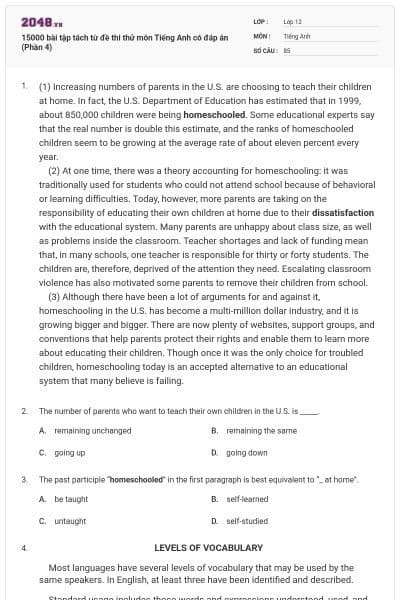
(1) Increasing numbers of parents in the U.S. are choosing to teach their children at home. In fact, the U.S. Department of Education has estimated that in 1999, about 850,000 children were being homeschooled. Some educational experts say that the real number is double this estimate, and the ranks of homeschooled children seem to be growing at the average rate of about eleven percent every year.
(2) At one time, there was a theory accounting for homeschooling: it was traditionally used for students who could not attend school because of behavioral or learning difficulties. Today, however, more parents are taking on the responsibility of educating their own children at home due to their dissatisfaction with the educational system. Many parents are unhappy about class size, as well as problems inside the classroom. Teacher shortages and lack of funding mean that, in many schools, one teacher is responsible for thirty or forty students. The children are, therefore, deprived of the attention they need. Escalating classroom violence has also motivated some parents to remove their children from school.
(3) Although there have been a lot of arguments for and against it, homeschooling in the U.S. has become a multi-million dollar industry, and it is growing bigger and bigger. There are now plenty of websites, support groups, and conventions that help parents protect their rights and enable them to learn more about educating their children. Though once it was the only choice for troubled children, homeschooling today is an accepted alternative to an educational system that many believe is failing.
The number of parents who want to teach their own children in the U.S. is _____.
remaining unchanged
remaining the same
going up
going down
Đáp án C
Thông tin nằm ở câu đầu đoạn 1: “Increasing numbers of parents in the U.S. are choosing to teach their children at home.” increasing: (a) ngày càng tăng, tăng dần
The past participle “homeschooled” in the first paragraph is best equivalent to “_ at home”.
be taught
self-learned
untaught
self-studied
Đáp án A
Homeschooled = be taught at home: được dạy dỗ tại nhà
This estimated number was presented by _____.
a government office
school teachers
the parents
homeschooled children
Đáp án A
Thông tin nằm ở đoạn 1: “In fact, the U.S. Department of Education has estimated that in 1999, about 850,000 children were being homeschooled.”
According to some experts, the exact number of homeschooled children in the US in the last year of the 20th century must be _____.
1,600,000
850,000
1,900,000
1,700,000
Đáp án D
Thông tin nằm ở đoạn 1: “In fact, the U.S. Department of Education has estimated that in 1999, about 850,000 children were being homeschooled. Some educational experts say that the real number is double this estimate, and the ranks of homeschooled children seem to be growing at the average rate of about eleven percent every year.”
More parents teach their children because they completely _ the current educational system.
please with
object to
appeal to
approve of
Đáp án B
Thông tin nằm ở đoạn 2: “Today, however, more parents are taking on the responsibility of educating their own children at home due to their dissatisfaction with the educational system.”
dissatisfaction: (n) không hài lòng, không thỏa mãn, bất mãn
The noun “dissatisfaction” in this paragraph is best equivalent to “_____”.
disappointment
disagreement
discrimination
discouragement
Đáp án A
dissatisfaction: (n) không hài lòng, không thỏa mãn, bất mãn = disappointment
Many parents stop their children from going to school because it is now too __ for them.
explosive
expensive
dangerous
humorous
Đáp án C
Thông tin nằm ở câu cuối đoạn 2: “Escalating classroom violence has also motivated some parents to remove their children from school.”
The attitude of the author towards homeschooling can be best described as _____.
acceptable
favorable
remarkable
unfavorable
Đáp án B
favorable: (a) có thiện chí, tán thành
Quan điểm này được bộc lộ ở câu cuối đoạn: “Though once it was the only choice for troubled children, homeschooling today is an accepted alternative to an educational system that many believe is failing.”
LEVELS OF VOCABULARY
Most languages have several levels of vocabulary that may be used by the same speakers. In English, at least three have been identified and described.
Standard usage includes those words and expressions understood, used, and accepted by a majority of the speakers of a language in any situation regardless of the level of formality. As such, these words and expressions are well defined and listed in standard dictionaries. Colloquialisms, on the other hand, are familiar words and idioms that are understood by almost all speakers of a language and used in informal speech or writing, but not considered acceptable for more formal situations. Almost all idiomatic expressions are colloquial language. Slang, refers to words and expressions understood by a large number of speakers but not accepted as appropriate formal usage by the majority. Colloquial expressions and even slang may be found in standard dictionaries but will be so identified. Both colloquial usage and slang are more common in speech than writing.
Colloquial speech often passes into standard speech. Some slang also passes into standard speech, but other slang expressions enjoy momentary popularity followed by obscurity. In some cases, the majority never accepts certain slang phrases but nevertheless retains them in their collective memories. Every generation seems to require its own set of words to describe familiar objects and events.
It has been pointed out by a number of linguists that three cultural conditions are necessary for the creation of a large body of slang expressions. First, the introduction and acceptance of new objects and situations in the society; second, a diverse population with a large number of subgroups; third, association among the subgroups and the majority population.
Finally, it is worth noting that the terms “standard”, “colloquial”, and “slang” exist only as abstract labels for scholars who study language. Only a tiny number of the speakers of any language will be aware that they are using colloquial or slang expressions. Most speakers of English will, during appropriate situations, select and use three types of expressions.
Which of the following is the main topic of the passage?
Standard speech
Idiomatic phrases
Different types of vocabulary
Dictionary usage
Đáp án C
Chủ đề chính của đoạnvăn là gì?
Câu chủ để của đoạn nằm ở 2 câu đoạn 1: “Most languages have several levels of vocabulary that may be used by the same speakers. In English, at least three have been identified and described.” Hầu hết các ngôn ngữ có nhiều cấp độ từ vựng cái mà có thể được sử dụng bởi cùng một người nói. Trong tiếng Anh, có ít nhất 3 cấp độ từ vựng được xác định và mô tả.
Đáp án C: các loại từ vựng khác nhau.
Các phương án khác còn lại chỉ là một ý nhỏ của đoạn văn. A. Lối nói chuẩn. B Các cụm thành ngữ. D cách sử dụng từ điển
How is slang defined by the author?
Words and phrases accepted by the majority of formal usage.
Words or phrases understood by the majority but not found in standard dictionaries.
Words or phrases that are understood by a restricted group of speakers.
Words or phrases understood by a large number of speakers but not accepted as formal usage.
Đáp án D
Tiếng lóng được tác giả định nghĩa như thế nào
Thông tin nằm ở dòng 6 + 7 +8 đoạn 2: “Slang, however, refers to words and expressions understood by a large number of speakers but not accepted as appropriate formal usage by the majority. Colloquial expressions and even slang may be found in standard dictionaries but will be so identified. Both colloquial usage and slang are more common in speech than writing.” Tiếng lóng là đề cập đến các từ và các diễn đạt được hiểu bởi nhiều người nói nhưng không được chấp nhập như là cách dùng chính thức phù hợp bởi hầu hết mọi người. Các diễn đạt thông tục và thậm chí từ long có thể được tìm thấy ở các từ điển chuẩn ngoại trừ được công nhận. Cả việc sử dụng lối nói thông tục và tiếng long đều phổ biến trong văn nói hơn là văn viết
Các phương án A. Các từ và cụm từ được chấp nhận bởi phần lớn cách dùng chính thống. B. Các từ và cụm từ được hiểu bởi hầu hết mọi người nhưng không tìm thấy trong các từ điển chuẩn. C. Các từ và cụm từ được hiểu bởi nhóm người nói giới hạn. D. Các từ và cụm từ được hiểu bởi nhiều người nói nhưng không được chấp nhận như là cách dùng chính thống.
The word “appropriate” in paragraph 2 is closest in meaning to _____.
old
large
correct
important
Đáp án D
Appropriate = important: (a) thích hợp, thích đáng, quan trọng
The word “them” in paragraph 3 refers to _____.
words
slang phrases
memories
the majority
Đáp án B
Thông tin nằm ở đoạn 3: “In some cases, the majority never accepts certain slang phrases but nevertheless retains them in their collective memories.” Trong một vài trường hợp, phần lớn mọi người không bao giờ chấp nhận một vài cụm từ lóng nào đó ngoại trừ việc lưu giữ chúng (cụm từ lóng đó) trong ký ức tập tập thể của họ.
What does the author mean by the statement in paragraph 2: “Colloquialisms, on the other hand, are familiar words and idioms that are understood by almost all speakers of a language and used in informal speech or writing, but not considered acceptable for more formal situations.”?
Familiar words and phrases are found in both speech and writing in formal settings.
Familiar situations that are experienced by most people are called colloquialisms.
Informal language contains colloquialisms, which are not found in more formal language.
Most of the speakers of a language can used both formal and informal speech in their appropriate situations.
Đáp án C
Thông tin nằm ở đoạn 2: “Colloquialisms, on the other hand, are familiar words and idioms that are understood by almost all speakers of a language and used in informal speech or writing, but not considered acceptable for more formal situations.” – Mặt khác, lối nói thân mật là những từ quen thuộc và những thành ngữ mà được hiểu bởi tất cả những người nói ngôn ngữ đó và sử dụng trong văn viết cũng như các bài phát biểu thân mật, nhưng không được chấp nhận ở các tình huống trang trọng.
Thông qua câu này, ý của tác giả là: Informal language contains colloquialisms, which are not found in more formal language. – Ngôn ngữ thân mật bao gồm các lối nói thân mật, các ngôn ngữ này thì không được tìm thấy ở ngôn ngữ sử dụng trong các tình huống trang trọng, nghi thức.
Which of the following is true of standard usage?
It can be used in formal and informal settings.
It is limited to written language.
It is only understood by the upper classes.
It is constantly changing.
Đáp án A
Câu nào thì đúng để nói về cách dùng chuẩn?
Thông tin nằm ở dòng 1 +2 đoạn 2: “Standard usage includes those words and expressions understood, used, and accepted by a majority of the speakers of a language in any situation regardless of the level of formality.” Cách dùng chuẩn bao gồm các từ và cách diễn đạt được hiểu, được sử dụng và được chấp nhận bởi hầu hết người nói của một ngôn ngữ trong bất kỳ hoàn cảnh nào bất kể mức độ trang trọng
The author mentions all of the following as requirements for slang expressions to be created EXCEPT _____.
new situations
a new generation
interaction among diverse groups
a number of linguists
Đáp án D
Tác giả đề cập đến tất cả những yêu cầu cho cách diễn đạt lóng được tạo thành ngoại trừ
Thông tin nằm ở dòng 2 +3 + 4 đoạn 4: “three cultural conditions are necessary for the creation of a large body of slang expressions. First, the introduction and acceptance of new objects and situations in the society; second, a diverse population with a large number of subgroups; third, association among the subgroups and the majority population.” Ba điều kiện văn hoá cần thiết cho việc tạo ra cách diễn đạt lóng. Thứ nhất, sự giới thiệu và chấp nhận những vật và hoàn cảnh mới trong xã hội, thứ 2, dân số đa sắc tộc, thứ 3, sự kết nối giữa các nhóm dân tộc nhỏ và nhóm dân tộc chính
In addition to the great ridges and volcanic chains, the oceans conceal another form of undersea mountains: the strange guyot, or flat-topped seamount. No marine geologist even suspected the existence of these isolated mountains until they were discovered by geologist Harry H. Hess in 1946.
He was serving at the time as naval officer on a ship equipped with a fathometer. Hess named these truncated peaks for the nineteenth-century Swiss-born geologist Arnold Guyot, who had served on the faculty of Princeton University for thirty years. Since then, hundreds of guyots have been discovered in every ocean but the Arctic. Like offshore canyons, guyots present a challenge to oceanographic theory. They are believed to be extinct volcanoes. Their flat tops indicate that they once stood above or just below the surface, where the action of waves leveled off their peaks. Yet today, by definition, their summits are at least 600 feet below the surface, and some are as deep as 8,200 feet. Most lie between 3,200 feet and 6,500 feet. Their tops are not really flat but slope upward to a low pinnacle at the center. Dredging from the tops of guyots has recovered basalt and coral rubble, and that would be expected from the eroded tops of what were once islands. Some of this material is over 80 million years old. Geologists think the drowning of the guyots involved two processes: The great weight of the volcanic mountains depressed the sea floor beneath them, and the level of the sea rose a number of times, especially when the last Ice Age ended, some 8,000 to 11,000 years ago.
The word “conceal” is closest in meaning to which of the following?
hide
create
erode
contain
Đáp án A
Conceal sb/ st: (v) che giấu, giấu giếm ≈ hide: (v) che giấu
Create: tạo ra
Erode: xói mòn
Contain: chứa
The passage implies that guyots were first detected by means of _____.
a deep-sea diving expedition
computer analysis
research submarines
a fathometer
Đáp án D
Đoạn văn ngụ ý rằng các guyots lần đầu được phát hiện nhờ vào đâu
Thông tin nằm ở đoạn 2: “…a ship equipped with a fathometer…Since then, hundreds of guyots have been discovered in every ocean…”
Đó là nhờ vào máy đo chiều sâu ((máy dùng tiếng vọng để đo chiều sâu của biển)
Các phương án còn lại không được đề cập đến như là phương pháp tìm ra các guyot đầu tiên là A. cuộc thám hiểm lặn xuống biển sâu. B. phân tích máy tính. C. tàu ngầm nghiên cứu
What does the passage say about the Arctic Ocean?
The first guyot was discovered there.
It is impossible that guyots were ever formed there.
There are more guyots there than in any other ocean.
No guyots have ever been found there.
Đáp án D
Đoạn văn nói gì về Bắc Băng Dương
Thông tin nằm ở đoạn 2: “Since then, hundreds of guyots have been discovered in every ocean but the Arctic.” Kế từ đó, hàng trăm guyot đã được phát hiện ở tát cả các đại dương ngoại trừ Bắc Băng Dương.
Các phương án còn lại sai hoặc không được đê cập đến. A. Guyot đầu tiên được phát hiện ra ở đó. B. Các guyot không thể hình thành ở đây. C. Ở đó có nhiều guyot hơn tất cả những đại dương khác
The author states that offshore canyons and guyots have which of the following characteristics in common?
Both are found on the ocean floor near continental shelves.
Both were formed by volcanic activity.
Both were, at one time, above the surface of the sea.
Both present oceanographers with a mystery.
Đáp án D
Tác giả nói rằng các hẻm núi ngoài khơi và các guyot có đặc điểm chung nào sau đây
Thông tin nằm ở đoạn 2: “Like offshore canyons, guyots present a challenge to oceanographic theory.” Giống như các hẻm núi ngoài khơi, các guyot đều gây thách thức cho việc đưa ra thuyết đại dương học về chúng Các phương án còn lại không được đề cập đến. A. Cả hai được tìm thấy ở đáy đại dương gần với thềm lục địa. B. Cả hai được hình thành bởi hoạt động núi lửa. C. Cả hai tại cùng một thời điểm đều nằm trên mặt biển
According to the passage, most guyots are found at a depth of _____.
between 600 and 3,200 feet
more than 8,200 feet
less than 600 feet
between 3,200 and 6,500 feet
Đáp án D
Theo đoạn văn, hầu hết các guyot được tìm thấy ở độ sâu
Thông tin nằm ở câu: “Most lie between 3,200 feet and 6,500 feet.”
According to the passage, which of the following two processes were involved in the submersion of guyots?
Erosion and volcanic activity.
The sinking of the sea floor and the rising of sea level.
High tides and earthquakes.
Mountain building and the action of ocean currents.
Đáp án B
Theo đoạn văn, 2 quá trình nào sau đây liên quan đến việc chìm xuống biển của các guyot
Thông tin nằm ở câu cuối đoạn văn: “The great weight of the volcanic mountains depressed the sea floor beneath them, and the level of the sea rose a number of times…” Ttrọng lượng lớn của những ngọn núi lửa làm yếu đáy biển bên dưới chúng, và mực nước biển đã tăng nhiều lần... "
Các phương án khác không được đề cập đến. A. xói mòn và hoạt động núi lửa. B. Thuỷ triều lên cao và động đất. D. Thi công núi và hoạt động của các dòng hải lưu
According to the passage, when did sea level significantly rise?
From 8,000 to 11,000 years
In the nineteenth century
In 1946
80 million years ago
Đáp án A
Theo đoạn văn, mực nước biển tăng mạnh khi nào
Thông tin nằm ở câu cuối đoạn văn: “The great weight of the volcanic mountains depressed the sea floor beneath them, and the level of the sea rose a number of times, especially when the last Ice Age ended, some 8,000 to 11,000 years ago.”
What is the author’s main purpose in writing this passage?
To describe feature of the undersea world.
To trace the career of Arnold Guyot
To present the results of recent geologic research.
To discuss underwater ridges and volcano chains.
Đáp án A
Mục đích chính của đoạn văn này là gì
Thông tin nằm ở đoạn 1: “In addition to the great ridges and volcanic chains, the oceans conceal another form of undersea mountains: the strange guyot, or flat-topped seamount.” Ngoài những dãy núi lớn và những ngọn núi lửa, đại dương cũng che dấu một hình thức khác của núi: đó là các guyot, hay gọi là núi ngầm dưới nước có đỉnh bằng
Câu này là câu mở của đoạn để giới thiệu mục đích chính sau đó của cả đoạn văn sẽ là mô tả đặc điểm của thế giới dưới biển.
Các phương án khác không phải là mục đích chính của bài. B. để lần theo nghề nghiệp của ông Amold Guyot. C. để trình bày các kết quả của nghiên cứu địa chất gần đây. D. để thảo luận về các dãy núi dưới nước và núi lửa.
The election of Andrew Jackson to the presidency in 1928 marked the political ascendancy of the “common man” in American politics. Whereas all previous presidents had been Easterners from well-to-do families, Jackson was a self-made man of modest wealth from the West. Born in 1767, Jackson fought in the American Revolution, in which many of his relatives died. Afterwards, he studied law and moved to the Western District of North California. When that territory became the state of Tennessee, Jackson was elected the state’s first congressman. His name became a household word during the war of 1812, when, as a U.S Army major general, he led troops against the Creek Indians in the Mississippi Territory and later defeated the British at New Orleans.
After his presidential inauguration, Jackson rode on horseback to the White House to attend a private party. Crowds of well-wishers suddenly appeared at the reception and nearly destroyed the White House as they tried to glimpse the new president. The common man had made a dramatic entrance onto the national political scene.
Jackson’s two terms moved American society toward truer democracy. Many states abandoned property requirements for voting. Elected officials began to act more truly as representatives of the people than as their leaders. As president of the common man, Jackson waged a war against the Bank of the United States, vetoing the bill that re-chartered the institution, declaring it a dangerous monopoly that profited the wealthy few.
Although he had built his reputation as an Indian fighter during the War of 1812, Jackson was not an Indian hater. He adopted what was at the time considered an enlightened solution to the Indian problem-removal. Many tribes submitted peacefully to being moved to the West. Others were marched by force to the Indian Territory, under brutal conditions, along what the Cherokees called the Trail of Tears.
One of Andrew Jackson’s most enduring legacies was the Democratic Party, which under him became a highly organized political party. In opposition to the Democrats were the Whigs, a party that attracted supporters of the Bank of the United States and opposed the tyranny of the man called “King Andrew”. A less specific but more basic legacy is the populist philosophy of politics that still bears the name “Jacksonian Democracy.”
The author’s perspective toward Andrew Jackson could be best described as _____.
critical
emotional
personal
historical
Đáp án D
Tác giả viết đoạn văn mang tính lịch sử
The author suggests that Jackson’s election and inauguration _____.
destroyed the White House
brought a new style to the presidency
made a lot of common people angry
put a military man in the White House for the first time
Đáp án B
Thông tin nằm ở câu đầu đoạn 1: “The election of Andrew Jackson to the presidency in 1928 marked the political ascendancy of the “common man” in American politics.”
The word “institution” in paragraph 3 refers to _____.
the presidency of the United States
American society
The Bank of the United States
democracy
Đáp án C
‘institution’ đề cập tới ngân hàng Hoa Kỳ xuất hiện trước nó
Đoạn 3: “Jackson waged a war against the Bank of the United States, vetoing the bill that re-chartered the institution, declaring it a dangerous monopoly that profited the wealthy few.”
According to the passage, why did Jackson oppose the Bank of the United States?
He thought it benefited only rich people.
It started a war.
It opposed electing him “King Andrew”.
It opposed giving common people the right to vote
Đáp án A
Thông tin nằm ở đoạn 3: “…declaring it a dangerous monopoly that profited the wealthy few.” – tuyên bố nó là 1 tổ chức nguy hiểm vì chỉ mang lợi nhuận cho những kẻ giàu có.
According to the passage, Jackson’s policy toward American Indians was _____.
developed during the War of 1812
forceful and cruel
considered his greatest achievement
considered progressive at the time
Đáp án D
Thông tin nằm ở đoạn 4: “He adopted what was at the time considered an enlightened solution to the Indian problem-removal.”
The word “brutal” in paragraph 4 is closest in meaning to _____.
tearful
abrupt
humane
harsh
Đáp án D
‘brutal’: (a) hung bạo, tàn ác = harsh (a): thô bạo, ác nghiệt, tàn nhẫn
Which of the following could NOT be inferred about Andrew Jackson?
He served his country throughout his life
He supported democratic reforms
He inspired populist politics
He was president during a violent war
Đáp án D
Thông tin nằm ở câu cuối đoạn 1: “His name became a household word during the war of 1812, when, as a U.S Army major general, he led troops against the Creek Indians in the Mississippi Territory and later defeated the British at New Orleans.”
The work of women has been economically vital since prehistory, although their contributions have varied according to the structure, needs, customs, and attitudes of society.
In prehistoric times, women and men participated almost equally in hunting and gathering activities to obtain food. With the development of agricultural communities, women’s work revolved more around the home. As urban centres developed, women sold or traded goods in the marketplace.
From ancient to modern times, four generalizations can be made about women's paid work. Women have worked because of economic necessity; poor women in particular worked outside the home whether they were unmarried or married, and especially if their husbands were unable to sustain the family solely through their own work. Women’s indentured work has often been similar to their work at home. Women have maintained the primary responsibility for raising children, regardless of their paid work. Women have historically been paid less than men and have been allocated lower-status work
Some major changes are now occurring in industrial nations, including the steadily increasing proportion of women in the labor force; decreasing family responsibilities (due to both smaller family size and technological innovation in the home); higher levels of education for women; and more middle and upper-income women working for pay or for job satisfaction. Statistically, they have not yet achieved parity of pay or senior appointments in the workplace in any nation.
Artisans working in their own homes not infrequently used the labor of their families. This custom was so prevalent during the Middle Ages, craft guilds of the period, including some that otherwise excluded women, often admitted to membership the widows of guild members, providing they met professional requirements. Dressmaking and lacemaking guilds were composed exclusively of women.
Gradually, the guilds were replaced by the putting-out system, whereby tools and materials were distributed to workers by merchants; the workers then produced articles on a piecework basis in their homes. During the 18th and early 19th centuries, as the Industrial Revolution developed, the putting-out system slowly declined. Goods that had been produced by hand in the home were manufactured by machine under the factory system. Women competed more with men for some jobs, but were concentrated primarily in textile mills and clothing factories. Manufacturers often favored women employees because of relevant skills and lower wages, and also because early trade union organization tended to occur first among men. Employees in sweatshops were also preponderantly women. The result was to institutionalize systems of low pay, poor working conditions, long hours, and other abuses, which along with child labor presented some of the worst examples of worker exploitation in early industrial capitalism. Minimum wage legislation and other protective laws, when introduced, concentrated particularly on the alleviation of these abuses of working women.
Women workers in business and the professions, the so-called white-collar occupations, suffered less from poor conditions of work and exploitative labor, but were denied equality of pay and opportunity. The growing use of the typewriter and the telephone after the 1870s created two new employment niches for women, as typists and telephonists, but in both fields the result was again to institutionalize a permanent category of low-paid, low-status women’s work.
When the the farming communities developed, women worked _____.
critical
emotional
personal
historical
Đáp án B
Thông tin nằm ở đoạn 2: “With the development of agricultural communities, women’s work revolved more around the home.”
The author suggests that Jackson’s election and inauguration _____.
destroyed the White House
brought a new style to the presidency.
made a lot of common people angry
put a military man in the White House for the first time.
Đáp án C
Thông tin nằm ở câu cuối đoạn 2: “As urban centres developed, women sold or traded goods in the marketplace.” (bán hoặc trao đổi hàng hóa ở chợ)
The word “institution” in paragraph 3 refers to _____.
the presidency of the United States
American society
The Bank of the United States
democracy
Đáp án A
Thông tin nằm ở đoạn 3: “Women’s indentured work has often been similar to their work at home.”
- indentured work = work outside the home
According to the passage, why did Jackson oppose the Bank of the United States?
He thought it benefited only rich people
It started a war.
It opposed electing him “King Andrew”.
It opposed giving common people the right to vote.
Đáp án C
Thông tin nằm ở đoạn 4: “Some major changes are now occurring in industrial nations,…; decreasing family responsibilities (due to both smaller family size and technological innovation in the home); higher levels of education for women; and more middle and upper-income women working for pay or for job satisfaction. Statistically, they have not yet achieved parity of pay or senior appointments in the workplace in any nation.”
- dù giảm trách nhiệm với gia đình và nâng cao về giáo dục,… họ vẫn chưa nhận được sự ngang bằng hay những vị trí công việc cao hơn ở nơi làm việc.
According to the passage, Jackson’s policy toward American Indians was _____.
developed during the War of 1812
forceful and cruel
considered his greatest achievement
considered progressive at the time
Đáp án D
Thông tin nằm ở đoạn 3: “Women have worked because of economic necessity; poor women in particular worked outside the home whether they were unmarried or married, and especially if their husbands were unable to sustain the family solely through their own work.”
– phụ nữ phải làm vì sự cần thiết về kinh tế, nếu như chồng của họ không thể 1 mình làm trụ cột gia đình.
The word “brutal” in paragraph 4 is closest in meaning to _____.
tearful
abrupt
humane
harsh
Đáp án C
sweatshops: xí nghiệp bóc lột công nhân tàn tệ
Which of the following could NOT be inferred about Andrew Jackson?
He served his country throughout his life
He supported democratic reforms.
He inspired populist politics
He was president during a violent war.
Đáp án C
Thông tin nằm ở đoạn 7: “…the Industrial Revolution developed, the putting-out system slowly declined. Goods that had been produced by hand in the home were manufactured by machine under the factory system. Women competed more with men for some jobs, but were concentrated primarily in textile mills and clothing factories.”
What women have done for the economic development have changed over time due to _____.
their role in the home
their marital status and their husbands
the different factors of the society
the Industrial Revolution
Đáp án C
Thông tin nằm ở đoạn 1: “The work of women has been economically vital since prehistory, although their contributions have varied according to the structure, needs, customs, and attitudes of society.”
Ambient divers are, unlike divers who go underwater in submersible vehicles of pressure resistant suits, exposed to the pressure and temperature of the surrounding ambient water. Of all types of diving, the oldest and simplest is free diving. Free divers may use no equipment at all, but most use a face mask, foot fins, and a snorkel. Under the surface, free divers must hold their breath. Most free divers can only descend 30 to 40 feet, but some skilled divers can go as deep as 100 feet.
Scuba diving provides greater range than free diving. The word scuba stands for self-contained underwater breathing apparatus. Scuba divers wear metal tanks with compressed air or other breathing gases. When using open-circuit equipment, a scuba diver simply breathes air form the tank through a hose and releases the exhaled air into the water. A closed-circuit breathing device, also called a rebreather, filters out carbon dioxide and other harmful gases and automatically adds oxygen. This enables the diver to breathe the same air over and over. In surface-supplied diving, divers wear helmets and waterproof canvas suits. Today, sophiticated plastic helmets have replaced the heavy copper helmets used in the past.These divers get their air from a hose connected to compressors on a boat. Surface-supplied divers can go deeper than any other type of ambient diver.
Ambient divers are ones who_____
can descend to extreme depths
use submersible vehicles
use no equipment
are exposed to the surrounding water
Đáp án C
Thợ lặn trong bờ là những người:
A. có thể xuống đến độ sâu cực đoan
B. sử dụng xe chìm
C. không sử dụng thiết bị
D. được tiếp xúc với nước xung quanh
What does the word “descend” in the paragraph probably mean?
move to a lower level
climb to a higher place
swim on the river bed
go up and down slowly
Đáp án A
Từ " descend" trong đoạn văn có thể có nghĩa là gì?
A. chuyển sang chỗ thấp hơn
B. leo lên một nơi cao hơn
C. bơi trên lòng sông
D. đi lên và xuống chậm
The word “This” in bold in paragraph 2 refers to_________.
filtering out carbon dioxide
adding oxygen
exhaling air into the water
filtering out harmful gases and adding oxygen.
Đáp án D
Từ "This" in đậm trong đoạn 2 đề cập đến:
A. lọc ra carbon dioxide
B. thêm oxy
C. thở ra không khí vào trong nước
D. lọc ra khí độc hại và thêm oxy.
What are the helmets that surface-supplied divers use today made from, according to the passage?
glass
copper
plastic
canvas
Đáp án C
Mũ bảo hiểm mà các thợ lặn cung cấp bề mặt sử dụng ngày nay được sản xuất là gì, theo đoạn văn?
Một ly
B. đồng
C. nhựa
D. canvas
According to the passage, a free diver may use any of the following EXCEPT______
a rebreather
a snorkel
foot fins
a mask
Đáp án A
Thợ lặn tự do có thể sử dụng bất kì cái gì trừ cái nào sau đây
A. một bình oxi
B. một ống thở
C. vây chân
D. mặt nạ
According to the passage, the maximum depth for free divers is around ______
40 feet
100 feet
200 feet
1,000 feet
Đáp án B
When using closed-circuit devices, divers_______
exhale air into the water
hold their breath
breathe the same air over and over
receive air from the surface
Đáp án C
Khi sử dụng thiết bị lặn, thợ lặn:
A. thở ra không khí trong nước
B. nín thở
C. hít thở nhiều lần
D. nhận không khí từ bề mặt
There are a number of natural disasters that can strike across the globe. Two that are frequently linked to one another are earthquakes and tsunamis. Both of them can cause a great amount of devastation when they hit. However, tsunamis are the direct result of earthquakes and cannot happen without them.
The Earth has three main parts. They are the crust, the mantle, and the core. The crust is the outer layer of the Earth. It is not a single piece of land. Instead, it is comprised of a number of plates. There are a few enormous plates and many smaller ones. These plates essentially rest upon the mantle, which is fluid. As a result, the plates are in constant
– yet slow – motion. The plates may move away from or toward other plates. In some cases, they collide violently with the plates adjoining them. The movement of the plates causes tension in the rock. Over a long time, this tension may build up. When it is released, an earthquake happens.Tens of thousands of earthquakes happen every year. The vast majority are so small that only scientific instruments can perceive them. Others are powerful enough that people can feel them, yet they cause little harm or damage. More powerful earthquakes, however, can cause buildings, bridges, and other structures to collapse. They may additionally injure and skill thousands of people and might even cause the land to change it appearance.
Since most of the Earth’s surface is water, numerous earthquakes happen beneath the planet’s oceans. Underwater earthquakes cause the seafloor to move. This results in the displacement of water in the ocean. When this occurs, a tsunami may form. This is a wave that forms on the surface and moves in all directions from the place where the earthquake happened. A tsunami moves extremely quickly and can travel thousnads of kilometres. As it approaches land, the water near the coast gets sucked out to sea. This causes the tsunamis to increase in height. Minutes later, the tsunami arrives. A large tsunami – one more than ten meters in height – can travel far inland. As it does that, it can flood the land, destroy human settlements, and kill large numbers of people
Which of the following statements does paragraph 1 support?
A tsunami happens in tandem with an earthquake.
The most severe type of natural disaster is an earthquake.
Earthquakes cause more destruction than tsunamis.
Earthquakes frequently take place after tsunamis do.
Đáp án A
Câu nào sau đây được nói đến ở đoạn 1?
A. Một cơn sóng thần xảy ra song song với một trận động đất.
B. Loại thiên tai nghiêm trọng nhất là một trận động đất.
C. Động đất gây ra nhiều sự hủy diệt hơn sóng thần.
D. Động đất thường xuyên xảy ra sau khi sóng thần làm.
The word “it” in the first paragraph refers to_____
The core
The crust
The Earth
The mantle
Đáp án B
Từ "it" trong đoạn đầu tiên đề cập đến:
A. Lõi
B. Lớp vỏ
C. Trái đất
D. Lớp phủ
What is the passage mainly about?
When earthquakes are the most likely to happen.
What kind of damage natural disasters can cause.
How earthquakes and tsunamis occur.
Why tsunamis are deadlier than earthquakes.
Đáp án C
Ý chính của bài là gì?
A. Khi động đất có nhiều khả năng xảy ra nhất.
B. Loại thiên tai gây hại nào có thể gây ra.
C. Làm thế nào động đất và sóng thần xảy ra.
D. Tại sao sóng thần đáng sợ hơn động đất.
The word “adjoining” in bold in paragraph 2 is closest in meaning to________.
residing
approaching
bordering
appearing
Đáp án C
Từ “adjoining” được in đậm ở đoạn 2 gần nghĩa với:
A. cư trú
B. tiếp cận
C. giáp
D. xuất hiện
The word “perceive” in bold in paragraph 3 is closest in meaning to________.
detect
prevent
comprehend
locate
:Đáp án A
Từ “perceive” được in đậm trong đoạn 3 gần nghĩa với:
A. phát hiện
B. ngăn chặn
C. thấu hiểu
D. xác định vị trí
Which of the following is true regarding the crust?
It is the smallest of the Earth’s three layers
It is thicker on land than it is under the water.
There many separate pieces that make it up
The mantle beneath it keeps it from moving too
Đáp án C
Điều nào sau đây là đúng về lớp vỏ?
A. Đây là lớp nhỏ nhất trong ba lớp của Trái Đất
B. Nó dày hơn trên đất hơn là dưới nước.
C. Có nhiều phần riêng biệt tạo nên
D. Lớp phủ bên dưới nó ngăn nó không di chuyển
Based on the passage, what is probably true about tsunamis?
They kill more people each year than earthquakes.
They are able to move as fast as the speed of sound.
They cannot damage ships sailing on the ocean.
They can be deadly to people standing near shore.
Đáp án D
Điều gì có lẽ đúng về sóng thần?
A. Chúng giết nhiều người hơn mỗi năm so với động đất.
B. Chúng có thể di chuyển nhanh như tốc độ của âm thanh.
C. Chúng không thể làm hỏng tàu thuyền trên đại dương.
D. Chúng có thể gây tử vong cho những người đứng gần bờ.
Which of the following is NOT mentioned in paragraph 3 about earthquakes?
How severe the majority of them are
What kind of damage they can cause
How often powerful ones take place
How many people they typically kill
Đáp án C
Điều nào sau đây KHÔNG được đề cập trong đoạn 3 về động đất?
A. Mức độ nghiêm trọng của của chúng như thế nào
B. Chúng có thể gây ra thiệt hại gì
C. Làm thế nào để một trận động đất mạnh diễn ra
D. Có bao nhiêu người thiệt mạng trong thiên tai
In many ways, the increasingly rapid pace of climate change is a direct result of the growth of the human population. In the last 100 years, the world population has more than tripled, from just under 2 billion at the beginning of the century to nearly 7 billion today. In addition, the average person uses more energy and natural resources than the average person one hundred years ago, meaning that the rates of consumption are actually much higher than just the increase in population would imply. For example, it took the world 125 years to use the first one trillion barrels of oil. The next trillion barrels will be used in less than 30 years, which is almost 5 times as fast, not three.
All of these activities: food production, energy usage, and the use of natural resources, contribute to climate change in some way. The greater amounts of oil and other fuels burned to create energy release chemicals which add to global warming. In order to produce more food, farmers cut down trees to gain more land for their fields. In addition, we cut down trees to build the houses needed for a larger population. Those trees are an essential part of controlling global warming; others are too numerous to mention.
In addition to a growing population, the world also has a population that desires a higher standard of living than in the past, and a higher standard of living requires the use of even more natural resources. A look at one country will provide a clear example of this fact. China is the world’s most populous nation, with 1.3 billion people. Currently, the standard of living for most of those people is far below that of people in first world nations. Therefore, the average Chinese citizen uses far fewer natural resources and less energy than the average citizen of the US or Japan. But China is growing in power, and more of its citizens are beginning to expect a first world lifestyle. If every Chinese person attains a first world lifestyle, the amount of energy and natural resources needed in the world will double, even if the standard of living in every other nation on Earth remains the same as it is today.
How many years did it take the world years to use the first one trillion barrels of
oil?
100 years
125 years
30 years
7 years
Đáp án B
Thế giới đã sử dụng một nghìn tỷ thùng dầu đầu tiên trong bao lâu?
A. 100 năm
B. 125 năm
C. 30 năm
D. 7 năm
The word “consumption” in the passage is closest in meaning to _____.
development
usage
population
increase
Đáp án B
Từ "consumption" trong đoạn văn gần nghĩa với:
A. phát triển
B. sử dụng
C. dân số
D. tăng
According to the passage, which of these activities Does NOT contribute to climate change in some way?
food production
energy usage
wild animals hunting
natural resources consumption
Đáp án C
Hoạt động nào trong số này KHÔNG đóng góp cho biến đổi khí hậu theo một cách nào đó?
A. sản xuất lương thực
B. sử dụng năng lượng
C. săn thú hoang dã
D. tiêu thụ tài nguyên thiên nhiên
According to the passage, how does food production contribute to global warming?
Producing more food leads to growth in the world population.
Food production uses many chemicals which add to global warming.
Food production requires that the forests be cleared to create farmland.
Food production decreases the ability of the air to release heat..
Đáp án C
Sản xuất lương thực đã gây ảnh hưởng tới sự nóng lên toàn cầu như thế nào?
A. Sản xuất nhiều thực phẩm hơn dẫn đến tăng trưởng dân số thế giới.
B. Sản xuất thực phẩm sử dụng nhiều hóa chất làm tăng sự nóng lên toàn cầu.
C. Sản xuất lương thực đòi hỏi rừng phải được khai hoang để tạo ra đất nông nghiệp.
D. Sản xuất lương thực làm giảm khả năng giải phóng nhiệt.
The word “others” in the passage refers to ________.
problems of global warming in the modern world
examples of the environmental consequences of population growth
ways in which our usage of oil will affect the world climate.
the reasons why trees are essential in controlling global warming
Đáp án D
Từ "others" trong đoạn văn đề cập đến:
A. vấn đề nóng lên toàn cầu trong thế giới hiện đại
B. ví dụ về hậu quả môi trường của tăng trưởng dân số
C. cách thức mà việc sử dụng dầu của chúng ta sẽ ảnh hưởng đến khí hậu thế giới.
D. lý do tại sao cây là điều cần thiết trong việc kiểm soát sự nóng lên toàn cầu
According to the passage, how does the standard of living affect global warming?
First world nations create less population than developing nations.
First world nations create less population than developing nations.
The use of natural resources is directly related to the standard of living.
High standards of living lead to increases in world population.
Đáp án C
Mức sống ảnh hưởng đến toàn cầu sự nóng lên như thế nào?
A. Mức sống cao hơn là tốt hơn cho môi trường.
B. Các quốc gia trên thế giới đầu tiên tạo ra dân số ít hơn các quốc gia đang phát triển.
C. Việc sử dụng tài nguyên thiên nhiên có liên quan trực tiếp đến mức sống.
D. Mức sống cao dẫn đến gia tăng dân số thế giới.
Why does the author discuss China, Japan, and the United States?
To compare the standard of their citizens.
To explain why China will not be able to become a first world nation.
To better illustrate the effects of an increase in standards of living.
To explain why the world's use of energy will need to double soon
Đáp án C
Tại sao tác giả thảo luận về Trung Quốc, Nhật Bản và Hoa Kỳ?
A. Để so sánh tiêu chuẩn của công dân của họ.
B. Để giải thích tại sao Trung Quốc sẽ không thể trở thành quốc gia đứng đầu trên thế giới.
C. Để minh họa tốt hơn ảnh hưởng của việc tăng mức sống.
D. Để giải thích tại sao việc sử dụng năng lượng của thế giới sẽ cần phải tăng gấp đôi.
Carnegie Hall, the famous concert hall in New York City, has again undergone a restoration. While this is not the first, it is certainly the most extensive in the building’s history. As a result of this new restoration, Carnegie Hall once again has the quality of sound that it had when it was first built.
Carnegie Hall owes its existence to Andrew Carnegie, the wealthy owner of a steel company in the late 1800s. The hall was finished in 1891 and quickly gained a reputation as an excellent performing arts hall where accomplished musicians gained fame. Despite its reputation, however, the concert hall suffered from several detrimental renovations over the years. During the Great Depression, when fewer people could afford to attend performances, the directors sold part of the building to commercial businesses. As a result, a coffee shop was opened in one corner of the building, for which the builders replaced the brick and terra cotta walls with windowpanes. A renovation in 1946 seriously damaged the acoustical quality of the hall when the makers of the film Carnegie Hall cut a gaping hole in the dome of the ceiling to allow for lights and air vents. The hole was later covered with short curtains and a fake ceiling, but the hall never sounded the same afterwards.
In 1960, the violinist Isaac Stern became involved in restoring the hall after a group of real estate developers unveiled plans to demolish Carnegie Hall and build a high-rise office building on the site. This threat spurred Stern to rally public support for Carnegie Hall and encourage the City of New York to buy the property. The movement was successful, and the concert hall is now owned by the city. In the current restoration, builders tested each new material for its sound qualities, and they replaced the hole in the ceiling with a dome. The builders also restored the outer walls to their original appearance and closed the coffee shop. Carnegie has never sounded better, and its prospects for the future have never looked more promising.
This passage is mainly about ________.
changes to Carnegie Hall
the appearance of Carnegie Hall
Carnegie Hall’s history during the Great Depression
damage to the ceiling in Carnegie Hall
Đáp án A
Nội dung chính của đoạn văn này là về:
A. sự thay đổi đối với Carnegie Hall
B. sự xuất hiện của Hội trường Carnegie
C. Lịch sử của Carnegie Hall trong thời kỳ Đại suy thoái
D. thiệt hại cho trần nhà trong Carnegie Hall
The word “it” in the first paragraph refers to_____
Carnegie Hall
New York City
a restoration.
a plan
Đáp án C
Từ "it" trong đoạn đầu tiên đề cập đến:
A. Carnegie Hall
B. Thành phố New York
C. một sự phục hồi.
D. một kế hoạch
What major change happened to the hall in 1946?
The acoustic dome was damaged.
Space in the building was sold to commercial businesses.
The walls were damaged in an earthquake.
The stage was renovated.
Đáp án A
Sự thay đổi lớn xảy ra với hội trường vào năm 1946 là gì?
A. Mái vòm âm thanh bị hỏng.
B. Không gian trong tòa nhà đã bị bán cho các doanh nghiệp thương mại.
C. Các bức tường bị hư hại trong một trận động đất.
D. Sân khấu đã được cải tạo.
Who was Andrew Carnegie?
A violinist.
An architect.
A steel mill owner.
Mayor of New York City.
Đáp án C
Andrew Carnegie là ai?
A. Một nghệ sĩ vĩ cầm.
B. Một kiến trúc sư.
C. Một chủ nhà máy thép.
D. Thị trưởng thành phố New York.
What was Isaac Stern’s relationship to Carnegie Hall?
He made the movie “Carnegie Hall” in 1946.
He performed on opening night in 1891.
He tried to save the hall, beginning in 1960.
He opened a coffee shop in Carnegie Hall during the Depression.
Đáp án C
Mối quan hệ của Isaac Stern với Carnegie Hall là gì?
A. Ông làm bộ phim "Carnegie Hall" vào năm 1946.
B. Ông đã biểu diễn vào đêm khai mạc năm 1891.
C. Ông đã cố gắng để cứu đại sảnh, bắt đầu vào năm 1960.
D. Anh mở một quán cà phê ở Carnegie Hall trong thời kỳ khủng hoảng.
What was probably the most important aspect of the recent renovation?
Restoring the outer wall.
Expanding the lobby.
Restoring the plaster trim.
Repairing the ceiling.
Đáp án D
Mối quan hệ của Isaac Stern với Carnegie Hall là gì?
A. Ông làm phim "Carnegie Hall" vào năm 1946.
B. Mr. expression in the last year 1891.
C. You tried to try to resetting, starting in the 1960.
D. Anh mở một quán cà phê tại Carnegie Hall trong thời gian khủng hoảng.
Which of the following is closest in meaning to the word “unveiled” in paragraph 3?
Announced.
Restricted.
Overshadowed.
Located.
Đáp án A
Điều nào sau đây có ý nghĩa gần nhất với từ “unveiled” trong đoạn 3?
A. Công bố.
B. Bị giới hạn.
C. Bị lu mờ.
D. Nằm.
How does the author seem to feel about the future of Carnegie Hall?
Ambiguous.
Guarded.
Optimistic
Negative.
Đáp án C
Tác giả cảm nhận về tương lai của Carnegie Hall như thế nào?
A. Không rõ ràng.
B. Được an toàn.
C. Lạc quan.
D. Phủ định.
We live in a world of tired, sleep deprived people. In his book Counting Sheep, Paul Martin – a behavioural biologist – describes a society which is just too busy to sleep and which does not give sleeping the importance it deserves.
Modern society has invented reasons not to sleep. We are now a 24/7 society where shops and services must be available all hours. We spend longer hours at work than we used to, and more time getting to work. Mobile phones and email allow us to stay in touch round the clock and late-night TV and the Internet tempt us away from our beds. When we need more time for work or pleasure, the easy solution is to sleep less. The average adult sleeps only 6.2 hours a night during the week, whereas research shows that most people need eight or even eight and a half hours’ sleep to feel at their best. Nowadays, many people have got used to sleeping less than they need and they live in an almost permanent state of ‘sleep debt’.
Until the invention of the electric light in 1879 our daily cycle of sleep used to depend on the hours of daylight. People would get up with the sun and go to bed at nightfall. But nowadays our hours of sleep are mainly determined by our working hours (or our social life) and most people are woken up artificially by an alarm clock. During the day caffeine, the world’s most popular drug, helps to keep us awake. 75% of the world’s population habitually consume caffeine, which up to a point masks the symptoms of sleep deprivation.
What does a chronic lack of sleep do to us? As well as making us irritable and unhappy as humans, it also reduces our motivation and ability to work. This has serious implications for society in general. Doctors, for example, are often chronically sleep deprived, especially when they are on ‘night call’, and may get less than three hours’ sleep. Lack of sleep can seriously impair their mood, judgment, and ability to take decisions. Tired engineers, in the early hours of the morning, made a series of mistakes with catastrophic results. On our roads and motorways lack of sleep kills thousands of people every year. Tests show that a tired driver can be just as dangerous as a drunken driver. However, driving when drunk is against the law but driving when exhausted isn’t. As Paul Martin says, it is very ironic that we admire people who function on very little sleep instead of criticizing them for being irresponsible. Our world would be a much safer, happier place if everyone, whatever their job, slept eight hours a night.
New English File Upper-intermediate by Clive Oxenden and Christina Latham-Koenig, OUP
The phrase “round the clock” in the second paragraph is similar in meaning to______.
surrounded with clocks
all day and night
during the daytime
having a round clock
Đáp án B
Cụm từ "round the clock" trong đoạn thứ hai cũng tương tự như:
A. bao quanh với đồng hồ
B. cả ngày lẫn đêm
C. vào ban ngày
D. có một chiếc đồng hồ tròn
The writer mentions the Internet in the passage as______.
a temptation that prevents us from sleeping
an easy solution to sleep deprivation
an ineffective means of communication
a factor that is not related to sleep deprivation
Đáp án A
Nhà văn đề cập đến Internet như:
A. một sự cám dỗ ngăn cản chúng ta ngủ
B. một giải pháp dễ dàng để thiếu ngủ
C. một phương tiện giao tiếp không hiệu quả
D. một yếu tố không liên quan đến thiếu ngủ
According to the third paragraph, which of the following statements is NOT TRUE?
Our social life has no influence on our hours of sleep.
The sun obviously determined our daily routines.
The electric light was invented in the 19th century.
The electric light has changed our daily cycle of sleep.
Đáp án A
câu nào sau đây KHÔNG THẬT?
A. Đời sống xã hội của chúng ta không ảnh hưởng đến giấc ngủ của chúng ta.
B. Mặt trời rõ ràng đã xác định thói quen hàng ngày của chúng tôi.
C. Ánh sáng điện được phát minh vào thế kỷ 19.
D. Ánh sáng điện đã thay đổi chu kỳ ngủ hàng ngày của chúng ta
The word “which” in the third paragraph refers to______.
reaching a point
masking the symptoms
the world’s population
caffeine consumption
Đáp án D
Từ “which” trong đoạn thứ ba đề cập đến:
A. đạt đến một điểm
B. che giấu các triệu chứng
C. dân số thế giới
D. tiêu thụ caffeine
Which of the following would the writer of the passage approve of?
Our world would be a much safer place without drinkers.
Both drunken drivers and sleep-deprived people should be criticized.
There is no point in criticizing irresponsible people in our society.
We certainly can function well even when we hardly sleep.
Đáp án B
Tác giả muốn nói lên điều gì?
A. Thế giới của chúng ta sẽ là một nơi an toàn hơn nhiều mà không có người uống rượu.
B. Cả người lái xe say rượu và người bị mất ngủ nên bị chỉ trích.8
C. Không có điểm chỉ trích những người vô trách nhiệm trong xã hội chúng ta.
D. Chúng tôi chắc chắn có thể hoạt động tốt ngay cả khi chúng tôi hầu như không ngủ.
All of the following are mentioned as those whose performance is affected by ‘sleep debt’ EXCEPT_____.
doctors
drivers
biologists
engineers
Đáp án C
Tất cả những điều sau đây được đề cập là những người có hiệu suất bị ảnh hưởng bởi “sleep debt” trừ:
A. bác sĩ
B. tài xế
C. sinh vật học
D. kỹ sư
Which of the following could best serve as the title of the passage?
Accident Prevention: Urgent!
Sleep Deprivation: Causes and Effects
A Society of Sleepless People
A Well-known Biologist
Đáp án B
Điều nào sau đây có thể là tiêu đề của đoạn văn?
A. Phòng chống tai nạn: Khẩn cấp!
B. Thiếu ngủ: Nguyên nhân và hiệu ứng
C. Một xã hội của những người không ngủ
D. Một nhà sinh vật học nổi tiếng
Bạn có thích hoạt động này không?