15000 bài tập tách từ đề thi thử môn Tiếng Anh có đáp án (Phần 3)
75 câu hỏi
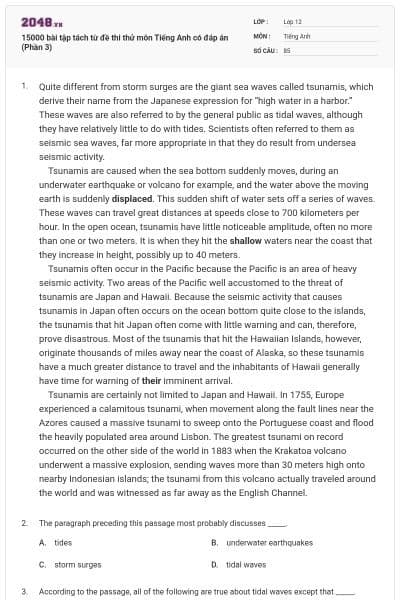
Quite different from storm surges are the giant sea waves called tsunamis, which derive their name from the Japanese expression for “high water in a harbor.” These waves are also referred to by the general public as tidal waves, although they have relatively little to do with tides. Scientists often referred to them as seismic sea waves, far more appropriate in that they do result from undersea seismic activity.
Tsunamis are caused when the sea bottom suddenly moves, during an underwater earthquake or volcano for example, and the water above the moving earth is suddenly displaced. This sudden shift of water sets off a series of waves. These waves can travel great distances at speeds close to 700 kilometers per hour. In the open ocean, tsunamis have little noticeable amplitude, often no more than one or two meters. It is when they hit the shallow waters near the coast that they increase in height, possibly up to 40 meters.
Tsunamis often occur in the Pacific because the Pacific is an area of heavy seismic activity. Two areas of the Pacific well accustomed to the threat of tsunamis are Japan and Hawaii. Because the seismic activity that causes tsunamis in Japan often occurs on the ocean bottom quite close to the islands, the tsunamis that hit Japan often come with little warning and can, therefore, prove disastrous. Most of the tsunamis that hit the Hawaiian Islands, however, originate thousands of miles away near the coast of Alaska, so these tsunamis have a much greater distance to travel and the inhabitants of Hawaii generally have time for warning of their imminent arrival.
Tsunamis are certainly not limited to Japan and Hawaii. In 1755, Europe experienced a calamitous tsunami, when movement along the fault lines near the Azores caused a massive tsunami to sweep onto the Portuguese coast and flood the heavily populated area around Lisbon. The greatest tsunami on record occurred on the other side of the world in 1883 when the Krakatoa volcano underwent a massive explosion, sending waves more than 30 meters high onto nearby Indonesian islands; the tsunami from this volcano actually traveled around the world and was witnessed as far away as the English Channel.
The paragraph preceding this passage most probably discusses _____.
tides
underwater earthquakes
storm surges
tidal waves
Đáp án C
Với dạng câu này ta đọc câu đầu của đoạn văn vì câu này sẽ là câu dẫn với đoạn văn trước đó: “Quite different from storm surges are the giant sea waves called tsunamis, which derive their name from the Japanese expression for “high water in a harbor.”Khác với những cơn song dâng cao do bão gây ra đó là những đợt sóng biển lớn được gọi là tsunamis, từ này được xuất phát từ cụm từ tiếng Nhật “nước dâng cao ở một cảng” Vậy đáp án là storm surges vì câu này so sánh với storm surge trong đoạn văn trước đoạn văn này
According to the passage, all of the following are true about tidal waves except that _____.
they are the same as tsunamis
they refer to the same phenomenon as seismic sea waves
they are caused by sudden changes in high and low tides
this terminology is not used by the scientific community
Đáp án C
Chúng ta scan từ tidal waves để tìm ra đáp án là C. they are caused by sudden changes in high and low tides (chúng được gây ra bởi sự thay đổi đột ngột của thuỷ triều lên và xuống. Ở dòng 2 +3 đoạn 1 có nhắc tới “These waves are also referred to by the general public as tidal waves, although they have relatively little to do with tides” Người dân xem những con sóng này như là những con sóng thuỷ triều mặc dù chúng gần như không liên quan đến thuỷ triều.
Phương án A được tìm thấy ở dòng 1 +2 + 3 đoạn 1: “Quite different from storm surges are the giant sea waves called tsunamis, which derive their name from the Japanese expression for “high water in a harbor.” These waves are also referred to by the general public as tidal waves” Những con sóng này cũng chính là tsunamis
Phương án B và D được tìm thấy ở dòng 3 đoan 1: “Scientists often referred to them as seismic sea waves, far more appropriate in that they do result from undersea seismic activity” Các nhà khoa học thường đề cập đến chúng như là các cơn sóng biển địa chấn, thuật ngữ này phù hợp hơn vì chúng được gây nên bởi hoạt động địa chấn dưới biển.
The word “displaced” in line 6 is closet in meaning to _____.
located
moved
filtered
not pleased
Đáp án B
Displace ≈ move: dịch chuyển
Các phương án khác là: located: nằm ở, filtered: lọc, not pleased: không thoải mái
It can be inferred from the passage that tsunamis _____.
are often identified by ships on the ocean
are far more dangerous on the coast than in the open ocean
causes serve damage in the middle if the ocean
generally reach heights greater than 40 meters
Đáp án B
Đáp án nằm ở dòng 4 +5 đoạn 2: “In the open ocean, tsunamis have little noticeable amplitude, often no more than one or two meters. It is when they hit the shallow waters near the coast that they increase in height, possibly up to 40 meters.” Ở ngoài đại dương, sóng thần không có ảnh hưởng gì đáng chú ý, thường không cao quá 1 hay 2m. Chỉ khi sóng đánh vào dòng nước nông gần bờ biển dâng cao có thể lên đến 40m. Nên suy ra là sóng thần nguy hiểm hơn rất nhiều ở bờ biển so với ở ngoài đại dương.
In line 9, water that is “shallow” is NOT _____.
coastal
tidal
clear
deep
Đáp án D
Shallow = not deep: nông, không sâu
Các phương án khác là: coastal: thuộc về bờ biển, tidal: thuỷ triều, clear: rõ ràng
A main difference between tsunamis in Japan and in Hawaii is that tsunamis in Japan are more likely to _____.
arrive without warning
originate in Alaska
be less of a problem
come from greater distances
Đáp án A
Đáp án ở dòng 3 + 4 đoạn 3: “the tsunamis that hit Japan often come with little warning and can, therefore, prove disastrous” Sóng thần đánh vào Nhật Bản thường đến mà không có cảnh báo trước và do đó có thể gây ra thảm hoạ.
Trong khi đó sóng thần ở Hawaii: “Most of the tsunamis that hit the Hawaiian Islands, however, originate thousands of miles away near the coast of Alaska, so these tsunamis have a much greater distance to travel and the inhabitants of Hawaii generally have time for warning of their imminent arrival” Tuy nhiên hầu hết các sóng thần đánh vào Hawaii bắt nguồn từ ngoài biển cách xa ngàn dặm so với bờ biển Alaska, vì vậy những cơn sóng thần này cần phải đi qua một chặng đường dài mới đánh vào đất liền và người dân ở Hawaii nhìn chung có thời gian cảnh báo về cơn sóng thần sắp đến.
The possessive “their” in line 15 refers to _____.
these tsunamis
thousands of miles
the inhabitants of Hawaii
the Hawaii Islands
Đáp án A
Their ở đây là đề cập đến các cơn sóng thần. “Most of the tsunamis that hit the Hawaiian Islands, however, originate thousands of miles away near the coast of Alaska, so these tsunamis have a much greater distance to travel and the inhabitants of Hawaii generally have time for warning of their imminent arrival” Tuy nhiên hầu hết các sóng thần đánh vào Hawaii bắt nguồn từ ngoài biển cách xa ngàn dặm so với bờ biển Alaska, vì vậy những cơn sóng thần này cần phải đi qua một chặng đường dài mới đánh vào đất liền và người dân ở Hawaii nhìn chung có thời gian cảnh báo về cơn sóng thần sắp đến.
The passage suggests that the tsunamis resulting from the Krakatoa volcano _____.
resulted in little damage
caused volcanic explosions in the English Channel
actually traveled around the world
was unobserved outside of the Indonesian islands
Đáp án C
Đáp án ở dòng 5 đoạn 4: “the tsunami from this volcano actually traveled around the world”
Millions of people are using cellphones today. In many places, it is actually considered unusual not to use one. In many countries, cellphones are very popular with young people. They find that the phones are more than a means of communication - having a mobile phone shows that they are cool and connected.
The explosion in mobile phone use around the world has made some health professionals worried. Some doctors are concerned that in the future many people may suffer health problems from the use of mobile phones. In England, there has been a serious debate about this issue. Mobile phone companies are worried about the negative publicity of such ideas. They say that there is no proof that mobile phones are bad for your health.
On the other hand, medical studies have shown changes in the brain cells of some people who use mobile phones. Signs of change in the tissues of the brain and head can be detected with modern scanning equipment. In one case, a traveling salesman had to retire at young age because of serious memory loss. He couldn't remember even simple tasks. He would often forget the name of his own son. This man used to talk on his mobile phone for about six hours a day, every day of his working week, for a couple of years. His family doctor blamed his mobile phone use, but his employer's doctor didn't agree.
What is it that makes mobile phones potentially harmful? The answer is radiation. High-tech machines can detect very small amounts of radiation from mobile phones. Mobile phone companies agree that there is some radiation, but they say the amount is too small to worry about.
As the discussion about their safety continues, it appears that it's best to use mobile phones less often. Use your regular phone if you want to talk for a long time. Use your mobile phone only when you really need it. Mobile phones can be very useful and convenient, especially in emergencies. In the future, mobile phones may have a warning label that says they are bad for your health. So for now, it's wise not to use your mobile phone too often.
According to the passage, cellphones are especially popular with young people because____.
they are indispensable in everyday communications
they make them look more stylish
they keep the users alert all the time
they cannot be replaced by regular phones
Đáp án B
Giải thích: “They find that the phones are more than a means of communication - having a mobile phone shows that they are cool and connected.” Cool đồng nghĩa với fashionable hoặc stylish.
The changes possibly caused by the cellphones are mainly concerned with ______.
the mobility of the mind and the body
the smallest units of the brain
the arteries of the brain
the resident memory
Đáp án B
Giải thích: “On the other hand, medical studies have shown changes in the brain cells of some people who use mobile phones”. Brain cells = the smallest units of the brain: tế bào não
The word "means" in the passage most closely means ______.
“meanings”
“expression”
“method”
“transmission”
Đáp án B
Giải thích: “On the other hand, medical studies have shown changes in the brain cells of some people who use mobile phones”. Brain cells = the smallest units of the brain: tế bào não
Doctors have tentatively concluded that cellphones may ________.
damage their users’ emotions
cause some mental malfunction
change their users’ temperament
change their users’ social behaviours
Đáp án B
Giải thích: “In one case, a traveling salesman had to retire at young age because of serious memory loss. He couldn't remember even simple tasks. He would often forget the name of his own son. This man used to talk on his mobile phone for about six hours a day, every day of his working week, for a couple of years. His family doctor blamed his mobile phone use, but his employer's doctor didn't agree.” Như vậy việc dùng điện thoại di động có thể gây ảnh hưởng đến các chức năng về mặt thần kinh. Đáp án của câu là cause some mental malfunction.
The man mentioned in the passage, who used his cellphone too often, ______.
suffered serious loss of mental ability
could no longer think lucidly
abandoned his family
had a problem with memory
Đáp án D
Giải thích: “In one case, a traveling salesman had to retire at young age because of serious memory loss. He couldn't remember even simple tasks.”
According to the writer, people shoul____.
only use mobile phones in urgent cases
only use mobile phones in medical emergencies
keep off mobile phones regularly
never use mobile phones in all cases
Đáp án A
Giải thích: Dòng 2 đoạn 5: “Use your mobile phone only when you really need it.”
The most suitable title for the passage could be ______.
“The Reasons Why Mobile Phones Are Popular”
“Technological Innovations and Their Price”
“The Way Mobile Phones Work”
“Mobile Phones: A Must of Our Time”
Đáp án B
Giải thích: Bài đọc đề cập đến 2 mặt của một vấn đề. Tác giả đưa ra sự tiện lợi hữu ích của điện thoại di động đồng thời cũng nêu lên những tác hại có thể gây cho con người. Đề tựa phù hợp nhất cho bài đọc trên là: “Technological Innovations and Their Price” vì nó thể hiện được đúng nội dung của bài.
Traditionally in America, helping the poor was a matter for private charities or local governments. Arriving immigrants depended mainly on predecessors from their homeland to help them start a new life. In the late 19th and early 20th centuries, several European nations instituted public-welfare programs. But such a movement was slow to take hold in the United States because the rapid pace of industrialization and the ready availability of farmland seemed to confirm the belief that anyone who was willing to work could find a job.
Most of the programs started during the Depression era were temporary relief measures, but one of the programs - Social Security - has become an American institution. Paid for by deductions from the paychecks of working people, Social Security ensures that retired persons receive a modest monthly income and also provides unemployment insurance, disability insurance, and other assistance to those who need it. Social Security payments to retired persons can start at age 62, but many wait until age 65, when the payments are slightly higher. Recently, there has been concern that the Social Security fund may not have enough money to fulfill its obligations in the 21st century, when the population of elderly Americans is expected to increase dramatically. Policy makers have proposed various ways to make up the anticipated deficit, but a long-term solution is still being debated.
In the years since Roosevelt, other American presidents have established assistance programs. These include Medicaid and Medicare; food stamps, certificates that people can use to purchase food; and public housing which is built at federal expense and made available to persons on low incomes.
Needy Americans can also turn to sources other than the government for help. A broad spectrum of private charities and voluntary organizations is available. Volunteerism is on the rise in the United States, especially among retired persons. It is estimated that almost 50 percent of Americans over age 18 do volunteer work, and nearly 75 percent of U.S. households contribute money to charity.
New immigrants to the U.S. could seek help from ______.
the people who came earlier
the US government agencies
only charity organizations
volunteer organizations
Đáp án A
Giải thích: Bằng chứng cho câu trả lời này nằm trong câu “Arriving immigrants depended mainly on predecessors from their homeland to help them start a new life.” Trong đó, từ predecessors có nghĩa tương đương với the people who came earlier (những người đến trước).
It took welfare programs a long time to gain a foothold in the U.S. due to the fast growth of___.
industrialization
modernization
urbanization
population
Đáp án A
Giải thích: Trong câu “several European nations instituted public-welfare programs. But such a movement was slow to take hold in the United States because the rapid pace of industrialization” từ fast growth cùng nghĩa với từ rapid pace. Vậy dáp án A là đáp án đúng.
The word “instituted” in the first paragraph mostly means ______.
“executed”
“studied”
“introduced”
“enforced”
Đáp án C
Giải thích: Từ instituted co nhiều nghĩanhưng trong ngữ cảnh của bài đọc này nó mang nghĩa là thành lập/mở. Vậy cho nên nó gần nghĩa nhất với từ introduced.
Most of the public assistance programs ____ after the severe economic crisis.
were introduced into institutions
did not become institutionalized
functioned fruitfully in institutions
did not work in institutions
Đáp án B
Giải thích: Trong câu “Most of the programs started during the Depression era were temporary relief measures, but one of the programs Social Security - has become an American institution.” từ “Depression era” tương đương với cụm từ “severe economic crisis” đều mang nghĩa là cuộc khủng hoảng kinh tế. Theo câu trên thì phần lớn các chương trình hỗ trợ ở thời kỳ khủng hoảng kinh tế ấy chỉ là giải pháp tạm thời sau đó các tổ chức ấy có thể lại tự giải tán và trong số đó chỉ có Social Security được thành lập.Vậy đáp án B là đúng.
That Social Security payments will be a burden comes from the concern that ______.
elderly people ask for more money
the program discourages working people
the number of elderly people is growing
younger people do not want to work
Đáp án C
Giải thích: “Recently, there has been concern that the Social Security fund may not have enough money to fulfill its obligations in the 21st century (=Social Security payments will be a burden) , when the population of elderly Americans is expected to increase dramatically (= the number of elderly people is growing).
Americans on low incomes can seek help from ______.
federal government
government agencies
state governments
non-government agencies
Đáp án D
Giải thích: Ngoài chính nguồn trợ cấp từ chính phủ thì những người nghèo còn có thể tìm kiếm sự giúp đỡ từ các tổ chức từ thiện hay tình nguyện nữa. (Needy Americans can also turn to sources other than the government for help. A broad spectrum of private charities and voluntary organizations is available.). Vậy đáp án D là đúng.
Public assistance has become more and more popular due to the ______.
young people’s voluntarism only
volunteer organizations
people’s growing commitment to charity
innovations in the tax system
Đáp án C
Giải thích: Đáp án C là đúng vì càng ngày càng có thêm nhiều người tham gia vào các chương trình tình nguyện kể cả người trẻ và người già như trong bài đọc đã viết “Volunteerism is on the rise, It is estimated that almost 50 percent of Americans over age 18 do volunteer work, and nearly 75 percent of U.S. households contribute money to charity.”
The passage mainly discusses ______.
public assistance in America
immigration into America
funding agencies in America
ways of fund-raising in America
Đáp án A
Giải thích: Toàn bộ bài đọc cho thấy nội dung chính của bài đọc là nói về các tổ chức công cộng hỗ trợ người nghèo (nên C sai), ở Mỹ nói chung chứ không chỉ là người nhập cư (nên B sai). Bài đọc đề cập đến việc các tổ chức này lấy tiền từ đâu chứ không phải là cách gây quỹ nói chung ở Mỹ nên D sai.
Probably the most famous film commenting on the twentieth-century technology is Modern Times, made in 1936. Charlie Chaplin was motivated to make the film by a reporter who, while interviewing him, happened to describe the working conditions in industrial Detroit. Chaplin was told that healthy young farm boys were lured to the city to work on automotive assembly lines. Within four or five years, these young men’s health was destroyed by the stress of work in the factories.
The film opens with a shot of a mass of sheep making their way down a crowded ramp.
Abruptly, the film shifts to a scene of factory workers jostling one another on their way to a factory. However, the rather bitter note of criticism in the implied comparison is not sustained. It is replaced by a gentle note of satire. Chaplin prefers to entertain rather than lecture.
Scenes of factory interiors account for only about one-third of Modern Times, but they contain some of the most pointed social commentary as well as the most comic situations. No one who has seen the film can ever forget Chaplin vainly trying to keep pace with the fast-moving conveyor belt, almost losing his mind in the process. Another popular scene involves an automatic feeding machine brought to the assembly line so that workers need not interrupt their labor to eat. The feeding machine malfunctions, hurling food at Chaplin, who is strapped in his position on the assembly line and cannot escape. This serves to illustrate people’s utter helplessness in the face of machines that are meant to serve their basic needs.
Clearly, Modern Times has its faults, but it remains the best film treating technology within a social context. It does not offer a radical social message, but it does accurately reflect the sentiment of many who feel they are victims of an over-mechanised world.
According to the passage, Chaplin got the idea for Modern Times from ______.
a movie
a conversation
a newspaper
fieldwork
Đáp án B
Đọc đoạn thứ nhất, ta có thể thấy ý t ưởng của bộ phim là từ cuộc hội thoại (conversation) khi Charlin nói chuyện với phóng viên.
Trong đoạn đầu có câu: “Charlie Chaplin was motivated to make the film by a reporter who, while interviewing him, happened to describe the working conditions in industrial Detroit.” Động từ motivate nghĩa là động cơ, trong ngữ cảnh này chính là khơi ngu ồn cảm hứng làm bộ phim Modern Times.
The young farm boys went to the city because they were ______.
promised better accommodation
driven out of their sheep farm
attracted by the prospect of a better life
forced to leave their sheep farm
Đáp án C
Đọc đoạn thứ nhất, ta thấy câu: “healthy young farm boys were lured to the city to work on automotive assembly lines.” Động từ lure = attract chia ở bị động tức là bị cuốn hút, lôi kéo. Chúng ta có thể thấy rằng, young farm boys ra thành phố bởi họ hi vọng có cuộc sống tốt đẹp hơn
The phrase “jostling one another” in the third paragraph is closest in meaning to “______”.
jogging side by side
pushing one another
hurrying up together
running against each other
Đáp án B
jostling one another nghĩa là xô đẩy lẫn nhau, vậy đáp án B: pushing one another là gần nghĩa nhất
According to the passage, the opening scene of the film is intended ______.
to reveal the situation of the factory workers
to introduce the main characters of the film
to produce a tacit association
to give the setting for the entire plot later
Đáp án C
Cảnh đầu của bộ phim là “mass of sheep making their way down a crowded ramp” có tác dụng ngụ ý (ẩn ý) về hình ảnh những công nhân nh à máy.
Vì vậy đáp án đúng là B, tacit nghĩa là ngụ ý, ẩn ý
The word “vainly” in the fourth paragraph is closest in meaning to “______”.
recklessly
carelessly
hopelessly
effortlessly
Đáp án C
Các trạng từ effortlessly (một cách dễ dàng), recklessly ( một cách thiếu thận trọng), hopelessly (tuyệt vọng), carelessly (một cách bất cẩn), vainly có nghĩa là vô ích, vô vọng, vì vậy từ gần nghĩa nhất với nó là phương án C hopelessly
According to the author, about two-thirds of Modern Times ______.
entertains the audience most
is rather discouraging
was shot outside a factory
is more critical than the rest
Đáp án C
Trong đoạn 2 có câu: “ Scenes of factory interiors account for only about one-third of Modern Times”, interior là bên trong, vì vậy two-thirds sẽ được quay bên ngoài “outside a factory”
The author refers to all of the following notions to describe Modern Times EXCEPT “______”.
satire
entertainment
criticism
revolution
Đáp án D
Đoạn cuối có câu:“ It does not offer a radical social message” vì vậy nó không có ý revolution
Very few people in the modern world obtain their food supply by hunting and gathering in the natural environment surrounding their homes. This method of harvesting from nature’s provision is the oldest known subsistence strategy and has been practised for at least the last two million years. It was, indeed, the only way to obtain food until rudimentary farming and the domestication of wild animals were introduced about 10,000 years ago.
Because hunter-gatherers have fared poorly in comparison with their agricultural cousins, their numbers have dwindled, and they have been forced to live in marginal environments, such as deserts and arctic wastelands. In higher latitudes, the shorter growing seasons have restricted the availability of plant life. Such conditions have caused a greater dependence on hunting, and on fishing along the coasts and waterways. The abundance of vegetation in the lower latitudes of the tropics, on the other hand, has provided a greater opportunity for gathering a variety of plants. In short, the environmental differences have restricted the diet and have limited possibilities for the development of subsistence societies.
Contemporary hunter-gatherers may help us understand our prehistoric ancestors. We know from the observation of modern hunter-gatherers in both Africa and Alaska that a society based on hunting and gathering must be very mobile. While the entire community camps in a central location, a smaller party harvests the food within a reasonable distance from the camp. When the food in the area has become exhausted, the community moves on to exploit another site. We also notice seasonal migration patterns evolving for most hunter-gatherers, along with a strict division of labor between the sexes. These patterns of behavior may be similar to those practised by mankind during the Paleolithic Period.
The word “domestication” in the first paragraph mostly means ______.
hatching and raising new species of wild animals in the home
adapting animals to suit a new working environment
teaching animals to do a particular job or activity in the home
making wild animals used to living with and working for humans
Đáp án D
domestication: thuần phục = making (làm cho) thú vật used to living with and working for humans (quen sống và làm việc cùng con người).
According to the passage, subsistence societies depend mainly on ______.
agricultural products
hunter-gatherers’ tools
nature’s provision
farming methods
Đáp án C
Ở câu 2 của đoạn một, ta thấy ngay cụm từ “nature’s provision” mà ngay sau nó, người viết còn cung cấp thêm “is the oldest known subsistence strategy“. Ta chọn C.
In the lower latitudes of the tropics, hunter-gatherers ______.
have better food gathering from nature
can free themselves from hunting
harvest shorter seasonal crops
live along the coasts and waterways for fishing
Đáp án A
Để trả lời câu này, ta cần đọc kĩ câu thứ 4 của đoạn 2.
The abundance of vegetation in the lower latitudes of the tropics, on the other hand, has provided a greater opportunity for gathering a variety of plants. (cung cấp cơ hội lớn lao để trồng nhiều loài cây)
Vậy, câu A. có nghĩa tích cực, phù hợp nhất (better food gathering)
According to the passage, studies of contemporary subsistence societies can provide a___.
further understanding of prehistoric times
broader vision of prehistoric natural environments
further understanding of modern subsistence societies
deeper insight into the dry-land farming
Đáp án A
Câu này hỏi, “việc nghiên cứu những xã hội sinh tồn tạm thời có thể cung cấp …“.
Nhìn vào câu đầu đoạn 3:
Contemporary hunter-gatherers may help us understand our prehistoric ancestors.
Chú ý chữ prehistoric ancestors (những tổ tiên thời tiền sử).
ancestors nói lên thời đại (times).
Ta bỏ C, D vì chúng không nhắc đến nghĩa của tĩnh từ prehistoric (tiền sử)
Còn A, B. Ở câu B, danh từ mà prehistoric bổ nghĩa là natural environments (môi trường thiên nhiên) => yếu tố thiên nhiên, trong khi theo câu đầu đoạn 3 nói đến yếu tố con người, yếu tố thời đại.
Câu A vừa hội đủ ý này, vừa có thêm danh từ understanding giống động từ understand trong bài.
The word “conditions” in the second paragraph refers to ______.
the environments where it is not favorable for vegetation to grow
the situations in which hunter-gatherers hardly find anything to eat
the places where plenty of animals and fish can be found
the situations in which hunter-gatherers can grow some crops
Đáp án A
Trên đoạn 2, câu 2 và 3:
In higher latitudes, the shorter growing seasons have restricted the availability of plant life. Such conditions have caused a greater dependence on hunting, and on fishing along the coasts and waterways. Such conditions có nghĩa: những điều kiện như vậy. Điều kiện như vậy là thế nào? Câu trước chữ such sẽ giải nghĩa nó cho chúng ta. Đọc câu trước, ta thấy ngay nghĩa tiêu cực “restricted the availability of plant life” (giới hạn sự sẵn có của thực vật), mang nghĩa này xét từng phương án: 1. nhắc tới việc cây trồng (vegetation) không thích hợp (not favorable) để sống (grow). Phù hợp.
B. hunter-gatherers không thể tìm cái gì ăn. Chỉ nhắc đến yếu tố con người, mà chưa nhắc được ý “hạn chế cây trồng”. Loại.
C. plenty (phong phú, đông đảo) hoàn toàn ngược với restricted (hạn chế). Loại.
D. can grow some crops (có thể trồng một vài vụ mùa). Chưa nhắc đến yếu tố “hạn chế”.
Vậy, A. đúng nhất.
According to the passage, which of the following is NOT mentioned?
The number of hunter-gatherers decreases where farming is convenient.
Hunting or fishing develops where there are no or short growing seasons.
Harvesting from the natural environment had existed long before farming was taken up.
The environmental differences produce no effect on subsistence societies.
Đáp án D
Trả lời những câu hỏi có tính chất phủ định, ta hãy dò các đáp án xem chúng có trong bài khoá hay không.
A. Đoạn 2 có nhắc tới.
B. Đoạn 2.
C. Đoạn 1.
D. no effect (không có tác động) => no là từ tuyệt đối và ý nghĩa câu này không được đề cập trong bài tuyệt đối như vậy. Đây là phương án chọn.
According to the author, most contemporary and prehistoric hunter-gatherers share_____.
only the way of duty division
some restricted daily rules
some methods of production
some patterns of behavior
Đáp án D
Câu này hỏi, “Theo tác giả, hầu hết những hunter-gatherers ở thời tiền sử và đương thời giống nhau ở …”
Xem xét 2 câu cuối đoạn 3:
We also notice seasonal migration patterns evolving for most hunter-gatherers, along with a strict division of labor between the sexes. These patterns of behavior may be similar to those practised by mankind during the Paleolithic Period.
similar to cũng có nghĩa là giống.
Cái gì giống? these patterns of behavior.
Ta chọn ngay câu D.
Which of the following would serve as the best title of the passage?
Hunter-gatherers: Always on the Move
Hunter-gatherers and Subsistence Societies
Evolution of Humans’ Farming Methods
A Brief History of Subsistence Farmi
Đáp án B
Câu chọn tiêu đề cho cả bài khoá. Ta nên chọn phương án nào không quá chung chung mà cũng không quá chi tiết, hoặc thiếu ý.
Ở đoạn 1 nói về xã hội sinh tồn (subsistence societies)
Đoạn 2 nói về cuộc sống của những hunter-gatherers
Đoạn 3 nói về cả hai điều trên.
Xét các phương án:
A. Chỉ mới nói đến hunter-gathers. Loại.
B. Có đủ 2 ý.
C. Methods là danh từ chánh, có nghĩa là “phương cách“. Hoàn toàn thiếu ý.
D. Chỉ mới nói đến việc làm nông trong xã hội sinh tồn.
Vậy, B. đúng nhất.
(1) The initial contact between American Indians and European settlers usually involved trade, whereby Indians acquired tools and firearms and the Europeans obtained furs. These initial events usually pitted Indian tribes against each other as they competed for the European trade and for the lands containing fur-producing animals. When the furs had been depleted, the Europeans began a campaign to obtain the lands the Indians occupied. The Indians often formed confederations and alliances to fight back the Europeans; however, the Indians’ involvement in the white people’s wars usually disrupted these confederations. Indians resisted the attempts by the whites to displace them. They fought defensive wars such as the Black Hawk War in 1832. Indian uprisings also occurred, like the Sioux uprising in the 1860s.
(2) Despite the resistance of the Indians, the Europeans were destined to win the conflict. After Indian resistance was crushed, the whites legitimized the taking of Indian lands by proposing treaties, frequently offering gifts to Indian chiefs to get them sign the treaties. Once an Indian group had signed a treaty, the whites proceeded to remove them from their land. Often the Indians were forced west of the Mississippi into Indian Territory-land the whites considered uninhabitable. If only a few Indians remained after the conquest, they were often absorbed by local tribes or forced onto reservations.
(3) No aspect of American history is more poignant than the accounts of the forced removal of Indians across the continent. As white settlers migrated farther west, Indians were forced to sign new treaties giving up the lands earlier treaties had promised them. Some Indian tribes, realizing the futility of resistance, accepted their fate and moved westward without force. The Winnebagos, who offered little resistance, were shifted from place to place between 1829 and 1866. About half of them perished during their perpetual sojourn. Other tribes, however, bitterly resisted. The Seminoles signed a treaty in 1832 but violently resisted removal. Hostilities broke out in 1835 and continued for seven years. The United States government lost nearly 1,500 men and spent over $50 million in its attempts to crush Seminole resistance. Most of Seminoles were eventually forced to Indian Territory. However, several hundred remained in the Florida Everglades, where their descendants live today.
What does the passage mainly discuss?
Violation of treaties by white settlers.
Conflict between American Indians and Europeans settlers.
The diverse cultures of American Indian tribes.
Trade between American Indians and European settlers.
Đáp án B
Đoạn văn nói về sự xung đột giữa người Mỹ da đỏ và người di cư Châu Âu.
The word “legitimized” in paragraph 2 is closet in meaning to _____.
encouraged
wrote to support
justified
coordinated
Đáp án C
To legitimize: (v) hợp pháp hóa = justify: (v) chứng minh là đúng, hợp pháp hóa
To encourage (v): khuyến khích
Wrote to support: được viết để ủng hộ
To coordinate (v): phối hợp
It can be concluded from the line 8-10 that _____.
Both Indians and European wanted to end the conflict by signing treaties
Indian chiefs were easily bribed by economic offerings
Europeans showed great speaking skill in their treaty proposals
Europeans had greater military, political, and economic power than Indians
Đáp án D
Thông tin ở đoạn 2: “Despite the resistance of the Indians, the Europeans were destined to win the conflict. After Indian resistance was crushed, the whites legitimized the taking of Indian lands by proposing treaties, frequently offering gifts to Indian chiefs to get them sign the treaties.”
The author makes the point that Indian Territory was _____.
where a few Indians remained
in the western part of Mississippi.
where several battles between Indians and whites took place.
considered undesirable by European settlers.
Đáp án D
Thông tin ở đoạn 2: “…Indian Territory-land the whites considered uninhabitable.” – vùng lãnh thổ người Da đỏ mà người da trắng (châu Âu) xem là không ở được.
Chú ý: undesirable: (a) không mong muốn, không ưa, không them muốn
According to the passage, which of the following did NOT happen?
Treaties allowed Indians to live where they wanted.
Indians tribes formed alliances with other tribes.
Indians were forced to live on reservations.
Indians rebelled against European settlers.
Đáp án A
Thông tin ở đoạn 2: “…the whites proceeded to remove them from their land.” – người da trắng tiếp tục loại bỏ họ ra khỏi vùng đất của mình… => người Da Đỏ không được sống nơi mà họ muốn sau khi kí hiệp ước.
In line 14-16, the author implies that _____
Indian treaties and removal were minor events in American history.
new treaties promised Indians more land than had the earlier treaties
many accounts of Indian removal are not true
Indian removal was a shameful tragedy of American history
Đáp án D
Thông tin nằm ở đoạn 3: “No aspect of American history is more poignant than the accounts of the forced removal of Indians across the continent.” – Không khía cạnh nào của lịch sử Mỹ đau xót hơn những bản miêu tả về việc bị ép phải chuyển đi của người Da Đỏ qua các lục địa.
The word “futility” could be best replaced by _____.
uselessness
expense
importance
advantage
Đáp án A
Futility: (n) sự vô ích, không hiệu quả = uselessness: (n) sự vô ích
Expense (n): chi phí
Importance (n): sự quan trọng
Advantage (n): lợi ích
No educational medium better as means of spatial communication than the atlas. Atlases deal with such invaluable information as population distribution and density. One of the best, Pennycooke's World Atlas, has been widely accepted as a standard owing to the quality of its maps and photographs, which not only show various settlements but also portray them in a variety of scales. In fact, the very first map in the atlas is a cleverly designed population cartogram that projects the size of each country if geographical size were proportional to population. Following the proportional layout, a sequence of smaller maps shows the world’s population density, each country’s birth and death rates, population increase or decrease, industrialization, urbanization, gross national product in terms of per capita income, the quality of medical care, literacy, and language. To give readers a perspective on how their own country fits in with the global view, additional projections depict the world's patterns in nutrition, calorie and protein consumption, health care, number of physicians per unit of population, and life expectancy by region. Population density maps on a subcontinental scale, as well as political maps. Convey the diverse demographic phenomena of the world in a broad array of scales.
What is the main topic of the passage?
The educational benefits of atlases.
Physical maps in an atlas.
The ideal in the making of atlases.
Partial maps and their uses.
Đáp án A
Ngay ở đầu đoạn văn, những lợi ích giáo dục của atlas đã được đề cập: “No educational medium better as means of spatial communication than the atlas.” – Không một phương tiện giáo dục nào tốt hơn phương tiện truyền thông về không gian như atlas.
According to the passage, the first map in Pennycooke's World Atlas shows______.
the population policy in each country
the hypothetical sizes of each country
geographical proportions of each country
national boundaries relative to population
Đáp án D
Thông tin nằm ở câu 4 của đoạn: “In fact, the very first map in the atlas is a cleverly designed population cartogram that projects the size of each country if geographical size were proportional to population.”
In the passage, the word “invaluable” is closet in meaning to ______.
incremental
invalid
priceless
shapeless
Đáp án C
Invaluable = priceless: (a) vô giá, rất giá trị, không định giá được
Incremental: (a) thuộc tiền lãi, tiền lời
Invalid: (a) không có hiệu lực; tàn tật, tàn phế
Shapeless: (a) không có hình thù
Which of the following is NOT mentioned in the passage?
calorie consumption
currency exchange rates
a level of educations
population decline
Đáp án B
Các lựa chọn A, C, D đều nằm trong đoạn văn: “Following the proportional layout, a sequence of smaller maps shows the world’s population density, each country’s birth and death rates, population increase or decrease (D), industrialization, urbanization, gross national product in terms of per capita income, the quality of medical care, literacy, and language (C). To give readers a perspective on how their own country fits in with the global view, additional projections depict the world's patterns in nutrition, calorie and protein consumption (A)…”
The word “layout” in the passage refers to _____.
the cartogram
the geographical size
population
each country
Đáp án A
Thông tin nằm ở câu: “In fact, the very first map in the atlas is a cleverly designed population cartogram that projects the size of each country if geographical size were proportional to population. Following the proportional layout, a sequence of smaller maps…”
It can be inferred from the passage that maps can be used to _____.
pinpoint ethnic strife in each country
identify a shortage of qualified labor
give readers a new perspective on their own country
show readers photographs in a new form
Đáp án C
Thông tin nằm ở câu: “Following the proportional layout, a sequence of smaller maps shows the world’s population density, each country’s birth and death rates, population increase or decrease, industrialization, urbanization, gross national product in terms of per capita income, the quality of medical care, literacy, and language. To give readers a perspective on how their own country fits in with the global view, additional projections depict the world's patterns in nutrition, calorie and protein consumption, health care, number of physicians per unit of population, and life expectancy by region.”
The author of the passage implies that _____.
atlases provide a bird's eye view of countries
maps use a variety of scales in each projection
maps of countries differ in size
atlases can be versatile instrument
Đáp án D
Dựa vào nội dung đoạn văn có thể rút ra được ẩn ý của tác giả. Theo tác giả thì tập bản đồ có thể là dụng cụ đa năng. Dựa vào tập bản đồ chúng ta có thể biết về sự tăng giảm dân số, về công nghiệp hóa, hiện đại hóa, biết về đất nước của mình, sự tiêu thụ calo, về dịch vụ chăm sóc sức khỏe hay tỷ lệ người biết đọc biết viết…
The word “convey” in the passage is closest meaning to _____.
devise
conjure up
demonstrate
indicate
Đáp án C
Covey: (v) truyền đạt, bày tỏ, biểu lộ = demonstrate: (v) chứng minh, giải thích, bày tỏ, biểu lộ
- devise: (v) nghĩ ra, đề ra, đặt kế hoạch
- conjure up: (v) gợi lên cái gì, gọi hồn
- indicate: (v) chỉ, cho biết, ra dấu
Whales are the largest animals in the world, and the gentlest creatures we know. Although the whale is very huge, it is not hindered at all by its size when it is in the water. Whales have tails that end like flippers. With just a gentle flick, it can propel itself forward. The skin of a whale is so smooth that it does not create any friction that can slow the whale down. A whale’s breathing hole is located on the top of its head, so it can breathe without having to completely push its head out of the water. Whales are protected from the cold seawater by body fat that is called blubber.
Whales live in the ocean but, in terms of behaviours, they are more similar to humans than fish. They live in family groups and they even travel in groups when they have to migrate from cooler to warmer waters. The young stay with their parents for as long as fifteen years. Whales are known not to desert the ill or injured members; instead, they cradle them.
When whales are in danger, there are people who go to great lengths to help them. One such case occurred in 1988, when three young whales were trapped in the sea. It was close to winter and the sea had begun to freeze over. Whales are mammals that require oxygen from the air, so the frozen ice was a great danger to them. All they had then was a tiny hole in the ice for them to breathe through. Volunteers from all over soon turned up to help these creatures. They cut holes in the ice to provide more breathing holes for the whales. These holes would also serve as guides for the whales so that they could swim to warmer waters.
(Adapted from http://www.englishdaily626.com?reading_comprehension)
Which of the following best describes the main idea of this passage?
Successful attempts to rescue whales all over the world
Some remarkable similarities of whales to humans
Whales as the largest, gentlest but vulnerable creatures
Whales as the only animals to live in warm water
Đáp án C
Đáp án là C. Whales as the largest, gentlest but vulnerable creatures
Dịch: Cá voi, loài đông vật lớn nhất và thân thiện nhất nhưng lại dễ bị tổn thương.
+ “Whales are the largest animals in the world, and the gentlest creatures we know”
+ “When whales are in danger”
Dịch bài đọc
Cá voi là loài động vật lớn nhất thế giới và là loài vật hiền lành nhất mà chúng ta biết. Mặc dù cá voi rất to lớn, nhưng nó không hề bị cản trở bởi kích thước của mình khi ở dưới nước. Cá voi có đuôi dài giống như vây. Chỉ cần một cú vẫy nhẹ, nó có thể tự đẩy mình về phía trước. Da của cá voi rất mịn nên không tạo ra bất kỳ ma sát nào có thể làm chậm tốc độ của cá voi. Lỗ thở của cá voi nằm ở đỉnh đầu, vì vậy nó có thể thở mà không cần phải nhô đầu ra khỏi mặt nước hoàn toàn. Cá voi được bảo vệ khỏi nước biển lạnh bằng lớp mỡ cơ thể được gọi là mỡ.
Cá voi sống ở đại dương nhưng về mặt hành vi, chúng giống con người hơn là cá. Chúng sống theo nhóm gia đình và thậm chí di chuyển theo nhóm khi phải di cư từ vùng nước lạnh hơn đến vùng nước ấm hơn. Cá voi con ở với bố mẹ trong vòng mười lăm năm. Cá voi được biết đến là không bỏ rơi những thành viên bị bệnh hoặc bị thương; thay vào đó, chúng nâng niu chúng.
Khi cá voi gặp nguy hiểm, có những người đã nỗ lực hết mình để giúp chúng. Một trường hợp như vậy đã xảy ra vào năm 1988, khi ba chú cá voi con bị mắc kẹt dưới biển. Lúc đó gần mùa đông và biển đã bắt đầu đóng băng. Cá voi là loài động vật có vú cần oxy từ không khí, vì vậy băng đóng băng là mối nguy hiểm lớn đối với chúng. Khi đó, tất cả những gì chúng có là một lỗ nhỏ trên băng để thở. Những người tình nguyện từ khắp nơi đã sớm xuất hiện để giúp đỡ những sinh vật này. Họ cắt lỗ trên băng để tạo thêm lỗ thở cho cá voi. Những lỗ này cũng sẽ đóng vai trò là hướng dẫn cho cá voi để chúng có thể bơi đến vùng nước ấm hơn.
(Chuyển thể từ http://www.englishdaily626.com?reading_comprehension)
Whales can move easily in water thanks to their .
tail and blubber
size and head
tail and skin
skin and head
Đáp án C
Đáp án là C. tail and skin
“Whales have tails that end like flippers. With just a gentle flick, it can propel itself forward.The skin of a whale is so smooth that it does not create any friction that can slow the whale down.
Dịch: Chiếc đuôi giống như mái chèo và bộ da mượt đã giúp cá voi bơi rất dễ dàng trong nước.
Where is the whale’s breathing hole located?
On its head
On its back
On its face
On its tail
Đáp án A
On its head “A whale’s breathing hole is located on the top of its head, so it can breathe without having to completely push its head out of the water”
Dịch: Lỗ thở của cá voi nằm ở đỉnh đầu nên nó có thể hít thở mà không cần phải hoàn toàn ngoi đầu khỏi mặt nước.
According to paragraph 2, the author mentions all of the following to show that whales “are more similar to humans” EXCEPT .
they do not desert the ill or injured members
they do not migrate from cooler to warmer waters
they live in family groups and travel in groups
the young stay with their parents for almost fifteen years
Đáp án B
Dịch: cá voi không di cư từ vừng nước lạnh hơn đến vùng ngước ấm hơn. – Sai : “they have to migrate from cooler to warmer waters”
A. có voi không bỏ mặc những thành viên đang bị ốm hoặc bị thương. - Đúng: “Whales are known not to desert the ill or injured members; instead, they cradlethem.”
C. có voi sống và di cư theo nhóm. – Sai: “They live in family groups and they even travel in groups”
D. những con cá voi con ở cùng với cá voi bố mẹ khoảng 15 năm. – Đúng: “The young stay with their parents for as long as fifteen years”
The word “tiny” in paragraph 3 probably means .
very small
very deep
very fat
very ugly
Đáp án A
Tiny (a): nhỏ bé = very small
The word “they” in paragraph 3 refers to .
guides
holes
the whales
warmer waters
Đáp án C
Từ “they” trong câu chỉ đến “whales” - những con cá voi
“These holes would also serve as guides for the whales so that they could swim to warmer waters.
Dịch: Những lỗ hổng trên băng cũng đóng vai cho như chỉ dẫn cho những con cá voi để chúng có thể bơi đến những khu nước ấm.
According to the passage, why was the frozen ice on the sea surface a danger to whales?
Because they couldn’t swim in icy cold water.
Because they couldn’t eat when the weather was too cold.
Because whales couldn’t breathe without sufficient oxygen.
Because the water was too cold for them as they were warm-blooded.
Đáp án C
Because whales couldn’t breathe without sufficient oxygen.
“Whales are mammals that require oxygen from the air, so the frozen ice was a great danger to them.” Dịch: cá voi là động vật có vú, chúng cần oxy từ không khí để sống, do đó băng là mối đe dọa đối với chúng.
It's called 42 - the name taken from the answer to the meaning of life, from the science fiction series The Hitchhiker's Guide to the Galaxy. 42 was founded by French technology billionaire Xavier Niel, whose backing means there are no tuition fees and accommodation is free. Mr Niel and his co-founders come from the world of technology and start-ups, and they are trying to do to education what Facebook did to communication and Airbnb to accommodation.
Students at 42 are given a choice of projects that they might be set in a job as a software engineer - perhaps to design a website or a computer game. They complete a project using resources freely available on the Internet and by seeking help from their fellow students, who work alongside them in a large open-plan room full of computers. Another student will then be randomly assigned to mark their work.
The founders claim this method of learning makes up for shortcomings in the traditional education system, which they say encourages students to be passive recipients of knowledge. "Peer-to-peer learning develops students with the confidence to search for solutions by themselves, often in quite creative and ingenious ways."
Like in computer games, the students are asked to design and they go up a level by completing a project. They graduate when they reach level 21, which usually takes three to five years. And at the end, there is a certificate but no formal degree. Recent graduates are now working at companies including IBM, Amazon, and Tesla, as well as starting their own firms.
"The feedback we have had from employers is that our graduates are more apt to go off and find out information for themselves, rather than asking their supervisors what to do next," says Brittany Bir, chief operating officer of 42 in California and a graduate of its sister school in Paris. Ms Bir says 42's graduates will be better able to work with others and discuss and defend their ideas - an important skill in the “real world” of work. "This is particularly important in computer programming, where individuals are notorious for lacking certain human skills," she says.
But could 42's model of teacher less learning work in mainstream universities? Brittany Bir admits 42's methods do not suit all students. "It suits individuals who are very disciplined and self-motivated, and who are not scared by having the freedom to work at their own pace," she says.
(Adapted from http://www.bbc.com/news/business-37694248)
According to the passage, 42 is
a kind of school
a type of accommodation
an innovation in technology
a tool of virtual communication
Đáp án A
+ “Mr Niel and his co-founders come from the world of technology and start-ups, and they are trying to do to education what Facebook did to communication and Airbnb toaccommodation.”
+ “Students at 4 ...”
42 chính là 1 loại trường học
The word “them” in paragraph 2 refers to .
students at 42
projects
resources
software engineers
Đáp án A
Từ “them” chỉ đến” students at 42”
“Students at 42 are given a choice of projects ... . They complete a project using resources freely available on the Internet and by seeking help from their fellow students, who work alongside them in a large open-plan room full of computers.”
Dịch: Học sinh ở 42 được nhận 1 dự án.... họ hoàn thành một dự án sử dụng các nguồn dữ liệu có sẵn trên mạng Internet và tìm kiếm sự giúp đỡ từ bạn học, người mà làm việc cùng với họ (học sinh 41) trong 1 căn phòng lớn đầy máy tính.
The author mentions “to design a website or a computer game” in paragraph 2 to illustrate___.
a job that a French software engineer always does
a choice of assignment that students at 42 have to complete
a free resource available on the Internet
a help that students at 42 get for their work
Đáp án B
“Students at 42 are given a choice of projects that they might be set in a job as a software engineer - perhaps to design a website or a computer game”
Dịch: Để minh họa cho một nhiệm vụ mà học tinh ở 42 phải hoàn thành: có thể là thiết kế 1 website hoặc là một game máy tính.
What do 42’s graduates receive on completion of their course?
a certificate
a degree
a project
a design
Đáp án A
“And at the end, there is a certificate but no formal degree”
Dịch: Một chứng chỉ chứ không phải bằng đại học
Which of the following is TRUE according to the passage?
The founders of 42 share the idea of providing free service on Facebook.
It normally takes 42’s students at least five years to complete their course.
The students of 42 are required to play computer games during their course.
42’s peer-to-peer approach promotes active learning and working.
Đáp án D
“Peer-to-peer learning develops students with the confidence to search for solutions by themselves, often in quite creative and ingenious ways”
Dịch: Học chung với bạn giúp học sinh phát triển sự tự tin dể tìm kiếm những giải pháp bởi chính họ, thường là với những cách sáng tạo và thông minh.
According to Ms Bir, 42’s graduates will be able to improve .
the skills of giving feedback
the skills of searching for information
the skills of teamwork and debating
the skills of software programming
Đáp án C
“Ms Bir says 42's graduates will be better able to work with others and discuss and defend their ideas - an important skill in the “real world” of work”.
Dịch: Sinh viên của 42 có thể làm tốt việc hoạt động nhóm với người khác, thảo luận và phản biện ý kiến của mình.
The word “notorious” in paragraph 5 can be best replaced by .
respectable
incompetent
infamous
memorable
Đáp án C
Notorious (a): ai cũng biết vì việc xấu nào đó, có tiếng xấu, khét tiếng
It can be inferred from the passage that .
42 is a good choice for people of all ages and nationalities
all 42’s graduates are employed by world leading technology companies
42’s students have to handle the task assigned without any assistance
42 adopts project-based and problem-solving learning methods
Đáp án D
Có thể suy ra từ bài khóa thông tin:
+ “Students at 42 are given a choice of projects that they might be set in a job as “
+ “Peer-to-peer learning develops students with the confidence to search for solutions by themselves, often in quite creative and ingenious ways”
42 áp dụng phương pháp học giải quyết vấn đề và thực hiện các dự án
(1) Aging is the process of growing old. It occurs eventually in every living thing provided, of course, that an illness or accident does not kill it prematurely. The most familiar outward signs of aging may be seen in old people, such as the graying of the hair and the wrinkling of the skin. Signs of aging in a pet dog or cat include loss of playfulness and energy, a decline in hearing and eyesight, or even a slight graying of the coat. Plants age too, but the signs are much harder to detect.
(2) Most body parts grow bigger and stronger, and function more efficiently during childhood. They reach their peak at the time of maturity, or early adulthood. After that, they begin to decline. Bones, for example, gradually become lighter and more brittle. In the aged, the joints between the bones also become rigid and more inflexible. This can make moving very painful.
(3) All the major organs of the body show signs of aging. The brain, for example, works less efficiently, and even gets smaller in size. Thinking processes of all sorts are slowed down. Old people often have trouble in remembering recent events.
(4) One of the most serious changes of old age occurs in the arteries, the blood vessels that lead from the heart. They become thickened and constricted, allowing less blood to flow to the rest of body. This condition accounts, directly or indirectly, for many of the diseases of the aged. It may, for example, result in heart attack.
(5) Aging is not a uniform process. Different parts of the body wear out at different rates. There are great differences among people in their rate of aging. Even the cells of the body differ in the way they age. The majority of cells are capable of reproducing themselves many times during the course of a lifetime. Nerve cells and muscle fibers can never be replaced once they wear out.
(6) Gerontologists - scientists who study the process of aging - believe this wearing out of the body is controlled by a built-in biological time-clock. They are trying to discover how this clock works so that they can slow down the process. This could give man a longer life and a great number of productive years.
What is the main idea of the first paragraph?
Signs of aging are easier to detect in animals than in plants.
Aging occurs in every living thing after it has reached maturity.
Not all signs of aging are visible.
The outward signs of aging may be seen in old people.
Đáp án B
Thông tin nằm ở đoạn 1: “Aging is the process of growing old. It occurs eventually in every living thing provided, of course, that an illness or accident does not kill it prematurely. The most familiar outward signs of aging may be seen in old people, such as the graying of the hair and the wrinkling of the skin. Signs of aging in a pet dog or cat include loss of playfulness and energy, a decline in hearing and eyesight, or even a slight graying of the coat. Plants age too, but the signs are much harder to detect.”
What does the word “it” in line 2 refers to?
aging
a living thing
an illness
an accident
Đáp án B
Thông tin nằm ở câu đầu đoạn 1: “Aging is the process of growing old. It occurs eventually in every living thing provided, of course, that an illness or accident does not kill it prematurely.”
All of the followings may be the outward signs of aging EXCEPT _____.
the graying of the hair
the wrinkling of the skin
the decline in hearing and eyesight
the loss of appetite
Đáp án D
Thông tin nằm ở đoạn 1: “The most familiar outward signs of aging may be seen in old people, such as the graying of the hair and the wrinkling of the skin. Signs of aging in a pet dog or cat include loss of playfulness and energy, a decline in hearing and eyesight, or even a slight graying of the coat. Plants age too, but the signs are much harder to detect.”
When does the human body begin to lose vigor and the ability to function efficiently?
Soon after reaching adulthood
During childhood
Early adulthood
Past middle age
Đáp án A
Thông tin nằm ở đoạn 2: “Most body parts grow bigger and stronger, and function more efficiently during childhood. They reach their peak at the time of maturity, or early adulthood. After that, they begin to decline. Bones, for example, gradually become lighter and more brittle. In the aged, the joints between the bones also become rigid and more inflexible. This can make moving very painful.”
The word “brittle” as used in the second paragraph means _____.
soft and easily bent
hard and endurable
hard but easily broken
rigid and inflexible
Đáp án C
brittle: (a) cứng nhưng giòn, dễ vỡ, dễ gãy = hard but easily broken
According to the passage, what condition is responsible for many of the diseases of the old?
The arteries have become thickened and constricted.
The blood vessels lead from the heart.
The brain gets smaller in size.
Bones become lighter and brittle.
Đáp án A
Thông tin nằm ở đoạn 4: “One of the most serious changes of old age occurs in the arteries, the blood vessels that lead from the heart. They become thickened and constricted, allowing less blood to flow to the rest of body. This condition accounts, directly or indirectly, for many of the diseases of the aged. It may, for example, result in heart attack.”
According to the passage, which of the following is NOT true?
All living things grow old.
Aging is unavoidable in any living things.
Plants show less signs of aging than any other living things.
Most body parts wear out during the course of a lifetime.
Đáp án C
- “Aging is the process of growing old. It occurs eventually in every living thing provided…” (Câu đầu đoạn 1) -> A, B đúng
- “Plants age too, but the signs are much harder to detect.” (câu cuối đoạn 1) -> “Cây cối cũng lão hóa, nhưng dấu hiệu khó nhận ra hơn.” không phải “ít có các dấu hiệu lão hóa hơn”, => C sai
- “Different parts of the body wear out at different rates.” (câu 2 đoạn 5) -> D đúng
Bạn có thích hoạt động này không?