15000 bài tập tách từ đề thi thử môn Tiếng Anh có đáp án (Phần 28)
65 câu hỏi
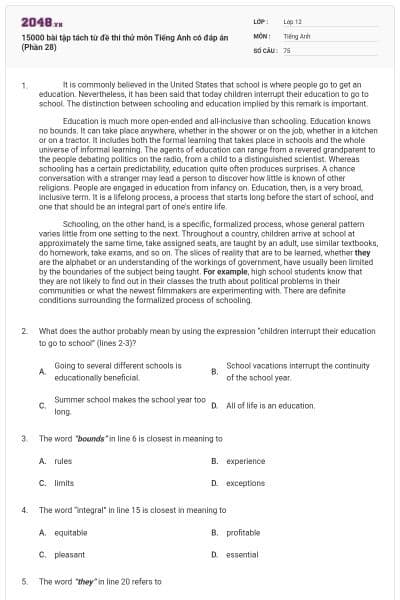
It is commonly believed in the United States that school is where people go to get an education. Nevertheless, it has been said that today children interrupt their education to go to school. The distinction between schooling and education implied by this remark is important.
Education is much more open-ended and all-inclusive than schooling. Education knows no bounds. It can take place anywhere, whether in the shower or on the job, whether in a kitchen or on a tractor. It includes both the formal learning that takes place in schools and the whole universe of informal learning. The agents of education can range from a revered grandparent to the people debating politics on the radio, from a child to a distinguished scientist. Whereas schooling has a certain predictability, education quite often produces surprises. A chance conversation with a stranger may lead a person to discover how little is known of other religions. People are engaged in education from infancy on. Education, then, is a very broad, inclusive term. It is a lifelong process, a process that starts long before the start of school, and one that should be an integral part of one's entire life.
Schooling, on the other hand, is a specific, formalized process, whose general pattern varies little from one setting to the next. Throughout a country, children arrive at school at approximately the same time, take assigned seats, are taught by an adult, use similar textbooks, do homework, take exams, and so on. The slices of reality that are to be learned, whether they are the alphabet or an understanding of the workings of government, have usually been limited by the boundaries of the subject being taught. For example, high school students know that they are not likely to find out in their classes the truth about political problems in their communities or what the newest filmmakers are experimenting with. There are definite conditions surrounding the formalized process of schooling.
What does the author probably mean by using the expression “children interrupt their education to go to school” (lines 2-3)?
Going to several different schools is educationally beneficial.
School vacations interrupt the continuity of the school year.
Summer school makes the school year too long.
All of life is an education.
Thông tin: Nevertheless, it has been said that today children interrupt their education to go to school … Education knows no bounds … It includes both the formal learning that takes place in schools and the whole universe of informal learning. Dịch nghĩa: Tuy nhiên, nó đã được nói rằng ngày nay trẻ em làm gián đoạn giáo dục của chúng để đi học ... Giáo dục không có giới hạn nào ... Nó bao gồm cả việc học tập chính thức diễn ra trong trường học và toàn thể vũ trụ của việc học phi chính thức. Như vậy câu “children interrupt their education to go to school” có hàm ý là tất cả các phương diện của cuộc sống đều là giáo dục, chứ không phải chỉ có học ở trường mới là học. Phương án D. All of life is an education = Tất cả cuộc sống là sự giáo dục; là phương án nêu chủ đề của bài đọc chính xác nhất. A. Going to several different schools is educationally beneficial = Đi học ở nhiều trường khác nhau là có lợi ích về mặt giáo dục. Không có thông tin như vậy trong bài. B. School vacations interrupt the continuity of the school year = Các kì nghỉ ở trường làm gián đoạn sự lien tục của năm học. Không có thông tin như vậy trong bài. C. Summer school makes the school year too long = Học hè khiến cho năm học quá dài. Không có thông tin như vậy trong bài. |
The word “bounds” in line 6 is closest in meaning to
rules
experience
limits
exceptions
Giải thích: Bounds (n) = giới hạn, phạm vi, hạn độ
Limits (n) = giới hạn
Dịch nghĩa: Education knows no bounds = Giáo dục không có giới hạn nào.
Như vậy phương án C. limits là phương án có nghĩa sát nhất.
A. rules (n) = quy tắc, luật lệ
B. experience (n) = kinh nghiệm
D. exceptions (n) = ngoại lệThe word “integral” in line 15 is closest in meaning to
equitable
profitable
pleasant
essential
Giải thích: Integral (adj) = liên đới, gắn bó mật thiết
Essential (adj) = quan trọng, cần thiết
Dịch nghĩa: It is a lifelong process, a process that starts long before the start of school, and one that should be an integral part of one's entire life = Nó là một quá trình suốt đời, một quá trình bắt đầu từ lâu trước khi bắt đầu đi học, và nó nên là một phần không thể thiếu trong toàn bộ cuộc sống của một người.
Như vậy phương án D. essential là phương án có nghĩa sát nhất.
A. equitable (adj) = công bằng
B. profitable (adj) = mang lại lợi nhuận, có thể sinh lời
C. pleasant (adj) = thoải mái, dễ chịuThe word “they” in line 20 refers to
slices of reality
similar textbooks
boundaries
seats
Thông tin: The slices of reality that are to be learned, whether they are the alphabet or an understanding of the workings of government, have usually been limited by the boundaries of the subject being taught.
Dịch nghĩa: Các lát cắt của thực tại mà là để được học, cho dù chúng là bảng chữ cái hoặc một sự hiểu biết về các hoạt động của chính phủ, đã thường được giới hạn bởi các ranh giới của đối tượng đang được giảng dạy.
Như vậy từ “they” là đại từ thay thế cho danh từ phía trước. Phương án A. slices of reality là phương án chính xác nhất.
B. similar textbooks = sách giáo khoa khác nhau
C. boundaries = ranh giới
D. seats = ghế, chỗ ngồiThe phrase “For example,” line 22, introduces a sentence that gives examples of
similar textbooks
the results of schooling
the workings of a government
the boundaries of classroom subjects
Thông tin: The slices of reality that are to be learned, whether they are the alphabet or an understanding of the workings of government, have usually been limited by the boundaries of the subject being taught. For example, high school students know that they are not likely to find out in their classes the truth about political problems in their communities or what the newest filmmakers are experimenting with. Dịch nghĩa: Các lát cắt của thực tại mà là để được học, cho dù chúng là bảng chữ cái hoặc một sự hiểu biết về các hoạt động của chính phủ, đã thường được giới hạn bởi các ranh giới của đối tượng đang được giảng dạy. Ví dụ, học sinh trung học biết rằng họ không có khả năng tìm ra trong các lớp học của họ sự thật về các vấn đề chính trị trong cộng đồng của họ hoặc những gì các nhà làm phim mới nhất đang thử nghiệm. Cụm từ “For example” là để nêu ví dụ cho ý được triển khai ngay trước nó. Ý của câu trước giải thích rằng những kiến thức thực tế thì thường bị hạn chế trong các môn học chính quy, hay chính là giới hạn của các các môn học. Phương án D. the boundaries of classroom subjects = giới hạn của các các môn học trên lớp; là phương án chính xác nhất. A. similar textbooks = sách giáo khoa khác nhau B. the results of schooling = các kết quả của việc đi học C. the workings of a government = các hoạt động của chính phủ |
The passage supports which of the following conclusions?
Without formal education, people would remain ignorant.
Education systems need to be radically reformed.
Going to school is only part of how people become educated.
Education involves many years of professional training.
Giải thích: Bài đọc nói về giáo dục trên hai khía cạnh: đi học ở trường và đi học ở trong cuộc sống. Do đó, có thể hiểu rằng việc học ở trường chỉ là một phần của giáo dục.
Phương án A. Going to school is only part of how people become educated = Đi học chỉ là một phần của cách mọi người được giáo dục, là phương án chính xác nhất.
B. Without formal education, people would remain ignorant = Không có giáo dục chính thức, người ta sẽ vẫn không biết gì.
C. Education systems need to be radically reformed = hệ thống giáo dục cần phải được cải cách triệt để
D. Education involves many years of professional training = Giáo dục liên quan đến nhiều năm đào tạo chuyên nghiệp.The passage is organized by
listing and discussing several educational problems
contrasting the meanings of two related words
narrating a story about excellent teachers
giving examples of different kinds of schools
Giải thích: Bài đọc sắp xếp ý bằng cách đưa ra sự khác nhau về ý nghĩa giữa hai khái niệm "education" và "schooling".
Phương án B. contrasting the meanings of two related words = tương phản ý nghĩa của hai từ có liên quan, là phương án chính xác nhất.
A. listing and discussing several educational problems = liệt kê và thảo luận về một số vấn đề giáo dục.
C. narrating a story about excellent teachers = kể lại một câu chuyện về các giáo viên xuất sắc.
D. giving examples of different kinds of schools = ví dụ về các loại trường học khác nhau.ReadthefollowingpassageandmarktheletterA,B,C,orDonyouranswersheettoindicatethe correctanswertoeachofthequestionsfrom44to50.
Life originated in the early seas less than a billion years after Earth was formed. Yet another three billion years were to pass before the first plants and animals appeared on the continents. Life's transition from the sea to the land was perhaps as much of an evolutionary challenge as was the genesis of life.
What forms of life were able to make such a drastic change in lifestyle? The traditional view of the first terrestrial organisms is based on mega fossils — relatively large specimens of essentially whole plants and animals. Vascular plants, related to modern seed plants and ferns, left the first comprehensive mega fossil record. Because of this, it has been commonly assumed that the sequence of terrestrialization reflected the evolution of modern terrestrial ecosystems. In this view, primitive vascular plants first colonized the margins of continental waters, followed by animals that fed on the plants, and lastly by animals that preyed on the plant-eaters. Moreover, the mega fossils suggest that terrestrial life appeared and diversified explosively near the boundary between the Silurian and the Devonian periods, a little more than 400 million years ago. Recently, however, paleontologists have been taking a closer look at the sediments below this Silurian-Devonian geological boundary. It turns out that some fossils can be extracted from these sediments by putting the rocks in an acid bath. The technique has uncovered new evidence from sediments that were deposited near the shores of the ancient oceans — plant microfossils and microscopic pieces of small animals. In many instances the specimens are less than one-tenth of a millimeter in diameter. Although they were entombed in the rocks for hundreds of millions of years, many of the fossils consist of the organic remains of the organism.
These newly discovered fossils have not only revealed the existence of previously unknown organisms, but have also pushed back these dates for the invasion of land by multicellular organisms. Our views about the nature of the early plant and animal communities are now being revised. And with those revisions come new speculations about the first terrestrial life-forms.
The word “drastic” in line 5 is closest in meaning to
widespread
radical
progressive
risky
Giải thích: Drastic (adj) = mạnh mẽ, quyết liệt
Radical (adj) = căn bản, triệt để
Dịch nghĩa: What forms of life were able to make such a drastic change in lifestyle? = Những hình thức của cuộc sống nào đã có thể tạo ra một sự thay đổi mạnh mẽ như vậy trong phong cách cuộc sống?
Như vậy phương án B. radical là phương án có nghĩa sát nhất.
A. widespread (adj) = lan rộng
C. progressive (adj) = tiến bộ
D. risky (adj) = rủi roAccording to the theory that the author calls “the traditional view,” what was the first form of life to appear on land?
Bacteria
Meat-eating animals
Plant-eating animals
Vascular plants
Thông tin: The traditional view of the first terrestrial organisms is based on mega fossils — relatively large specimens of essentially whole plants and animals. Vascular plants, related to modern seed plants and ferns, left the first comprehensive mega fossil record.
Dịch nghĩa: Quan niệm truyền thống về các sinh vật trên cạn đầu tiên được dựa trên những hóa thạch lớn - mẫu vật tương đối lớn về cơ bản toàn bộ cây và động vật. Thực vật có mạch, liên quan đến cây có hạt hiện đại và dương xỉ, để lại các mẫu hóa thạch khổng lồ toàn diện đầu tiên.
Như vậy có thể hiểu là thực vật có mạch là sinh vật trên cạn đầu tiên. Phương án D. Vascular plants = thực vật có mạch; là phương án chính xác nhất.
A. Bacteria = vi khuẩn.
B. Meat-eating animals = động vật ăn thịt.
C. Plant-eating animals = động vật ăn cỏ.According to the passage, what happened about 400 million years ago?
Many terrestrial life-forms died out.
New life-forms on land developed at a rapid rate.
The mega fossils were destroyed by floods.
Life began to develop in the ancient seas.
Thông tin: Moreover, the mega fossils suggest that terrestrial life appeared and diversified explosively near the boundary between the Silurian and the Devonian periods, a little more than 400 million years ago. Dịch nghĩa: Hơn nữa, các hóa thạch khổng lồ cho thấy rằng cuộc sống trên mặt đất xuất hiện và đa dạng hóa một cách bùng nổ gần ranh giới giữa các giai đoạn Silur và Devon, ít hơn 400 triệu năm trước. Như vậy phương án B. New life-forms on land developed at a rapid rate = Các hình thức sự sống mới trên mặt đất phát triển với một tốc độ nhanh chóng; là phương án chính xác nhất. A. Many terrestrial life-forms died out = Nhiều hình thái sự sống trên mặt đất chết đi. C. The mega fossils were destroyed by floods = Hóa thạch khổng lồ đã bị phá hủy bởi lũ lụt. D. Life began to develop in the ancient seas = Cuộc sống bắt đầu phát triển ở các vùng biển cổ đại. |
What can be inferred from the passage about the fossils mentioned in lines 17-20?
They have not been helpful in understanding the evolution of terrestrial life.
They were found in approximately the same numbers as vascular plant fossils.
They are older than the mega fossils.
They consist of modern life-forms.
Giải thích: The technique has uncovered new evidence from sediments that were deposited near the shores of the ancient oceans — plant microfossils and microscopic pieces of small animals … These newly discovered fossils have not only revealed the existence of previously unknown organisms, but have also pushed back these dates for the invasion of land by multicellular organisms. Dịch nghĩa: Kỹ thuật này đã phát hiện bằng chứng mới từ trầm tích được lắng đọng gần bờ biển của các đại dương cổ đại - vi cổ thực vật và các mảnh hiển vi của động vật nhỏ ... Những hóa thạch mới được phát hiện này không chỉ cho thấy sự tồn tại của những sinh vật chưa từng được biết, mà còn cũng đẩy lùi ngày tháng cho cuộc xâm chiếm đất đai của các sinh vật đa bào. Như vậy có thể suy ra rằng hóa thạch mới được phát hiện cổ đại hơn những hóa thạch khổng lồ nhiều. Phương án C. They are older than the mega fossils = Chúng lâu đời hơn các hóa thạch khổng lồ. A. They have not been helpful in understanding the evolution of terrestrial life = Chúng đã không hữu ích trong việc tìm hiểu sự tiến hóa của sự sống trên cạn. B. They were found in approximately the same numbers as vascular plant fossils = Chúng được tìm thấy trong số lượng xấp xỉ như hóa thạch thực vật có mạch. D. They consist of modern life-forms = Chúng bao gồm các hình thái sự sống hiện đại. |
The word “they” in line 22 refers to
rocks
shores
oceans
specimens
Thông tin: In many instances the specimens are less than one-tenth of a millimeter in diameter. Although they were entombed in the rocks for hundreds of millions of years, many of the fossils consist of the organic remains of the organism.
Dịch nghĩa: Trong nhiều trường hợp, các mẫu vật là ít hơn một phần mười của milimet đường kính. Mặc dù chúng đã được chôn vùi trong các hòn đá trong hàng trăm triệu năm, rất nhiều các hóa thạch bao gồm các bộ hài cốt hữu cơ của sinh vật.
Như vậy từ “they” là đại từ thay thế cho danh từ phía trước. Phương án D. specimens là phương án chính xác nhất.
A. rocks (n) = các hòn đá
The word “entombed” in lime 22 is closest in meaning to
crushed
trapped
produced
excavated
Giải thích: Entombed (v) = bị chôn vùi
Trapped (v) = mắc kẹt, nhốt
Dịch nghĩa: Although they were entombed in the rocks for hundreds of millions of years, many of the fossils consist of the organic remains of the organism. = Mặc dù chúng đã được chôn vùi trong các hòn đá trong hàng trăm triệu năm, rất nhiều các hóa thạch bao gồm các bộ hài cốt hữu cơ của sinh vật.
Như vậy phương án B. trapped là phương án có nghĩa sát nhất.
A. crushed (v) = bị nghiền nát
C. produced (v) = được sản xuất
D. excavated (v) = được khai quậtWhich of the following resulted from the discovery of microscopic fossils?
The time estimate for the first appearance of terrestrial life-forms was revised.
Old techniques for analyzing fossils were found to have new uses.
The origins of primitive sea life were explained.
Assumptions about the locations of ancient seas were changed.
Thông tin: These newly discovered fossils have not only revealed the existence of previously unknown organisms, but have also pushed back these dates for the invasion of land by multicellular organisms. Dịch nghĩa: Những hóa thạch mới được phát hiện này không chỉ cho thấy sự tồn tại của những sinh vật chưa từng được biết, mà còn cũng đẩy lùi ngày tháng cho cuộc xâm chiếm đất đai của các sinh vật đa bào. Phương án A. The time estimate for the first appearance of terrestrial life-forms was revised = Ước tính thời gian cho sự xuất hiện đầu tiên của các hình thái sự sống trên mặt đất đã được sửa đổi, là phương án chính xác nhất. B. Old techniques for analyzing fossils were found to have new uses = Các phương pháp phân tích hóa thạch cũ được tìm ra là có những ứng dụng mới. Không có thông tin như vậy trong bài. C. The origins of primitive sea life were explained = Nguồn gốc của cuộc sống biển nguyên thủy đã được giải thích. Không có thông tin như vậy trong bài. D. Assumptions about the locations of ancient seas were changed = Giả định về vị trí của vùng biển cổ đại đã được thay đổi. Không có thông tin như vậy trong bài. |
With which of the following conclusions would the author probably agree?
The evolution of terrestrial life was as complicated as the origin of life itself.
The discovery of microfossils supports the traditional view of how terrestrial life evolved.
New species have appeared at the same rate over the course of the last 400 million years.
The technology used by paleontologists is too primitive to make accurate determinations about ages of fossils
Thông tin: Life's transition from the sea to the land was perhaps as much of an evolutionary challenge as was the genesis of life. Dịch nghĩa: Quá trình chuyển đổi của cuộc sống từ biển vào đất có lẽ cũng là một thách thức tiến hóa như là nguồn gốc của sự sống. Phương án A. The evolution of terrestrial life was as complicated as the origin of life itself = Sự tiến hóa của sự sống trên cạn cũng phức tạp như nguồn gốc của sự sống, lợi nhuận; là phương án chính xác nhất. B. The discovery of microfossils supports the traditional view of how terrestrial life evolved = Việc phát hiện ra vi cổ ủng hộ quan điểm truyền thống của cuộc sống về việc cuộc sống trên mặt đất phát triển như thế nào. Việc phát hiện ra vi cổ không ủng hộ quan điểm truyền thống mà phản bác nó. C. New species have appeared at the same rate over the course of the last 400 million years = Nhiều loài mới đã xuất hiện ở tốc độ tương tự trong quá trình của 400 triệu năm trước. Không có thông tin như vậy trong bài. D. The technology used by paleontologists is too primitive to make accurate determinations about ages of fossils = Công nghệ được sử dụng bởi các nhà khảo cổ là quá thô sơ để đưa ra quyết định chính xác về tuổi của hóa thạch. Không có thông tin như vậy trong bài. |
Around the year 1500, hunting people occupied the entire northern third of North America. They lived well from the animals with which they shared these lands. Hunters of sea mammals had colonized the Arctic coasts of Canada and Greenland between four and five thousand years before. Land-hunting people had lived throughout much of the northern interior for at least 12,000 years.
Northern North America is part of a larger circumpolar ecological domain that continues across the narrow Bering Strait into Siberia and northern Europe. The overall circumpolar environment in the 1500's was not very different from the environment of the present. This vast landmass had a continental climate and was dominated by cold arctic air throughout a long winter and spring season. Summer temperature ranged from near freezing to the mid-20's Celsius, while winter temperature were often as low as 40 degrees below zero Celsius.
Geographers divide the overall circumpolar domain into two zones, the Arctic and, below it, the Subarctic. They refer to the landforms of these areas as tundra and taiga, respectively.
Temperatures in the northern lands were below freezing for eight or nine months of the year. Subsurface soil in the Arctic's tundra remained permanently frozen. Even when summer temperatures were above freezing and the top inches of earth became saturated with water, the soil below remained frozen into a permafrost, as hard as rock. When water flowed upon the surface of permanently frozen tundra, it made overland travel extremely difficult. Summer travel in the boggy lands, or muskeg country, of the Sub Arctic’s taiga was also slow and arduous. Tracking animals was more difficult than it was during the winter when the swampy ground was frozen solid and covered with snow. In both tundra and taiga, hordes of mosquitoes and biting flies bred in the standing pools of water. Clothing lost its thermal efficiency when it became damp. Northern people looked forward to the turn of the season to bring the easier traveling conditions associated with cold weather. In the Arctic, they could haul food and supplies by dogsled while in the Subarctic; people could travel quickly and efficiently by snowshoes and toboggan.
What does the passage mainly discuss?
The hunting people of North America
The circumpolar environment of the sixteenth century
Animals that inhabit the Arctic coast
The geography of Canada and Greenland
Giải thích: Đoạn đầu tiên của bài đọc giới thiệu về lịch sử con người đã sinh sống ở khu vực phía Bắc Trái Đất từ thế kỷ XVI. Từ đoạn 2 đến cuối bài đọc là những thông tin về môi trường khu vực quanh cực. Do đó, nội dung chính của bài đọc là môi trường quanh vùng vực ở thế kỷ XVI. Phương án B. The circumpolar environment of the sixteenth century = Môi trường quanh cực ở thế kỷ XVI. A. The hunting people of North America = Những người thợ săn ở Bắc Mỹ. Around the year 1500, hunting people occupied the entire northern third of North America = Khoảng năm 1500, những người thợ săn chiếm đóng toàn bộ một phần ba phía bắc của Bắc Mỹ. Đây chỉ là thông tin đưa ra đề dẫn dắt vào nội dung chính của bài. C. Animals that inhabit the Arctic coast = Động vật cư trú ở vùng bờ biển Bắc Cực. Không có thông tin như vậy trong bài. D. The geography of Canada and Greenland = Các điều kiện địa lý của Canada và Greenland. Bài đọc không chỉ đưa ra các điều kiện địa lý của Canada và Greenland mà là của toàn bộ khu vực quanh cực nói chung. |
The word “domain” in line 6 is closest in meaning to
temperature
period
region
process
Giải thích: Domain (n) = miền, lãnh địa, lãnh thổ Region (n) = khu vực, miền, vùng Dịch nghĩa: Northern North America is part of a larger circumpolar ecological domain that continues across the narrow Bering Strait into Siberia and northern Europe = Bắc Bắc Mỹ là một phần của một miền sinh thái quanh cực lớn hơn mà vẫn tiếp tục qua eo biển Bering hẹp vào Siberia và Bắc Âu. Như vậy phương án C. region là phương án có nghĩa sát nhất. A. temperature (n) = nhiệt độ B. period (n) = quãng thời gian, giai đoạn D. process (n) = quá trình, tiền trình |
Which of the following terms is used to describe the landforms of the
Arctic region?
Subarctic
Taiga
Tundra
Muskeg
Thông tin: Geographers divide the overall circumpolar domain into two zones, the Arctic and, below it, the Subarctic. They refer to the landforms of these areas as tundra and taiga, respectively.
Dịch nghĩa: Các nhà địa lý chia miền quanh cực tổng thể thành hai khu, Bắc Cực, và bên dưới nó, cận Bắc Cực. Họ đề cập đến các địa hình của các khu vực này là lãnh nguyên và rừng lá kim, một cách tương ứng.
Như vậy địa hình của khu vực Bắc Cực chính là lãnh nguyên. Phương án C. Tundra là phương án chính xác nhất.
A. Subarctic = cận Bắc Cực
B. Taiga = rừng lá kim
D. Muskeg = vũng lầy, bãi lầyFor how many months of the year were temperatures below freezing in the circumpolar region?
4-5 months
6 months
8-9 months
12 months
Thông tin: Temperatures in the northern lands were below freezing for eight or nine months of the year.
Dịch nghĩa: Nhiệt độ ở các vùng đất phía Bắc đã dưới nhiệt độ đóng bang trong tám hoặc chín tháng trong năm.
Phương án C. 8-9 months = 8-9 tháng là phương án chính xác nhất.
A. 4-5 months = 4-5 tháng
B. 6 months = 6 tháng
D. 12 months = 12 thángThe word “standing” in line 25 is closest in meaning to
not flowing
very deep
numerous
contaminated
Giải thích: Standing (adj) = đứng lại, lặng
Not Flowing (adj) = không chảy
Dịch nghĩa: In both tundra and taiga, hordes of mosquitoes and biting flies bred in the standing pools of water. = Trong cả hai vùng lãnh nguyên và rừng taiga, lũ muỗi và ruồi cắn sinh sản trong các vũng nước lặng.
B. very deep (adj) = rất sâu
C. numerous (adj) = nhiều
D. contaminated (adj) = bị nhiễm độc, bị ô nhiễmAll of the following are mentioned as having made travel in the summer difficult EXCEPT
insects
wet clothing
swampy lands
lack of supplies
Giải thích: Chỉ có phương án D. lack of supplies = thiếu nguồn cung cấp là phương án không được nhắc đến như là một khó khăn khi di chuyển trong mùa hè, còn các phương án khác đều có thông tin trong bài.
A. insects = côn trùng
In both tundra and taiga, hordes of mosquitoes and biting flies bred in the standing pools of water. = Trong cả hai vùng lãnh nguyên và rừng taiga, lũ muỗi và ruồi cắn sinh sản trong các vũng nước lặng.
B. wet clothing = quần áo ướt
Clothing lost its thermal efficiency when it became damp. = Quần áo bị mất hiệu suất giữ nhiệt của nó khi nó trở nên ẩm ướt.
C. swampy lands = vùng đất đầm lầy
Tracking animals was more difficult than it was during the winter when the swampy ground was frozen solid and covered with snow. = Theo dõi động vật là khó khăn hơn là khi trong mùa đông khi mặt đất đầm lầy đã bị đóng băng vững chắc và bao phủ bởi tuyết.The subsurface soil in the Arctic's tundra is most comparable to which of the following?
Cement
A bog
A pond
Sand
Thông tin: Subsurface soil in the Arctic's tundra remained permanently frozen.
Dịch nghĩa: Đất dưới bề mặt trong vùng lãnh nguyên Bắc Cực vẫn đóng băng vĩnh viễn.
Như vây nghĩa là vùng đất dưới bề mặt cực kỳ rắn chắc, có thể được so sánh với xi măng. Phương án A. Cement là phương án chính xác nhất.
B. A bog (n) = một cái cầu tiêu.
C. A pond (n) = một cái ao.
D. Sand (n) = cát.Social parasitism involves one species relying on another to raise its young. Among vertebrates, the best known social parasites are such birds as cuckoos and cowbirds; the female lays egg in a nest belonging to another species and leaves it for the host to rear.
The dulotic species of ants, however, are the supreme social parasites. Consider, for example, the unusual behavior of ants belonging to the genus Polyergus. All species of this ant have lost the ability to care for themselves. The workers do not forage for food, feed their brood or queen, or even clean their own nest. To compensate for these deficits, Polyergus has become specialized at obtaining workers from the related genus Formica to do these chores.
In a raid, several thousand Polyergus workers will travel up to 500 feet in search of a Formica nest, penetrate it, drive off the queen and her workers, capture the pupal brood, and transport it back to their nest. The captured brood is then reared by the resident Formica workers until the developing pupae emerge to add to the Formica population, which maintains the mixed-species nest. The Formica workers forage for food and give it to colony members of both species. They also remove wastes and excavate new chambers as the population increases.
The true extent of the Polyergus ants' dependence on the Formica becomes apparent when the worker population grows too large for existing nest. Formica scouts locate a new nesting site, return to the mixed-species colony, and recruit additional Formica nest mates. During a period that may last seven days, the Formica workers carry to the new nest all the Polyergus eggs, larvae, and pupae, every Polyergus adult, and even the Polyergus queen.
Of the approximately 8,000 species of ants in the world, all 5 species of Polyergus and some 200 species in other genera have evolved some degree of parasitic relationship with other ants.
Which of the following statements best represents the main idea of the passage?
Ants belonging to the genus Formica are incapable of performing certain tasks.
The genus Polyergus is quite similar to the genus Formica.
Ants belonging to the genus Polyergus have an unusual relationship with ants belonging to the genus Formica.
Poltergus ants frequently leave their nests to build new colonies.
Giải thích: Đoạn đầu của bài đọc nói về các mối quan hệ cộng sinh trong thế giới tự nhiên để dẫn dắt vào loài kiến cộng sinh. Sau đó tác giả làm rõ hơn về loài kiến thuộc chi Polyergus cộng sinh với loài kiến thuộc chi Formica. Như vậy phương án C. Ants belonging to the genus Polyergus have an unusual relationship with ants belonging to the genus Formica. = Kiến thuộc chi Polyergus có một mối quan hệ không bình thường với kiến thuộc chi Formica; là phương án có nghĩa sát nhất. A. Ants belonging to the genus Formica are incapable of performing certain tasks = Kiến thuộc chi Formica không có khả năng thực hiện một số nhiệm vụ nhất định. Kiến thuộc chi Polyergus chứ không phải chi Formica mới không có khả năng thực hiện một số nhiệm vụ nhất định. B. The genus Polyergus is quite similar to the genus Formica. = Các chi Polyergus là khá giống với các chi Formica. Không có thông tin như vậy trong bài. D. Poltergus ants frequently leave their nests to build new colonies = Loài kiến Poltergus thường xuyên rời khỏi tổ của chúng để xây dựng thuộc địa mới. Không có thông tin như vậy trong bài. |
The word “raise” in line 1 is closest in meaning to
rear
lift
collect
increase
Giải thích: Raise (v) = nuôi dưỡng, nuôi lớn
Rear (v) = nuôi nấng
Dịch nghĩa: Social parasitism involves one species relying on another to raise its young = Sự ký sinh xã hội liên quan đến một loài dựa vào loài khác để nuôi con của nó.
B. lift (v) = nâng lên / tăng lên / cất cánh / ngẩng đầu
C. collect (v) = thu thập, sưu tầm
D. increase (v) = tăng lênThe author mentions cuckoos and cowbirds in line 2 because they
share their nests with each other
are closely related species
raise the young of their birds
are social parasites
Thông tin: Among vertebrates, the best known social parasites are such birds as cuckoos and cowbirds; the female lays egg in a nest belonging to another species and leaves it for the host to rear.
Dịch nghĩa: Trong số các loài có xương sống, ký sinh trùng xã hội nổi tiếng nhất là các loài chim như chim cu cu và năng chìa vôi con; con cái đẻ trứng trong tổ thuộc một loài khác và để lại nó cho các chủ tổ để nuôi dưỡng.
Như vậy chim cu cu và năng chìa vôi con được nhắc đến như là một ví dụ điển hình cho các loài kí sinh. Phương án D. are social parasites = là ký sinh trùng xã hội; là phương án chính xác nhất.
A. share their nests with each other = chia sẻ tổ của chúng với nhau.
B. are closely related species = là các loài có liên quan chặt chẽ.
C. raise the young of their birds = nuôi con của các loài chim của chúng.What does the author mean by stating that “The dulotic species of
ants...are the supreme social parasites” (line5) ?
The Polyergus are more highly developed than the Formica.
The Formica have developed specialized roles.
The Polyergus are heavily dependent on the Formica.
The Formica do not reproduce rapidly enough to care for themselves.
Giải thích: The dulotic species of ants, however, are the supreme social parasites … To compensate for these deficits, Polyergus has become specialized at obtaining workers from the related genus Formica to do these chores. Dịch nghĩa: Các loài kiến, tuy nhiên, là những ký sinh trùng xã hội tối cao ... Để bù đắp cho những thiếu hụt, Polyergus đã trở nên chuyên về lấy những công nhân từ chi liên quan Formica để làm những công việc nhà. Như vậy có thể suy ra rằng tác giả nói kiến là loài kí sinh tối cao vì loài Polyergus phụ thuộc năng nề vào loài Formica. Phương án C. The Polyergus are heavily dependent on the Formica = Polyergus phụ thuộc rất nhiều vào Formica; là phương án chính xác nhất. A. The Polyergus are more highly developed than the Formica = Chi Polyergus đang phát triển cao hơn chi Formica. B. The Formica have developed specialized roles = Chi Formica đã phát triển những vai trò đặc biệt. D. The Formica do not reproduce rapidly enough to care for themselves = Chi Formica không sinh sản nhanh chóng đủ để chăm sóc bản thân. |
Which of the following is a task that an ant of the genus Polyergus might
do?
Look for food.
Raid another nest.
Care for the young.
Clean its own nest.
Thông tin: In a raid, several thousand Polyergus workers will travel up to 500 feet in search of a Formica nest, penetrate it, drive off the queen and her workers, capture the pupal brood, and transport it back to their nest.
Dịch nghĩa: Trong một cuộc đột kích, hàng ngàn kiến thợ Polyergus sẽ di chuyển lên đến 500 feet để tìm kiếm một tổ Formica, thâm nhập nó, bắt hoàng hậu và công nhân của cô, bắt nhộng, và vận chuyển nó trở lại tổ của chúng.
Như vậy phương án B. Raid another nest = đột kích một tổ kiến khác là phương án chính xác nhất.
A. Look for food = tìm thức ăn
C. Care for the young = chăm sóc con trẻ
D. Clean its own nest = làm sạch tổ của chúngThe word “recruit” in line 20 is closest in meaning to
create
enlist
endure
capture
Giải thích: Recruit (v) = tuyển dụng, chiêu mộ
Enlist (v) = chieu mộ, đầu quân
Dịch nghĩa: Formica scouts locate a new nesting site, return to the mixed-species colony, and recruit additional Formica nest mates. = Kiến do thám Formica xác định vị trí làm tổ mới, trở về lãnh địa của hỗn hợp các loài, và tuyển dụng thêm bạn cùng tổ Formica.
A. create (v) = sáng tạo
C. endure (v) = chịu đựng, kiên nhẫn
D. capture (v) = bắt, chiếmWhat happens when a mixed colony of Polyergus and Formica ants
becomes too large?
The Polyergus workers enlarge the existing nest.
The captured Formica workers return to their original nest.
The Polyergus and the Formica build separate nests.
The Polyergus and the Formica move to a new nest.
Thông tin: The true extent of the Polyergus ants' dependence on the Formica becomes apparent when the worker population grows too large for existing nest. Formica scouts locate a new nesting site, return to the mixed-species colony, and recruit additional Formica nest mates. During a period that may last seven days, the Formica workers carry to the new nest all the Polyergus eggs, larvae, and pupae, every Polyergus adult, and even the Polyergus queen. Dịch nghĩa: Mức độ thực sự của sự phụ thuộc của kiến Polyergus đối với kiến Formica trở nên rõ ràng khi dân số lao động trở nên quá lớn cho tổ hiện có. Kiến do thám Formica xác định vị trí làm tổ mới, trở về lãnh địa của hỗn hợp các loài, và tuyển dụng thêm bạn cùng tổ Formica. Trong thời gian có thể kéo dài bảy ngày, các công nhân Formica mang về tổ mới tất cả các trứng của Polyergus, ấu trùng và nhộng, mỗi kiến trưởng thành Polyergus, và thậm chí cả nữ hoàng Polyergus. Phương án D. The Polyergus and the Formica move to a new nest = Kiến Polyergus và Formica di chuyển đến một tổ mới, là phương án chính xác nhất. A. The Polyergus workers enlarge the existing nest = Kiến thợ Polyergus nới rộng tổ hiện có. Không có thông tin như vậy trong bài. B. The captured Formica workers return to their original nest = Những kiến thợ Formica bị bắt trở về tổ ban đầu của chúng. Không có thông tin như vậy trong bài. C. The Polyergus and the Formica build separate nests = Polyergus và Formica làm tổ riêng. Không có thông tin như vậy trong bài. |
According to the information in the passage, all of the following terms
refer to ants belonging to the genus Formica EXCEPT the
dulotic species of ants (line 5)
captured brood (line 13)
developing pupae (line 14)
worker population (line 19)
Thông tin: The dulotic species of ants, however, are the supreme social parasites. Consider, for example, the unusual behavior of ants belonging to the genus Polyergus = Các loài kiến xâm lược, tuy nhiên, là những ký sinh trùng xã hội cao. Xem xét, ví dụ, hành vi bất thường của loài kiến thuộc chi Polyergus. Như vậy thuật ngữ “dulotic species of ants” là chỉ loài Polyergus chứ không phải loài Formica. B. captured brood = con nhộng bị bắt. In a raid, several thousand Polyergus workers will travel up to 500 feet in search of a Formica nest, penetrate it, drive off the queen and her workers, capture the pupal brood, and transport it back to their nest. The captured brood is then reared by the resident Formica workers … = Trong một cuộc đột kích, hàng ngàn kiến thợ Polyergus sẽ di chuyển lên đến 500 feet để tìm kiếm một tổ Formica, thâm nhập nó, bắt hoàng hậu và công nhân của cô, bắt nhộng, và vận chuyển nó trở lại tổ của chúng. Những con nhộng bị bắt sẽ được nuôi dưỡng bởi cư dân kiến thợ Formica … C. developing pupae = những con nhộng đang phát triển. The captured brood is then reared by the resident Formica workers until the developing pupae emerge to add to the Formica population, which maintains the mixed-species nest. = Những con nhộng bị bắt sẽ được nuôi dưỡng bởi cư dân kiến thợ Formica cho đến khi nhộng đang phát triển trưởng thành để thêm vào dân số Formica, trong đó duy trì tổ hỗn hợp các loài. D. worker population = dân số kiến thợ The true extent of the Polyergus ants' dependence on the Formica becomes apparent when the worker population grows too large for existing nest = Mức độ thực sự của sự phụ thuộc của kiến Polyergus đối với kiến Formica trở nên rõ ràng khi dân số lao động trở nên quá lớn cho tổ hiện có. |
Archimedes’s Principle is a law of physics that states that when an object is totally or partially immersed in a fluid, it experiences an upthrust equal to the weight of the fluid displaced. The principle is most frequently applied to the behaviour of objects in water, and helps to explain floating and sinking, and why objects seem lighter in water. It also applies to balloons.
The key word in the principle is “upthrust”, which refers to the force acting upward to reduce the apparent weight of the object when it is under water. If, for example, a metal block with a volume of 100 cm3 is dipped in water, it displaces an equal volume of water, which has a weight of approximately 1 N (3.5 oz). The block therefore seems to weigh about 1 N less.
An object will float if its average density is less than that of water. If it is totally submerged, the weight of the water it displaces (and hence the upthrust on it) is greater than its own weight, and it is forced upward and out of water, until the weight if water displaced by submerged part is exactly equal to the weight of the floating object. Thus a block of wood with a density six tenthsthat of water will float with six tenths of its volume under water, since at that point the weight of fluid displaced is the same as the blocks’s own weight. If a dense material is made into a suitable shape, it will float because of Archimedes’s principle. A ship floats, whereas a block of iron of the same mass sinks.
It is also because of Archimedes’s principle that ships float lower in the water when they are heavily loaded (more water must be displaced to give the necessary upthrust). In addition, they cannot be so heavily loaded if they are to sail in fresh water as they can if they are to sail in the sea, since fresh water is less dense than sea water, and so more water must be displaced to give the necessary upthrust. This means the ship is lower in the water, which can be dangerous in rough weather.
From “Archimedes’s Principle”, MicrosoftÒ Student 2008[DVD]. Microsoft Corporation, 2007.
What happens when something is immersed in a fluid?
It will be pushed further down with a force, equal to the weight of the fluid displaced.
It receives an upward force, equal to the weight of the fluid displaced.
It receives a download force, equal to the weight of the fluid displaced.
The fluid will expand the object and overflow to the floor.
It receives an upward force, equal to the weight of the fluid displaced: “Nó nhận một lực đẩy lên tương đương với trọng lượng của chất lỏng bị chiếm chỗ”.
Câu này thích hợp với câu hỏi: “Điều gì xảy ra khi một vật nào đó nổi lên trong một chất lỏng?”
Chúng ta có thể tìm thấy ý này trong câu đầu của đoạn một: “Archimedes’s Principle is a law of physics that states that when an object is totally or partially immersed in a fluid, it experiences an upthrust equal to the weight of the fluid displaced.”The word “volume” in the passage refers to ______.
loudness
quantity
frequency
quantity
B. quantity: từ “quantity” có nghĩa là “số lượng”.
Cụm từ “a volume of water” trong đoạn hai có nghĩa là “một lượng nước”.
Câu A “loudness” có nghĩa là “độ lớn của âm thanh”.
Câu C “frequency” có nghĩa là “tần suất”.
Câu D “length” có nghĩa là “độ dài”.The word “displaces” in the passage almost means “_____”.
takes the place of
takes place
replaces with a new one
puts in position
A. takes the place of: động từ “displaces” trong đoạn ba có nghĩa là “chiếm chỗ của”.
Còn các đáp
Câu B “takes places” có nghĩa là “xảy ra”.
Câu C “replaces with a new one = thay thế bằng một cái mới”, không đúng với ý nghĩa trong câu.
Câu D “puts in position” có nghĩa là “đặt vào vị trí”.A block of wood with a density seven tenths that of water will _____.
go up and down the sink
float with a half of its volume under water
float with an equal volume of its volume under water
sink immediately when submerged
C. float with an equal volume of its volume under water
Ý nghĩa của cả câu: “Một khối gỗ có tỉ trọng bảy phần mười tỉ trọng của nước sẽ nổi lên với một thể tích tương đương với thể tích chìm của nước”.
Chúng ta có thể tìm thấy ý này trong câu ba của đoạn 3: “Thus a block of wood with a density six tenths that of water will float with six tenths of its volume under water, since at that point the weight of fluid displaces is the same as the block’s own weight”.A ship floats, whereas a block of iron of the same mass sinks because the ship _____.
is made of wood
is lighter
has buoys
has a special shape
D. has a special shape: ý nghĩa cả câu này: “Một chiếc tàu nổi bềnh bồng trong khi một khối sắt có trọng lượng giống như thế thì chìm bởi vì chiếc tàu có hình dáng đặc biệt”.
Chúng ta có thể tìm thấy ý này trong hai câu cuối của đoạn 3: “If a dense material is made into a suitable shape, it will float because of Archimedes’ principle. A ship floats, whereas a block of iron of the same mass sinks”.The word “upthrust” in the passage refers to the _____.
upward push
upper side of an object
upturned force
upside-down turn
A. upward push: từ “upthrust” trong đoạn bốn đề cập đến “lực đẩy từ dưới lên = upward push”.
Còn các đáp án khác
Câu B “upperside of an object”: phía bên trên của một vật.
Câu C “upward force”: lực làm lật tàu, thuyền.
Câu D “upside-down turn”: việc lật lại từ trên xuống dưới.Ships cannot be so heavily loaded if they want to sail in fresh water as they sail in the sea, because _____.
fresh water is ‘lighter’ than sea water
there’s too much salt in sea water
sea water is ‘saltier’ than fresh water
fresh water is more polluted
A. fresh water is ‘lighter’ than sea water: ý nghĩa của cả câu này là “Tàu thuyền không thể được chất nặng khi chúng đi trên sông như khi chúng đi trên biển, bởi vì nước sông thì nhẹ hơn nước biển”.
Chúng ta có thể tìm thấy ý này trong câu hai của đoạn bốn: “In addition, they cannot be so heavily loaded….to give the necesssary upthrust”Archimedes’ Principle explains why _____.
all objects will float
Archimedes became famous
objects seem lighter in water
humans can swim
C. objects seem lighter in water: Định lí Archimedes giải thích tại sao: các vật thể có thể nhẹ hơn nước.
Chúng ta có thể tìm thấy ý này trong câu hai của đoạn một : “The principle is most frequently applied….and why objects seem lighter in water”.In the West, cartoons are used chiefly to make people laugh. The important feature of all these cartoons is the joke and the element of surprise which is contained. Even though it is very funny, a good cartoon is always based on close observation of a particular feature of life and usually has a serious purpose.
Cartoons in the West have been associated with political and social matters for many years. In wartime, for example, they proved to be an excellent way of spreading propaganda. Nowadays cartoons are often used to make short, sharp comments on politics and governments as well as on a variety of social matters. In this way, the modern cartoon has become a very powerful force in influencing people in Europe and the United States.
Unlike most American and European cartoons, however, many Chinese cartoon drawings in the past have also attempted to educate people, especially those who could not read and write. Such cartoons about the lives and sayings of great men in China have proved extremely useful in bringing education to illiterate and semi-literate people throughout China. Confucius, Mencius and Laozi have all appeared in very interesting stories presented in the form of cartoons. The cartoons themselves have thus served to illustrate the teachings of the Chinese sages in a very attractive way.
In this sense, many Chinese cartoons are different from Western cartoons in so far as they do not depend chiefly on telling jokes. Often, there is nothing to laugh at when you see Chines cartoons. This is not their primary aim. In addition to commenting on serious political and social matters, Chinese cartoons have aimed at spreading the traditional Chinese thoughts and culture as widely as possible among the people.
Today, howerver, Chinese cartoons have an added part to play in spreading knowledge. They offer a very attractive and useful way of reaching people throughout the world, regardless of the particular country in which they live. Thus, through cartoons, the thoughts and teachings of the old Chinese philosophers and sages can now reach people who live in such countries as Britain, France, America, Japan, Malaysia or Australia and who are unfamiliar with the Chinese culture.
Until recently, the transfer of knowledge and culture has been overwhelmingly from the West to the East and not vice versa. By means of cartoons, however, publishing companies in Taiwan, Hong Kong and Singapore are now having success in correcting this imbalance between the East and the West.
Cartoons can overcome language barriers in all foreign countries. The vast increase in the popularity of these cartoons serves to illustrate the truth of Confucius’s famous saying “One picture is worth a thousand words.”
Which of the following clearly characterizes Western cartoons?
Originality, freshness, and astonishment.
Humour, unexpectedness, and criticism.
Enjoyment, liveliness, and carefulness.
Seriousness, propagande, and attractiveness.
B. “Humour, unexpectedness, and criticism”: đặc tính phim hoạt hình của phương Tây là “hài hước, bất ngờ và phê phán”. Chúng ta có thể thấy chi tiết này trong đoạn 1, câu: “The important feature …. serious purpose”, và trong đoạn 2, câu: “Nowadays cartoons are often …. of social matters”. |
Chinese cartoons have been useful as an important means of________.
educating ordinary people
spreading Western ideas
political propaganda in wartime
amusing people all the time
A. “educating ordinary people”: phim hoạt hình Trung Quốc thì có tác dụng như một phương tiện “giáo dục giới tính bình dân”.
Chúng ta thấy chi tiết này trong đoạn 3, câu: “Unlike most Ảmerican ….. who could not read and write”.The major differences between Chinese cartoons and Western cartoons come from their________.
purposes
nationalities
values
styles
A. purposes: sự khác biệt chủ yếu của phim hoạt hình Trung Quốc và phim hoạt hình phương Tây là ở “mục đích” làm phim.
Chúng ta thấy chi tiết này khi đọc ý chính của đoạn 4 nói về mục đích làm phim hoạt hình của Trung Quốc và ý của đoạn 1 và 2 nói về mục đích phim hoạt hình của phương Tây.The passage is intended to present________.
a contrast between Western cartoons and Chinese cartoons
an opinion about how cartoons entertain people
a description of cartoons of all kinds the world over
an outline of Western cartoons and Chinese cartoons
Which of the following could be the best title for the passage?
A Very Powerful Force in Influencing People
Cartoons as a Way of Educating People
Chinese Cartoons and Western Cartoons
An Excellent Way of Spreading Propaganda
In general, Chinese cartoons are now aiming at________.
illustrating the truth of Chinese great men’s famous sayings
bringing education to illiterate and semi-literate people in the world
spreading the Chinese ideas and cultural values throughout the world
disseminating traditional practices in China and throughout the world
C. spreading the Chinese ideas and cultural values throughout the world: nhìn chung phim hoạt hình Trung Quốc ngày nay nhắm đến việc “phổ biến tư tưởng và giá trị Trung Quốc ra khắp thế giới”.
Chúng ta tìm thấy chi tiết này trong đoạn 5, câu: “Today, however, Chinese cartoons ….in spreading knowledge”. Và câu: “Thus, through cartoons, the thoughts and teachings….the Chinese culture”.The word “imbalance” in paragraph 6 refers to________.
The mismatch between the East cartoons and the West cartoons
the influence of the East cartoons over the West cartoons
the dominant cultural influence of the West over the East
the discrimination between the West culture and the East culture
C. the dominant culture influence of the West over the East: từ “imbalance” trong đoạn 6 nói đến “ảnh hưởng văn hóa thống trị của phương Tây đối với phương Đông”.
Nghĩa đen của từ “imbalance” là “sự mất cân đối”. Chúng ta thấy chi tiết này trong câu: “Until recently,….and not vice versa”.
There has been an outbreak of avian influenza, better known as bird flu in Asia recently. The first (31) _____ died two weeks ago in Vietnam and there have been the cases reported since in Thailand, and there are some suspected cases in Cambodia as well as.
Wild birds are affected by a large number of flu viruses, just as the humans and other animals are, but they are normally exclusive to birds. If the viruses manage to mutate, they can to jump the species barrier and infect human beings. The first case (32) _____ someone died was in Hong Kong in 1997.
There are the several different forms of bird flu, ranging from mild to very (33) _____ infections, which spreading rapidly and kill many of the birds they infect. It is spread by wild birds-ducks, in particular – which carry the virus, but aren't killed by it. They can spread the virus to farm birds through (34) _____ contact or by the contaminating water supplies.
World Health Organization officials have attributed the spread of bird flu to human contact with the
droppings of infected birds and (35) _____ sanitation. There was no evidence at first that the virus spread from person to person, though there has been a case of this happening being investigated by scientists.
The first (31) _____ died two weeks ago in Vietnam and there have been the cases reported since in Thailand, and there are some suspected cases in Cambodia as well as.
victim
casualty
sufferer
infector
Đáp án A
victim
Victim (n): nạn nhân, casualty (n): tai nạn, sufferer (n): người bị thiệt hại, infector (n): tác nhân gây nhiễm
Đáp án A phù hợp với nghĩa của câu
Tạm dịch : Nạn nhân đầu tiên đã chết cách đây 2 tuần ở Việt Nam
The first case (32) _____ someone died was in Hong Kong in 1997.
where
when
which
why
Đáp án A
where
Vế sau có “in Hong Kong” chỉ địa điểm nên đại từ quan hệ được dùng là where (nơi mà)
Tạm dịch: Trường hợp đầu tiên nơi mà ai đó đã tử vong là ở Hồng Kông vào năm 1997.
strict
severe
serious
heavy
Đáp án C
serious
Đáp án C – serious (nghiệm trọng) phù hợp với nghĩa của câu: “Có rất nhiều loại bệnh cúm khác nhau, từ những loại lây nhiễm nhẹ cho đến những loại lây nhiễm nghiêm trọng”. Các phương án khác là strict (nghiêm khắc), severe (khốc liệt), heavy (nặng, thường dùng để nói về khối lượng).
They can spread the virus to farm birds through (34) _____ contact or by the contaminating water supplies.
direct
straight
immediate
square
Đáp án A
direct
Đáp án A phù hợp với nghĩa của câu : (direct contact: tiếp xúc trực tiếp): "Chúng có thể lây lan virus đến các loài gia cầm trhoong qua tiếp xúc trực tiếp hoặc qua nguồn nước bị nhiễm virus". Các phương án khác là straight (thẳng), immediate (ngay lập tức), square (thẳng thắn)
World Health Organization officials have attributed the spread of bird flu to human contact with the
droppings of infected birds and (35) _____ sanitationawful
bad
terrible
poor
Đáp án D
poor
Collocation: poor sanitation: vệ sinh kém
Tạm dịch: “Tổ chức Y Tế Thế Giới cho rằng việc lây lan của bệnh cúm là do tiếp xúc của con người với các chất thải của các con chim bị bệnh và do vệ sinh kém
The heart has long been considered to be (31)………….feelings of love dwell. In love songs throughout the ages, love almost always goes together (32)…….the heart. The heart has continuously been viewed as the place where love begins and develops. Even the Bible gives preference to love and the heart.
The role of the heart in love must come from what happens to it when a person feels strongly (33)…….. to someone. The strong feelings (34)………the other person, especially in the early stages of a relationship, have the results that the heart starts beating faster and breathing starts speeding up.
According to psychologists, a love relationship is a situation that (35)………a lot of stress and the body reacts to this by getting ready to face the unknown. This has been called the "fight or flight" reaction, meeting danger by fighting it or running away. So with love, the heart accelerates and breathing becomes quick.
what
when
where
that
Đáp án C
dwell: cư ngụ, tồn tại. Chọn C vì ở đây muốn nói đến vị trí: nơi mà những xúc cảm tình yêu nảy nở
with
to
at
from
Đáp án A
Cụm từ: go together with something/somebody: đi kèm với
attracted
attractive
attract
attracting
Đáp án A
Sau động từ liên kết feel thì chúng ta phải dùng một tính từ. To be attracted to something: bị thu hút, quyến rũ bới cái gì
The strong feelings (34)………the other person, especially in the early stages of a relationship, have the results that the heart starts beating faster and breathing starts speeding up.
of
to
with
for
Đáp án D
feeling for somebody: những xúc cảm dành cho một ai đó
includes
involves
comprises
arouses
Đáp án B
Involve: lien quan
Include: bao gồm
Comprise: bao gồm
Arouse: đánh thức, khơi gợi
Dịch bài
Tiền lãi là phí phải trả cho 1 khoản tiền vay trong 1 khoảng thời gian xác định. Gốc là số tiền vay, còn lãi suất là tỷ lệ người vay phải trả trong mỗi năm cho việc sử dụng số tiền gốc. Hầu hết lợi nhuận của ngân hàng là từ số tiền lãi họ nhận được khi cho người khác vay chính tiền của mình hoặc của các khách hàng gửi tiền.
Công thức để tính tiền lãi là:
Số tiền lãi = Số tiền gốc x Lãi suất cho vay x Thời gian vay
Có thể tìm ra 1 đại lượng bất kì nếu biết 3 đại lượng còn lại. Thời gian vay được tính bằng năm. Lãi suất cho vay được thể hiện bằng số thập phân.
Do đó, nếu thấy tỉ lệ lãi suất là 6%, nghĩa là với 1$ tiền gốc, người vay phải trả 6 cents tiền lãi trong 1 năm. Dù thời gian vay có thể ngắn hăn, bằng hoặc dài hơn 1 năm, đa số các đơn xin vay đều có thời gian ngắn hơn 1 năm. Với khoản vay ngắn hạn, 1 năm sẽ được tính là 360 ngày, nhưng nếu khoản vay lớn, 1 năm sẽ được tính chính xác là 365 ngày.
The heart has long been considered to be (31)___feelings of love dwell. In love songs throughout the ages, love almost always goes together (32)___the heart. The heart has continuously been viewed as the place where love begins and develops. Even the Bible gives preference to love and the heart.
The role of the heart in love must come from what happens to it when a person feels strongly (33) ___ to someone. The strong feelings (34)___the other person, especially in the early stages of a relationship, have the results that the heart starts beating faster and breathing starts speeding (35)
what
when
where
that
Đáp án C
dwell: cư ngụ, tồn tại. Chọn C vì ở đây muốn nói đến vị trí: nơi mà những xúc cảm tình yêu nảy nở
with
to
at
from
Đáp án A
Cụm từ: go together with something/somebody: đi kèm với
attracted
attractive
attract
attraction
Đáp án A
Sau động từ liên kết feel thì chúng ta phải dùng một tính từ. To be attracted to something: bị thu hút, quyến rũ bới cái gì
of
to
with
for
Đáp án D
feeling for somebody: những xúc cảm dành cho một ai đó
have the results that the heart starts beating faster and breathing starts speeding (35)
on
up
upon
forward
Đáp án B
speed up: tăng tốc
How men first learnt to (1) ........ words is unknown; in other words, the origin of language is a mystery. All we really know is that men, unlike animals, (2) ............ invented certain sounds to express thoughts and feelings, actions and things so that they could communicate with each other; and that later they agreed (3) ........... certain signs, called letters, which could be combined to represent those sounds, and which could be written down. These sounds, (4) .......... spoken or written in letters, are called words. Great writers are those who not only have great thoughts but also express these thoughts in words that a peal powerfully to our minds and emotions. This charming and telling use of words is what we call literary (5) ........... Above all, the real poet is a master of words.
invent
create
make
discover
Đáp án A
Invent: khi nói tới vật gì đó mà do con người tạo ra. Ví dụ: Điện thoại, ô tô, xe máy vv…
Discover khi nói tới gì đó mà nó đã tồn tại ngoài ý muốn của con người, tìm ra cái gì đó nó bị ẩn đi mà con người chưa biết.
Ví dụ: một hành tinh, hòn đảo, một
Make= Tạo ra sản phẩm nhờ vào việc lắp ghép các bộ phận, phần, vật liệu đã có.
Create tạo ra cái gì mang tính sáng tạo như tư tưởng, tác phẩm
somehow
however
somewhat
whatever
Đáp án A
Somehow: bằng cách nào đó
Somewhat: ở một mức độ nào đó
at
upon
with
to
Đáp án B
Agree with sb on/upon st: thống nhất với ai về việc gì
if
however
whether
though
Đáp án C
whether…or: hoặc là…hoặc là
prose
work
form
style
Đáp án D
literacy style: phong cách văn chương
prose: văn xuôi
work: tác phẩm
form: hình thức
Bạn có thích hoạt động này không?