15000 bài tập tách từ đề thi thử môn Tiếng Anh có đáp án (Phần 27)
75 câu hỏi
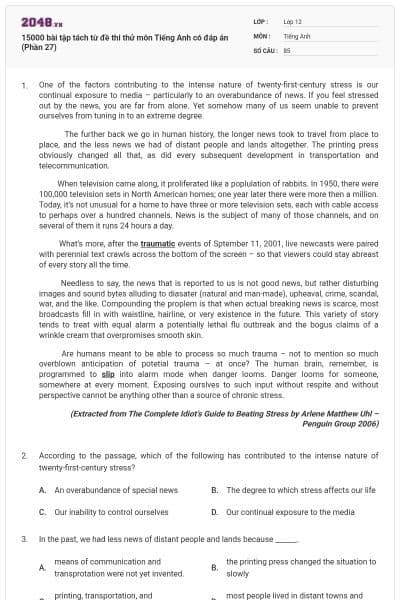
One of the factors contributing to the intense nature of twenty-first-century stress is our continual exposure to media – particularly to an overabundance of news. If you feel stressed out by the news, you are far from alone. Yet somehow many of us seem unable to prevent ourselves from tuning in to an extreme degree.
The further back we go in human history, the longer news took to travel from place to place, and the less news we had of distant people and lands altogether. The printing press obviously changed all that, as did every subsequent development in transportation and telecommunication.
When television came along, it proliferated like a poplulation of rabbits. In 1950, there were 100,000 television sets in North American homes; one year later there were more then a million. Today, it’s not unusual for a home to have three or more television sets, each with cable access to perhaps over a hundred channels. News is the subject of many of those channels, and on several of them it runs 24 hours a day.
What’s more, after the traumatic events of Sptember 11, 2001, live newcasts were paired with perennial text crawls across the bottom of the screen – so that viewers could stay abreast of every story all the time.
Needless to say, the news that is reported to us is not good news, but rather disturbing images and sound bytes alluding to diasater (natural and man-made), upheaval, crime, scandal, war, and the like. Compounding the proplem is that when actual breaking news is scarce, most broadcasts fill in with waistline, hairline, or very existence in the future. This variety of story tends to treat with equal alarm a potentially lethal flu outbreak and the bogus claims of a wrinkle cream that overpromises smooth skin.
Are humans meant to be able to process so much trauma – not to mention so much overblown anticipation of potetial trauma – at once? The human brain, remember, is programmed to slip into alarm mode when danger looms. Danger looms for someone, somewhere at every moment. Exposing ourslves to such input without respite and without perspective cannot be anything other than a source of chronic stress.
(Extracted from The Complete Idiot’s Guide to Beating Stress by Arlene Matthew Uhl – Penguin Group 2006)
According to the passage, which of the following has contributed to the intense nature of twenty-first-century stress?
An overabundance of special news
The degree to which stress affects our life
Our inability to control ourselves
Our continual exposure to the media
D. Our continual exposure to the media: theo bài đọc, một điều góp phần vào bản chất căng thẳng của những áp lực trong thế kỉ 21 là việc đối mặt thường xuyên với các phương tiện truyền thông đại chúng.
Chi tiết này có trong câu đầu đoạn một: “One of the factors contributing to the intense nature of twenty-first-century stress is our continual exposure to media – particularly to an overabundance of news.”Dịch bài đọc
Một trong những yếu tố góp phần vào bản chất căng thẳng dữ dội của thế kỷ 21 là việc chúng ta liên tục tiếp xúc với phương tiện truyền thông – đặc biệt là với quá nhiều tin tức. Nếu bạn cảm thấy căng thẳng vì tin tức, bạn không phải là người duy nhất. Tuy nhiên, bằng cách nào đó, nhiều người trong chúng ta dường như không thể ngăn mình không nghe tin tức ở mức độ cực đoan.
Càng đi ngược về quá khứ trong lịch sử loài người, tin tức càng mất nhiều thời gian để truyền từ nơi này sang nơi khác và chúng ta càng ít tin tức về những con người và vùng đất xa xôi. Rõ ràng là máy in đã thay đổi tất cả, cũng như mọi sự phát triển sau đó trong giao thông vận tải và viễn thông.
Khi truyền hình xuất hiện, nó phát triển mạnh mẽ như một đàn thỏ. Năm 1950, có 100.000 chiếc tivi trong các hộ gia đình ở Bắc Mỹ; một năm sau, con số đó đã lên tới hơn một triệu. Ngày nay, không có gì lạ khi một ngôi nhà có ba hoặc nhiều chiếc tivi, mỗi chiếc có thể truy cập cáp tới hơn một trăm kênh. Tin tức là chủ đề của nhiều kênh trong số đó và trên một số kênh, tin tức được phát 24 giờ một ngày.
Hơn nữa, sau các sự kiện đau thương ngày 11 tháng 9 năm 2001, các bản tin trực tiếp được ghép nối với các dòng chữ chạy dài liên tục ở cuối màn hình - để người xem có thể cập nhật mọi câu chuyện mọi lúc.
Không cần phải nói, tin tức được đưa đến chúng ta không phải là tin tốt, mà là những hình ảnh và âm thanh đáng lo ngại ám chỉ đến thảm họa (tự nhiên và do con người gây ra), biến động, tội phạm, bê bối, chiến tranh, v.v. Vấn đề trở nên trầm trọng hơn khi tin tức nóng hổi thực sự khan hiếm, hầu hết các chương trình phát sóng đều lấp đầy bằng vòng eo, đường chân tóc hoặc sự tồn tại trong tương lai. Kiểu câu chuyện này có xu hướng đề cập đến một đợt bùng phát cúm có khả năng gây tử vong và những tuyên bố sai lầm về một loại kem chống nhăn hứa hẹn quá mức về làn da mịn màng.
Liệu con người có thể xử lý quá nhiều chấn thương - chưa kể đến quá nhiều dự đoán quá mức về chấn thương tiềm ẩn - cùng một lúc không? Hãy nhớ rằng, bộ não con người được lập trình để chuyển sang chế độ báo động khi nguy hiểm rình rập. Nguy hiểm rình rập ai đó, ở đâu đó tại mọi thời điểm. Việc để bản thân tiếp xúc với những thông tin đầu vào như vậy mà không có sự nghỉ ngơi và không có góc nhìn không thể là gì khác ngoài nguồn gây ra căng thẳng mãn tính.
(Trích từ The Complete Idiot’s Guide to Beating Stress của Arlene Matthew Uhl – Penguin Group 2006)
In the past, we had less news of distant people and lands because ______.
means of communication and transprotation were not yet invented.
the printing press changed the situation to slowly
printing, transportation, and telecommunications were not developed
most people lived in distant towns and villages
C. printing, transportation, and telecommunications were not developed: trong quá khứ chúng ta có ít tin tức hơn về những dân tộc và những vùng đất xa xôi bởi vì việc in ấn, vận chuyển và truyền thông chưa phát triển.
Chúng ta có thể tìm thấy chi tiết này trong hai câu của đoạn hai “The printing press obviously changed all that, as did every subsequent development in transportation and telecommunication.”The word “traumatic” in paragraph 4 is closest in meaning to _______.
boring
fascinating
upsetting
exciting
C. upsetting: từ “traumatic” trong đoạn bốn sát ý nghĩa với từ “upsetting= gây sốc”.
Chính xác từ “traumatic” có nghĩa là “extremely unpleasant and causing you to feel upset and/or anxious”.According to the passage, when there is not enough actual breaking news, broadcasts
are full of dangerous diseases such as flu.
send out live newscasts paired with text across the screen
send out frightening stories about potential dangers
are forced to publicise an alarming increase in crime
Which of the following is NOT true, according to the passage?
The news that is reported to us is not good news.
Many people are under stress caused by the media.
Many TV channels supply the public with breaking news.
The only source of stress in our modern life is the media.
D. The only source of stress in our modern life is the media: theo bài đọc, các phương tiện truyền thông chỉ là một trong những nguồn – chứ không phải là duy nhất – gây chứng căng thẳng cho con người trong cuộc sống hiện đại.
Chúng ta có thể thấy chi tiết này ngay trong câu thứ nhất của đoạn một với cụm từ: “One of the factors contributing to the intense nature of twenty-first-century stress…”The word “slip” in paragraph 6 is closest in meaning to ______.
release
bring
fail
fall
D. fall: từ “slip = rơi vào” sát nghĩa với từ “fall”.
Ý nghĩa cả câu: “The human brain, remember, is programmed to slip into alarm mode when danger looms” = “Hãy nhớ rằng bộ óc của con người được lập trình để rơi vào trạng thái báo động mỗi khi nguy hiểm xuất hiện”.According to the passage, our continual exposure to bad news without perspective is obviously ________.
the result of human brain’s switch to alarm mode.
a source of chronic stress.
the result of an overabundance of good news.
a source of defects in human brain.
B. a source of chronic stress: theo bài đọc, việc tiếp xúc liên tục với tin tức xấu mà thiếu cân nhắc rõ ràng là cội nguồn của chứng căng thẳng kinh niên.
Chúng ta có thể thấy chi tiết này trong câu cuối của đoạn sáu.: “Exposing ourslves to such input without respite and without perspective cannot be anything other than a source of chronic stress.”What is probably the best title for this passage?
Effective Ways to Beat Stress
More Modern Life - More Stress
The Media - A Major Cause of Stress
Developments in Telecommunications
THE SAVANNAH
The tourist looking at the African savannah on a summer afternoon might be excused for thinking that the wide yellow grass plain was completely deserted of life, almost a desert. With only a few small thorn trees sticking out through the veldt, there seems to be almost no place for a living creature to hide.
However, under those trees you might find small steenbok, sleeping in the shade, and waiting for the night to fall. There may even be a small group of lions somewhere, their bodies exactly the same shade as the tall grass around them. In the holes in the ground a host of tiny creatures, from rabbits and badgers to rats and' snakes are waiting for the heat to finish.
The tall grass also hides the fact that there may be a small stream running across the middle of the plain. One clue that there may be water here is the sight of a majestic Marshall eagle circling slowly over the grassland. When he drops, he may come up with a small fish, or maybe a grass snake that has been waiting at the edge of a pool in the hope of catching a frog.
The best time to see the animals then, is in the evening, just as the sun is setting. The best time of the year to come is in late September, or early August, just before the rains. Then the animals must come to the waterholes, as there is no other place for them to drink. And they like to come while it is still light; so they can see if any dangers are creeping up on them.
So it is at sunset, and after the night falls, that the creatures of the African veld rise and go about their business.
The savannah appears to be empty because:
The animals are sleeping
The animals have gone about their business
They have been frightened by an eagle
The temperature prevents much activity
Các thảo nguyên dường như là trống rỗng, vì:
A. Các loài động vật đang ngủ
B. Các loài động vật đã đi công việc hoạt động của chúng
C. Họ đã bị hoảng sợ bởi một con đại bàng
D. Nhiệt độ ngăn chặn nhiều hoạt động
Câu cuối – Đoạn 2: “..............are waiting for the heat to finish.”
Tạm dịch: “......................đang đợi chờ kết thúc đợt nóng”By "go about their business" the writer means:
Tourism in Africa is big business
The animals go to the river to drink
The animals go on with their normal activity
The animals are observed by naturalists
Ta có: “go about one’s business”: ai đó đang làm chuyện riêng của mình
Đáp án C – diễn tả chính nội dung ý nghĩa trong bàiWhat kind of book does the text seem to be from?
A book for experts on wildlife
A fictional story
A history of Africa
General non-fiction
The phrase "be excused for" in paragraph 1 is closest in meaning to
easily make a mistake of
feel sorry for
be regretting for
be actually forgiven for
The tourist looking at the African savannah on a summer afternoon might be excused for thinking that the wide yellow grass plain was completely deserted of life, almost a desert.”
Tạm dịch: “Các khu du lịch nhìn vào hoang mạc châu Phi vào một buổi chiều mùa hè có thể bỏ qua nếu nghĩ rằng đồng bằng cỏ vàng rộng đã hoàn toàn vắng vẻ của cuộc sống, gần như một sa mạc.”
Cụm từ "be excuted for" trong đoạn 1 là gần nhất trong ý nghĩa cho
A. dễ dàng mắc một sai lầm
B. cảm thấy tiếc cho
C. hối hận về
D. được thực sự tha thứ cho
Đáp án A có nghĩa tương đồng, có thể thay thế vào đoạn vănThe phrase "a host of" in paragraph 2 is closest in meaning to
a large number of
only a few
a group of
a gang of
Cụm từ "hàng loạt các" trong đoạn 2 là có nghĩa gần nhất với
A. một số lượng lớn
B. chỉ có một vài
C. một nhóm
D. một băng nhóm
Đáp án A – đồng nghĩa với “ a host of”Why do animals come to the waterholes while it is still light?
To see their ways .better
To be alert to the possibility of danger
To drink enough water before hunting
To avoid people watching them
The word "he" in paragraph 3 refers to
a person
the writer
a Marshall eagle
a small fish
Câu 2 – 3 – Đoạn 3: “One clue that there may be water here is the sight of a majestic Marshall eagle circling slowly over the grassland. When he drops, he may come up with a small fish, or maybe a grass snake that has been waiting at the edge of a pool in the hope of catching a frog.”
Tạm dịch: “Một manh mối rằng có thể có nước ở đây là tầm nhìn của một con đại bàng Marshall vĩ đại lượn quanh dần trên đồng cỏ. Khi nó xuống, nó có thể đi lên với một con cá nhỏ, hoặc có thể là một con rắn cỏ chờ đợi ở các cạnh của một hồ bơi với hy vọng bắt được một con ếch.”
Ta có thể “he” chính là con đại bàng MarshallThe ability of falling cats to right themselves in midair and land on their feet has been a source of wonder for ages. Biologists long regarded it as an example of adaptation by natural selection, but for physicists it bordered on the miraculous.
Newton's laws of motion assume that the total amount of spin of a body cannot change unless an external torque speeds it up or slows it down. If a cat has no spin when it isreleased and experiences no external torque, it ought not to be able to twist around as it falls.
In the speed of its execution, the righting of a tumbling cat resembles a magician's trick. The gyrations of the cat in midair are too fast for the human eye to follow, so the process is obscured. Either the eye must be speeded up, or the cat's fall slowed down for the phenomenon to be observed. A century ago the former was accomplished by means of high-speed photography using equipment now available in any pharmacy. But in the nineteenth century the capture on film of a falling cat constituted a scientific experiment.
The experiment was described in a paper presented to the Paris Academy in 1894. Two sequences of twenty photographs each, one from the side and one from behind, show a white cat in the act of righting itself. Grainy and quaint though they are, the photos show that the cat was dropped upside down, with no initial spin, and still landed on its feet. Careful analysis of the photos reveals the secret; as the cat rotates the front of its body clockwise, the rear and tail twist counterclockwise, so that the total spin remains zero, in perfect accord with Newton's laws. Halfway down, the cat pulls in its legs before reversing its twist and then extends them again, with the desired end result. The explanation was that while nobody can acquire spin without torque, a flexible one can readily change its orientation, or phase. Cats know this instinctively, but scientists could not be sure how it happened until they increased the speed of their perceptions a thousandfold.
What does the passage mainly discuss?
The explanation of an interesting phenomenon
Miracles in modern science
Procedures in scientific investigation
The differences between biology and physics
Giải thích: Bài đọc xoay quanh việc giải thích hiện tượng mèo có thể xoay mình khi bị thả từ trên cao xuống và đáp xuống đất bằng bốn chân an toàn.
Phương án A. The explanation of an interesting phenomenon = Một lời giải thích cho một hiện tượng thú vị, là phương án thể hiện chủ đề của bài chính xác nhất.
B. Miracles in modern science = Phép lạ trong khoa học hiện đại
C. Procedures in scientific investigation = Thủ tục trong nghiên cứu khoa học
D. The differences between biology and physics = Sự khác biệt giữa sinh học và vật lý.The word “process” in line 10 refers to
the righting of a tumbling cat
the cat's fall slowed down
high-speed photography
a scientific experiment
Thông tin: In the speed of its execution, the righting of a tumbling cat resembles a magician's trick. The gyrations of the cat in midair are too fast for the human eye to follow, so the process is obscured.
Dịch nghĩa: Trong tốc độ thực hiện của nó, là sự xoay người của một con mèo nhào lộn giống trò lừa của một nhà ảo thuật. Các xoay chuyển của con mèo trên không trung quá nhanh để mắt con người có thể theo dõi, vì vậy quá trình bị che khuất.
Quá trình được nhắc đến ở đây chính là quá trình xoay người của con mèo được thả từ trên cao.
B. the cat's fall slowed down = sự rơi của con mèo chậm lại
C. high – speed photography = nhiếp ảnh tốc độ cao
D. a scientific experiment = một thí nghiệm khoa họcWhy are the photographs mentioned in line 16 referred to as an “experiment”?
The photographs were not very clear.
The purpose of the photographs was to explain the process.
The photographer used inferior equipment.
The photographer thought the cat might be injured.
Thông tin: Either the eye must be speeded up, or the cat's fall slowed down for the phenomenon to be observed. A century ago the former was accomplished by means of high-speed photography using equipment now available in any pharmacy. But in the nineteenth century the capture on film of a falling cat constituted a scientific experiment. Dịch nghĩa: Hoặc là con mắt được đẩy nhanh tốc độ, hoặc là sự rơi của con mèo chậm lại để hiện tượng này được quan sát. Một thế kỷ trước, điều thứ nhất đã được thực hiện bằng phương tiện của nhiếp ảnh tốc độ cao sử dụng các thiết bị sẵn có ngày nay ở bất kỳ hiệu thuốc nào. Nhưng trong thế kỷ mười chín, sự chụp phim của một con mèo rơi xuống tạo thành một thí nghiệm khoa học. Như vậy những bức ảnh được gọi là thí nghiệm bởi vì mục đích của nó là ghi lại hình ảnh và giải thích hiện tượng về con mèo. A. The photographs were not very clear = Các hình ảnh không phải là rất rõ ràng. Không có thông tin như vậy trong bài. C. The photographer used inferior equipment = Các nhiếp ảnh gia sử dụng thiết bị kém. Không có thông tin như vậy trong bài. D. The photographer thought the cat might be injured = Các nhiếp ảnh gia cho rằng con mèo có thể bị thương. Không có thông tin như vậy trong bài. |
Which of the following can be inferred about high-speed photography in the late 1800's?
It was a relatively new technology.
The necessary equipment was easy to obtain.
The resulting photographs are difficult to interpret.
It was not fast enough to provide new information.
Thông tin: A century ago the former was accomplished by means of high-speed photography using equipment now available in any pharmacy. But in the nineteenth century the capture on film of a falling cat constituted a scientific experiment. Dịch nghĩa: Một thế kỷ trước, điều thứ nhất đã được thực hiện bằng phương tiện của nhiếp ảnh tốc độ cao sử dụng các thiết bị sẵn có ngày nay ở bất kỳ hiệu thuốc nào. Nhưng trong thế kỷ mười chín, sự chụp phim của một con mèo rơi xuống tạo thành một thí nghiệm khoa học. Một thế kỷ trước (tức là thế kỷ XX) thì nhiếp ảnh tốc độ cao đã phổ biến đến mức dụng cụ có thể được tìm thấy ở bất cứ hiệu thuốc nào. Nhưng trước đó, ở thế kỷ XIX thì nó tạo thành thì nghiệm khoa học, nghĩa là nó còn rất mới mẻ, là một công nghệ mới. Phương án A. It was a relatively new technology = nó là một công nghệ rất mới, là phương án chính xác nhất. B. The necessary equipment was easy to obtain = Các thiết bị cần thiết là dễ dàng để có được. Đó là khi ở thế kỷ XX thì các thiết bị cần thiết mới dễ dàng có được, chứ cuối những năm 1800 thì không. C. The resulting photographs are difficult to interpret = Những hình ảnh thu được rất khó để giải thích. Không có thông tin như vậy trong bài. D. It was not fast enough to provide new information = Nó không đủ nhanh để cung cấp thông tin mới. Không có thông tin như vậy trong bài. |
The word “rotates” in line 19 is closest in meaning to
drops
turns
controls
touches
Giải thích: Rotate (v) = xoay quanh, quay vòng Turn (v) = xoay, quay tròn Dịch nghĩa: Careful analysis of the photos reveals the secret; as the cat rotates the front of its body clockwise, the rear and tail twist counterclockwise, so that the total spin remains zero, in perfect accord with Newton's laws = Phân tích cẩn thận các bức ảnh tiết lộ bí mật; khi con mèo quay mặt trước của cơ thể của nó theo chiều kim đồng hồ, phía sau và đuôi xoắn ngược chiều kim đồng hồ, do đó tổng lực xoay vẫn bằng không, phù hợp hoàn hảo với định luật của Newton. A. drops (v) = rơi xuống, giảm xuống C. controls (v) = kiểm soát D. touches (v) = chạm vào |
According to the passage, a cat is able to right itself in midair because it is
frightened
small
intelligent
flexible
Thông tin: The explanation was that while nobody can acquire spin without torque, a flexible one can readily change its orientation, or phase. Cats know this instinctively…
Dịch nghĩa: Lời giải thích là trong khi không ai có thể quay mà không có mô-men xoắn, một người linh hoạt có thể dễ dàng thay đổi hướng của nó, hoặc giai đoạn. Mèo biết điều này theo bản năng …
Như vậy, lý do mèo có thể tự xoay mình trong không trung là bởi vì cơ thể nó linh hoạt nên có thể điều khiển được hướng hoặc giai đoạn xoay.
Phương án D. flexible (adj) = linh hoạt, là phương án chính xác nhất.
A. frightened (adj) = bị sợ hãi
B. small (adj) = nhỏ
C. intelligent (adj) = thông minhHow did scientists increase “the speed of their perceptions a thousandfold” (lines 25-26)?
By analyzing photographs
By observing a white cat in a dark room
By dropping a cat from a greater height
By studying Newton's laws of motion
Thông tin: Either the eye must be speeded up, or the cat's fall slowed down for the phenomenon to be observed. A century ago the former was accomplished by means of high-speed photography using equipment now available in any pharmacy … Careful analysis of the photos reveals the secret Dịch nghĩa: Hoặc là con mắt được đẩy nhanh tốc độ, hoặc là sự rơi của con mèo chậm lại để hiện tượng này được quan sát. Một thế kỷ trước, điều thứ nhất đã được thực hiện bằng phương tiện của nhiếp ảnh tốc độ cao sử dụng các thiết bị sẵn có ngày nay ở bất kỳ hiệu thuốc nào … Phân tích cẩn thận các bức ảnh tiết lộ bí mật Như vậy để tăng tốc độ của nhận thức của họ một nghìn lần thì các nhà khoa học phải nhờ đến công cụ là nhiếp ảnh tốc đọ cao và phân tích các bức ảnh. Phương án A. By analyzing photographs = bằng cách phân tích các bức ảnh, là phương án chính xác nhất. B. By observing a white cat in a dark room = Bằng cách quan sát một con mèo trắng trong một căn phòng tối. C. By dropping a cat from a greater height = Khi thả một con mèo từ độ cao lớn hơn. D. By studying Newton's laws of motion = Bằng cách nghiên cứu quy luật chuyển động của Newton. |
Read the following passage and mark the letter A, B, C, or D on your answer sheet to indicate the correct answer to each of the questions from 43 to 50.
With Robert Laurent and William Zorach, direct carving enters into the story of modern sculpture in the United States. Direct carving - in which the sculptors themselves carve stone or wood with mallet and chisel - must be recognized as something more than just a technique. Implicit in it is an aesthetic principle as well:that the medium has certain qualities of beauty and expressiveness with whichsculptors must bring their own aesthetic sensibilities into harmony. For example, sometimes the shape or veining in a piece of stone or wood suggests, perhaps even dictates, not only the ultimate form, but even the subject matter.
The technique of direct carving was a break with the nineteenth-century tradition in which the making of a clay model was considered the creative act and the work was then turned over to studio assistants to be cast in plaster or bronze or carved in marble.
Neoclassical sculptors seldom held a mallet or chisel in their own hands, readily conceding that the assistants they employed were far better than they were at carving the finished marble.With the turn-of-the-century Crafts movement and the discovery of nontraditional sources of inspiration, such as wooden African figures and masks, there arose a new urge for hands-on, personal execution of art and an interaction with the medium. Even as early as the 1880's and 1890's, nonconformist European artists were attempting direct carving. By the second decade of the twentieth century, Americans — Laurent and Zorach most notably — had adopted it as their primary means of working.
Born in France, Robert Laurent(1890-1970)was a prodigy who received his education in the United States. In 1905 he was sent to Paris as an apprentice to an art dealer, and in the years that followed he witnessed the birth of Cubism, discovered primitive art, and learned the techniques of woodcarving from a frame maker.
Back in New York City by 1910, Laurent began carving pieces such as The Priestess, which reveals his fascination with African, pre-Columbian, and South Pacific art. Taking a walnut plank, the sculptor carved the expressive, stylized design. It is one of the earliest examples of direct carving in American sculpture. The plank's form dictated the rigidly frontal view and the low relief. Even its irregular shape must have appealed to Laurent as a break with a long-standing tradition that required a sculptor to work within a perfect rectangle or square.
The word “medium” in line 5 could be used to refer to
stone or wood
mallet and chisel
technique
principle
Thông tin: Direct carving - in which the sculptors themselves carve stone or wood with mallet and chisel - must be recognized as something more than just a technique. Implicit in it is an aesthetic principle as well: that the medium has certain qualities of beauty and expressiveness with which sculptors must bring their own aesthetic sensibilities into harmony. Dịch nghĩa: Chạm khắc trực tiếp - trong đó các nhà điêu khắc tự khắc bằng đá hoặc gỗ với vồ và đục - phải được công nhận là một cái gì đó nhiều hơn một kỹ thuật. Tiềm ẩn trong nó cũng là một nguyên tắc thẩm mỹ: rằng phương tiện có những phẩm chất nhất định của vẻ đẹp và biểu cảm mà nhà điêu khắc phải mang sự nhạy cảm thẩm mỹ riêng của chúng vào sự hòa hợp. Như vậy từ “medium” chính là các phương tiện để nhà điêu khắc thực hiện công việc, mà trong bài được đưa ra cụ thể là đá hoặc gỗ. Phương án A. stone or wood = đá hoặc gỗ, là phương án chính xác nhất. B. mallet and chisel = vồ và đục Đây là những dụng cụ để thực hiện việc điêu khắc, chúng không được miêu tả là những vật có vẻ đẹp nhất định mà nhà điêu khắc cần khai thác. C. technique (n) = kỹ thuật “Technique” được nhắc đến để nhấn mạnh vai trò của chạm khắc trực tiếp nhiều hơn một kỹ thuật đơn thuần, chứ không phải một phương tiện mang vẻ đẹp trong nó. D. principle (n) = nguyên tắc Bản thân từ “medium” chính là nằm trong nguyên tắc được nhắc đến, chứ không phải thay thế cho từ “principle”. |
What is one of the fundamental principles of direct carving?
A sculptor must work with talented assistants.
The subject of a sculpture should be derived from classical stories.
The material is an important element in a sculpture.
Designing a sculpture is a more creative activity than carving it.
Thông tin: Implicit in it is an aesthetic principle as well: that the medium has certain qualities of beauty and expressiveness with which sculptors must bring their own aesthetic sensibilities into harmony. For example, sometimes the shape or veining in a piece of stone or wood suggests, perhaps even dictates, not only the ultimate form, but even the subject matter. Dịch nghĩa: Tiềm ẩn trong nó cũng là một nguyên tắc thẩm mỹ: rằng phương tiện có những phẩm chất nhất định của vẻ đẹp và biểu cảm mà nhà điêu khắc phải mang sự nhạy cảm thẩm mỹ riêng của chúng vào sự hòa hợp. Ví dụ, đôi khi hình dạng hoặc hoa văn trong một mảnh đá hay gỗ cho thấy, có lẽ thậm chí quyết định, không chỉ hình thức cuối cùng, mà cả chủ đề. Phương án C. The material is an important element in a sculpture = nguyên liệu là một yếu tố quan trọng trong một tác phẩm điêu khắc; là phương án chính xác nhất. A. A sculptor must work with talented assistants = Một nhà điêu khắc phải làm việc với các trợ lý tài năng. Neoclassical sculptors seldom held a mallet or chisel in their own hands, readily conceding that the assistants they employed were far better than they were at carving the finished marble. = Các nhà điêu khắc tân cổ điển hiếm khi tự cầm một vồ hoặc đục trong tay mình, sẵn sàng thừa nhận rằng các trợ lý họ sử dụng là giỏi hơn nhiều so với họ khi khắc tạc tác phẩm đá cẩm thạch hoàn chỉnh. Đây là sự thật thường xảy ra, nhưng không có nguyên tắc nào quy định một nhà điêu khắc phải làm việc với các trợ lý tài năng. B. The subject of a sculpture should be derived from classical stories = Các chủ đề của một tác phẩm điêu khắc nên được bắt nguồn từ những câu chuyện cổ điển. Không có thông tin như vậy trong bài. D. Designing a sculpture is a more creative activity than carving it = Thiết kế một tác phẩm điêu khắc là một hoạt động sáng tạo hơn khắc nó. Không có thông tin như vậy trong bài. |
The word “dictates” in line 8 is closest in meaning to
reads aloud
determines
includes
records
Giải thích: Dictate (v) = ra lệnh, chỉ đạo
Determine (v) = quyết định
Dịch nghĩa: For example, sometimes the shape or veining in a piece of stone or wood suggests, perhaps even dictates, not only the ultimate form, but even the subject matter = Ví dụ, đôi khi hình dạng hoặc hoa văn trong một mảnh đá hay gỗ cho thấy, có lẽ thậm chí quyết định, không chỉ hình thức cuối cùng, mà cả chủ đề.
A. reads aloud (v) = đọc to
C. includes (v) = bao gồm
D. records (v) = ghi lại, lưu trữ lạiHow does direct carving differ from the nineteenth-century tradition of sculpture?
Sculptors are personally involved in the carving of a piece.
Sculptors find their inspiration in neoclassical sources.
Sculptors have replaced the mallet and chisel with other tools.
Sculptors receive more formal training.
Thông tin: Direct carving - in which the sculptors themselves carve stone or wood with mallet and chisel … Neoclassical sculptors seldom held a mallet or chisel in their own hands Dịch nghĩa: Chạm khắc trực tiếp - trong đó các nhà điêu khắc tự khắc bằng đá hoặc gỗ với vồ và đục … Các nhà điêu khắc tân cổ điển hiếm khi tự cầm một vồ hoặc đục trong tay mình Như vậy sự khác nhau cơ bản giữa chạm khắc trực tiếp và chạm khắc truyền thống là nhà điêu khắc tự mình làm ra sản phẩm. Phương án A. Sculptors are personally involved in the carving of a piece = Các nhà điêu khắc tham gia một cách cá nhân vào việc chạm khắc một tác phẩm; là phương án chính xác nhất. B. Sculptors find their inspiration in neoclassical sources = Các nhà điêu khắc tìm thấy cảm hứng của họ trong các nguồn tân cổ điển. C. Sculptors have replaced the mallet and chisel with other tools = Các nhà điêu khắc đã thay thế vồ và đục bởi các dụng cụ khác. D. Sculptors receive more formal training = Các nhà điêu khắc được đào tạo chính quy hơn. |
The word “witnessed” in line 23 is closest in meaning to
influenced
studied
validated
observed
Giải thích: Witness (v) = chứng kiến
Observe (v) = quan sát
Dịch nghĩa: In 1905 he was sent to Paris as an apprentice to an art dealer, and in the years that followed he witnessed the birth of Cubism, discovered primitive art, and learned the techniques of woodcarving from a frame maker = Năm 1905, ông đã được gửi đến Paris như một người học việc cho một kẻ buôn tác phẩm nghệ thuật, và trong những năm sau đó, ông đã chứng kiến sự ra đời của chủ nghĩa Lập thể, phát hiện ra nghệ thuật nguyên thủy, và học được các kỹ thuật khắc gỗ từ một nhà sản xuất khung.
A. influenced (v) = ảnh hưởng, tác động
B. studied (v) = học tập
C. validated (v) = xác nhận, làm cho có hiệu lựcWhere did Robert Laurent learn to carve?
New York
Africa
The South Pacific
Paris
Thông tin: In 1905 he was sent to Paris as an apprentice to an art dealer, and in the years that followed he witnessed the birth of Cubism, discovered primitive art, and learned the techniques of woodcarving from a frame maker. Dịch nghĩa: Năm 1905, ông đã được gửi đến Paris như một người học việc cho một kẻ buôn tác phẩm nghệ thuật, và trong những năm sau đó, ông đã chứng kiến sự ra đời của chủ nghĩa Lập thể, phát hiện ra nghệ thuật nguyên thủy, và học được các kỹ thuật khắc gỗ từ một nhà sản xuất khung. Như vậy Laurent đã học điêu khắc tại Paris khi làm việc cho một nhà sản xuất khung. Phương án D. Paris là phương án chính xác nhất. A. New York Đây là nơi Laurent trở lại vào năm 1910 sau khi đã học điêu khắc. B. Africa = châu Phi Đây là nơi mà nghệ thuật của nó mang đến cảm hứng sáng tác bức tượng “The priestess” cho ông. C. The South Pacific = vùng Nam Thái Bình Dương Đây là nơi mà nghệ thuật của nó mang đến cảm hứng sáng tác bức tượng “The priestess” cho ông. |
The phrase “a break with” in line 30 is closest in meaning to
a destruction of
a departure from
a collapse of
a solution to
Giải thích: A break with = một sự phá vỡ cái gì
A departure from = một sự rời đi khỏi cái gì
Dịch nghĩa: The technique of direct carving was a break with the nineteenth-century tradition in which the making of a clay model was considered the creative act and the work was then turned over to studio assistants to be cast in plaster or bronze or carved in marble. = Kỹ thuật khắc trực tiếp là một sự phá vỡ truyền thống thế kỷ XIX, trong đó việc tạo ra một mô hình đất sét đã được coi là hành động sáng tạo và tác phẩm sau đó đã được chuyển cho trợ lý studio để được đúc thạch cao hoặc bằng đồng hay chạm khắc bằng đá cẩm thạch.
A. a destruction of = một sự phá hủy cái gì
C. a collapse of = một sự sụp đổ của cái gì
D. a solution to = một giải pháp cho cái gìThe piece titled The Priestess has all of the following characteristics EXCEPT
The design is stylized.
It is made of marble.
The carving is not deep.
It depicts the front of a person.
Giải thích: Back in New York City by 1910, Laurent began carving pieces such as The Priestess, which reveals his fascination with African, pre-Columbian, and South Pacific art. Taking a walnut plank, the sculptor carved the expressive, stylized design … The plank's form dictated the rigidly frontal view and the low relief. Dịch nghĩa: Trở lại thành phố New York năm 1910, Laurent bắt đầu khắc các tác phẩm như The Priestess, trong đó cho thấy niềm đam mê của ông với nghệ thuật của châu Phi, tiền Columbus, và Nam Thái Bình Dương. Lấy một tấm ván óc chó, nhà điêu khắc chạm khắc các biểu cảm, thiết kế cách điệu … Hình thức của tấm ván quyết định góc nhìn phía trước và độ khắc nông. Như vậy, các phương án A. The design is stylized, C. The carving is not deep, D. It depicts the front of a person đều được nhắc đến là đặc điểm của bức tượng. Chỉ có phương án B. It is made of marble = Nó được làm bằng đá cẩm thạch là không có thông tin trong bài. |
The hard, rigid plates that form the outermost portion of the Earth are about 100 kilometers thick. These plates include both the Earth's crust and the upper mantle. The rocks of the crust are composed mostly of minerals with light elements, like aluminum and sodium, while the mantle contains some heavier elements, like iron and magnesium. Together, the crust and upper mantle that form the surface plates are called the lithosphere. This rigid layer floats on the denser material of the lower mantle the way a wooden raft floats on a pond. The plates are supported by a weak, plastic layer of the lower mantle called the asthenosphere. Also like a raft on a pond, the lithospheric plates are carried along by slow currents in this more fluid layer beneath them.
With an understanding of plate tectonics, geologists have put together a new history for the Earth's surface. About 200 million years ago, the plates at the Earth's surface formed a “supercontinent” called Pangaea. When this supercontinent started to tear apart because of plate movement, Pangaea first broke into two large continental masses with a newly formed sea that grew between the land areas as the depression filled with water. The southern one — which included the modern continents of South America, Africa, Australia, and Antarctica — is called Gondwanaland. The northern one — with North America, Europe, and Asia — is called Laurasia. North America tore away from Europe about 180 million years ago, forming the northern Atlantic Ocean. Some of the lithospheric plates carry ocean floor and others carry land masses or a combination of the two types. The movement of the lithospheric plates is responsible for earthquakes, volcanoes, and the Earth's largest mountain ranges. Current understanding of the interaction between different plates explains why these occur where they do. For example, the edge of the Pacific Ocean has been called the “Ring of Fire” because so many volcanic eruptions and earthquakes happen there. Before the 1960's, geologists could not explain why active volcanoes and strong earthquakes were concentrated in that region. The theory of plate tectonics gave them an answer.
With which of the following topics is the passage mainly concerned?
The contributions of the theory of plate tectonics to geological knowledge
The mineral composition of the Earth's crust
The location of the Earth's major plates
The methods used by scientists to measure plate movement
Giải thích: Đoạn đầu của bài đọc giải thích về lý thuyết kiến tạo mảng. Đoạn còn lại nói về các tác dụng, đóng góp của lý thuyết này trong việc giải thích các hiện tượng địa tầng từ nhiên. Phương án A. The contributions of the theory of plate tectonics to geological knowledge = Những đóng góp của lý thuyết kiến tạo mảng đối với kiến thức địa chất; là phương án nêu chủ đề của bài đọc chính xác nhất. B. The mineral composition of the Earth's crust = Các thành phần khoáng chất của vỏ Trái Đất. The rocks of the crust are composed mostly of minerals with light elements, like aluminum and sodium, while the mantle contains some heavier elements, like iron and magnesium. = Các đá của lớp vỏ được cấu tạo chủ yếu là khoáng chất với các nguyên tố nhẹ, như nhôm và natri, trong khi lớp manti có chứa một số nguyên tố nặng hơn, như sắt và magiê. Các thành phần khoáng chất của vỏ Trái Đất được nhắc đến để làm rõ lý thuyết kiến tạo mảng. Tuy nhiên đây không phải nội dung mang tính chủ đạo trong bài. C. The location of the Earth's major plates = Vị trí của các mảng lớn của Trái Đất. The southern one - which included the modern continents of South America, Africa, Australia, and Antarctica - is called Gondwanaland. The northern one - with North America, Europe, and Asia - is called Laurasia. = Mảng phía nam - trong đó bao gồm các lục địa hiện đại là Nam Mỹ, châu Phi, Úc và Nam Cực - được gọi là Gondwanaland. Mảng phía bắc - với Bắc Mỹ, châu Âu và châu Á - được gọi là Laurasia. Đây là một phần của lý thuyết kết quả suy ra từ lý thuyết kiến tạo mảng chứ không phải nội dung mang tính chủ đạo của bài. D. The methods used by scientists to measure plate movement = Các phương pháp được sử dụng bởi các nhà khoa học để đo chuyển động mảng. Không có thông tin như vậy trong bài. |
According to the passage, the lithospheric plates are given support by the
upper mantle
ocean floor
crust
asthenosphere
Thông tin: Together, the crust and upper mantle that form the surface plates are called the lithosphere … The plates are supported by a weak, plastic layer of the lower mantle called the asthenosphere.
Dịch nghĩa: Cùng với nhau, lớp vỏ và lớp manti trên tạo thành các mảng bề mặt được gọi là thạch quyển ... Các mảng được hỗ trợ bởi một lớp nhựa yếu của lớp manti dưới gọi là quyển mềm.
Như vậy phương án D. asthenosphere là phương án chính xác nhất.
A. upper mantle = lớp manti trên
B. ocean floor = đáy đại dương
C. crust = lớp vỏ Trái ĐấtThe author compares the relationship between the lithosphere and the asthenosphere to which of the following?
Lava flowing from a volcano
A boat floating on the water
A fish swimming in a pond
The erosion of rocks by running water
Thông tin: Also like a raft on a pond, the lithospheric plates are carried along by slow currents in this more fluid layer beneath them.
Dịch nghĩa: Cũng giống như một chiếc bè trên ao, những tấm thạch quyển được đưa đi bởi những dòng chảy chậm trong lớp chất lỏng hơn phía dưới chúng.
Như vậy phương án B. A boat floating on the water = một chiếc thuyền nổi trên mặt nước; là phương án chính xác nhất.
A. Lava flowing from a volcano = Nham thạch tuôn trào từ một ngọn núi lửa.
C. A fish swimming in a pond = Một con cá bơi trong nước.
D. The erosion of rocks by running water = Sự ăn mòn của đá bởi nước chảy.The word “one” in line 14 refers to
movements
masses
sea
depression
Thông tin: Pangaea first broke into two large continental masses with a newly formed sea that grew between the land areas as the depression filled with water. The southern one - which included the modern continents of South America, Africa, Australia, and Antarctica - is called Gondwanaland. Dịch nghĩa: Pangaea lần đầu tiên tách thành hai khối lục địa rộng lớn với một biển mới được tạo ra cái mà đã phát triển giữa các vùng đất khi vùng trũng được đổ đầy nước. Mảng phía nam - trong đó bao gồm các lục địa hiện đại là Nam Mỹ, châu Phi, Úc và Nam Cực - được gọi là Gondwanaland. Thông tin đưa ra rằng Pangaea tách thành hai mảng lục địa lớn, mảng phía nam và mảng phía bắc. Do đó từ “one” là từ thay thế cho từ “masses”. A. movements (n) = các chuyển động C. sea (n) = biển D. depression (n) = vùng trũng, vùng thấp hơn |
According to the passage, the northern Atlantic Ocean was formed when
Pangaea was created
plate movement ceased
Gondwanaland collided with Pangaea
parts of Laurasia separated from each other
Giải thích: North America tore away from Europe about 180 million years ago, forming the northern Atlantic Ocean.
Dịch nghĩa: Bắc Mỹ tách ra từ châu Âu khoảng 180 triệu năm trước, tạo thành khu vực phía Bắc của Đại Tây Dương.
Như vậy phái Bắc Đại Tây Dương được hình thành do sự phân tách một lục địa làm hai phần. Phương án D. parts of Laurasia separated from each other = các phần của Laurasia phân tách khỏi nhau; là phương án chính xác nhất.
A. Pangaea was created = Pangaea được tạo ra
B. plate movement ceased = chuyển động mảng dừng lại
C. Gondwanaland collided with Pangaea = Gondwanaland đâm vào PangaeaWhich of the following can be inferred about the theory of plate tectonics?
It is no longer of great interest to geologists.
It was first proposed in the 1960's.
It fails to explain why earthquakes occur.
It refutes the theory of the existence of a supercontinent.
Thông tin: Before the 1960's, geologists could not explain why active volcanoes and strong earthquakes were concentrated in that region. The theory of plate tectonics gave them an answer. Dịch nghĩa: Trước những năm 1960, các nhà địa chất không thể giải thích tại sao núi lửa đang hoạt động và động đất mạnh đã được tập trung ở khu vực đó. Lý thuyết kiến tạo mảng đã cho họ một câu trả lời. Như vậy, có thể suy ra rằng chỉ từ những năm 1960 trở đi mới có lý thuyết kiến tạo mảng. Phương án B. It was first proposed in the 1960's = Nó lần đầu được đưa ra trong những năm 1960, là phương án chính xác nhất. A. It is no longer of great interest to geologists = Nó không còn tạo hứng thú lớn cho các nhà địa chất. Không có thông tin như vậy trong bài. C. It fails to explain why earthquakes occur = Nó thất bại trong việc giải thích tại sao động đất xảy ra. The movement of the lithospheric plates is responsible for earthquakes, volcanoes, and the Earth's largest mountain ranges. = Sự di chuyển của các mảng thạch quyển chịu trách nhiệm cho những trận động đất, núi lửa, và các dãy núi lớn nhất của Trái Đất. Như vậy lý thuyết đó đã thành công khi giải thích hoạt động của núi lửa chứ không phải thất bại. D. It refutes the theory of the existence of a supercontinent = Nó bác bỏ các lý thuyết về sự tồn tại của một siêu lục địa. Không có thông tin như vậy trong bài. |
The paragraph following the passage most probably discusses
why certain geological events happen where they do
how geological occurrences have changed over the years
the most unusual geological developments in the Earth's history
the latest innovations in geological measurement
Giải thích: Ý lớn cuối cùng của đoạn cuối là Current understanding of the interaction between different plates explains why these occur where they do. = Sự hiểu biết hiện tại của sự tương tác giữa các mảng khác nhau giải thích tại sao những hiện tượng xảy ra nơi chúng xảy ra. Do đó đoạn tiếp theo có khả năng lướn là sẽ nói sâu hơn vào ý này.
Phương án A. why certain geological events happen where they do = tại sao một số sự kiện địa chất nhất định xảy ra ở nói chúng xảy ra, là phương án chính xác nhất.
B. how geological occurrences have changed over the years = các sự kiện địa chất đã thay đổi như thế nào trong những năm qua.
C. the most unusual geological developments in the Earth's history = sự phát triển địa chất bất thường nhất trong lịch sử Trái Đất
D. the latest innovations in geological measurement = những cải tiến mới nhất trong đo lường địa chất.In line 27, the word “concentrated” is closest in meaning to which of the following?
Allowed
Clustered
Exploded
Strengthened
Giải thích: Concentrated (adj) = được tập trung
Clustered (adj) = được tập hợp lại
Dịch nghĩa: Before the 1960's, geologists could not explain why active volcanoes and strong earthquakes were concentrated in that region. The theory of plate tectonics gave them an answer = Trước những năm 1960, các nhà địa chất không thể giải thích tại sao núi lửa hoạt động và động đất mạnh đã được tập trung ở khu vực đó. Lý thuyết kiến tạo mảng đã cho họ một câu trả lời.
A. Allowed (v) = được cho phép
C. Exploded (v) = nổ tung
D. Strengthen (v) = làm mạnh mẽ hơnThe changing profile of a city in the United States is apparent in the shifting definitions used by the United States Bureau of the Census. In 1870 the census officially distinguished the nation's “urban” from its “rural” population for the first time. “Urban population” was defined as persons living in towns of 8,000 inhabitants or more. But after 1900 it meant persons living in incorporated places having 2,500 or more inhabitants. Then, in 1950 the Census Bureau radically changed its definition of “urban” to take account of the new vagueness of city boundaries. In addition to persons living in incorporated units of 2,500 or more, the census now included those who lived in unincorporated units of that size, and also all persons living in the densely settled urban fringe, including both incorporated and unincorporated areas located around cities of 50,000 inhabitants or more. Each such unit, conceived as an integrated economic and social unit with a large population nucleus, was named a Standard Metropolitan Statistical Area (SMSA).
Each SMSA would contain at least (a) one central city with 50,000 inhabitants or more or (b) two cities having shared boundaries and constituting, for general economic and social purposes, a single community with a combined population of at least 50,000, the smaller of which must have a population of at least 15,000. Such an area included the county in which the central city is located, and adjacent counties that are found to be metropolitan in character and economically and socially integrated with the county of the central city. By 1970, about two-thirds of the population of the United States was living in these urbanized areas, and of that figure more than half were living outside the central cities.
While the Census Bureau and the United States government used the term SMSA (by 1969 there were 233 of them), social scientists were also using new terms to describe the elusive, vaguely defined areas reaching out from what used to be simple “towns” and “cities”. A host of terms came into use: “metropolitan regions,” “polynucleated population groups”, “conurbations,” “metropolitan clusters,” “megalopolises,” and so on.
What does the passage mainly discuss?
How cities in the United States began and developed
Solutions to overcrowding in cities
The changing definition of an urban area
How the United States Census Bureau conducts a census
Thông tin: The changing profile of a city in the United States is apparent in the shifting definitions used by the United States Bureau of the Census. Dịch nghĩa: Hồ sơ đang thay đổi của một thành phố tại Hoa Kỳ là rõ ràng trong các định nghĩa thay đổi được sử dụng bởi Cục điều tra dân số của Hoa Kỳ. Đây là câu chủ đề của cả bài đọc, sau đó bài đọc làm rõ hơn về sự thay đổi các định nghĩa của một khu vực thành phố. Phương án C. The changing definition of an urban area = Sự thay đổi định nghĩa về một khu vực thành thị; là phương án chính xác nhất. A. How cities in the United States began and developed = Làm thế nào thành phố ở Hoa Kỳ bắt đầu và phát triển. Không có thông tin như vậy trong bài. B. Solutions to overcrowding in cities = Giải pháp cho tình trạng quá tải ở các thành phố. Không có thông tin như vậy trong bài. D. How the United States Census Bureau conducts a census = Cục điều tra dân Hoa Kỳ tiến hành một điều tra dân số như thế nào. Không có thông tin như vậy trong bài. |
Dịch bài đọc
Sự thay đổi về mặt hình ảnh của một thành phố tại Hoa Kỳ thể hiện rõ qua những định nghĩa thay đổi được Cục Thống kê Dân số Hoa Kỳ sử dụng. Năm 1870, cuộc điều tra dân số chính thức phân biệt dân số “thành thị” của quốc gia với dân số “nông thôn” lần đầu tiên. “Dân số thành thị” được định nghĩa là những người sống ở các thị trấn có 8.000 cư dân trở lên. Nhưng sau năm 1900, nó có nghĩa là những người sống ở những nơi hợp nhất có 2.500 cư dân trở lên. Sau đó, vào năm 1950, Cục Thống kê Dân số đã thay đổi hoàn toàn định nghĩa về “thành thị” để tính đến sự mơ hồ mới của ranh giới thành phố. Ngoài những người sống trong các đơn vị hợp nhất có 2.500 cư dân trở lên, cuộc điều tra dân số hiện bao gồm những người sống trong các đơn vị chưa hợp nhất có quy mô đó và tất cả những người sống ở vùng ngoại ô đô thị đông đúc, bao gồm cả các khu vực đã hợp nhất và chưa hợp nhất nằm xung quanh các thành phố có 50.000 cư dân trở lên. Mỗi đơn vị như vậy, được hình thành như một đơn vị kinh tế và xã hội tích hợp với một hạt nhân dân số lớn, được gọi là Khu vực thống kê đô thị chuẩn (SMSA).
Mỗi SMSA sẽ bao gồm ít nhất (a) một thành phố trung tâm với 50.000 cư dân trở lên hoặc (b) hai thành phố có ranh giới chung và cấu thành, vì mục đích kinh tế và xã hội chung, một cộng đồng duy nhất với tổng dân số ít nhất là 50.000 người, trong đó thành phố nhỏ hơn phải có dân số ít nhất là 15.000 người. Một khu vực như vậy bao gồm quận mà thành phố trung tâm tọa lạc và các quận lân cận được xác định là có đặc điểm đô thị và tích hợp về mặt kinh tế và xã hội với quận của thành phố trung tâm. Đến năm 1970, khoảng hai phần ba dân số Hoa Kỳ đang sống ở các khu vực đô thị hóa này và trong số đó, hơn một nửa sống bên ngoài các thành phố trung tâm.
Trong khi Cục Thống kê Dân số và chính phủ Hoa Kỳ sử dụng thuật ngữ SMSA (đến năm 1969 đã có 233 SMSA), các nhà khoa học xã hội cũng sử dụng các thuật ngữ mới để mô tả các khu vực khó nắm bắt, được định nghĩa mơ hồ, trải dài từ những gì trước đây chỉ là “thị trấn” và “thành phố”. Một loạt các thuật ngữ đã được sử dụng: “khu vực đô thị”, “nhóm dân số đa nhân”, “khu đô thị”, “cụm đô thị”, “siêu đô thị”, v.v.
According to the passage, the population of the United States was first classified as rural or urban in
1870
1900
1950
1970
Thông tin: In 1870 the census officially distinguished the nation's “urban” from its “rural” population for the first time.
Dịch nghĩa: Năm 1870, Cục điều tra dân số chính thức phân chia "đô thị" của quốc gia từ dân "nông thôn" của nó lần đầu tiên.
Như vậy phương án A. 1870 là phương án chính xác nhất.According to the passage, why did the Census Bureau revise the definition of urban in 1950?
City borders had become less distinct.
Cities had undergone radical social change.
Elected officials could not agree on an acceptable definition.
New businesses had relocated to larger cities.
Thông tin: While the Census Bureau and the United States government used the term SMSA (by 1969 there were 233 of them), social scientists were also using new terms to describe the elusive, vaguely defined areas reaching out from what used to be simple “towns” and “cities”. Dịch nghĩa: Trong khi Cục điều tra dân số và Chính phủ Hoa Kỳ sử dụng khái niệm SMSA (đến năm 1969 đã có 233 trong số đó), các nhà khoa học xã hội cũng đã đang sử dụng thuật ngữ mới để mô tả các khu vực mơ hồ, khó xác định vươn ra từ những gì từng là các "thị trấn" và “thành phố" đơn giản. Như vậy những khu vực thành thị hiện nay đã mơ hồ và khó nắm bắt hơn rất nhiều so với năm 1950, do đó mới có sự thay đổi tên gọi. Phương án A. City borders had become less distinct = biên giới thành phố đã trở nên ít rõ rệt; là phương án chính xác nhất. B. Cities had undergone radical social change = Các thành phố đã trải qua những thay đổi xã hội triệt để. Không có thông tin như vậy trong bài. C. Elected officials could not agree on an acceptable definition = Các công chức được bầu không thể đồng ý về một định nghĩa có thể chấp nhận được. Không có thông tin như vậy trong bài. D. New businesses had relocated to larger cities = Các doanh nghiệp mới đã di chuyển đến các thành phố lớn. Không có thông tin như vậy trong bài. |
Which of the following is NOT true of an SMSA?
It has a population of at least 50,000
It can include a city's outlying regions.
It can include unincorporated regions.
It consists of at least two cities.
Thông tin: Each SMSA would contain at least one central city with 50,000 inhabitants or more or two cities having shared boundaries and constituting, for general economic and social purposes, a single community with a combined population of at least 50,000, the smaller of which must have a population of at least 15,000. Dịch nghĩa: Mỗi SMSA sẽ chứa ít nhất một trung tâm thành phố với 50.000 nhân khẩu trở lên hoặc hai thành phố có ranh giới chung và cấu thành, cho các mục đích kinh tế và xã hội nói chung, một cộng đồng duy nhất với tổng dân số ít nhất là 50.000, cái nhỏ hơn trong đó phải có một dân số ít nhất 15.000. Như vậy chỉ có phương án D. It consists of at least two cities = Nó bao gồm ít nhất hai thành phố là sai so với thông tin trong bài, vì nó có thể chỉ gồm một siêu thành phố. Còn phương án A, B, C đều đúng về một SMSA. A. It has a population of at least 50,000 = Nó có dân số ít nhất là 50.000. B. It can include a city's outlying regions = Nó có thể bao gồm các khu vực xa trung tâm của một thành phố. C. It can include unincorporated regions = Nó có thể bao gồm các khu vực chưa hợp nhất. |
By 1970, what proportion of the population in the United States did NOT live in an SMSA?
3/4
2/3
1/2
1/3
Thông tin: By 1970, about two-thirds of the population of the United States was living in these urbanized areas, and of that figure more than half were living outside the central cities.
Dịch nghĩa: Cho đến năm 1970, khoảng hai phần ba dân số của Hoa Kỳ đang sống trong các khu vực đô thị hóa, và trong con số đó hơn một nửa đã sống bên ngoài các thành phố trung tâm.
Đến 1970 có khoảng 2/3 dân số sống trong khu vực đô thị, nghĩa là có khoảng 1/3 dân số Hoa Kỳ không sống trong khu vực đô thị. Phương án D. 1/3 là phương án chính xác nhất.The Census Bureau first used the term “SMSA” in
1900
1950
1969
1970
Giải thích: Then, in 1950 the Census Bureau radically changed its definition of “urban” to take account of the new vagueness of city boundaries …. Each such unit, conceived as an integrated economic and social unit with a large population nucleus, was named a Standard Metropolitan Statistical Area (SMSA).
Dịch nghĩa: Sau đó, vào năm 1950 Cục điều tra dân số thay đổi hoàn toàn định nghĩa về "đô thị" để tính đến sự mơ hồ mới của ranh giới thành phố .... Mỗi đơn vị như vậy, được quan niệm như là một đơn vị kinh tế và xã hội tích hợp với một hạt nhân dân số lớn, được đặt tên một Khu vực thống kê đô thị tiêu chuẩn (SMSA).
Như vậy cụm từ SMSA lần đầu tiên được đưa ra vào năm 1950. Phương án B. 1950 là phương án chính xác nhất.Prior to 1900, how many inhabitants would a town have to have before being defined as urban?
2,500
8,000
15,000
50,000
Giải thích: “Urban population” was defined as persons living in towns of 8,000 inhabitants or more. But after 1900 it meant persons living in incorporated places having 2,500 or more inhabitants.
Dịch nghĩa: "Dân số đô thị" được định nghĩa là những người sống ở các thị trấn 8.000 dân trở lên. Nhưng sau 1900 nó có nghĩa là những người sống ở những khu vực hợp nhất có 2.500 cư dân hoặc hơn.
Như vậy, trước năm 1900 mỗi đô thị cần có ít nhất 8,000 cư dân. Con số này sau năm 1900 mới được thay đổi. Phương án B. 8,000 là phương án chính xác nhất.In the American colonies there was little money. England did not supply the colonies with coins and did not allow the colonies to make their own coins, except for the Massachusetts Bay Colony, which received permission for a short period in 1652 to make several kinds of silver coins. England wanted to keep money out of America as a means of controlling trade: America was forced to trade only with England if it did not have the money to buy products from other countries. The result during this pre-revolutionary period was that the colonists used various goods in place of money: beaver pelts, Indian wampum, and tobacco leaves were all commonly used substitutes for money. The colonists also made use of any foreign coins they could obtain. Dutch, Spanish, French, and English coins were all in use in the American colonies.
During the Revolutionary War, funds were needed to finance the world, so each of the individual states and the Continental Congress issued paper money. So much of this paper money was printed that by the end of the war, almost no one would accept it. As a result, trade in goods and the use of foreign coins still flourished during this period.
By the time the Revolutionary War had been won by the American colonists, the monetary system was in a state of total disarray. To remedy this situation, the new Constitution of the United States, approved in 1789, allowed Congress to issue money. The individual states could no longer have their own money supply. A few years later, the Coinage Act of 1792 made the dollar the official currency of the United States and put the country on a bimetallic standard. In this bimetallic system, both gold and silver were legal money, and the rate of exchange of silver to gold was fixed by the government at sixteen to one.
The passage mainly discusses
American money from past to present.
the English monetary policies in colonial America.
the effect of the Revolution on American money.
the American monetary system of the seventeenth and eighteenth centuries.
Đoạn văn chủ yếu bàn về
A. tiền Mỹ từ xưa đến nay.
B. chính sách tiền tệ nước Ạnh trong thời thuộc địa Mỹ.
C. sự ảnh hưởng của cuộc cách mạng về tiền Mỹ.
D. hệ thống tiền tệ của Mỹ trong các thế kỷ XVII và XVIII.
Đối với dạng câu này, chúng ta trả lời hết các câu hỏi khác, câu này chúng ta trả lời sau cùng sẽ giúp cho chúng ta hiểu được toàn bộ nội dung của bài.The passage indicates that during the colonial period, money was
supplied by England.
coined by colonists.
scarce.
used extensively for trade.
Câu 1 – Đoạn 1: “In the American colonies there was little money”
Tạm dịch: Tại các thuộc địa Mỹ có rất ít tiền.”
Câu 5 – Đoạn 1: “The result during this pre-revolutionary period was that the colonists used various goods in place of money: beaver pelts, Indian wampum, and tobacco leaves were all commonly used substitutes for money.”
Tạm dịch: “Các kết quả trong thời gian này thời kỳ trước cách mạng là việc khai hoang sử dụng hàng hoá khác nhau thay thế cho tiền: tấm da hải ly, chuổi làm bằng vỏ sò Ấn Độ, và lá thuốc lá đã được tất cả thường được sử dụng để thay thế tiền.”
Như vậy ta thấy tiền ở giai đoạn thuộc địa còn hiếm.
A. Được cung cấp bởi Anh
B. Được đưa ra bởi thực dân
C. Hiếm
D. Sử dụng rộng rãi trong thương mại
Đáp án C đúng nhấtThe Massachusetts Bay Colony was allowed to make coins
continuously from the inception of the colonies.
throughout the seventeenth century.
from 1652 until the Revolutionary War.
for a short time during one year.
Câu 2 – Đoạn 1: “England did not supply the colonies with coins and did not allow the colonies to make their own coins, except for the Massachusetts Bay Colony, which received permission for a short period in 1652 to make several kinds of silver coins.”
Tạm dịch: “Nước Anh đã không cung cấp tiền cho các thuộc địa và không cho phép các thuộc địa làm đồng tiền của mình, ngoại trừ cho các thuộc địa Vịnh Massachusetts, đã nhận được sự cho phép trong một thời gian ngắn trong năm 1652 để thực hiện một số các loại tiền xu bạc."
Đáp án D đúng nhấtThe pronoun “it” in paragraph 2 refers to which of the following
the Continental Congress
Paper money
the War
Trade in goods
Câu 1 – 2 – Đoạn 2: “So much of this paper money was printed that by the end of the war, almost no one would accept it.”
Tạm dịch: “Vì vậy, nhiều tiền giấy này được in ra sau chiến tranh kết thúc, hầu như không ai có thể chấp nhận nó ".
Vì vậy ta thấy “ it” ở đây chính là “ paper money”The word “remedy” in paragraph 3 is closest in meaning to
resolve
Understand
renew
medicate
Remedy (v) sửa chữa, cứu chữa
A. Resolve (v) giải quyết ( vấn đề....)
B. Understand(v) hiểu
C. Renew (v) thay mới, làm mới
D. Medicate (v) điều trị, ngâm thuốc
Ta thấy đáp án A thích hợp nhất : Resolve this situationHow was the monetary system arranged in the Constitution?
Only the US Congress could issue money.
The US officially went on a bimetallic monetary system.
Various state governments, including Massachusetts, could issue money.
The dollar was made official currency of the US.
Câu 1 – 2 – Đoạn 3: “By the time the Revolutionary War had been won by the American colonists, the monetary system was in a state of total disarray. To remedy this situation, the new Constitution of the United States, approved in 1789, allowed Congress to issue money.”
Tạm dịch: “Vào thời điểm người dân thuộc địa Mỹ đã chiến thắng chiến tranh cách mạng, hệ thống tiền tệ trong tình trạng hỗn loạn. Để khắc phục tình trạng này, Hiến pháp mới của Hoa Kỳ, đã được phê duyệt vào năm 1789, cho phép Quốc hội phát hành tiền.”
Ta thấy đáp án A chính xácAccording to the passage, which of the following is NOT true about the bimetallic monetary system?
Either gold or silver could be used as official money.
Gold could be exchanged for silver at the rate of sixteen to one.
The monetary system was based on two matters.
It was established in 1792
The individual states could no longer have their own money supply. A few years later, the Coinage Act of 1792 made the dollar the official currency of the United States and put the country on a bimetallic standard. In this bimetallic system, both gold and silver were legal money, and the rate of exchange of silver to gold was fixed by the government at sixteen to one.”
Ta thấy có đáp án C là không chính xác
C – Vàng có thể đổi ra bạc với tỉ giá 16 – 1
Nhưng trong bài “Tỉ giá chuyển đổi giữa bạc tới vàng có thể được sửa chữa bởi chính phủ từ 16 – 1”A survey is a study, generally in the form of an interview or a questionnaire, that provides information concerning how people think and act. In the United States, the best-known surveys are the Gallup and the Harris poll. As anyone who watches the news during presidential campaigns knows, these polls have become an important part of political life in the United States.
North American are familiar with many “person on the street” interviews on local television news shows. While such interviews can be highly entertaining, they are not necessarily an accurate indication of public opinion. First, they reflect the opinions of only those people who appear at a certain location. Thus, such samples can be biased in favor of commuters, middle-class shoppers, or factory workers, depending on which area the news people select. Second, television interviews tend to attract outgoing people who are willing to appear on the air, while they frighten away others who may feel intimidated by a camera. A survey must be based on a precise, representative sampling if it is to genuinely reflect a broad range of the population.
In preparing to conduct a survey, sociologists must exercise great care in the wording of questions. An effect survey question must be simple and clear enough for people to understand it. I must also be specific enough so that there are no problems in interpreting the results. Even questions that are less structured must be carefully phrased in order to elicit the type of information desired. Surveys can be indispensable sources of information, but only if the sampling is done properly and the questions are worded accurately.
There are two main forms of surveys: the interview and the questionnaire. Each of these forms of survey research has its advantages. An interviewer can obtain a high response rate because people find it more difficult to turn down a personal request for an interview than to throw away a written questionnaire. In addition, an interview can go beyond written questions and probe for a subject’s underlying feelings and reasons. However, questionnaires have the advantage of being cheaper and more consistent.
What does the passage mainly discuss?
The history of surveys in North America
The principles of conducting surveys
Problems associated with interpreting surveys
The importance of polls in American political life
A. Lịch sử khảo sát tại Bắc Mỹ
B. Các quy tắc tiến hành cuộc điều tra
C. Các vấn đề liên quan đến giải thích cuộc điều tra
D. Tầm quan trọng của các cuộc thăm dò trong đời sống chính trị Mỹ
Ta thấy mỗi đoạn văn đều nói đến cuộc điều tra, phỏng vấn
Ví dụ như câu 1 – đoạn 1: “A survey is a study, generally in the form of an interview or a questionnaire, that provides information concerning how people think and act.”
Câu cuối – đoạn 2:” A survey must be based on a precise, representative sampling if it is to genuinely reflect a broad range of the population”
Câu 1 – Đoạn 3: “In preparing to conduct a survey, sociologists must exercise great care in the wording of questions.”
Như vậy ta thấy, để tiến hành cuộc điều tra tuân theo nhiều bước, nhiều quy tắc => Đáp án B thích hợpDịch bài đọc
Một cuộc khảo sát là một nghiên cứu, thường dưới dạng phỏng vấn hoặc bảng câu hỏi, cung cấp thông tin về cách mọi người nghĩ và hành động. Ở Hoa Kỳ, các cuộc khảo sát nổi tiếng nhất là cuộc thăm dò Gallup và thăm dò Harris. Như bất kỳ ai theo dõi tin tức trong các chiến dịch bầu cử tổng thống đều biết, những cuộc khảo sát này đã trở thành một phần quan trọng trong đời sống chính trị ở Hoa Kỳ.
Người Bắc Mỹ rất quen thuộc với các cuộc phỏng vấn “người trên đường phố” trong các chương trình tin tức địa phương. Mặc dù những cuộc phỏng vấn này có thể rất giải trí, nhưng chúng không nhất thiết phải là chỉ báo chính xác về ý kiến công chúng. Thứ nhất, chúng chỉ phản ánh ý kiến của những người xuất hiện tại một địa điểm cụ thể. Do đó, các mẫu này có thể có sự thiên lệch về những người đi lại, những người mua sắm trung lưu hoặc công nhân nhà máy, tùy thuộc vào khu vực mà phóng viên lựa chọn. Thứ hai, các cuộc phỏng vấn truyền hình có xu hướng thu hút những người hướng ngoại, những người sẵn sàng xuất hiện trên sóng truyền hình, trong khi lại làm cho những người cảm thấy lo lắng với máy quay sợ hãi và không tham gia. Một cuộc khảo sát phải được dựa trên một mẫu đại diện chính xác nếu nó thực sự muốn phản ánh một cách rộng rãi các thành phần trong dân số.
Khi chuẩn bị thực hiện một cuộc khảo sát, các nhà xã hội học phải rất cẩn trọng trong việc soạn thảo câu hỏi. Một câu hỏi khảo sát hiệu quả phải đơn giản và rõ ràng đủ để mọi người có thể hiểu được. Nó cũng phải cụ thể đủ để không có sự hiểu lầm khi giải thích kết quả. Ngay cả những câu hỏi ít cấu trúc cũng phải được phrased một cách cẩn thận để thu thập được loại thông tin mong muốn. Các cuộc khảo sát có thể là nguồn thông tin vô giá, nhưng chỉ khi mẫu khảo sát được thực hiện đúng và câu hỏi được soạn thảo một cách chính xác.
Có hai hình thức chính của khảo sát: phỏng vấn và bảng câu hỏi. Mỗi hình thức khảo sát đều có những ưu điểm riêng. Một người phỏng vấn có thể thu được tỷ lệ phản hồi cao hơn vì mọi người cảm thấy khó từ chối một yêu cầu phỏng vấn trực tiếp hơn là vứt bỏ một bảng câu hỏi viết sẵn. Thêm vào đó, một người phỏng vấn có thể đi xa hơn các câu hỏi viết sẵn và khai thác cảm xúc cũng như lý do ẩn sâu của người tham gia. Tuy nhiên, bảng câu hỏi có lợi thế là rẻ hơn và đồng nhất hơn.
The word “they” in line 7 refers to
North Americans
news shows
interviews
opinions
Câu 1 -2 -3 – Đoạn 2: “North American are familiar with many “person on the street” interviews on local television news shows. While such interviews can be highly entertaining, they are not necessarily an accurate indication of public opinion. First, they reflect the opinions of only those people who appear at a certain location.”
Tạm dịch: “Người Bắc Mỹ đã quen thuộc với nhiều cuộc phỏng vấn "người trên đường phố" trên chương trình tin tức truyền hình địa phương. Trong khi các cuộc phỏng vấn như vậy có thể có tính giải trí cao, nó không nhất thiết phải đưa ra chính xác ý kiến của cộng đồng. Đầu tiên, nó phản ánh ý kiến của chỉ những người xuất hiện tại một địa điểm nhất định. "
Như vậy ta thấy “they” ở đây chính là cuộc phỏng vấn của người
trên phốAccording to the passage, the main disadvantage of the person-on-the-street interviews is that they
are not based on a representative sampling
are used only on television
are not carefully worked
reflect political opinions
Câu 2 – Đoạn 2: “While such interviews can be highly entertaining, they are not necessarily an accurate indication of public opinion “
Tạm dịch “Trong khi các cuộc phỏng vấn như vậy có thể có tính giải trí cao, nó không nhất thiết phải đưa ra chính xác ý kiến của cộng đồng.”
Ta thấy đáp án A thích hợp nhấtThe word “precise” in line 10 is closest in meaning to
planned
rational
required
accurate
Precise (a) rõ rành, chính các
A. Planned (a) có kế hoạch
B. Rational (a) có lí trí trên lí trí
C. Required (a) có yêu cầu
D. Accurate (a) chính xác
Ta thấy có Đáp án D sát nghĩa nhấtAccording to paragraph 3, which of the following is most important for an effective survey?
a high number of respondents
Carefully worded questions
An interviewer’s ability to measure respondents’ feelings
A sociologist who is able to interpret the results
Câu cuối – Đoạn 3: “Surveys can be indispensable sources of information, but only if the sampling is done properly and the questions are worded accurately.”
Tạm dich: “Khảo sát là nguồn thông tin không thể thiếu, không chỉ lấy mẫu phải thực sự đúng cahs mà câu hỏi phải được diễn đạt 1 cách chính xác”
Ta thấy Đáp án B thích hợp nhấtThe word “exercise” in line 13 is closest in meaning to
utilize
consider
design
defend
Exercise (v) sử dụng, tập luyện
A. Utilize (v) sử dụng, tận dụng
B. Consider (v) Cân nhắc, xem xét
C. Design (v) thiết kế
D. Defend (v) bảo vệ
Ta thấy Đáp án A có nghĩa gần nhất với “ Exercise”It can be inferred from the passage that one reason that sociologists may become frustrated with questionnaire is that
respondents often do not complete and return questionnaires
questionnaires are often difficult to read
questionnaires are expensive and difficult to distribute
respondents are too eager to supplement questions with their own opinions
Câu 1 -2 -3 – Đoạn 3: “In preparing to conduct a survey, sociologists must exercise great care in the wording of questions. An effect survey question must be simple and clear enough for people to understand it. I must also be specific enough so that there are no problems in interpreting the results.” Tạm dịch: “Khi chuẩn bị tiến hành một cuộc khảo sát, nhà xã hội học phải thực hiện cẩn thận trong cách diễn đạt của câu hỏi. Một câu hỏi khảo sát hiệu lực phải phải đơn giản và rõ ràng, đủ để mọi người hiểu nó. Nó cũng phải đủ cụ thể để không có vấn đề trong việc giải thích kết quả.” Từ đó ta thấy rằng nhà xã hội học rất lo lắng về cuộc khảo sát nếu câu trả lời không đáp ứng yêu cầu câu hỏi và phải trở lại câu hỏi để giai thích => Đáp án A thích hợp nhất |
According to the passage, one advantage of live interviews over questionnaires is that live interviews
cost less
can produce more information
are easier to interpret
minimize the influence of the researcher
Câu 2 – 3 - Đoạn 4: “An interviewer can obtain a high response rate because people find it more difficult to turn down a personal request for an interview than to throw away a written questionnaire. In addition, an interview can go beyond written questions and probe for a subject’s underlying feelings and reasons.”
Tạm dịch: “Một người phỏng vấn có thể có được một tỷ lệ đáp ứng cao bởi vì mọi người tìm thấy khó để mà từ chối một yêu cầu cá nhân cho một cuộc phỏng vấn hơn là vứt bỏ một câu hỏi bằng văn bản. Ngoài ra, một cuộc phỏng vấn có thể vượt qua các câu hỏi bằng văn bản và thăm dò cảm xúc và lý do cơ bản của đối tượng.”
Từ đó ta thấy rằng cuộc phỏng vấn trực tiếp sẽ có nhiều thông tin hơn vì nó bao gồm cả cảm xúc, quan điểm cá nhân. Đáp án B thích hợpIn the United States in the early 1800's, individual state governments had more effect on the economy than did the federal government. States chartered manufacturing, banking, mining, and transportation firms and participated in the construction of various internal improvements such as canals, turnpikes, and railroads. The states encouraged internal improvements in two distinct ways; first, by actually establishing state companies to build such improvement; second, by providing part of the capital for mixed public-private companies setting out to make a profit.
In the early nineteenth century, state governments also engaged in a surprisingly large amount of direct regulatory activity, including extensive licensing and inspection programs. Licensing targets reflected both similarities in and differences between the economy of the nineteenth century and that of today: in the nineteenth century, state regulation through licensing fell especially on peddlers, innkeepers, and retail merchants of various kinds. The perishable commodities of trade generally came under state inspection, and such important frontier staples as lumber and gunpowder were also subject to state control. Finally, state governments experimented with direct labor and business regulation designed to help the individual laborer or consumer, including setting maximum limits on hours of work and restrictions on price-fixing by businesses.
Although the states dominated economic activity during this period, the federal government was not inactive. Its goals were the facilitation of western settlement and the development of native industries. Toward these ends the federal government pursued several courses of action. It established a national bank to stabilize banking activities in the country and, in part, to provide a supply of relatively easy money to the frontier, where it was greatly needed for settlement. It permitted access to public western lands on increasingly easy terms, culminating in the Homestead Act of 1862, by which title to land could be claimed on the basis of residence alone. Finally, it set up a system of tariffs that was basically protectionist in effect, although maneuvering for position by various regional interests produced frequent changes in tariff rates throughout the nineteenth century.
What does the passage mainly discuss?
States's rights versus federal rights
The participation of state governments in railroad, canal, and turnpike construction
The roles of state and federal governments in the economy of the nineteenth century.
Regulatory activity by state governments
Thông tin: In the United States in the early 1800's, individual state governments had more effect on the economy than did the federal government. Dịch nghĩa: Tại Hoa Kỳ vào đầu những năm 1800, chính quyền tiểu bang cá nhân có hiệu lực nhiều hơn đối với nền kinh tế hơn so với chính phủ liên bang. Đây là câu chủ đề của cả bài viết. Phần sau của bài giải thích rỗ hươn về sự tác động đối với nền kinh tế của hai loại hình chính phủ này. Phương án C. The roles of state and federal governments in the economy of the nineteenth century = Vai trò của chính quyền tiểu bang và liên bang trong nền kinh tế của thế kỷ XIX; là phương án nêu chủ đề của bài đọc chính xác nhất. A. States's rights versus federal rights = Các quyền của tiểu bang đối đầu với các quyền của liên bang. Không có thông tin như vậy trong bài. B. The participation of state governments in railroad, canal, and turnpike construction = Sự tham gia của chính quyền tiểu bang trong đường sắt, kênh mương, xây dựng cửa xoay tròn Đây là một phần của chính sách phát triển kinh tế của chính quyền tiểu bang chứ không phải nội dung mang tính chủ đạo của bài. D. Regulatory activity by state governments = Hoạt động điều tiết của chính quyền tiểu bang. Đây là một phần của chính sách phát triển kinh tế của chính quyền tiểu bang chứ không phải nội dung mang tính chủ đạo của bài. |
All of the following are mentioned in the passage as areas that involved state
governments in the nineteenth century EXCEPT
mining
banking
manufacturing
higher education
Thông tin: States chartered manufacturing, banking, mining, and transportation firms and participated in the construction of various internal improvements such as canals, turnpikes, and railroads.
Dịch nghĩa: Các tiểu bang điều lệ sản xuất, ngân hàng, khai thác mỏ, và các công ty vận tải và tham gia vào việc xây dựng các cải tiến nội bộ khác nhau như kênh đào, đường cao tốc, và đường sắt.
Như vậy phương án D. higher education là phương án không được nhắc đến.
A. mining = khai thác mỏ
B. banking = ngân hàng
C. manufacturing = sản xuấtIt can be inferred from the first paragraph that in the nineteenth century canals
and railroads were
built with money that came from the federal government
much more expensive to build than they had been previously
built predominantly in the western part of the country
sometimes built in part by state companies
Thông tin: The states encouraged internal improvements in two distinct ways; first, by actually establishing state companies to build such improvement; second, by providing part of the capital for mixed public-private companies setting out to make a profit. Dịch nghĩa: Các tiểu bang khuyến khích cải tiến nội bộ theo hai cách riêng biệt; đầu tiên, bằng cách thực sự thiết lập các công ty nhà nước để xây dựng cải tiến đó; thứ hai, bằng cách cung cấp một phần vốn cho các công ty công tư hỗn hợp thiết lập ra để tạo ra lợi nhuận. Như vậy các cải tiến nội bộ như kênh đào, đường cao tốc, đường sắt có thể được xây dựng hoàn toàn bởi công ty nhà nước hoặc một phần bởi công ty nhà nước và một phần bởi công ty tư nhân. Phương án D. sometimes built in part by state companies = một chiếc thuyền nổi trên mặt nước; là phương án chính xác nhất. A. built with money that came from the federal government = được xây dựng với số tiền đến từ chính phủ liên bang. Không có thông tin như vậy trong bài. B. much more expensive to build than they had been previously = đắt hơn nhiều để xây dựng so với chúng đã từng trước đây. Không có thông tin như vậy trong bài. C. built predominantly in the western part of the country = được xây dựng chủ yếu ở phía tây của đất nước. Không có thông tin như vậy trong bài. |
The regulatory activities of state governments included all of the following
EXCEPT
licensing of retail merchants
inspecting materials used in turnpike maintenance
imposing limits on price-fixing
control of lumber
Giải thích: Trong đoạn thứ hai của bài đọc, tác giả nhắc đến phạm vi của các hoạt động điều tiết của chính phủ tiểu bang. Trong đó chỉ có phương án B. inspecting materials used in turnpike maintenance = kiểm tra các vật liệu được sử dụng cho bảo trì đường cao tốc là không được nhắc đến. A. licensing of retail merchants = việc cấp phép của các thương nhân bán lẻ. in the nineteenth century, state regulation through licensing fell especially on peddlers, innkeepers, and retail merchants of various kinds = trong thế kỷ XIX, quy định nhà nước thông qua cấp phép rơi đặc biệt vào những người bán rong, chủ nhà nghỉ, và các thương gia bán lẻ các loại. C. imposing limits on price-fixing = áp đặt giới hạn về ấn định giá. Finally, state governments experimented with direct labor and business regulation designed to help the individual laborer or consumer, including setting maximum limits on hours of work and restrictions on price-fixing by businesses. = Cuối cùng, chính quyền bang đã thử nghiệm với lao động trực tiếp và quy định kinh doanh được thiết kế để giúp người lao động cá nhân hoặc người tiêu dùng, bao gồm thiết lập giới hạn tối đa về giờ làm việc và hạn chế ấn định giá của các doanh nghiệp. D. control of lumber = kiểm soát gỗ The perishable commodities of trade generally came under state inspection, and such important frontier staples as lumber and gunpowder were also subject to state control = Các mặt hàng dễ hỏng của thương mại nói chung chịu dưới sự thanh tra nhà nước, và như vậy mặt hàng chủ lực biên giới quan trọng như gỗ và thuốc súng cũng là đối tượng để nhà nước kiểm soát. |
The word “ends” in line 20 is closest in meaning to
benefits
decisions
services
goals
Giải thích: Ends (n) = mục đích, mục tiêu
Goals (n) = mục tiêu
Dịch nghĩa: Toward these ends the federal government pursued several courses of action = Hướng tới những mục đích đó chính phủ liên bang theo đuổi nhiều hành động.
A. benefits (n) = những lợi ích
B. decisions (n) = những quyết định
C. services (n) = những dịch vụAccording to the passage, which of the following is true of the
Homestead Act of 1862?
It made it increasingly possible for settlers to obtain land in the West.
It was a law first passed by state governments in the West.
It increased the money supply in the West.
It established tariffs in a number of regions.
Thông tin: It permitted access to public western lands on increasingly easy terms, culminating in the Homestead Act of 1862, by which title to land could be claimed on the basis of residence alone. Dịch nghĩa: Nó cho phép tiếp cận đến những vùng đất công phía tây với điều kiện ngày càng dễ dàng, mà đỉnh cao là trong Đạo luật năm 1862, do đó quyền sở hữu đất đai có thể được khẳng định chỉ trên cơ sở cư trú. Phương án A. It made it increasingly possible for settlers to obtain land in the West = Nó làm cho ngày càng có khả năng cho người định cư để có được đất ở phương Tây, là phương án chính xác nhất. B. It was a law first passed by state governments in the West = Đó là một đạo luật đầu tiên được thông qua bởi chính quyền các bang ở miền Tây. Không có thông tin như vậy trong bài. C. It increased the money supply in the West = Nó làm tăng cung tiền ở phương Tây. Không có thông tin như vậy trong bài. D. It established tariffs in a number of regions = Nó thiết lập mức thuế trong một số khu vực. Không có thông tin như vậy trong bài. |
Which of the following activities was the responsibility of the federal
government in the nineteenth century?
Control of the manufacture of gunpowder
Determining the conditions under which individuals worked
Regulation of the supply of money
Inspection of new homes built on western lands
Thông tin: It established a national bank to stabilize banking activities in the country and, in part, to provide a supply of relatively easy money to the frontier, where it was greatly needed for settlement. Dịch nghĩa: Nó đã thành lập một ngân hàng quốc gia để ổn định hoạt động ngân hàng trong nước và một phần là để cung cấp một nguồn cung tiền tương đối dễ dàng đến biên giới, nơi nó được cần rất nhiều để giải quyết vấn đề yên định. Phương án C. Regulation of the supply of money = Quy định về việc cung cấp tiền, là phương án chính xác nhất. A. Control of the manufacture of gunpowder = Kiểm soát sản xuất thuốc súng Đây là trách nhiệm của chính quyền tiểu bang. B. Determining the conditions under which individuals worked = Xác định các điều kiện theo đó các cá nhân làm việc. Đây là trách nhiệm của chính quyền tiểu bang. D. Inspection of new homes built on western lands = Kiểm tra ngôi nhà mới được xây dựng trên vùng đất phía tây. Không có thông tin như vậy trong bài. |
What we today call American folk art was, indeed, art of, by, and for ordinary, everyday “folks” who, with increasing prosperity and leisure, created a market for art of all kinds, and especially for portraits. Citizens of prosperous, essentially middle-class republics — whether ancient Romans, seventeenth-century Dutch burghers, or nineteenth-century Americans — have always shown a marked taste for portraiture. Starting in the late eighteenth century, the United States contained increasing numbers of such people, and of the artists who could meet their demands. The earliest American folk art portraits come, not surprisingly, from New England — especially Connecticut and Massachusetts — for this was a wealthy and populous region and the center of a strong craft tradition. Within a few decades after the signing of the Declaration of Independence in 1776, the population was pushing westward, and portrait painters could be found at work in western New York, Ohio,
Kentucky, Illinois, and Missouri. Midway through its first century as a nation, the United States' population had increased roughly five times, and eleven new states had been added to the original thirteen. During these years the demand for portraits grew and grew eventually to be satisfied by the camera. In 1839 the daguerreotype was introduced to America, ushering in the age of photography, and within a generation the new invention put an end to the popularity of painted portraits. Once again an original portrait became a luxury, commissioned by the wealthy and executed by the professional.
But in the heyday of portrait painting — from the late eighteenth century until the
1850's — anyone with a modicum of artistic ability could become a limner, as such a portraitist was called. Local craftspeople — sign, coach, and house painters — began to paint portraits as a profitable sideline; sometimes a talented man or woman who began by sketching family members gained a local reputation and was besieged with requests for portraits; artists found it worth their while to pack their paints, canvases, and brushes and to travel the countryside, often combining house decorating with portrait painting.
In lines 4-5 the author mentions seventeenth-century Dutch burghers as an example of a group that
consisted mainly of self-taught artists
appreciated portraits
influenced American folk art
had little time for the arts
Thông tin: Citizens of prosperous, essentially middle-class republics - whether ancient Romans, seventeenth-century Dutch burghers, or nineteenth-century Americans - have always shown a marked taste for portraiture Dịch nghĩa: Những công dân của các nước cộng hòa thịnh vượng, về cơ bản thuộc tầng lớp trung lưu - cho dù người La Mã cổ đại, dân thành thị Hà Lan thế kỷ XVII, hoặc người Mỹ thế kỷ XIX - luôn thể hiện một thị hiếu đáng đối với vẽ chân dung. Như vậy những người dân thành thị Hà Lan được nhắc đến như là một ví dụ cho những người có thị hiếu rõ rệt đối với tranh chân dung. Phương án B. appreciated portraits = đánh giá cao tranh chân dung; là phương án chính xác nhất. A. consisted mainly of self-taught artists = gồm chủ yếu là các nghệ sĩ tự học. Không có thông tin như vậy trong bài. C. influenced American folk art = ảnh hưởng nghệ thuật dân gian của Mỹ. Không có thông tin như vậy trong bài. D. had little time for the arts = có ít thời gian dành cho nghệ thuật. Không có thông tin như vậy trong bài. |
According to the passage, where were many of the first American folk art portraits painted?
In western New York
In Illinois and Missouri
In Connecticut and Massachusetts
In Ohio
Thông tin: The earliest American folk art portraits come, not surprisingly, from New England — especially Connecticut and Massachusetts — for this was a wealthy and populous region and the center of a strong craft tradition. Dịch nghĩa: Các bức chân dung nghệ thuật dân gian Mỹ đầu tiên đến, một cách không đáng ngạc nhiên, từ New England - đặc biệt là Connecticut và Massachusetts - vì đây là một khu vực giàu có và đông dân và là trung tâm của một truyền thống thủ công mạnh mẽ. Như vậy rất nhiều những bức chân dung nghệ thuật dân gian Mỹ đầu tiên đến từ Connecticut và Massachusetts. Phương án C là phương án chính xác nhất. A. In western New York = Ở phía tây New York. B. In Illinois and Missouri = Ở Illinois và Missouri. D. In Ohio = Ở Ohio. Ba phương án trên không chính xác vì đó là những nơi có thể tìm thấy các nghệ sĩ vẽ chân dung sau 1776 chứ không phải nơi các bức chân dung đầu tiên ra đời. Within a few decades after the signing of the Declaration of Independence in 1776, the population was pushing westward, and portrait painters could be found at work in western New York, Ohio, Kentucky, Illinois, and Missouri. = Trong vòng một vài thập kỷ sau khi ký bản Tuyên ngôn Độc lập năm 1776, dân số đã được đẩy về phía tây, và họa sĩ chân dung có thể được tìm thấy tại nơi làm việc ở phía tây New York, Ohio, Kentucky, Illinois và Missouri. |
How much did the population of the United States increase in the first fifty
years following independence?
It became three times larger.
It became five times larger.
It became eleven times larger.
It became thirteen times larger.
Thông tin: Midway through its first century as a nation, the United States's population had increased roughly five times
Dịch nghĩa: Nửa chặng đường qua thế kỷ đầu tiên của nó như là một quốc gia, dân số của Hoa Kỳ đã tăng khoảng năm lần
Như vậy phương án B. It became five times larger = Nó trở nên lớn hơn gấp 5 lần; là phương án chính xác nhất.
A. It became three times larger = Nó trở nên lớn hơn gấp 5 lần.
C. It became eleven times larger = Nó trở nên lớn hơn gấp 11 lần.
D. It became thirteen times larger = Nó trở nên lớn hơn gấp 13 lần.The phrase “ushering in” in line 17 is closest in meaning to
beginning
demanding
publishing
increasing
Giải thích: Usher in = bắt đầu thứ gì mới mẻ
Beginning = bắt đầu
Dịch nghĩa: In 1839 the daguerreotype was introduced to America, ushering in the age of photography, and within a generation the new invention put an end to the popularity of painted portraits. = Năm 1839 các bức ảnh được chụp theo phương pháp cổ điển được giới thiệu đến Mỹ, mở ra thời đại của nhiếp ảnh, và trong vòng một thế hệ những phát minh mới đặt dấu chấm hết cho sự phổ biến của những bức chân dung được sơn vẽ.
B. demanding (v) = đòi hỏi, yêu cầu
C. publishing (v) = xuất bản
D. increasing (v) = tăng lênThe relationship between the daguerreotype (line 16) and the painted portrait is
similar to the relationship between the automobile and the
highway
driver
engine
horse-drawn carriage
Thông tin: In 1839 the daguerreotype was introduced to America, ushering in the age of photography, and within a generation the new invention put an end to the popularity of painted portraits. Dịch nghĩa: Năm 1839 các bức ảnh được chụp theo phương pháp cổ điển được giới thiệu đến Mỹ, mở ra thời đại của nhiếp ảnh, và trong vòng một thế hệ những phát minh mới đặt dấu chấm hết cho sự phổ biến của những bức chân dung được sơn vẽ. Khi các bức ảnh đầu tiên ra đời thì nó khiến các bức chân dung vẽ tay bị lụi tàn dần. Mối quan hệ này cũng giống như khi ô tô ra đời khiến các cỗ xe ngựa không được sử dụng nữa. Phương án D. horse-drawn carriage = Cỗ xe ngựa kéo là phương án chính xác nhất. A. highway (n) = đường cao tốc B. driver (n) = tài xế C. engine (n) = động cơ |
According to the passage, which of the following contributed to a decline in the
demand for painted portrait?
The lack of a strong craft tradition
The westward migration of many painters
The growing preference for landscape paintings
The invention of the camera
Thông tin: During these years the demand for portraits grew and grew eventually to be satisfied by the camera.
Dịch nghĩa: Trong những năm này nhu cầu cho bức chân dung tăng lên và tăng lên cuối cùng được thỏa mãn bởi máy ảnh.
Như vậy nghĩa là sự ra đời của máy ảnh đã đáp ứng được nhu cầu ngày càng tăng đối với tranh chân dung. Đó cũng là yếu tố khiến nhu cầu tranh chân dung bị giảm sút.
Phương án D. The invention of the camera = Sự phát minh của máy ảnh; là phương án chính xác nhất.
A. The lack of a strong craft tradition = Việc thiếu một truyền thống thủ công mạnh mẽ.
Không có thông tin như vậy trong bài.
B. The westward migration of many painters = Sự di chuyển về phía tây của nhiều họa sĩ.
Không có thông tin như vậy trong bài.
C. The growing preference for landscape paintings = Sự ưu tiên phát triển cho các bức tranh phong cảnh.
Không có thông tin như vậy trong bài.The author implies that most limners (line 22)
received instruction from traveling teachers
were women
were from wealthy families
had no formal art training
Giải thích: But in the heyday of portrait painting — from the late eighteenth century until the 1850's — anyone with a modicum of artistic ability could become a limner, as such a portraitist was called. Dịch nghĩa: Nhưng trong thời kỳ hoàng kim của hội họa chân dung - từ cuối thế kỷ thứ mười tám cho đến năm 1850 - bất cứ ai có một chút khả năng nghệ thuật có thể trở thành một thợ vẽ, như một người vẽ chân dung như vậy được gọi. Như vậy hàm ý của câu là hầu hết các thợ vẽ không được đào tạo một cách bài bản. Phương án D. had no formal art training = không được đào tạo chính quy, là phương án chính xác nhất. A. received instruction from traveling teachers = nhận được hướng dẫn từ các giáo viên đi du lịch. Không có thông tin như vậy trong bài. B. were women = là phụ nữ Không có thông tin như vậy trong bài. C. were from wealthy families = đều đến từ những gia đình giàu có Không có thông tin như vậy trong bài. |
The phrase “worth their while” in line 26 is closest in meaning to
essential
educational
profitable
pleasurable
Giải thích: Worth their while = đáng giá, đáng công sức
Dịch nghĩa: artists found it worth their while to pack their paints, canvases, and brushes and to travel the countryside, often combining house decorating with portrait painting = nghệ sĩ cảm thấy nó có giá trị để đóng gói các loại sơn của họ, vải vẽ, và bàn chải và để đi du lịch nông thôn, thường kết hợp trang trí nhà với vẽ tranh chân dung.
Phương án C. profitable = có lợi ích, lợi nhuận; là phương án chính xác nhất.
A. essential (adj) = cần thiết, quan trọng
B. educational (adj) = mang tính giáo dục
D. pleasurable (adj) = vui vẻ, thoải máiBạn có thích hoạt động này không?