15000 bài tập tách từ đề thi thử môn Tiếng Anh có đáp án (Phần 26)
75 câu hỏi
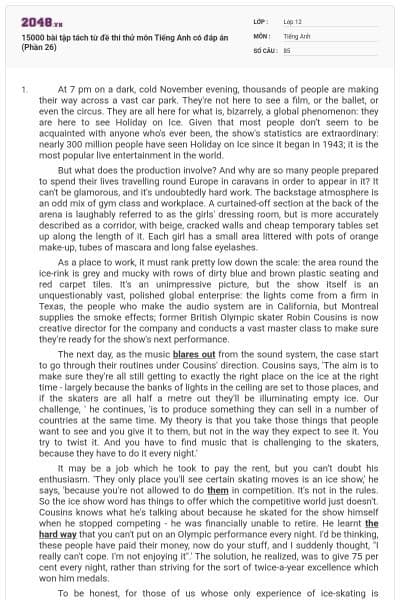
At 7 pm on a dark, cold November evening, thousands of people are making their way across a vast car park. They're not here to see a film, or the ballet, or even the circus. They are all here for what is, bizarrely, a global phenomenon: they are here to see Holiday on Ice. Given that most people don’t seem to be acquainted with anyone who's ever been, the show's statistics are extraordinary: nearly 300 million people have seen Holiday on Ice since it began in 1943; it is the most popular live entertainment in the world.
But what does the production involve? And why are so many people prepared to spend their lives travelling round Europe in caravans in order to appear in it? It can't be glamorous, and it's undoubtedly hard work. The backstage atmosphere is an odd mix of gym class and workplace. A curtained-off section at the back of the arena is laughably referred to as the girls' dressing room, but is more accurately described as a corridor, with beige, cracked walls and cheap temporary tables set up along the length of it. Each girl has a small area littered with pots of orange make-up, tubes of mascara and long false eyelashes.
As a place to work, it must rank pretty low down the scale: the area round the ice-rink is grey and mucky with rows of dirty blue and brown plastic seating and red carpet tiles. It's an unimpressive picture, but the show itself is an unquestionably vast, polished global enterprise: the lights come from a firm in Texas, the people who make the audio system are in California, but Montreal supplies the smoke effects; former British Olympic skater Robin Cousins is now creative director for the company and conducts a vast master class to make sure they're ready for the show's next performance.
The next day, as the music blares out from the sound system, the case start to go through their routines under Cousins' direction. Cousins says, 'The aim is to make sure they're all still getting to exactly the right place on the ice at the right time - largely because the banks of lights in the ceiling are set to those places, and if the skaters are all half a metre out they'll be illuminating empty ice. Our challenge, ' he continues, 'is to produce something they can sell in a number of countries at the same time. My theory is that you take those things that people want to see and you give it to them, but not in the way they expect to see it. You try to twist it. And you have to find music that is challenging to the skaters, because they have to do it every night.'
It may be a job which he took to pay the rent, but you can’t doubt his enthusiasm. 'They only place you'll see certain skating moves is an ice show,' he says, 'because you're not allowed to do them in competition. It's not in the rules. So the ice show word has things to offer which the competitive world just doesn't. Cousins knows what he's talking about because he skated for the show himself when he stopped competing - he was financially unable to retire. He learnt the hard way that you can't put on an Olympic performance every night. I'd be thinking, these people have paid their money, now do your stuff, and I suddenly thought, "I really can't cope. I'm not enjoying it".' The solution, he realized, was to give 75 per cent every night, rather than striving for the sort of twice-a-year excellence which won him medals.
To be honest, for those of us whose only experience of ice-skating is watching top-class Olympic skaters, some of the movements can look a bit amateurish, but then, who are we to judge? Equally, it's impossible not to be swept up in the whole thing; well, you'd have to try pretty hard not to enjoy it.
The writer describes the backstage area in order to show
how much fun the cast have during their work
how much preparation is needed for a performance
the type of skater that the show attracts
the conditions that the skaters put up with
Tác giả miêu tả khu vực sau sân khẩu đề thể hiện rằng: A. các diễn viên vui như thế nào trong công việc của họ B. chuẩn bị bao nhiêu là cần thiết cho một man trình diễn C. các loại vận động viên trượt băng người chương trình thu hút D. các điều kiện mà vận động viên trượt phải chịu đựng Câu 2 – 3 -4 – Đoạn 2: “It can't be glamorous, and it's undoubtedly hard work. The backstage atmosphere is an odd mix of gym class and workplace. A curtained-off section at the back of the arena is laughably referred to as the girls' dressing room, but is more accurately described as a corridor, with beige, cracked walls and cheap temporary tables set up along the length of it.” Tạm dịch: “Nó không hào nhoáng nhưng nó chắc chắc là công việc vất vả. Bầu không khí phía sau sân khấu là sự pha trôn kì lạ giữa lớp học thể dục và nơi làm việc. Một phần màn che ở mặt sau của đấu trường một cách nực cười gọi là phòng thay đồ cô gái, nhưng miêu tả một cách chính xác là một hành lang, với màu be, nứt tường và bàn rẻ tiền tạm thời đượng đặt dọc theo hành lang” Như vậy ta thấy sự thiếu thốn, cơ sở vật chất không có mà các vận động viên phải chịu đựng Đáp án D là đáp án đúng |
Dịch bài đọc
Vào lúc 7 giờ tối trong một buổi tối tháng 11 lạnh lẽo và u ám, hàng ngàn người đang đi qua một bãi đậu xe rộng lớn. Họ không đến đây để xem phim, hay xem ba lê, hay thậm chí là xem xiếc. Họ đều đến đây vì một hiện tượng kỳ lạ mang tính toàn cầu: họ đến đây để xem Holiday on Ice. Vì hầu hết mọi người dường như không quen biết bất kỳ ai đã từng đến, nên số liệu thống kê của chương trình này thật phi thường: gần 300 triệu người đã xem Holiday on Ice kể từ khi chương trình bắt đầu vào năm 1943; đây là chương trình giải trí trực tiếp phổ biến nhất trên thế giới.
Nhưng chương trình này bao gồm những gì? Và tại sao nhiều người lại sẵn sàng dành cả cuộc đời để đi khắp châu Âu bằng xe kéo để được xuất hiện trong chương trình? Nó không thể hào nhoáng và chắc chắn là rất vất vả. Không khí hậu trường là sự kết hợp kỳ lạ giữa lớp thể dục và nơi làm việc. Một phần có rèm che ở phía sau đấu trường được gọi một cách buồn cười là phòng thay đồ của các cô gái, nhưng được mô tả chính xác hơn là một hành lang, với những bức tường màu be nứt nẻ và những chiếc bàn tạm thời rẻ tiền được dựng dọc theo chiều dài của nó. Mỗi cô gái có một khu vực nhỏ rải rác những lọ đồ trang điểm màu cam, ống mascara và lông mi giả dài.
Là một nơi để làm việc, nó phải được xếp hạng khá thấp trong thang điểm: khu vực xung quanh sân trượt băng có màu xám và bẩn thỉu với những hàng ghế nhựa màu xanh và nâu bẩn thỉu và những tấm thảm trải sàn màu đỏ. Đó là một bức tranh không mấy ấn tượng, nhưng bản thân chương trình này chắc chắn là một doanh nghiệp toàn cầu rộng lớn và được đánh bóng: ánh sáng đến từ một công ty ở Texas, những người tạo ra hệ thống âm thanh ở California, nhưng Montreal cung cấp hiệu ứng khói; cựu vận động viên trượt băng Olympic người Anh Robin Cousins hiện là giám đốc sáng tạo cho công ty và điều hành một lớp học nâng cao rộng lớn để đảm bảo họ đã sẵn sàng cho buổi biểu diễn tiếp theo của chương trình.
Ngày hôm sau, khi âm nhạc vang lên từ hệ thống âm thanh, vụ án bắt đầu thực hiện các thói quen của họ dưới sự chỉ đạo của Cousins. Cousins nói, 'Mục đích là đảm bảo rằng tất cả họ vẫn đến đúng vị trí trên băng vào đúng thời điểm - phần lớn là vì các dãy đèn trên trần nhà được đặt ở những vị trí đó và nếu tất cả những người trượt băng đều ở ngoài nửa mét, họ sẽ chiếu sáng những tảng băng trống. Thách thức của chúng tôi, ' ông tiếp tục, 'là tạo ra thứ gì đó mà họ có thể bán ở nhiều quốc gia cùng một lúc. Lý thuyết của tôi là bạn lấy những thứ mà mọi người muốn xem và đưa cho họ, nhưng không phải theo cách họ mong đợi. Bạn cố gắng bóp méo nó. Và bạn phải tìm ra âm nhạc có tính thách thức đối với những người trượt băng, vì họ phải làm điều đó mỗi đêm.'
Có thể đó là công việc mà anh ấy làm để trả tiền thuê nhà, nhưng bạn không thể nghi ngờ sự nhiệt tình của anh ấy. 'Họ chỉ đặt một số động tác trượt băng nhất định trong chương trình biểu diễn trên băng,' anh ấy nói, 'vì bạn không được phép thực hiện chúng trong cuộc thi. Điều đó không có trong luật. Vì vậy, từ chương trình biểu diễn trên băng có những thứ để cung cấp mà thế giới cạnh tranh không có. Cousins biết anh ấy đang nói gì vì anh ấy đã trượt băng cho chương trình khi anh ấy ngừng thi đấu - anh ấy không có khả năng tài chính để nghỉ hưu. Anh ấy đã học được một bài học khó khăn rằng bạn không thể biểu diễn Olympic mỗi đêm. Tôi đã nghĩ, những người này đã trả tiền của họ, giờ thì làm việc của bạn đi, và tôi đột nhiên nghĩ, "Tôi thực sự không thể đối phó được. Tôi không thích điều đó". Anh ấy nhận ra rằng giải pháp là phải cống hiến 75 phần trăm mỗi đêm, thay vì phấn đấu để đạt được sự xuất sắc hai lần một năm giúp anh ấy giành được huy chương.
Thành thật mà nói, đối với những người trong chúng ta chỉ có kinh nghiệm trượt băng là xem các vận động viên trượt băng Olympic hàng đầu, một số động tác có thể trông hơi nghiệp dư, nhưng sau đó, chúng ta là ai để phán xét? Tương tự như vậy, không thể không bị cuốn vào toàn bộ mọi thứ; tốt, bạn sẽ phải cố gắng rất nhiều để không thích nó.
The word blares out in paragraph 4 is closest in meaning to
seeps out
sounds beautifully
resounds loudly
rings
Blarses out: âm thanh to
A. seep out: thấm ra
B. sound beautifully: âm thanh hay
C. resound loudly: vang lên ầm ĩ
D. ring: kêu, đổ chuông
Đáp án C có nghĩa gần nhất với từ in đậmWhat does the writer highlight about the show in the third paragraph?
the difficulty of finding suitable equipment
the need for a higher level of professional support
the range of companies involved in the production
the variety of places in which the show has been staged
Câu 1 – Đoạn 3: “As a place to work, it must rank pretty low down the scale: the area round the ice-rink is grey and mucky with rows of dirty blue and brown plastic seating and red carpet tiles. It's an unimpressive picture, but the show itself is an unquestionably vast, polished global enterprise: the lights come from a firm in Texas, the people who make the audio system are in California, but Montreal supplies the smoke effects; former British Olympic skater Robin Cousins is now creative director for the company and conducts a vast master class to make sure they're ready for the show's next performance.”
Tạm dich: “Là một nơi làm việc, nó phải xếp hạng khá thấp về phạm vi: khu vực quanh sân trượt có màu xám với những hàng ghế nhựa màu xanh bẩn thỉu và nâu bẩn và gạch thảm đỏ. Đây là một hình ảnh không mấy ấn tượng, nhưng các chương trình lớn không có nghi ngờ gì, được đánh bóng bằng doanh nghiệp toàn cầu: ánh sáng đến từ một công ty ở Texas, những người làm cho các hệ thống âm thanh đang ở California, nhưng Montreal cung cấp các hiệu ứng khói; cựu vận động viên Olympic Robin Cousins - anh giờ là giám đốc sáng tạo cho công ty và quản lí các bậc thầy để đảm bảo rằng họ đã sẵn sàng để thực hiện tiếp theo của chương trình.”
Như vậy ta thấy đoạn 3 – đề cập đến phạm vi mà công ty sản xuấtThe word them in paragraph 5 refers to
skating moves
skating competitions
things that people want to see
the skaters
Câu 2 – Đoạn 4: “They only place you'll see certain skating moves is an ice show,' he says, 'because you're not allowed to do them in competition.”
Tạm dịch: “"Chúng chỉ diễn ra bạn sẽ thấy chuyển động trượt chắc chắn là một chương trình băng," ông nói, "bởi vì bạn không được phép để làm như vậy trong cuộc thi.”
Làm như vậy ở đây chính là : - chuyển động trượt băng
Đáp án A đúng nhấtFor Robin Cousins, the key point when rehearsing skating routines is
keeping in time with the music
the skaters' positions on the ice
the movement of the lights
filling all available space on the ice
Câu 2 – Đoạn 3: “Cousins says, 'The aim is to make sure they're all still getting to exactly the right place on the ice at the right time - largely because the banks of lights in the ceiling are set to those places, and if the skaters are all half a metre out they'll be illuminating empty ice.”
Tạm dịch: Cousins nói, "Mục đích là để đảm bảo rằng tất cả chúng vẫn nhận chính xác đúng nơi trên băng vào đúng thời điểm - chủ yếu là do bên bờ đèn trên trần nhà được thiết lập để những nơi đó, và nếu trượt ván là tất cả một nửa mét ra họ sẽ được chiếu sáng băng trống.”
Đáp án B là đáp án đúngCousins believes that he can meet the challenge of producing shows for different audiences
by adapting movements to suit local tastes
by presenting familiar material in an unexpected way
by selecting music that local audiences will respond to
by varying the routines each night
Dòng 5 6 7 – đoạn 4: “My theory is that you take those things that people want to see and you give it to them, but not in the way they expect to see it. You try to twist it. And you have to find music that is challenging to the skaters, because they have to do it every night.'”
Tạm dịch : “Lí thuyết của tôi là bạn lấy những thứ cái mà mọi người muốn xem và bạn cung cấp cho họ, nhưng không phải theo cách mà họ muốn xem nó. Bạn nên cố gắng thay đổi cách thể hiện nó. Và bạn phải tìm âm nhạc cái mà thách thức được các nghệ sĩ trượt, vì họ phải làm điều đó mỗi tối”
Đáp án B – được trình diễn các chất liệu quen thuộc theo cách bất ngờ => đáp án B đung nhấtWhat is meant by 'the hard way'?
through making a lot of errors
through difficult personal experience
by misunderstanding the expectations of others
by over-estimating the ability of others
Câu 5 – 6 – Đoạn 5: “Cousins knows what he's talking about because he skated for the show himself when he stopped competing - he was financially unable to retire. He learnt the hard way that you can't put on an Olympic performance every night.”
Tạm dịch: “Cousins biết những gì ông nói về vì anh đã trượt băng cho chương trình của mình khi anh dừng hẳn việc thi đấu - anh không thể nghỉ hưu vì mặt tài chính. Ông đã học trượt băng 1 cách khó khăn cái mà bạn không thể thấy ở một biểu diễn Olympic mỗi đêm.”
Như vậy ta thấy việc ông ấy học trải qua giai đoạn dài khó khăn nên có nhiều kinh nghiệm trong lĩnh vực này.
có nghĩa là gì 'một cách khó khăn' trong đoạn văn ?
A. thông qua làm ra nhiều lỗi
B. thông qua kinh nghiệm cá nhân khó khăn
C. do hiểu nhầm sự mong đợi của người khác
D. bởi đánh giá quá mức khả năng của người khác
Đáp án B thích hợp nhấtWhat conclusion does the writer draw about Holiday on Ice?
It is hard to know who really enjoys it
It requires as much skill as Olympic ice-skating
It is more enjoyable to watch than formal ice-skating
It is difficult to dislike it
Câu cuối – Đoạn 1: “Equally, it's impossible not to be swept up in the whole thing; well, you'd have to try pretty hard not to enjoy it.”
Tạm dich: “Một cách công bằng, thật khó mà không thể không bị cuốn hút vào tất cả mọi thứ; bạn thấy rằng khó mà không thưởng thức nó.”
Đoạn này ý rằng: Nó rất lôi cuốn – nên chúng ta khó có thể không thích nó
Đáp án D đúng nhấtBefore the 1500’s, the western plains of North America were dominated by farmers. One group, the Mandans, lived in the upper Missouri River country, primarily in present – day North Dakota. They had large villages of houses built close together. The tight arrangement enabled the Mandans to protect themselves more easily from the attacks of others who might seek to obtain some of the food these highly capable farmers stored from one year to the next.
The women had primary responsibility for the fields. They had to exercise considerable skill to produce the desired results, for their northern location meant fleeting growing seasons. Winter often lingered; autumn could be ushered in by severe frost. For good measure, during the spring and summer, drought, heat, hail, grasshoppers, and other frustrations might await the wary grower.
Under such conditions, Mandan women had to grow maize capable of weathering adversity. They began as early as it appeared feasible to do so in the spring, clearing the land, using fire to clear stubble from the fields and then planting. From this point until the first green corn could be harvested, the crop required labor and vigilance.
Harvesting proceeded in two stages. In August the Mandans picked a smaller amount of the crop before it had matured fully. This green corn was boiled, dried and shelled, with some of the maize slated for immediate consumption and the rest stored in animal – skin bags. Later in the fall, the people picked the rest of the corn. They saved the best of the harvest for seeds or for trade, with the remainder eaten right away or stored for alter use in underground reserves. With appropriate banking of the extra food, the Mandans protected themselves against the disaster of crop failure and accompany hunger.
The woman planted another staple, squash, about the first of June, and harvested it near the time of the green corn harvest. After they picked it, they sliced it, dried it, and strung the slices before they stored them. Once again, they saved the seeds from the best of the year’s crop. The Mandans also grew sunflowers and tobacco; the latter was the particular task of the older men.
What is the main topic of the passage ?
The agricultural activities of a North American Society
Various ways corn can be used.
The problems encountered by farmers specializing in growing once crop
Weather conditions on the western plains.
The Mandans built their houses close together in order to ____________.
share farming implements
guard their supplies of food
protect themselves against the weather
allow more room for growing corn
Câu cuối – Đoạn 1: “The tight arrangement enabled the Mandans to protect themselves more easily from the attacks of others who might seek to obtain some of the food these highly capable farmers stored from one year to the next.”
Tạm dịch: “Việc bố trí chặt chẽ cho phép các Mandans để tự bảo vệ mình một cách dễ dàng khỏi các cuộc tấn công của những người khác người mà tìm kiếm để có được một số các thực phẩm của những nông dân này tích trữ từ năm này đến năm khác.
Như vậy ta thấy đáp án B: bảo vệ thực phẩm của họWhy does the author believe that the Mandans were skilled farmers?
They developed new varieties of corn.
They could grow crops despite adverse weather.
They developed effective fertilizers.
They could grow crops in most types of soil.
Câu 2 -3 – Đoạn 2: “They had to exercise considerable skill to produce the desired results, for their northern location meant fleeting growing seasons. Winter often lingered; autumn could be ushered in by severe frost.”
Tạm dịch: “Họ đã phải tập luyện khá nhiều kỹ năng sản xuất có được các kết quả mong muốn, vì vị trí phía bắc của họ có nghĩa là mùa sinh trưởng ngắn. Mùa đông thường dài; mùa thu có thể kèm theo sương giá khắc nghiệt. “
Ta thấy thời tiết ở nơi đây rất khắc nghiệt vì vậy để có vụ mua tốt người nông dân phải có kĩ năng tốt.Which of the following processes does the author imply was done by both men and women
clearing fields
Harvesting corn
Harvesting squash
Planting corn
Câu 2 – 3 – Đoạn 3: “. They began as early as it appeared feasible to do so in the spring, clearing the land, using fire to clear stubble from the fields and then planting. From this point until the first green corn could be harvested, the crop required labor and vigilance.”
Tạm dịch: “Họ bắt đầu vụ có tính khả thi nhất là vào mùa xuân dọn dẹp mặt bằng, sử dụng lửa để xóa gốc rạ ở đồng và sau đó trồng cây. Từ thời điểm này cho đến khi ngô xanh đầu tiên có thể được thu hoạch,vụ mùa cần lao động và sự cảnh giác ".
Ta thấy công việc này yêu câu lao động và sự cảnh giác nên phải cả phụ nữ và đàn ông cùng làm việc.
Đáp án B đúng nhấtThe word “disaster” in paragraph 4 is closest in meaning to __________
catastrophe
history.
control
avoidance
Disaster (n) thảm họa
A. Catastrophe (n) thảm họa , thiên tai
B. History (n) lịch sử
C. Control (n) sự điều khiển
D. Avoidance (n) sự tránh né
Đáp án đúng: AThe word “them” in the last paragraph refers to _________.
women
seeds
slices
the Mandans
“After they picked it, they sliced it, dried it, and strung the slices before they stored them.”
Tạm dịch: “Sau khi họ nhặt nó, họ cắt nó, khô nó, và xâu thành chuỗi những lát thái trước khi chúng được lưu trữ chúng.”
Như vậy ta thấy” them” ở đây chính là “slices”
Throughout the passage, the author implies that the Mandans _________.
valued individuality
were very adventurous
were open to strangers
planned for the future
Tạm dịch: Trong suốt đoạn văn, tác giả ngụ ý rằng Mandans ________. A. có giá trị cá nhân B. là rất mạo hiểm C. mở cửa cho người lạ D. lên kế hoạch cho tương lai Đọc toàn bộ nội dung của bài ta thấy mọi hành động, việc lam của người đều lên kế hoạch sẵn cho tương lai. Ví dụ: Câu cuối – Đoạn 1: “The tight arrangement enabled the Mandans to protect themselves more easily from the attacks of others who might seek to obtain some of the food these highly capable farmers stored from one year to the next.” Tạm dịch: “Việc bố trí chặt chẽ cho phép các Mandans để tự bảo vệ mình một cách dễ dàng khỏi các cuộc tấn công của những người khác người mà tìm kiếm để có được một số các thực phẩm của những nông dân này tích trữ từ năm này đến năm khác. Câu 2 -3 – Đoạn 2: “They had to exercise considerable skill to produce the desired results, for their northern location meant fleeting growing seasons. Winter often lingered; autumn could be ushered in by severe frost.” Tạm dịch: “Họ đã phải tập luyện khá nhiều kỹ năng sản xuất có được các kết quả mong muốn, vì vị trí phía bắc của họ có nghĩa là mùa sinh trưởng ngắn. Mùa đông thường dài; mùa thu có thể kèm theo sương giá khắc nghiệt. “ Câu 3 – 4- 5 – Đoạn 4: “Later in the fall, the people picked the rest of the corn. They saved the best of the harvest for seeds or for trade, with the remainder eaten right away or stored for alter use in underground reserves. With appropriate banking of the extra food, the Mandans protected themselves against the disaster of crop failure and accompany hunger.” Tất cả việc họ làm đều tính toán và lên kế hoạch cho tương lai. |
Even with his diverse experience as an elected official at the state level, Andrew Johnson was the first president of the United States ever to be impeached, primarily because of his violent temper and unyielding stubbornness. His career started in 1828 with his collection to the city council of Greenville, Tennessee, and after two years as an alderman, he took office as mayor. His advancements followed in rapid succession when he was elected to the Tennessee state senate, then as the state governor, and later to the U.S. House of Representatives for five consecutive terms.
In 1864, Johnson ran for the office of vice-president on the Lincoln- Johnson ticket and was inaugurated in 1865. After Lincoln’s assassination six weeks into his term, Johnson found himself president at a time when southern leaders were concerned about their forced alliance with the northern states and feared retaliation for their support of the secession. Instead, however, with the diplomatic skill he had learned from Lincoln, Johnson offered full pardon to almost all Confederates on the condition that they take an oath of allegiance. He further reorganized the former Confederate states and set up legislative elections.
Congressional opposition to his peace- making policies resulted in gridlock between the House and Johnson, and the stalemate grew into an open conflict on the issue of the emancipation of slaves. While Johnson held the view that newly freed slaves lacked understanding and knowledge of civil liberties to vote intelligently, Congress overrode Johnson’s veto of the Civil Rights Bill, which awarded them citizenship and ratified the Fourteenth Amendment. In the years that followed, Congress passed bills depriving the president of the power to pardon political criminals, stripping away his status of commander-in-chief, and taking away Johnson’s right to dismiss civil and executive officers from their duties. Johnson vetoed each bill, and each veto was overridden. When Johnson dismissedvthe secretary of war, Edwin Stanton, Stanton refused to step down and was supported by the House of Representatives, which voted to impeach Johnson. At the trial, the Senate came one vote short of the two-thirds majority necessary to remove him from office. After Johnson’s term expired, he returned to his home state, but in 1875 he was elected senator and went back to Washington to take his seat.
What does the passage mainly discuss?
Andrew Johnson’s career as a politician
Congressional decisions in the late 1800s
Andrew Johnson’s personal characteristics
Congressional decisions and procedures in the late 1800s
Giải thích: Toàn bộ bài đọc nói về quá trình làm chính trị của Andrew Johnson, từ lúc ông còn làm lãnh đạo cấp tiểu bang đến khi làm tổng thống đến khi bị bãi miễn chức vụ.
Phương án A. Andrew Johnson’s career as a politician = sự nghiệp của Andrew Johnson như một chính trị gia, là phương án chính xác nhất
B. Congressional decisions in the late 1800s = Các quyết định của Quốc hội vào cuối những năm 1800.
Đây chỉ là thông tin đưa ra để giải thích cho sự bị bãi nhiệm của ông.
C. Andrew Johnson’s personal characteristics = Tính cách cá nhân của Andrew Johnson.
Đây chỉ là thông tin đưa ra để giải thích cho sự bị bãi nhiệm của ông.
D. Congressional decisions and procedures in the late 1800s = Các quyết định của Quốc hội và các thủ tục vào cuối những năm 1800.Dịch bài đọc
Ngay cả với kinh nghiệm đa dạng của mình với tư cách là một viên chức được bầu ở cấp tiểu bang, Andrew Johnson vẫn là tổng thống đầu tiên của Hoa Kỳ bị luận tội, chủ yếu là vì tính khí hung dữ và sự bướng bỉnh không chịu khuất phục của ông. Sự nghiệp của ông bắt đầu vào năm 1828 với việc ông nộp đơn xin vào hội đồng thành phố Greenville, Tennessee, và sau hai năm làm thị trưởng, ông đã nhậm chức thị trưởng. Ông thăng tiến nhanh chóng khi được bầu vào thượng viện tiểu bang Tennessee, sau đó là thống đốc tiểu bang và sau đó là Hạ viện Hoa Kỳ trong năm nhiệm kỳ liên tiếp.
Năm 1864, Johnson ứng cử chức phó tổng thống theo liên danh Lincoln-Johnson và nhậm chức vào năm 1865. Sau vụ ám sát Lincoln sáu tuần sau khi nhậm chức, Johnson trở thành tổng thống vào thời điểm các nhà lãnh đạo miền Nam lo ngại về liên minh cưỡng ép của họ với các tiểu bang phía Bắc và lo sợ bị trả thù vì ủng hộ việc ly khai. Tuy nhiên, thay vào đó, với kỹ năng ngoại giao học được từ Lincoln, Johnson đã ân xá hoàn toàn cho hầu hết những người theo Liên minh miền Nam với điều kiện họ phải tuyên thệ trung thành. Ông tiếp tục tổ chức lại các tiểu bang Liên minh miền Nam trước đây và thiết lập các cuộc bầu cử lập pháp.
Sự phản đối của Quốc hội đối với các chính sách hòa giải của ông đã dẫn đến bế tắc giữa Hạ viện và Johnson, và sự bế tắc đã phát triển thành một cuộc xung đột công khai về vấn đề giải phóng nô lệ. Trong khi Johnson cho rằng những nô lệ mới được giải phóng thiếu hiểu biết và kiến thức về quyền tự do dân sự để bỏ phiếu một cách thông minh, Quốc hội đã phủ quyết quyền phủ quyết của Johnson đối với Dự luật Dân quyền, trao cho họ quyền công dân và phê chuẩn Tu chính án thứ Mười bốn. Trong những năm sau đó, Quốc hội đã thông qua các dự luật tước quyền ân xá tội phạm chính trị của tổng thống, tước bỏ tư cách tổng tư lệnh của ông và tước quyền của Johnson trong việc sa thải các viên chức dân sự và hành pháp khỏi nhiệm vụ của họ. Johnson phủ quyết từng dự luật và mỗi quyền phủ quyết đều bị phủ quyết. Khi Johnson sa thải bộ trưởng chiến tranh Edwin Stanton, Stanton từ chối từ chức và được Hạ viện ủng hộ, nơi đã bỏ phiếu luận tội Johnson. Tại phiên tòa, Thượng viện thiếu một phiếu để đạt được đa số hai phần ba cần thiết để bãi nhiệm ông. Sau khi nhiệm kỳ của Johnson kết thúc, ông trở về tiểu bang quê nhà, nhưng vào năm 1875, ông được bầu làm thượng nghị sĩ và trở lại Washington để nhận ghế của mình.
What can be inferred from the first paragraph about Andrew Johnson’s work in Tennessee?
He was represented to the posts five times.
His personality precluded him from important positions.
His work became known to the governor.
He was elected to several important posts.
Thông tin: His career started in 1828 with his collection to the city council of Greenville, Tennessee, and after two years as an alderman, he took office as mayor. His advancements followed in rapid succession when he was elected to the Tennessee state senate, then as the state governor, and later to the U.S. House of Representatives for five consecutive terms. Dịch nghĩa: Sự nghiệp của ông bắt đầu vào năm 1828 với sự gia nhập hội đồng thành phố Greenville, bang Tennessee, và sau hai năm như là một hội viên cao niên, ông nhậm chức thị trưởng. Sự thăng cấp của ông theo sau trong sự kề thừa nhanh chóng khi ông được bầu vào thượng viện bang Tennessee, sau đó là thống đốc tiểu bang, và sau đó đến Hạ viện Hoa Kỳ cho năm nhiệm kỳ liên tiếp. Phương án D. He was elected to several important posts = Ông được bổ nhiệm vào một vài chức vụ quan trọng, là phương án chính xác nhất A. He was represented to the posts five times = Ông đã được đại diện cho những vị trí ấy năm lần. Không có thông tin như vậy trong bài. B. His personality precluded him from important positions = Tính cách của ông ngăn cản ông từ các vị trí quan trọng. Chỉ có thông tin cho rằng tính cách của ông khiến ông bị bãi nhiệm tổng thống, chứ không có thông tin nói rằng tính cách ấy ngăn cản ông đến với chức vụ quan trọng. . C. His work became known to the governor = Công việc của ông được biết đến với các thống đốc Không có thông tin như vậy trong bài. |
According to the passage, what led to Johnson’s downfall?
His personal characteristics
His waffling and hesitation
The state of the nation’s economy
His liberal position on slavery
Thông tin: Even with his diverse experience as an elected official at the state level, Andrew Johnson was the first president of the United States ever to be impeached, primarily because of his violent temper and unyielding stubbornness.
Dịch nghĩa: Ngay cả với kinh nghiệm đa dạng của mình như là một viên chức dân cử ở cấp tiểu bang, Andrew Johnson là tổng thống đầu tiên của Hoa Kỳ từng bị luận tội, chủ yếu là vì tính khí bạo lực của mình và sự bướng bỉnh không chịu thua.
Như vậy nguyên nhânchính dẫn đến việc bị luận tội, hay chính là sự sụp đổ sự nghiệp của ông là do tính cách của ông. Phương ánA. His personal characteristics = tính cách cá nhân của ông, là phương án chính xác nhất.
B His waffling and hesitation = Sự lảm nhảm và chần chừ của ông.
Không có thông tin như vậy trong bài.
C. The state of the nation’s economy = Tình trạng kinh tế của quốc gia.
Không có thông tin như vậy trong bài.
D. His liberal position on slavery = Quan điểm tự do của ông về chế độ nô lệ.
Không có thông tin như vậy trong bài.According to the passage, Congress’s disapproval of Andrew Johnson’s policies was
directed at his civic duties
short-lived and groundless
detrimental to his presidency
stopped as soon as it emerged
Thông tin: Congressional opposition to his peace - making policies resulted in gridlock between the House and Johnson, and the stalemate grew into an open conflict on the issue of the emancipation of slaves… In the years that followed, Congress passed bills depriving the president of the power to pardon political criminals, stripping away his status of commander-in-chief, and taking away Johnson’s right to dismiss civil and executive officers from their duties. Dịch nghĩa: Sự phản đối của Quốc hội đối với chính sách hòa bình của ông dẫn đến sự bế tắc giữa các Viện và Johnson, và bế tắc phát triển thành một cuộc xung đột mở về vấn đề giải phóng nô lệ ... Trong những năm sau đó, Quốc hội thông qua dự luật tước quyền Tổng thống về tha thứ cho tội phạm chính trị, tước đi địa vị chỉ huy trưởng, và lấy đi quyền của Johnson để miễn nhiệm cán bộ dân sự và điều hành từ nhiệm vụ của họ. Như vậy sự phản đối của Quốc hội gây hại lớn tới sự nghiệp của Johnson. Phương án C. detrimental to his presidency = gây hại cho sự nghiệp tổng thống của ông, là phương án chính xác nhất. A. directed at his civic duties = hướng vào nghĩa vụ công dân của ông Không có thông tin như vậy trong bài. B. short-lived and groundless = ngắn ngủi và không có căn cứ Không có thông tin như vậy trong bài. D. stopped as soon as it emerged = dừng lại ngay khi nó xuất hiện. Không có thông tin như vậy trong bài. |
In line 21, the word “pardon” is closest in meaning to
exonerate
parade
patronize
extricate
Giải thích: Pardon (v) = tha thứ, tha tội
Exonerate (v) = tha bổng, miễn tội
Dịch nghĩa: In the years that followed, Congress passed bills depriving the president of the power to pardon political criminals, stripping away his status of commander-in-chief, and taking away Johnson’s right to dismiss civil and executive officers from their duties. = Trong những năm sau đó, Quốc hội thông qua dự luật tước quyền Tổng thống về tha thứ cho tội phạm chính trị, tước đi địa vị chỉ huy trưởng, và lấy đi quyền của Johnson để miễn nhiệm cán bộ dân sự và điều hành từ nhiệm vụ của họ.
B. parade (v) = diễu hành
C. patronize (v) = bảo trợ
D. extricate (v) = giải thoátAccording to the passage, the attempt to impeach Andrew Johnson
overwhelmed his supporters in Tennessee
succeeded as expected by the House
failed by a minimal margin
put an end to his political career
Thông tin: At the trial, the Senate came one vote short of the two-thirds majority necessary to remove him from office. Dịch nghĩa: Tại phiên tòa, Thượng viện thiếu một phiếu của hai phần ba tổng số cần thiết để loại bỏ ông khỏi văn phòng. Như vậy nỗ lực bãi nhiệm Johnson chỉ thiếu 1 phiếu nữa là thành công, đó là một khoảng cách rất nhỏ. Phương án C. failed by a minimal margin = thất bại với khoảng cách tối thiểu, là phương án chính xác nhất. A. overwhelmed his supporters in Tennessee = choáng ngợp người ủng hộ ông ở Tennessee Không có thông tin như vậy trong bài. B. succeeded as expected by the House = đã thành công như mong đợi của các nhà Không có thông tin như vậy trong bài. D. put an end to his political career = đặt dấu chấm hết cho sự nghiệp chính trị của ông Không có thông tin như vậy trong bài. |
The author of the passage implies that when Johnson became president he
had already experienced political turmoil
was a dedicated supporter of civil rights
was a soft-spoken and careful diplomat
had an extensive background in politics
Giải thích: Even with his diverse experience as an elected official at the state level, Andrew Johnson was the first president of the United States ever to be impeached, primarily because of his violent temper and unyielding stubbornness. Dịch nghĩa: Ngay cả với kinh nghiệm đa dạng của mình như là một viên chức dân cử ở cấp tiểu bang, Andrew Johnson là tổng thống đầu tiên của Hoa Kỳ từng bị luận tội, chủ yếu là vì tính khí bạo lực của mình và sự bướng bỉnh không chịu thua. Ở cấp tiểu bang, Andrew Johnson đã có kinh nghiệm đa dạng trong lĩnh vực chính trị, hàm ý là khi ông lên làm tổng thống, ông đã có nền tảng chính trị dày dặn. Phương án D. had an extensive background in politics = đã có một nền tảng rộng lớn trong chính trị, là phương án chính xác nhất. A. had already experienced political turmoil = đã có kinh nghiệm bất ổn chính trị. After Lincoln’s assassination six weeks into his term, Johnson found himself president at a time when southern leaders were concerned about their forced alliance with the northern states and feared retaliation for their support of the secession = Sau vụ ám sát Lincoln sáu tuần vào nhiệm kỳ của mình, Johnson thấy mình là tổng thống tại một thời điểm khi các nhà lãnh đạo miền Nam lo ngại về liên minh bắt buộc của họ với các bang miền Bắc và sợ bị trả thù cho sự ủng hộ của sự ly khai. Sự bất ổn chính trị xảy ra sau khi ông lên làm tổng thống chứ không phải trước. B. was a dedicated supporter of civil rights = là một người ủng hộ nhiệt tình của các quyền dân sự. While Johnson held the view that newly freed slaves lacked understanding and knowledge of civil liberties to vote intelligently, Congress overrode Johnson’s veto of the Civil Rights Bill, which awarded them citizenship and ratified the Fourteenth Amendment = Trong khi Johnson có quan điểm rằng các nô lệ mới được trả tự do thiếu hiểu biết và kiến thức về tự do dân bầu một cách thông minh, Quốc hội gạt quyền phủ quyết của Johnson về Bản dự luật Quyền Dân sự, cái trao cho họ quyền công dân và phê duyệt Tu chính án thứ mười bốn. Như vậy ông là một người ủng hộ nhiệt tình của các quyền dân sự, nhưng sự việc đó xảy ra sau khi ông lên làm Tổng thống. C. was a soft-spoken and careful diplomat = là một nhà ngoại giao nói nhỏ nhẹ và cẩn thận. Instead, however, with the diplomatic skill he had learned from Lincoln, Johnson offered full pardon to almost all Confederates on the condition that they take an oath of allegiance. = Thay vào đó, tuy nhiên, với các kỹ năng ngoại giaoông đã học được từ Lincoln, Johnson cung cấp lệnh tha bổng hoàn toàn cho gần như tất cả các quân miền Nam với điều kiện là họ phải thề trung thành. Như vậy Johnson không hề là một nhà ngoại giao nhỏ nhẹ và cẩn thận mà rất quyết đoán. |
Even before the turn of the century, movies began to develop in two major directions: the realistic and the formalistic. Realism and formalism are merely general, rather than absolute, terms. When used to suggest a tendency toward either polarity, such labels can be helpful, but in the end they are just labels. Few films are exclusively formalist in style, and fewer yet are completely realist. There is also an important difference between realism and reality, although this distinction is often forgotten. Realism is a particular type, whereas physical reality is the source of all the raw materials of film, both realistic and formalistic. Virtually, all movie directors go to the photographable world for their subject matter, but what they do with this material- how they shape and manipulate it- determines their stylistic emphasis.
Generally speaking, realistic films attempt to reproduce the surface of concrete reality with a minimum of distortion. In photographing objects and events, the Filmmaker tries to suggest the copiousness of life itself. Both realist and formalist film directors must select (and hence emphasize) certain details from the chaotic sprawl of reality. But the element of selectivity in realistic films is less obvious. Realists, in short, to preserve the illusion that their film world is unmanipulated, an objective mirror the actual world. Formalists, on the other hand, make no such pretense. They deliberately stylize and distort their raw materials so that only the very naive would mistake a manipulated image of an object or event for the real thing. We rarely notice the style in a realistic movie; the artist tends to be self-effacing. The filmmakers are more concerned with what is being shown than how it is manipulated. The camera is used conservatively. It is essentially a recording mechanism that produces the surface of tangible objects with as little commentary as possible. A high premium is placed on simplicity, spontaneity, and directness. It is not to suggest that these movies lack artistry, however, for at its best the realistic cinema specializes in art that conceals art.
What does the passage mainly discuss?
Styles of filmmaking
Filmmaking 100 years ago
Acting styles
Film plots
Giải thích: Câu chủ đề của bài viết là “Even before the turn of the century, movies began to develop in two major directions: the realistic and the formalistic.” = Ngay cả trước khi chuyển giao thế kỷ, phim bắt đầu phát triển theo hai hướng chính: thực tế và mang tính hình thức.
Đó là hai phong cáh làm phim khác nhau, sau đó tác giả đi sâu trình bày về hai phong cáh này. Do đó, ý chính của bài là phương án A. Styles of filmmaking = các phong cách làm phim
B. Filmmaking 100 years ago = Việc làm phim 100 năm trước.
Không có thông tin như vậy trong bài.
C. Acting styles = các phong cách diễn phim.
Không có thông tin như vậy trong bài.
D. Film plots = các kịch bản phim.
Không có thông tin như vậy trong bài.With which of the following statements would the author be most likely to agree?
Most films are neither exclusively realistic nor formalistic.
Realistic films are more popular than formalistic ones.
Realism and formalism are outdated terms.
Formalistic films are less artistic than realistic ones.
Thông tin: Few films are exclusively formalist in style, and fewer yet are completely realist.
Dịch nghĩa: Rất ít phim là duy nhất mang tính hình thức trong phong cách, và càng ít hơn là hoàn toàn mang tính hiện thực.
Phương án A. Most films are neither exclusively realistic nor formalistic = Hầu hết các bộ phim không hoàn toàn mang tính hiện thực hay mang tính hình thức; là phương án dễ được tác giả đồng tình nhất.
B. Realistic films are more popular than formalistic ones = Phim hiện thực phổ biến hơn so với phim mang tính hình thức.
Không có thông tin như vậy trong bài.
C. Realism and formalism are outdated terms = Chủ nghĩa hiện thực và chủ nghĩa hình thức là những khái niệm lỗi thời.
Không có thông tin như vậy trong bài.
D. Formalistic films are less artistic than realistic ones = Các bộ phim mang tính hình thức thì ít mang tính nghệ thuật hơn các bộ phim hiện thực.
Không có thông tin như vậy trong bài.The phrase "this distinction" in the first paragraph refers to the difference between
general and absolute
physical reality and raw materials
formalists and realists
realism and reality
Thông tin: There is also an important difference between realism and reality, although this distinction is often forgotten. Dịch nghĩa: Ngoài ra còn có một sự khác biệt quan trọng giữa chủ nghĩa thực tế và thực tế, mặc dù sự khác biệt này thường bị bỏ quên. Phương án D. realism and reality = chủ nghĩa thực tế và thực tế; là phương án chính xác nhất. A. general and absolute = nói chung và tuyệt đối. Realism and formalism are merely general, rather than absolute, terms = Chủ nghĩa hiện thực và chủ nghĩa hình thức chỉ là những khái niệm nói chung, chứ không phải tuyệt đối. Đây không phải là điều mà this distinction nói đến. B. physical reality and raw materials = thực tại vật lý và nguyên liệu thô Realism is a particular type, whereas physical reality is the source of all the raw materials of film, both realistic and formalistic = Chủ nghĩa hiện thực là một loại đặc biệt, trong khi thực tế vật chất là nguồn gốc của tất cả các nguyên liệu thô của các bộ phim, cả thực tế và mang tính hình thức. Đây không phải là điều mà this distinction nói đến. C. formalists and realists = Những người theo chủ nghĩa hình thức và những người theo chủ nghĩa hiện thực. Realists, in short, to preserve the illusion that their film world is unmanipulated, an objective mirror the actual world. Formalists, on the other hand, make no such pretense. = Những người theo chủ nghĩa hiện thực, tóm lại, để bảo tồn ảo tưởng rằng thế giới phim ảnh của họ là không bị thao túng, một tấm gương khách quan của thế giới thực tế. Những người theo chủ nghĩa hình thức, mặt khác, không giả vờ như vậy. Đây không phải là điều mà this distinction nói đến. |
Whom does the author say is primarily responsible for a style of film?
The producer
The camera operator
The director
The actors
Thông tin: Both realist and formalist film directors must select (and hence emphasize) certain details from the chaotic sprawl of reality.
Dịch nghĩa: Cả đạo diễn theo chủ nghĩa hiện thực và chủ nghĩa hình thức phải chọn (và do đó nhấn mạnh) chi tiết nhất định từ sự mở rộng hỗn loạn của thực tế.
Như vậy chính đạo diễn là người chịu trách nhiệm về phong cách của bộ phim. Phương án C. The director = đạo diễn, là phương án chính xác nhất.
A. The producer = Nhà sản xuất
B. The camera operator = Nguời quay phim
D. The actors = Các diễn viênThe word "Copiousness" in the second paragraph is closest in meaning to
abundance
greatness
fullness
variety
Giải thích: Copiousness (n) = nhiều, phong phú
Abundance (n) = sự nhiều nhặn, phong phú
Dịch nghĩa: In photographing objects and events, the Filmmaker tries to suggest the copiousness of life itself. = Trong chụp ảnh các đối tượng và các sự kiện, các nhà làm phim cố gắng đưa ra sự phong phú của chính cuộc sống.
B. greatness (n) = sự cao cả, sự vĩ đại
C. fullness (n) = sự trọn vẹn
D. variety (n) = sự đa dạng, chủng, loạiHow can one recognize the formalist style?
it mirrors the actual world.
it obviously manipulated images.
it uses familiar images.
it is very impersonal.
Thông tin: Formalists, on the other hand, make no such pretense. They deliberately stylize and distort their raw materials so that only the very naive would mistake a manipulated image of an object or event for the real thing.
Dịch nghĩa: Những người theo chủ nghĩa hình thức, mặt khác, không giả vờ như vậy. Họ cố tình bóp méo phong cách hóa và nguyên liệu của họ để chỉ người rất ngây thơ mới lầm tưởng một hình ảnh được chỉnh sửa của một đối tượng hoặc sự kiện với sự thật.
Phương án B. it obviously manipulated images = nó chỉnh sửa các hình ảnh một cách rõ ràng; là phương án chính xác nhất.
A. it mirrors the actual world = Nó phản chiếu thế giới thực.
Đây là đặc trưng của phim theo chủ nghĩa hiện thực.
C. it uses familiar images = nó sử dụng các hình ảnh quen thuộc.
Không có thông tin như vậy trong bài.
D. it is very impersonal = nó rất không mang tính cá nhân.
Không có thông tin như vậy trong bài.The word "tangible" in the last paragraph is closest in meaning to
various
comprehensible
concrete
complex
Giải thích: Tangible (adj) = Concrete (adj) = cụ thể
Dịch nghĩa: It is essentially a recording mechanism that produces the surface of tangible objects with as little commentary as possible. = Nó thực chất là một cơ chế ghi nhận mà sản xuất các bề mặt của các đối tượng cụ thể với ít bình luận nhất có thể.
A. various (adj) = nhiều, đa dạng
B. comprehensible (adj) = có thể hiểu được
D. complex (adj) = phức tạpWhich of the following films would most likely use a realist style?
A musical drama
An animated cartoon
A science fiction film
A travel documentary
Giải thích: Một bộ phim tài liệu về du lịch là teo phong cách phim hiện thực vì nó tôn trọng các diễn biến thực tế, và các tình tiết được chọn lọc sao cho người xem có cảm giác giống hiện thực nhất.
Ba thể loại phim còn lại đều có tính chất của phim có tính hình thức, với các hình ảnh được chủ động chỉnh sửa.
A. A musical drama = một bộ phim nhạc kịch
B. An animated cartoon = một bộ phim hoạt hình
C. A science fiction film = một bộ phim khoa học viễn tưởngBecause geologists have long indicated that fossil fuels will not last indefinitely, the U.S government finally acknowledged that sooner or later other energy sources would be needed and, as a result, turned its attention to nuclear power. It was anticipated that nuclear power plants could supply electricity in such large amounts and so inexpensively that they would be integrated into an economy in which electricity would take over virtually all fuel-generating functions at nominal cost. Thus, the government subsidized the promotion of commercial nuclear power plants and authorized their construction by utility companies. In the 1960s and early 1970s, the public accepted the notion of electricity being generated by nuclear power plants in or near residential areas. By 1975, 54 plants were fully operational, supplying 11 percent of the nation’s electricity, and another 167 plants were at various stages of planning and construction. Officials estimated that by 1990 hundreds of plants would be on line, and by the turn of the century as many as 1000 plants would be in working order.
Since 1975, this outlook and this estimation have changed drastically, and many utilizes have cancelled existing orders. In some cases, construction was terminated even after billions of dollars had already been invested. After being completed and licensed at a cost of almost $6 billion, the Shoreham Power Plant on Long Island was turned over to the state of New York to be dismantled without ever having generated electric power. The reason was that residents and state authorities deemed that there was no possibility of evacuating residents from the area should an accident occur.
Just 68 of those plants under way in 1975 have been completed, and another 3 are still under construction. Therefore, it appears that in the mid1990s 124 nuclear power plants in the nation will be in operation, generating about 18 percent of the nation’s electricity, a figure that will undoubtedly decline as relatively outdated plants are shut down
What was initially planned for the nation’s fuel supply in the 1950s and in the early 1960s?
Expansion and renovation of existing fuel-generating plants
Creation of additional storage capacities for fossil fuels
Conversion of the industry and the economy to nuclear power
Development of an array of alternative fuel and power sources
Cái gì được chuẩn bị đầu tiên cho việc cung cấp nhiên liệu cho quốc gia trong những năm 1950 và đầu những năm 1960? Đáp án C – Sự chuyển đổi ngành công nghiệp và nền kinh tế sang điện hạt nhân Dẫn chứng – Câu 1 – 2 – 3 – Đoạn 1: “Because geologists have long indicated that fossil fuels will not last indefinitely, the U.S government finally acknowledged that sooner or later other energy sources would be needed and, as a result, turned its attention to nuclear power. It was anticipated that nuclear power plants could supply electricity in such large amounts and so inexpensively that they would be integrated into an economy in which electricity would take over virtually all fuel-generating functions at nominal cost. Thus, the government subsidized the promotion of commercial nuclear power plants and authorized their construction by utility companies.” Tạm dịch – Bởi vì các nhà địa chất học đã chi ra rằng nhiên liệu hóa thạch sẽ không kéo dài vô hạn, chính phủ Mỹ cuối cùng đã thừa nhận rằng không sớm hoặc muộn các nguồn năng lượng khác sẽ là cần thiết và do đó đã chuyển sự chú ý đến năng lượng hạt nhân. Nó được liệu trước rằng nhà máy điện hạt nhân có thể cung cấp điện với số lượng lớn và không quá đắt cái chúng ta có thể kết kết trong 1 nền kinh tế cacis mà điện sẽ đảm nhận hầu hết các chức năng tạo ra nhiên liệu với chi phí thấp. Do đó, chính phủ đã trợ cấp cho việc quảng bá nhà máy điện hạt nhân và ủy quyền xây dựng cho các công ty đạt tiêu chuẩn hóa. Các đáp án khác A – Sự mở rộng và sự đổi mới của nhà máy sản xuất nhiên liệu có sẵn B - Tạo ra khả năng lưu trữ bổ sung cho nhiên liệu hóa thạch D - Phát triển một loạt các nguồn nhiên liệu và nguồn năng lượng thay thế |
How does the author describe the attitude of the population in regard to nuclear power as fuel in the early to the mid 1970s?
Apprehensive
Ambivalent
Receptive
Resentful
Tác giả miêu tả thái độ của dân số liên quan đến điện hạt nhân như là nhiên liệu vào đầu đến giữa năm 1970?
Đán án C – Receptive (a) tiếp thu, lĩnh hội
Dẫn chứng – Câu 4 – Đoạn 1: In the 1960s and early 1970s, the public accepted the notion of electricity being generated by nuclear power plants in or near residential areas.
Tạm dịch: Trong những năm 1960 và đầu những năm 70, công chúng đã chấp nhận khái niệm điện được tạo ra bởi các nhà máy điện hạt nhân tạo trong hoặc gần các khu dân cư.
Các đáp án khác
A – sợ hãi, e sợ
B – hai chiều
D – không bằng lòngIn line 5, the word “nominal” is closet in meaning to _____
so-called
minimal
exorbitant
inflated
Nominal (a) nhỏ bé (không đáng kể)
Đáp án đồng nghĩa B – minimal (a) rất nhỏ, tối thiểu
Các đáp án khác
A – cái gọi là
C – cao quá đáng (cắt cổ)
D – được thổi phồngIn line 7, the word “notion” is closet in meaning to _____
nonsense
notice
idea
consequence
Notion (n) ý niệm/ quan niệm; ý kiến, quan điểm
Đáp án đồng nghĩa: C – idea (n) quan niệm, ý tưởng, tư tưởng
Các đáp án khác
A – lời nói vô lí
B – yết thị, thông báo
D – kết quả, hậu quảIn line 13, the phrase “this outlook” refers to _____
the number of operating nuclear plants
the expectation for increase in the number of nuclear plants
the possibility of generating electricity at nuclear installations
the forecast for the capacity of the nuclear plants
Ở dòng 13, cụm từ “this outlook – quan điểm này” đề cập đến______
Đáp án B – sự mong đợi về sự tăng số lượng các nhà máy điện hạt nhân
Dẫn chứng – Câu cuối – Đoạn 1: “Officials estimated that by 1990 hundreds of plants would be on line, and by the turn of the century as many as 1000 plants would be in working order.”
Tạm dịch: Các quan chức ước tính rằng vào năm 1990, hàng trăm nhà máy sẽ được đưa vào hoạt động, và đến cuối thế kỷ này có tới 1000 nhà máy sẽ hoạt động tốt.
Câu đầu – Đoạn 2: “Since 1975, this outlook and this estimation have changed drastically,”
Tạm dịch: Từ năm 1975, quan điểm này và sự ước tính này đã thay đổi mạnh mẽ.
=> “THIS OUTLOOK” – thay thế cho chính ý câu cuối – đoạn 1
Các đáp án khác
A. Số lượng các nhà máy hạt nhân hoạt động
C. khả năng phát điện tại các cơ sở hạt nhân
D. dự báo khả năng của các nhà máy hạt nhânIt can be inferred from the passage that government officials made a critical error in judgment by ____
disregarding the low utility of nuclear power plants
relying on inferior materials and faulty plant design
overlooking the possibility of a meltdown, however remote
locating installation in densely wooded areas
Có thể suy luận được từ đoạn văn rằng các quan chức chính phủ đã phạm sai lầm có tính quyết định trong phán quyết bằng cách ____ Đáp án C – bỏ qua khả năng xảy ra của hiện tượng lõi lò phản ứng hạt nhân tan chảy, tuy nhiên từ xa Dẫn chứng – Câu cuối – Đoạn 2: “The reason was that residents and state authorities deemed that there was no possibility of evacuating residents from the area should an accident occur.” Tạm dịch: Lí do đó là các cư dân và những người có quyền lực của nhà nước đã cho rằng không có khả năng sơ tán cư dân khỏi khu vực nếu tai nạn xảy ra. Các đáp án khác A – Không quan tâm đến các tính thiết thực của nhà máy điện hạt nhân B – Phụ thuộc vào các nhiêu liệu kém và mẫu nhà máy nhiều lỗi D – Xác định vị trí lắp đặt trong khu vực nhiều cây dày đặc |
In line 14, the word “terminated” is closet in meaning to ______
delayed
stopped
kept going
conserved
Terminate (v) làm xong, kết thúc, hoàn thành
Đáp án đồng nghĩa B – Stop (v) dừng lại
Các đáp án khác
A – hoãn, trì hoãn
C – tiếp tục
D – bảo tồnThe author of the passage implies that the construction of new nuclear power plants____
is continuing on a smaller scale
is being geared for greater safety
has been completely halted for fear of disaster
has been decelerated but not terminated
Tác giả của đoạn văn ngụ ý rằng việc xây dựng các nhà máy điện hạt nhân mới________
Đáp án B – bị giảm tốc độ nhưng không chấm dứt
Dẫn chứng – Câu đầu – Đoan cuối: “Just 68 of those plants under way in 1975 have been completed, and another 3 are still under construction.”
Tạm dịch: Chỉ 68 trong những nhà máy đang vận động năm 1975 được hoàn thiên, và 3 nhà máy khác vẫn đang được xây dựng.
Các đáp án khác
A – đang tiếp tục với quy mô nhỏ
B – đang được hướng đến sự an toàn lớn hơn
C – đã bị ngưng hoàn toàn vì sợ rằng thiên taiAccording to some accounts, the first optical telescope was accidentally invented in the 1600s by children who put two glass lenses together while playing with them in a Dutch optical shop. The owner of the shop, Hans Lippershey, looked through the lenses and was amazed by the way they made the nearby church look so much larger. Soon after that, he invented a device that he called a “looker”, a long thin tube where light passed in a straight line from the front lens to the viewing lens at the other end of the tube. In 1608 he tried to sell his invention unsuccessfully. In the same year, someone described the “looker” to the Italian scientists Galileo, who made his own version of the device. In 1610 Galileo used his version to make observations of the Moon, the planet Jupiter, and the Milky Way. In April of 1611, Galileo showed his device to guests at a banquet in his honor. One of guests suggested a name for the device: telescope
When Isaac Newton began using Galileo’s telescope more than a century later, he noticed a problem. The type of telescope that Galileo designed is called a refractor because the front lens bends, or refracts, the light. However, the curved front lens also caused the light to the separated into colors. This meant that when Newton looked through the refracting telescope, the images of bright objects appeared with a ring of colors around them. This sometimes interfered with viewing. He solved this problem by designing a new type of telescope that used a curved mirror. This mirror concentrated the light and reflected a beam of light to the eyepiece at the other end of the telescope. Because Newton used a mirror, his telescope was called a reflector
Very much larger optical telescopes can now be found in many parts of the world, built on hills and mountains far from city lights. The world’s largest refracting telescope is located at the Yerkes Observatory in Williams Bay, Wisconsin. Another telescope stands on Mount Palomar in California. This huge reflecting telescope was for many years the largest reflecting telescope in the world until an even larger reflecting telescope was built in the Caucasus Mountains. A fourth famous reflector telescope, the Keck Telescope situated on a mountain in Hawaii, does not use a single large mirror to collect the light. Instead, the Keck uses the combined light that falls on thirty-six mirrors
Radio telescopes, like optical telescopes allow astronomers to collect data from outer space, but they are different in important ways. First of all, they look very different because instead of light waves, they collect radio waves. Thus, in the place of lenses or mirror, radio telescopes employ bowl-shaped disks that resemble huge TV satellite dished. Also, apart from their distinctive appearance, radio telescope and optical telescopes use different methods to record the information they collect. Optical telescopes use cameras to take photographs of visible objects, while radio telescopes use radio receivers to record radio waves from distant object in space
What can be inferred about the first optical telescope?
It was bought by children
It was invented in America
It was sold by a shop owner
It was invented by accident
Điều gì có thể được suy ra về kính viễn vọng quang học đầu tiên? Đáp án D – Nó được phát minh một cách ngẫu nhiên
Dẫn chứng – Câu đầu tiên – Đoạn 1: “According to some accounts, the first optical telescope was accidentally invented in the 1600s by children ….. “
Tạm dịch: Theo một vài báo cáo, kính viễn vọng quang học đầu tiên được phát minh 1 cách vô tình vào những năm 1600 bởi trẻ em…
Ta có: by chance = accidentally : vô tình, ngẫu nhiên
Các đáp án khác
A – Nó được mua bởi trẻ em
B – Nó được phát minh ở Mỹ
C – Nó được bán bởi chủ cửa hàngWhich of the following is NOT true about Hans Lippershey?
He owned a shop
He was a Dutch
He sold his invention in 1608
He got his idea of a telescope from the kids in his shop
Điều nào sau đây là không đúng về Hans Lippershey?
Đáp án C – Anh ấy đã bán vật phát minh của anh ấy vào năm 1608
Dẫn chứng – Câu 4 – Đoạn 1: “In 1608 he tried to sell his invention unsuccessfully”
Tạm dịch: Năm 1608 anh ấy đã cố bán vật phát minh của anh ấy không thành công
=> Không bán được
Các đáp án khác đều được nhắc đến trong bài
A – Anh ấy làm chủ 1 cửa hàng
B – Anh ấy là người Hà Lan
D – Anh ấy có từ tưởng về kính viễn vọng từ những đứa trẻ trong cửa hàng anh ấyWhen was Galileo’s invention called “telescope”?
in 1611
in 1610
in 1608
in 1600
Khi nào phát minh của Galileo được gọi là Kính viễn vọng
Đáp án A – năm 1611
Dẫn chứng – Câu cuối – Đoạn 1: “In April of 1611, Galileo showed his device to guests at a banquet in his honor. One of guests suggested a name for the device: telescope”
Tạm dịch: Vào tháng 4 năm 1611, Galileo đã đưa cho những vị khách của mình xem thiết bị của mình tại một bữa tiệc vinh danh ông ấy. Một trong những vị khách đề xuất 1 cái tên cho thiết bị này: Kính viễn vọngWhat did Newton notice about Galileo’s telescope when he used it?
It had many problems
It refracted the light
It was called a refractor
It had a curved mirror
Newton nhận thấy gì về kính thiên văn của Galileo khi ông sử dụng nó?
Đáp án B – Nó khúc xạ ánh sáng
Dẫn chứng – Câu 1 – 2 – Đoạn 2: “When Isaac Newton began using Galileo’s telescope more than a century later, he noticed a problem. The type of telescope that Galileo designed is called a refractor because the front lens bends, or refracts, the light.”
Tạm dịch: Khi Isacc Newton bắt đầu sử dụng kính viễn vọng của Galileo 1 thế kỉ sau, ông nhận thấy có 1 vấn đề. Loại kính viễn vọng này cái mà Galileo thiết kế được gọi là kính nhìn xa khúc xạ bởi vì phía trước thấu kính uốn cong hoặc khúc xạ ánh sáng.
Các đáp án khác
A – Nó có nhiều vấn đề
C – Nó được gọi là kính viễn vọng khúc xạ
D – Nó có 1 gương congWhat did Newton do with Galileo’s telescope?
He called it reflector
He sent it back to Galileo
He improved it
He stopped using it after his notice
Newton đã làm gì với kính viễn vọng của Galileo? Đáp án C – Ông ấy cải tiến nó Dẫn chứng – Câu 6 – 7 – 8 – Đoạn 2: “He solved this problem by designing a new type of telescope that used a curved mirror. This mirror concentrated the light and reflected a beam of light to the eyepiece at the other end of the telescope. Because Newton used a mirror, his telescope was called a reflector “ Tạm dịch: Ông ấy đã giải quyết vấn đề này bằng cách thiết kế 1 loại kính viễn vọng mới cái sử dụng 1 cái gương cong. Cái gương này tập trung ánh sáng và phản chiếu 1 chùm ánh sáng đến thị kính ở đầu kia của kính viễn vọng. Bởi vì Newton sử dụng 1 gương, nên kính viễn vọng của ông ấy được gọi là kính viễn vọng khúc xạ Các đáp án khác A – Ông ấy gọi nó là kính nhìn xa khúc xạ B – Ông ấy gửi lại nó cho Galileo D – Ông ấy dừng việc sử dụng nó sau nhận thấy của mình |
When did Newton start to use Galileo’s telescope?
in the 17th century
in the 18th century
in the 16th century
in the 15th century
Newton bắt đầu sử dụng kính viễn vọng của Galileo khi nào?
Đáp án B – thế kỉ 18
Ta có Câu cuối – Đoạn 1: “In April of 1611, Galileo showed his device to guests at a banquet in his honor. One of guests suggested a name for the device: telescope”
Tạm dịch: Vào tháng 4 năm 1611, Galileo đã đưa cho những vị khách của mình xem thiết bị của mình tại một bữa tiệc vinh danh ông ấy. Một trong những vị khách đề xuất tên cho thiết bị này là: Kính viễn vọng
Câu đầu – Đoạn 2: When Isaac Newton began using Galileo’s telescope more than a century later,
Tạm dịch: Khi Isacc Newton bắt đầu sử dụng kính viễn vọng của Galileo 1 thế kỉ sau,
Vậy 1 thế kỉ sau là vào khoảng năm 1711
Ta có: Thế kỉ 18 là khoảng thời gian tính từ thời điểm năm 1701 đến hết năm 1800, nghĩa là bằng 100 năm, trong lịch Gregory.
Các đáp án khác
A – thế kỉ 17
C – thế kỉ 16
D – thế kỉ 15Where does the largest reflecting telescope stand?
in Wisconsin
in California
in Hawaii
in Caucasus Mountains
Kính viễn vọng phản xạ lớn nhất đứng ở đâu?
Đáp án D - ở dãy núi Caucasus
Dẫn chứng – Câu 4 – Đoạn 3: “This huge reflecting telescope was for many years the largest reflecting telescope in the world until an even larger reflecting telescope was built in the Caucasus Mountains.”
Tạm dịch: Kính viễn vọng phản xạ khổng lồ này là kính viễn vọng phản xạ lớn nhất trong nhiều năm cho đến khi kính viễn vọng phản xạ lớn hơn được xây dựng ở dãy núi Caucasus.The modem comic strip started out as ammunition in a newspaper was between giants of the American press in the late nineteenth century. The first full-color comic strip appeared in January 1894 in the New York World, owned by Joseph Pulitzer. The first regular weekly full-color comic supplement, similar to today's Sunday funnies, appeared two years later, in William Randolph Hearst's rival New York paper, the Morning Journal.
Both were immensely popular, and publishers realized that supplementing the news with comic relief boosted the sale of papers. The Morning Journal started another feature in 1896, the "Yellow Kid," the first continuous comic character in the United States, whose creator, Richard Outcault, had been lured away from the World by the ambitious Hearst. The "Yellow Kid" was in many ways a pioneer. Its comic dialogue was the strictly urban farce that came to characterize later strips, and it introduced the speech balloon inside the strip, usually placed above the characters' heads.
The first strip to incorporate all the elements of later comics was Rudolph Dirks's "Katzenjammer Kids", based on Wilhelm Busch's Max and Moritz, a European satire of the nineteenth century. The "Kids" strip, first published in 1897, served as the prototype for future American strips. It contained not only speech balloons, but a continuous cast of characters, and was divided into small regular panels that did away with the larger panoramic scenes of the earliest comics.
Newspaper syndication played a major role in spreading the popularity of comic strips throughout the country. Though weekly colored comics came first, daily black-and-white strips were not far behind. They first appeared in the Chicago American in 1904. It was followed by many imitators, and by 1915 black-and-white comic strips had become a staple of daily newspaper; around the country.
What does the passage mainly discuss?
A comparison of two popular comic strips
The differences between early and modern comic strips
The effects of newspapers on comic strip stories
Features of early comic strips in the United States
Giải thích: Toàn bộ bài đọc nói về đặc điểm của những bộ truyện tranh đầu tiên của Mỹ. Đoạn đầu giới thiệu về hai bộ truyện tranh đầu tiên với đặc điểm là in toàn bộ màu và phát hành hàng tuần. Đoạn 2 nói về một bộ truyện khác có nhân vật xuyên suốt trong các tập truyện, ngôn ngữ khôi hài và các bong bóng hội thoại. Đoạn 3 nói về bộ truyện có các ô tranh được chia nhỏ chứ không to dài như trước. Đoạn cuối cùng nói về sự kết hợp truyện tranh vào trong các tờ báo. Phương án D. Features of early comic strips in the United States = Các đặc điểm của những bộ truyện tranh đầu tiên ở Mỹ, là phương án chính xác nhất A. A comparison of two popular comic strips = Sự so sánh giữa hai bộ truyện tranh nổi tiếng. Trong đoạn đầu có nhắc đến hai bộ truyện tranh rất nổi tiếng, nhưng không nhằm mục đích so sánh, và bài đọc cũng nhắc đến nhiều bộ truyện tranh khác chứ không chỉ hai bộ đó. Đây không phải là nội dung chính, xuyên suốt của bài đọc. B. The differences between early and modern comic strips = Sự khác biệt giữa truyện tranh đời đầu và truyện tranh hiện đại. Có một số câu nhắc đến truyện tranh hiện đại, nhưng đó là nói đến những điểm tương đồng mà truyện tranh đời đầu có giống như truyện tranh hiện đại. Đây không phải là nội dung chính, xuyên suốt của bài đọc. C. The effects of newspapers on comic strip stories = CÁc tác động của báo chỉ lên truyện tranh. Đoạn cuối có nói đến tác động của báo chí đến truyện tranh, nhưng đó không phải tư tưởng xuyên suốt cả bài đọc. Ở các đoạn khác, báo chí chỉ được giới thiệu đến với các bộ truyện đặc biệt, chứ không đề cập đến tác động. |
Why does the author mention Joseph Pulitzer and William Randolph Hearst?
They established New York's first newspaper.
They published comic strips about the newspaper war.
Their comic strips are still published today.
They owned major competitive newspapers.
Thông tin: The first full-color comic strip appeared in January 1894 in the New York World, owned by Joseph Pulitzer. The first regular weekly full-color comic supplement, similar to today's Sunday funnies, appeared two years later, in William Randolph Hearst's rival New York paper, the Morning Journal. Both were immensely popular … Dịch nghĩa: Bộ truyện tranh màu đầu tiên xuất hiện trong tháng 1 năm 1894 tại New York World, thuộc sở hữu của Joseph Pulitzer. Phần bổ sung bằng truyện tranh màu hàng tuần đầu tiên, tương tự như những phần truyện tranh màu ngắn trong các tờ báo hiện nay, xuất hiện hai năm sau đó, trong tờ báo đối thủ của New York của William Randolph Hearst, tờ Morning Journal. Cả hai đều cực kỳ nổi tiếng … (Sunday funnies là những phần truyện tranh màu ngắn trong các tờ báo) Phương án D. They owned major competitive newspapers = Họ sở hữu tờ báo có sức cạnh tranh lớn, là phương án chính xác nhất A. They established New York's first newspaper = Họ thành lập tờ báo đầu tiên của New York. Không có thông tin như vậy trong bài. B. They published comic strips about the newspaper war = Họ xuất bản truyện tranh về cuộc chiến báo chí. Không có thông tin như vậy trong bài. C. Their comic strips are still published today = Truyện tranh của họ vẫn được xuất bản ngày nay. Không có thông tin như vậy trong bài. |
The passage suggests that comic strips were popular for which of the following reasons?
They provided a break from serious news stories.
Readers enjoyed the unusual drawings
Readers could identify with the characters.
They were about real-life situations.
Thông tin: Both were immensely popular, and publishers realized that supplementing the news with comic relief boosted the sale of papers. Dịch nghĩa: Cả hai đều vô cùng phổ biến, và các nhà xuất bản nhận ra rằng bổ sung các tin tức với truyện tranh giải trí thúc đẩy việc bán các tờ báo. Như vậy truyện tranh có tính giải trí, và điều đó khiến nó phổ biến đến mức khiến lượng bán báo tăng lên nhiều. Phương án A. They provided a break from serious news stories = chúng cung cấp một sự giải lao từ những tin tức nghiêm túc, là phương án chính xác nhất. B. Readers enjoyed the unusual drawings = Độc giả rất thích những bản vẽ khác thường. Không có thông tin như vậy trong bài. C. Readers could identify with the characters = Độc giả có thể đồng cảm với các nhân vật. Không có thông tin như vậy trong bài. D. They were about real-life situations = Chúng là về những tình huống thực tế cuộc sống. Không có thông tin như vậy trong bài. |
To say that Richard Outcault had been "lured away from the World” by Hearst (line 7) means which of the following?
Hearst convinced Outcault to leave the World.
Hearst fired Outcault from the World.
Hearst warned Outcault to leave the World.
Hearst wanted Outcault to work for the World.
Thông tin: The Morning Journal started another feature in 1896, the "Yellow Kid," the first continuous comic character in the United States, whose creator, Richard Outcault, had been lured away from the World by the ambitious Hearst.
Dịch nghĩa: The Morning Journal bắt đầu một chuyên mục khác trong năm 1896, truyện "Yellow Kid", nhân vật truyện tranh liên tục đầu tiên tại Hoa Kỳ, mà người sáng tạo của nó , Richard Outcault, đã bị lôi kéo đi từ tờ World bởi Hearst đầy tham vọng.
Cấu trúc Lure sb from = lôi kéo ai khỏi
Phương án A. Hearst convinced Outcault to leave the World = Hearst thuyết phục Outcault rời khỏi tờ World, là phương án chính xác nhất.
B. Hearst fired Outcault from the World = Hearst sa thải Outcault khỏi tờ World.
Không có thông tin như vậy trong bài.
C. Hearst warned Outcault to leave the World = Hearst cảnh báo Outcault nên rời khỏi tờ World.
Không có thông tin như vậy trong bài.
D. Hearst wanted Outcault to work for the World = Hearst muốn Outcault làm việc cho tờ World.
Không có thông tin như vậy trong bài.The word “it” in line 9 refers to.
The “YellowKid”
dialogue
farce
balloon
Thông tin: The "Yellow Kid" was in many ways a pioneer. Its comic dialogue was the strictly urban farce that came to characterize later strips, and it introduced the speech balloon inside the strip, usually placed above the characters' heads. Dịch nghĩa: "Yellow Kid" trong nhiều phương diện là một nhà tiên phong. Đoạn hội thoại của nó là chuyện khôi hài đô thị nghiêm ngặt cái mà tiến tới đặc trưng cho các truyện tranh về sau, và nó giới thiệu bong bóng hội thoại bên trong dải, thường được đặt trên đầu của các nhân vật. Như vậy có thể thấy địa từ “it” được sử dụng để thay thế cho “Yellow Kid” ở câu trước. Phương án A. The “Yellow Kid” = truyện “Yellow Kid”, là phương án chính xác nhất. B. dialogue (n) = cuộc hội thoại. C. farce (n) = chuyện khôi hài, trò hề. D. balloon (n) = bóng bay, bong bóng. |
According to the passage, the “Yellow Kid” was the first comic strip to do all of the
following EXCEPT
feature the same character in each episode
include dialogue inside a balloon
appear in a Chicago newspaper
characterize city life in a humorous way
Giải thích: Các phương án khác đều có thông tin trong bài, chỉ có phương án C. appear in a Chicago newspaper = xuất hiện trong một tờ báo Chicago, là không có thông tin gì trong bài.
A. feature the same character in each episode = miêu tả một nhân vật giống nhau trong mỗi tập truyện.
The Morning Journal started another feature in 1896, the "Yellow Kid," the first continuous comic character in the United States = The Morning Journal bắt đầu một chuyên mục khác trong năm 1896, truyện "Yellow Kid", nhân vật truyện tranh liên tục đầu tiên tại Hoa Kỳ.
B. include dialogue inside a balloon = bao gồm đối thoại bên trong một quả bóng.
it introduced the speech balloon inside the strip, usually placed above the characters' heads = nó giới thiệu bong bóng hội thoại bên trong dải, thường được đặt trên đầu của các nhân vật.
D. characterize city life in a humorous way = biểu thị cho cuộc sống trong thành phố một cách hài hước.
Its comic dialogue was the strictly urban farce that came to characterize later strips = Đoạn hội thoại của nó là chuyện khôi hài đô thị nghiêm ngặt cái mà tiến tới đặc trưng cho các truyện tranh về sau.The word "incorporate" in line 11 is closest in meaning to.
affect
create
combine
mention
Giải thích: Incorporate (v) = kết hợp, hợp lại thành một
Combine (v) = kết hợp, hợp nhất
Dịch nghĩa: The first strip to incorporate all the elements of later comics was Rudolph Dirks's "Katzenjammer Kids" = Bộ truyện tranh đầu tiên kết hợp tất cả các yếu tố của truyện tranh sau này là "Katzenjammer Kids" của Rudolph Dirks.
A. affect (v) = ảnh hưởng
B. create (v) = sáng tạo
D. mention (v) = nhắc đến, đề cập đếnThe word "prototype" in line 13 is closest in meaning to
story
humor
drawing
model
Giải thích: Prototype (n) = vật mẫu, mô hình
Model (n) = mẫu, mô hình
Dịch nghĩa: The "Kids" strip, first published in 1897, served as the prototype for future American strips = Truyện “Kids”, xuất bản lần đầu vào năm 1897, đóng vai trò như là nguyên mẫu cho truyện tranh Mỹ trong tương lai.
A. story (n) = câu chuyện
B. humor (n) = sự hài hước, óc hài hước
C. drawing (n) = bản vẽIn what order does the author discuss various comic strips in the passage?
In alphabetical order by title
In the order in which they were created
According to the newspaper in which they appeared
From most popular to least popular
Giải thích: Trong bài đọc đưa ra rất nhiều bộ truyện tranh, và tác giả sắp xếp thứ tự của chúng theo trình tự thời gian, truyện nào ra đời trước thì viết trước, hay chính là trình tự mà chúng được sáng tạo ra.
Phương án B. In the order in which they were created = theo trình tự mà chúng được sáng tạo ra; là phương án chính xác nhất.
A. In alphabetical order by title = theo thứ tự bẳng chữ cái tiêu đề.
C. According to the newspaper in which they appeared = theo tờ báo mà chúng xuất hiện.
D. From most popular to least popular = Từ phổ biến nhất đến ít phổ biến nhất.The Atmosphere of Venus
Venus, also called the Morning Star and Evening Star, is the second-closest planet to the sun and the brightest object in the night sky. The planet orbits the sun every two hundred and twenty four Earth-days and is sometimes referred to as Earth’s sister planet because the two share both a similar size and bulk. What is not similar, however, is Venus’s atmosphere in comparison to Earth’s atmosphere.
The atmosphere on Venus is much heavier and has a higher density than that of Earth. Venus’s atmosphere also expands significantly higher than Earth’s atmosphere although a thick cloud cover makes the surface of Venus nearly impossible to see unless observed through radar mapping.
While the pressure and temperature of Venus’s upper atmosphere are comparable to those of Earth, the heat and pressure of the lower atmosphere are not unlike a furnace. Venus’s atmosphere is very thick due to a composition consisting mainly of carbon dioxide, and a small amount of nitrogen. If man could survive the extreme heat of Venus’s surface (400 degrees Celsius), then he would have to contend with a surface pressure that is more than 90 times that of Earth. Venus’s extremely high temperature is thanks to the greenhouse effect caused by such a large amount of carbon dioxide. The greenhouse effect is a process by which the sun’s infrared radiation is more readily absorbed by the atmosphere. Just like in a real greenhouse used to grow plants years round, the proliferation of carbon dioxide traps radiation and warms Venus’s atmosphere. Due to this phenomenon, Venus boasts a higher atmospheric temperature than Mercury, even though Venus is twice the distance from the sun.
However, scientists postulate that Venus’s atmosphere was not always so hot. Studies show that large bodies of water were once on Venus’s surface but that eventually evaporation of all the water caused the runaway greenhouse effect which regulates the planet today.Thus Venus has become a critical study for today’s scientists, as human being are only beginning to struggle with the early stages of the greenhouse effect. Our problems do not stem from evaporated water supplies but from a propagation of carbon dioxide and other greenhouse gases due to industrial and automobile emissions.
Another interesting characteristic to note regarding Venus’s atmosphere is that its daytime temperatures and nighttime temperatures are not that far removed from each other. This is due to the thermal inertia, the ability of a substance to store heat despite changing temperatures and the transfer of heat by Venus’s strong winds. Although winds on the surface of Venus move slowly in comparison with Earth’s winds, Venus’s air is so dense that a slow-moving there can move large obstructions and even skip stones along the planet’s surface.
In 1966, humankind made its first attempt at sending a recording instrument into Venus’s atmosphere. The Venera 3 probe did collide with Venus surface; however, the abrupt impact caused its communication system to fail, and it was unable to send and feedback. In 1967, Venera 4 successfully enter Venus’s atmosphere and was able to take many readings, one of which recorded that Venus’s atmosphere was between ninety and ninety-five percent carbon dioxide. Subsequent Venera probes were sent into Venus’s atmosphere, but most of them succumbed to the crushing air pressure.
According to paragraph 1, Venus is named the Morning Star and Evening Star because
it is very bright
it is close to the sun
it can be seen from evening till morning
it is used to find the direction by sailors
Thông tin: Venus, also called the Morning Star and Evening Star, is the second-closest planet to the sun and the brightest object in the night sky.
Dịch nghĩa: Sao Kim, cũng được gọi là Sao Mai và Sao Hôm, là hành tinh thứ hai gần Mặt Trời và là vật thể sáng nhất trên bầu trời đêm.
Như vậy Sao Kim được gọi là Sao Mai và Sao Hôm là bởi vì nó là ngôi sao sáng nhất. Phương án A. it is very bright = nó rất sáng; là phương án chính xác nhất.
B. it is close to the sun = nó gần với Mặt Trời.
Vì nó gần với Mặt Trời nên nó mới là ngồi sao sáng nhất nên mới được đặt tên như vậy. Tóm lại vẫn là do độ sáng của nó mà sao Kim được đặt thêm 2 cái tên khác nữa.
C. it can be seen from evening till morning = nó có thể được nhìn thấy từ tối đến sáng.
Không có thông tin như vậy trong bài.
D. it is used to find the direction by sailors = nó được sử dụng để tìm hướng bởi các thủy thủ.
Không có thông tin như vậy trong bài.The word that in paragraph 2 refers to
size
bulk
atmosphere
density
Thông tin: The atmosphere on Venus is much heavier and has a higher density than that of Earth.
Dịch nghĩa: Bầu không khí trên sao Kim nặng hơn nhiều và có mật độ cao hơn so với bầu không khí của Trái đất.
Như vậy đại từ “that” thay thế cho từ “The atmostphere” khi không muốn nhắc lại một từ y hệt trong cấu trúc so sánh. Phương án C. atmosphere = bầu không khí, là phương án chính xác nhất.
A. size (n) = kích cỡ
B. bulk (n) = số lượng lớn, đống, trọng tải hàng hóa
D. density (n) = mật độWhich of the following best expresses the essential information in the bold sentence in paragraph 3? Incorrect answer choices change the meaning in important ways or leave out essential information.
Earth experiences greater surface pressure than Venus.
If a man could survive its surface pressure.
The surface pressure and heat of Venus are much greater than those on Earth.
Venus’s surface temperature and pressure make it uninhabitable by humans.
Thông tin: If man could survive the extreme heat of Venus’s surface (400 degrees Celsius), then he would have to contend with a surface pressure that is more than 90 times that of Earth.
Dịch nghĩa: Nếu con người có thể sống sót trong nhiệt độ cực cao của bề mặt Sao Kim (400 độ C), thì sau đó anh ta sẽ phải đối mặt với một áp lực bề mặt mà cao hơn 90 lần so với áp lực của Trái đất.
Phương án D. Venus’s surface temperature and pressure make it uninhabitable by humans = Nhiệt độ và áp lực bề mặt của Sao Kim làm cho nó không thể ở được bởi con người, là phương án thể hiện hàm ý của câu in đậm chính xác nhất.
A. Earth experiences greater surface pressure than Venus = Trái đất trải qua áp lực bề mặt lớn hơn Sao Kim.
Phương án này sai hoàn toàn so với thông tin trong bài.
B. If a man could survive its surface pressure = Nếu một người đàn ông có thể tồn tại dưới áp suất bề mặt của nó.
C. The surface pressure and heat of Venus are much greater than those on Earth = Áp lực bề mặt và sức nóng của Sao Kim là lớn hơn nhiều so với trên Trái đất.
Phương án này đúng với thông tin trong bài, tuy nhiên đây không phải là nhằm mục đích so sánh đơn thuần mà có hàm ý là con người không thể sống trong điều kiện nhiệt độ và áp lực như vậy. Do đó phương án D chính xác hơn.According to paragraph 3, the greenhouse effect on Venus is owed to
the small amounts of nitrogen
the rapid increasing amounts of carbon dioxide
growing plants
the high atmospheric temperatures
Thông tin: Venus’s extremely high temperature is thanks to the greenhouse effect caused by such a large amount of carbon dioxide … Just like in a real greenhouse used to grow plants years round, the proliferation of carbon dioxide traps radiation and warms Venus’s atmosphere. Dịch nghĩa: Nhiệt độ cực cao của Venus là do hiệu ứng nhà kính gây ra bởi một lượng lớn carbon dioxide ... Cũng giống như trong một nhà kính thực được sử dụng để trồng cây quanh năm, sự gia tăng nhanh chóng của khí carbon dioxide nhốt các tia bức xạ và làm ấm không khí của Venus. Phương án B. the rapid increasing amounts of carbon dioxide = sự gia tăng nhanh chóng của khí carbon dioxide; là phương án chính xác nhất. A. the small amounts of nitrogen = lượng nhỏ khí nitơ Venus’s atmosphere is very thick due to a composition consisting mainly of carbon dioxide, and a small amount of nitrogen = khí quyển của Kim tinh là rất dày do một thành phần chủ yếu gồm carbon dioxide, và một lượng nhỏ nitơ. Thông tin này chỉ giải thích lượng nhỏ nitơ khiến khí quyển dày, chứ không giải thích hiện tượng hiệu ứng nhà kính trên sao Kim. C. growing plants = trồng cây. Just like in a real greenhouse used to grow plants years round = Cũng giống như trong một nhà kính thực được sử dụng để trồng cây quanh năm. Đây chỉ là một ví dụ để giải thích rõ hơn cho hiệu ứng nhà kính, chứ không phải nguyên nhân gây ra nó. D. the high atmospheric temperatures = nhiệt độ không khí cao. If man could survive the extreme heat of Venus’s surface (400 degrees Celsius) = Nếu con người có thể sống sót trong nhiệt độ cực cao của bề mặt Sao Kim (400 độ C). Phương án này nói về độ khắc nghiệt của nhiệt độ trên sao Kim chứ không giải thích về hiệu ứng nhà kính. |
In paragraph 4, the author of the passage implies that Earth
might suffer the same greenhouse effect as Venus
once had an atmosphere similar to Venus’s
has bodies of water similar to those on Venus today
is experiencing a reduction of carbon dioxide emissions
Thông tin: Thus Venus has become a critical study for today’s scientists, as human being are only beginning to struggle with the early stages of the greenhouse effect. Dịch nghĩa: Như vậy Venus đã trở thành một nghiên cứu quan trọng đối với các nhà khoa học ngày nay, khi con người chỉ mới bắt đầu đấu tranh với giai đoạn đầu của hiệu ứng nhà kính. Phương án A. might suffer the same greenhouse effect as Venus = có thể phải chịu đựng hiệu ứng nhà kính giống hệt với sao Kim, là phương án chính xác nhất. B. once had an atmosphere similar to Venus’s = đã từng có một bầu không khí như của sao Kim. Không có thông tin như vậy trong bài. C. has bodies of water similar to those on Venus today = có những nguồn nước giống với những cái của sao Kim hiện nay. Không có thông tin như vậy trong bài. D. is experiencing a reduction of carbon dioxide emissions = đang trải qua một sự giảm lượng khí thải carbon dioxide. Không có thông tin như vậy trong bài. |
The word propagation in paragraph 4 is closest in meaning to
generation
elimination
evaporation
desecration
Giải thích: Propagation (n) = sự truyền bá, sự gia tăng
Generation (n) = tạo ra, sinh ra
Dịch nghĩa: Our problems do not stem from evaporated water supplies but from a propagation of carbon dioxide and other greenhouse gases due to industrial and automobile emissions. = vấn đề của chúng ta không xuất phát từ nguồn cung cấp nước bị bốc hơi nhưng từ một sự gia tăng của carbon dioxide và các khí nhà kính khác do khí thải công nghiệp và ô tô.
B. elimination (n) = sự loại bỏ
C. evaporation (n) = sự bốc hơi nước
D. desecration (n) = sự xúc phạm thần thánhResearchers in the field of psychology have found that one of the best ways to make an important decision, such as choosing a university to attend or a business to invest in, involves the utilization of a decision worksheet. Psychologists who study optimization compare the actual decisions made by people to theoretical ideal decisions to see how similar they are. Proponents of the worksheet procedure believe that it will yield optimal, that is, the nest decisions. Although there are several variations on the exact format that worksheets can take, they are all similar in their essential aspects.
Worksheets require defining the problem in a clear and concise way and then listing all possible solutions to the problem. Next, the pertinent considerations that will be affected by each decision are listed, and the relative importance of each consideration or consequence is determined. Each consideration is assigned a numerical value to reflect its relative importance. A decision is mathematically calculated by adding these valued together. The alternative with the highest number of points emerges as the best decision.
Since most important problems are multi-faceted, there are several alternatives to choose from, each with unique advantages and disadvantages. One of the benefits of a pencil and paper decision-making procedure is that it permits people to deal with more variables than their minds can generally comprehend and remember. On the average, people can keep about seven ideas in their mind at once. A worksheet can be especially useful when the decision involves a large number of variables with complex relationships. A. realistic example for many college students in the question "What will I do after graduation?. A graduate might seek a position that offers specialized training, purse an advanced degree, or travel abroad for a year.
A decision-making worksheet begins with a succinct statement of the problem that will also help to narrow it.It is important to be clear about the distinction between long-range and immediate goals because long-range goals often involve a different decision than short-range ones. Focusing on long-range goals, a graduating student might revise the question above to "What will I do after graduation that will lead to a successful career?"
What does the passage mainly discuss?
A comparison of actual decisions and ideal ones
A tool to assist in making complex decisions
Research on how people make decisions
Differences between long-range and short-range decision making
Giải thích: Bài đọc giới thiệu về một công cụ giúp chúng ta trong việc đưa ra quyết định, đó là bảng tính ra quyết định. Đoạn 1 giới thiệu về phương tiện này, đoạn 2 nói về cách thức sử dụng bảng tính, đoạn 3 nói về tác dụng vượt trội của nó, đoạn 4 nói về yêu cầu xác định chính xác tính chất của quyết định khi sử dụng bảng tính. Phương án B. A tool to assist in making complex decisions = Một công cụ để hỗ trợ trong việc đưa ra các quyết định phức tạp, là phương án chính xác nhất A. A comparison of actual decisions and ideal ones = Sự so sánh giữa những quyết định thực tế và những quyết định lý tưởng. Psychologists who study optimization compare the actual decisions made by people to theoretical ideal decisions to see how similar they are. = Các nhà tâm lý học nghiên cứu sự tối ưu hóa so sánh những quyết định thực tế được thực hiện bởi con người với quyết định lý tưởng lý thuyết để xem chúng giống nhau như thế nào. Đây chỉ là ý nhỏ để dẫn dắt vào chủ đề chính chứ không phải chủ đề của bài. C. Research on how people make decisions = Nghiên cứu về con người ra quyết định như thế nào. Không có thông tin như vậy trong bài. D. Differences between long-range and short-range decision making = Sự khác biệt giữa việc ra quyết định dài hạn và quyết định ngắn hạn. Đây là một ý ở đoạn cuối của bài chứ không phải ý chính của cả bài đọc. |
The word "essential" in paragraph 1 is closest in meaning to
introductory
changeable
beneficial
fundamental
Giải thích: Essential (adj) = cần thiết, quan trọng
Fundamental (adj) = quan trọng, nền tảng
Dịch nghĩa: Although there are several variations on the exact format that worksheets can take, they are all similar in their essential aspects = Mặc dù có một số biến thể trên các định dạng chính xác mà các bảng tính có thể có, tất cả chúng đều tương tự nhau trong các khía cạnh thiết yếu của chúng.
A. introductory (adj) = mang tính mở đầu, giới thiệu
B. changeable (adj) = có thể thay đổi được
C. beneficial (adj) = có lợi, bổ íchAccording to decision-worksheet theory, an optimal decision is defined as one that
is agreed to by the greatest number of people
uses the most decision worksheet
has the most points assigned to it
is agreed to by the greatest number of worksheet
Thông tin: The alternative with the highest number of points emerges as the best decision.
Dịch nghĩa: Phương án với số điểm cao nhất hiện lên như là quyết định tốt nhất.
Như vậy một quyết định tối ưu được định nghĩa là quyết định có nhiều điểm nhất. Phương án C. has the most points assigned to it = Có số điểm cao nhất được gán cho nó, là phương án chính xác nhất.
A. is agreed to by the greatest number of people = được đồng ý bởi số lượng người lớn nhất.
Không có thông tin như vậy trong bài.
B. uses the most decision worksheet = sử dụng nhiều bảng quyết định nhất.
Không có thông tin như vậy trong bài.
D. is agreed to by the greatest number of worksheet = được đồng ý bởi nhiều bản tính nhất.
Không có thông tin như vậy trong bài.The author organizes paragraph 2 by
describing a process
classifying types of worksheets
providing historical background
explaining a theory
Giải thích: Đoạn thứ hai trong bài tác giả giải thích về quá trình, cách thức từng bước một sử dụng bảng tính để ra quyết định, từ định nghĩa vấn đề, liệt kê giải pháp, liệt kê tiêu chí cho đến gán giá trị số học rồi cộng điểm để tìm ra quyết định tốt nhất.
Phương án A. describing a process = miêu tả một quá trình, là phương án chính xác nhất.
B. classifying types of worksheet = phân loại các kiểu bảng tính.
C. providing historical background = cung cấp nền tảng lịch sử.
D. explaining a theory = giải thích một lý thuyết.The word "succinct" in paragraph 4 is closest in meaning to
creative
satisfactory
personal
concise
Giải thích: Succint (adj) = ngắn gọn, rõ ràng, chính xác
Concise (adj) = ngắn gọn, súc tích
Dịch nghĩa: A decision-making worksheet begins with a succinct statement of the problem that will also help to narrow it = Một bảng tính ra quyết định bắt đầu với một tuyên bố ngắn gọn về vấn đề mà cũng sẽ giúp thu hẹp nó.
A. creative (adj) = sáng tạo
B. satisfactory (adj) = thỏa đáng, hài lòng
C. personal (adj) = cá nhânThe author states that"On the average, people can keep about seven ideas in their mind at once"(paragraph 3) to explain that
most decisions involve seven steps
human mental capacity has limitations
some people have difficulty making minor as well as major decisions
people can learn to keep more than seven ideas in their minds with practice
Thông tin: One of the benefits of a pencil and paper decision-making procedure is that it permits people to deal with more variables than their minds can generally comprehend and remember. On the average, people can keep about seven ideas in their mind at once. Dịch nghĩa: Một trong những lợi ích của một quá trình ra quyết định với bút chì và giấy là nó cho phép người ta đối phó với nhiều phương án hơn tâm trí của họ thường có thể hiểu và ghi nhớ. Tính trung bình, mọi người có thể giữ khoảng bảy ý tưởng trong tâm trí của họ cùng một lúc. Như vậy, câu văn được in đậm là một ví dụ cụ thể cho việc tâm trí con người thông thường không thể hiểu và ghi nhớ quá nhiều. Phương án B. human mental capacity has limitations = khả năng trí tuệ của con người có giới hạn, là phương án chính xác nhất. A. most decisions involve seven steps = hầu hết các quyết định liên quan đến bảy bước. Không có thông tin như vậy trong bài. C. some people have difficulty making minor as well as major decisions = một số người gặp khó khăn đưa ra các quyết định nhỏ cũng như các quyết định lớn. Không có thông tin như vậy trong bài. D. people can learn to keep more than seven ideas in their minds with practice = Con người có thể học để giữ nhiều hơn bảy ý tưởng trong đầu bằng cách luyện tập. Không có thông tin như vậy trong bài. |
The word "revise" in paragraph 4 is closest in meaning to
ask
explain
change
predict
Giải thích: Revise (v) = xem lại, chỉnh sửa lại
Change (v) = thay đổi
Dịch nghĩa: Focusing on long-range goals, a graduating student might revise the question above to "What will I do after graduation that will lead to a successful career?" = Tập trung vào mục tiêu lâu dài, một sinh viên tốt nghiệp có thể sửa đổi câu hỏi trên thành "Tôi sẽ làm gì sau khi tốt nghiệp sẽ dẫn đến một sự nghiệp thành công?"
A. ask (v) = hỏi
B. explain (v) = giải thích
D. predict (v) = dự đoánOrchids are unique in having the most highly developed of all blossoms, in which the usual male and female reproductive organs are fused in a single structure called the column. The column is designed so that a single pollination will fertilize hundreds or thousands, and in some cases millions, of seeds, so microscopic and light they are easily carried by the breeze. Surrounding the column are three sepals and three petals, sometimes easily recognizable as such, often distorted into gorgeous, weird, but always functional shapes. The most noticeable of the petals is called the labellum, or lip. It is often dramatically marked as an unmistakable landing strip to attract the specific insect the orchid has chosen as its pollinator.
To lure their pollinators from afar, orchids use appropriately intriguing shapes, colors, and scents. At least 50 different aromatic compounds have been analyzed in the orchid family, each blended to attract one, or at most a few, species of insects or birds. Some orchids even change their scents to interest different insects at different times.
Once the right insect has been attracted, some orchids present all sorts of one-way obstacle courses to make sure it does not leave until pollen has been accurately placed or removed. By such ingenious adaptations to specific pollinators, orchids have avoided the hazards of rampant crossbreeding in the wild, assuring the survival of species as discrete identities. At the same time they have made themselves irresistible to collectors.
What does the passage mainly discuss?
Birds
Insects
Flowers
Perfume
Giải thích: Bài đọc xoay quanh một loài hoa đó là hoa lan (orchids). Do đó thứ mà bài đọc chủ yếu đề cập đến là phương án C. Flowers = các loài hoa.
A. Birds (n) = các loài chim
B. Insects (n) = các loài côn trùng
D. Perfume (n) = nước hoaThe orchid is unique because of_________.
the habitat in which it lives
the structure of its blossom
the variety of products that can bemade from it
the length of its life
Thông tin: Orchids are unique in having the most highly developed of all blossoms, in which the usual male and female reproductive organs are fused in a single structure called the column.
Dịch nghĩa: Hoa lan là duy nhất trong việc có bông hoa được phát triển cao nhất trong tất cả các loài hoa, trong đó cơ quan sinh dục đực và cái bình thường được hợp nhất thành một cơ cấu trúc duy nhất được gọi là trụ nhụy.
Phương án B. the structure of its blossom = cấu trúc của bông hoa của nó; là phương án chính xác nhất.
A. the habitat in which it lives = môi trường trong đó nó sống
C. the variety of products that can be made from it = sự đa dạng của các sản phẩm có thể làm từ nó.
D. the length of its life = độ dài cuộc sống của nó.The word "fused" in line 2 is closest in meaning to.
combined
hidden
fertilized
produced
Giải thích: Fuse (v) = gộp lại
Combine (v) = kết hợp lại, gộp lại
Dịch nghĩa: … the usual male and female reproductive organs are fused in a single structure called the column = … cơ quan sinh dục đực và cái bình thường được hợp nhất thành một cơ cấu trúc duy nhất được gọi là trụ nhụy.
B. hidden (v) = được giấu đi
C. fertilized (v) = được thụ thai / làm phì nhiêu, làm phong phú
D. produced (v) = được sản xuất raHow many orchid seeds are typically pollinated at one time?
200
2,000
20,000
200,000
Thông tin: The column is designed so that a single pollination will fertilize hundreds or thousands, and in some cases millions, of seeds
Dịch nghĩa: Trụ nhụy được thiết kế để cho một hạt phấn duy nhất sẽ thụ tinh cho hàng trăm hoặc hàng ngàn, và trong một số trường hợp hàng triệu, hạt giống
Từ thông tin trên, phương án D. 200,000 là phương án chính xác nhất. Các phương án còn lại đưa ra con số quá nhỏ.Which of the following is a kind of petal?
The column
The sepal
The stem
The labellum
Thông tin: The most noticeable of the petals is called the labellum, or lip.
Dịch nghĩa: Đáng chú ý nhất trong những cánh hoa được gọi là cánh môi, hay môi.
Như vậy “labellum” là một loại cánh hoa. Phương án D. The labellum = cánh môi, là phương án chính xác nhất.
A. The column = trụ nhụy
… the usual male and female reproductive organs are fused in a single structure called the column = … cơ quan sinh dục đực và cái bình thường được hợp nhất thành một cơ cấu trúc duy nhất được gọi là trụ nhụy.
Như vậy trụ nhụy là cơ quan sinh dục của hoa chứ không phải cánh hoa.
B. The sepal = lá đài
Surrounding the column are three sepals and three petals = Xung quanh trụ nhụy là ba lá đài và ba cánh hoa.
“sepal” và “petal” là hai khái niệm được tách hẳn nhau ra, do đó lá đài không phải một loại cánh hoa.
C. The stem = rễ câyThe labellum (line 6) is most comparable to.
a microscope
an obstacle course
an airport runway
a racetrack
Thông tin: It is often dramatically marked as an unmistakable landing strip to attract the specific insect the orchid has chosen as its pollinator.
Dịch nghĩa: Nó thường được đánh dấu một cách rõ ràng như một đường băng không thể nhầm lẫn để thu hút loài côn trùng cụ thể mà những cây lan đã chọn như là loài thụ phấn của nó.
Phương án C. an airport runway = một đường băng sân bay; là phương án chính xác nhất.
A. a microscope = một chiếc kính hiển vi
B. an obstacle course = một khóa học trở ngại
D. a racetrack = một đường đuaThe word "their" in line 10 refers to.
orchids
birds
insects
species
Thông tin: Some orchids even change their scents to interest different insects at different times.
Dịch nghĩa: Một số loài hoa lan thậm chí thay đổi mùi hương của chúng để làm quan tâm đến các loài côn trùng khác nhau vào những thời điểm khác nhau.
Như vậy từ “their” là tính từ sở hữu tương ứng của danh từ “some orchids”. Phương án A. orchids = các loài hoa, là phương án chính xác nhất.
B. birds (n) = các loài chim
C. insects (n) = các loài côn trùng
D. species (n) = các loài sinh vậtThe word "discrete" in line 13 is closest in meaning to.
complicated
separate
inoffensive
functional
Giải thích: Discrete (adj) = gián đoạn, đứt đoạn
Separate (adj) = riêng biệt, tách rời
Dịch nghĩa: By such ingenious adaptations to specific pollinators, orchids have avoided the hazards of rampant crossbreeding in the wild, assuring the survival of species as discrete identities. = Bằng cách thích nghi khéo léo như vậy đến loài thụ phấn cụ thể, hoa lan đã tránh được những nguy hiểm của việc lai giống tràn lan trong tự nhiên, đảm bảo sự tồn tại của các loài như bản sắc riêng biệt.
A. complicated (adj) = phức tạp
C. inoffensive (adj) = không mang tính xúc phạm
D. functional (adj) = chức năngBạn có thích hoạt động này không?