15000 bài tập tách từ đề thi thử môn Tiếng Anh có đáp án (Phần 25)
75 câu hỏi
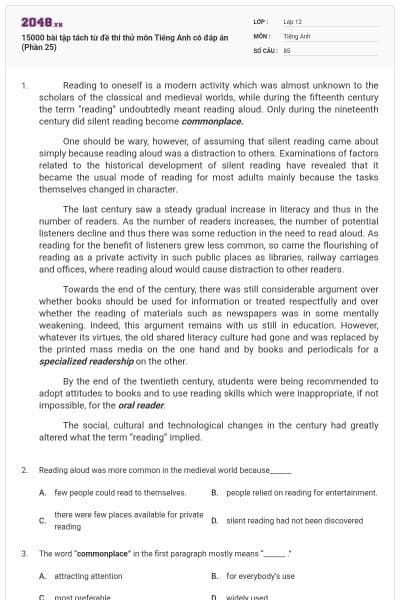
Reading to oneself is a modern activity which was almost unknown to the scholars of the classical and medieval worlds, while during the fifteenth century the term “reading” undoubtedly meant reading aloud. Only during the nineteenth century did silent reading become commonplace.
One should be wary, however, of assuming that silent reading came about simply because reading aloud was a distraction to others. Examinations of factors related to the historical development of silent reading have revealed that it became the usual mode of reading for most adults mainly because the tasks themselves changed in character.
The last century saw a steady gradual increase in literacy and thus in the number of readers. As the number of readers increases, the number of potential listeners decline and thus there was some reduction in the need to read aloud. As reading for the benefit of listeners grew less common, so came the flourishing of reading as a private activity in such public places as libraries, railway carriages and offices, where reading aloud would cause distraction to other readers.
Towards the end of the century, there was still considerable argument over whether books should be used for information or treated respectfully and over whether the reading of materials such as newspapers was in some mentally weakening. Indeed, this argument remains with us still in education. However, whatever its virtues, the old shared literacy culture had gone and was replaced by the printed mass media on the one hand and by books and periodicals for a specialized readership on the other.
By the end of the twentieth century, students were being recommended to adopt attitudes to books and to use reading skills which were inappropriate, if not impossible, for the oral reader.
The social, cultural and technological changes in the century had greatly altered what the term “reading” implied.
Reading aloud was more common in the medieval world because______
few people could read to themselves.
people relied on reading for entertainment.
there were few places available for private reading
silent reading had not been discovered
Thông tin: The last century saw a steady gradual increase in literacy and thus in the number of readers. As the number of readers increases, the number of potential listeners decline and thus there was some reduction in the need to read aloud.
Dịch nghĩa: Thế kỷ trước đã thấy một sự gia tăng dần dần ổn định trong trình độ học vấn và do đó trong số độc giả. Khi số lượng độc giả tăng lên, số lượng thính giả tiềm năng suy giảm và do đó có sự tụt giảm sự cần thiết phải đọc to.
Từ thông tin trên, có thể thấy việc đọc to phổ biến ở thời kỳ trung cổ là vì trình độ học vấn thấp, rất ít người biết chữ để tự đọc. Khi trình độ học vấn tăng lên thì nhu cầu cần đọc to cũng theo đó giảm đi. Phương án A. few people could read to themselves = rất ít người có thể tự đọc cho họ, là phương án chính xác nhất
B. people relied on reading for entertainment = người ta dựa vào việc đọc để giải trí.
Không có thông tin trong bài nói rằng con người dựa vào việc đọc để giải trí. Có thông tin cho rằng việc đọc là hoạt động cá nhân, nhưng không nói rằng mục đích của nó là để giải trí.
C. there were few places available for private reading = có rất ít địa điểm sẵn có cho việc đọc cá nhân.
Không có thông tin như vậy trong bài..
D. silent reading had not been discovered = đọc thầm đã không được phát hiện ra
Không có thông tin như vậy trong bài.The word “commonplace” in the first paragraph mostly means “______ .”
attracting attention
for everybody’s use
most preferable.
widely used
Thông tin: Reading to oneself is a modern activity which was almost unknown to the scholars of the classical and medieval worlds, while during the fifteenth century the term “reading” undoubtedly meant reading aloud. Only during the nineteenth century did silent reading become commonplace. Dịch nghĩa: Việc đọc sách cho mình là một hoạt động hiện đại mà hầu như không được biết đến với những học giả của thế giới cổ điển và trung cổ, khi mà suốt thế kỷ XV, thuật ngữ "đọc" chắc chắn có nghĩa là đọc lớn tiếng. Chỉ trong thế kỷ XIX thì đọc thầm mới trở nên phổ biến. Phần đầu của đoạn văn nói rằng việc đọc thầm hầu như không được biết đến ở thế kỷ XV mà phải đến tận thế kỷ XIX nó mới trở nên commonplace. Do đó từ commonplace có nghĩa trái ngược với từ “unknown” (không được biết đến). Phương án D. widely used (adj) = được sử dụng rộng rãi, là phương án chính xác nhất. A. attracting attention = thu hút sự chú ý. B. for everybody’s use = phục vụ việc sử dụng của tất cả mọi người C. most preferable = được ưa chuộng nhất |
The development of silent reading during the last century indicated______
an increase in the number of books.
an increase in the average age of readers.
a change in the nature of reading
a change in the status of literate people.
Thông tin: Examinations of factors related to the historical development of silent reading have revealed that it became the usual mode of reading for most adults mainly because the tasks themselves changed in character. Dịch nghĩa: Các cuộc kiểm tra của các yếu tố liên quan đến sự phát triển lịch sử của việc đọc thầm đã tiết lộ rằng nó đã trở thành chế độ đọc phổ biến cho hầu hết người lớn chủ yếu là bởi vì chính nhiệm vụ đó thay đổi trong bản chất. Như vậy sự phát triển của việc đọc thầm trong thế kỷ trước đã thể hiện một sự thay đổi trong bản chất của việc đọc. Phương án C. a change in the nature of reading = một sự thay đổi bản chất của việc đọc, là phương án chính xác nhất. A an increase in the number of books = sự gia tăng số lượng sách. “The old shared literacy culture had gone and was replaced by the printed mass media on the one hand and by books and periodicals for a specialized readership on the other” = văn hóa đọc viết chung cũ đã biến mất và được thay thế bởi các phương tiện truyền thông đại chúng in ấn trên một mặt và bởi những cuốn sách và tạp chí cho độc giả chuyên môn trên mặt khác. Thông tin trong bài chỉ cho biết số lượng sách, báo, tạp chí tăng lên thay thế cho văn hóa đọc chia sẻ. Đây là hệ quả của việc đọc thầm phát triển chứ không phải nguyên nhân gây ra nó, vì nếu trình độ học vấn không tăng lên thì số lượng sách tăng lên cũng không có nhiều người có thể đọc nó. B. an increase in the average age of readers = sự gia tăng về độ tuổi trung bình của độc giả. Không có thông tin như vậy trong bài. D. a change in the status of literate people = một sự thay đổi trong địa vị của người biết chữ. Không có thông tin như vậy trong bài. |
Silent reading, especially in public places, flourished mainly because of______
the increase in literacy
the decreasing number of listeners
the decreasing need to read aloud
the development of libraries
Giải thích: The last century saw a steady gradual increase in literacy and thus in the number of readers. As the number of readers increases, the number of potential listeners decline and thus there was some reduction in the need to read aloud. As reading for the benefit of listeners grew less common, so came the flourishing of reading as a private activity in such public places as libraries, railway carriages and offices, where reading aloud would cause distraction to other readers. Dịch nghĩa: Thế kỷ trước đã thấy một sự gia tăng dần dần ổn định trong trình độ học vấn và do đó trong số độc giả. Khi số lượng độc giả tăng lên, số lượng thính giả tiềm năng suy giảm và do đó có sự tụt giảm sự cần thiết phải đọc to. Khi đọc vì lợi ích của người nghe trở nên ít phổ biến, thì đến sự hưng thịnh của việc đọc như một hoạt động cá nhân ở những nơi công cộng như thư viện, toa xe đường sắt và các cơ quan, nơi đọc to sẽ gây mất tập trung cho các độc giả khác. Như vậy, việc đọc thầm, đặc biệt là ở những nơi công cộng, phát triển chủ yếu vì trình độ học vấn chung tăng lên, ai cũng có thể tự đọc nên nếu đọc to sẽ làm ảnh hưởng đến người khác. Phương án A. the increase in literacy = sự tăng lên về trình độ học vấn, là phương án chính xác nhất. B. the decreasing number of listeners = số lượng ngày càng giảm các thính giả. Sự giảm số lượng người nghe cũng chính là vì trình độ học vấn tăng nên người ta không cần người khác đọc cho nữa. C. the decreasing need to read aloud. = nhu cầu đọc to ngày càng giảm Đây cũng là một hệ quả của trình độ học vấn tăng lên. D. the development of libraries = sự phát triển của thư viện Đây là hệ quả của việc đọc thầm phát triển hơn, chứ không phải nguyên nhân dẫn đến nó. |
The phrase “a specialized readership” in paragraph 4 mostly means “______ ”
a reading volume for particular professionals.
a status for reader specialized in mass media.
a requirement for readers in a particular area of knowledge
a limited number of readers in a particular area of knowledge
Thông tin: The old shared literacy culture had gone and was replaced by the printed mass media on the one hand and by books and periodicals for a specialized readership on the other. Dịch nghĩa: văn hóa đọc viết chung cũ đã biến mất và được thay thế bởi các phương tiện truyền thông đại chúng in ấn trên một mặt và bởi những cuốn sách và tạp chí cho độc giả chuyên môn trên mặt khác. Cấu trúc: on the one hand … on the other (hand) = một mặt thì … mặt khác thì, dùng để nối hai vế có mối quan hệ trái ngược. Trong vế “on the one hand” là từ “mass media” (phương tiện truyền thông đại chúng) nên trong vế còn lại mang ý nghĩa trái ngược lại với đại chúng là cá biệt. Phương án D. a limited number of readers in a particular area of knowledge = một số lượng hạn chế độc giả trong một lĩnh vực kiến thức cụ thể, là phương án chính xác nhất. A. a reading volume for particular professionals = một khối lượng đọc cho các chuyên gia đặc biệt “Books and periodicals” chính là những khối lượng, phương tiện đọc rồi, không thể dành cho khối lượng đọc khác nữa. B. a status for reader specialized in mass media = một địa vị cho người đọc chuyên về thông tin đại chúng Thông tin đại chúng là dành cho tát cả mọi người đọc, chứ không có ai chuyên về thông tin đại chúng. Hơn nữa, không có thông tin nói về địa vị xã hội. C. a requirement for readers in a particular area of knowledge = một yêu cầu cho độc giả trong một lĩnh vực kiến thức cụ thể. Không có thông tin như vậy trong bài. |
All of the following might be the factors that effected the continuation of the old shard literacy culture EXCEPT ____
the specialized readership
the inappropriate reading skills
the diversity of reading materials.
the print mass media
Thông tin: The old shared literacy culture had gone and was replaced by the printed mass media on the one hand and by books and periodicals for a specialized readership on the other.
Dịch nghĩa: văn hóa đọc viết chung cũ đã biến mất và được thay thế bởi các phương tiện truyền thông đại chúng in ấn trên một mặt và bởi những cuốn sách và tạp chí cho độc giả chuyên môn trên mặt khác.
Như vậy chính “the printed mass media”, “books and periodicals for a specialized readership” là điều đã thay thế, hay chính là ảnh hưởng đến sự tiếp tục của nền văn hóa đọc cũ.
Phương án A. the specialized readership; C. the diversity of reading materials và D. the print mass media đều xuất hiện thông tin trong bài đọc là yếu tố ảnh hưởng đến sự tiếp tục của nền văn hóa đọc cũ.
Phương án B. the inappropriate reading skills = những kĩ năng đọc không phù hợp cũng xuất hiện thông tin trong bài nưng không phải là một yếu tố ảnh hưởng.
By the end of the twentieth century, students were being recommended to adopt attitudes to books and to use reading skills which were inappropriate, if not impossible, for the oral reader. = Đến cuối thế kỷ XX, sinh viên đã được đề nghị áp dụng thái độ đối với sách và sử dụng các kỹ năng đọc mà không thích hợp, nếu không phải không thể, cho người đọc thành tiếng.Which of the following statements is NOT TRUE according to the passage?
The decline of reading aloud was wholly due to its distracting effect
Reading aloud was more common in the past than it is today
Not all printed mass media was appropriate for reading aloud
The change in reading habits was partly due to the social, cultural and technological changes.
Thông tin: One should be wary, however, of assuming that silent reading came about simply because reading aloud was a distraction to others. Dịch nghĩa: Người ta phải thận trọng, tuy nhiên, khi giả định rằng đọc thầm xảy đến đơn giản chỉ vì đọc to là một sự phân tâm cho người khác. Như vậy nghĩa là sự phát triển của việc đọc thầm không phải chỉ vì đọc to thành tiếng làm những người khác bị phân tâm. Phương án A. The decline of reading aloud was wholly due to its distracting effect = Sự suy giảm của việc đọc to là hoàn toàn do ảnh hưởng mất tập trung của nó, là phương án không đúng với thông tin trong đề bài. Do đó đây là đáp án đúng. B. Reading aloud was more common in the past than it is today = Đọc to là phổ biến hơn trong quá khứ so với hiện nay. “Reading to oneself is a modern activity which was almost unknown to the scholars of the classical and medieval worlds” = Việc đọc sách cho mình là một hoạt động hiện đại mà hầu như không được biết đến với những học giả của thế giới cổ điển và trung cổ C. Not all printed mass media was appropriate for reading aloud = Không phải tất cả phương tiện truyền thông đại chúng được in ấn là thích hợp cho việc đọc to. “By the end of the twentieth century, students were being recommended to adopt attitudes to books and to use reading skills which were inappropriate, if not impossible, for the oral reader”. = Đến cuối thế kỷ XX, sinh viên đã được đề nghị áp dụng thái độ đối với sách và sử dụng các kỹ năng đọc mà không thích hợp, nếu không phải không thể, cho người đọc thành tiếng. Nghĩa là người đọc thành tiếng không thích hợp sử dụng những kĩ năng ấy để đọc sách, hay những cuốn sách ấy vốn không phù hợp để đọc to. D. The change in reading habits was partly due to the social, cultural and technological changes = Sự thay đổi trong thói quen đọc một phần là do những thay đổi xã hội, văn hóa và công nghệ. “The social, cultural and technological changes in the century had greatly altered what the term “reading” implied” = Những thay đổi xã hội, văn hóa và công nghệ trong thế kỷ này đã thay đổi rất nhiều những gì thuật ngữ "đọc" ám chỉ. |
The writer of this passage is attempting to______
show how reading methods have improved
encourage the growth of reading
explain how reading habits have developed
change people’s attitudes to reading
Giải thích: Cả bài đọc giải thích về việc văn hóa đọc dã chuyển từ đọc to thành đọc thầm như thế nào, nguyên nhân và các yếu tố ảnh hưởng đến quá trình ấy. Do đó, điều mà tác giả đã cố gắng diễn tả (hay ý chính của bài) là phương án C. explain how reading habits have developed = giải thích thói quen đọc sách đã phát triển như thế nào. A. show how reading methods have improved = cho thấy các phương pháp đọc sách đã được cải thiện như thế nào. Trong bài đọc không đề cập đến sự phát triển của phương pháp đọc sách. B. encourage the growth of reading = khuyến khích sự phát triển của việc đọc. Bài đọc không hề đưa ra lời khuyến khích sự tiếp tục phát triển của việc đọc. D. change people’s attitudes to reading = thay đổi thái độ đọc của mọi người. Bài đọc không hề kêu gọi hay khuyến khích mọi người thay đổi thái độ của mình với việc đọc sách. |
For many people who live in cities, parks are an important part of the landscape. They provide a place for people to relax and play sports, as well as a refuge from the often harsh environment of a city. What people often overlook is that parks also provide considerable environmental benefits.
One benefit of parks is that plants absorb carbon dioxide—a key pollutant—and emit oxygen, which humans need to breathe. According to one study, an acre of trees can absorb the same amount of carbon dioxide that a typical car emits in 11,000 miles of driving. Parks also make cities cooler. Scientists have long noted what is called the Urban Heat Island Effect: building materials such as metal, concrete, and asphalt absorb much more of the sun’s heat and release it much more quickly than organic surfaces like trees and grass. Because city landscapes contain so much of these building materials, cities are usually warmer than surrounding rural areas. Parks and other green spaces help to mitigate the Urban Heat Island Effect.
Unfortunately, many cities cannot easily create more parks because most land is already being used for buildings, roads, parking lots, and other essential parts of the urban environment. However, cities could benefit from many of the positive effects of parks by encouraging citizens to create another type of green space: rooftop gardens. While most people would not think of starting a garden on their roof, human beings have been planting gardens on rooftops for thousands of years. Some rooftop gardens are very complex and require complicated engineering, but others are simple container gardens that anyone can create with the investment of a few hundred dollars and a few hours of work.
Rooftop gardens provide many of the same benefits as other urban park and garden spaces, but without taking up the much-needed land. Like parks, rooftop gardens help to replace carbon dioxide in the air with nourishing oxygen. They also help to lessen the Urban Heat Island Effect, which can save people money. In the summer, rooftop gardens prevent buildings from absorbing heat from the sun, which can significantly reduce cooling bills. In the winter, gardens help hold in the heat that materials like brick and concrete radiate so quickly, leading to savings on heating bills. Rooftop vegetable and herb gardens can also provide fresh food for city dwellers, saving them money and making their diets healthier. Rooftop gardens are not only something everyone can enjoy, they are also a smart environmental investment.
Based on its use in paragraph 2, it can be inferred that mitigate belongs to which of the following word groups?
allay, alleviate, reduce
absorb, intake, consume
exacerbate, aggravate, intensify
obliterate, destroy, annihilate
Giải thích: mitigate (v) = làm dịu bớt
Đoạn 2 nói về hiện tượng các vật liệu xây dựng ở thành phố làm không khí nóng hơn lên do hấp thụ nhiều nhiệt lượng và giải phóng chúng nhanh, còn cây cối có thể hấp thụ khí cacbonic và thải ra khí oxy nên có thể làm dịu bớt, làm giảm tác động này.
Phương án A. allay, alleviate, reduce = xoa dịu, làm giảm bớt, giảm là phương án có các từ đồng nghĩa với từ “mitigate”
B. absorb, intake, consume = hấp thụ, tiêu thụ, tiêu thụ
C. exacerbate, aggravate, intensify = làm trầm trọng thêm, làm nặng thêm, tăng cường
D. obliterate, destroy, annihilate = tiêu diệt, phá hủy, tiêu diệtUsing the information in paragraph 2 as a guide, it can be inferred that ______________
most people prefer parks to rooftop gardens
most people prefer life in the country over life in the city
cities with rooftop gardens are cooler than those without rooftop gardens
some plants are not suitable for growth in rooftop gardens
Thông tin: Parks also make cities cooler. Scientists have long noted what is called the Urban Heat Island Effect: building materials such as metal, concrete, and asphalt absorb much more of the sun’s heat and release it much more quickly than organic surfaces like trees and grass. Because city landscapes contain so much of these building materials, cities are usually warmer than surrounding rural areas. Parks and other green spaces help to mitigate the Urban Heat Island Effect. Dịch nghĩa: Công viên cũng làm cho các thành phố mát hơn. Các nhà khoa học từ lâu đã ghi nhận những gì được gọi là Hiệu ứng đô thị đảo nhiệt: vật liệu xây dựng như kim loại, bê tông và nhựa đường hấp thụ nhiều nhiệt của mặt trời và phát tán nó nhanh hơn nhiều so với bề mặt hữu cơ như cây cối và cỏ. Bởi vì phong cảnh thành phố chứa rất nhiều các vật liệu xây dựng, thành phố thường ấm hơn so với khu vực nông thôn xung quanh. Công viên và không gian xanh khác sẽ giúp giảm thiểu Hiệu ứng đô thị đảo nhiệt. Như vậy có thể suy ra rằng thành phố có nhiều cây xanh sẽ mát hơn là khi không có cây xanh. Phương án C. cities with rooftop gardens are cooler than those without rooftop gardens = những thành phố với những khu vườn trên mái nhà mát hơn những thành phố không có vườn trên mái nhà, là phương án chính xác nhất. A. most people prefer parks to rooftop gardens = hầu hết mọi người thích công viên hơn các khu vườn trên mái nhà. Không có thông tin như vậy trong đoạn 2. B. most people prefer life in the country over life in the city = hầu hết mọi người thích cuộc sống ở nông thôn hơn cuộc sống trong thành phố Không có thông tin như vậy trong đoạn 2. D. some plants are not suitable for growth in rooftop gardens = một số loài cây không phù hợp để trồng trong các khu vườn trên mái nhà. Không có thông tin như vậy trong đoạn 2. |
Based on the information in paragraph 3, which of the following best describes the main difference between parks and rooftop gardens?
Parks absorb heat while rooftop gardens do not.
Parks require much space while rooftop gardens do not.
Parks are expensive to create while rooftop gardens are not.
Parks are public while rooftop gardens are private.
Thông tin: Unfortunately, many cities cannot easily create more parks because most land is already being used for buildings, roads, parking lots, and other essential parts of the urban environment… Rooftop gardens provide many of the same benefits as other urban park and garden spaces, but without taking up the much-needed land. Dịch nghĩa: Thật không may, nhiều thành phố không thể dễ dàng tạo ra nhiều công viên hơn vì hầu hết đất đai đã được sử dụng cho các tòa nhà, đường giao thông, bãi đậu xe, và các bộ phận quan trọng khác trong môi trường đô thị ... Khu vườn thượng cung cấp nhiều lợi ích như không gian công viên và vườn đô thị khác, nhưng mà không chiếm phần đất rất cần thiết. Phương án B. Parks require much space while rooftop gardens do not = Công viên đòi hỏi nhiều không gian trong khi các khu vườn trên mái nhà thì không, là phương án chính xác nhất. A. Parks absorb heat while rooftop gardens do not = Công viên hấp thụ nhiệt trong khi các khu vườn trên mái nhà thì không. “In the winter, gardens help hold in the heat that materials like brick and concrete radiate so quickly” = Vào mùa đông, các khu vườn giúp giữ nhiệt mà các vật liệu như gạch và bê tông tỏa một cách nhanh chóng. Như vậy các khu vườn thượng cũng hấp thụ nhiệt như các công viên. C. Parks are expensive to create while rooftop gardens are not. = Công viên là đắt tiền để tạo ra trong khi các khu vườn trên mái nhà thì không. “Some rooftop gardens are very complex and require complicated engineering, but others are simple container gardens that anyone can create with the investment of a few hundred dollars and a few hours of work” = Một số khu vườn trên mái nhà là rất phức tạp và đòi hỏi kỹ thuật phức tạp, nhưng cái người khác là những khu vườn chứa đơn giản mà ai cũng có thể tạo ra với sự đầu tư của một vài trăm đô la và một vài giờ làm việc. Như vậy cũng có những khu vườn sân thượng tốn nhiều tiền của và công sức để tạo ra. D. Parks are public while rooftop gardens are private = Công viên là công cộng, trong khi các khu vườn trên mái nhà là tư nhân. Không có thông tin như vậy trong bài. |
The author claims all of the following to be the benefits of rooftop gardens EXCEPT ______________
savings on heating and cooling costs
better food for city dwellers
improved air quality
increased space for private relaxation
Giải thích: Tất cả các phương án khác đều được tác giả nhắc đến là một tác dụng của vườn sân thượng, chỉ có phương án D. increased space for private relaxation là không được nhắc đến trong bài. A. savings on heating and cooling costs = tiết kiệm chi phí sưởi ấm và làm mát. “In the summer, rooftop gardens prevent buildings from absorbing heat from the sun, which can significantly reduce cooling bills. In the winter, gardens help hold in the heat that materials like brick and concrete radiate so quickly, leading to savings on heating bills”. = Vào mùa hè, các khu vườn thượng ngăn các tòa nhà hấp thụ nhiệt từ ánh nắng mặt trời, có thể làm giảm đáng kể các hóa đơn làm mát. Vào mùa đông, vườn giúp giữ nhiệt mà các vật liệu như gạch và bê tông tỏa ra quá nhanh, dẫn đến tiết kiệm về chi phí sưởi ấm. B. better food for city dwellers = thực phẩm tốt hơn cho cư dân thành phố. “Rooftop vegetable and herb gardens can also provide fresh food for city dwellers” = vườn rau và thảo mộc trên sân thượng cũng có thể cung cấp thực phẩm tươi sống cho cư dân thành phố. C. improved air quality = cải thiện chất lượng không khí “Like parks, rooftop gardens help to replace carbon dioxide in the air with nourishing oxygen”. = Giống như công viên, vườn trên mái nhà giúp thay thế carbon dioxide trong không khí bằng oxy bổ dưỡng. |
According to the author, one advantage that rooftop gardens have over parks is that they ______________
do not require the use of valuable urban land
decrease the Urban Heat Island Effect
replenish the air with nourishing oxygen
are less expensive than traditional park spaces
Thông tin: Rooftop gardens provide many of the same benefits as other urban park and garden spaces, but without taking up the much-needed land. Dịch nghĩa: Khu vườn thượng cung cấp nhiều lợi ích như không gian công viên và vườn đô thị khác, nhưng mà không chiếm phần đất rất cần thiết. Đó chính là lợi ích của vườn thượng hơn hẳn so với công viên. Phương án A. do not require the use of valuable urban land = không yêu cầu sử dụng đất đô thị quý giá, là phương án chính xác nhất. B. decrease the Urban Heat Island Effect = giảm hiệu ứng đảo nhiệt đô thị. “Parks and other green spaces help to mitigate the Urban Heat Island Effect … Like parks, rooftop gardens help to replace carbon dioxide in the air with nourishing oxygen. They also help to lessen the Urban Heat Island Effect” = Công viên và các không gian xanh khác sẽ giúp giảm thiểu hiệu ứng đảo nhiệt đô thị ... Giống như công viên, vườn trên mái nhà giúp thay thế carbon dioxide trong không khí bằng oxy bổ dưỡng. Chúng cũng giúp làm giảm bớt hiệu ứng đảo nhiệt đô thị. Như vậy cả công viên và vườn thượng đều giúp giảm hiệu ứng đảo nhiệt đô thị. C. replenish the air with nourishing oxygen = bổ sung lượng khí oxy bổ dưỡng “One benefit of parks is that plants absorb carbon dioxide—a key pollutant—and emit oxygen, which humans need to breathe … Like parks, rooftop gardens help to replace carbon dioxide in the air with nourishing oxygen” = Một lợi ích của công viên là thực vật hấp thụ chất ô nhiễm và khí cacbonic, một chất ô nhiễm quan trọng, và phát ra oxy, mà con người cần phải thở ... Giống như công viên, vườn trên mái nhà giúp thay thế carbon dioxide trong không khí bằng oxy bổ dưỡng. Như vậy cả công viên và vườn thượng đều bổ sung lượng khí oxy bổ dưỡng. D. are less expensive than traditional park spaces = ít tốn kém hơn so với các không gian công viên truyền thống. Không có thông tin như vậy trong bài. |
The author’s tone in the passage is best described as______________
informative
argumentative
descriptive
passionate
Giải thích: Cấu trúc bài văn là đưa ra một ý kiến “What people often overlook is that parks also provide considerable environmental benefits” = Những gì mọi người thường bỏ qua là các công viên cũng cung cấp các lợi ích đáng kể về môi trường, sau đó phân tích và bảo vê ý kiến đó bằng cách đưa ra các luận điểm trong thân bài.
Như vậy bài văn viết theo lối tranh luận nên giọng văn cũng là giọng văn tranh luận (argumentative)
A. informative = cung cấp thông tin
Nếu giọng văn là cung cấp thông tin thì tác giả chỉ đưa ra các thông tin mình biết chứ không có ý kiến và bảo vệ ý kiến.
C. descriptive = miêu tả
Đây không phải bài văn miêu tả cảnh hay tả người, tả vật.
D. passionate = kịch liệt, dữ dội
Giọng văn trong bài rất trung tính chứ không có những từ ngữ, cấu trúc thể hiện cảm xúc.Which of the following best describes the organization of the passage?
A thesis is presented and then supported.
A hypothesis is stated and then analyzed.
A proposal is evaluated and alternatives are explored.
A viewpoint is established and then defended.
Giải thích: Cấu trúc bài văn là đưa ra một ý kiến “What people often overlook is that parks also provide considerable environmental benefits” = Những gì mọi người thường bỏ qua là các công viên cũng cung cấp các lợi ích đáng kể về môi trường, sau đó phân tích và bảo vê ý kiến đó bằng cách đưa ra các luận điểm trong thân bài.
A. A luận đề is presented and then supported = Một giả thuyết được trình bày và sau đó được hỗ trợ.
Trong bài không đưa ra luận đề nghiên cứu mà là một thực tế.
B. A hypothesis is stated and then analyzed = Một giả thuyết được nêu ra và sau đó phân tích
Trong bài không đưa ra giả thuyết chưa được kiểm định mà là một thực tế.
C. A proposal is evaluated and alternatives are explored = Một đề nghị được đánh giá và các lựa chọn thay thế được khám phá
Không có đề nghị hay lựa chọn thay thế nào được đưa ra trong bài.Not so long ago almost any students who successfully completed a university degree or diploma course could find a good career quite easily. Companies toured the academic institutions, competing with each other to recruit graduates. However, those days are gone, even in Hong Kong, and nowadays graduates often face strong competition in the search for jobs.
Most careers organization highlight three stages for graduates to follow in the process of securing a suitable career: recognizing abilities, matching these to available vacancies and presenting them well to prospective employers
Job seekers have to make a careful assessment of their own abilities. One area of assessment should be of their academic qualifications, which would include special skills within their subject area. Graduates should also consider their own personal values and attitudes, or the relative importance to themselves of such matters as money, security, leadership and caring or others. An honest assessment of personal interests and abilities such as creative or scientific skills acquired from work experience should also be give careful thought
The second stage is to study the opportunities available for employment and to think about how the general employment situation is likely to develop in the future. To do this, graduates can study job vacancies and information in newspapers or the can visit a career office, write to possible employers for information or contact friends or relatives who may already be involved in a particular profession. After studying all various options, they should be in a position to make informed comparisons between various careers
Good personal presentation is essential in the search for a good career. Job application forms and letters should, of course, be filled in carefully and correctly, without grammar or spelling errors. Where additional information is asked for, job seekers should describe their abilities and work experience in more depth, with example if possible. They should try to balance their own abilities with the employer’s needs, explain why they are interested in a career with the particular company and try to show that they already know something about the company and its activities
When graduates are asked to attend for the interview, they should prepare properly by finding out all they can about the prospective employer. Dressing suitably and arriving for the interview on time are also obviously important. Interviewees should try to give positive and helpful answers and should not be afraid to ask questions about anything they are unsure about. This is much better than pretending to understand a question and giving an unsuitable answer
There will always be good career opportunities for people with ability, skills, and determination; the secret to securing a good job is to be one of them
In paragraph 1, “those days are gone, even in Hong Kong”. Suggests that ____
in the past, finding a good career was easier in Hong Kong than elsewhere
nowadays, everyone in Hong Kong has an equal chance of finding a good job
it used to be harder to find a good job in Hong Kong than in other countries
even in Hong Kong companies tour the universities trying to recruit graduates
Trong đoạn số 1, “những ngày đã trôi qua, thậm chí ở Hồng Kong” ám chỉ rằng_______ Đáp án A – trong quá khứ, tìm thấy công việc tôt là dễ dàng ở Hồng Kông hơn bất cứ nơi nào Các đáp án khác Dẫn chứng – Hai câu đầu – Đoạn 1: “Not so long ago almost any students who successfully completed a university degree or diploma course could find a good career quite easily. Companies toured the academic institutions, competing with each other to recruit graduates.” Tạm dịch: Cách đây không lâu hầu hết bất cứ sinh viên nào người đã hoàn thành 1 cách thành công bằng đại học hay bằng tốt nghiệp có thể tìm thấy 1 công việc 1 cách dễ dàng. Các công ty du lịch, các cơ sở học thuật, cạnh trạnh với nhau để tuyển dụng sinh viên đã tốt nghiệp Các đáp án khác B – Ngày nay, mọi người ở Hồng Kông có cơ hội ngang bằng nhau trong việc tìm công việc tốt C – Nó đã từng khó hơn để tìm kiếm công việc ở Hồng Kông hơn các đất nước khác D – Thậm chí ở các công ty Hồng Kông các tour du lịch các trường đại học cố gắng tuyển dụng sinh viên tốt nghiệp |
The word “prospective” in paragraph 2 is closed in meaning to ____
generous
reasonable
future
ambitious
Prospective (a) thuộc về tương lai, về sau, sắp tới
Đáp án đồng nghĩa A – future (n) tương lai
Các đáp án khác
A – hào phóng
B – hợp lí
D – tham vọngAccording to paragraph 3, job seekers should:
aim to give a balanced account of what the employer needs
divide the time equally between listening to the interviewer and speaking
discuss their own abilities in relation to what the employer is looking for
attempt to show the employer is looking for
Theo đoạn số 3, những người tìm kiếm công việc nên:
Đáp án C –bàn luận về những khả năng của mình cái có liên quan đến cái nhà tuyển dụng đang tìm kiếm
Dẫn chứng – Câu 1 – Đoạn 3: “Job seekers have to make a careful assessment of their own abilities.”
Tạm dịch: “Những người tìm việc phải đánh giá cẩn thận khả năng của mình”
Câu cuối – Đoạn 3: “An honest assessment of personal interests and abilities such as creative or scientific skills acquired from work experience should also be give careful thought”
Tạm dịch: Một đánh giá trung thực về lợi ích và khả năng của cá nhân như là các kĩ năng sáng tạo hoặc khoa học cái đạt được từ kinh nghiệm công việc nên được suy nghĩa cẩn thận.
Các đáp án khác
A – mục đích đưa ra bản miêu tả cân nhắc về cái nhà tuyển dụng cần
B – chia thời gian như nhau giữa việc nghe người phỏng vấn và người nói
D – cố gắng thể hiện cái nhà tuyện dụng tìm kiếmAccording to paragraph 3, graduates should ____
only consider careers which are suited to them as people
include information about personal attitudes and values in their job application
consider how lucky they are to be able to find careers that provide such things
consider the values of their parents and families as well their own wishes
Theo đoạn số 3, những sinh viên tốt nghiệp nên_________________ Đáp án A – chỉ nên cân nhắc các công việc cái phù hợp họ Dẫn chứng - Câu 1 – Đoạn 3: “Job seekers have to make a careful assessment of their own abilities.” Tạm dịch: “Những người tìm việc phải đánh giá cẩn thận khả năng của mình” Các đáp án khác B – bao gồm thông tin về thái độ và giá trị cá nhân trong đơn xin việc C – cân nhắc sự may mắn họ có thể tìm thấy công việc như thế nào cái mà cung cấp những thứ như vậy D – xem xét các giá trị của bố mẹ và gia đình cũng như mong muốn của họ |
The advice given in the first sentences of paragraph 4 is to___
find out what jobs are available and the opportunities for future promotion
examine the careers available and how these will be affected in the future
look at the information on, and probably future location of, various careers
study the opportunities and the kinds of training that will be available
Lời khuyên được đưa ra trong các câu đầu tiên của đoạn 4 là để___
Đáp án B – Khảo sát các công việc có sẵn và những công việc này sẽ bị ảnh hưởng trong tương lai như thế nào
Dẫn chứng
Câu đầu tiên – Đoạn số 4: “The second stage is to study the opportunities available for employment and to think about how the general employment situation is likely to develop in the future. “
Tạm dịch: Giai đoạn thứ 2 là để xem xét cẩn thận những cơ hội có giá trị cho công việc và để nghĩ về những tình huống việc chung có khả năng phát triển trong tương lai như thế nào.
Như vậy chúng ta dịch câu đầu tiên ra chúng ta thấy rằng đáp án B – đáp án chính xác
Các đáp án khác
A – tìm ra công việc nào có giá trị và những cơ hội thăng tiến cho tương lai
C – xem xét các thông tin, vị trí tương lai, nghề khác nhau
D – xem xét cẩn thận những cơ hội và những loại hình đào tạo cái mà sẽ có giá trịAccording to paragraph 4, graduates should ____
find a good position and then compare it with other careers
ask friends or relatives to secure them a good job
get information about a number of careers before making comparisons
find out as much as possible and inform employers of the complaints they want
Theo đoạn số 4, những sinh viên đã tốt nghiệp nên __________
Đáp án C – có thông tin về số lượng các công việc trước khi so sánh
Dẫn chứng - After studying all various options, they should be in a position to make informed comparisons between various careers
Tạm dịch: Sau khi nghiên cứu tất cả các vị trí khác nhau, họ có khả năng đưa ra những sự so sánh có hiểu biết giữa các nghề khác nhau.
Các đáp án khác
A – tìm vị trí tốt và sau đó so sánh chúng với các công việc khác
B – hỏi bạn bà và họ hàng để đảm bảo rằng chúng là công việc tốt
D – tìm hiểu nhiều nhất có thể và thông báo cho nhà tuyển dụng những khiếu nạn mà họ muốnWhich of the following does “this” in paragraph 6 refers to?
Not being afraid to be unsure
Giving positive and helpful answers to the questions
Being prepared to ask questions about things they don’t understand
Being unsure about the questions
This” – trong đoạn số 6 đề cập đến điều gì?
Đáp án C – Chuẩn bị để hỏi về những thứ họ không hiểu
Dẫn chứng – Câu 3 – 4 – Đoạn 6: “Interviewees should try to give positive and helpful answers and should not be afraid to ask questions about anything they are unsure about. This is much better than pretending to understand a question and giving an unsuitable answer“
Tạm dịch: Những người dược phỏng vấn nên cố gắng đưa ra những câu trả lời tích cực và hữu ích và không nên lo lắng/ sợ về việc hỏi bất cứ điều gì mà họ không chắc chắn. Điều đó tốt hơn là giả vờ hiểu câu hỏi và đưa câu trả lời không thích hợp.
Ta thấy: “This” – chính là việc chuẩn bị các câu hỏi về bất cứ điều gì họ không chắc ( k hiểu)
Các đáp án khác
A - Không lo lắng về điều không chắn chắn
B – Đưa ra những câu trả lời tích cực và hữu ích cho những câu hỏi
D – Không chắc chắn về những câu hỏiIn paragraph 6, the writer seems to suggest that ____
interviewees should ask question if they can’t think of an answer
pretending to understand a question is better than giving a suitable answer
it is better for interviewees to be honest than to pretend to understand
it is not a good idea for interviewees to be completely honest in their answers
Trong đoạn số 6, tác giả dường như gợi ý rằng____________
Đáp án C – Tốt hơn cho người được phỏng vấn là trung thực hơn là giả vờ không hiểu
Các đáp án khác
A – Người được phỏng vấn nên hỏi nếu họ không thể nghĩ ra câu trả lời
B – Giả vờ hiểu câu hỏi là tốt hơn đưa câu trả lời thích hợp
D – Đó là 1 ý tưởng không hay cho người được phỏng vấn là trung thực 1 cách hoàn toàn trong câu trả lời của họ.
(Đọc lại dẫn chứng câu số 32)Social parasitism involves one species relying on another to raise its young. Among vertebrates, the best known social parasites are such birds as cuckoos and cowbirds; the female lays egg in a nest belonging to another species and leaves it for the host to rear
The dulotic species of ants, however, are the supreme social parasites. Consider, for example, the unusual behavior of ants belonging to the genus Polyergus. All species of this ant have lost the ability to care for themselves. The workers do not forage for food, feed their brood or queen, or even clean their own nest. To compensate for these deficits, Polyergus has become specialized at obtaining workers from the related genus Formica to do these chores
In a raid, several thousand Polyergus workers will travel up to 500 feet in search of a Formica nest, penetrate it, drive off the queen and her workers, capture the pupal brood, and transport it back to their nest. The captured brood is then reared by the resident Formica workers until the developing pupaeemerge to add to the Formica population, which maintains the mixed-species nest. The Formica workers forage for food and give it to colony members of both species. They also remove wastes and excavate new chambers as the population increases
The true extent of the Polyergus and dependence on the Formica becomes apparent when the worker population grows too large for existing nest. Formica scouts locate a new nesting site, return to the mixed-species colony, and recruit additional Formica nest mates. During a period that may last seven days, the Formica workers carry to the new nest all the Polyergus eggs, larvae, and pupae, every Polyergus adult, and even the Polyergus queen
Of the approximately 8000 species of ants in the world, all 5 species of Polyergus and some 200 species in other genera have evolved some degree of parasitic relationship with other ants
Which of the following statements best represents the main idea of the passage?
Ants belonging to the genus Formica are incapable of performing certain tasks
The genus Polyergus is quite similar to the genus Formica
Ants belonging to the genus Polyergus have an unusual relationship with ants belonging to the genus Formica
Polyergus ants frequently leave their nests to build new colonies
Câu nào sau đây đại diện ý chính cho bài văn? Đáp án C - Các loài kiến thuộc chi Polyergus có quan hệ bất thường với những con kiến thuộc chi Formica Dẫn chứng – Câu 1 – 2 – Đoạn 2: “The dulotic species of ants, however, are the supreme social parasites. Consider, for example, the unusual behavior of ants belonging to the genus Polyergus.” Tạm dịch – Tuy nhiên, loài dulotic của kiến là loài động vật kí sinh mang tính chất xã hội cao. Ví dụ xem xét các hành vi bất thường của loài kiến thuộc về chi Polyergus. Câu cuối – Đoạn 2: “Polyergus has become specialized at obtaining workers from the related genus Formica to do these chores” Tạm dịch: Polyergus đã trở thành chuyên gia trong việc giành được những con kiến thợ từ chi Formica để làm những công việc vặt này. Câu cuối – Đoạn 3: “During a period that may last seven days, the Formica workers carry to the new nest all the Polyergus eggs, larvae, and pupae, every Polyergus adult, and even the Polyergus queen” Tạm dịch: Trong suốt khoảng thời gian đó có lẽ kéo dài 7 ngày, kiến thợ Formica mang tất cả trứng của Polyergus, những ấu trùng, những con nhộng, tất cả các con Polyergus trưởng thành, và thậm chí nữ hoàng Polyergus đến tổ mới. Các đáp án khác A – Con kiến thuộc chi Formica không có khả năng thực hiện những công việc nhất định. B – Chi Polyergus khá là giống chi Formica D – Kiến Polyergus thường để lại tổ của chungs để xây dựng đàn mới |
The word “raise” is closest in meaning to _____
rear
lift
collect
increase
Raise (v) nuôi nấng
Đáp án đồng nghĩa A – rear (v) nuôi dạy, nuôi nấng
Các đáp án khác
A – nhấc lên
C – thu lượm
D – tăngThe author mentions cuckoos and cowbirds because they _____
share their nests with each other
are closely related species
raise the young of their birds
are social parasites
Tác giả đề cập đến chim cu và chim bò vì chúng______
Đáp án D – là động vật kí sinh có tính chất xã hội
Dẫn chứng – Câu 1 – 2 – Đoạn 1: “Social parasitism involves one species relying on another to raise its young. Among vertebrates, the best known social parasites are such birds as cuckoos and cowbirds;”
Động vật kí sinh có tính chất xã hội liên quan đến 1 loài dựa vào 1 loài khác để nuôi nấng con của nó. Giữa các động vật có xương sống, động vật kí sinh có tính chất xã hội được biết đến nhiều nhất là loài chim như chim cu và chim bò.
=> Đưa ra ví dụ minh họa thế nào là động vật kí sinh có tính chất xã hội
Các đáp án khac
A – chia sẻ tổ của chúng với nhau
B – là loài có liên quan gần gũi
C – nuôi nấng chim con của chúngThe word “it” refers to _____
species
nest
egg
female
it” đề cập đến điều gì?
Đáp án C – trứng
“the female lays egg in a nest belonging to another species and leaves it for the host to rear”
Tạm dịch: Con cái đẻ trứng trong 1 cái tổ thuộc 1 loài khác và để lại nó cho chủ của tổ đó nuôi nấng
=> “It” chính là “trứng”
Các đáp án khác
A – loài
B – tổ
D – con máiWhat does the author mean by stating that “The dulotic species of ants, however, are the supreme social parasites”
The Polyergus are more highly developed than the Formica
The Formica have developed specialized roles
The Polyergus are heavily dependent on the Formica
The Formica do not reproduce rapidly enough to care for themselves
Tác giả có ý nghĩa gì bằng cách nói rằng "Tuy nhiên các loài dulotic của kiến là những ký sinh trùng xã hội tối cao" Đáp án C – Polyergus phụ thuộc nặng vào Formica Chúng ta cần đọc hết đoạn số 2 để hiểu được ý nghĩa tác giả muốn nói ở đây là gì? Câu 1 – 2 – Đoạn 2: “The dulotic species of ants, however, are the supreme social parasites. Consider, for example, the unusual behavior of ants belonging to the genus Polyergus. All species of this ant have lost the ability to care for themselves. The workers do not forage for food, feed their brood or queen, or even clean their own nest. To compensate for these deficits, Polyergus has become specialized at obtaining workers from the related genus Formica to do these chores Tạm dịch – Tuy nhiên, loài dulotic của kiến là loài động vật kí sinh mang tính chất xã hội cao. Ví dụ xem xét các hành vi bất thường của loài kiến thuộc về chi Polyergus. Tất cả các loài này đều đã mất đi khả năng tự chăm sóc bản thân. Kiến thợ không tìm đồ ăn, nuôi con hoặc nữ hoàng, thậm chí dọn chính cái ổ của chúng. Để bù đắp cho những thiếu hụt này, Polyergus đã trở thành chuyên gia trong việc giành kiến thợ từ chi Formuca để làm những việc này. => Chúng k thể làm bất cứ việc gì, giành từ kiến thợ thuộc chi Formuca. Các đáp án khác A – Polyergus được phát triển cao hơn so với Formica B – Formica đã phát triển các vai trò chuyên dụng D – Formica không sinh sản 1 cách nhanh chóng đủ để tự chăm sóc bản thân chúng |
The word “excavate” is closest in meaning to _____
find
clean
repair
dig
Excavate (v) đào bới
Đáp án đồng nghĩa: dig (v) đào bới, cuốc
Các đáp án khác
A – tìm kiếm
B – dọn
C – sửa chữaAccording to the information in the passage, all of the following terms refer to ants beginning to the genus Formica EXCEPT ______
dulotic
captured brood
developing pupae
worker population
Theo thông tin trong đoan văn, tất cả các thuật ngữ sau đề cập đến loài kiến bắt đầu từ chi Formica ngoại trừ ___________
Đáp án A – dulotic
Các đáp án B, C, D đều được nhắc đến
Dẫn chứng – Câu 2 – 3 - 4– Đoạn 3: “The captured brood is then reared by the resident Formica workers until the developing pupae emerge to add to the Formica population, which maintains the mixed-species nest. The Formica workers forage for food and give it to colony members of both species. They also remove wastes and excavate new chambers as the population increases
Tạm dịch: Các con bị bắt giữ sau đó được nuôi nấng bởi các con kiến thợ Formica cho tới khi sự xuất hiện của những con nhộng phát triển để thêm vào dân số của Formica, cái duy trì sự hỗn hợp loài. Kiến thợ Formica tìm kiếm đồ ăn và đưa nó cho các thành viên của cả hai loài. Chúng cũng loại bỏ chất thải và đào các buồn mới vì dân số tăng lên.
Các đáp án khác
B – bắt giữ con
C – phát triển những con nhộng
D – dân số kiếnARE HUMAN BEINGS GETTING SMARTER?
Do you think you're smarter than your parents and grandparents? According to James Flynn, a professor at a New Zealand university, you are! Over the course of the last century, people who have taken IQ tests have gotten increasingly better scores-on average, three points better for every decade that has passed. This improvement is known as "the Flynn effect," and scientists want to know what is behind it.
IQ tests and other similar tests are designed to measure general intelligence rather than knowledge. Flynn knew that intelligence is partly inherited from our parents and partly the result of our environment and experiences, but the improvement in test scores was happening too quickly to be explained by heredity. So what was happening in the 20th century that was helping people achieve higher scores on intelligence tests?
Scientists have proposed several explanations for the Flynn effect. Some suggest that the improved test scores simply reflect an increased exposure to tests in general. Because we take so many tests, we learn test-taking techniques that help us perform better on any test. Others have pointed to better nutrition since it results in babies being born larger, healthier, and with more brain development than in the past. Another possible explanation is a change in educational styles, with teachers encouraging children to learn by discovering things for themselves rather than just memorizing information. This could prepare people to do the kind of problem solving that intelligence tests require.
Flynn limited the possible explanations when he looked carefully at the test data and discovered that the improvement in scores was only on certain parts of the IQ test. Test takers didn't do better on the arithmetic or vocabulary sections of the test; they did better on sections that required a special kind of reasoning and problem solving. For example, one part of the test shows a set of abstract shapes, and test-takers must look for patterns and connections between them and decide which shape should be added to the set.
According to Flynn, this visual intelligence improves as the amount of technology in our lives increases. Every time you play a computer game or figure out how to program a new cell phone, you are exercising exactly the kind of thinking and problem solving that helps you do well on one kind of intelligence test. So are you really smarter than your parents? In one very specific way, you may be.
The Flynn effect is____________.
used to measure intelligent
an increase in IQ test scores over time
unknown in some parts of the world
not connected to our experiences
Thông tin: people who have taken IQ tests have gotten increasingly better scores-on average, three points better for every decade that has passed. This improvement is known as "the Flynn effect" Dịch nghĩa: những người đã làm bài kiểm tra trí tuệ đã đạt được điểm ngày càng cao hơn – trung bình, 3 điểm cao hơn cho mỗi thập kỷ qua đi. Sự cải thiện này được biết đến như là “Hiệu ứng Flynn” Từ thông tin trên, phương án B. The Flynn effect is an increase in IQ test scores over time = Hiệu ứng Flynn là một sự tăng lên về điểm kiểm tra trí tuệ qua thời gian, là phương án chính xác nhất. A. used to measure intelligent = được dùng để đo lường sự thông minh. Không có thông tin trong bài nói rằng hiệu ứng Flynn được dùng để đo lường sự thông minh, mà đó là những bài kiểm tra trí tuệ (IQ tests and other similar tests are designed to measure general intelligence) C. unknown in some parts of the world = không được biết tới ở một số nơi trên thế giới. Không có thông tin như vậy trong bài . D. not connected to our experiences = không liên quan đến những khinh nghiệm của chúng ta. “Flynn knew that intelligence is partly inherited from our parents and partly the result of our environment and experiences” = Flynn biết rằng sự thông minh là một phần được di truyền từ bố mẹ và một phần là kết quả của môi trường và kinh nghiệm Ta thấy rõ ràng hiệu ứng Flynn có liên quan đến kinh nghiệm. Do đó phương án D sai. |
The Flynn effect must be the result of____________.
heredity
our environment and experiences
taking fewer tests
memorizing information
Thông tin: Flynn knew that intelligence is partly inherited from our parents and partly the result of our environment and experiences, but the improvement in test scores was happening too quickly to be explained by heredity. Dịch nghĩa: Flynn biết rằng sự thông minh là một phần được di truyền từ bố mẹ và một phần là kết quả của môi trường và kinh nghiệm, nhưng sự cải thiện trong điểm kiểm tra đã đang xảy ra quá nhanh để có thể được giải thích bằng di truyền. Nghĩa là yếu tố di truyền không đóng vai trò quan trọng trong việc giải thích, từ đó Hiệu ứng Flynn hẳn là do yếu tố môi trường và kinh nghiệm. Phương án B. our environment and experiences = môi trường và những kinh nghiệm của chúng ta là phương án chính xác nhất. A. heredity (n) = sự di truyền. C. taking fewer tests = làm ít bài kiểm tra hơn. “Because we take so many tests, we learn test-taking techniques that help us perform better on any test” = Bởi vì chúng ta làm quá nhiều bài kiểm tra, chúng ta học các kỹ thuật làm bài kiểm tra mà giúp chúng ta thể hiện tốt hơn trong bất kì bài kiểm tra nào. Như vậy, Hiệu ứng Flynn phải là kết quả của việc làm nhiều bài kiểm tra hơn mới đúng. D. memorizing information = nhớ thông tin. “Another possible explanation is a change in educational styles, with teachers encouraging children to learn by discovering things for themselves rather than just memorizing information” = Một giải thích có khả năng khác là sự thay đổi trong phong cách giáo dục, với việc giáo viên khuyến khích trẻ con học bằng cách tự khám phá mọi thứ thay vì chỉ ghi nhớ thông tin. Như vậy nghĩa là việc ghi nhớ thông tin không làm cho kết quả kiểm tra tăng lên, không dẫn đến Hiệu ứng Flynn. |
IQ tests evaluate____________.
our knowledge
our environment
our intelligence
our memories
Thông tin: IQ tests and other similar tests are designed to measure general intelligence rather than knowledge.
Dịch nghĩa: Bài kiểm tra IQ và các bài kiểm tra tương tự khác được thiết kế để đo lường trí thông minh chung hơn là kiến thức.
Từ “evaluate” (v) = đánh giá trong câu hỏi đồng nghĩa với từ “measure” (v) = đo lường, đánh giá. Do đó, phương án C. our intelligence là phương án chính xác nhất.
A our knowledge = kiến thức của chúng ta.
Theo thông tin trên, các bài thi IQ không đánh giá về kiến thức.
B. our environment = môi trường của chúng ta.
Không có thông tin như vậy trong bài.
D. our memories = những kí ức của chúng ta.
Không có thông tin như vậy trong bài.Which sentence from the article gives a main idea?
Scientists have proposed several explanations for the Flynn effect.
Because we take so many tests in our lives, we learn test-taking techniques that help us perform better on any test.
Test-takers didn’t do better on the arithmetic or vocabulary sections of the test.
For example, one part of the test shows a set of abstract shapes, and test-takers must look for pattern and connections between them and decide which shape should be added to the set.
Giải thích: Hai đoạn đầu tiên trong bài đọc có tác dụng dẫn dắt, giới thiệu "Hiệu ứng Flynn" và đặt ra v ấn đề là điểm các bài kiểm tra trí tuệ ngày càng tăng lên. Câu hỏi cần được trả lời trong bài đọc là So what was happening in the 20th century that was helping people achieve higher scores on intelligence tests? = Vậy điều gì đang xảy ra vào thế kỷ 20 mà đang giúp cho con người đạt được điểm số cao hơn trong các bài kiểm tra trí tuệ? Nghĩa là ta đang cần đi tìm nguyên nhân cho việc con người đạt được điểm số cao hơn trong các bài kiểm tra trí tuệ. Do đó, phương án A. Scientists have proposed several explanations for the Flynn effect. = Các nhà khoa học đã đặt ra một vài lời giải thích cho Hiệu ứng Flynn, là phương án chính xác nhất. B. Because we take so many tests in our lives, we learn test-taking techniques that help us perform better on any test. = Bởi vì chúng ta làm quá nhiều bài kiểm tra, chúng ta học các kỹ thuật làm bài kiểm tra mà giúp chúng ta thể hiện tốt hơn trong bất kì bài kiểm tra nào. Đây chỉ là một ý nhỏ để giải thích rõ hơn cho ý lướn trước nó: Some suggest that the improved test scores simply reflect an increased exposure to tests in general. C. Test-takers didn’t do better on the arithmetic or vocabulary sections of the test. = Những người làm kiểm tra không làm tốt hơn trong phần toán học hoặc phần từ vựng của bài thi. Đây chỉ là một ý nhỏ để giải thích rõ hơn cho ý lướn trước nó: Flynn limited the possible explanations when he looked carefully at the test data and discovered that the improvement in scores was only on certain parts of the IQ test. D. For example, one part of the test shows a set of abstract shapes, and test-takers must look for pattern and connections between them and decide which shape should be added to the set. = Ví dụ, một phần của bài kiểm tra cho thấy một bộ các hình dạng trừu tượng, và thí sinh phải tìm ra quy luật và sự kết nối giữa chúng và quyết định hình nào nên được them vào trong bộ đấy. Đây chỉ là một ví dụ minh họa cho ý lớn trước nó: they did better on sections that required a special kind of reasoning and problem solving. |
According to the article, newer education techniques include____________.
exposure to many tests
children finding things out themselves
memorizing information
improved test scores
Thông tin: Another possible explanation is a change in educational styles, with teachers encouraging children to learn by discovering things for themselves rather than just memorizing information. Dịch nghĩa: Một giải thích có khả năng khác là sự thay đổi trong phong cách giáo dục, với việc giáo viên khuyến khích trẻ con học bằng cách tự khám phá mọi thứ thay vì chỉ ghi nhớ thông tin. Như vậy, các phương pháp giáo dục mới bao gồm việc trẻ con phải tự khám phá mọi thứ. Phương án B. children finding things out themselves là chính xác nhất. A. exposure to many tests = sự tiếp xúc với nhiều bài thi. “Some suggest that the improved test scores simply reflect an increased exposure to tests in general” = Một số gợi ý rằng điểm kiểm tra cao hơn chỉ đơn giản phản ánh một sự tăng cường tiếp xúc với các bài thi. Sự tiếp xúc với nhiều bài thi chỉ giải thích việc điểm cao hơn chứ không được nói là nằm trong phương pháp giáo dục mới. C. memorizing information = ghi nhớ thông tin Từ thông tin được giải thích, ta có thể hiểu phương pháp giáo dục cũ bao gồm ghi nhớ thông tin, nhưng phương pháp mới không như thế nữa. D. improved test scores = điểm kiểm tra được cải thiện. Đây là kết quả của việc áp dụng phương pháp giáo dục mới, chứ không nằm trong những phương pháp ấy. |
Why does the author mention computer games?
to give an example of technology that improve our visual intelligence.
to explain why young people have poor vocabularies.
to encourage the reader to exercise.
to show that young people are not getting more intelligent.
Thông tin: According to Flynn, this visual intelligence improves as the amount of technology in our lives increases. Every time you play a computer game or figure out how to program a new cell phone, you are exercising exactly the kind of thinking and problem solving that helps you do well on one kind of intelligence test. Dịch nghĩa: Theo Flynn, loại thông minh hình ảnh này cải thiện khi lượng công nghệ trong cuộc sống chúng ta tăng lên. Mỗi lần bạn chơi một trò chơi điện tử hoặc tìm ra cách cài đặt một chiếc điện thoại mới, bạn đang luyện tập chính xác loại suy nghĩ và giải quyết vấn đề mà giúp bạn làm tốt trong một bài kiểm tra trí tuệ. Việc chơi trò chơi điện tử (computer game) được đưa ra để làm ví dụ minh họa cho ý kiến phía trước là “this visual intelligence improves as the amount of technology in our lives increases” (loại thông minh hình ảnh này cải thiện khi lượng công nghệ trong cuộc sống chúng ta tăng lên) Do đó phương án A. to give an example of technology that improve our visual intelligent = để đưa ra một ví dụ của công nghệ làm cải thiện trí thông minh hình ảnh của chúng ta, là phương án chính xác nhất. B. to explain why young people have poor vocabularies = để giải thích tại sao những người trẻ lại có vốn từ vựng kém. Test takers didn't do better on the arithmetic or vocabulary sections of the test = những người làm kiểm tra không làm tốt hơn trong phần toán học hoặc phần từ vựng của bài thi. Thông tin này chỉ nói là phần từ vựng không được cải thiện điểm, chứ không nói là những người trẻ tuổi có vốn từ vựng kém. C. to encourage the reader to exercise = để khuyến khích ngừoi đọc luyện tập. Không có thông tin như vậy trong bài. D. to show that young people are not getting more intelligent = để chỉ ra rằng những người trẻ tuổi đang không trở nên thông minh hơn. Câu này trái ngược với ý kiến được đưa ra trong bài rằng càng ngày các thế hệ sau càng thông minh hơn cha mẹ họ. |
Which statement would Professor Flynn agree with?
People today are more intelligent than in the past in every way.
People today have fewer problems to solve.
People today are taking easier tests.
People today have more visual intelligence.
Thông tin: According to Flynn, this visual intelligence improves as the amount of technology in our lives increases. Dịch nghĩa: Theo Flynn, loại thông minh hình ảnh này cải thiện khi lượng công nghệ trong cuộc sống chúng ta tăng lên. Cuộc sống của chúng ta ngày càng được bao phủ bởi công nghệ, do đó ta ngày càng thông minh hình ảnh hơn. Phương án D. People today have more visual intelligence= Con người ngày nay có nhiều trí thông minh hình ảnh hơn, là phương án chính xác nhất. A. People today are more intelligent than in the past in every way = Con người ngày nay thông minh hơn ngày xưa ở mọi khía cạnh. “the improvement in scores was only on certain parts of the IQ test” = sự cải thiện trong điểm số chỉ ở một số phần nhất định của bài kiểm tra IQ. Do đó con người ngày nay chỉ thông minh hơn ở một số phần nhất định chứ không phải tất cả các mặt. B. People today have fewer problems to solve = Con người ngày nay có ít vấn đề cần giải quyết hơn. Không có thông tin như vậy trong bài. C. People today are taking easier tests. = Con người ngày nay đang làm những bài kiểm tra dễ hơn. Không có thông tin như vậy trong bài. |
Learning means acquiring knowledge or developing the ability to perform new behaviors. It is common to think of learning as something that takes place in school, but much of human learning occurs outside the classroom, and people continue to learn throughout their lives.
Even before they enter school, young children learn to walk, to talk, and to use their hands to manipulate toys, food, and other objects. They use all of their senses to learn about the sights, sounds, tastes, and smells in their environments. They learn how to interact with their parents, siblings, friends, and other people important to their world. When they enter school, children learn basic academic subjects such as reading, writing, and mathematics. They also continue to learn a great deal outside the classroom. They learn which behaviors are likely to be rewarded and which are likely to be punished. They learn social skills for interacting with other children. After they finish school, people must learn to adapt to the many major changes that affect their lives, such as getting married, raising children, and finding and keeping a job.
Because learning continues throughout our lives and affects almost everything we do, the study of learning is important in many different fields. Teachers need to understand the best ways to educate children. Psychologists, social workers, criminologists, and other human-service workers need to understand how certain experiences change people’s behaviors. Employers, politicians, and advertisers make use of the principles of learning to influence the behavior of workers, voters, and consumers.
Learning is closely related to memory, which is the storage of information in the brain. Psychologists who study memory are interested in how the brain stores knowledge, where this storage takes place, and how the brain later retrieves knowledge when we need it. In contrast, psychologists who study learning are more interested in behavior and how behavior changes as a result of a person’s experiences.
There are many forms of learning, ranging from simple to complex. Simple forms of learning involve a single stimulus. A stimulus is anything perceptible to the senses, such as a sight, sound, smell, touch, or taste. In a form of learning known as classical conditioning, people learn to associate two stimuli that occur in sequence, such as lightning followed by thunder. In operant conditioning, people learn by forming an association between a behavior and its consequences (reward or punishment). People and animals can also learn by observation – that is, by watching others perform behaviors. More complex forms of learning in clued learning languages, concepts, and motor skills.
According to the passage, which of the following is learning in broad view comprised of?
Acquisition of academic knowledge
Acquisition of social and behavioral skills
Knowledge acquisition and ability development
Knowledge acquisition outside the classroom
Thông tin: Learning means acquiring knowledge or developing the ability to perform new behaviors.
Dịch nghĩa: Học có nghĩa là thu nhận kiến thức hay phát triển khả năng để thực hiện những hành vi mới.
Đây là một định nghĩa chung về việc học, do đó việc học nhìn chung được tạo thành bởi việc thu nhận kiến thức và phát triển khả năng. Phương án C. Knowledge acquisition and ability development = sự thu nhận kiến thức và phát triển khả năng, là phương án chính xác nhất.
A. Acquisition of academic knowledge = Sự thu nhận kiến thức hàn lâm
Trong bài đọc không nói rõ là khiến thức hàn lâm, và phương án A bị thiếu sự phát triển khả năng.
B. Acquisition of social and behavioral skills = Sự thu nhận cấc kĩ năng xã hội và hành vi.
Không có thông tin như vậy trong bài.
D. Knowledge acquisition outside the classroom = Sự thu nhận kiến thức bên ngoài lớp học.
Đây chỉ là một phần của sự thu nhận kiến thức, không phải nghĩa của từ học một cách chung nhất.According to the passage, what are children NOT usually taught outside the classroom?
Literacy and calculation
Interpersonal communication
Life skills
Right from wrong
Thông tin: When they enter school, children learn basic academic subjects such as reading, writing, and mathematics. Dịch nghĩa: Khi chúng vào trường học, trẻ con học những môn học lý thuyết cơ bản như đọc, viết và toán học. Đây là những môn thường được dạy trong nhà trường, không hay được dạy bên ngoài lớp học. Do đó, phương án A. Literacy and calculation = đọc viết chữ và tính toán, là phương án chính xác nhất. B. Interpersonal communication = giao tiếp giữa các cá nhân They also continue to learn a great deal outside the classroom … They learn social skills for interacting with other children. = Chúng cũng tiếp tục học được rất nhiều ngoài lớp học … Chúng học các kĩ năng xã hội để tương tác với những đứa trẻ khác. Kĩ năng để tương tác với những đứa trẻ khác chính là sự giao tiếp giữa các cá nhân. Đó là điều được dạy ngoài lớp học chứ không phải trong lớp học. Do đó phương án B sai. C. Life skills = kỹ năng sống They also continue to learn a great deal outside the classroom … After they finish school, people must learn to adapt to the many major changes that affect their lives, such as getting married, raising children, and finding and keeping a job. = Chúng cũng tiếp tục học được rất nhiều ngoài lớp học … Sau khi ra trường, người ta phải học để thích nghi với rất nhiều biến cố lớn ảnh hưởng đến cuộc sống, như kết hôn, nuôi con, và tìm và giữ việc làm. Việc thích nghi với rất nhiều biến cố lớn ảnh hưởng đến cuộc sống chính là các kỹ năng sống. Đó là điều được dạy ngoài lớp học chứ không phải trong lớp học. Do đó phương án C sai. D. Right from wrong = phân biệt đúng sai They also continue to learn a great deal outside the classroom. They learn which behaviors are likely to be rewarded and which are likely to be punished. = Chúng cũng tiếp tục học được rất nhiều ngoài lớp học … Chúng học những hành vi nào là dễ dược khen thưởng và những hành vi nào là dễ bị trách phạt. Việc phân biệt những hành vi nào là dễ dược khen thưởng và những hành vi nào là dễ bị trách phạt chính là phân biệt đúng sai. Đó là điều được dạy ngoài lớp học chứ không phải trong lớp học. Do đó phương án B sai. |
Getting married, raising children, and finding and keeping a job are mentioned in paragraph 2 as examples of ________.
the situations in which people cannot teach themselves
the changes to which people have to orient themselves
the areas of learning which affect people’s lives
the ways people’s lives are influenced by education
Thông tin: After they finish school, people must learn to adapt to the many major changes that affect their lives, such as getting married, raising children, and finding and keeping a job. Dịch nghĩa: Sau khi ra trường, người ta phải học để thích nghi với rất nhiều thay đổi lớn ảnh hưởng đến cuộc sống, như kết hôn, nuôi con, và tìm và giữ việc làm. Getting married, raising children, and finding and keeping a job được nêu ra làm ví dụ cho những thay đổi lớn mà con người phải thích nghi. Orient oneself (v) = tự định hướng trong trường hợp này có ý nghĩa tương đương với adapt (v) = thích nghi Phương án B. the changes to which people have to orient themselves = những thay đổi mà con người phải tự định hướng, là phương án chính xác nhất. A. the situations in which people cannot teach themselves = những trường hợp mà con người không thể tự dạy chính mình . Không có thông tin như vậy trong bài. C. the areas of learning which affect people’s lives = những lĩnh vực học tập ảnh hưởng đến cuộc sống con người Không có thông tin như vậy trong bài. D. the ways people’s lives are influenced by education = những cách mà cuộc sống con người bị ảnh hưởng bởi giáo dục. Không có thông tin như vậy trong bài. |
Which of the following can be inferred about the learning process from the passage?
It is more interesting and effective in school than that in life.
It becomes less challenging and complicated when people grow older.
It plays a crucial part in improving the learner’s motivation in school.
It takes place more frequently in real life than in academic institutions.
Giải thích: Toàn bộ đoạn 2 của bài đọc nói về quá trình học tập của con người. Trong trường học, học sinh chỉ học những môn lý thuyết và thời gian này chỉ kéo dài khoảng 10 – 20 năm. Nhưng từ trước khi vào trường học, con người đã phải học những kỹ năng sinh tồn cơ bản, sau khi ra trường vẫn phải học các kỹ năng sống đến cuối cuộc đời. Do đó phần lớn thời gian là con người học ngoài cuộc sống thực. Phương án D. It takes place more frequently in real life than in academic institutions = Nó diễn ra thường xuyên trong cuộc sống thực hơn là những học viện hàn lâm, là phương án chính xác nhất. A. It is more interesting and effective in school than that in life. = Nó thú vị và hiệu quả ở trong trường hơn là trong cuộc sống. Không có thông tin như vậy trong bài. B. It becomes less challenging and complicated when people grow older. = Nó trở nên ít thách thức và phức tạp khi con người già hơn. Không có thông tin như vậy trong bài. C. It plays a crucial part in improving the learner’s motivation in school. = Nó đóng một vai trò quan trọng trong việc cải thiện động lực của học sinh trong trường. Không có thông tin như vậy trong bài. |
It can be inferred from the passage that social workers, employers, and politicians concern themselves with the study of learning because they need to ______.
understand how a stimulus relates to the senses of the objects of their interest
change the behaviors of the objects of their interest towards learning
thoroughly understand the behaviors of the objects of their interest
make the objects of their interest more aware of the importance of learning
Thông tin: Psychologists, social workers, criminologists, and other human-service workers need to understand how certain experiences change people’s behaviors. Employers, politicians, and advertisers make use of the principles of learning to influence the behavior of workers, voters, and consumers. Dịch nghĩa: Các nhà tâm lí học, công nhân xã hội, nhà tội phạm học, và những người lao động thuộc ngành dịch vụ liên quan đến con người cần hiểu những trải nghiệm nhất định thay đổi hành vi con người như thế nào. Ông chủ, nhà chính trị, và nhà quảng cáo sử dụng những nguyên tắc của việc học để tác động lên hành vi của công nhân, cử tri và khách hàng. Từ có có thể hiểu rằng công nhân xã hội, ông chủ và nhà chính trị quan tâm đến nghiên cứu việc học để có thể hiểu rõ hơn về hành vi của đối tượng mà họ cần hướng đến. Do đó, phương án C. thoroughly understand the behaviors of the objects of their interest = hiểu một cách kỹ lưỡng những hành vi của đối tượng mà họ quan tâm, là phương án chính xác nhất. A. understand how a stimulus relates to the senses of the objects of their interest = hiểu làm thế nào một kích thích liên quan đến các giác quan của đối tượng mà họ quan tâm. Không có thông tin như vậy trong bài. B. change the behaviors of the objects of their interest towards learning = thay đổi những hành vi của đối tượng mà họ quan tâm đối với việc học. Không có thông tin như vậy trong bài. D. make the objects of their interest more aware of the importance of learning = làm cho đối tượng mà họ quan tâm hiểu biết hơn về tầm quan trọng của việc học. Không có thông tin như vậy trong bài. |
The word “retrieves” in paragraph 4 is closest in meaning to ______.
recovers
generates
creates
gains
Giải thích: retrieve (v) = hồi tưởng, khôi phục lại
Recover (v) = hồi phục, lấy lại, tìm lại được
Psychologists who study memory are interested in how the brain stores knowledge, where this storage takes place, and how the brain later retrieves knowledge when we need it.
Dịch nghĩa: Các nhà tâm lý học nghiên cứu trí nhớ có hứng thú với cách bộ não chứa kiến thức, nơi sự chứa đựng diễn ra và cách bộ não tìm lại kiến thức khi chúng ta cần nó.
B. generate (v) = tạo ra, sinh ra
C. create (v) = sáng tạo
D. gain (v) = thu đượcWhich of the following statements is NOT true according to the passage?
Psychologists studying learning are interested in human behaviors.
Psychologists studying memory are concerned with how the stored knowledge is used.
Psychologists studying memory are concerned with the brain’s storage of knowledge.
Psychologists are all interested in memory as much as behaviors.
Giải thích: 3 phương án đầu được nhắc đến đúng như trong bài đọc, còn phương án D không đúng so với thông tin trong bài. A. Psychologists studying learning are interested in human behaviors. = Những nhà tâm lý học nghiên cứu việc học thích thú với hành vi con người. In contrast, psychologists who study learning are more interested in behavior … = Ngược lại, những nhà tâm lý học nghiên cứu việc học thích thú với hành vi con người hơn … B. Psychologists studying memory are concerned with how the stored knowledge is used. = Những nhà tâm lý học nghiên cứu trí nhớ quan tâm đến cách mà kiến thức đã lưu trữ được sử dụng. Psychologists who study memory are interested in how the brain stores knowledge, where this storage takes place, and how the brain later retrieves knowledge when we need it. = Các nhà tâm lý học nghiên cứu trí nhớ có hứng thú với cách bộ não chứa kiến thức, nơi sự chứa đựng diễn ra và cách bộ não tìm lại kiến thức khi chúng ta cần nó. C. Psychologists studying memory are concerned with the brain’s storage of knowledge. = Những nhà tâm lý học nghiên cứu trí nhớ quan tâm đến sự lưu trữ kiến thức của bộ não. Psychologists who study memory are interested in how the brain stores knowledge, where this storage takes place, and how the brain later retrieves knowledge when we need it. = Các nhà tâm lý học nghiên cứu trí nhớ có hứng thú với cách bộ não chứa kiến thức, nơi sự chứa đựng diễn ra và cách bộ não tìm lại kiến thức khi chúng ta cần nó. D. Psychologists are all interested in memory as much as behaviors. = Những nhà tâm lý học đều quan tâm đến trí nhớ và hành vi như nhau. Trong bài đọc không có thông tin nói trực tiếp về điều này, nhưng việc phân chia các nhà tâm lý học ra làm hai phía, một chuyên nghiên cứu trí nhớ, một chuyên nghiên cứu hành vi cho thấy rằng không phải tất cả các nhà tâm lý học đều quan tâm đến trí nhớ và hành vi như nhau. Do đó phương án D không đúng với thông tin trong bài và là phương án đúng. |
The passage mainly discusses ______.
simple forms of learning
practical examples of learning inside the classroom
general principles of learning
application of learning principles to formal education
Giải thích: Đoạn 1 của bài nói về định nghĩa chung của việc học, đoạn 2 nói về quá trình học, đoạn 3 nói về vai trò của việc học trong các lĩnh vực khác nhau, đoạn 4 nói về mối liên hệ giữa việc học và trí nhớ, đoạn 5 nói về các hình thức của việc học.
Như vậy nhìn chung cả bài đọc cung cấp thông tin về những khía cạnh cơ bản của việc học. Phương án C. general principles of learning = những nguyên tắc chung của việc học, thể hiện rõ nhất ý chính của bài.
A. simple forms of learning = hình thức học đơn giản
Đây chỉ là một phần rất nhỏ trong bài đọc, không phản ánh được toàn bộ nội dung bài.
B. practical examples of learning inside the classroom = những ví dụ thực tế của học bên trong lớp học
Trong bài không đưa ra những ví dụ thực tế về việc học trong lớp học.
D. application of learning principles to formal education = sự ứng dụng của những nguyên tắc học vào giáo dục chính quy.
Không có thông tin như vậy trong bài.BRINGING UP CHILDREN
Where one stage of child development has been left out, or not sufficiently experienced, the child may have to go back and capture the experience of it. A good home makes this possible - for example, by providing the opportunity for the child to play with a clockwork car or toy railway train up to any age if he still needs to do so. This principle, in fact, underlies all psychological treatment of children in difficulties with their development, and is the basic of work in child clinics.
The beginnings of discipline are in the nursery. Even the youngest baby is taught by gradual stages to wait for food, to sleep and wake at regular intervals and so on. If the child feels the world around him is a warm and friendly one, he slowly accepts its rhythm and accustoms himself to conforming to its demands. Learning to wait for things, particularly for food, is a very important element in upbringing, and is achieved successfully only if too great demands are not made before the child can understand them. Every parent watches eagerly the child's acquisition of each new skill: the first spoken words, the first independent steps, or the beginning of reading and writing. It is often tempting to hurry the child beyond his natural learning rate, but this can set up dangerous feelings of failure and states of anxiety in the child. This might happen at any stage. A baby might be forced to use a toilet too early, a young child might be encouraged to learn to read before he knows the meaning of the words he reads. On the other hand, though, if a child is left alone too much, or without any learning opportunities, he loses his natural zest for life and his desire to find out new things for himself.
Learning together is a fruitful source of relationship between children and parents. By playing together, parents learn more about their children and children learn more from their parents. Toys and games which both parents and children can share are an important means of achieving this co-operation. Building-block toys, jigsaw puzzles and crosswords are good examples.
Parents vary greatly in their degree of strictness or indulgence towards their children. Some may be especially strict in money matters; others are severe over times of coming home at night, punctuality for meals or personal cleanliness. In general, the controls imposed represent the needs of the parents and the values of the community as much as the child's own happiness and well-being.
With regard to the development of moral standards in the growing child, consistency is very important in parental teaching. To forbid a thing one day and excuse it the next is no foundation for morality. Also, parents should realize that“Example is better than precept”. If they are hypocritical and do not practice what they preach, their children may grow confused and emotionally insecure when they grow old enough to think for themselves, and realize they have been, to some extent, deceived. A sudden awareness of a marked difference between their parents' ethics and their morals can be a dangerous disillusion.
The principle underlying all treatment of developmental difficulties in children______________________________________
is in the provision of clockwork toys and trains
is to send them to clinics
is to capture them before they are sufficiently experienced
offers recapture of earlier experiences
Thông tin: Where one stage of child development has been left out, or not sufficiently experienced, the child may have to go back and capture the experience of it. … This principle, in fact, underlies all psychological treatment of children in difficulties with their development, and is the basic of work in child clinics. Dịch nghĩa: Trong trường hợp một giai đoạn phát triển của trẻ đã bị bỏ sót, hoặc không được trải nghiệm đầy đủ, trẻ có thể phải quay trở lại và nắm bắt những kinh nghiệm đó. ... Nguyên tắc này, trên thực tế, làm nền tảng cho tất cả các điều trị tâm lý của trẻ em gặp khó khăn với sự phát triển của họ, và là điều cơ bản của công việc tại các phòng khám trẻ em. Như vậy nguyên tắc được nhắc đến chính là việc quay lại nắm bắt những điều bị thiếu sót. Phương án D. offers recapture of earlier experiences = đề nghị sự lấy lại những kinh nghiệm trước đó, là phương án chính xác nhất A. is in the provision of clockwork toys and trains = nằm trong việc cung cấp đồ chơi đồng hồ và xe lửa A good home makes this possible - for example, by providing the opportunity for the child to play with a clockwork car or toy railway train up to any age if he still needs to do so. = Một ngôi nhà tốt khiến điều này có thể - ví dụ, bằng cách cung cấp các cơ hội cho trẻ chơi với một chiếc xe ô tô dây cót hoặc đồ chơi tàu hỏa lên đến độ tuổi bất kì nếu trẻ vẫn cần phải làm như vậy. Đây chỉ là một ví dụ cho nguyên tắc được đưa ra trong bài. B. is to send them to clinics = là gửi chúng đến phòng khám. Không có thông tin như vậy trong bài. C. is to capture them before they are sufficiently experienced = là để nắm bắt chúng trước khi chúng được trải nghiệm đầy đủ. Thông tin sai với thông tin được nêu trên. |
Learning to wait for things is successfully taught
in spite of excessive demands being made
only if excessive demands are avoided
because excessive demands are not advisable
is achieved successfully by all children
Thông tin: Learning to wait for things, particularly for food, is a very important element in upbringing, and is achieved successfully only if too great demands are not made before the child can understand them. Dịch nghĩa: Học cách chờ mọi thứ, đặc biệt đối với thức ăn, là một yếu tố rất quan trọng trong sự giáo dục, và đạt được một cách thành công chỉ khi những nhu cầu quá lớn không được đưa ra trước khi trẻ có thể hiểu chúng. Phương án B. only if excessive demands are avoided = chỉ khi những yêu cầu quá lớn được tránh khỏi, là phương án chính xác nhất. A. in spite of excessive demands being made = mặc dù những yêu cầu quá lớn được đưa ra C. because excessive demands are not advisable = bởi vì những nhu cầu quá mức là không được khuyến khích D. is achieved successfully by all children = được đạt được một cách thành công bởi tất cả trẻ em. |
The encouragement of children to achieve new skills
should be focused on only at school
can never be taken too far
will always assist their development
should be balanced and moderate
Thông tin: Every parent watches eagerly the child's acquisition of each new skill: the first spoken words, the first independent steps, or the beginning of reading and writing. It is often tempting to hurry the child beyond his natural learning rate, but this can set up dangerous feelings of failure and states of anxiety in the child. Dịch nghĩa: Mỗi phụ huynh háo hức xem sự đạt được mỗi kỹ năng mới của đứa trẻ: những tiếng nói đầu tiên, các bước đi độc lập đầu tiên, hoặc sự bắt đầu đọc và viết. Nó thường là hấp dẫn để đẩy nhanh các con vượt quá khả năng học tự nhiên của mình, nhưng điều này có thể tạo nên cảm giác nguy hiểm về sự thất bại và trạng thái lo âu ở trẻ em. Việc đẩy nhanh tốc độ học các kỹ năng của trẻ có thể gây ra những tác dụng phụ không mong muốn, do đó việc khuyến khích con trẻ học các kỹ năng mới cần phải từ từ, điều độ. Phương án D. should be balanced and moderate = nên được cân bằng và điều độ, là phương án chính xác nhất. A. should be focused on only at school = nên được tập trung vào chỉ ở trường học. Không có thông tin như vậy trong bài. B. can never be taken too far = không bao giờ có thể đi quá xa. Không có thông tin như vậy trong bài. C. will always assist their development = sẽ luôn luôn giúp đỡ sự phát triển của chúng. Không có thông tin như vậy trong bài. |
Parental controls and discipline
serve a dual purpose
are designed to promote the child's happiness
reflect only the values of the community
should be avoided as far as possible
Giải thích: In general, the controls imposed represent the needs of the parents and the values of the community as much as the child's own happiness and well-being.
Dịch nghĩa: Nhìn chung, những sự kiểm soát được đạt ra đại diện cho nhu cầu của cha mẹ và các giá trị của xã hội cũng như sự vui vẻ và hạnh phúc của chính đứa trẻ.
Như vậy, nhũng sự kiểm soát, luật lệ từ cha mẹ vừa nhằm thỏa mãn nhu cầu của bậc phụ huynh và xã hội vừa nhằm khiến cho đứa trẻ được phát triển hạnh phúc. Nó đáp ứng được nhiều mục đích khác nhau.
Phương án A. serve a dual purpose = phục vụ một mục đích kép, là phương án chính xác nhất.
B. are designed to promote the child's happiness = được thiết kế để khuyến khích, nâng cao sự hạnh phúc của trẻ.
Phương án này đúng những chưa đủ so với thông tin trong bài.
C. reflect only the values of the community = chỉ phản ánh những giá trị của cộng đồng.
Phương án này đúng những chưa đủ so với thông tin trong bài. D. should be avoided as far as possible = nên được tránh càng nhiều càng tốt.
Không có thông tin như vậy trong bài.The practice of the rule “Example is better than precept”.
only works when the children grow old enough to think for themselves
would help avoid the necessity for ethics and morals
will free a child from disillusion when he grows up
is too difficult for all parents to exercise
Thông tin: Also, parents should realize that“Example is better than precept”. If they are hypocritical and do not practice what they preach, their children may grow confused and emotionally insecure when they grow old enough to think for themselves, and realize they have been, to some extent, deceived. A sudden awareness of a marked difference between their parents' ethics and their morals can be a dangerous disillusion. Dịch nghĩa: Các bậc phụ huynh cũng nên nhận ra rằng “Ví dụ tốt hơn lời giáo huấn”. Nếu họ đạo đức giả và không thực hành những gì họ nói, con cái của họ có thể trở nên bối rối và không an toàn về mặt cảm xúc khi chúng đủ lớn để tự suy nghĩ, và nhận ra họ bị, đến một mức độ nào đó, lừa dối. Một nhận thức đột ngột của một sự khác biệt đáng kể giữa đạo đức của cha mẹ và đạo đức của họ có thể là một sự vỡ mộng nguy hiểm. Do đó sự thực hành phương châm “Example is better than precept” có thể giúp trẻ tránh khỏi tất cả những cảm xúc bối rối và không an toàn, hơn hết là giúp họ tránh khỏi bị vỡ mộng về chính cha mẹ mình. Phương án C. will free a child from disillusion when he grows up = sẽ giải phóng đứa trẻ khỏi sự vỡ mộng khi nó lớn lên, là phương án chính xác nhất. A. only works when the children grow old enough to think for themselves = chỉ các tác dụng khi đứa trẻ đủ lớn để tự suy nghĩ. Trong bài chỉ có thông tin nói rằng nếu cha mẹ không thực hành phương châm trên thì đứa trẻ sẽ bị rối loạn khi đủ lớn để tự suy nghĩ chứ không có thông tin nào nói rằng sự thực hành phương châm chỉ có tác dụng khi đứa trẻ đủ lớn để tự suy nghĩ. B. would help avoid the necessity for ethics and morals = sẽ giúp tránh khỏi sự cần thiết cho đạo đức và luân lý. Không có thông tin như vậy trong bài. D. is too difficult for all parents to exercise = là quá khó để cho tất cả phụ huynh thực hiện. Không có thông tin như vậy trong bài. |
In the 1st paragraph, the author lays some emphasis on the role of ____ helping the child in trouble.
Psychiatrists
community
family
nursery
Thông tin: A good home makes this possible - for example, by providing the opportunity for the child to play with a clockwork car or toy railway train up to any age if he still needs to do so.
Dịch nghĩa: Một ngôi nhà tốt khiến điều này có thể - ví dụ, bằng cách cung cấp các cơ hội cho trẻ chơi với một chiếc xe ô tô dây cót hoặc đồ chơi tàu hỏa lên đến độ tuổi bất kì nếu trẻ vẫn cần phải làm như vậy.
Ngôi nhà được nhắc đến như yếu tố quan trọng trong việc giúp trẻ em gặp khiếm khuyết có cơ hội trải nghiệm trở lại. Nói các khác, tác giả nhấn mạnh tầm quan trọng của gia đình khi đứa trẻ gặp rắc rối.
Phương án C. family = gia đình, là phương án chính xác nhất.
A. Psychiatrists (n) = bác sĩ tâm thần
B. community (n) = cộng đồng
D. nursery (n) = nhà trẻHypocrisy on the part of the Parents may__________.
result in their children's wrong behaviors.
make their children lose faith in them
disqualify their teachings altogether
impair their children's mind
Thông tin: If they are hypocritical and do not practice what they preach, their children may grow confused and emotionally insecure when they grow old enough to think for themselves, and realize they have been, to some extent, deceived.
Dịch nghĩa: Nếu họ đạo đức giả và không thực hành những gì họ nói, con cái của họ có thể trở nên bối rối và không an toàn về mặt cảm xúc khi chúng đủ lớn để tự suy nghĩ, và nhận ra họ bị, đến một mức độ nào đó, lừa dối.
Sự đọa đức giả của cha mẹ có thể khiến trẻ cảm thấy bị lừa dối và do đó mất niềm tin vào cha mẹ.
Phương án B. make their children lose faith in them = khiến con họ mất niềm tin vào họ, là phương án chính xác nhất.
A. result in their children's wrong behaviors = dẫn tới những hành động sai trái của con họ.
Không có thông tin như vậy trong bài.
C. disqualify their teachings altogether = làm mất tư cách giảng dạy của họ một cách toàn bộ.
Không có thông tin như vậy trong bài.
D. impair their children's mind = làm suy yếu tâm trí của con cái.
Không có thông tin như vậy trong bài.According to airline industry statistics, almost 90 percent of airline accidents are survivable or partially survivable. But passengers can increase their chances of survival by learning and following certain tips. Experts say that you should read and listen to safety instructions before take-off and ask questions if you have uncertainties. You should fasten your seat belt low on your hips and as tightly as possible. Of course, you should also know how to release mechanism of your belt operates. During take-offs and landings, you are advised to keep your feet flat on the floor. Before take-off you should locate the nearest exit and an alternative exit and count the rows of seats between you and the exits to so that you can find them in the dark if necessary.
In the event that you are forewarned of a possible accident, you should put your hands on your ankles and keep your head down until the plane comes to a complete stop. If smoke is present in the cabin, you should keep your head low and cover your face with napkins, towels, or clothing. If possible, wet these for added protection against smoke inhalation. To evacuate as quickly as possible, follow crew commands and do not take personal belongings with you. Do not jump on escape slides before they are inflated, and when you jump, do so with your arms and legs extended in front of you. When you get to the ground, you should move away from them as quickly as possible, and never smoke near the wreckage.
What is the main topic of the passage?
Guidelines for increasing aircraft passenger survival.
Airline industry accident statistics.
Procedures for evacuating aircraft.
Safety instructions in air travel.
Giải thích: Câu chủ đề của bài “But passengers can increase their chances of survival by learning and following certain tips.” = Nhưng hành khách có thể gia tăng cơ hội sống sót của họ bằng cách học và làm theo một số mẹo nhất định. Sau đó cả bài đọc trình bày về các mẹo để giúp hành khách an toàn hơn khi đi máy bay. Phương án A. Guidelines for increasing aircraft passenger survival = Những hướng dẫn cho việc tăng khả năng sống sót của hành khách đi máy bay; là phương án chính xác nhất. B. Airline industry accident statistics = các số liệu thống kê tai nạn ngành hàng không. Đây chỉ là thông tin chung được đưa ra để dẫn vào chủ đề bài viết chứ không phải nội dung chính của bài. C. Procedures for evacuating aircraft = Phương pháp sơ tán khỏi máy bay. Đây chỉ là một trong những hướng dẫn được đưa ra để tăng khả năng sống sót của hành khách chứ không phải nội dung chính của bài. D. Safety instructions in air travel = Các hướng dẫn an toàn khi đi chuyển bằng đường hàng không. Lắng nghe các hướng dẫn an toàn trên máy bay chỉ là một trong những hướng dẫn được đưa ra để tăng khả năng sống sót của hành khách chứ không phải nội dung chính của bài. |
Travelers are urged by experts to read and listen to safety instructions
if smoke is in the cabin
before take off
in an emergency
before locating the exits
Giải thích: Experts say that you should read and listen to safety instructions before take-off and ask questions if you have uncertainties.
Dịch nghĩa: Các chuyên gia nói rằng bạn nên đọc và nghe hướng dẫn an toàn trước khi cất cánh và đặt câu hỏi nếu bạn còn chưa chắc chắn.
Phương án B. before take off = trước khi cất cánh; là phương án chính xác nhất.
A. if smoke is in the cabin = nếu có khói ở trong khoang
C. in an emergency = trong trường hợp khẩn cấp
D. before locating the exits = trước khi định vị được của raAccording to the passage, which exits should an airline passenger locate before takeoff.
The ones with counted rows of seats between them.
The ones that can be found in the dark.
The two closest to the passenger's seat.
The nearest one.
Thông tin: Before take-off you should locate the nearest exit and an alterative exit Dịch nghĩa: Trước khi cất cánh, bạn nên xác định vị trí lối ra gần nhất và một lối ra dự phòng. Như vậy có thể suy ra rằng hành khách nên xác định được hai lối ra gần vị trí họ ngồi nhất. Phương án C. The two closest to the passenger's seat = hai cái gần với chỗ ngồi của hành khách nhất; là phương án chính xác nhất. A. The ones with counted rows of seats between them = cái mà có những hàng ghế được đếm giữa chúng. “count the rows of seats between you and the exits to so that you can find them in the dark if necessary” = đếm số hàng ghế giữa bạn và lối ra để bạn có thể tìm thấy chúng trong bóng tối nếu cần thiết. Việc đếm hàng ghế là sau khi đã xác định được 2 lối ra gần nhất. B. The ones that can be found in the dark = cái mà có thể được tìm thấy trong bóng tối. “count the rows of seats between you and the exits to so that you can find them in the dark if necessary” = đếm số hàng ghế giữa bạn và lối ra để bạn có thể tìm thấy chúng trong bóng tối nếu cần thiết. Cái có thể được tìm thấy trong bóng tối chính là chỉ 2 cái gần hành khách nhất, sau đó mới đếm số hàng ghế đề phòng bóng tối. D. The nearest one = cái gần nhất. Phương án này đúng nhưng chưa đủ so với thông tin trong bài. |
It can be inferred from the passage that people are more likely to survive fires in aircrafts if they____________.
wear a safety belt
don't smoke in or near a plane
read airline safety statistics
keep their heads low
Thông tin: If smoke is present in the cabin, you should keep your head low and cover your face with napkins, towels, or clothing.
Dịch nghĩa: Nếu có khói trong khoang ngồi, bạn nên cúi đầu thấp và phủ mặt bằng khăn giấy, khăn tắm, hoặc quần áo.
Có khói trong khoang ngồi chính là khi có hỏa hoạn trên máy bay. Do đó, phương án D. keep their heads low = giữ đầu cúi thấp; là phương án chính xác nhất.
A. wear a safety belt = đeo dây an toàn.
B. don't smoke in or near a plane = không hút thuốc trong hoặc gần một chiếc máy bay.
C. read airline safety statistics = đọc các thống kê an toàn hàng không.Airline passengers are advised to do all of the following EXCEPT
locate the nearest exit
ask questions about safety
fasten their seat belts before takeoff
carry personal belongings in an emergency
Giải thích: Tất cả các phương án khác đều được tác giả khuyên làm trong bài, chỉ có phương án D. carry personal belongings in an emergency là không được khuyến khích. A. locate the nearest exit = định vị lối ra gần nhất. “Before take-off you should locate the nearest exit and an alterative exit”. = Trước khi cất cánh, bạn nên xác định vị trí lối ra gần nhất và một lối ra dự phòng. B. ask questions about safety = hỏi các câu hỏi về an toàn. “Experts say that you should read and listen to safety instructions before take-off and ask questions if you have uncertainties.” = Các chuyên gia nói rằng bạn nên đọc và nghe hướng dẫn an toàn trước khi cất cánh và đặt câu hỏi nếu bạn còn chưa chắc chắn. C. fasten their seat belts before takeoff = thắt chặt dây đeo an toàn trước khi cất cánh “You should fasten your seat belt low on your hips and as tightly as possible”. = Bạn nên thắt chặt dây đeo an toàn thấp trên hông và càng chặt càng tốt. D. carry personal belongings in an emergency = mang theo tài sản cá nhân trong trường hợp khẩn cấp. “To evacuate as quickly as possible, follow crew commands and do not take personal belongings with you” = để sơ tán nhanh nhất có thể, làm theo những mệnh lệnh của phi hành đoàn và đừng mang theo tài sản cá nhân với bạn. |
The word "inflated" in the second paragraph is closest in meaning to
extended
assembled
lifted
expanded
Giải thích: inflated (v) = phồng lên
Expanded (v) = mở rộng ra (về kích thước)
Dịch nghĩa: Do not jump on escape slides before they are inflated = Đừng nhảy trên dù thoát hiểm trước khi chúng được làm phồng lên.
A. extended (v) = gia tăng, kéo dài, mở rộng
B. assembled (v) = lắp ráp, tập hợp
C. lifted (v) = tăng lên, nâng lênThe word "wreckage" in the second paragraph is closest in meaning to
material
damage
prosperity
wreck
Giải thích: wreckage (n) = sự đổ nát
Damage (n) = sự phá hoại
Dịch nghĩa: When you get to the ground, you should move away from them as quickly as possible, and never smoke near the wreckage = Khi bạn đặt chân lên mặt đất, bạn nên chạy ra xa khỏi chúng càng nhanh càng tốt, và không bao giờ hút thuốc gần nơi đổ nát.
A. material (n) = nguyên liệu
C. prosperity (n) = sự thịnh vượng
D. wreck (n) = sự chìm, đắm tàu; sự phá sản; sự sụp đổ; tàn tích, xác tàuWhat does the paragraph following the passage most probably discuss!
How to recover your luggage
Where to go to continue your trip
When to return to the aircraft
How to proceed once you are away from the aircraft
Giải thích: Đoạn cuối cùng của bài đọc hướng dẫn an toàn đến đoạn khi hành khách ra khỏi máy bay (When you get to the ground, you should move away from them as quickly as possible, and never smoke near the wreckage), do đó đoạn tiếp theo sẽ hướng dẫn khi hành khách đã rời khỏi máy bay rồi.
Phương án D. How to proceed once you are away from the aircraft = Làm thế nào để tiếp tục một khi bạn đã xa khỏi chiếc máy bay; là phương án chính xác nhất.
A. How to recover your luggage = Làm thế nào để lấy lại hành lý.
B. Where to go to continue your trip = Tiếp tục chuyến đi ở đâu.
C. When to return to the aircraft = Khi nào thì trở về chiếc máy bay.According to airline industry statistics, almost 90% of airline accidents are survivable or partially survivable. But passengers can increase their chances of survival by learning and following certain tips. Experts say that you should read and listen to safety instructions before take-off and ask questions if you have uncertainties. You should fasten your seat belt low on your hips and as tightly as possible. Of course, you should also know how the release mechanism of your belt operates. During take-offs and landings, you are advised to keep your feed flat on the floor. Before take-off you should locate the nearest exit and an alternative exit and count the rows of seats between you and the exits so that you can find them in the dark if necessary
In the event that you are forewarned of a possible accident, you should put your hands on your ankles and keep your head down until the plane comes to a complete stop. If smoke is present in the cabin, you should keep your head low and cover your face with napkin, towels or clothing. If possible, wet these for added protection against smoke inhalation. To evacuate as quickly as possible, follow crew commands and do not take personal belongings with you. Do not jump on escape slides before they’re fully inflated, and when you jump, do so with your arms and legs extended in front of you. When you get to the ground, you should move away from the plane as quickly as possible, and never smoke near the wreckage
What is the main topic of the passage?
Airline industry accident statistics
Procedures for evacuating aircraft
Guidelines for increasing aircraft passenger survival
Safety instruction in air travel
Ý chính của đoạn là gì? Đáp án C - Hướng dẫn cho việc tăng tỷ lệ sống sót của hành khách trên máy bay Điển hình – Các dẫn chứng sau Dẫn chứng – Câu 2 – Đoạn 1: “But passengers can increase their chances of survival by learning and following certain tips.” Tạm dịch Nhưng hành khách có thể tăng cơ hội sống sót của họ bằng cách học và làm theo các những lời khuyên chắc chắn. Câu 3 – Đoạn 1: “Experts say that you should read and listen to safety instructions before take-off and ask questions if you have uncertainties.” Tạm dịch: Các chuyên gia nói rằng bạn nên đọc và lắng nghe hướng dẫn an toàn trước khi cất cánh và đặt câu hỏi nếu bạn không chắc chắn. Câu cuối – Đoạn 2: “When you get to the ground, you should move away from the plane as quickly as possible, and never smoke near the wreckage” Tạm dịch: Khi bạn xuống mặt đất, bạn nên di chuyển ra khỏi máy bay nhanh nhất có thể và không bao giờ hút thuốc gần mảnh vỡ Ngoài ra, xuyên suốt trong bài chúng ta còn thấy nhiều hướng dẫn khác nữa Các đáp án khác A – Số liệu thống kê về tại nạn của ngành hàng không B –Những thủ tục cho việc di tản máy bay D – Hướng dẫn an toàn trong chuyến đi hàng không |
Travelers are urged by experts to read and listen to safety instructions _____
in an emergency
before locating the exits
if smoke is in the cabin
before take-off
Khách du lịch được thuyết phục/ đề xuất đọc và nghe hướng dẫn an toàn bởi các chuyên gia_____
Đáp án D – Trước khi cất cánh
Dẫn chứng - Câu 3 – Đoạn 1: “Experts say that you should read and listen to safety instructions before take-off and ask questions if you have uncertainties.”
Tạm dịch: Các chuyên gia nói rằng bạn nên đọc và lắng nghe hướng dẫn an toàn trước khi cất cánh và đặt câu hỏi nếu bạn không chắc chắn.
Các đáp án khác
A – trong trường hợp khẩn cấp
B – trước khi xác định lối ra
C – nếu khói trong cabinAccording to the passage, when should you keep your feet flat on the floor?
throughout the flight
during take-offs and landings
especially during landings
only if an accident is possible
Trong đoạn văn, khi nào bạn nên giữ đôi chân của bạn bằng so với sàn nhà (để chân xuống sàn)?
Đáp án B – trong lúc cất cánh và hạ cánh
Dẫn chứng – Câu 6 – Đoạn 1: “. During take-offs and landings, you are advised to keep your feed flat on the floor.”
Tạm dịch: Trong khi cất cánh và hạ cánh, bạn được khuyên rằng để chân xuống sàn
Các đáp án khác
A – suốt chuyến bay
C – đặc biệt trong lúc hạ cánh
D – chỉ khi tai nạn xảy raAccording to the passage, which exits should an airline passenger locate before take-off”
The ones that can be found in the dark
The two closest to the passenger’s seat
The nearest one
The ones with counted rows of seats between them
Theo đoạn văn, khách hàng nên xác định vị trí lối thoát hiểm nào trước khi cất cánh
Đáp án B – Hai cái gần chỗ ngồi hành khách nhất
Dẫn chứng – Câu cuối – Đoạn 1: “Before take-off you should locate the nearest exit and an alternative exit and count the rows of seats between you and the exits so that you can find them in the dark if necessary”
Tạm dịch: Trước khi cất cánh bạn nên xác định vị trí lối thoát hiểm gần nhất và 1 lối thoát hiểm thay thế và đếm hàng ghế giữa bạn và những lối thoát hiểm vì vậy bạn có thể tìm thấy chúng trong bóng tối nếu cần thiết.
Các đáp án khác
A – Những cái có thể được tìm thấy trong bóng tối
C – Một cái gần nhất
D – Những cái với hàng ghế được đánh số giữa chúngThe word “them” in the last line of the first paragraph refers to ___
rows
feet
seats
exits
them” – Trong dòng cuối cùng của đoạn 1 đề cập đến cái gì?
Đáp án D – exits – những lối thoát hiểm
Các đáp án khác
A – các hàng
B – chân
C – ghế
Dẫn chứng – Câu cuối – Đoạn 1: “Before take-off you should locate the nearest exit and an alternative exit and count the rows of seats between you and the exits so that you can find them in the dark if necessary”
Tạm dịch: Trước khi cất cánh bạn nên xác định vị trí lối thoát hiểm gần nhất và 1 lối thoát hiểm thay thế và đếm hàng ghế giữa bạn và những lối thoát hiểm vì vậy bạn có thể tìm thấy chúng trong bóng tối nếu cần thiết.
Ta thấy – them – chính là những lối thoát hiểmIt can be inferred from the passage that people are more likely to survive fires in aircraft if they ___
keep their heads low
war a safety belt
don’t smoke in or near a plane
read airline safety statistics
Có thể suy ra từ đoạn văn rằng mọi người có thể có nhiều cơ hội sống sót hơn trong các đám cháy trên máy bay nếu họ?
Đáp án A – cúi thấp đầu xuống
Câu 1 – Đoạn 2: “In the event that you are forewarned of a possible accident, you should put your hands on your ankles and keep your head down until the plane comes to a complete stop.”
Tạm dịch: Trong trường hợp bạn được cảnh báo trước về 1 tai nạn có thể xảy ra, bạn nên đặt hai tay trên mắt cá chân và cúi đầu xuống cho đến khi máy bay dừng lại hoàn toàn.
Các đáp án khác
B – đeo dây an toàn
C – không hút thuốc trong hoặc gần máy bay
D – đọc số liệu thống kê an toàn hàng khôngAirline passengers are advised to do all of the following EXCEPT ____
locate the nearest exits
ask questions about safety
fasten their seat belts before take-off
carry personal belongings in an emergency
Hành khách được khuyên làm theo tất cả những điều dưới đây ngoại trừ?
Đáp án B – mang theo đồ cá nhân trong trường hợp khẩn cấp
Dẫn chứng – Câu 4 – Đoạn 2: “To evacuate as quickly as possible, follow crew commands and do not take personal belongings with you.”
Tạm dịch: Để sơ tán nhanh nhất có thể, làm theo mệnh lệnh của phi hành đoàn và không nên mang theo đề đạc cá nhân cùng với bạn.
Các đáp án khác
A – xác định vị trí những lối thoát gần nhất
B – đặt câu hỏi về sự an toàn
C – thắt chặt dây an toàn trước khi cất cánhThe word “evacuate” in the second paragraph is closest in meaning to ____
evade
vacate
escape
maintain
Evacuate (v) di tản, sơ tản
Đáp án đồng nghĩa – Vacate (v) bỏ trống/ bỏ không
Các đáp án khác
A – tránh, lảng tránh
C – trốn thoát
D – duy trìFranklin D. Roosevelt, the 32nd President of the United States, was from a wealthy well-known family. As a child, he attended private school, had private tutors, and traveled with his parents to Europe. He attended Harvard University, and afterward studied law. At age 39, Roosevelt suddenly developed polio, a disease that left him without the full use of his legs for the rest of his life. Even though the worst of his illness, however, he continued his life in politics. In 1942 he appeared at the Democratic National Convention to nominate Al Smith for president, and eight years after that he himself was nominated for the same office. Roosevelt was elected to the presidency during the Great Depression of the 1930s, at a time when more than 5,000 banks had failed and thousands of people were out of work. Roosevelt took action. First he declared a bank holiday that closed all the banks so no more could fail; then he reopened the banks little by little with government support. Roosevelt believed in using the full power of government to help what he called the “forgotten people”. And it was these workers, the wage earners, who felt the strongest affection toward Roosevelt. There were others, however, who felt that Roosevelt’s policies were destroying the American system of government, and they opposed him in the same intense way that others admired him
In 1940 the Democrats nominated Roosevelt for an unprecedented third term. No president in American history had ever served three terms, but Roosevelt felt an obligation not to quit while the United States’ entry into World War II was looming in the future. He accepted the nomination and went on to an easy victory
What does the passage mainly discuss?
political aspects of Roosevelt’s life
problems during the Great Depression
Roosevelt’s upbringing
criticisms of Roosevelt’s action
Đoạn văn chủ yếu bàn luận về điều gì? A – Các khía cạnh chính trị của cuộc đời Roosevelt Dẫn chứng - Trong bài tập chung nói về con đường chính trị của Roosevelt Ví dụ + Câu 1 – Đoạn 1: “Franklin D. Roosevelt, the 32nd President of the United States, was from a wealthy well-known family.” Tạm dịch: Franklin D. Roosevelt là tông thống thứ 32 của Mỹ, đến từ một gia đình giàu có nổi tiếng + Câu 6 – 7 - 8– Đoạn 1: “. In 1942 he appeared at the Democratic National Convention to nominate Al Smith for president, and eight years after that he himself was nominated for the same office. Roosevelt was elected to the presidency during the Great Depression of the 1930s, at a time when more than 5,000 banks had failed and thousands of people were out of work. Roosevelt took action.” Tạm dịch – Tại năm 1942 ông xuất hiện tại Hội nghị quốc gia dân chủ để đề cử Al Smith cho vị trí tổng thống, và tám năm sau đó ông được bổ nhiệm cho cùng 1 chức vụ. Roosevelt được bầu cho chức vụ tổng thống trong suốt thời Đại suy thoái của những năm 1930, tại thời điểm đó khi hơn 5000 ngân hàng đã thất bại và hàng nghìn người đã thất nghiệp. Roosevelt đã hành động. + Câu đầu - 2 – Đoạn 2: “In 1940 the Democrats nominated Roosevelt for an unprecedented third term. No president in American history had ever served three terms,…” Tạm dịch Năm 1940 Đảng dân chủ đã bổ nhiệm Roosevelt cho nhiệm kì thứ 3 chưa từng xảy ra. Không một vị tổng thống nào trong lịch sử nước Mỹ đã từng phục vụ 3 nhiệm kì… Các đáp án khác B – Những vấn đề trong Đại suy thoái C – Sự giáo dục của Roosevelt D – Lời phê bình về hành động của Roosevelt. |
Which on of the following statements is NOT mentioned in the passage?
Roosevelt was elected during the Great Depression
Roosevelt voted for Al Smith
Roosevelt had difficulty walking during his presidency
Roosevelt supported strong government powers
Câu nào sau đây không được đề cập trong đoạn?
Đáp án B – Roosevelt bỏ phiếu bầu cho Al Smith
Dẫn chứng: Câu 6 – Đoạn 1: “In 1942 he appeared at the Democratic National Convention to nominate Al Smith for president,..”
Tạm dịch: Năm 1942 ông xuất hiện tại Hội nghị quốc gia dân chủ để để cử Al Smith cho vị trí tổng thống,…”
=> Ông chỉ xuất hiện tại Hội nghị quốc gia dân chủ , việc bỏ phiếu bầu hay k thì k rõ/ k đề cập
=> "Đề cử" là một chuyện, nhưng cuối cùng có "Bỏ phiếu cho" hay không mới là quan trọng.
=> Đáp án B – Không được đề cập đến trong đoạnThe phrase “took action” in the first paragraph is used to illustrate the idea that Roosevelt _______
performed admirably
exerted himself physically
responded immediately
got assistance
Cụm từ: “took action” – hành động trong đoạn số 1 dùng để minh họa tư tưởng rằng Roosevelt_______
Đáp án C – đối phó lại ngay lập tức
Chúng ta dựa vào nội dung câu trước: Câu 7 – 8 – Đoạn 1:
“Roosevelt was elected to the presidency during the Great Depression of the 1930s, at a time when more than 5,000 banks had failed and thousands of people were out of work. Roosevelt took action.”
Tạm dịch: Roosevelt được bầu cho chức vụ tổng thống trong suốt thời Đại suy thoái của những năm 1930, tại thời điểm đó khi hơn 5000 ngân hàng đã thất bại và hàng nghìn người đã thất nghiệp. Roosevelt đã hành động.
Các đáp án khác
A – thực hiện đáng ngưỡng mộ
B – thể hiện về mặt thể chất
D – có sự giúp đỡAs used in the passage, the phrase “little by little” means that Roosevelt ____
opened the smaller banks first
opened the banks for minimal services
opened the banks a few at a time
opened the bank for a short time
Cụm từ: “little by little” có nghĩa rằng Roosevelt______
- Little by little – dần dần/ từng li từng tí
Câu 9 – Đoạn 1: “First he declared a bank holiday that closed all the banks so no more could fail; then he reopened the banks little by little with government support.”
Tạm dịch: Đầu tiên, ông tuyên bố ngày nghỉ của ngân hàng ngày các ngân hàng đóng cửa vì vậy không còn ngân hàng nào phá sản; sau đó ông ấy mở lại các ngân hàng dần dần với sự hỗ trợ của chính phủ.
Đáp án C – mở một vài ngân hàng kế tiếp nhau/ riêng biệt
Các đáp án khác
A – Mở các ngân hàng nhỏ hơn ban đầu
B – Mở các ngân hàng với các dịch vụ nhỏ
D – Mở ngân hàng trong thời gian ngắnpacked
loaded
overflowing
complete
Full (a) trọn vẹn, hoàn toàn
Đáp án D – complete (a) đầy đủ, trọn vẹn, hoàn toàn
Các đáp án khác
A – (a) nhồi nhét, tràn đầy
B – (a) nặng nề, gay go
C – (a) tràn đầy, chan chứafascination
fondness
lure
appeal
Affection (n) cảm thấy ưa thích, yêu mến
Đáp án B – fondness (a) sự yêu mến
Các đáp án khác
A – sự quyến rũ, sự thôi miên
C – sự cám dỗ
D – sự hấp dẫn, sự thích thúIn the second paragraph, the author uses the word “looming” to indicate a feeling of _____
reservation
determination
regret
threat
Trong đoạn thứ 2, tác giả sử dụng từ “ looming” để chỉ ra cảm nhận của________
Đáp án D – threat (n) sự đe doạn
“…but Roosevelt felt an obligation not to quit while the United States’ entry into World War II was looming in the future.”
Tạm dịch: nhưng Roosevelt cảm thấy có nghĩa vụ không từ bỏ khi sự gia nhập Hoa Kì vào Chiến tranh thế giới thứ II đang hiện ra mờ mờ trong tương lai”
Theo oxford ta có: LOOM (v) to appear important or threatening and likely to happen soon to appear as a large shape that is not clear, especially in a frightening or threatening way
Các đáp án khác
A – sự giành chỗ, giữ chỗ
B – sự quyết đinh, quyết tâm
C – sự hối tiếcBạn có thích hoạt động này không?