15000 bài tập tách từ đề thi thử môn Tiếng Anh có đáp án (Phần 24)
75 câu hỏi
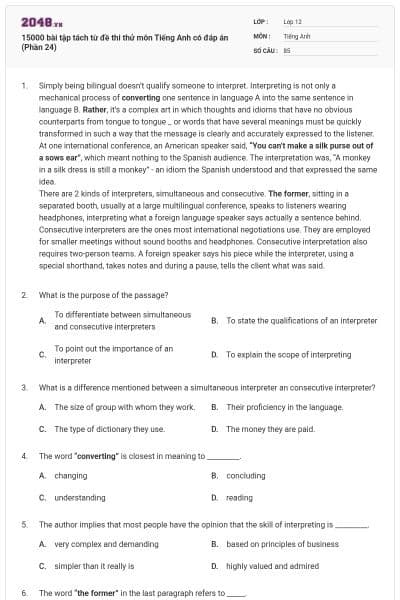
Simply being bilingual doesn’t qualify someone to interpret. Interpreting is not only a mechanical process of converting one sentence in language A into the same sentence in language B. Rather, it’s a complex art in which thoughts and idioms that have no obvious counterparts from tongue to tongue _ or words that have several meanings must be quickly transformed in such a way that the message is clearly and accurately expressed to the listener.
At one international conference, an American speaker said, “You can’t make a silk purse out of a sows ear”, which meant nothing to the Spanish audience. The interpretation was, “A monkey in a silk dress is still a monkey” - an idiom the Spanish understood and that expressed the same idea.
There are 2 kinds of interpreters, simultaneous and consecutive. The former, sitting in a separated booth, usually at a large multilingual conference, speaks to listeners wearing headphones, interpreting what a foreign language speaker says actually a sentence behind. Consecutive interpreters are the ones most international negotiations use. They are employed for smaller meetings without sound booths and headphones. Consecutive interpretation also requires two-person teams. A foreign speaker says his piece while the interpreter, using a special shorthand, takes notes and during a pause, tells the client what was said.
What is the purpose of the passage?
To differentiate between simultaneous and consecutive interpreters
To state the qualifications of an interpreter
To point out the importance of an interpreter
To explain the scope of interpreting
Đáp án A
Mục đích của đoạn văn là gì?
A. Để phân biệt giữa phiên dịch viên đồng thời và nối tiếp.
B. Để rõ trình độ của một phiên dịch viên.
C. Để chỉ ra tầm quan trọng của một phiên dịch viên.
D. Để giải thích phạm vi công việc phiên dịch
Thông tin ở câu: “There are 2 kinds of interpreters, simultaneous and consecutive.” (Có 2 loại phiên dịch viên, đồng thời và nối tiếp.)
Tiếp đó, tác giả chỉ ra những đặc điểm củ 2 loại hình phiên dịch viên để làm rõ sự khác biệt giữa 2 loại hình đó. => Mục đích của đoạn văn là phân biệt giữa phiên dịch viên nối tiếp và liên tục.
What is a difference mentioned between a simultaneous interpreter an consecutive interpreter?
The size of group with whom they work.
Their proficiency in the language.
The type of dictionary they use.
The money they are paid.
Đáp án A
Một sự khác biệt giữa đề cập một phiên dịch đồng thời và nối tiếp là gì?
A. Kích thước của nhóm người mà họ làm việc.
B. Khả năng của họ trong ngôn ngữ.
C. Các loại từ điển mà họ sử dụng.
D. Số tiền họ được trả tiền.
Thông tin ở câu: “They are employed for smaller meetings without sound booths and headphones.” (Họ được thuê cho các cuộc họp nhỏ hơn mà không có buồng âm thanh và tai nghe.)
The word “converting” is closest in meaning to _________.
changing
concluding
understanding
reading
Đáp án A
Từ “converting” gần nghĩa nhất với _________.
A. changing: đổi
B. concluding: kết luận
C. understanding: hiểu
D. reading: đọc
convert (v): chuyển đổi = change (v): đổi
The author implies that most people have the opinion that the skill of interpreting is _________.
very complex and demanding
based on principles of business
simpler than it really is
highly valued and admired
Đáp án D
Các tác giả ngụ ý rằng hầu hết mọi người có ý kiến rằng các kỹ năng phiên dịch ______.
A. rất phức tạp và đòi hỏi cao
B. dựa trên các nguyên tắc của kinh doanh
C. đánh giá cao và ngưỡng mộ
D. đơn giản hơn nó thực sự là
Thông tin ở câu : “Interpreting is not only a mechanical process of converting one sentence in language A into the same sentence in language B. Rather, it’s a complex art in which thoughts and idioms that have no obvious counterparts from tongue to tongue.” (Phiên dịch không chỉ là một quá trình cơ học để chuyển một câu thành ngôn ngữ A sang cùng một câu trong ngôn ngữ B. Thay vào đó, đó là một nghệ thuật phức tạp, trong đó các ý nghĩ và thành ngữ không có bản tương ứng rõ ràng từ ngôn ngữ này đến ngôn ngữ khác.) => Có vẻ có nhiều người nghĩ phiên dịch đơn giản chỉ là một quá trình cơ học để chuyển một câu thành ngôn ngữ A sang cùng một câu trong ngôn ngữ B nhưng thực chất phiên dịch rất phức tạp. => Đáp án D đúng
The word “the former” in the last paragraph refers to _____.
simultaneous interpreters
the conference
consecutive interpreters
both A & B
Đáp án A
Từ "the former" trong đoạn cuối cùng đề cập tới _____.
A. những phiên dịch viên đồng thời.
B. hội nghị
C. những phiên dịch viên liên tục.
D. cả A và B
Thông tin ở câu: “There are 2 kinds of interpreters, simultaneous and consecutive. The former,...” (Có 2 loại thông dịch viên, đồng thời và nối tiếp. Loại được nhắc đến trước,...) => Loại hình phiên dịch viên được đề cập trước là simultaneous. => Đáp án đúng là A.
The example “You can’t make a silk purse out of a sows ear” is used to________.
point out the difference in attributes of animals in English and Spanish
emphasize the need for translation of the meaning of what is said
show the differences in language A and language B
stress the importance of word for word translation
Đáp án B
Các ví dụ " You can’t make a silk purse out of a sows ear" được sử dụng để ________.
A. chỉ ra sự khác biệt trong các thuộc tính của các loài động vật bằng tiếng Anh và tiếng Tây Ban Nha
B. nhấn mạnh sự cần thiết của dịch về ý nghĩa của những gì được nói
C. cho thấy sự khác biệt giữa ngôn ngữ A và ngôn ngữ B
D. nhấn mạnh tầm quan trọng của bản dịch từng chữ
You can’t make a silk purse out of a sows ear: bạn không thể biến một thứ xấu xí thành thứ đẹp được.
Thông tin ở câu: “At one international conference, an American speaker said, “You can’t make a silk purse out of a sows ear”, which meant nothing to the Spanish audience. The interpretation was, “A monkey in a silk dress is still a monkey” - an idiom the Spanish understood and that expressed the same idea.” (Tại một cuộc hội thảo quốc tế, một diễn giả người Mỹ đã nói, "You can’t make a silk purse out of a sows ear", điều đó không có nghĩa gì đối với khán giả Tây Ban Nha. Phiên dịch ra sẽ là, "A monkey in a silk dress is still a monkey" - một thành ngữ mà người Tây Ban Nha hiểu và thể hiện cùng một ý nghĩa. ) => Ví dụ You can’t make a silk purse out of a sows ear là để nhấn mạnh việc dịch ra ý nghĩa của câu chứ không phải dịch nghĩa từng chữ.
The word “rather” is closest in meaning to _________.
in brief
on the contrary
in general
as a result
Đáp án B
Từ “rather” gần nghĩa nhất với _________.
A. in brief: tóm lại
B. on the contrary: ngược lại
C. in general: nói chung
D. as a result: kết quả là
Thông tin ở câu: “Rather, it’s a complex art in which thoughts and idioms that have no obvious counterparts from tongue to tongue.” (Thay vào đó, đó là một nghệ thuật phức tạp, trong đó các ý nghĩ và thành ngữ không có bản tương ứng rõ ràng từ ngôn ngữ này đến ngôn ngữ khác. ) => Ở trường hợp này Rather gần nghĩa nhất với on the contrary.
Which of the following would a consecutive interpreter be used for?
An interpretation of a major literary work.
A business transaction between 2 foreign speakers.
A large meeting of many nations.
A translation of a foreign book.
Đáp án B
Điều nào sau đây là một tình huống thông dịch viên nối tiếp sẽ được sử dụng?
A. Một cách phiên dịch của một tác phẩm văn học lớn.
B. Một giao dịch kinh doanh giữa 2 người nước ngoài.
C. Một cuộc họp lớn của nhiều quốc gia.
D. Một bản dịch của một cuốn sách nước ngoài.
Thông tin ở câu: “Consecutive interpreters are the ones most international negotiations use. They are employed for smaller meetings without sound booths and headphones. Consecutive interpretation also requires two-person teams. A foreign speaker says his piece while the interpreter, using a special shorthand, takes notes and during a pause, tells the client what was said.” (Phiên dịch viên nối tiếp là những người mà các cuộc đàm phán quốc tế hay sử dụng nhất. Họ được thuê cho các cuộc họp nhỏ hơn mà không có buồng âm thanh và tai nghe. Phiên dịch nối tiếp cũng yêu cầu nhóm 2 người. Một người nói tiếng nước ngoài nói phần của anh ta trong khi người phiên dịch, sử dụng một ký tự đặc biệt, ghi chép và trong thời gian tạm dừng, nói lại với khách hàng những gì đã được nói.)
Dịch bài
Cá sống dưới đáy biển có lợi bởi việc phẳng và siết chặt các đường viền. Có hai loài cá thân bẹt và chúng tiến hóa theo các con đường khác nhau. Cá đuối quạt và cá đuối, họ hàng của cá mập đã trở nên dẹt theo một cách có thể được gọi là rõ ràng. Cơ thể của chúng đã phát triển ngang để tạo thành những "đôi cánh" lớn. Chúng trông như thể chúng đã được làm phẳng nhưng vẫn cân đối và "phát triển đúng cách". Ngược lại, những loài như cá vược, cá bơn, và cá chim lớn đã trở nên dẹt theo một cách khác. Có những loài cá xương có khuynh hướng phẳng ra theo hướng dọc; chúng "cao" nhiều hơn là rộng. Chúng sử dụng toàn bộ cơ thể phẳng của chúng làm bề mặt bơi, mà tạo những gợn sóng qua nước khi chúng di chuyển. Vì thế, khi tổ tiên của chúng di cư xuống đáy biển, chúng đã nằm một bên chứ không phải trên bụng. Tuy nhiên, điều này làm nảy sinh vấn đề mà một mắt nhìn xuống cát và kết quả là khá vô ích - Trong tiến hóa vấn đề này đã được giải quyết bằng việc mắt dưới "di chuyển" xung quanh bên phía còn lại. Chúng ta có thể thấy quá trình di chuyển này đã được phổ biến trong sự phát triển của tất cả các cá thể cá thân bẹt xương trẻ. Nó bắt đầu bơi gần bề mặ nướct, và đối xứng phẳng và theo chiều thẳng đứng, nhưng sau đó hộp sọ bắt đầu phát triển theo kiểu xoắn bất đối xứng kỳ quặc, vì thế mắt một bên trái, di chuyển trên đỉnh đầu lên trên, theo kiểu Picasso cũ - như ảo cảnh. Ngẫu nhiên, một số loài gồm 20 loài cá thân bẹt nằm phía bên phải, một số khác ở bên trái, và một số khác ở hai bên.
Fish that live on the sea bottom benefit by being flat and hugging the contours. There are two very different types of flatfish and they have evolved in very separate ways. The skates and rays, relatives of the sharks have become flat in what might be called the obvious way. Their bodies have grown out sideways to form great “wings” They look as though they have been flattened but have remained symmetrical and “the right way up”. Conversely fish such as plaice, sole, and halibut have become flat in a different way. There are bony fish which have a marked tendency to be flattened in a vertical direction; they are much “taller” than they are wide. They use their whole vertically flattened bodies as swimming surfaces, which undulate through the water as they move. Therefore when * their ancestors migrated to the seabed, they lay on one side than on their bellies. However, this raises the problem that one eye was always looking down into the sand and was effectively useless - In evolution this problem was solved by the lower eye “moving” around the other side. We see this process of moving around enacted in the development of every young bony flatfish. It starts life swimming near the surface, and is symmetrical and vertically flattened, but then the skull starts to grow in a strange asymmetrical twisted fashion, so that one eye for instance the left, moves over the top of the head upwards, an old Picasso - like vision. Incidentally, some species of 20 flatfish settle on the right side, others on the left, and others on either side.
The passage is mainly concerned with:
symmetrical flatfish
bony flatfish
evolution of flatfish
different types of flatfish
Đáp án C
Đoạn văn chủ yếu liên quan đến:
A. cá thân bẹt đối xứng
B. cá thân bẹt xương
C. sự tiến hoá của cá thân bẹt
D. các loại cá thân bẹt khác nhau
Thông tin ở câu: “ There are two very different types of flatfish and they have evolved in very separate ways” (Có hai loài cá thân bẹt và chúng tiến hóa theo các con đường khác nhau.) “In evolution this problem was solved...” Trong quá trình tiến hóa, vấn đề này đã được giải quyết.
Ngoài ra từ “flatfish” cũng xuất hiện nhiều lần trong bài và bài này đề cập đến những vấn đề thích nghi của loài cá này trong quá trình tiến hóa => Đáp án C. evolution of flatfish là đáp án đúng.
The author mentions skates and rays as examples of fish that:
become asymmetrical
appear to fly
have spread horizontally
resemble sharks
Đáp án C
Tác giả đề cập đến cá đuối quạt và cá đuối là những ví dụ về cá:
A. trở nên bất đối xứng
B. có vẻ có thể bay
C. trải rộng theo chiều ngang
D. giống với cá mập
Thông tin ở câu: “The skates and rays, relatives of the sharks have become flat in what might be called the obvious way. Their bodies have grown out sideways to form great “wings” They look as though they have been flattened but have remained symmetrical and “the right way up” (Cá đuối quạt và cá đuối, họ hàng của cá mập đã trở nên dẹt theo một cách có thể được gọi là rõ ràng. Cơ thể của chúng đã phát triển ngang để tạo thành những "đôi cánh" lớn. Chúng trông như thể chúng đã được làm phẳng nhưng vẫn cân đối và "phát triển đúng cách".)
It can be inferred from the passage that the early life of a flatfish is:
often confusing
pretty normal
very difficult
full of danger
Đáp án B
Có thể suy luận từ đoạn văn rằng những năm đầu đời của một con cá thân bẹt là
A. thường gây nhầm lẫn
B. khá bình thường
C. rất khó
D. đầy nguy hiểm
Thông tin ở câu: “However, this raises the problem that one eye was always looking down into the sand and was effectively useless - In evolution this problem was solved by the lower eye “moving” around the other side. We see this process of moving around enacted in the development of every young bony flatfish.” (Tuy nhiên, điều này làm nảy sinh vấn đề mà một mắt nhìn xuống cát và kết quả là khá vô ích - Trong tiến hóa vấn đề này đã được giải quyết bằng việc mắt dưới "di chuyển" xung quanh bên phía còn lại. Chúng ta có thể thấy quá trình di chuyển này đã được phổ biến trong sự phát triển của tất cả các cá thể cá thân bẹt xương trẻ.) => Quá trình tiến hóa đã hoàn thành do vậy khi cá con sinh ra và lớn lên vẫn theo quá trình tương tự như bố mẹ chúng. Do vậy, giai đoạn đầu đời của cá dẹt được xem là bình thường.
It can be inferred from the passage that horizontal symmetrical fish:
have one eye each side of the head
have one eye underneath the head
have two eyes on top of the head
have eyes that move around the head
Đáp án C
Có thể suy luận từ đoạn văn rằng cá cân đối ngang:
A. có một mắt mỗi bên của đầu
B. có một mắt bên dưới đầu
C. có hai mắt trên đỉnh đầu
D. có mắt chuyển động quanh đầu
Có hai loài cá đẹt được đề cập trong bài là cá dẹt đối xứng ngang (horizontal symmetrical fish) và cá dẹt đối xứng đọc (vertically symmetrical fish). Thông tin về mắt lại chỉ được cung cấp về loài thứ hai, do đó ta phải tự suy đoán, Loại đối xứng dọc có mắt ở hai bên, và loài đối xứng ngang như hình ảnh cá đối thì cả hai mắt đều ờ trên đầu.
The word “conversely” is closest in meaning to:
similarly
alternatively
inversely
contrarily
Đáp án D
Từ “conversely” gần nghĩa nhất với:
A. similarly (adv): giống nhau
B. alternatively (adv): luân phiên
C. inversely (adv): ngược lại
D. contrarily (adv): ngược lại
Thông tin ở câu: “Conversely, fish such as plaice, sole, and halibut have become flat in a different way.” (Ngược lại, những loài như cá vược, cá bơn, và cá chim lớn đã trở nên dẹt theo một cách khác.) => Conversely nghĩa là ngược lại nhưng ở đây nó gần nhất với contrarily vì inversely không thể dùng để nối 2 câu.
The word “this” refers to:
the migration of the ancestors
the practice of lying on one side
the problem of the one eye looking downwards
the difficulty of the only one eye being useful
Đáp án B
Từ "this" dùng để chỉ:
A. sự di cư của tổ tiên
B. việc chỉ nằm về một phía
C. vấn đề của việc một mắt nhìn xuống
D. sự khó khăn của việc chỉ một mắt có ích
Thông tin ở câu: “Therefore when * their ancestors migrated to the seabed, they lay on one side than on their bellies. However, this raises the problem that one eye was always looking down into the sand and was effectively useless.” (Vì thế, khi tổ tiên của chúng di cư xuống đáy biển, chúng đã nằm một bên chứ không phải trên bụng. Tuy nhiên, điều này làm nảy sinh vấn đề mà một mắt nhìn xuống cát và kết quả là khá vô ích.) => Dựa theo nghĩa của câu this đáp án B là đáp án đúng.
According to the passage, the ability of a bony flatfish to move its eyes around is:
average
weak
excellent
variable
Đáp án C
Theo đoạn văn, khả năng của một cá thân bẹt xương di chuyển mắt của nó xung quanh:
A. trung bình
B. yếu
C. tuyệt vời
D. biến hóa
Thông tin ở câu: “In evolution this problem was solved by the lower eye- "moving” around the other side. We see this process of moving around enacted in the development of every young bony flatfish.” (Trong tiến hóa vấn đề này đã được giải quyết bằng việc mắt dưới "di chuyển" xung quanh bên phía còn lại. Chúng ta có thể thấy quá trình di chuyển này đã được phổ biến trong sự phát triển của tất cả các cá thể cá thân bẹt xương trẻ.) => Từ giọng điệu của tác giả ta suy ra khả năng này của cá bẹt rất tuyệt vời.
Dịch bài
Có hàng triệu người đang sử dụng điện thoại di động ngày nay. Ở nhiều nơi, điều đó thậm chí bị coi là bất thường nếu ta không sử dụng tới 1 chiếc. Ở nhiều quốc gia, điện thoại di động rất phổ biến đối với giới trẻ. Họ nhận thấy rằng điện thoại không chỉ đơn thuần là 1 phương tiện giao tiếp mà chúng còn chứng minh rằng họ sành điệu có nhiều mối quan hệ.
Sự bùng nổ trong sử dụng điện thoại di động trên khắp thế giới đã khiến một số chuyên gia y tế lo ngại. Một số bác sĩ quan ngại rằng trong tương lai, nhiều người có thể sẽ gặp vấn đề về sức khoẻ do việc sử dụng điện thoại di động. Tại Anh, đã có một cuộc tranh luận gay gắt về vấn đề này. Các công ty điện thoại đang lo lắng về việc công chúng sẽ biết đến những ảnh hưởng xấu của điện thoại di động. Họ nói rằng không có bằng chứng nào cho thấy điện thoại di động có hại cho sức khoẻ của người dùng. Mặt khác, các nghiên cứu y học đã cho thấy có sự thay đổi trong tế bào não của một số người đang sử dụng điện thoại di động. Dấu hiệu thay đổi mô trong não có thể được phát hiện bằng thiết bị quét hiện đại. Trong một trường hợp, một nhân viên bán hàng đã phải nghỉ hưu khi còn rất trẻ vì chứng mất trí nhớ trầm trọng. Anh ta không thể nhớ những thao tác nghiệp vụ đơn giản và thường xuyên quên cả tên của con trai mình. Người đàn ông này thường nói chuyện điện thoại di động khoảng sáu giờ mỗi ngày trong tuần làm việc của mình trong một vài năm. Bác sĩ gia đình đổ lỗi cho việc sử dụng điện thoại di động, nhưng bác sĩ công ti thì không đồng tình.
Điều gì làm cho điện thoại di động có khả năng gây hại như vậy? Câu trả lời là bức xạ. Các máy móc công nghệ cao có thể phát hiện ra một lượng nhỏ bức xạ phát ra từ điện thoại di động. Các công ty điện thoại di động đồng ý rằng có một vài bức xạ, nhưng họ nói rằng số lượng đó rất nhỏ để phải bận tâm. Bàn về sự an toàn khi tiếp tục sử dụng điện thoại di động, cách tốt nhất là sử dụng chúng ít thường xuyên hơn. Dùng điện thoại thông thường nếu là cuộc nói chuyện dài. Chỉ sử dụng điện thoại di động khi bạn thực sự cần. Điện thoại di động có thể rất hữu ích và tiện dụng, đặc biệt là trong những trường hợp khẩn cấp. Trong tương lai, điện thoại di động có thể là 1 cảnh báo rằng chúng không tốt cho sức khoẻ của bạn. Vì vậy, ngay từ bây giờ, hãy khôn ngoan khi không sử dụng chúng quá thường xuyên.
Millions of people are using cell phones today. In many places, it is actually considered unusual not to use one. In many countries, cell phones are very popular with young people. They find that the phones are more than a means of communication - having a mobile phone shows that they are cool and connected.
The explosion in mobile phone use around the world has made some health professionals worried. Some doctors are concerned that in the future, many people may suffer health problems from the use of mobile phones. In England, there has been a serious debate about this issue. Mobile phone companies are worried about the negative publicity of such ideas. They say that there is no proof that mobile phones are bad for your health. On the other hand, medical studies have shown changes in the brain cells of some people who use mobile phones. Signs of change in the tissues of the brain and head can be detected with modern scanning equipment. In one case, a traveling salesman had to retire at young age because of serious memory loss. He couldn't remember even simple tasks. He would often forget the name of his own son. This man used to talk on his mobile phone for about six hours a day, every day of his working week, for a couple of years. His family doctor blamed his mobile phone use, but his employer's doctor didn't agree.
What is it that makes mobile phones potentially harmful? The answer is radiation. High-tech machines can detect very small amounts of radiation from mobile phones. Mobile phone companies agree that there is some radiation, but they say the amount is too small to worry about. As the discussion about their safety continues, it appears that it's best to use mobile phones less often. Use your regular phone if you want to talk for a long time. Use your mobile phone only when you really need it. Mobile phones can be very useful and convenient, especially in emergencies. In the future, mobile phones may have a warning label that says they are bad for your health. So for now, it's wise not to use your mobile phone too often.
According to the passage, cell phones are especially popular with young people because ______.
they cannot be replaced by regular phones.
they are indispensable in everyday communications.
they keep the users alert all the time.
they make them look more stylish.
Đáp án D
Theo như đoạn văn, điện thoại di động đặc biệt phổ biến với giới trẻ bởi vì______.
A. chúng không thể bị thay thế bởi những chiếc điện thoại thông thường.
B. chúng rất cần thiết trong giao tiếp hằng ngày.
C. chúng khiến người dùng cảnh giác mọi lúc.
D. chúng khiến họ trông sành điệu hơn.
Dẫn chứng câu cuối- đoạn 1 “They find that the phones are more than a means of communication - having a mobile phone shows that they are cool and connected” – (Họ thấy rằng điện thoại không chỉ là 1 phương tiện giao tiếp- việc có 1 chiếc điện thoại cho thấy rằng họ sành điệu và có nhiều mối quan hệ).
The phrase “negative publicity” in the passage most likely means______.
information on the lethal effects of cell phones.
the negative public use of cell phones.
poor ideas about the effects of cell phones.
widespread opinion about bad effects of cell phones.
Đáp án D
"Negative publicity" ở đoạn 2 có nghĩa là gì?
A. Thông tin về những ảnh hưởng chết người của điện thoại di động.
B. Công khai tiêu cực việc sử dụng điện thoại di động.
C. Ý kiến xấu về những ảnh hưởng của điện thoại di động.
D. Ý kiến lan rộng về những ảnh hưởng xấu của điện thoại di động.
Dẫn chứng đoạn 2: “Some doctors are concerned that in the future many people may suffer health problems from the use of mobile phones. In England, there has been a serious debate about this issue. Mobile phone companies are worried about the negative publicity of such ideas.”-(Một vài bác sĩ quan ngại rằng trong tương lai, nhiều người có thể sẽ phải chịu những vấn đề về mặt sức khỏe từ việc sử dụng điện thoại di động. Ở Anh, đang có những cuộc tranh luận gay gắt về vấn đề này. Các công ti điện thoại di động thì lo lắng về việc công chúng sẽ biết đến rộng rãi những ý kiến đó).
Như vậy negative publicity tức là việc công chúng biết tới rộng rãi những mặt tiêu cực của một vấn đề gì đó, mà cụ thể ở đây là việc sử dụng điện thoại di động có thể ảnh hưởng xấu tới sức khỏe.
The word “potentially” in the passage most closely means ______.
possibly.
privately.
certainly.
obviously.
Đáp án A
Câu hỏi từ vựng.
Potentiall (adv): có tiềm năng, có khả năng = A. possibly (adv): có thể, có khả năng.
Các đáp án còn lại:
B. privately (adv): một cách riêng tư.
C. certainly (adv): một cách chắc chắn.
D. obviously(adv): một cách hiển nhiên, rõ ràng.
Tạm dịch: “What is it that makes mobile phones potentially harmful?” – (Điều gì khiến cho điện thoại di động có khả năng gây hại như vậy?).
According to the writer, people should ______.
never use mobile phones in all cases.
only use mobile phones in medical emergencies.
keep off mobile phones regularly.
only use mobile phones in urgent cases.
Đáp án D
Theo như đoạn văn, chúng ta nên ______.
A. không bao giờ sử dụng điện thoại di động trong mọi trường hợp.
B. chỉ sử dụng điện thoại di động trong những trường hợp cấp cứu khẩn cấp.
C. tránh xa điện thoại di động thường xuyên.
D. chỉ sử dụng điện thoại di động trong những trường hợp khẩn cấp.
Dẫn chứng ở đoạn 5: “Use your mobile phone only when you really need it. Mobile phones can be very useful and convenient, especially in emergencies” – (Chỉ sử dụng điện thoại di động khi bạn thực sự cần. Điện thoại di động có thể rất hữu ích và tiện dụng, đặc biệt là lúc khẩn cấp).
According to the passage, what makes mobile phones potentially harmful is ______.
their raiding power.
their power of attraction.
their invisible rays.
their radiant light.
Đáp án C
Theo như đoạn văn, thứ gì khiến cho điện thoại di động có khả năng gây hại?
A. năng lượng bức xạ của chúng.
B. lực hấp dẫn của chúng.
C. những tia bức xạ vô hình của chúng.
D. ánh sáng bức xạ của chúng.
Dẫn chứng ở 2 câu đầu- đoạn 3: “What is it that makes mobile phones potentially harmful? The answer is radiation. High-tech machines can detect very small amounts of radiation from mobile phones”- (Điều gì khiến cho điện thoại di động có khả năng gây hại như vậy? Câu trả lời chính là bức xạ. Các máy móc công nghệ cao có thể phát hiện ra một lượng nhỏ tia bức xạ phát ra từ điện thoại di động).
The man mentioned in the passage, who used his cell phone too often, ______.
could no longer think lucidly.
had a problem with memory.
abandoned his family.
suffered serious loss of social skills
Đáp án B
Người đàn ông được đề cập tới trong đoạn văn- người mà sử dụng điện thoại di động rất thường xuyên, anh ta______.
A. không thể suy nghĩ minh mẫn.
B. có vấn đề về trí nhớ.
C. từ bỏ chính gia đình mình.
D. chịu những thương tổn về các kĩ năng xã hội.
Dẫn chứng ở cuối đoạn 2: “He couldn't remember even simple tasks. He would often forget the name of his own son. This man used to talk on his mobile phone for about six hours a day, every day of his working week, for a couple of years” - (Anh ta thậm chí không nhớ nổi những thao tác nghiệp vụ đơn giản, thường xuyên quên tên của con trai mình. Người đàn ông này nói chuyện qua điện thoại khoảng 6 giờ mỗi ngày và trong những ngày làm việc trong tuần trong khoảng vài năm).
The changes possibly caused by the cell phones are mainly concerned with ______.
the smallest units of the brain.
the mobility of the mind and the body.
the arteries of the brain
the resident memory.
Đáp án A
Những thay đổi có thể bị gây ra bởi điện thoại di động chủ yếu liên quan tới______.
A. những tế bào nhỏ nhất của não bộ.
B. tính linh hoạt của đầu óc và cơ thể.
C. những động mạch trong não.
D. bộ nhớ cư trú.
Dẫn chứng ở đoạn 2: “On the other hand, medical studies have shown changes in the brain cells of some people who use mobile phones. Signs of change in the tissues of the brain and head can be detected with modern scanning equipment” – (Mặt khác, các nghiên cứu y học đã cho thấy có sự thay đổi trong tế bào não của một số người đang sử dụng điện thoại di động. Những dấu hiệu thay đổi trong mô của não bộ và đầu có thể được phát hiện bằng thiết bị quét hiện đại).
Doctors have tentatively concluded that cell phones may .
cause some mental malfunction.
have damaged their users’ emotion.
change their users’ social behaviours.
change their users’ temperament..
Đáp án A
Các bác sĩ kết luận tạm thời rằng điện thoại di động có thể .
A. gây ra một số vấn đề về thần kinh.
B. làm tổn hại tới cảm xúc của người sử dụng.
C. thay đổi hành vi xã hội của người sử dụng.
D. thay đổi tính khí của người sử dụng.
Dựa vào ví dụ trong bài về người đàn ông sửa dụng điện thoại di động quá thường xuyên và dẫn tới ảnh hưởng về mặt trí nhớ, ta suy ra được đáp án A.
Dịch bài
Bạn có thể biết được khi nào bạn của mình hạnh phúc hay tức giận bằng cách nhìn vào mặt hoặc hành động của họ. Cách này rất hữu hiệu bởi việc đọc được những cảm xúc của họ sẽ giúp bạn biết phải trả lời như thế nào với họ. Những cảm xúc phát triển để giúp chúng ta phản ứng lại những tình huống quan trọng và truyền đạt ý đồ tới những người khác. Nhưng phải chăng việc nhướn lông mày và làm tròn miệng ở Minneapolis và Madagascar cùng nói lên một ý nghĩa? Nhiều nghiên cứu về biểu hiện cảm xúc đã tập trung và đặt nghi vấn vào câu hỏi này.
Theo như Paul Ekman, chuyên gia nghiên cứu trong lĩnh vực này cho hay, con người nói và hiểu về căn bản được coi như là “bộ mặt của ngôn ngữ”. Những nghiên cứu được thực hiện bởi nhóm của Ekman đã chứng minh rằng: con người có chung những biểu hiện cảm xúc phổ biến giống nhau, điều này chứng tỏ cho sự kế thừa về mặt sinh học của loài người. Thí dụ như, cười là dấu hiệu của sự hạnh phục và cái cau mày ám chỉ sự buồn phiền trên khuôn mặc của những người ở nơi xa như Argentina, Nhật Bản, Tây Ban Nha, Hungary, Ba Lan, Sumatra, Hoa Kỳ, Việt Nam, rừng già của New Guinea, và các làng Eskimo ở phía bắc Artic Circle. Ekman và những người cộng sự cho rằng mọi người ở khắp nơi có thể nhận ra được ít nhất bảy sắc thái cảm xúc cơ bản: buồn, sợ hãi, tức giận, ghê tởm, khinh miệt, hạnh phúc và bất ngờ. Mặc dù vậy, vẫn có những khác biệt đáng kể giữa các nền văn hóa trong cả hoàn cảnh lẫn mức độ biển hiện- hay còn gọi là quy tắc biểu hiện. Thí dụ như, ở nhiều nền văn hóa Á Đông, trẻ em được dạy cách kiểm soát những phản ứng cảm xúc, đặc biệt là những cảm xúc tiêu cực. Trong khi đó, nhiều trẻ Mĩ được khuyến khích bày tỏ cảm xúc một cách cởi mở. Tuy nhiên, nếu không kể tới yếu tố văn hóa, thì cảm xúc vẫn luôn thể hiện ra chính nó, ở một mức độ nào đó, trong hành vi của con người. Từ những ngày đầu tiên của cuộc đời, những đứa trẻ sơ sinh đã biết tạo ra những biểu cảm trên khuôn mặt để thể hiện cảm xúc của chúng.
Khả năng đọc được biểu cảm trên khuôn mặt cũng vậy, nó phát triển từ rất sớm. Những đứa trẻ nhỏ rất chú ý tới những biểu hiện trên khuôn mặt, và khi lên 5, chúng đã gần như đã có được những kĩ năng về đọc cảm xúc trên khuôn mặt tương tự như những người trưởng thành. Tất cả những bằng chứng này đều chỉ ra một cơ sở sinh học cho những khả năng của chúng ta về bày tỏ và giải thích một tập hợp cảm xúc cơ bản của con người. Hơn nữa, như Charles Darwin đã nêu ra hơn 1 thế kỉ trước, một số biểu hiện cảm xúc dường như xuất hiện trên ranh giới giữa các loài. Các nhà tâm lí học xuyên văn hóa nói với chúng ta rằng: những phản ứng cảm xúc nhất định mang những ý nghĩa khác nhau tùy thuộc vào từng nền văn hóa khác nhau. Ví dụ, cảm xúc nào của bạn được cho rằng có thể được truyền tải bằng cách lè lưỡi?. Đối với người Mĩ, hành động đó ám chỉ sự kinh tởm, trong khi ở Chi-lê, hành động đó là biển hiện cho sự ngạc nhiên. Tương tự như vậy, điệu cười toe toét trên khuôn mặt người Mĩ lầ dấu hiệu cho niềm hân hoan, vui sướng; trong khi đó ở Nhật, nó chỉ đơn giản là biểu hiện của sự lúng túng. Rõ ràng là, văn hóa có ảnh hưởng tới biểu hiện cảm xúc.
You can usually tell when your friends are happy or angry by the looks on their faces or by their actions. This is useful because reading their emotional expressions helps you to know how to respond to them. Emotions have evolved to help us respond to important situations and to convey our intentions to others. But does raising the eyebrows and rounding the mouth say the same thing in Minneapolis as it does in Madagascar? Much research on emotional expressions has centered on such questions.
According to Paul Ekman, the leading researcher in this area, people speak and understand substantially the same "facial language". Studies by Ekman's group have demonstrated that humans share a set of universal emotional expressions that testify to the common biological heritage of the human species. Smiles, for example, signal happiness and frowns indicate sadness on the faces of people in such far- flung places as Argentina, Japan, Spain, Hungary, Poland , Sumatra ,the United States, Vietnam, the jungles of New Guinea , and the Eskimo villages north of Artic Circle. Ekman and his colleagues claim that people everywhere can recognize at least seven basic emotions: sadness, fear, anger, disgust, contempt, happiness, and surprise. There are, however, huge differences across cultures in both the context and intensity of emotional displays - the so called display rules. In many Asian cultures, for example, children are taught to control emotional responses - especially negative ones- while many American children are encouraged to express their feelings more openly. Regardless of culture, however, emotions usually show themselves, to some degree , in people's behavior. From their first days of life, babies produce facial expressions that communicate their feelings.
The ability to read facial expressions develops early, too. Very young children pay close attention to facial expressions, and by age five, they nearly equal adults in their skill at reading emotions on people's faces. This evidence all points to a biological underpinning for our abilities to express and interpret a basic set of human emotions. Moreover, as Charles Darwin pointed out over a century ago, some emotional expressions seem to appear across species boundaries. Cross - cultural psychologists tell us that certain emotional responses carry different meanings in different cultures. For example, what emotion do you suppose might be conveyed by sticking out your tongue? For Americans, this might indicate disgust, while in China it can signify surprise. Likewise, a grin on an American face may indicate joy, while on a Japanese face it may just as easily mean embarrassment. Clearly, culture influences emotional expressions.
According to the passage, we respond to others by______.
observing their emotional expressions
looking at their faces.
watching their actions.
observing their looks.
Đáp án A
Theo như đoạn văn, chúng ta trả lời lại người khác bằng cách______.
A. quan sát biểu hiện cảm xúc của họ.
B. nhìn vào mặt họ.
C. theo dõi các hành động của họ.
D. quan sát ngoại hình của họ.
Dẫn chứng ở 2 câu đầu tiên của bài: “You can usually tell when your friends are happy or angry by the looks on their faces or by their actions. This is useful because reading their emotional expressions helps you to know how to respond to them” – (Bạn có thể biết được khi nào bạn của mình hạnh phúc hay tức giận bằng cách nhìn vào mặt hoặc hành động của họ. Cách này rất hữu hiệu bởi việc đọc được những cảm xúc của họ sẽ giúp bạn biết phải trả lời như thế nào với họ).
Many studies on emotional expressions try to answer whether ______.
eyebrow raising means the same in Minneapolis and Madagascar.
raising the eyebrows has similar meaning to rounding the mouth.
different cultures have similar emotional expressions.
rounding the mouth has the same meaning in Minneapolis and Madagascar.
Đáp án C
Nhiều cuộc nghiên cứu về biểu hiện cảm xúc cố gắng trả lời liệu là______.
A. biểu hiện nhướn lông mày có cùng ý nghĩa ở Minneapolis và Madagascar.
B. nhướn lông mày có ý nghĩa giống với làm tròn miệng.
C. những nền văn hoá khác nhau có những biểu hiện cảm xúc giống nhau.
D. tròn miệng có cùng ý nghĩa ở Minneapolis và Madagascar.
Giải thích: Từ câu hỏi trong bài: “But does raising the eyebrows and rounding the mouth say the same thing in Minneapolis as it does in Madagascar?”- (Nhưng phải chăng việc nhướn lông mày và làm tròn miệng ở Minneapolis và Madagascar cùng nói lên một ý nghĩa?). Tác giả đưa ra câu hỏi này nhằm mục đích nghi vấn rằng liệu có phải những nền văn hóa khác nhau (như Minneapolis và Madagascar) cùng có những biển hiện cảm xúc giống nhau biểu thị những ý nghĩa giống nhau.
The word ''evolved" in the passage is closest in meaning to______.
Developed
increased
reduced
Simplified
Đáp án A
Câu hỏi từ vựng.
Từ " evolved" trong đoạn văn đồng nghĩa với ______.
A. developed (v): phát triển.
B. increased (v): tăng lên.
C. reduced (v): giảm xuống, làm giảm.
D. simplified (v): đơn giản hóa.
Evolve (v): tiến hóa = A. develop (v): phát triển.
The best title for the passage is______.
ways to control emotional expressions.
A review of research on emotional expressions.
Human habits of displaying emotions.
cultural universals in emotional expressions.
Đáp án D
Tiêu đề phù hợp nhất cho đoạn văn là______.
A. các cách kiểm soát cảm xúc.
B. tóm tắt lại các nghiên cứu về biểu hiện cảm xúc.
C. thói quen của con người trong việc bày tỏ cảm xúc.
D. những điểm chung phổ biến giữa các nền văn hoá trong những biểu hiện cảm xúc.
Dạng câu hỏi tìm tiêu đề này luôn ưu tiên làm sau cùng.
Ta dễ dàng loại bỏi được đáp án A do không có thông tin trong bài và đáp án B, C do không bao quát và xuyên suốt toàn bài.
Unlike American children, Asian children are encouraged to______.
display their emotions openly
change their behaviour.
control their emotions.
conceal their positive emotions.
Đáp án C
Không giống như trẻ em Mĩ, trẻ em Châu Á được khuyến khích______.
A. thể hiện cảm xúc một cách cởi mở.
B. thay đổi thái độ, hành vi.
C. điều khiển cảm xúc.
D. che đậy những cảm xúc tích cực.
Dẫn chứng ở câu thứ 3 từ cuối lên- đoạn 2: “In many Asian cultures, for example, children are taught to control emotional responses - especially negative ones, while many American children are encouraged to express their feelings more openly” – (Thí dụ như, ở nhiều nền văn hóa Á Đông, trẻ em được dạy cách kiểm soát những phản ứng cảm xúc, đặc biệt là những cảm xúc tiêu cực. Trong khi đó, trẻ Mĩ lại được khuyến khích bày tỏ cảm xúc một cách cởi mở).
Young children______.
are sensitive towards others' emotions.
take time to control their facial expressions.
spend a long time learning to read others' emotions.
make amazing progress in controlling their emotions.
Đáp án A
Trẻ nhỏ______.
A. nhạy cảm với cảm xúc của người khác.
B. cần nhiều thời gian để kiểm soát được biểu hiện trên khuôn mặt.
C. mất một thời gian dài để học cách “đọc” cảm xúc của người khác.
D. tiến bộ tuyệt vời trong việc kiểm soát cảm xúc.
Dẫn chứng ở câu 2- đoạn cuối: “Very young children pay close attention to facial expressions, and by age five, they nearly equal adults in their skill at reading emotions on people's faces” – (Những đứa trẻ nhỏ rất chú ý tới những biểu hiện trên khuôn mặt, và khi lên 5, chúng đã gần như đã có được những kĩ năng về đọc cảm xúc trên khuôn mặt tương tự như những người trưởng thành).
The biggest difference lies in______.
how often positive emotions are shown.
how emotional responses are controlled.
how intensive emotions are expressed.
how long negative emotions are displayed.
Đáp án C
Sự khác biệt lớn nhất nằm ở ______.
A. những cảm xúc tích cực thường được thể hiện như thế nào.
B. những phản ứng cảm xúc được kiểm soát như thế nào.
C. những mức độ cảm xúc được thể hiện như thế nào.
D. những cảm xúc tiêu cực được biểu hiện trong bao lâu.
Dẫn chứng ở đoạn 2: “There are, however, huge differences across cultures in both the context and intensity of emotional displays - the so called display rules” – (Mặc dù vậy, vẫn có những khác biệt đáng kể giữa các nền văn hóa trong cả hoàn cảnh và mức độ biển hiện- hay còn gọi là quy tắc biểu hiện).
Duncan Phyfe made some of the most beautiful furniture found in America. His family name was originally Fife, and he was born in Scotland in 1768. In 1784, the Fife family immigrated to Albany, New York where Duncan’s father opened a cabinetmaking shop. Duncan followed his father’s footsteps and was apprenticed to a cabinetmaker. After completing his training, Duncan moved to New York City.
Duncan Fife was first mentioned in the 1792 NYC Directory as a furniture “joiner” in business at 2 Broad Street. Two years later, he moved, expanded his business, and changed his name to Phyfe. He was a quiet-living, God-fearing young man who felt his new name would probably appeal to potential customers who were definitely anti-British in this post-Revolutionary War period.
Duncan Phyfe’s name distinguished him from his contemporaries. Although the new spelling helped him better compete with French emigrant craftsmen, his new name had more to do with hanging it on a sign over his door stoop.
The artisans and merchants who came to America discovered a unique kind of freedom. They were no longer restricted by class and guild traditions of Europe. For the first time in history, a man learned that by working hard, he could build his business based on his own name and reputation and quality of work.
Phyfe’s workshop apparently took off immediately. At the peak of his success, Phyfe employed 100 craftsmen. Some economic historians point to Phyfe as having employed division of labor and an assembly line. What his workshop produced shows Phyfe’s absolute dedication to quality in workmanship. Each piece of furniture was made of the best available materials. He was reported to have paid $1,000 for a single Santo Domingo mahogany log.
Phyfe did not create new designs. Rather, he borrowed from a broad range of the period’s classical styles, Empire, Sheraton, Regency, and French Classical among them. Nevertheless, Phyfe’s high quality craftsmanship established him as America’s patriotic interpreter of European design in the late eighteenth and early nineteenth centuries.
Although the number of pieces produced by Duncan Phyfe’s workshop is enormous, comparatively few marked or labeled pieces have been found extant. In antiques shops and auctions, collectors have paid $11,000 for a card table, $24,200 for a tea table, and $93,500 for a sewing table.
What is the main idea of the passage?
The business of cabinetmaking.
The significance of Duncan Phyfe’s name.
Duncan Phyfe’s life and career.
Duncan Phyfe’s cabinetmaking designs.
Đáp án C
Đâu là ý chính của đoạn văn?
A. Việc kinh doanh ngành đồ gỗ mỹ nghệ.
B. Ý nghĩa của cái tên Duncan Phyfe.
C. Cuộc đời và sự nghiệp của Duncan Phyfe.
D. Việc thiết kế đồ gỗ mỹ nghệ của D. Duncan Phyfe.
Giải thích: Xuyên suốt toàn bài đều nói về Duncan Phyfe trên khía cạnh cuộc đời và sự nghiệp làm đồ nội thất của ông.
Một số dẫn chứng như:
+ “he was born in Scotland in 1768. In 1784, the Fife family immigrated to Albany, New York where Duncan’s father opened a cabinetmaking shop. Duncan followed his father’s footsteps and was apprenticed to a cabinetmaker” – (Ông được sinh ra ở Scotland vào năm 1768, gia đình ông nhập cư vào Albany, New York- nơi mà cha ông mở một cửa hàng đồ gỗ mĩ nghệ. Duncan đã nối gót cha và theo học nghề đồ gỗ mĩ nghệ).
+ “Two years later, he moved, expanded his business, and changed his name to Phyfe” – (2 năm sau, ông rời đi và mở rộng việc kinh doanh, đổi tên thành Phyfe”.
+ “At the peak of his success, Phyfe employed 100 craftsmen” – (Vào thời kì đỉnh cao của thành công, Phyfe đã thuê về 100 thợ thủ công).
According to the passage, which of the following does the author imply?
Duncan Fife and his father had the same first name.
Duncan Fife worked for his father in Scotland.
Duncan Fife and his father were in the same business.
Duncan Phyfe made over 100 different kinds of tables.
Đáp án C
Theo như đoạn văn, tác giả ám chỉ điều nào sau đây?
A. Duncan Fife và cha của ông có cùng tên riêng.
B. Duncan Fife làm việc cho cha ông ở Scotland.
C. Duncan Fife và cha ông ta cũng có cùng sự nghiệp kinh doanh giống nhau.
D. Duncan Phyfe đã chế tác ra trên 100 loại bàn khác nhau.
Dẫn chứng ở đoạn 1: “Duncan followed his father’s footsteps and was apprenticed to a cabinetmaker” – (Duncan đã nối gót cha và theo học nghề đồ gỗ mĩ nghệ).
Which choice does the word “it” in paragraph 3 refer to?
His spelling
His chair
His French
His name
Đáp án D
Từ “it” ở đoạn 3 đề cập tới.
A. cách đánh vần.
B. chiếc ghế.
C. tiếng Pháp.
D. tên.
Đọc cả câu chứ “it”: “Although the new spelling helped him better compete with French emigrant craftsmen, his new name had more to do with hanging it on a sign over his door stoop” – (Mặc dù phát âm mới đã giúp ông cạnh tranh tốt hơn với các thợ thủ công nhập cư người Pháp, nhưng cái tên mới mới có nhiều điều đáng để nói và nó được khắc thành một dấu hiệu ở trên cái chặn cửa).
Which choice is closest in meaning to the word “guild” in paragraph 4?
Verdict of a jury
Organization of craftsmen
Political party of emigrants
Immigrants’ club
Đáp án B
Câu hỏi từ vựng.
Từ “guild” ở đoạn 2 đồng nghĩa với?
A. Lời phán quyết của bồi thẩm đoàn
B. Tổ chức của những người thợ thủ công.
C. Đảng chính trị của những người nhập cư
D. Câu lạc bộ những người nhập cư.
Guild (n): phường, hội, tập thể, tổ chức.
Các đáp án A, C, D không có nội dung liên quan .
Tạm dịch: “They were no longer restricted by class and guild traditions of Europe” – (Họ không còn bị giới hạn, cấm đoán bởi những tầng lớp hay tổ chức truyền thống của Châu Âu).
In his business, Duncan Phyfe used all of the following EXCEPT ______.
division of labor
an assembly line
continental designs
the least expensive materials
Đáp án D
Trong sự nghiệp của mình, Duncan Phyfe đã sử dụng tới tất cả những điều sau đây, NGOẠI TRỪ______.
A. sự phân chia lực lượng lao động.
B. dây chuyền lắp ráp.
C. những thiết kế nội địa.
D. những vật liệu ít tốn kém nhất.
Các dẫn chứng A, B, C được tìm thấy trong bài:
+ Đoạn 5: “At the peak of his success, Phyfe employed 100 craftsmen. Some economic historians point to Phyfe as having employed division of labor (A) and an assembly line (B)” – (Vào thời kì đỉnh cao của thành công, Phyfe đã thuê về 100 thợ thủ công. Một số nhà sử gia kinh tế đã chỉ ra rằng Phyfe đã áp dụng sự phân công lao động và một dây chuyền lắp ráp).
+ Đoạn 6 – (C): “Phyfe did not create new designs. Rather, he borrowed from a broad range of the period’s classical styles, Empire, Sheraton, Regency, and French Classical among them ” – (Phyfe không tạo ra những thiết kế mới. Thay vào đó, ông vay mượn từ một loạt các phong cách cổ điển của các thời kỳ, Empire, Sheraton, Regency, và Pháp cổ điển trong số đó).
Ngoài ra cũng có dẫn chứng chứng minh D sai, nằm ở đoạn 5: “Each piece of furniture was made of the best available materials. He was reported to have paid $1,000 for a single Santo Domingo mahogany log” – (Từng phần của đồ nột thất được làm từ những chất liệu có sẵn tốt thất. Ông được cho là đã chi ra 1000 đô cho một khúc gỗ gụ Santo Domingo).
Based on the information in the passage, what can be inferred about Duncan Phyfe’s death?
He died in the eighteenth century.
He died in Albany.
He died in the nineteenth century.
He died in Scotland.
Đáp án C
Dựa vào thông tin có trong đoạn văn, có thể suy ra được điều gì từ cái chết của Duncan Phyfe?
A. Ông qua đời vào thế kỉ 18.
B. Ông qua đời ở Albany.
C. Ông qua đời vào thế kỉ 19.
D. Ông qua đời ở Scotland.
Giải thích:
Trong đoạn văn không đề cập trực tiếp tới thời gian và địa điểm qua đời của Phyfe, nên ta cần suy ta từ những dữ kiện có trong bài.
+ Đoạn đầu tiên: “he was born in Scotland in 1768” – (Ông được sinh ra ở Scotland vào năm 1768).
+ Cuối đoạn 5: “Nevertheless, Phyfe’s high quality craftsmanship established him as America’s patriotic interpreter of European design in the late eighteenth and early nineteenth centuries” – (Mặc dù vậy, sự nghiệp đồ thủ công mĩ nghệ chất lượng cao của Phyfe đã giúp ông trở thành thông dịch ái quốc của Mĩ về thiết kế Châu Âu và cuối thế kỉ 18 và đầu thế kỉ 19).
=> Ông sống ít nhất qua đầu thế kỉ 19, nhưng không thể sống được tới thế kỉ 20 (vì nếu tới thế kỉ 20 là ông hơn 130 tuổi) =>Ông mất vào thế kỉ 19.
The author implies that ______.
furniture from Duncan Phyfe’s workshop no longer exists.
furniture from Duncan Phyfe’s workshop costs a lot of money today.
furniture from Duncan Phyfe’s workshop was ignored by New Yorkers.
furniture from Duncan Phyfe’s workshop was made by his father.
Đáp án B
Tác giả ám chỉ rằng ______.
A. đồ nột thất từ xưởng của Duncan Phyfe không còn tồn tại.
B. đồ nột thất từ xưởng của Duncan Phyfe có giá rất cao ngày nay.
C. đồ nột thất từ xưởng của Duncan Phyfe bị người dân New York ngó lơ.
D. đồ nột thất từ xưởng của Duncan Phyfe được làm ra bởi cha của ông.
Dẫn chứng ở câu cuối cùng: “In antiques shops and auctions, collectors have paid $11,000 for a card table, $24,200 for a tea table, and $93,500 for a sewing table” – (Trong các cửa hàng bán đồ cổ và những cuộc đấu giá, có những nhà sưu tầm đã trả 11.000 đô la cho một chiếc bàn đánh bài, 24.200 đô la cho một chiếc bàn trà và 93.500 đô la cho một chiếc bàn mây) => giá trị những đồ nội thất được làm ra từ xưởng của Phyfe ngày nay có giá rất cao
After the United States purchased Louisiana from France and made it their newest territory in 1803, President Thomas Jefferson called for an expedition to investigate the land the United States had bought for $15 million. Jefferson’s secretary, Meriwether Lewis, a woodsman and a hunter from childhood, persuaded the president to let him lead this expedition. Lewis recruited Army officer William Clark to be his co-commander. The Lewis and Clark expedition led the two young explorers to discover a new natural wealth of variety and abundance about which they would return to tell the world.
When Lewis and Clark departed from St. Louis in 1804, they had twenty-nine in their party, including a few Frenchmen and several men from Kentucky who were well-known frontiersmen. Along the way, they picked up an interpreter named Toussant Charbonneau and his Native American wife, Sacajawea, the Shoshoni “Bird Woman” who aided them as guide and peacemaker and later became an American legend.
The expedition followed the Missouri River to its source, made a long portage overland though the Rocky Mountains, and descended the Columbia River to the Pacific Ocean. On the journey, they encountered peaceful Otos, whom they befriended, and hostile Teton Sioux, who demanded tribute from all traders. They also met Shoshoni, who welcomed their little sister Sacajawea, who had been abducted as a child by the Mandans. They discovered a paradise full of giant buffalo herds and elk and antelope so innocent of human contact that they tamely approached the men. The explorers also found a hell blighted by mosquitoes and winters harsher than anyone could reasonably hope to survive. They became desperately lost, then found their way again. Lewis and Clark kept detailed journals of the expedition, cataloging a dazzling array of new plants and animals, and even unearthing the bones of a forty-five-foot dinosaur.
When the party returned to St. Louis in 1806 after travelling almost 8,000 miles, they were eagerly greeted and grandly entertained. Their glowing descriptions of this vast new West provided a boon to the westward migration now becoming a permanent part of American life. The journals written by Lewis and Clark are still widely read today.
The purpose of the Lewis and Clark expedition was ______.
to establish trade with the Otos and Teton Sioux.
to explore territory purchased by the United States.
to purchase land from France.
to find the source of the Missouri River.
Đáp án B
Mục đích của cuộc thám hiểm Lewis và Clark là để ______.
A. thành lập mối quan hệ thương mại với Otos và Teton Sioux.
B. khám phá vùng lãnh thổ mà Hoa Kỳ đã mua.
C. mua đất từ Pháp.
D. tìm nguồn gốc của sông Missouri.
Dẫn chứng ở những câu đầu tiên của đoạn văn: “After the United States purchased Louisiana from France and made it their newest territory in 1803, President Thomas Jefferson called for an expedition to investigate the land the United States had bought for $15 million. Jefferson’s secretary, Meriwether Lewis, a woodsman and a hunter from childhood, persuaded the president to let him lead this expedition. Lewis recruited Army officer William Clark to be his co-commander” – (Sau khi Hoa Kỳ mua Louisiana từ Pháp và biến nó thành lãnh thổ mới nhất vào năm 1803, Tổng thống Thomas Jefferson đã yêu cầu một cuộc thám hiểm để điều tra mảnh đất mà Hoa Kỳ đã mua với giá 15 triệu USD. Thư ký của Jefferson, Meriwether Lewis, từng là người thợ rừng và thợ săn từ khi còn thơ ấu, đã thuyết phục Tổng thống để ông chỉ huy chuyến thám hiểm này. Lewis đã tuyển mộ thêm sĩ quan quân đội William Clark làm đồng chỉ huy với mình).
Where in the passage does the author mention hardship faced by the expedition?
Lines 4-6 B.
Lines 8-10
Lines 12-13
Lines 16-17
Đáp án D
Ở đâu trong đoạn văn này tác giả đề cập đến sự khó khăn mà đoàn thám hiểm phải đối mặt?
A. Dòng 4-6
B. Dòng 8-10
C. Dòng 12-13
D. Dòng 16-17
Dòng 16-17: “The explorers also found a hell blighted by mosquitoes and winters harsher than anyone could reasonably hope to survive” – (Những nhà thám hiểm đồng thời cũng nhận thấy có một nhà tù bị làm cho tàn lụi bởi muỗi và những mùa đông thì khắc nghiệt đến nỗi con người khó mà có hy vọng sống sót).
can be inferred that Sacajawea ______.
married a Shoshoni interpreter
abducted a child
demanded tribute from the traders
is a well-known American heroine
Đáp án D
Có thể suy luận rằng Sacajawea đã ______.
A. kết hôn với một thông dịch viên người Shoshoni.
B. bắt cóc một đứa trẻ.
C. yêu cầu sự cống nạp từ những thương nhân.
D. là một nữ anh hùng nổi tiếng người Mỹ.
Dẫn chứng ở câu cuối đoạn 2: “Sacajawea, the Shoshoni “Bird Woman” who aided them as guide and peacemaker and later became an American legend” – (Sacajawea- biệt danh là “Người phụ nữ chim” của bộ tộc Shoshoni, người đã giúp đỡ đoàn thám hiểm với tư cách là người chỉ đường và thông dịch viên hòa bình, về sau bà đã trở thành một người hùng của nước Mĩ).
The word “they” in paragraph 3 refers to ______.
elk and antelope
buffalo herds
the members of the expedition
Shoshoni and Mandans
Đáp án A
Từ “they” ở đoạn 3 ám chỉ tới______.
A. hươu và linh dương.
B. những đàn trâu.
C. các thành viên của đoàn thám hiểm.
D. người Shoshoni và Mandans.
Đọc cả câu chứa “they”: “They discovered a paradise full of giant buffalo herds and elk and antelope so innocent of human contact that they tamely approached the men” – (Họ đã phát hiện ra một thiên đường đầy những đàn trâu mộng, hươu cao cổ và linh dương không sợ con người, đến nỗi chúng như được thuần hóa để tiếp xúc với con người).
Như vậy “they” chỉ có thể là chỉ “elk and antelope”.
The word “blighted” in paragraph 3 is closest in meaning to ______.
increased
ruined
swollen
driven
Đáp án B
Câu hỏi từ vựng.
Từ “blighted” ở đoạn 3 đồng nghĩa với ______.
A. increased: tăng lên.
B. ruined: phá hủy.
C. swollen: sưng phồng, phình ra, căng ra.
D. driven: lái.
(to) blight: là hỏng, làm hư hại, tàn phá = B. ruin (v): tàn phá, làm hỏng, làm suy nhược.
Lewis and Clark encountered all of the following EXCEPT ______.
mountains
buffaloes
dinosaur herds
friendly people
Đáp án C
Lewis and Clark đã chạm gặp phải cả những điều sau đây, NGOẠI TRỪ ______.
A. những ngọn núi.
B. những đàn trâu.
C. những đàn khủng long.
D. những người thân thiện.
Các đáp án A, B, D có dẫn chứng ở trong đoạn 3:
+ “The expedition followed the Missouri River to its source, made a long portage overland though the Rocky Mountains (A)” – (Đoàn thám hiểm đi dọc theo con sông Missouri dẫn tới nguồn của nó, thực hiện một chuyến đi bộ dài bất kể là qua dãy núi Rocky).
+ “They discovered a paradise full of giant buffalo herds (B)[…]” – (Họ đã phát hiện ra một thiên đường đầy những đàn trâu mộng […]).
+ “On the journey, they encountered peaceful Otos, whom they befriended (D)”- (Trong chuyến đi, họ gặp Otos, người mà họ đã đối xử như bạn bè).
The word “boon” in paragraph 5 is closest in meaning to ______.
power
hurdle
benefit
conclusion
Đáp án C
Câu hỏi từ vựng.
Từ “boon” ở đoạn 5 đồng nghĩa với từ nào dưới đây?
A. power (n): năng lực, sức mạnh.
B. hurdle (n): chướng ngại vật.
C. benefit (n): lợi ích.
D. conclusion (n): sự kết luận.
Boon (n): mối lợi, lợi ích = C. benefit.
It can be inferred from the passage that the Lewis and Clark expedition ______.
experienced more hardships than successes.
encouraged Americans to move to the West.
probably cost the United States more than $15 million.
caused the deaths of some of the explorers.
Đáp án B
Có thể được suy ra từ đoạn văn rằng cuộc thám hiểm Lewis và Clark______.
A. trải qua nhiều khó khăn hơn là thành công.
B. khuyến khích người Mỹ di cư sang phương Tây.
C. có thể khiến nước Mĩ phải chi trả hơn 15 triệu USD.
D. gây ra cái chết của một số nhà thám hiểm.
Dẫn chứng ở câu gần cuối cùng: “Their glowing descriptions of this vast new West provided a boon to the westward migration now becoming a permanent part of American life” – (Những lời mô tả sinh động của họ về chân trời phương Tây rộng lớn đã mang lại lợi ích cho những cuộc di cư về phía Tây mà giờ đây trở thành một phần vĩnh viễn của tiểu sử của nước Mĩ).
In the explosion of the linguistic life cycle, it is apparent that it is much more difficult to learn a second language in adulthood than a first language in childhood. Most adults never completely master a foreign language, especially in Phonology – hence the ubiquitous foreign accent. Their development often “fossilizes” into permanent error patterns that no teaching or correction can undo. Of course, there are great individual differences, which depend on effort, attitudes, amount of exposure, quality of teaching and plain talent, but there seems to be a cap for the best adults in the best circumstances
Many explanations have been advanced for children’s superiority; they exploit Motherese (the simplified, repetitive conversation between parents and children), make errors unself-consciously, are more motivated to communicate, like to conform, are not set in their ways, and have not first language to interfere. But some of these accounts are unlikely, based on what is known about how language acquisition works. Recent evidence is calling these social and motivation explanations into doubt. Holding every other factor constant, a key factor stands out: sheer age
Systematic evidence comes from the psychologist Elissa Newport and her colleagues. They tested Korean and Chinese – born students at the University of Illinois who had spent a least ten years in the United States. The immigrants were give a list of 276 simple English sentences, half of them containing some grammatical error. The immigrants who came to the United States between the age of 3 and 7 performed identically to American – born students. Those who arrived between ages 8 and 15 did worse the latter they arrived, and those who arrived between 17 and 39 did the worst of all, and showed huge variability unrelated to their age of arrival
The passage mainly discussed
adult differences in learning a foreign language
children’s ability to learn a language
the age factor in learning languages fast
research into language acquisition
- Đoạn văn chủ yếu thảo luận về___________
Đáp án C – yếu tố tuổi tác trong việc học nhanh ngôn ngữ
Dẫn chứng – Câu 1 – Đoạn 1: “….it is apparent that it is much more difficult to learn a second language in adulthood than a first language in childhood.”
Tạm dịch: “………rõ ràng rằng học ngôn ngữ thứ hai khó hơn ở độ tuổi trưởng thành hơn là ngôn ngữ thứ nhất ở độ tuổi thơ ấu.
Câu cuối – Đoạn 2: “Holding every other factor constant, a key factor stands out: sheer age”
Tạm dịch: “Cho là mọi yếu tố bất biến khác, yếu tố then chốt nổi bật: hoàn toàn tuổi tác.
Các đáp án khác
A – những sự khác biệt người lớn trong việc học ngoại ngữ
B – Khả năng học ngôn ngữ của trẻ em
D – nghiên cứu trong việc tiếp nhận ngôn ngữFrom the passage, it can be inferred that “Phonology” is the study of ____
he grammar of language
the rules of a language
the sound system of a language
Theo đoạn văn, có thể được suy ra rằng: “Âm vị học” là nghiên cứu của_____
Đáp án B – hệ thống âm của một ngôn ngữ
Dẫn chứng –Câu 2 – Đoạn 1: “Most adults never completely master a foreign language, especially in Phonology – hence the ubiquitous foreign accent.”
Tạm dịch: Hầu hết người lớn không bao giờ nắm vững ngoại ngữ 1 cách hoàn toàn – đặc biệt trong âm vị học - vì lí do đó âm ngoại ngữ thường gặp.”
Các đáp án khác
A – ngữ pháp của 1 ngôn ngữ
B – các quy tắc của 1 ngôn ngữ
C – từ vựng của 1 ngôn ngữThe word “cap” in paragraph 1 is closet in meaning to _____
prize
limit
covering
level
Từ “cap” trong đoạn 1 có nghĩa gần nhất_____________
“…but there seems to be a cap for the best adults in the best circumstances”
Tạm dịch: …nhưng dường như có giới hạn cho những người lớn giỏi nhất trong hoàn cảnh tốt nhất.”
A – giải thưởng
According to the passage, young children learn languages quickly for all of the following reasons EXCEPT __________
they make many mistakes
they want to talk
their approach is flexible
they frequently repeat words
Theo đoạn văn, trẻ con học ngôn ngữ 1 cách nhanh chóng vì các lí do sau, ngoại trừ________
Đáp án A – chúng mắc nhiều lỗi
Dẫn chứng – Câu 1 - Đoạn 2: “Many explanations have been advanced for children’s superiority; they exploit Motherese (the simplified, repetitive conversation between parents and children), make errors unself-consciously, are more motivated to communicate, like to conform, are not set in their ways, ….”
Tạm dịch: Có nhiều sự giải thích đã được đưa ra cho sự ưu việt của trẻ con; chúng khai tác tiếng mẹ đẻ (sự giản đơn hóa, nhắc lại các cuộc hội thoại giữa bố mẹ và trẻ), mắc lỗi không tư ý thức, đã thúc đẩy chúng hơn để giao tiếp, thích làm theo, không được sắp đặt theo cách của chúng ………
Các đáp án khác
B – chúng muốn nói
C – các tiếp cân của chúng là linh hoạt
D – chúng thường nhắc đi nhắc lại các từ nhiều lầnThe word “unrelated” in paragraph 3 is closet in meaning to ___
unconnected
unfamiliar
unclassified
unidentified
Unrelated - không liên quan
Đáp án A – không liên kết
Các đáp án khác
B – không quen thuộc
C – không phân loại
D – không xác định đượcIn the experiment in the passage, the Psychologists discovered _____
most students had lived in the U.S for more that 10 years
older students were unable to learn English
young students learned English best
students who arrived late were worst of all
Trong thí nghiệm trong đoạn văn, các nhà tâm lý học khám phá ra _____
Đáp án C – học sinh trẻ tuổi học tiếng Anh tốt nhất
Dẫn chứng – Câu 3 4 5 – Đoạn cuối: “The immigrants were given a list of 276 simple English sentences, half of them containing some grammatical error. The immigrants who came to the United States between the age of 3 and 7 performed identically to American – born students. Those who arrived between ages 8 and 15 did worse the latter they arrived, and those who arrived between 17 and 39 did the worst of all”
Tạm dịch: Những người nhập cư được đưa cho 1 danh sách 276 câu Tiếng Anh đơn giản, một nửa số chúng có một vài lỗi ngữ pháp. Những người di cư người đến Mỹ ở giữa dộ tuổi 3 và 7 thực hiện y hệt như học sinh Mỹ. Những người người đến ở giữa độ tuổi 8 và 15 thực hiện kém hơn, những người người đến độ tưởi 17 và 39 làm kém nhất trong tất cả.
=> Ta thấy học sinh trẻ tuổi học tiếng anh tốt nhất
Các đáp án khác
A – phần lớn học sinh đã sống ở Mỹ hơn 10 năm
B – những học sinh nhiều tuổi hơn không có khả năng học tiếng Anh
D – những học sinh, người đến muộn là kém nhấtThe word “who” in paragraph 3 refers to ____
Elissa Newport
Koreans
students
colleagues
Từ “ who” trong đoạn số 3 đề cập đến
Đáp án C – những học sinh
“They tested Korean and Chinese – born students at the University of Illinois who had spent at least ten years in the United States.”
Tạm dịch: Họ kiểm tra người Hàn quốc và Trung quốc sinh viên tại đại học Illinois người đã dành ít nhất 10 năm ở Mỹ
=> Chúng ta thấy” who” – chính là “students”According to the passage, what was the purpose of examining a sample number of immigrants?
To compare different age groups
To detect differences in nationalities
To confirm different language characteristics
To measure the use of grammar
Theo đoạn văn này, mục đích của việc kiểm tra một số mẫu người nhập cư là gì?
Đáp án A – để so sánh nhóm độ tuổi khác nhau
Đọc lại dẫn chứng – Câu 31 – Ta thấy ở đây so sánh việc học Tiếng Anh giữa các nhóm tuổi chênh lệch nhau như thế nào?
Các đáp án khác
B – để phát hiện sự khác biệt trong các quốc tịch
C – để xác nhận đặc trưng ngôn ngữ khác nhau
D – để đo lường việc sử dụng ngôn ngữThe time when human crossed the Arctic land bridge from Siberia to Alaska seems remote to us today, but actually represents a late stage in the prehistory of humans, an era when polished stone implements and bows and arrows were already being used and dogs had already been domesticated
When these early migrants arrived in North America, they found the woods and plains dominated by three types of American mammoths. These elephants were distinguished from today’s elephants mainly by their thick, shaggy coats and their huge, upward-curving tusks. They had arrived on the continent hundreds of thousands of years before their followers. The woody mammoth in the North, the Columbian mammoth in middle North America, and the imperial mammoth of the South, together with their distant cousins the mastodons, dominated the land. Here, as in the Old World, there is evidence that humans hunted these elephants, as shown by numerous spear points found with mammoth remains
Then, at the end of the Ice Age, when the last glaciers had retreated, there was a relatively sudden and widespread extinction of elephants. In the New World, both mammoths and mastodons disappeared. In the Old World, only Indian and African elephants survived.
Why did the huge, seemingly successful mammoths disappear? Were humans connected with their extinction? Perhaps, but at that time, although they were cunning hunters, humans were still widely settled and not very numerous. It is difficult to see how they could have prevailed over the mammoth to such an extent
With which of the following is the passage primarily concerned?
Migration from Siberia to Alaska
Techniques used to hunt mammoths
The prehistory of humans
The relationship between man and mammoth in the New World
Điều nào sau đây là điều đoan văn chủ yếu quan tâm đến?
Đáp án D – mỗi quan hệ giữa loài người và voi ma mút trong thế giới mới.
Dẫn chứng: ___________
Các đáp án khác
A – Sự di cư từ Siberia đên Alaska
B – Những kỹ thuật sử dụng để săn bắn voi ma mút
C – Thời tiển sử của loài ngườiThe word “implements” in paragraph 1 is closest in meaning to ____
tools
ornaments
houses
carvings
Đáp án A – đáp án đồng nghĩa A – tools – (n) công cụ
Các đáp án khác
B – vật trang trí
C – nhà
D – nghệ thuật khắcThe phrase “these early migrants” in paragraph 2 refers to ____
mammoths
humans
dogs
mastodons
Cụm từ” these early migrants” trong đoạn số 2 đề cập đến________________
Đáp án B – con người
Dẫn chứng: Chúng ta xem xét các câu phía trước để xem nó thay thế cho cái gì?
Đoạn 1: “The time when human crossed the Arctic land bridge from Siberia to Alaska seems remote to us today,… When these early migrants arrived in North America, they found the woods and plains dominated by three types of American mammoths”
Tạm dịch: Thời gian khi con người vượt qua cầu lục địa Bắc Cực từ Siberia đến Alaska dường như từ xa để chúng ta ngày nay,…. Khi những người này di cư sớm đến Bắc Mỹ, họ đã tìm thấy những khu rừng và đồng bằng bị chi phối bởi ba loại voi ma mút Mỹ.
Ta thấy” these early migrants “ – chính là”human”
Các đáp án khác
A – voi ma mút
C – con chó
D – voi răng mấuWhere were the imperial mammoths the dominant type of mammoth?
Alaska
the central portion of North America
the southern part of North America
South America
Loại voi ma mút khổng lồ thống trị ở vị trí nào?
Đáp án C – phía Nam Bắc Mỹ
Dẫn chứng – Câu đầu tiên – Đoạn số 2: “When these early migrants arrived in North America, they found the woods and plains dominated by three types of American mammoths.”
Tạm dịch: Khi những người này di cư sớm đến Bắc Mỹ, họ đã tìm thấy những khu rừng và đồng bằng bị chi phối bởi ba loại voi ma mút Mỹ.It can be inferred that when humans crossed into the New World, they ____
had previously hunted mammoths in Siberia
had never seen mammoth before
brought mammoths with them from the Old World
soon learned to use dogs to hunt mammoths
Which of the following could be best substitute for the word “remains” in paragraph 2?
bones
drawings
footprints
spear points
Cái nào sau đây có thể thay thế tốt nhất cho từ “remain” trong đoạn số 2?
Remains (n) còn lại, tàn dư
Đáp án A – bones – xương, bộ xương
“Here, as in the Old World, there is evidence that humans hunted these elephants, as shown by numerous spear points found with mammoth remains”
Tạm dịch: Ở đây, như ở Thế giới Cũ, có bằng chứng cho thấy con người đã săn bắt những con voi này, như được chỉ ra bởi rất nhiều mũi giáo cái được tìm thấy với những tàn dư voi ma mút
Như vậy chúng ta thấy tàn dư còn lại ở đây chúng ta có thể thay thế là “xương, bộ xương”
Các đáp án khác
B – bản vẽ, bức vẽ
C – dấu chân
D – mũi giáoThe passage supports which of the following conclusions about mammoth
Humans hunted them to extinction
The freezing temperatures of the Ice Age destroyed their food supply
The cause of their extinction is not definitely known
Competition with mastodons caused them to become extinct
Đoạn văn ủng hộ kết luận nào sau đây về moi ma mút?
Đáp án C – Nguyên nhân về sự tuyệt chủng của chúng không chắc chắn được biết đến
Dẫn chứng – Câu 1 – 2 – Đoạn cuối: Why did the huge, seemingly successful mammoths disappear? Were humans connected with their extinction?
Tạm dịch: Tại sao những con ma mút khổng lổ có vẻ biến mất thành công như vậy? Có phải con người có liên quan đến sự tuyệt chủng của chúng?
=> Chúng ta thấy sự tuyệt chủng của chúng dường như chúng ta thấy không rõ ràng nguyên nhân vì sao?
Các đáp án khác
A – Con người đã săn bắn chúng đến tuyệt chủng
B – Nhiệt độ đóng băng của Kỷ bang hà đã phá hủy sự cung cấp lương thực của chúng
D – Sự canh trạnh với voi rang mấu là nguyên nhân khiến chúng trở nên tuyệt chủng.THE DIGITAL DIVIDE
Information technology is influencing the way many of us live and work today. We use the Internet to look and apply for jobs, shop, conduct research, make airline reservations, and explore areas of interest. We use e-mail and the Internet to communicate instantaneously with friends and business associates around the world. Computers are commonplace in homes and the workplace.
Although the number of Internet users is growing exponentially each year, most of the world’s population does not have access to computers or the Internet. Only 6 percent of the population in developing countries are connected to telephones. Although more than 94 percent of U.S. households have a telephone, only 42 percent have personal computers at home and 26 percent have Internet access. The lack of what most of us would consider a basic communications necessity –the telephone –does not occur just in developing nations. On some Native American reservations only 60 percent of the residents have a telephone. The move to wireless connections may eliminate the need for telephone lines, but it does not remove the barrier to equipment costs.
Who has Internet access? Fifty percent of the children in urban households with an income over $75,000 have Internet access, compared with 2 percent of the children in low-income, rural households. Nearly half of college-educated people have Internet access, compared to 6 percent of those with only some high school education. Forty percent of households with two parents have access; 15 percent of female, single-parent households do. Thirty percent of white households, 11 percent of black households, and 13 percent of Hispanic households have access. Teens and children are the two fastest-growing segments of Internet users. The digital divide between the populations who have access to the Internet and information technology tools is based on income, race, education, household type, and geographic location. Only 16 percent of the rural poor, rural and central city minorities, young householders, and single parent female households are connected..
Another problem that exacerbates these disparities is that African-Americans, Hispanics, and Native Americans hold few of the jobs in information technology. Women hold about 20 percent of these jobs and are receiving fewer than 30 percent of the computer science degrees. The result is that women and members of the most oppressed ethnic groups are not eligible for the jobs with the highest salaries at graduation. Baccalaureate candidates with degrees in computer science were offered the highest salaries of all new college graduates in 1998 at $44,949.
Do similar disparities exist in schools? More than 90 percent of all schools in the country are wired with at least one Internet connection. The number of classrooms with Internet connections differs by the income level of students. Using the percentage of students who are eligible for free lunches at a school to determine income level, we see that nearly twice as many of the schools with more affluent students have wired classrooms as those with high concentrations of low-income students.
Access to computers and the Internet will be important in reducing disparities between groups. It will require greater equality across diverse groups whose members develop knowledge and skills in computer and information technologies. If computers and the Internet are to be used to promote equality, they will have to become accessible to populations that cannot currently afford the equipment which needs to be updated every three years or so. However, access alone is not enough. Students will have to be interacting with the technology in authentic settings. As technology becomes a tool for learning in almost all courses taken by students, it will be seen as a means to an end rather than an end in itself. If it is used in culturally relevant ways, all students can benefit from its power.
Why does the author mention the telephone in paragraph 2?
To contrast the absence of telephone usage with that of Internet usage
To describe the development of communications from telephone to Internet
To demonstrate that even technology like the telephone is not available to all
To argue that basic telephone service is a first step to using the Internet
Thông tin: Although the number of Internet users is growing exponentially each year, most of the world’s population does not have access to computers or the Internet. Only 6 percent of the population in developing countries are connected to telephones. … On some Native American reservations only 60 percent of the residents have a telephone. Dịch nghĩa: Mặc dù số lượng người sử dụng Internet đang tăng theo cấp số nhân mỗi năm, phần lớn dân số thế giới không được tiếp cận với máy tính hoặc Internet. Chỉ có 6 phần trăm dân số ở các nước đang phát triển được kết nối với điện thoại. … Ở một số khu vực người gốc Mỹ chỉ có 60 phần trăm dân số có một chiếc điện thoại. Như vậy cả ở các nước phát triển và các nước đang phát triển, không phải tất cả mọi người đều có điện thoại. Phương án C. To demonstrate that even technology like the telephone is not available to all = để chứng tỏ rằng kể cả công nghệ như chiếc điện thoại cũng không phải có sẵn cho tất cả mọi người A. To contrast the absence of telephone usage with that of Internet usage = để đối lập sự thiếu vắng việc sử dụng điện thoại với việc sử dụng Internet. Không có thông tin như vậy trong đoạn 2. B. To describe the development of communications from telephone to Internet = để miêu tả sự phát triển của giao tiếp từ điện thoại đến Internet. Không có thông tin như vậy trong đoạn 2. D. To argue that basic telephone service is a first step to using the Internet = để tranh luận rằng dịch vụ điệ thoại cơ bản là bước khởi đầu cho việc sử dụng Internet. Không có thông tin như vậy trong đoạn 2. |
Which of the sentences below best expresses the information in the statement “Although the number ............. or the Internet.” in the paragraph 2?
The number of computers that can make the Internet available to most of the people in the world is not increasing fast enough.
The Internet is available to most of the people in the world, even though they don't have their own computer terminals.
Most of the people in the world use the Internet now because the number of computers has been increasing every year.
The number of people who use computers and the Internet is increasing every year, but most people in the world still do not have connections.
Thông tin: Although the number of Internet users is growing exponentially each year, most of the world’s population does not have access to computers or the Internet. Dịch nghĩa: Mặc dù số lượng người sử dụng Internet đang tăng theo cấp số nhân mỗi năm, phần lớn dân số thế giới không được tiếp cận với máy tính hoặc Internet. Phương án D. The number of people who use computers and the Internet is increasing every year, but most people in the world still do not have connections. = Số lượng người sử dụng máy tính và mạng Internet đang tăng lên hàng năm, những phần lớn nguwoif dân trên thế giới vẫn không có sự kết nối mạng, là phương án chính xác nhất. A. The number of computers that can make the Internet available to most of the people in the world is not increasing fast enough. = Số lượng máy tính có thể làm cho Internet có sẵn cho hầu hết những người trên thế giới tăng không đủ nhanh. B. The Internet is available to most of the people in the world, even though they don't have their own computer terminals. = Internet là có sẵn cho hầu hết những người trên thế giới, mặc dù họ không có thiết bị đầu cuối máy tính của mình. C. Most of the people in the world use the Internet now because the number of computers has been increasing every year = Hầu hết mọi người trên thế giới sử dụng Internet hiện nay vì số lượng máy tính đã đang tăng lên hàng năm. |
Based on information in paragraph 3, which of the following best explains the term "digital divide?"
The disparity in the opportunity to use the Internet
Differences in socioeconomic levels among Internet users
The number of Internet users in developing nations
Segments of the population with Internet access
Thông tin: The digital divide between the populations who have access to the Internet and information technology tools is based on income, race, education, household type, and geographic location.
Dịch nghĩa: Khoảng cách công nghệ giữa các quần thể những người có quyền truy cập vào các công cụ công nghệ thông tin và Internet dựa trên thu nhập, chủng tộc, giáo dục, loại hộ gia đình, và vị trí địa lý.
Như vậy, khoảng cách công nghệ chính là sự khác biệt về cơ hội được tiếp cận với công nghệ dựa trên nhiều tiêu chí khác nhau.
Phương án A. The disparity in the opportunity to use the Internet = Sự chênh lệch về cơ hội sử dụng Internet.
B. Differences in socioeconomic levels among Internet users = Sự khác biệt về mức độ kinh tế xã hội trong những người dùng Internet.
Đây là những căn cứ tạo ra sự phân biệt cơ hội tiếp cận công nghệ của người dân chứ không phải bản thân khoảng cách đó.
C. The number of Internet users in developing nations = Số người sử dụng Internet ở các nước đang phát triển.
Không có thông tin như vậy trong bài.
D. Segments of the population with Internet access = Các phân đoạn dân số có truy cập Internet.
Đây chỉ là số liệu thông kê làm rõ hơn cho sự phân biệt đó.Why does the author give details about the percentages of Internet users in paragraph 3?
To argue for more Internet connections at all levels of society
To suggest that improvements in Internet access are beginning to take place
To prove that there are differences in opportunities among social groups
To explain why many people have Internet connections now
Giải thích: Câu chủ đề của đoạn 3 chính là câu "The digital divide between the populations who have access to the Internet and information technology tools is based on income, race, education, household type, and geographic location”. Các số liệu được đưa ra trong đoạn đều nhằm làm ví dụ, làm rõ hơn cho câu chủ đề đó. Phương án C. To prove that there are differences in opportunities among social groups = Để chứng minh rằng có sự khác biệt trong cơ hội giữa các nhóm xã hội, là phương án chính xác nhất. A. To argue for more Internet connections at all levels of society = Để lập luận cho các kết nối Internet nhiều hơn ở tất cả các tầng lớp xã hội. Không có thông tin như vậy trong bài. B. To suggest that improvements in Internet access are beginning to take place = Để cho thấy những cải tiến trong truy cập Internet đang bắt đầu diễn ra. Không có thông tin như vậy trong bài. D. To explain why many people have Internet connections now = Để giải thích tại sao nhiều người có kết nối Internet hiện nay. Không có thông tin như vậy trong bài. |
According to paragraph 4, why are fewer women and minorities employed in the field of computer technology?
They do not have an interest in technology.
They prefer training for jobs with higher salaries.
They are not admitted to the degree programs.
They do not possess the educational qualifications.
Thông tin: Another problem that exacerbates these disparities is that African-Americans, Hispanics, and Native Americans hold few of the jobs in information technology. Women hold about 20 percent of these jobs and are receiving fewer than 30 percent of the computer science degrees. The result is that women and members of the most oppressed ethnic groups are not eligible for the jobs with the highest salaries at graduation. Dịch nghĩa: Một vấn đề khác mà làm trầm trọng thêm những sự bất bình đẳng là người Mỹ gốc Phi, gốc Tây Ban Nha, và người Mỹ bản địa giữ rất ít trong số các công việc công nghệ thông tin. Phụ nữ giữ khoảng 20 phần trăm của các công việc này và đang nhận được ít hơn 30 phần trăm bằng cấp khoa học máy tính. Kết quả là phụ nữ và các thành viên của các nhóm dân tộc bị áp bức nhất không đủ điều kiện cho các công việc với mức lương cao nhất khi tốt nghiệp. Như vậy nguyên nhân chính khiến phụ nữ và dân tộc thiểu số không nhận được việc làm trong lĩnh vực công nghệ máy tính là do họ không có bằng cấp cần thiết. Phương án D. They do not possess the educational qualifications = họ không sở hữu những bằng cấp giáo dục, là phương án chính xác nhất. A They do not have an interest in technology = Họ không có một mối quan tâm đến công nghệ. Không có thông tin như vậy trong bài. B. They prefer training for jobs with higher salaries = Họ thích đào tạo cho công ăn việc làm với mức lương cao hơn. Không có thông tin như vậy trong bài. C. They are not admitted to the degree programs = Họ không được nhận vào các chương trình đại học. Không có thông tin như vậy trong bài. |
The word “concentrations” in the passage is closest in meaning to
confidence
protections
numbers
support
Thông tin: Using the percentage of students who are eligible for free lunches at a school to determine income level, we see that nearly twice as many of the schools with more affluent students have wired classrooms as those with high concentrations of low-income students. Dịch nghĩa: Sử dụng tỷ lệ học sinh có đủ điều kiện cho các bữa ăn trưa miễn phí tại một trường học để xác định mức thu nhập, chúng ta thấy rằng gần như số trường học với sinh viên giàu có hơn có lớp học được nối mạng gấp đôi số trường có sự tập trung cao sinh viên có thu nhập thấp.
Sự tập trung cao sinh viên ở đây chính là số lượng sinh viên của trường đó.
Phương án C. numbers = số lượng, là phương án chính xác nhất.
A. confidence (n) = sự tự tin
B. protections (n) = những sự bảo vêh, những biện pháp bảo vệ
D. support (n) = sự hỗ trợWhat can be inferred from paragraph 6 about Internet access?
The cost of replacing equipment is a problem.
Technology will be more helpful in three years.
Better computers need to be designed.
Schools should provide newer computers for students.
Thông tin: If computers and the Internet are to be used to promote equality, they will have to become accessible to populations that cannot currently afford the equipment which needs to be updated every three years or so.. Dịch nghĩa: Nếu máy tính và Internet sẽ được sử dụng để thúc đẩy sự bình đẳng, chúng sẽ phải trở nên dễ tiếp cận với các nhóm dân số hiện không có khả năng chi trả cho thiết bị mà cần được cập nhật mỗi ba năm hoặc lâu hơn. Như vậy có thể suy ra rằng người sử dụng không chỉ phải mua thiết bị mà còn phải tốn chi phí để nâng cấp, sửa chữa định kì. Phương án A. The cost of replacing equipment is a problem = khiến con họ mất niềm tin vào họ, là phương án chính xác nhất. B. Technology will be more helpful in three years = Công nghệ sẽ hữu ích hơn trong ba năm. Không có thông tin như vậy trong bài. C. Better computers need to be designed = máy tính tốt hơn cần phải được thiết kế. Không có thông tin như vậy trong bài. D. Schools should provide newer computers for students = Các trường học cần cung cấp máy tính mới dành cho sinh viên. Không có thông tin như vậy trong bài. |
Cooperation is the common endeavor of two or more people to perform a task or reach a jointly cherished goal. Like competition and conflict, there are different forms of cooperation, based on group organization and attitudes.
In the first form, known as primary cooperation, group and individual fuse. The group contains nearly all of each individual’s life. The rewards of the group’s work are shared with each member. There is an interlocking identity of individual, group and task performed. Means and goals become one, for cooperation itself is valued.
While primary cooperation is most often characteristic of preliterature societies, secondary cooperation is characteristic of many modern societies. In secondary cooperation, individuals devote only part of their lives to the group. Cooperation itself is not a value. Most members of the group feel loyalty, but the welfare of the group is not the first consideration. Members perform tasks so that they can separately enjoy the fruits of their cooperation in the form of salary, prestige, or power. Business offices and professional athletic teams are examples of secondary cooperation.
In the third type, called tertiary cooperation or accommodation, latent conflict underlies the shared work. The attitudes of the cooperating parties are purely opportunistic: the organization is loose and fragile. Accommodation involves common means to achieve antagonistic goals: it breaks down when the common means cease to aid each party in reaching its goals. This is not, strictly speaking, cooperation at all, and hence the somewhat contradictory term antagonistic cooperation is sometimes used for this relationship.
What is the author’s main purpose in the first paragraph of the passage?
To offer a brief definition of cooperation
To explain how cooperation differs from competition and conflict
To urge readers to cooperate more often
To show the importance of group organization and attitudes
Thông tin: Cooperation is the common endeavor of two or more people to perform a task or reach a jointly cherished goal. Like competition and conflict, there are different forms of cooperation, based on group organization and attitudes. Dịch nghĩa: Hợp tác là nỗ lực chung của hai hoặc nhiều người để thực hiện một công việc hoặc đạt được một mục tiêu cùng nhau ấp ủ. Giống như đối thủ cạnh tranh và xung đột, có những hình thức khác nhau của sự hợp tác, dựa trên tổ chức và thái độ của nhóm. Phương án A. To offer a brief definition of cooperation = để đưa ra một định nghĩa ngắn gọn về sự hợp tác; là phương án chính xác nhất. B. To explain how cooperation differs from competition and conflict = Để giải thích hợp tác khác với cạnh tranh và xung đột như thế nào. Không có thông tin như vậy trong đoạn 1. C. To urge readers to cooperate more often = Đôn đốc độc giả để hợp tác thường xuyên hơn. Không có thông tin như vậy trong đoạn 1. D. To show the importance of group organization and attitudes = Để thể hiện tầm quan trọng của tổ chức và thái độ của nhóm. Không có thông tin như vậy trong đoạn 1. |
The word cherished in paragraph 1 is closest in meaning to _______
agreed on
prized
defined
set up
Giải thích: Cherished (adj) = được ấp ủ, nâng niu, yêu quý
Prized (adj) = rất quý giá với ai
Dịch nghĩa: Hợp tác là nỗ lực chung của hai hoặc nhiều người để thực hiện một công việc hoặc đạt được một mục tiêu cùng nhau ấp ủ.
A. agreed on (adj) = được đồng ý về
C. defined (adj) = được định nghĩa
D. set up (adj) = được dựng lên, thành lập nênWhich of the following statements about primary cooperation is supported by information in the passage?
It is an ideal that can never be achieved
It was confined to prehistoric times
It is usually the first stage of cooperation achieved by a group of individuals attempting to cooperate
It is most commonly seen among people who have not yet developed reading and writing skills
Thông tin: While primary cooperation is most often characteristic of preliterature societies, …
2Dịch nghĩa: Trong khi sự hợp tác cơ bản là chủ yếu đặc trương cho xã hội trước khi văn học ra đời, …
Như vậy có thể suy ra rằng hợp tác cơ bản diễn ra khi con người chưa có văn học, hay chính là chưa biết đọc biết viết.
Phương án D. It is most commonly seen among people who have not yet developed reading and writing skills = Nó thường được nhìn thấy trong số những người chưa phát triển kỹ năng đọc và viết; là phương án chính xác nhất.
A. It is an ideal that can never be achieved = Đó là một lý tưởng mà không bao giờ có thể đạt được.
Không có thông tin như vậy trong bài.
B. It was confined to prehistoric times = Nó được giới hạn trong thời tiền sử.
Thông tin trong bài chỉ nói là thời kỳ trước khi có văn học, nghĩa là có thể bao gồm nhiều thời kỳ khác nhau chứ không nhất thiết chỉ có thời tiền sử.
C. It is usually the first stage of cooperation achieved by a group of individuals attempting to cooperate = Nó thường là giai đoạn đầu tiên của sự hợp tác đạt được bởi một nhóm các cá nhân cố gắng hợp tác.
Không có thông tin như vậy trong bài.According to the passage, why do people join groups that practice secondary cooperation?
To get rewards for themselves
To defeat a common enemy
To experience the satisfaction of cooperation
To associate with people who have similar backgrounds
Thông tin: Members perform tasks so that they can separately enjoy the fruits of their cooperation in the form of salary, prestige, or power. Dịch nghĩa: Thành viên thực hiện nhiệm vụ để họ riêng rẽ có thể tận hưởng thành quả của sự hợp tác của họ trong các hình thức tiền lương, uy tín, hoặc quyền lực. Như vậy mục đích tham gia vào sự hợp tác thứ cấp là để đạt được lợi ích nào đó cho bản thân. Do đó, phương án A. To get rewards for themselves = Để nhận được phần thưởng cho bản thân; là phương án chính xác nhất. B. To defeat a common enemy = Để đánh bại một kẻ thù chung. Không có thông tin như vậy trong bài. C. To experience the satisfaction of cooperation = Để trải nghiệm sự hài lòng hợp tác. Không có thông tin như vậy trong bài. D. To associate with people who have similar backgrounds = Để kết hợp với những người có lý lịch tương tự. Không có thông tin như vậy trong bài. |
Which of the following is an example of the third form of cooperation as it is defined in the fourth paragraph?
Members of a farming community share work and the food that they grow
Two rival political parties temporarily work together to defeat a third party
Students form a study group so that all of them can improve their grades
A new business attempts to take customers away from an established company
Thông tin: In the third type, called tertiary cooperation or accommodation, latent conflict underlies the shared work. The attitudes of the cooperating parties are purely opportunistic: the organization is loose and fragile. Accommodation involves common means to achieve antagonistic goals: it breaks down when the common means cease to aid each party in reaching its goals. Dịch nghĩa: Trong loại thứ ba, gọi là hợp tác thứ ba hoặc sự thỏa thuận, xung đột tiềm ẩn là cơ sở cho công việc chung. Thái độ của các bên hợp tác hoàn toàn mang tính cơ hội: tổ chức lỏng lẻo và dễ vỡ. Sự thỏa thuận liên quan đến phương tiện chung để đạt được các mục tiêu đối kháng: nó sụp đổ khi các phương tiện chung không còn hỗ trợ mỗi bên trong việc đạt được mục tiêu của mình. Như vậy bản chất của hợp tác loại ba là hai bên vốn đối đầu nhau, nhưng tạm thời hợp tác để đạt được một mục tiêu chung, sau khi đạt được lại quay trở lại quan hệ ban đầu. Phương án B. Two rival political parties temporarily work together to defeat a third party = Hai đảng chính trị đối thủ tạm thời làm việc với nhau để đánh bại một bên thứ ba; là phương án chính xác nhất. A. Members of a farming community share work and the food that they grow = Thành viên của một cộng đồng nông nghiệp chia sẻ công việc và thực phẩm mà họ trồng. Đây là ví dụ của hợp tác cơ bản. C. Students form a study group so that all of them can improve their grades = Học sinh tạo thành một nhóm nghiên cứu để tất cả trong số họ có thể cải thiện điểm số. Đây là ví dụ của hợp tác thứ cấp. D. A new business attempts to take customers away from an established company = Một doanh nghiệp mới cố gắng để đưa khách hàng đi từ một công ty đã thành lập. Đây không phải ví dụ phù hợp cho bất cứ loại hợp tác nào được nhắc đến trong bài. |
Which of the following is NOT given as a name for the third type of cooperation?
Accommodation
Latent conflict
Tertiary cooperation
Antagonistic cooperation
Thông tin: In the third type, called tertiary cooperation or accommodation, latent conflict underlies the shared work … This is not, strictly speaking, cooperation at all, and hence the somewhat contradictory term antagonistic cooperation is sometimes used for this relationship.
Dịch nghĩa: Trong loại thứ ba, gọi là hợp tác thứ ba hoặc sự thỏa thuận, xung đột tiềm ẩn là cơ sở cho công việc chung … Đây không phải là, nói một cách nghiêm khắc, sự hợp tác một chút nào, và vì thế thuật ngữ hơi đối lập là hợp tác đối kháng thỉnh thoảng được dùng cho mối quan hệ này.
Như vậy “tertiary cooperation”, “accommodation” và “antagonistic cooperation” đều là tên gọi cho sự hợp tác loại 3. Chỉ có “latent conflict” là không phải, mà là sự giải thích về bản chất của loại hợp tác này.The word fragile in paragraph 4 is closest in meaning to
poorly planned
involuntary
inefficient
easily broken
Giải thích: Fragile (adj) = mỏng manh dễ vỡ
Easily broken (adj) = dễ đổ vỡ
Dịch nghĩa: The attitudes of the cooperating parties are purely opportunistic: the organization is loose and fragile = Thái độ của các bên hợp tác hoàn toàn mang tính cơ hội: tổ chức lỏng lẻo và dễ vỡ.
A. poorly planned (adj) = được lên kế hoạch kém
B. involuntary (adj) = không tình nguyện
C. inefficient (adj) = không hiệu quảWhich of the following best describes the overall organization of the passage?
The author presents the points of view of three experts on the same topic
The author compares and contrasts two types of human relations
The author describes a concept by analyzing its three forms
The author provides a number of concrete examples and then draws a conclusion
Giải thích: Đoạn đầu của bài đọc đưa ra định nghĩa của sự hợp tác, sau đó mỗi đoạn tiếp theo nói về một thể loại hợp tác khác nhau.
Phương án C. The author describes a concept by analyzing its three forms = Tác giả mô tả một khái niệm bằng cách phân tích ba hình thức của nó; là phương án chính xác nhất.
A. The author presents the points of view of three experts on the same topic = Các tác giả trình bày các quan điểm của ba chuyên gia về cùng một chủ đề.
B. The author compares and contrasts two types of human relations = Tác giả so sánh và đối chiếu hai loại quan hệ con người.
D. The author provides a number of concrete examples and then draws a conclusion = Tác giả cung cấp một số ví dụ cụ thể và sau đó rút ra một kết luận.Bạn có thích hoạt động này không?