15000 bài tập tách từ đề thi thử môn Tiếng Anh có đáp án (Phần 22)
75 câu hỏi
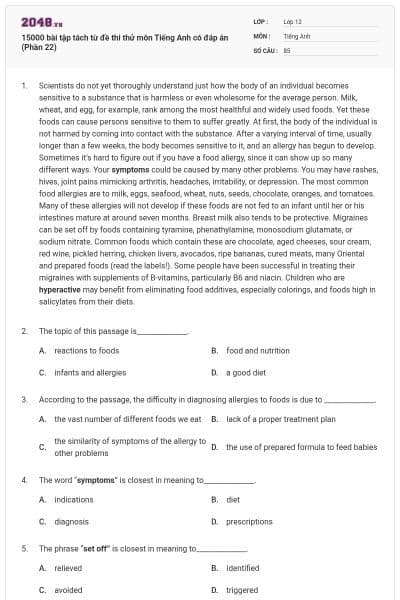
Scientists do not yet thoroughly understand just how the body of an individual becomes sensitive to a substance that is harmless or even wholesome for the average person. Milk, wheat, and egg, for example, rank among the most healthful and widely used foods. Yet these foods can cause persons sensitive to them to suffer greatly. At first, the body of the individual is not harmed by coming into contact with the substance. After a varying interval of time, usually longer than a few weeks, the body becomes sensitive to it, and an allergy has begun to develop. Sometimes it’s hard to figure out if you have a food allergy, since it can show up so many different ways. Your symptoms could be caused by many other problems. You may have rashes, hives, joint pains mimicking arthritis, headaches, irritability, or depression. The most common food allergies are to milk, eggs, seafood, wheat, nuts, seeds, chocolate, oranges, and tomatoes. Many of these allergies will not develop if these foods are not fed to an infant until her or his intestines mature at around seven months. Breast milk also tends to be protective. Migraines can be set off by foods containing tyramine, phenathylamine, monosodium glutamate, or sodium nitrate. Common foods which contain these are chocolate, aged cheeses, sour cream, red wine, pickled herring, chicken livers, avocados, ripe bananas, cured meats, many Oriental and prepared foods (read the labels!). Some people have been successful in treating their migraines with supplements of B-vitamins, particularly B6 and niacin. Children who are hyperactive may benefit from eliminating food additives, especially colorings, and foods high in salicylates from their diets.
The topic of this passage is______________.
reactions to foods
food and nutrition
infants and allergies
a good diet
Đáp án A
A những phản ứng với thức ăn.
B thức ăn và dinh dưỡng
C trẻ em và dị ứng
D một chế độ ăn uống tốt
Giải thích: Câu chủ đề của đoạn là câu đầu tiên “Scientists do not yet thoroughly understand just how the body of an individual becomes sensitive to a substance that is harmless or even wholesome for the average person.” (Các nhà khoa học vẫn chưa hiểu hết được làm cách nào mà cơ thể của một cá nhân lại nhạy cảm với một chất mà vô hại hoặc thậm chí lành cho một người bình thường)
According to the passage, the difficulty in diagnosing allergies to foods is due to ______________.
the vast number of different foods we eat
lack of a proper treatment plan
the similarity of symptoms of the allergy to other problems
the use of prepared formula to feed babies
Đáp án C
Theo đoạn văn, những khó khăn trong việc chẩn đoán dị ứng với thực phẩm là do……
A số lượng lớn các loại thực phẩm khác nhau mà chúng ta ăn
B. thiếu một kế hoạch điều trị thích hợp
C. sự giống nhau của các triệu chứng của dị ứng với các vấn đề khác
D. việc sử dụng sữa bột có sẵn để cho bé ăn
Giải thích: Thông tin ở 2 câu trong bài: Sometimes it’s hard to figure out if you have a food allergy, since it can show up so many different ways. Your symptoms could be caused by many other problems. (Đôi khi thật khó để tìm ra nếu bạn bị dị ứng thực phẩm, vì nó có thể biểu hiện lên rất nhiều cách khác nhau. triệu chứng của bạn có thể bị gây ra bởi nhiều vấn đề khác.)
The word “symptoms” is closest in meaning to______________.
indications
diet
diagnosis
prescriptions
Đáp án A
Từ “symptoms: dấu hiệu, triệu chứng” gần nghĩa nhất với…..
A indications: dấu hiệu, biểu hiện
B. diet : chế độ ăn
C. diagnosis : sự chuẩn đoán
D. prescription : đơn thuốc
The phrase “set off” is closest in meaning to______________.
relieved
identified
avoided
triggered
Đáp án D
Cụm từ “set off: gây ra” gần nghĩa nhất với…..
A relieved: được làm yên lòng;
B. identified: được xác định;
C. avoided: được tránh
D. triggered: được gây ra
triggered = set off: được gây ra
They can eat almost anything.
They should have a carefully restricted diet as infants.
They gain little benefit from being breast fed.
They may become hyperactive if fed solid food too early.
Đáp án B
Điều gì có thể được suy ra về trẻ sơ sinh từ đoạn này?
A Chúng có thể ăn hầu hết mọi thứ
B. Chúng nên có một chế độ ăn uống hạn chế một cách cẩn thận như trẻ sơ sinh.
C. Chúng có được một ít lợi ích từ việc được cho bú mẹ
D. Chúng có thể trở nên hiếu động nếu được cho thức ăn rắn quá sớm
Thông tin ở câu cuối: Children who are hyperactive may benefit from eliminating food additives, especially colorings, and foods high in salicylates from their diets. (Những trẻ quá hiếu động có thể được hưởng lợi từ việc loại bỏ các chất phụ gia thực phẩm, đặc biệt là chất tạo màu, và các thực phẩm giàu salicylate từ chế độ ăn uống của chúng.)
=> They should have a carefully restricted diet as infants. (Chúng nên có một chế độ ăn uống hạn chế một cách cẩn thận như trẻ sơ sinh.)
The word “hyperactive” is closest in meaning to______________.
overly active
unusually low activity
excited
inquisitive
Đáp án A
Từ “Hyperactive: hiếu động thái quá” gần nghĩa nhất với….
A overly active: hiếu động thái quá
B. unusually low activity: hoạt động thấp bất thường
C. excited: thích thú
D. inquisitive: tò mò
The author states that the reason that infants need to avoid certain foods related to allergies has to do with the infant’s______________.
lack of teeth
poor metabolism
underdeveloped intestinal tract
inability to swallow solid foods
Đáp án C
Tác giả cho rằng lý do mà khiến trẻ sơ sinh cần phải tránh các loại thực phẩm nhất định liên quan đến dị ứng cần phải làm với trẻ…………….
A lack of teeth : thiếu răng
B. poor metabolism: trao đổi chất kém
C. underdeveloped intestinal tract: đường ruột chưa phát triển
D. inability to swallow solid foods: không có khả năng nuốt thức ăn rắn
Giải thích: Thông tin trong bài: Many of these allergies will not develop if these foods are not fed to an infant until her or his intestines mature at around seven months (Nhiều loại dị ứng sẽ không phát triển nếu những thực phẩm này không được làm thức ăn cho trẻ sơ sinh cho đến khi đường ruột của bé trưởng thành vào khoảng bảy tháng)
DỊCH BÀI
Việc định cư xuyên lục địa nhanh chóng và những trường hợp công nghiệp đô thị mới của nửa cuối của thế kỷ 19 đã được đi kèm với sự phát triển của văn học dân tộc một cách phong phú và đa dạng. Các chủ đề mới, hình thức mới, đề tài mới, các vùng mới, tác giả mới, khán thính giả mới nổi lên tất cả trong văn chương của nửa thế kỷ này.
Kết quả là, vào lúc bắt đầu của Thế chiến I, tinh thần và vật chất của văn học Mỹ đã phát triển đáng kể, cũng như các trung tâm sản xuất đã chuyển từ Boston sang New York vào cuối những năm 1880 và nguồn năng lượng của nó đến Chicago và Midwest. Văn chương, ít ra là các thể loại chính, không còn chủ yếu được viết bởi những người nghiêm trang, đạo đức tiêu biểu từ Tân Anh Cát Lợi và miền Nam cũ; không còn việc những người trẻ lịch sự, ăn mặc đẹp, chú trọng ngữ pháp, thuộc tầng lớp trung lưu là những nhân vật trung tâm trong tác phẩm; không còn việc các tác phẩm được đặt ở những địa điểm và thời gian xa xăm; không còn việc tiểu thuyết, thơ, kịch, lịch sử chính quy là các thể loại được chấp nhận khi thể hiện văn chương; cuối cùng, không còn việc văn chương chủ yếu chỉ được những phụ nữ trẻ trung lưu đọc.
Tóm lại, văn học Mỹ trong những năm này đã đáp ứng, xét theo một tiêu chuẩn thích hợp, được điều kiện mà Walt Whitman yêu cầu vào năm 1867 khi mô tả tác phẩm Leaves of Grass : Nó xem, ông ấy nói về chính công việc của mình, mỗi tiểu bang và khu vực như những đồng nghiệp và mở rộng từ đó, và bao gồm cả thể giới….kết nối một công dân Mỹ với các công dân của tất cả các quốc gia.”
The rapid transcontinental settlement and these new urban industrial circumstances of the last half of the 19th century were accompanied by the development of national literature of great abundance and variety. New themes, new forms, new subjects, new regions, new authors, new audiences all emerged in the literature of this half century.
As a result, at the onset of World War I, the spirit and substance of American literature had evolved remarkably, just as its center of production had shifted from Boston to New York in the late 1880s and the sources of its energy to Chicago and the Midwest. No longer was it produced, at least in its popular forms, in the main by solemn, typically moralistic men from New England and the Old South; no longer were polite, well-dressed, grammatically correct, middle-class young people the only central characters in its narratives; no longer were these narratives to be set in exotic places and remote times; no longer, indeed, were fiction, poetry, drama, and formal history the chief acceptable forms of literary expression; no longer, finally, was literature read primarily by young, middle class women.
In sum, American literature in these years fulfilled in considerable measure the condition Walt Whitman called for in 1867 in describing Leaves of Grass: it treats, he said of his own major work, each state and region as “and expands from them, and includes the world ... connecting an American citizen with the citizens of all nations"
The main idea of this passage is________.
that the new American literature was less provincial than the old
that World War I caused a dramatic change in America
that centers of culture shifted from East to West
that most people were wary of the new literature
Đáp án A
Chủ đề chính của đoạn văn là……..
A. văn chương mới của Mỹ ít có tính lẻ tẻ hơn văn học cũ
B. chiến tranh thế giới thứ nhất đã gây ra sự thay đổi sâu sắc ở Mĩ
C. trung tâm văn hoá chuyển từ Đông sang West
D. hầu hết mọi người đều cảnh giác với các văn học mới
Giải thích: Ý chính của cả đoạn được kết luận lại ở đoạn cuối “In sum, American literature in these years fulfilled in considerable measure the condition Walt Whitman called for in 1867 in describing Leaves of Grass: it treats, he said of his own major work, each state and region as peers’ and expands from them, and includes the world ... connecting an American citizen with the citizens of all nations.” (Tóm lại, văn học Mỹ trong những năm này đã đáp ứng, xét theo một tiêu chuẩn thích hợp, được điều kiện mà Walt Whitman yêu cầu vào năm 1867 khi mô tả tác phẩm Leaves of Grass : Nó xem, ông ấy nói về chính công việc của mình, mỗi tiểu bang và khu vực như những đồng nghiệp và mở rộng từ đó, và bao gồm cả thể giới….kết nối một công dân Mỹ với các công dân của tất cả các quốc gia”
=> Văn chương mới mở rộng hơn, ít có tính lẻ tẻ hơn văn học cũ
It can be inferred from the passage that the previous passage probably discussed________.
the importance of tradition to writers
new developments in industrialization and population shifts
the fashions and values of 19th century America
the limitations of American literature to this time
Đáp án B
Có thể suy luận từ đoạn văn rằng đoạn văn trước đó có thể thảo luận về………….
A. tầm quan trọng của truyền thống đối với các nhà văn
B. phát triển mới trong công nghiệp và chuyển dịch dân cư
C. thời trang và giá trị của thế kỷ 19 Mỹ
D. những hạn chế của văn học Mỹ đến thời điểm này
Giải thích: Câu đầu tiên của bài đọc là: The rapid transcontinentat settlement and these new urban industrial circumstances of the last half of the 19th century were accompanied by the development of national literature of great abundance and variety. (Việc định cư xuyên lục địa nhanh chóng và những trường hợp công nghiệp đô thị mới của nửa cuối của thế kỷ 19 đã được đi kèm với sự phát triển của văn học dân tộc một cách phong phú và đa dạng.)
The word “evolved” in paragraph two is closest in meaning to________.
became famous
turned back
diminished
changed
Đáp án D
Từ “evolved: tiến triển” trong đoạn 2 gần nghĩa nhất với….
A. became famous: trở nên nổi tiếng
B. turned back: quay trở lại
C. diminished: giảm
D. changed: thay đổi
“evolved” ~ changed: thay đổi, tiến triển
Dịch câu: As a result, at the onset of World War I, the spirit and substance of American literature had evolved remarkably: Kết quả là, vào lúc bắt đầu của Thế chiến I, tinh thần và vật chất của văn học Mỹ đã phát triển đáng kể
The word “it” in the second paragraph refers to________.
the population
the energy
American literature
the manufacturing
Đáp án C
Từ “it” ở đoạn 2 đề cập tới………….
A.the population: dân số
B. the energy: năng lượng
C. American literature: văn học Mỹ
D. the manufacturing: việc sản xuất
Giải thích: “it” được thay thế cho American literature trong câu trước: As a result, at the onset of World War I, the spirit and substance of American literature had evolved remarkably...
The word “exotic” in paragraph two is closest in meaning to________.
urban
unusual
well-known
old-fashioned
Đáp án B
Từ “exotic: kỳ lạ” ở đoạn 2 gần nghĩa nhất với ………..
A.urban: đô thị
B. unusual: khác thường
C. well-known: nổi tiếng
D. old-fashioned: lỗi thời
“exotic” ~ unusual: kỳ lạ, khác thường
Dịch câu: “no longer were these narratives to be set in exotic places and remote times: những câu chuyện không còn bị đặt ở những nơi kỳ lạ và thời gian xa xăm”
The author uses the word “indeed” in the second paragraph for what purpose?
To emphasize the contrast he is making.
For variety in a lengthy paragraph.
To wind down his argument.
To show a favorable attitude to these forms of literature.
Đáp án A
Tác giả sử dụng từ “indeed” ở đoạn 2 nhằm mục đích gì?
A.Để nhấn mạnh sự tương phản ông đang làm.
B. Cho sự đa dạng trong một đoạn văn dài
C. Để giảm dần lý luận của ông ta
D. Để cho thấy thái độ tốt đối với những hình thức này của văn học Giải thích: “No longer was it produced, at least in its popular forms;…; no longer, indeed, were fiction, poetry, drama, and formal history the chief acceptable forms of literary expression” ( Nó không còn được sản xuất, ít nhất là trong các hình thức phổ biến của nó;…; thực sự, tiểu thuyết, thơ, kịch, và lịch sử chính thống không còn được chấp nhận là các hình thức chính của biểu đạt văn chương)
The phrase “these years” in the third paragraph refers to________.
1850-1900
the 1900s
the early 1800s
the present
Đáp án A
Cụm từ “these years” ở đoạn 3 đề cập đến….
A. 1850-1900
B. những năm 1990
C. đầu những năm 1800
D. hiện tại
Giải thích: The rapid transcontinentat settlement and these new urban industrial circumstances of the last half of the 19 th century were accompanied by the development of national literature of great abundance and variety. New themes, new forms, new subjects, new regions, new authors, new audiences all emerged in the literature of this half century.
=> “these years” ở đây chính là đề cập đến the last half of the 19 th century (nửa cuối thế kỉ 19) => từ năm 1850-1900
It can be inferred from the passage that Walt Whitman________.
disliked urban life
was disapproving of the new literature
wrote Leaves of Grass
was an international diplomat
Đáp án C
Có thể suy ra từ đoạn văn rằng Walt Whitman…………..
A.không thích cuộc sống đô thị
B. không chấp nhận văn học mới
C. đã viết cuốn Leaves of Grass
D. là một nhà ngoại giao quốc tế
Giải thích: Thông tin ở câu đầu đoạn cuối: In sum, American literature in these years fulfilled in considerable measure the condition Walt Whitman called for in 1867 in describing Leaves of Grass (Tóm lại, văn học Mỹ trong những năm này đã đáp ứng, xét theo một tiêu chuẩn thích hợp, được điều kiện mà Walt Whitman yêu cầu vào năm 1867 khi mô tả tác phẩm Leaves of Grass.)
=> Walt Whitman đã viết “Leaves of Grass”
DỊCH BÀI
Chester Arthur, Tổng thống thứ hai của Hoa Kỳ, là một người nắm giữ văn phòng cao nhất trong đất liền. Sinh ra ở Vermont năm 1830, ông là con của một người cha nhập cư Ai-len và một người mẹ ở New Hampshire. Sau khi trở thành một luật sư ở New York, ông gia nhập đảng Cộng hòa và cuối cùng nắm giữ một số văn phòng của bang tại đó, bao gồm cả vị trí đứng đầu Hải quan New York. Mặc dù Mặc dù cá nhân thì trung thực, chính quyền của Arthur bị làm hỏng bởi những hành vi tham nhũng, và ông ta đã bị truất nhiệm vào năm 1878. Khi James Garfield được bầu làm ứng cử viên của đảng Cộng hòa trong những năm 1880, Arthur, người thuộc phe phái ủng hộ quan hệ Tổng thống Grant, đã được trao cho Phó Tổng thống như là một cử chỉ hòa giải. Arthur chấp nhận, và sau đó, vào năm 1881, đã được nâng lên vị trí Tổng thống sau vụ ám sát Garfield. Theo quan điểm của ông, kỷ lục không có gì đáng ghi nhận và thiếu sự ủng hộ chính trị mạnh mẽ của ông, ngay cả trong đảng của ông, Arthur chuyển tới Nhà Trắng đã được nhiều người Mỹ quan tâm, nhưng, ngạc nhiên nhất, chính quyền của ông tỏ ra là một người có thẩm quyền và trung thực. Tuy nhiên, ông không bao giờ được bầu làm Chủ tịch một mình, bị đánh bại vì đề cử tại Đại hội đảng năm 1884, và chết vào tháng Mười Hai năm sau khi bị bệnh Bright trong cuộc bầu cử tổng thống đảng Dân chủ Grover Cleveland.
Chester Arthur, the twenty-first President of the United States, was an unlikely holder of the highest office in land. Born in Vermont in 1830, he was the son of an Irish immigrant father and a New Hampshire mother. After becoming a lawyer in New York, he joined the Republican Party and eventually came to hold a number of state offices there, including a position as head of the New York Customs House. Though personally honest, Arthur' s administration was marred by corrupt practices, and he was removed from office in 1878. When James Garfield was elected as the Republican Party's presidential candidate in 1880's, Arthur, who belonged to a faction that had supported the denomination of President Grant, was offered the Vice-presidency as a conciliatory gesture. Arthur accepted, and then, in 1881, was elevated to the Presidency following Garfield's assassination. In view of his far from unblemished record and his lack of strong political support, even within his own party, Arthur's move to the White House was viewed with great concern by many Americans, but, to the astonishment of most, his administration proved to be a competent and honest one. However, he never was elected President in his own right, being defeated for the nomination at his party's convention in 1884, and dying in November two years later of Bright's disease during the presidency of a Democrat, Grover Cleveland.
How does the writer describe the fact that Arthur became President ?
as disliked
as eventual
as improbable
as conciliatory
Đáp án C
Nhà văn mô tả sự kiện Arthur trở thành Tổng thống như thế nào?
A. không được yêu thích
B. như là cuối cùng cũng xảy ra
C. như không thể xảy ra
D. như hoà giải
Giải thích: improbable = unlikely: không chắc chắn sẽ xảy ra
Dẫn chứng ở câu: “was an unlikely holder of the highest office in land.” (là một người nắm giữ văn phòng cao nhất trong đất liền)
Chester Arthur was
of mixed Irish-American stock
born in Irish parents
born in New Hampshire
born in New York
Đáp án A
Chester Arthur đã
A. con lai giữa dòng máu của Ailen-Mỹ
B. sinh ra ở bố mẹ là người Ailen
C. sinh ra ở New Hampshire
D. sinh ra ở New York
Giải thích: Dẫn chứng: “Born in Vermont in 1830, he was the son of an Irish immigrant father and a New Hampshire mother” (Sinh ra ở Vermont năm 1830, ông là con của một người cha nhập cư Ai-len và một người mẹ ở New Hampshire.)
Which of the following best describes Arthur's tenure as the head of the New York Customs House ?
a thoroughly corrupt administration
one suffering from much corruption that Arthur, though not involved, failed to remedy.
one which, in spite of the efforts of honest officials, was made corrupt by its leader
one in which corruption was not eradicated from Arthur's office until 1878.
Đáp án B
Điều nào sau đây mô tả tốt nhất vai trò của Arthur trong vai trò người đứng đầu Hải quan New York?
A. một chính quyền hoàn toàn tham nhũng
B. người hứng chịu tham nhũng mà Arthur, mặc dù không liên quan, thất bại trong việc sửa chữa.
C. mặc dù những nỗ lực của các quan chức trung thực, đã bị lãnh đạo của nó làm hư hỏng
D. một trong đó tham nhũng đã không được tiêu diệt từ văn phòng của Arthur cho đến năm 1878.
Giải thích: Thông tin: “Though personally honest, Arthur' s administration was marred by corrupt practices” (Mặc dù cá nhân thì trung thực, chính quyền của Arthur bị làm hỏng bởi những hành vi tham nhũng)
Why was Arthur invited to become Garfield's running-mate ?
because his support for President Grant was half-hearted.
because of his previous record in office.
because Garfield wanted to hold the Republican Party together
because there was a danger of Garfield's being assassinated.
Đáp án C
Tại sao Arthur lại mời Garfield chạy cùng bạn?
A. bởi vì sự ủng hộ của ông đối với Tổng thống Grant là vô tận.
B. bởi vì hồ sơ trước đây của ông tại văn phòng.
C. bởi vì Garfield muốn giữ Đảng Cộng hòa cùng nhau
D. bởi vì có nguy cơ Garfield bị ám sát
Giải thích: Thông tin “When James Garfield was elected as the Republican Party's presidential candidate in 1880's, Arthur, who belonged to a faction that had supported the denomination of President Grant, was offered the Vice-presidency as a conciliatory gesture” (Khi James Garfield được bầu làm ứng cử viên của đảng Cộng hòa trong những năm 1880, Arthur, người thuộc phe phái ủng hộ quan hệ Tổng thống Grant, đã được trao cho Phó Tổng thống như là một cử chỉ hòa giải.)
During his years as President, Arthur was
a cause of great concern to the American people.
a pleasant surprise to most people.
far from unblemished in his conduct.
the focus of strong political support.
Đáp án B
Trong những năm làm Tổng thống, Arthur đã
A. một nguyên nhân quan tâm lớn đối với người Mỹ.
B. một sự ngạc nhiên thú vị đối với hầu hết mọi người.
C. không có gì khác biệt trong cách ứng xử của ông.
D. trọng tâm của sự ủng hộ chính trị mạnh mẽ.
Giải thích: Thông tin nằm ở “Arthur's move to the White House was viewed with great concern by many Americans” (Arthur chuyển tới Nhà Trắng đã được nhiều người Mỹ quan tâm)
Who was the twentieth President of the United States ?
Grover Cleveland
Ulysses S. Grant
Chester Arthur
James Garlield
Đáp án D
Ai là Tổng thống thứ 12 của nước Mỹ?
A. Grover Cleveland
B. Ulysses S. Grant
C. Chester Arthur
D. James Garlield
Giải thích: Thông tin nằm ở “Chester Arthur, the twenty-first President of the United States” (Chester Arthur, Tổng thống thứ hai của Hoa Kỳ) và “Arthur accepted, and then, in 1881, was elevated to the Presidency following Garfield's assassination” (Arthur chấp nhận, và sau đó, vào năm 1881, đã được nâng lên vị trí Tổng thống sau vụ ám sát Garfield) => James Garlield là tổng thống thứ 20.
In his bid for re-election. Authur was defeated by
a fellow Republican
Bright
Grover Cleveland
an unnamed Democrat
Đáp án A
Trong lời đề nghị tái cử. Authur đã bị đánh bại bởi
A. một đồng đảng Cộng hòa
B. bệnh Bright
C. Grover Cleveland
D. một người dân chủ không tên
Giải thích: Thông tin ở đoạn “In view of his far from unblemished record and his lack of strong political support, even within his own party, Arthur's move to the White House was viewed with great concern by many Americans, but, to the astonishment of most, his administration proved to be a competent and honest one. However, he never was elected President in his own right, being defeated for the nomination at his party's convention in 1884,” (Th)eo quan điểm của ông, kỷ lục không có gì đáng ghi nhận và thiếu sự ủng hộ chính trị mạnh mẽ của ông, ngay cả trong đảng của ông, Arthur chuyển tới Nhà Trắng đã được nhiều người Mỹ quan tâm, nhưng, ngạc nhiên nhất, chính quyền của ông tỏ ra là một người có thẩm quyền và trung thực. Tuy nhiên, ông không bao giờ được bầu làm Chủ tịch một mình, bị đánh bại vì đề cử tại Đại hội đảng năm 1884,
DỊCH BÀI
Chạy bộ là một hoạt động phổ biến ở Hoa Kỳ. Nó được xem không chỉ như một môn thể thao cạnh tranh mà còn là một cách để tập thể dục, thưởng thức tình bạn của những người có cùng chí hướng và quyên góp tiền vì một lý do chính đáng. Mặc dù những người chạy nghiêm túc có thể phải mất nhiều tháng huấn luyện để thi đấu, một vài vận động viên khác và những người đi bộ khác có thể không cần thực hành. Những người không cạnh tranh để giành chiến thắng có thể chạy một cách nỗ lực để đánh bại thời gian của họ hoặc chỉ đơn giản là để tận hưởng những niềm vui và tập thể dục. Mọi người ở mọi lứa tuổi, từ những người dưới một năm (người có thể bị đẩy vào giỏ hàng) cho đến những người khoảng 80 tuổi, đều gia vào môn thể thao này. Các cuộc đua được tổ chức trên các đường phố của các thành phố, các trường đại học, công viên và các khu vực ngoại ô, và thường là từ 5 đến 10 cây số.
Địa điểm tổ chức nhất trên thế giới là Vịnh 12 dặm về phía đường đua Breakers tổ chức tại San Francisco mỗi mùa xuân. Cuộc đua này bắt đầu ở phía đông của thành phố gần Vịnh San Francisco và kết thúc ở phía tây Thái Bình Dương. Có thể có 80.000 người chạy bộ trong cuộc đua này thông qua các đường phố và đồi San Francisco. Ở phía trước là những người chạy để cạnh tranh để giành chiến thắng và ai sẽ kết thúc ít nhất 34 phút. Đằng sau họ là hàng ngàn người mất vài giờ để kết thúc. Ở phía sau của cuộc đua là những người mặc trang phục và chỉ đến để vui chơi. Một năm có một nhóm người đàn ông ăn mặc như Elvis Presley, và một nhóm khác bao gồm các nhân viên cứu hỏa, những người đã được gắn liền với nhau trong một đường dài và những người mang một vòi chữa cháy. Có một đám cưới, trong đó cô dâu trang phục trắng và chú rể mặc một bộ tuxedo. Cô dâu và chú rể ném hoa cho người ngoài, và họ thực sự đã kết hôn ở một số điểm dọc theo tuyến đường
Footracing is a popular activity in the United States. It is seen not only as a competitive sport but also as a way to exercise, to enjoy the camaraderie of like-minded people, and to donate money to a good cause. Though serious runners may spend months training to compete, other runners and walkers might not train at all. Those not competing to win might run in an effort to beat their own time or simply to enjoy the fun and exercise. People of all ages, from those of less than one year (who may be pushed in strollers) to those in their eighties, enter into this sport. The races are held on city streets, on college campuses, through parks, and in suburban areas, and they are commonly 5 to 10 kilometers in length.
The largest footrace in the world is the 12-kilometer Bay to Breakers race that is held in San Francisco every spring. This race begins on the east side of the city near San Francisco Bay and ends on the west side at the Pacific Ocean. There may be 80,000 or more people running in this race through the streets and hills of San Francisco. In the front are the serious runners who compete to win and who might finish in as little as 34 minutes. Behind them are the thousands who take several hours to finish. In the back of the race are those who dress in costumes and come just for fun. One year there was a group of men who dressed like Elvis Presley, and another group consisted of firefighters who were tied together in a long line and who were carrying a firehose. There was even a bridal party, in which the bride was dressed in a long white gown and the groom wore a tuxedo. The bride and groom threw flowers to bystanders, and they were actually married at some point along the route.
The main purpose of this passage is to
encourage people to exercise
describe a popular activity
make fun of runners in costume
give reasons for the popularity of footraces
Đáp án B
Mục đích chính của đoạn này là để
A. khuyến khích mọi người tập thể dục
B. mô tả một hoạt động phổ biến
C. làm cho niềm vui của những người chạy trong trang phục
D. đưa ra lý do cho sự phổ biến của các cuộc đua chạy bộ.
Giải thích: Đoạn văn trên đề cập đến tên môn thể thao, mục đích, địa điểm và hoạt động nổi tiếng khi tham gia môn thể thao này.
As used in line 1, the word "activity" is most similar to which of the following?
pursuit
motion
pilgrimage
expectation
Đáp án A
Như được sử dụng trong dòng 1, từ "hoạt động" là tương tự nhất với từ nào sau đây?
A. theo đuổi
B. chuyển động
C. hành hương
D. mong đợi
The word " camaraderie " as used in line 2 could be best replaced by which of the following?
games
companionship
jokes
views
Đáp án B
Từ "tình bạn thân thiết" như được sử dụng trong dòng 2 có thể được thay thế tốt nhất bằng cách nào sau đây?
A. trò chơi
B. tình bạn, mối quan hệ cộng sự
C. trò đùa
D. quan điểm
The phrase "to a good cause" in line 2 could be best replaced by which of the following?
for an award
to reward the winner
for a good purpose
to protect a wise investment
Đáp án C
Cụm từ "có lý do chính đáng" trong dòng 2 có thể được thay thế tốt nhất bằng cách nào sau đây?
A. cho một giải thưởng
B. để thưởng cho người chiến thắng
C. cho một mục đích tốt
D. để bảo vệ đầu tư khôn ngoan
Which of the following is NOT implied by the author?
Footraces appeal to a variety of people.
Walkers can compete for prizes.
Entering a race is a way to give support to an organization.
Running is a good way to strengthen the heart.
Đáp án D
Điều nào sau đây không phải là ngụ ý của tác giả?
A. Người tham gia chạy bộ kêu gọi nhiều người.
B. Người đi bộ có thể tranh giải.
C. Tham gia ra một cuộc đua là một cách để hỗ trợ một tổ chức.
D. Chạy là một cách tốt để có một trái tim khỏe mạnh.
Giải thích:
A. Thông tin “People of all ages, from those of less than one year (who may be pushed in strollers) to those in their eighties, enter into this sport.” (Mọi người ở mọi lứa tuổi, từ những người dưới một năm (người có thể bị đẩy vào giỏ hàng) cho đến những người khoảng 80 tuổi, đều gia vào môn thể thao này)
=> HẤP DẪN MỌI NGƯỜI
B. Thông tin “Though serious runners may spend months training to compete, other runners and walkers might not train at all.” (Mặc dù những người chạy nghiêm túc có thể phải mất nhiều tháng huấn luyện để thi đấu, một vài vận động viên khác và những người đi bộ khác có thể không cần thực hành). Ngụ ý người đi bộ dù không cần luyện tập nhưng vẫn có thể tranh giải.
C. Thông tin: “donate money to a good cause” (quyên góp tiền vì một lý do chính đáng)
D. Không nhắc tới.
As used in line 5, the word "strollers" refers to
cribs
wheelchairs
wagons
carriages
Đáp án D
Như được sử dụng trong dòng 5, từ "xe đẩy" dùng để chỉ
A. nêm
B. xe lăn
C. toa xe
D. xe kéo
Which of the following is NOT mentioned in this passage?
Some runners looked like Elvis Presley.
Some runners were ready to put out a fire.
Some runners were participating in a wedding.
Some runners were serious about winning.
Đáp án B
Những điều sau đây KHÔNG được đề cập trong đoạn văn này?
A. Một số vận động viên trông giống như Elvis Presley.
B. Một số vận động viên đã sẵn sàng để đưa ra một đám cháy.
C. Một số vận động viên đã tham gia vào một đám cưới.
D. Một số vận động viên đã rất nghiêm túc về việc chiến thắng.
Giải thích:
A. Thông tin ở “there was a group of men who dressed like Elvis Presley” (có một nhóm người đàn ông ăn mặc như Elvis Presley)
B. KHÔNG CÓ
C. Thông tin ở “The bride and groom threw flowers to bystanders, and they were actually married at some point along the route.” (Cô dâu và chú rể ném hoa cho người ngoài, và họ thực sự đã kết hôn ở một số điểm dọc theo tuyến đường)
D. Thông tin ở “serious runners may spend months training to compete” (những người chạy nghiêm túc có thể phải mất nhiều tháng huấn luyện để thi đấu)
Which of the following best describes the organization of this passage?
chronological order
specific to general
cause and result
statement and example
Đáp án D
Điều nào sau đây mô tả tốt nhất việc tổ chức đoạn văn này?
A. Thứ tự thời gian
B. cụ thể cho tới tổng quát
C. nguyên nhân và kết quả
D. nhận định và ví dụ
DỊCH BÀI
Khi chúng tôi chuyển đến nhà mới gần biển, tôi đã tám tuổi. Ngay cả trước đó tôi đã dành mỗi mùa hè lộn xộn trên thuyền. Bố tôi đã dạy tôi đi thuyền trước khi học lái xe đạp vì vậy tôi biết tôi muốn dành thời gian ở nhà mới như thế nào - tôi sẽ đi thuyền của riêng tôi và đi thuyền hàng ngày. Ngôi nhà chỉ cách bờ biển vài mét, và trong thời tiết khắc nghiệt, những con sóng sẽ đâm vào khu vườn phía trước. Tôi thường ngồi với mũi của tôi ép vào ly, bị cuốn hút bởi sức mạnh của đại dương. Tôi lớn lên nhìn bầu trời để xem nếu trời sắp mưa; tôi sẽ đi thuyền vào buổi chiều hay không?
Tất nhiên đôi khi tôi ước mình có thể sống trong thị trấn như bạn bè của tôi. Tôi đã từng bị kích thích với bố mẹ tôi, người đã nghỉ hưu sớm vì họ dường như không thể đi được bất cứ lúc nào. Bố lái xe cho tôi tám dặm đến trường hàng ngày, nhưng tôi thường là muộn vì ông đã đi bộ trên các vách đá sớm vào buổi sáng và đã mất theo dõi thời gian. Khi tôi đang dự kỳ thi vào đại học, tôi đã từng ở lại một người bạn trong thành phố, chỉ trong trường hợp. Trong tất cả, tôi đã may mắn lớn lên ở biển và tôi vẫn thích đi thuyền buồm.
When we moved to our new house near the sea, I was eight years old. Even before that I had spent every summer messing about on boats. My dad had taught me to sail before I learnt to ride a bike so I knew how I wanted to spend my time at the new house- I was going to get my own boat and sail it everyday. The house was only a few meters from the water's edge, and in rough weather the waves would come crashing into the front garden. I used to sit with my nose pressed to the glass, fascinated by the power of the ocean. I grew up watching the skies to see if it was going to rain; would I be going sailing that afternoon or not?
Of course I sometimes wished I could live in the town like my friends. I used to get irritated with my parents, who had taken early retirement because they seemed incapable of getting anywhere on time. Dad drove me the eight miles to school everyday, but I was often late because he had been walking on the cliffs earlier in the morning and had lost track of time. When I was taking my university entrance exams, I used to stay over at a friend’s in town, just in case. All in all, I was lucky to grow up by the sea and I still love to sail.
At the age of eight, the writer's house was ___________.
in the town
by the sea
on boat
under the mountain
Đáp án B
Ở tuổi tám, nhà của nhà văn là ___________.
A. Trong thị trấn
B. gần biển
C. trên thuyền
D. dưới núi
Giải thích: “When we moved to our new house near the sea, I was eight years old.” (Khi chúng tôi chuyển đến căn nhà mới gần biển, tôi lên 8 tuổi.
The word “rough” is closest in meaning to ____________.
careful
forceful
easy
mild
Đáp án B
Giải thích: Rough (dữ dội, hung hãn, mạnh mẽ) = forceful.
Easy: dễ dàng
Careful: cẩn thận
Mild: nhẹ nhàng
The writer's father retired early because ___________.
he walked on the cliffs every morning
he lost track of time
he had to drive his kid to school everyday
he was unable to get anywhere on time
Đáp án D
Cha của người viết đã về hưu sớm vì ___________.
A. Ông ấy leo lên vách đá mỗi sáng
B. Ông ấy mất khái niệm về thời gian
C. Ông ấy phải lái xe đưa bọn trẻ con đi học mỗi ngày
D. Ông ấy không thể đi đến bất cứ nơi nào đúng giờ.
Giải thích: “I used to get irritated with my parents, who had taken early retirement because they seemed incapable of getting anywhere on time.” (Tôi đã từng hay bực mình với bố mẹ mình, người nghỉ hưu sớm bởi họ dường như chẳng bao giờ đến được đâu cho đúng giờ.)
The following are true EXCEPT ___________.
the waves came crashing into the writer's front garden in bad weather
the write moved to a new house when he was 8
the writer didn't know how to sail
the distance from the writer's house to school was 8 miles
Đáp án C
Những điều sau đây đúng là ngoại trừ ___________.
A. các sóng đến đâm vào khu vườn phía trước của nhà văn trong thời tiết xấu
B. nhà văn chuyển tới nhà mới vào năm 8 tuổi.
C. nhà văn không biết làm thế nào để chèo thuyền.
D. khoảng cách từ ngôi nhà của nhà văn đến trường học là 8 dặm
Giải thích: “My dad had taught me to sail before I learnt to ride a bike...” (Bố tôi đã dạy tôi chèo thuyền từ trước khi tôi học đạp xe đạp...)
Growing up by the sea, the writer felt___________.
unlucky
irritated
excited
lucky
Đáp án A
Lớn lên gần biển, nhà văn cảm thấy ___
A. không may mắn
B. khó chịu
C. vui thích
D. may mắn
Giải thích: “All in all, I was lucky to grow up by the sea and I still love to sail.” (Cuối cùng thì, tôi đã rất may mắn lớn lên gần biển, và tôi vẫn rất yêu thích việc chèo thuyền.
The writer learnt to sail _____________.
before learning to ride a bike
when his family moved to a new house
before going to school
when he/ she was eight
Đáp án A
Người viết đã học chèo thuyền_____________.
A. Trước khi học lái xe đạp
B. khi gia đình chuyển đến ngôi nhà mới
C. trước khi đi học
D. khi anh ta / cô ta lên tám
Giải thích: "My dad had taught me to sail before I learnt to ride a bike...” (Bố tôi đã dạy tôi chèo thuyền từ trước khi tôi học đạp xe đạp...)
When taking the university entrance exams, ___________.
the writer's family moved to a new house by the sea
the writer had to live in a friend's house
the weather was terrible
the writer's father drove him/ her to university
Đáp án B
Khi thi đại học, ___________.
A. gia đình nhà văn chuyển sang một ngôi nhà mới bên bờ biển
B. các nhà văn phải sống trong nhà của một người bạn
C. thời tiết là khủng khiếp
D. cha của người viết lái xe đưa anh ta lên đại học
Giải thích: “When I was taking my university entrance exams, I used to stay over at a friend's in town, just in case.” (Khi tôi đi thi đại học, tôi đã phải ở lại nhà bạn trong thành phố, phòng trường hợp ko may.)
DỊCH BÀI
Mặc dù tiếng ồn, thường được định nghĩa là âm thanh không mong muốn, là một hình thức ô nhiễm được thừa nhận rộng rãi, nó rất khó để đo lường bởi vì sự khó chịu của các cá nhân khác nhau là chủ quan và, vì vậy, nó rất đa dạng. Tiếp xúc với mức độ tiếng ồn thấp có thể gây khó chịu một chút, trong khi tiếp xúc ở mức cao hơn có thể gây ra tình trạng mất thính giác. Đặc biệt ở các khu đô thị đông đúc, tiếng ồn, phát sinh như là sản phẩm phụ của công nghệ tiên tiến, gây ra những tổn hại về thể chất và tâm lý, và làm giảm chất lượng cuộc sống của những người tiếp xúc với nó.
Không giống như mắt, có thể được bao phủ bởi mí mắt giúp chống lại ánh sáng mạnh mẽ, tai không có thứ gì che đậy, và do đó, nó luôn luôn mở và dễ bị tổn thương; tiếng ồn xâm nhập mà không cần thông qua màn bảo vệ. Tiếng ồn gây ra những phản ứng mà người nghe không thể kiểm soát được và cơ thể không bao giờ quen thuộc với chúng. Những âm thanh ồn ào theo bản năng báo hiệu sự nguy hiểm cho bất cứ sinh vật nào bằng cơ chế lắng nghe, bao gồm cả con người. Đáp lại, nhịp tim và hô hấp tăng lên, các mạch máu co lại, da trở nên nhợt nhạt và cơ căng lên. Trên thực tế, có một sự gia tăng chung trong các chức năng do luồng adrenaline phát ra do phản ứng sợ hãi, và một số phản ứng vẫn tồn tại lâu hơn tiếng ồn, đôi khi là ba mươi phút sau khi âm thanh dừng lại. Bởi vì tiếng ồn là điều không thể tránh khỏi trong một xã hội công nghiệp phức tạp, chúng ta liên tục phản ứng lại nó theo cách mà chúng ta sẽ phản ứng lại với nguy hiểm. Gần đây, các nhà nghiên cứu đã kết luận rằng tác hại của tiếng ồn và phản ứng của chúng ta có thể nhiều hơn là sự khó chịu. Nó có thể là một mối đe dọa nghiêm trọng đối với sức khoẻ thể chất và tâm lý và hạnh phúc của chúng ta, nó gây tổn thương không chỉ ở tai và não mà còn cho tim và dạ dày. Từ lâu chúng ta biết rằng mất thính giác là vấn đề sức khoẻ không nguy hiểm đến tính mạng số một của Hoa Kỳ, nhưng bây giờ chúng ta đang được nghe rằng một số trong chúng ta có bệnh tim và loét dạ dày cũng có thể là nạn nhân của tiếng ồn. Các thai nhi tiếp xúc với tiếng ồn thường có phản ứng quá khích, chúng dễ khóc và nhạy cảm hơn với các vấn đề về đường tiêu hóa sau khi sinh. Ngoài ra, ảnh hưởng tấm lí của tiếng ồn cũng rất quan trọng. Sự bồn chồn, cáu kỉnh căng thẳng, và lo lắng tăng lên ảnh hưởng đến chất lượng của sự thư giãn trong khi ngủ, và hiệu quả của các hoạt động trong thời gian thức giấc, cũng như cách mà chúng ta tương tác với nhau.
Although noise, commonly defined as unwanted sound, is a widely recognized form of pollution, it is very difficult to measure because the discomfort experienced by different individuals is highly subjective and, therefore, variable. Exposure to lower levels of noise may be slightly irritating, whereas exposure to higher levels may actually cause hearing loss. Particularly in congested urban areas, the noise produced as a by-product of our advancing technology causes physical and psychological harm, and detracts from the quality of life for those who are exposed to it.
Unlike the eyes, which can be covered by the eyelids against strong light, the ear has no lid, and is, therefore, always open and vulnerable; noise penetrates without protection.
Noise causes effects that the hearer cannot control and to which the body never becomes accustomed. Loud noises instinctively signal danger to any organism with a hearing mechanism, including human beings. In response, heartbeat and respiration accelerate, blood vessels constrict, the skin pales, and muscles tense. In fact, there is a general increase in functioning brought about by the flow of adrenaline released in response to fear, and some of these responses persist even longer than the noise, occasionally as long as thirty minutes after the sound has ceased.
Because noise is unavoidable in a complex, industrial society, we are constantly responding in the same way that we would respond to danger. Recently, researchers have concluded that noise and our response may be much more than an annoyance. It may be a serious threat to physical and psychological health and well-being, causing damage not only to the ear and brain but also to the heart and stomach. We have long known that hearing loss is America’s number one nonfatal health problem, but now we are learning that some of us with heart disease and ulcers may be victims of noise as well. Fetuses exposed to noise tend to be overactive, they cry easily, and they are more sensitive to gastrointestinal problems after birth. In addition, the psychic effect of noise is very important. Nervousness, irritability, tension, and anxiety increase affecting the quality of rest during sleep, and the efficiency of activities during waking hours, as well as the way that we interact with each other.
Which of the following is the author’s main point?
Hearing loss is America’s number one nonfatal health problem.
Loud noises signal danger.
Noise may pose a serious threat to our physical and psychological health.
The ear is not like the eye.
Đáp án C
Giải thích:
Dòng nào sau đây là ý chính của tác giả?
A. Mất thính giác là vấn đề sức khoẻ không đe dọa đến tính mạng số một ở Mỹ.
B. Tiếng ồn phát ra tín hiệu nguy hiểm.
C. Tiếng ồn có thể gây ra mối đe dọa nghiêm trọng đối với sức khoẻ thể chất và tâm lý của chúng ta.
D. Tai không giống với mắt.
Trong đoạn 1, tác giả chỉ ra “Particularly in congested urban areas, the noise produced as a by-product of our advancing technology causes physical and psychological harm, and detracts from the quality of life for those who are exposed to it.” (Đặc biệt ở các khu đô thị đông đúc, tiếng ồn, phát sinh như là sản phẩm phụ của công nghệ tiên tiến, gây ra những tổn hại về thể chất và tâm lý, và làm giảm chất lượng cuộc sống của những người tiếp xúc với nó.)
Ở đoạn 2, tác giả chỉ ra những phản ứng của cơ thể đối với tiếng ồn “Noise causes effects that the hearer cannot control and to which the body never becomes accustomed. (Tiếng ồn gây ra những phản ứng mà người nghe không thể kiểm soát được và cơ thể không bao giờ có thể quen thuộc với chúng.)
Đến đoạn 3, tác giả chỉ ra những tác hại của tiếng ồn đối với con người “Recently, researchers have concluded that noise and our response may be much more than an annoyance. It may be a serious threat to physical and psychological health and well-being” (Gần đây, các nhà nghiên cứu đã kết luận rằng tác hại của tiếng ồn và phản ứng của chúng ta có thể nhiều hơn là sự khó chịu. Nó có thể là một mối đe dọa nghiêm trọng đối với sức khoẻ thể chất và tâm lý và hạnh phúc của chúng ta.)
=> Ý chính của tác giả trong văn bản này là “Tiếng ồn có thể gây ra mối đe dọa nghiêm trọng đối với sức khoẻ thể chất và tâm lý của chúng ta.”
According to the passage, what is noise?
A byproduct of technology
Physical and psychological harm
Congestion
Unwanted sound
Đáp án D
Theo đoạn văn, tiếng ồn là gì?
A. Một sản phẩm phụ của công nghệ
B. Tổn thương về thể chất và tâm lý
C. Sự tắc nghẽn
D. Những âm thanh không mong muốn
Thông tin ở câu: “Although noise, commonly defined as unwanted sound, is a widely recognized form of pollution,...” (Mặc dù tiếng ồn, thường được định nghĩa là âm thanh không mong muốn, là một hình thức ô nhiễm được thừa nhận rộng rãi,...)
Why is noise difficult to measure?
All people do not respond to it in the same way.
It causes hearing loss.
It is unwanted.
People become accustomed to it.
Đáp án A
Tại sao tiếng ồn khó đo lường?
A. Mọi người không phản ứng với nó theo một cách giống nhau.
B. Nó gây mất thính giác.
C. Nó không được mong muốn
D. Người ta trở nên quen thuộc với nó.
Thông tin ở câu: “... it is very difficult to measure because the discomfort experienced by different individuals is highly subjective and, therefore, variable” (nó rất khó để đo lường bởi vì sự khó chịu của các cá nhân khác nhau là chủ quan và, vì vậy, nó rất đa dạng.)
The word congested in paragraph 1 could best be replaced by ________ .
hazardous
crowded
polluted
rushed
Đáp án B
Từ congested trong đoạn 1 có thể được thay thế bằng ________ .
A. hazardous (adj): nguy hiểm
B. crowded (adj): đông đúc
C. polluted (adj): bị ô nhiễm
D. rushed (adj): gấp gáp
congested (adj): bị tắc nghẽn ≈ crowded
The word it in the first paragraph refers to ________ .
The quality of life
our advancing technology
the noise
physical and psychological harm
Đáp án C
Từ it trong đoạn đầu đề cập đến ________.
A. chất lượng cuộc sống
B. tiến bộ khoa học kỹ thuật
C. tiếng ồn
D. tổn thương về thể chất và tâm lí
Thông tin ở câu: “...the noise produced as a by-product of our advancing technology causes physical and psychological harm, and detracts from the quality of life for those who are exposed to it.” (...tiếng ồn, phát sinh như là sản phẩm phụ của công nghệ tiên tiến, gây ra những tổn hại về thể chất và tâm lý, và làm giảm chất lượng cuộc sống của những người tiếp xúc với nó.)
=> Dựa theo nghĩa của câu, it ở đây thay thế cho danh từ noise ở phía trước.
According to the passage, people respond to loud noises in the same way that they respond to ________.
annoyance
danger
damage
disease
Đáp án B
Theo đoạn văn, mọi người phản ứng tiếng ồn lớn theo cùng một cách mà họ phản ứng với ________.
A. annoyance (n): sự khó chịu
B. danger (n): mối nguy hiểm
C. damage (n): hư hại
D. disease (n): dịch bệnh
Thông tin ở câu: “Because noise is unavoidable in a complex, industrial society, we are constantly responding in the same way that we would respond to danger.” (Bởi vì tiếng ồn là điều không thể tránh khỏi trong một xã hội công nghiệp phức tạp, chúng ta liên tục phản ứng lại nó theo cách mà chúng ta sẽ phản ứng lại với nguy hiểm.)
Look at the verb accelerate in paragraph 3. Which of the following is the closest meaning to it?
cease
rise
swell
increase
Đáp án D
Nhìn vào động từ accelerate ở đoạn 3. Từ nào sau đây là gần nghĩa nhất với nó?
A. cease (v): ngưng
B. rise (v): tăng lên
C. swell (v): sưng lên
D. increase (v): tăng
accelerate (v): tăng nhanh hơn ≈ increase
It can be inferred from this passage that the eye ________.
responds to fears
enjoys greater protection than the ear
increases function
is damaged by noise
Đáp án B
Có thể suy ra từ đoạn văn này rằng mắt ________.
A. phản ứng với sự sợ hãi
B. hưởng nhiều sự bảo vệ hơn tai
C. tăng các chức năng
D. bị tổn thương bởi tiếng ồn
Thông tin ở câu: “Unlike the eyes, which can be covered by the eyelids against strong light, the ear has no lid, and is, therefore, always open and vulnerable; noise penetrates without protection...” (Không giống như mắt, có thể được bao phủ bởi mí mắt chống lại ánh sáng mạnh mẽ, tai không có thứ gì che đậy, và do đó, nó luôn luôn mở và dễ bị tổn thương; tiếng ồn xâm nhập mà không cần thông qua màn bảo vệ...)
Dịch bài
Khi John Mills lần đầu tiên ở trên máy bay, ông ấy đã sợ hãi. Ông ta không thích ý tưởng ở độ cao hàng ngàn feet trên không trung. "Tôi không thích sự thực rằng tôi sẽ không thể trong tầm kiểm soát", John nói. "Tôi là một hành khách khủng khiếp trên xe hơi. Khi ai đó đang lái xe, tôi nói với họ những điều họ phải làm. Nó khiến mọi người tức giận."
Tuy nhiên, John không thể tránh việc bay thêm được nữa. Đó là cách duy nhất để ông ấy có thể thăm những đứa cháu của mình ở Canada. “Tôi đã quyết định rằng tôi sẽ làm điều đó, tôi không thể để con trai tôi, vợ và ba đứa con của chúng đi cả chặng đường dài để thăm tôi. Việc đó sẽ rất đắt đối với chúng và tôi biết rằng việc kinh doanh của Tom không tốt lắm vào thời điểm hiện tại - điều đó cũng sẽ rất mệt mỏi đối với bọn trẻ - đó là chuyến bay kéo dài 9 giờ! ", ông nói.
Để chuẩn bị cho chuyến bay John đã đọc rất nhiều về máy bay. Khi anh đặt chỗ ngồi, ông được cho biết rằng ông sẽ bay trên máy bay Boeing 747, hay còn được biết đến là máy bay phản lực khổng lồ. Tôi cần biết càng nhiều càng tốt trước khi bước vào chiếc máy bay đó. Tôi cho rằng nó là một cách để làm cho bản thân mình cảm thấy tốt hơn. Boeing 747 là chiếc máy bay chở khách lớn nhất thế giới cho đến thời điểm hiện tại. Chuyến bay đầu tiên bay vào ngày 9 tháng 2 năm 1969 tại Mỹ. Nó có thể chở đến 524 hành khách và 3.400 hành lý. Nhiên liệu cho máy bay được giữ trong cánh và đôi cánh của 747 lớn đến nỗi chúng có thể mang đủ nhiên liệu cho một chiếc xe trung bình để có thể đi được 16.000 km một năm dùng trong 70 năm. Thật sự không thể tin nổi phải không? Mặc dù tôi đã khám phá tất cả những thông tin thú vị này về chiếc jumbo, lần đầu tiên tôi nhìn thấy nó, ngay trước khi tôi đi đến Canada, tôi vẫn không thể tin rằng một cái gì đó to lớn như vậy sẽ có thể ở trên không trung và bay. Tôi thậm chí còn ấn tượng hơn khi tôi nhìn thấy nó lớn như thế nào với hàng trăm người bên trong! Điều ngạc nhiên lớn nhất của John là chuyến bay.Việc cất cánh êm thấm hơn tôi mong đợi mặc dù tôi vẫn còn khá sợ hãi cho đến khi chúng tôi đã ở trên không trung. Cuối cùng, tôi đã cố gắng thư giãn, thưởng thức món ăn và xem một bộ phim và crnh tượng nhìn từ cửa sổ thật là ngoạn mục. Tôi thậm chí còn ngủ được một lúc! Tất nhiên, "John tiếp tục," phần thưởng tốt nhất trong tất cả là khi tôi đến Canada và nhìn thấy con trai tôi và gia đình nó, đặc biệt là những đứa cháu xinh đẹp của tôi. Bỗng nhiên, tôi cảm thấy thật ngớ ngẩn trong suốt những năm khi tôi thậm chí còn không nghĩ đến việc bước lên máy bay. Tôi đã để cho nỗi sợ hãi của tôi ngăn tôi nhìn thấy những người tôi yêu nhất trên đời. Giờ thì tôi có thể ghé thăm con trai và gia đình của tôi thường bất cứ khi nào tôi muốn! "
FIRST TIME IN THE AIR
When John Mills was going to fly in an aero plane for the first time, he was frightened. He did not like the idea of being thousands of feet up in the air. “ ‘I also didn’t like the fact that I wouldn’t be in control,” says John. “I’m a terrible passenger in the car. When somebody else is driving, I tell them what to so. It drives everybody crazy.” However John couldn’t avoid flying any longer. It was the only way he could visit his grandchildren in Canada. “I had made up my mind that I was going to do it, I couldn’t let my son, his wife and their three children travel all the way here to visit me. It would be so expensive for them and I know Tom’s business isn’t doing so well at the moment – it would also be tiring for the children – it’s a nine-hour flight!” he says. To get ready for the flight John did lots of reading about aero planes. When he booked his seat, he was told that he would be flying on a Boeing 747, which is better known as a jumbo jet. “I needed to know as much as possible before getting in that plane. I suppose it was a way of making myself feel better. The Boeing 747 is the largest passenger aircraft in the world at the moment. The first one flew on February 9th 1969 in the USA. It can carry up to 524 passengers and 3.400 pieces of luggage. The fuel for aero planes is kept in the wings and the 747’s wings are so big that they can carry enough fuel for an average car to be able to travel 16,000 kilometers a year for 70 years. Isn’t that unbelievable? Even though I had discovered all this very interesting information about the jumbo, when I saw it for the first time, just before I was going to travel to Canada, I still couldn’t believe that something so enormous was going to get up in the air and fly. I was even more impressed when I saw how big it was inside with hundreds of people!” The biggest surprise of all for John was the flight itself. “The take-off itself was much smoother than I expected although I was still quite scared until we were in the air. In the end, I managed to relax, enjoy the food and watch one of the movies and the view from the window was spectacular. I even managed to sleep for a while! Of course,” continues John, “the best reward of all was when I arrived in Canada and saw my son and his family, particularly my beautiful grandchildren. Suddenly, I felt so silly about all the years when I couldn’t even think of getting on a plane. I had let my fear of living stop me from seeing the people I love most in the world. I can visit my son and family as often as I like now!”
Why did John Mills fly in an aero plane?
He wanted to go on holiday
He wanted to try it.
He wanted to see his family.
He had to travel on business
Đáp án C
Tại sao John Mills lại đi trong máy bay?
A. Ông ấy muốn đi nghỉ.
B. Ông ấy muốn thử.
C. Ông ấy muốn đi thăm gia đình.
D. Ông ấy phải đi công tác.
Thông tin ở câu: “However John couldn’t avoid flying any longer. It was the only way he could visit his grandchildren in Canada.” (Tuy nhiên, John không thể tránh việc bay thêm được nữa. Đó là cách duy nhất để ông ấy có thể thăm những đứa cháu của mình ở Canada.)
Why did John read about aero plane?
He wanted to know how they work.
It was his body.
It guaranteed safety.
He had found a book on them.
Đáp án A
Tại sao John lại đọc về máy bay?
A. Ông ấy muốn biết cách chúng làm việc.
B. Nó là cơ thể của ông ấy.
C. Nó đảm bảo an toàn.
D. Ông ấy đã tìm thấy một cuốn sách về chúng.
Thông tin ở câu: “I needed to know as much as possible before getting in that plane. I suppose it was a way of making myself feel better.” (Tôi cần biết càng nhiều càng tốt trước khi bước vào chiếc máy bay đó. Tôi cho rằng nó là một cách để làm cho bản thân mình cảm thấy tốt hơn.)
What happened when he saw the jumbo jet for the first time?
He felt much safer.
He liked the shape of it.
He was surprised at how big it was.
He thought the wings were very small.
Đáp án C
Chuyện gì đã xảy ra khi ông ấy nhìn thấy chiếc máy bay phản lực jumbo lần đầu tiên?
A. Ông ấy cảm thấy an toàn hơn nhiều.
B. Ông ấy thích hình dạng của nó.
C. Ông ấy rất ngạc nhiên về độ lớn của nó.
D. Ông ấy nghĩ đôi cánh rất nhỏ.
Thông tin ở đoạn: “Even though I had discovered all this very interesting information about the jumbo, when I saw it for the first time, just before I was going to travel to Canada, I still couldn’t believe that something so enormous was going to get up in the air and fly. I was even more impressed when I saw how big it was inside with hundreds of people!” (Mặc dù tôi đã khám phá tất cả những thông tin thú vị này về chiếc jumbo, lần đầu tiên tôi nhìn thấy nó, ngay trước khi tôi đi đến Canada, tôi vẫn không thể tin rằng một cái gì đó to lớn như vậy sẽ có thể ở trên không trung và bay. Tôi thậm chí còn ấn tượng hơn khi tôi nhìn thấy nó lớn như thế nào với hàng trăm người bên trong!)
How did John feel when the aero plane was taking off?
excited
happy
sad
frightened
Đáp án D
John cảm thấy thế nào khi máy bay cất cánh?
A. excited (adj): thích thú
B. happy (adj): hạnh phúc
C. sad (adj): buồn
D. frightened (adj): sợ hãi
Thông tin ở câu: “The take-off itself was much smoother than I expected although I was still quite scared until we were in the air.” (Việc cất cánh êm thấm hơn tôi mong đợi mặc dù tôi vẫn còn khá sợ hãi cho đến khi chúng tôi đã ở trên không trung.)
What surprised John most about the flight?
that he liked the food
that he was able to sleep
that there was a movie being shown
that the view was good
Đáp án B
Điều gì làm John ngạc nhiên nhất về chuyến bay?
A. rằng ông ấy thích đồ ăn
B. rằng ông ấy đã có thể ngủ
C. rằng có một bộ phim đang được chiếu
D. rằng cảnh quan rất đẹp
Thông tin ở câu: “I even managed to sleep for a while!” (Tôi thậm chí còn ngủ được một lúc!)
How did John feel about his fears in the end?
He thought he had wasted time being afraid.
He realized it was okay to be afraid.
He hoped his grandchildren weren’t afraid of flying.
He realized that being afraid kept his safe.
Đáp án A
Cuối cùng, John cảm thấy như thế nào về những nỗi sợ hãi của mình?
A. Ông ấy nghĩ mình đã lãng phí thời gian để sợ hãi.
B. Ông nhận ra rằng sợ hãi cũng không sao cả.
C. Ông ấy hy vọng cháu của mình không sợ bay.
D. Ông ấy nhận ra rằng sự sợ hãi đã giữ an toàn cho ông ấy.
Thông tin ở câu: “Suddenly, I felt so silly about all the years when I couldn’t even think of getting on a plane.” (Bỗng nhiên, tôi cảm thấy thật ngớ ngẩn trong suốt những năm khi tôi thậm chí còn không nghĩ đến việc bước lên máy bay.)
Dịch bài
Mặc dù tiếng ồn, thường được định nghĩa là âm thanh không mong muốn, là một hình thức ô nhiễm được thừa nhận rộng rãi, nó rất khó để đo lường bởi vì sự khó chịu của các cá nhân khác nhau là chủ quan và, vì vậy, nó rất đa dạng. Tiếp xúc với mức độ tiếng ồn thấp có thể gây khó chịu một chút, trong khi tiếp xúc ở mức cao hơn có thể gây ra tình trạng mất thính giác. Đặc biệt ở các khu đô thị đông đúc, tiếng ồn, phát sinh như là sản phẩm phụ của công nghệ tiên tiến, gây ra những tổn hại về thể chất và tâm lý, và làm giảm chất lượng cuộc sống của những người tiếp xúc với nó.
Không giống như mắt, có thể được bao phủ bởi mí mắt giúp chống lại ánh sáng mạnh mẽ, tai không có thứ gì che đậy, và do đó, nó luôn luôn mở và dễ bị tổn thương; tiếng ồn xâm nhập mà không cần thông qua màn bảo vệ. Tiếng ồn gây ra những phản ứng mà người nghe không thể kiểm soát được và cơ thể không bao giờ quen thuộc với chúng. Những âm thanh ồn ào theo bản năng báo hiệu sự nguy hiểm cho bất cứ sinh vật nào bằng cơ chế lắng nghe, bao gồm cả con người. Đáp lại, nhịp tim và hô hấp tăng lên, các mạch máu co lại, da trở nên nhợt nhạt và cơ căng lên. Trên thực tế, có một sự gia tăng chung trong các chức năng do luồng adrenaline phát ra do phản ứng sợ hãi, và một số phản ứng vẫn tồn tại lâu hơn tiếng ồn, đôi khi là ba mươi phút sau khi âm thanh dừng lại. Bởi vì tiếng ồn là điều không thể tránh khỏi trong một xã hội công nghiệp phức tạp, chúng ta liên tục phản ứng lại nó theo cách mà chúng ta sẽ phản ứng lại với nguy hiểm. Gần đây, các nhà nghiên cứu đã kết luận rằng tác hại của tiếng ồn và phản ứng của chúng ta có thể nhiều hơn là sự khó chịu. Nó có thể là một mối đe dọa nghiêm trọng đối với sức khoẻ thể chất và tâm lý và hạnh phúc của chúng ta, nó gây tổn thương không chỉ ở tai và não mà còn cho tim và dạ dày. Từ lâu chúng ta biết rằng mất thính giác là vấn đề sức khoẻ không nguy hiểm đến tính mạng số một của Hoa Kỳ, nhưng bây giờ chúng ta đang được nghe rằng một số trong chúng ta có bệnh tim và loét dạ dày cũng có thể là nạn nhân của tiếng ồn. Các thai nhi tiếp xúc với tiếng ồn thường có phản ứng quá khích, chúng dễ khóc và nhạy cảm hơn với các vấn đề về đường tiêu hóa sau khi sinh. Ngoài ra, ảnh hưởng tấm lí của tiếng ồn cũng rất quan trọng. Sự bồn chồn, cáu kỉnh căng thẳng, và lo lắng tăng lên ảnh hưởng đến chất lượng của sự thư giãn trong khi ngủ, và hiệu quả của các hoạt động trong thời gian thức giấc, cũng như cách mà chúng ta tương tác với nhau.
Although noise, commonly defined as unwanted sound, is a widely recognized form of pollution, it is very difficult to measure because the discomfort experienced by different individuals is highly subjective and, therefore, variable. Exposure to lower levels of noise may be slightly irritating, whereas exposure to higher levels may actually cause hearing loss. Particularly in congested urban areas, the noise produced as a by-product of our advancing technology causes physical and psychological harm, and detracts from the quality of life for those who are exposed to it.
Unlike the eyes, which can be covered by the eyelids against strong light, the ear has no lid, and is, therefore, always open and vulnerable; noise penetrates without protection. Noise causes effects that the hearer cannot control and to which the body never becomes accustomed. Loud noises instinctively signal danger to any organism with a hearing mechanism, including human beings. In response, heartbeat and respiration accelerate, blood vessels constrict, the skin pales, and muscles tense. In fact, there is a general increase in functioning brought about by the flow of adrenaline released in response to fear, and some of these responses persist even longer than the noise, occasionally as long as thirty minutes after the sound has ceased.
Because noise is unavoidable in a complex, industrial society, we are constantly responding in the same way that we would respond to danger. Recently, researchers have concluded that noise and our response may be much more than an annoyance. It may be a serious threat to physical and psychological health and well-being, causing damage not only to the ear and brain but also to the heart and stomach. We have long known that hearing loss is America’s number one nonfatal health problem, but now we are learning that some of us with heart disease and ulcers may be victims of noise as well. Fetuses exposed to noise tend to be overactive, they cry easily, and they are more sensitive to gastrointestinal problems after birth. In addition, the psychic effect of noise is very important. Nervousness, irritability, tension, and anxiety increase affecting the quality of rest during sleep, and the efficiency of activities during waking hours, as well as the way that we interact with each other.
Which of the following is the author’s main point?
Hearing loss is America’s number one nonfatal health problem.
Loud noises signal danger.
Noise may pose a serious threat to our physical and psychological health.
The ear is not like the eye.
Đáp án C
Dòng nào sau đây là ý chính của tác giả?
A. Mất thính giác là vấn đề sức khoẻ không đe dọa đến tính mạng số một ở Mỹ.
B. Tiếng ồn phát ra tín hiệu nguy hiểm.
C. Tiếng ồn có thể gây ra mối đe dọa nghiêm trọng đối với sức khoẻ thể chất và tâm lý của chúng ta.
D. Tai không giống với mắt.
Trong đoạn 1, tác giả chỉ ra “Particularly in congested urban areas, the noise produced as a by-product of our advancing technology causes physical and psychological harm, and detracts from the quality of life for those who are exposed to it.” (Đặc biệt ở các khu đô thị đông đúc, tiếng ồn, phát sinh như là sản phẩm phụ của công nghệ tiên tiến, gây ra những tổn hại về thể chất và tâm lý, và làm giảm chất lượng cuộc sống của những người tiếp xúc với nó.)
Ở đoạn 2, tác giả chỉ ra những phản ứng của cơ thể đối với tiếng ồn “Noise causes effects that the hearer cannot control and to which the body never becomes accustomed. (Tiếng ồn gây ra những phản ứng mà người nghe không thể kiểm soát được và cơ thể không bao giờ có thể quen thuộc với chúng.)
Đến đoạn 3, tác giả chỉ ra những tác hại của tiếng ồn đối với con người “Recently, researchers have concluded that noise and our response may be much more than an annoyance. It may be a serious threat to physical and psychological health and well-being” (Gần đây, các nhà nghiên cứu đã kết luận rằng tác hại của tiếng ồn và phản ứng của chúng ta có thể nhiều hơn là sự khó chịu. Nó có thể là một mối đe dọa nghiêm trọng đối với sức khoẻ thể chất và tâm lý và hạnh phúc của chúng ta.)
=> Ý chính của tác giả trong văn bản này là “Tiếng ồn có thể gây ra mối đe dọa nghiêm trọng đối với sức khoẻ thể chất và tâm lý của chúng ta.”
According to the passage, what is noise?
A byproduct of technology
Physical and psychological harm
Congestion
Unwanted sound
Đáp án D
Theo đoạn văn, tiếng ồn là gì?
A. Một sản phẩm phụ của công nghệ
B. Tổn thương về thể chất và tâm lý
C. Sự tắc nghẽn
D. Những âm thanh không mong muốn
Thông tin ở câu: “Although noise, commonly defined as unwanted sound, is a widely recognized form of pollution,...” (Mặc dù tiếng ồn, thường được định nghĩa là âm thanh không mong muốn, là một hình thức ô nhiễm được thừa nhận rộng rãi,...)
Why is noise difficult to measure?
All people do not respond to it in the same way.
It causes hearing loss.
It is unwanted.
People become accustomed to it.
Đáp án A
Tại sao tiếng ồn khó đo lường?
A. Mọi người không phản ứng với nó theo một cách giống nhau.
B. Nó gây mất thính giác.
C. Nó không được mong muốn
D. Người ta trở nên quen thuộc với nó.
Thông tin ở câu: “... it is very difficult to measure because the discomfort experienced by different individuals is highly subjective and, therefore, variable” (nó rất khó để đo lường bởi vì sự khó chịu của các cá nhân khác nhau là chủ quan và, vì vậy, nó rất đa dạng.)
The word congested in paragraph 1 could best be replaced by ________ .
hazardous
crowded
polluted
rushed
Đáp án B
Từ congested trong đoạn 1 có thể được thay thế bằng ________ .
A. hazardous (adj): nguy hiểm
B. crowded (adj): đông đúc
C. polluted (adj): bị ô nhiễm
D. rushed (adj): gấp gáp
congested (adj): bị tắc nghẽn ≈ crowded
The word it in the first paragraph refers to ________ .
The quality of life
our advancing technology
the noise
physical and psychological harm
Đáp án C
Từ it trong đoạn đầu đề cập đến ________.
A. chất lượng cuộc sống
B. tiến bộ khoa học kỹ thuật
C. tiếng ồn
D. tổn thương về thể chất và tâm lí
Thông tin ở câu: “...the noise produced as a by-product of our advancing technology causes physical and psychological harm, and detracts from the quality of life for those who are exposed to it.” (...tiếng ồn, phát sinh như là sản phẩm phụ của công nghệ tiên tiến, gây ra những tổn hại về thể chất và tâm lý, và làm giảm chất lượng cuộc sống của những người tiếp xúc với nó.) => Dựa theo nghĩa của câu, it ở đây thay thế cho danh từ noise ở phía trước.
According to the passage, people respond to loud noises in the same way that they respond to ________.
annoyance
danger
damage
disease
Đáp án B
Theo đoạn văn, mọi người phản ứng tiếng ồn lớn theo cùng một cách mà họ phản ứng với ________.
A. annoyance (n): sự khó chịu
B. danger (n): mối nguy hiểm
C. damage (n): hư hại
D. disease (n): dịch bệnh
Thông tin ở câu: “Because noise is unavoidable in a complex, industrial society, we are constantly responding in the same way that we would respond to danger.” (Bởi vì tiếng ồn là điều không thể tránh khỏi trong một xã hội công nghiệp phức tạp, chúng ta liên tục phản ứng lại nó theo cách mà chúng ta sẽ phản ứng lại với nguy hiểm.)
Look at the verb accelerate in paragraph 3. Which of the following is the closest meaning to it?
cease
rise
swell
increase
Đáp án D
Nhìn vào động từ accelerate ở đoạn 3. Từ nào sau đây là gần nghĩa nhất với nó?
A. cease (v): ngưng
B. rise (v): tăng lên
C. swell (v): sưng lên
D. increase (v): tăng
accelerate (v): tăng nhanh hơn ≈ increase
The phrase as well in paragraph 4 is closest in meaning to ________.
after all
instead
also
regardless
Đáp án C
Cụm as well trong đoạn 4 gần nghĩa nhất với ________.
A. after all: sau cùng
B. instead: thay vì
C. also: cũng
D. regardless: không kể
as well: cũng như = also
It can be inferred from this passage that the eye ________.
responds to fears
enjoys greater protection than the ear
increases function
is damaged by noise
Đáp án B
Có thể suy ra từ đoạn văn này rằng mắt ________.
A. phản ứng với sự sợ hãi
B. hưởng nhiều sự bảo vệ hơn tai
C. tăng các chức năng
D. bị tổn thương bởi tiếng ồn
Thông tin ở câu: “Unlike the eyes, which can be covered by the eyelids against strong light, the ear has no lid, and is, therefore, always open and vulnerable; noise penetrates without protection...” (Không giống như mắt, có thể được bao phủ bởi mí mắt chống lại ánh sáng mạnh mẽ, tai không có thứ gì che đậy, và do đó, nó luôn luôn mở và dễ bị tổn thương; tiếng ồn xâm nhập mà không cần thông qua màn bảo vệ...)
Dịch bài
Những người đứng sau sân khấu
Hãy nghĩ một chút về album âm nhạc cuối cùng bạn mua. Gần như chắc chắn rằng bạn sẽ nghĩ đến ca sĩ hay nhóm nhạc đã khiến bạn muốn mua album đó. Bạn thậm chí có thể biết đến tên của người chơi guitar hay chơi trống. Tuy nhiên những nghệ sĩ tài năng đó chỉ là một số trong số những người làm việc trong ngành công nghiệp âm nhạc đứng sau sân khấu, nhưng vai trò của họ trong sự phát triển của ngành âm nhạc lại rất quan trọng.
Nhạc sĩ sáng tác bài hát: Các bài hát bắt đầu từ các nhạc sĩ sáng tác bài hát. Một số nhạc sĩ sáng tác bài hát làm việc một mình, nhưng nhiều người làm việc theo nhóm có sự kết hợp tài năng của một người viết lời, đảm nhận việc viết lời cho các bài hát, và một nhạc công, thường là người chơi đàn piano hoặc guitar, đảm nhận việc viết nhạc. Nhiều ngôi sao nhạc pop nổi tiếng hiện nay làm việc với các nhạc sĩ sáng tác bài hát. Chẳng hạn, một số hit nổi tiếng nhất của Lady Gaga được viết bởi Nadir Khayat, người còn được biết đến với cái tên “RedOne”. Một số nhóm viết lời bài hát đã trở nên rất nổi tiếng như Mike Stock, Matt Aitken, and Pete Waterman, những người đã tạo nên nhiều ‘pop hits’ trong những năm 1980.
Những người sắp xếp lại bản nhạc: Sau khi bài hát được viết xong, những người sắp xếp lại bản nhạc sẽ làm cho nó hấp dẫn hơn bằng việc quyết định xem nhạc cụ nào sẽ được sử dụng, bài hát ở nhịp nào hay có tốc độ ra sao, và bài hát nên có cao độ cao hơn hay thấp hơn. Một sự sắp xếp tốt có thể mang đến sức sống cho bài hát và biến nó thành một tác phẩm kinh điển.
Nghệ sĩ trong phòng thu: Không phải ca sĩ hay nhạc công nào cũng có thể trở thành một ngôi sao, và nhiều người làm việc trong hậu trường như những nghệ sĩ trong phòng thu. Các nghệ sĩ này không thuộc về riêng một nhóm nhạc nào. Thay vào đó, họ được thuê để thu âm những bản sẽ thực sự trở thành album mà bạn mua, cũng như thu âm nhạc cho các chương trình truyền hình, nhạc phim hay quảng cáo trên đài.
Kĩ sư thu âm: Các kĩ sư thu âm đóng vai trò chính trong việc tạo ra những âm thanh cuối cùng mà bạn nghe. Đầu tiên, các kĩ sư này thiết kế phòng thu, nơi các nghệ sĩ biểu diễn, sắp xếp chính xác vị trí cho các nghệ sĩ và micrô để thu được âm thanh tốt nhất. Sau đó, họ sử dụng các thiết bị điện tử như máy ghi âm nhiều rãnh để thu nhạc. Cuối cùng, rất lâu sau khi các nghệ sĩ đã trở về nhà, các kĩ sư thu âm sử dụng một "bảng trộn" để cân bằng giai điệu và nhịp điệu của mỗi nghệ sĩ, và đôi khi thêm vào các hiệu ứng âm thanh hay một vài phần trong đĩa. Nhiều người kiếm sống nhờ âm nhạc. Bạn có thể không nhận ra tên của tất cả những người đó, nhưng họ đã làm việc cùng nhau để tạo ra những bài hát mà bạn thích nghe.
THE PEOPLE BEHIND THE MUSIC
Think for a moment about the last music album you bought. Most likely, you’ll think of the singer or band that made you want to buy the album. You might even know the name of the guitar player or the drummer. Those talented performers, however, are only some of the people in the music industry work behind the scenes, but the roles they play in the musical progress are very important.
Songwriters: Songs begin with the songwriter. Some songwriters work alone, but many work in teams that combine the talents of a lyricist, who writes the words to songs, and an instrumentalist, often a piano player or guitarist, who writes the music. Many of today’s pop stars work with songwriters. For example, some of Lady Gaga’s biggest hits were written by Nadir Khayat, also known “RedOne”. Some songwriting teams have become very famous, such as Mike Stock, Matt Aitken, and Pete Waterman, who were responsible for many big 1980s pop hits.
Arrangers: After a song has been written, music arrangers make it more appealing by deciding which instruments will be used, what tempo, or speed, the song will have, and whether the song should have a lower or higher pitch. A good arrangement can bring a song to life and make it a classic.
Studio Musicians: Not every singer or instrumentalist can be a star, and many work in the background as studio musicians. These artists are not a part of any one musical group. Instead, they are hired for recording sessions that eventually become the albums you buy, as well as soundtracks for television shows, movies, and radio ads.
Recording Engineers: Recording engineers also play a major role in creating the final sound that you hear. First, these engineers set up the recording studio, the room where the performers play, placing musicians and microphones in exactly the right places to get the best sound. Next, they use electronic equipment, such multi-track recorders, to capture the music. Finally, long after the musicians have gone home, recording engineers use a mixing board to balance the melodies and rhythms of each musician, and sometimes to incorporate special sound effects or additional tracks. Many people make a living with music. You may not recognize all of their names, but all of them work together to create the songs you love to listen to.
Which piece of equipment is used at the end of the recording process?
a multi-track recorder
a guitar or piano
a mixing board
a microphone
Đáp án C
Loại thiết bị nào được sử dụng khi kết thúc quá trình ghi âm?
A. một máy ghi âm nhiều rãnh
B. một cây đàn ghita hoặc piano.
C. một bảng trộn
D. một microphone
Thông tin ở câu cuối cùng của đoạn 5: "Finally, long after the musicians have gone home, recording engineers use a mixing board to balance the melodies and rhythms of each musician..." (Cuối cùng, một thời gian dài sau khi các nhạc công trở về nhà, các kỹ sư âm thanh sử dụng một "bảng trộn" để cân bằng giai điệu và nhịp điệu của mỗi nhạc sĩ...)
Which sentence is NOT true about studio musicians?
They work in the recording studio.
They earn money for each session that they do.
They usually support or play for the same artist.
Đáp án D
Câu nào KHÔNG đúng về các nhạc sĩ trong phòng thu?
A. Họ làm việc trong phòng thu.
B. Họ kiếm được tiền cho mỗi phần mà họ làm.
C. Họ không nổi tiếng như các nghệ sĩ mà họ chơi cho.
D. Họ thường hỗ trợ hoặc chơi cho cùng một nghệ sĩ.
Thông tin ở đoạn 4: “Not every singer or instrumentalist can be a
star...” (Không phải ca sĩ hay nhạc công nào cũng có thể trở thành một ngôi sao) => Họ có thể sẽ không nổi tiếng như các nghệ sĩ họ chơi cho. => Đáp án C đúng
“...and many work in the background as studio musicians.” (và nhiều người làm việc trong hậu trường như những nghệ sĩ trong phòng thu) => Họ làm việc trong các phong thu => Đáp án A đúng
“Instead they are hired for recording sessions that eventually become the albums you buy...” (Thay vào đó, họ được thuê để thu âm những phần mà cuối cùng sẽ thành album mà bạn mua...) => Họ được thuê và nhận tiền cho những phần mình làm. => Đáp án B đúng.
“These artists are not a part of any one musical group.” (Các nghệ sĩ này không thuộc về riêng một nhóm nhạc nào) => Họ làm việc với nhiều nghệ sĩ khác nhau. => Đáp án D
Which of the following do music arrangers probably NOT do?
decide the price of the CD
decide how fast or slow a song will be
decide which instrument to use
decide which pitch to use
Đáp án D
Những người sắp xếp lại bản nhạc không làm điều gì sau đây?
A. quyết định giá của CD
B. quyết định mức độ nhanh hay chậm của một bài hát
C. quyết định loại nhạc cụ để sử dụng
D. quyết định sử dụng cao độ nào
Thông tin ở câu đầu tiên của đoạn 3: “ After a song has been written, music arrangers make it more appealing by deciding which instruments will be used, what tempo, or speed, the song will have, and whether the song should have a lower or higher pitch.” (Sau khi bài hát được viết xong, những người sắp xếp lại bản nhạc sẽ làm cho nó hấp dẫn hơn bằng việc quyết định xem nhạc cụ nào sẽ được sử dụng, bài hát ở nhịp nào hay có tốc độ ra sao, và bài hát nên có cao độ cao hơn hay thấp hơn.) => Chỉ cosvieejc quyết đinh giá của CD là không được nhắc đến như một công việc của những người sắp xếp lại bản nhạc .
The word “classic” in paragraph 3 is closest in meaning to _________.
a traditional song
a famous song
a lively song
a modern song
Đáp án B
Từ “classic” trong đoạn 3 gần nghĩa nhất với _________.
A. một bài hát truyền thống
B. một bài hát nổi tiếng
C. một bài hát sống động
D. một bài hát hiện đại
Thông tin ở câu: “A good arrangement can bring a song to life and make it a classic.” (Một sự sắp xếp tốt có thể mang đến sức sống cho bài hát và biến nó thành một tác phẩm kinh điển.) => classic (n): tác phẩm kinh điển. Ở đây ta có thể hiểu là một bài hát nổi tiếngWhich statement would the author probably agree with?
Studio musicians would be more successful as members of one musical group.
It is important to buy albums made by performing artists who are not yet famous.
Having a famous person sing a song will usually make it successful.
People are often unaware of the amount of work that goes into creating music.
Đáp án D
Tác giả có thể sẽ đồng ý với dòng nào sau đây?
A. Các nhạc sĩ của phòng thu sẽ thành công hơn với tư cách là thành viên của một nhóm nhạc.
B. Rất quan trọng để mua album được biêur diễn bởi các nghệ sỹ chưa nổi tiếng.
C. Có một người nổi tiếng hát một bài hát thường sẽ làm cho bài hát đó thành công.
D. Người ta thường không ý thức về số lượng người làm trong công việc tạo ra âm nhạc.
Thông tin ở đoạn cuối cùng: “Many people make a living with music. You may not recognize all of their names, but all of them work together to create the songs you love to listen to.” (Nhiều người kiếm sống nhờ âm nhạc. Bạn có thể không nhận ra tên của tất cả những người đó, nhưng họ đã làm việc cùng nhau để tạo ra những bài hát mà bạn thích nghe.)
Why does the author mention Lady Gaga?
to give an example of a star who works with a songwriter.
to explain why she does not write her own songs.
to compare her with other talented songwriters.
to persuade readers to buy her music.
Đáp án A
Tại sao tác giả đề cập đến Lady Gaga?
A. để lấy ví dụ về một ngôi sao làm việc với một nhạc sĩ sáng tác bài hát.
B. để giải thích lý do tại sao cô ấy không viết bài hát của riêng mình.
C. để so sánh cô với các nhà nhạc sĩ sáng tác bài hát tài năng khác.
D. để thuyết phục người đọc mua nhạc của cô.
Thông tin ở câu: “For example, some of Lady Gaga’s biggest hits were written by Nadir Khayat, also known “RedOne”."”(Ví dụ, một số hit nổi tiếng nhất của Lady Gaga được viết bởi Nadir Khayat, người còn được biết đến với cái tên “RedOne”). => Điều đó cho thấy Lady Gaga được nhắc đến như một ví dụ về một ngôi sao làm việc với những người viết nhạc.
The article is mainly about ________.
people who play a background role in creating music
pop stars who write the biggest hits
songwriting teams who combine their talents
instrumentalists who work as hired musicians
Đáp án A
Bài này chủ yếu là về ________.
A. những người đóng vai trò nền tảng trong việc tạo ra âm nhạc
B. ngôi sao nhạc pop đã viết các hit lớn nhất
C. các nhạc sĩ sáng tác bài hát những người mà đã kết hợp tài năng của họ với nhau
D. nhạc công những người làm việc như nhạc sĩ được thuê.
Trong đoạn mở đầu tác giả viết: “Those talented performers, however, are only some of the people in the music industry work behind the scenes, but the roles they play in the musical progress are very important. (Tuy nhiên những nghệ sĩ tài năng đó chỉ là một số trong số những người làm việc trong ngành công nghiệp âm nhạc đứng sau sân khấu, nhưng vai trò của họ trong sự phát triển của ngành âm nhạc lại rất quan trọng.). Sau đó tác giả nói về những người có vai trò quan trọng trong việc tạo ra âm nhạc => Nội dung chủ yếu của bài này là những người đóng vai trò nền tảng trong việc tạo ra âm nhạc.
Sự gia tăng của robot
Ngày còn bé, ông bà thường làm chúng ta sợ hãi bằng cách kể về việc cuộc sống khó khăn như thế nào khi họ lớn lên. Họ nhắc đến việc phải đi bộ hàng dặm trên tuyết, hay phải làm các công việc chân tay nhiều giờ liền mới kiếm được một chút tiền. Cuộc sống đã thay đổi rất nhiều kể từ đó, và có vẻ dễ dàng hơn theo từng năm. Trên thực tế, với sự giúp đỡ của robot, chúng ta có thể sẽ sớm không phải làm gì nhiều cả. Nhưng điều này có tốt hay không?
Trước năm 2030, ước tính rằng ngành công nghiệp robot sẽ thu được 10 tỉ đô la trên toàn thế giới. Các công ty đang cố gắng hợp nhất chúng với lực lượng lao động. Hãng sản xuất linh kiện điện tử Foxconn đang lên kế hoạch để triển khai một nhà máy với công nhân hoàn toàn là người máy trong vòng 10 năm tới. Trong khi đó, công ty Mỹ Briggo đã chế tạo ra một robot có thể phục vụ cà phê chất lượng cao cho khách hàng. Với một nút nhấn nó sẽ nghiền nát hạt cà phê, đo lượng nước chính xác, và thậm chí có thể vẫy cây gậy đánh sữa để đảm bảo khách hàng có được lượng kem vừa đủ trên đó. Không giống như những nhân viên pha chế cà phê, nó có thể phục vụ nhiều loại đồ uống cùng một lúc và làm việc cả ngày lẫn đêm không ngừng nghỉ.
Người máy cũng đang xâm nhập vào các ngôi nhà. Rooma là một loại robot mini hút bụi các căn phòng một cách tự động theo lịch trình. Robomow là một thiết bị sẽ cắt cỏ cho bạn trong khi bạn ngồi trong bóng râm. Sau đó có đồng hồ Nanda, một loại đồng hồ báo thức đảm bảo chắc chắn ngay cả những người ngủ say nhất cũng có thể thức dậy đúng giờ. Đồng hồ được gắn một cặp bánh xe, và nó sẽ di chuyển ngẫu nhiên quanh phòng. Một khi bạn bắt được nó, có lẽ bạn đã quá tỉnh táo để nhấn nút hoãn báo thức. Mặc dù những người máy gia đình ban đầu này khá cơ bản, chúng có thể sẽ trở nên tài giỏi hơn theo thời gian.
Mặc dù robot chắc chắn giúp chúng ta không phải làm những công việc buồn chán, nhiều người lo lắng về một tương lai toàn là người máy. Một số người lo ngại rằng lòng nhân đạo của con người sẽ đi xuống nếu máy móc làm hết mọi thứ cho chúng ta. Một số người khác thậm chí còn cảnh báo về cuộc nổi loạn của robot khi mà robot trở nên thông minh đến mức chúng quyết định chống lại chủ nhân của mình. Những ý tưởng này có vẻ còn hơi xa vời, nhưng chắc chắn còn có nhiều câu hỏi cần được giải đáp trước khi mọi người đón nhận ý tưởng về một tương lai robot.
The Rise of Robots
As kids, our grandparents frequently scared us by talking about how difficult life was when they were growing up. They mentioned walking miles to school in the snow, or doing hours of manual labour for little pay. Life has changed greatly since then, and it seems to get easier year by year. In fact, with the help of robots we soon might have to do much at all. But is this a good thing?
By 2030, it’s estimated that robotics will be a $10 billion business worldwide. Companies are already starting to integrate them into the workforce. The electronics manufacturer Foxconn is drawing up plans to launch a factory within the next 10 years that’s completely staffed by robot workers. Meanwhile, an American company Briggo has invented a robot that serves gourmet-quality coffee to customers. With the push of a button it will crush coffee beans, measure exact quantities of water, and even wave a steam wand to ensure customers get the perfect cream on top. Unlike human baristas, it can serve multiple drinks at once and work all day and night without a break.
Robots are also invading our homes. The Rooma is a mini-robot that vacuums rooms automatically according to a schedule. The Robomow is a device that will cut the grass for you while you sit in the shade. Then there’s the Nanda clocky, an alarm clock that makes sure that even the deepest sleepers get up on time. The clock is attached to a pair of wheels, and it will randomly move around the room. Once you finally catch it, you’re probably too awake to hit the snooze button.
Although these early home robots are somewhat basic, they will likely become more capable as times goes on. Although robots certainly help us to eliminate tedious tasks, many people are concerned about a future filled with robots. Some fear that humanity will start to decline if machines do everything for us. Others have even warned about the robot rebellion, in which robots become so smart that they may decide to turn on their masters. These ideas may seem a bit far-fetched, but there are certainly lots of questions that need to be answered before everyone opens up to the idea of a robotic future.
How is Briggo’s invention superior to human workers?
It is more knowledgeable about coffee-making.
It is better at conversation.
It never has to stop.
It can operate machinery.
Đáp án C
Phát minh của Briggo tốt hơn công nhân loài người ở điểm nào?
A. nó có nhiều kiến thức về làm cà phê hơn.
B. nó tốt hơn trong cuộc trò chuyện.
C. nó không bao giờ phải nghỉ.
D. nó có thể vận hành máy móc.
Thông tn ở câu: “Unlike human baristas, it can serve multiple drinks at once and work all day and night without a break.” (Không giống như những nhân viên pha chế cà phê, nó có thể phục vụ nhiều loại đồ uống cùng một lúc và làm việc cả ngày lẫn đêm không ngừng nghỉ.)
=> Nó không cần nghỉ ngơi => Đáp án C đúng.
What would happen if you pressed the snooze button?
You would have to wake up immediately
The alarm clock would turn off forever
The alarm would stop, but go off again soon
Nothing would happen at all
Đáp án A
Điều gì sẽ xảy ra nếu bạn nhấn nút tạm nghỉ?
A. Bạn sẽ phải thức dậy ngay lập tức
B. Đồng hồ báo thức sẽ tắt mãi
C. Báo thức sẽ dừng, nhưng sẽ sớm rung lại
D. Không có gì xảy ra cả
Thông tin ở câu: “Once you finally catch it, you’re probably too awake to hit the snooze button.” (Một khi bạn bắt được nó, có lẽ bạn đã quá tỉnh táo để nhấn nút hoãn báo
Which of the following is NOT true about the concerns over roboties?
It takes some time for people to accept robots.
Robots may do some harm to humans
The idea of robotics may seem far-fetched.
Robots may be dominant at the workplace.
Đáp án D
Điều nào sau đây KHÔNG đúng về mối lo ngại về robot?
A. Phải mất một thời gian để mọi người chấp nhận robot.
B. Robot có thể gây hại cho con người.
C. Ý tưởng về người máy có vẻ như khá xa vời.
D. Robot có thể sẽ thống trị tại nơi làm việc.
Thông tin ở đoạn: “Some fear that humanity will start to decline if machines do everything for us. Others have even warned about the robot rebellion, in which robots become so smart that they may decide to turn on their masters.” (Một số người lo ngại rằng lòng nhân đạo của con người sẽ đi xuống nếu máy móc làm hết mọi thứ cho chúng ta. Một số người khác thậm chí còn cảnh báo về cuộc nổi loạn của robot khi mà robot trở nên thông minh đến mức chúng quyết định chống lại chủ nhân của mình.)=> Robot có thể sẽ gây hại cho con người
=> Đáp án B đúng
“These ideas may seem a bit far-fetched, but there are certainly lots of questions that need to be answered before everyone opens up to the idea of a robotic future.” (Những ý tưởng này có vẻ còn hơi xa vời, nhưng chắc chắn còn có nhiều câu hỏi cần được giải đáp trước khi mọi người đón nhận ý tưởng về một tương lai robot.) => Những ý tưởng về robot còn xa vời và còn rất nhiều người chưa chấp nhận về một tương lai với robot. => Đáp án B và C đúng.
Chỉ có đáp án D không được nhắc đến.
The word “tedious” in the last paragraph mostly means __________ .
boring
difficult
intelligent
expensive
Đáp án A
Từ “tedious” trong đoạn cuối có nghĩa gần nhất với __________.
A. boring (adj): nhàm chán, tẻ nhạt
B. difficult (adj): khó khăn
C. intelligent (adj): thông minh
D. expensive (adj): đắt
tedious (adj) = boring (adj): tẻ nhạt
What is the last paragraph mainly about?
Some reasons why people don’t accept robots yet.
A very amusing science-fiction story about robots.
How people in local communities are supporting robots.
A few of the lastest robots on the market today.
Đáp án A
Nội dung chủ yếu của đoạn cuối là về?
A. Một số lý do khiến mọi người không chấp nhận robot.
B. Một câu chuyện khoa học viễn tưởng rất thú vị về robot.
C. Người dân trong các vùng hỗ trợ robot như thế nào.
D. Một vài robot mới nhất trên thị trường hiện nay.
Ở đoạn 5, tác giả có viết “many people are concerned about a future filled with robots” (nhiều người đang lo ngại đến một tương lai đầy robot) và sau đó liệt kê một số mối lo ngại của con người với robot. => Nội dụng đoạn cuối là về những lí dó nhiều người vẫn chưa chấp nhận robot.
According to the first paragraph, how is the life changed since our parents time?
The education system has got much worse
Things aren’t as hard as they once were
Children have to walk longer distance to school
It hasn’t changed much at all
Đáp án B
Theo đoạn văn đầu tiên, cuộc sống thay đổi như thế nào từ thời cha mẹ chúng ta?
A. Hệ thống giáo dục đã tệ hơn nhiều
B. Mọi việc không còn khó khăn như trước đây
C. Trẻ em phải đi bộ xa hơn để đến trường
D. Không có gì thay đổi nhiều
Thông tin ở câu: “Life has changed greatly since then, and it seems to get easier year by year.” (Cuộc sống đã thay đổi rất nhiều kể từ đó, và có vẻ dễ dàng hơn theo từng năm.)
All of the following are true about robots EXCEPT that __________ .
they can work all day and night without break
they have greater capabilities
they can draw up plans to launch a story
they can do boring tasks for human
Đáp án C
Tất cả những điều dưới đây là đúng đối với robot ngoại trừ __________.
A. chúng có thể hoạt động cả ngày lẫn đêm không ngừng nghỉ
B. chúng có những năng lực tuyệt vời hơn
C. chúng có thể lập kế hoạch để khởi tạo một câu chuyện
D. chúng có thể làm những công việc nhàm chán cho con người
Thông tin ở câu: “Unlike human baristas, it can serve multiple drinks at once and work all day and night without a break.” (Không giống như những nhân viên pha chế cà phê, nó có thể phục vụ nhiều loại đồ uống cùng một lúc và làm việc cả ngày lẫn đêm không ngừng nghỉ.)
=> Đáp án A đúng
“ Although these early home robots are somewhat basic, they will likely become more capable as times goes on.” (Mặc dù các người máy gia đình ban đầu rất cơ bản, chúng tôi sẽ có thể trở nên tài giỏi hơn theo thời gian.) => Đáp án B đúng
Although robots certainly help us to eliminate tedious tasks, many people are concerned about a future filled with robots. (Mặc dù robot chắc chắn giúp chúng ta không phải làm những công việc buồn chán, nhiều người lo lắng về một tương lai toàn là người máy.) => Đáp án D đúng. Chỉ có đáp án C là không được nhắc tới trong đoạn văn.
We can infer from the passage that __________ .
present domestic robots can work without any programs
the communication will decline with the use of robots
a robot rebellion can happen daily
robotics will have been a major business by 2030
Đáp án D
Chúng ta có thể suy luận từ đoạn văn rằng __________.
A. robot trong gia đình hiện nay có thể hoạt động mà không cần bất kỳ chương trình nào
B. giao tiếp sẽ giảm cùng với việc sử dụng robot
C. cuộc nổi dậy của robot có thể xảy ra hàng ngày
D. robot sẽ trở thành một ngành kinh doanh chính vào năm 2030
Thông tin ở câu: “By 2030, it’s estimated that robotics will be a $10 billion business worldwide.” (Trước năm 2030, ước tính rằng ngành công nghiệp robot sẽ thu được 10 tỉ đô la trên toàn thế giới.) => Đến năm 2030, robot sẽ trở thành một nền công nghiệp lớn. => Đáp án D đúng.
Bạn có thích hoạt động này không?