15000 bài tập tách từ đề thi thử môn Tiếng Anh có đáp án (Phần 21)
75 câu hỏi
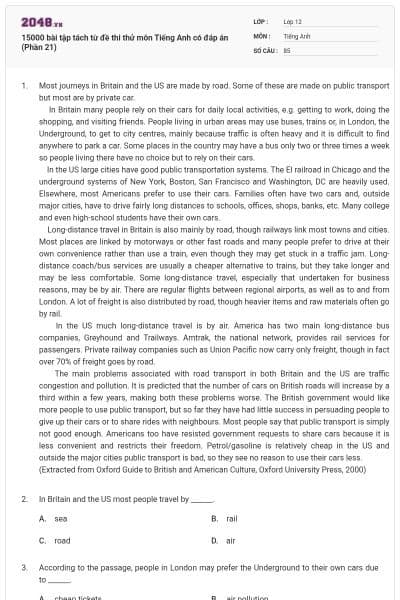
Most journeys in Britain and the US are made by road. Some of these are made on public transport but most are by private car.
In Britain many people rely on their cars for daily local activities, e.g. getting to work, doing the shopping, and visiting friends. People living in urban areas may use buses, trains or, in London, the Underground, to get to city centres, mainly because traffic is often heavy and it is difficult to find anywhere to park a car. Some places in the country may have a bus only two or three times a week so people living there have no choice but to rely on their cars.
In the US large cities have good public transportation systems. The El railroad in Chicago and the underground systems of New York, Boston, San Francisco and Washington, DC are heavily used. Elsewhere, most Americans prefer to use their cars. Families often have two cars and, outside major cities, have to drive fairly long distances to schools, offices, shops, banks, etc. Many college and even high-school students have their own cars.
Long-distance travel in Britain is also mainly by road, though railways link most towns and cities. Most places are linked by motorways or other fast roads and many people prefer to drive at their own convenience rather than use a train, even though they may get stuck in a traffic jam. Long- distance coach/bus services are usually a cheaper alternative to trains, but they take longer and may be less comfortable. Some long-distance travel, especially that undertaken for business reasons, may be by air. There are regular flights between regional airports, as well as to and from London. A lot of freight is also distributed by road, though heavier items and raw materials often go by rail.
In the US much long-distance travel is by air. America has two main long-distance bus companies, Greyhound and Trailways. Amtrak, the national network, provides rail services for passengers. Private railway companies such as Union Pacific now carry only freight, though in fact over 70% of freight goes by road.
The main problems associated with road transport in both Britain and the US are traffic congestion and pollution. It is predicted that the number of cars on British roads will increase by a third within a few years, making both these problems worse. The British government would like more people to use public transport, but so far they have had little success in persuading people to give up their cars or to share rides with neighbours. Most people say that public transport is simply not good enough. Americans too have resisted government requests to share cars because it is less convenient and restricts their freedom. Petrol/gasoline is relatively cheap in the US and outside the major cities public transport is bad, so they see no reason to use their cars less.
(Extracted from Oxford Guide to British and American Culture, Oxford University Press, 2000)
In Britain and the US most people travel by ______.
sea
rail
road
air
Đáp án C
Ở nước Anh và nước Mỹ, hầu hết mọi người di chuyển bằng _________.
A. đường biển
B. đường tàu
C. đường bộ
D. đường hàng không
Thông tin ở câu: “Most journeys in Britain and the US are made by road” (Hầu hết các chuyến đi ở nước Anh và nước Mỹ đều được thực hiện qua đường bộ)
According to the passage, people in London may prefer the Underground to their own cars due to ______.
cheap tickets
air pollution
long distances
heavy traffic
Đáp án D
Dựa vào đoạn văn, mọi người ở London có thể thích đi tàu điện ngầm hơn là xe riêng của họ bởi vì _______.
A. vé rẻ
B. ô nhiễm không khí
C. khoảng cách xa
D. tắc đường
Thông tin ở câu: “People living in urban areas may use buses, trains or, in London, the Underground, to get to city centres, mainly because traffic is often heavy and it is difficult to find anywhere to park a car.”
It is mentioned in paragraph 3 that the public transportation systems in the US are good in ______.
some states
all cities
large states
large cities
Đáp án D
Từ đoạn văn 3, ta có thể suy ra rằng hệ thống phương tiện giao thông công cộng ở nước Mỹ rất tốt ở _________.
A. một vài bang
B. tất cả các thành phố
C. những bang lớn
D. những thành phố lớn
Thông tin ở câu: “In the US large cities have good public transportation systems” (ở các thành phố lớn trên nước Mỹ có hệ thống phương tiện giao thông công cộng tốt)
Which of the following is NOT true according to the passage?
Few college students in the US have their own cars.
Families in the US often have more than one car.
Most Americans prefer to drive their cars outside large cities.
The underground systems are popular in some major US cities.
Đáp án A
Điều gì là không đúng dựa theo đoạn văn?
A. Một vài sinh viên đại học ở nước Mỹ có xe hơi.
B. Các gia đình ở Mỹ thường có nhiều hơn một xe ô tô.
C. Hầu hết người Mỹ thích lái xe ô tô của hộ ra ngoài các thành phố lớn
D. Hệ thống tàu điện ngầm phổ biến ở một vài thành phố lớn ở Mỹ.
Giải thích: Thông tin của đáp án A ở câu: “Many college and even high-school students have their own cars.” (Rất nhiều sinh viên Đại học và thậm chí học sinh trung học phổ thông có xe hơi riêng.) >< Few college (một vài sinh viên)
Dẫn chứng của đáp án B: “Families often have two cars” (Các gia đình thường có 02 xe hơi).
Dẫn chứng của đáp án C: “Families often have two cars and, outside major cities, have to drive fairly long distances to schools, offices, shops, banks, etc” (Các gia đình thường có 02 xe hơi, và khi ra ngoài thành phố, họ thường lái xe khá xa để đi đến trường học, văn phòng, cửa hàng, ngân hàng v.v...)
Dân chứng của đáp án D: “In the US large cities have good public transportation systems. The El railroad in Chicago and the underground systems of New York, Boston, San Francisco and Washington, DC are heavily used” (Ở các thành phố lớn trên nước Mỹ có hệ thống phương tiện giao thông công cộng tốt. Hệ thống tàu hỏa ở Chicago và hệ thống tài điện ngầm ở NY, Boston, San Francisco và Washington DC đều được sử dụng nhiều và rộng rãi) = popular.
The phrase “at their own convenience” in paragraph 4 is closest in meaning to ______.
at the latest time and nearest place
at an appropriate time and place
at an early time and nearby place
at the fastest time and nearest place
Đáp án B
Cụm từ “at their own convenience” ở đoạn 4 gần nghĩa với ________.
A. ở thời gian gần nhất và địa điểm gần nhất
B. ở một thời gian và địa điểm thích hợp
C. ở thời gian sớm và địa điểm gần
D. ở thời gian nhanh nhất và địa điểm gần nhất
Giải thích: convenience = thuận lợi, thuận tiện = appropriate
Dẫn chứng : « many people prefer to drive at their own convenience rather than use a train, even though they may get stuck in a traffic jam” (nhiều người thích lái xe vào lúc phù hợp với họ hơn là sử dụng tàu hỏa, mặc dù họ có thể bị tắc đường.)
Which of the following is true about transport in Britain?
Long-distance travel in Britain is only by road.
There are no regular flights between regional airports.
Trains are usually cheaper than long-distance coach services.
Heavier items and raw materials are often transported by train.
Đáp án D
Câu nào dưới đây là đúng về phương tiện giao thông ở nước Anh?
A. Những chuyến đi xa ở Anh đều chỉ đi bằng đường bộ.
B. Không có máy bay thông thường nào giữa các sân bay khu vực.
C. Tàu hỏa thường rẻ hơn dịch vụ xe khách đường dài
D. Các vật nặng và nguyên liệu thơ sơ thường được vận chuyển bằng tàu.
Giải thích: dẫn chứng của đáp án D: “though heavier items and raw materials often go by rail” (Các vật nặng và nguyên liệu thơ sơ thường được vận chuyển bằng đường tàu)
Đáp án A sai vì có tận 03 cách thức di chuyển đường dài. Dân chứng: “In the US much long-distance travel is by air. America has two main long-distance bus companies, Greyhound and Trailways. Amtrak, the national network, provides rail services for passengers. Private railway companies such as Union Pacific now carry only freight, though in fact over 70% of freight goes by road.” (Ở Hoa Kỳ nhiều du lịch đường dài là bằng đường hàng không. Mỹ có hai chính đường dài xe buýt công ty, Greyhound và Trailways. Amtrak, mạng quốc gia, cung cấp dịch vụ đường sắt cho hành khách. Công ty đường sắt tư nhân như là Union Pacific bây giờ mang chỉ vận chuyển, cho dù thực ra trên 70% vận chuyển chạy bằng đường bộ. )
Đáp án B sai ở chữ “no”. Dẫn chứng “There are regular flights between regional airports” (Có chuyến bay thông thường giữa sân bay khu vực) Đáp án C sai ở “usually cheaper”. Dẫn chứng “Long- distance coach/bus services are usually a cheaper alternative to trains” (Xe khách đường dài / dịch vụ xe buýt thường là giải pháp thay thế rẻ hơn đến xe lửa) => xe khách rẻ hơn xe lửa.
According to the passage, people in Britain refuse public transport because _____
they like to share rides with neighbours
they think it is not good enough
they see no reason to use their cars less
petrol is relatively cheap in Britain
Đáp án B
Dựa vào đoạn văn, người dân ở Anh từ chối sử dụng các phương tiện giao thông công cộng vì __________.
A. Họ thích đi chung xe với hàng xóm
B. Họ nghĩ nó không đủ tốt
C. Họ không thấy có lí do gì để ít sử dụng xe ô tô của họ đi
D. Gía xăng tương đối rẻ ở Anh.
Dẫn chứng: « Most people say that public transport is simply not good enough.” (Hầu hết mọi người nói rằng nó đơn giản là không đủ tốt)
Dịch bài
Vào năm 1826, Người Pháp đã đặt tên Niépce cần hình ảnh cho công ty của anh ấy. Anh ấy không phải là nghệ sĩ tài năng, vì thế anh ấy phát minh máy ảnh rất đơn giản. Anh ấy đặt nó trong cửa sổ của nhà của anh ấy và chụp hình sân của anh ấy. Đó là ảnh đầu tiên.
Quan trọng tới ngày trong lịch sử nghề nhiếp ảnh là 1837. Năm đó, Daguerre, Người Pháp khác, chụp hình vẽ của anh ấy. Anh ấy sử dụng mới loại của máy ảnh và quá trình khác. Ở hình ảnh của anh ấy, bạn thấy được mọi thứ rõ ràng, chi tiết nhỏ nhất dù. Loại ảnh này được gọi là phép chụp hình da - ge.
Sớm, người khác bắt đầu sử dụng tiến trình của Daguerre. Khách bộ hành mang lại phép chụp hình da - ge từ khắp nơi trên thế giới. Mọi người chụp ảnh toà nhà nổi tiếng, thành phố, và núi.
Trong khoảng 1840, quá trình đã được cải thiện. Sau đó nhiếp ảnh gia có thể chụp hình mọi người và di chuyển những thứ. Quá trình không đơn giản và nhiếp ảnh gia phải mang nhiều phim và chế biến thiết bị. Tuy nhiên, này không nhiếp ảnh gia dừng, nhất là ở Hoa Kỳ. Sau năm 1840, nghệ sĩ phép chụp hình da - ge phổ biến trong hầu hết thành phố.
Matthew Brady là một nhiếp ảnh gia Mỹ nổi tiếng. Anh ấy chụp chân dung những người nổi tiếng. Chân dung trông khác thường vì họ giống như thật và đầy tính cách. Brady cũng là người đầu tiên chụp hình chiến tranh. Bức tranh của anh ấy về cuộc nội chiến 1862 cho thấy chiến sĩ tử trận và thành phố bị hư hỏng. Họ làm chiến tranh trông có vẻ thực và ̣khủng khiếp hơn.
Vào những năm 1880, phát minh mới bắt đầu thay đổi nghề nhiếp ảnh. Nhiếp ảnh gia có thể mua phim sẵn sàng - làm trong cuộn, thay vì phải tự làm phim. Hơn nữa, họ chẳng cần phải xử lý phim ngay lập tức. Họ có thể đưa nó trở về với trường quay của họ và phát triển sau này. Họ chẳng cần phải mang nhiều thiết bị. Và cuối cùng, phát minh máy ảnh cầm tay nhỏ làm nghề nhiếp ảnh ít đắt đỏ hơn.
Với máy ảnh nhỏ, ai cũng có thể là nhiếp ảnh gia. Mọi người bắt đầu sử dụng máy quay phim chỉ để cho vui. Họ chụp hình gia đình của họ, bạn bè, và nơi được yêu thích nhất. Họ gọi hình ảnh này" ảnh chụp nhanh".
Ảnh phim tài liệu trở thành phổ biến trong báo chí vào những năm 1890. Sớm tạp chí và sách cũng sử dụng chúng. Hình ảnh này cho thấy sự kiện đúng và mọi người. Họ thực sự hơn rất nhiều so với bản vẽ.
Một số người bắt đầu nghĩ nghề nhiếp ảnh là một loại hình nghệ thuật. Họ nghĩ rằng nghề nhiếp ảnh có thể làm nhiều hơn cho thấy thế giới thực. Nó cũng cho thấy khái niệm và tình cảm, như loại hình nghệ thuật khác
In 1826, a Frenchman named Niépce needed pictures for his business. He was not a good artist, so he invented a very simple camera. He put it in a window of his house and took a picture of his yard. That was the first photograph.
The next important date in the history of photography was 1837. That year, Daguerre, another Frenchman, took a picture of his studio. He used a new kind of camera and a different process. In his pictures, you could see everything clearly, even the smallest details. This kind of photograph was called a daguerreotype.
Soon, other people began to use Daguerre's process. Travelers brought back daguerreotypes from all around the world. People photographed famous buildings, cities, and mountains.
In about 1840, the process was improved. Then photographers could take pictures of people and moving things. The process was not simple and photographers had to carry lots of film and processing equipment. However, this did not stop photographers, especially in the United States. After 1840, daguerreotype artists were popular in most cities.
Matthew Brady was one well-known American photographer. He took many portraits of famous people. The portraits were unusual because they were lifelike and full of personality. Brady was also the first person to take pictures of a war. His 1862 Civil War pictures showed dead soldiers and ruined cities. They made the war seem more real and more terrible.
In the 1880s, new inventions began to change photography. Photographers could buy film ready- made in rolls, instead of having to make the film themselves. Also, they did not have to process the film immediately. They could bring it back to their studios and develop it later. They did not have to carry lots of equipment. And finally, the invention of the small handheld camera made photography less expensive.
With a small camera, anyone could be a photographer. People began to use cameras just for fun. They took pictures of their families, friends, and favorite places. They called these pictures "snapshots".
Documentary photographs became popular in newspapers in the 1890s. Soon magazines and books also used them. These pictures showed true events and people. They were much more real than drawings.
Some people began to think of photography as a form of art. They thought that photographycould do more than show the real world. It could also show ideas and feelings, like other art forms.
From “Reading Power” by Beatrice S. Mikulecky and Linda Jeffries
The first photograph was taken with ______.
a small handheld camera
a very simple camera
a daguerreotype
new types of film
Đáp án B
Bức ảnh đầu tiên được chụp bởi _____.
A. một camera nhỏ cầm tay
B. một camera rất đơn giản
C. Phương pháp chụp hình đage
D. những dạng mới của phim
Dẫn chứng: “He was not a good artist, so he invented a very simple camera. He put it in a window of his house and took a picture of his yard. That was the first photograph.” (Anh ấy không phải là nghệ sĩ tài năng, vì thế anh ấy phát minh máy ảnh rất đơn giản. Anh ấy đặt nó trong cửa sổ của nhà của anh ấy và chụp hình sân của anh ấy. Đó là ảnh đầu tiên.)
Daguerre took a picture of his studio with ______.
a new kind of camera
a very simple camera
special equipment
an electronic camera
Đáp án A
Daguerre chụp ảnh studio của anh ấy bằng ________.
A. một loại camera mới
B. một camera rất đơn giản
C. thiết bị đặc biệt
D. một camera điện tử
Dẫn chứng: “That year, Daguerre, another Frenchman, took a picture of his studio. He used a new kind of camera.” (Năm đó, Daguerre, một người Pháp khác, chụp studio của anh ấy. Anh ấy sử dụng loại mới của máy ảnh.)
The word “this” in the passage refers to the ______.
carrying of lots of film and processing equipment
stopping of photographers from taking photos
fact that daguerreotype artists were popular in most cities
taking of pictures of people and moving things
Đáp án A
Từ “This” trong đoạn văn đề cập đến __________.
A. chứa nhiều phim và các thiết bị xử lí
B. ngăn chặn nhiếp ảnh gia chụp ảnh
C. sự thật là ác nghệ sĩ theo phương pháp chụp hình đage nổi tiếng ở hầu hết các thành phố
D. chụp ảnh về người và vật cử động
Dân chứng: “The process was not simple and photographers had to carry lots of film and processing equipment. However, this did not stop photographers, especially in the United States” (Quá trình không đơn giản và nhiếp ảnh gia phải mang nhiều phim và thiết bị xử lí. Tuy nhiên, việc này này không ngăn được các nhiếp ảnh gia, nhất là ở Hoa Kỳ)
=> việc chứa nhiều phim và các thiết bị xử lí không ngăn được nhiếp ảnh gia.
The word “ruined” in the passage is closest in meaning to “______”.
poorly-painted
heavily-polluted
terribly spoiled
badly damaged
Đáp án D
Từ “ruined” trong đoạn văn gần nghĩa với ____.
A. tranh vẽ kém chất lượng
B. ô nhiễm nặng
C. bị làm hư hỏng một cách tồi tệ
D. phá hủy nghiêm trọng
Dẫn chứng: “His 1862 Civil War pictures showed dead soldiers and ruined cities. They made the war seem more real and more terrible.” (Bức tranh của anh ấy về cuộc nội chiến 1862 cho thấy chiến sĩ tử trận và thành phố bị hư hỏng. Họ làm chiến tranh trông có vẻ thực và ̣khủng khiếp hơn.) => chiến tranh làm thành phố bị phá hủy nghiêm trọng
The word “lifelike” in the passage is closest in meaning to “______”.
moving
realistic
touching
manlike
Đáp án B
Từ “lifelike” trong đoạn văn gần nghĩa với _______.
A. di chuyển
B. mang tính hiện thực
C. cảm động
D. giống người
Dẫn chứng: “The portraits were unusual because they were lifelike and full of personality.” (Chân dung trông khác thường vì họ giống như thật và mang đầy tính cách).
Matthew Brady was well-known for ______.
inventing daguerreotypes
the small handheld camera
taking pictures of French cities
portraits and war photographs
Đáp án D
Matthew Brady nổi tiếng vì ______.
A. sáng tạo ra hương pháp chụp hình đage
B. một camera nhỏ cầm tay
C. chụp ảnh những thành phố ở Pháp
D. chân dung và ảnh về chiến tranh
Dẫn chứng: “Matthew Brady was one well-known American photographer. He took many portraits of famous people. The portraits were unusual because they were lifelike and full of personality. Brady was also the first person to take pictures of a war. His 1862 Civil War pictures showed dead soldiers and ruined cities. They made the war seem more real and more terrible.” (Matthew Brady là một nhiếp ảnh gia Mỹ nổi tiếng. Anh ấy chụp chân dung những người nổi tiếng. Chân dung trông khác thường vì họ giống như thật và đầy tính cách. Brady cũng là người đầu tiên chụp hình chiến tranh. Bức tranh của anh ấy về cuộc nội chiến 1862 cho thấy chiến sĩ tử trận và thành phố bị hư hỏng. Họ làm chiến tranh trông có vẻ thực và ̣khủng khiếp hơn.)
As mentioned in the passage, photography can ______.
print old pictures
convey ideas and feelings
show the underworld
replace drawings
Đáp án B
Như đã đề cập ở trong bài, chụp ảnh có thể ______.
A. in các bức tranh cũ
B. truyền tải ý tưởng và cảm xúc
C. phô diễn thế giới ngầm
D. thay thế tranh vẽ
Dẫn chứng: “They thought that photographycould do more than show the real world. It could also show ideas and feelings, like other art forms.” (Một số người bắt đầu nghĩ nghề nhiếp ảnh là một loại hình nghệ thuật. Họ nghĩ rằng nghề nhiếp ảnh có thể làm nhiều hơn cho thấy thế giới thực. Nó cũng cho thấy khái niệm và tình cảm, như loại hình nghệ thuật khác)
Which of the following could best serve as the title of the passage?
Different Steps in Film Processing
Story of Photography
Photography and Painting
Story of Famous Photographers
Đáp án B
Đáp án nào dưới đây có thể được coi là tiêu đề thích hợp nhất cho đoạn văn?
A. Các bước khác nhau của xử lí phim
B. Câu chuyện về nhiếp ảnh
C. Nhiếp ảnh và tranh vẽ
D. Câu chuyện về những nhà nhiếp ảnh nổi tiếng
Giải thích: Toàn bài văn này đều nói về nhiếp ảnh (bức ảnh đầu tiên. camera chụp hình, nhiếp ảnh gia nổi tiếng, nhiếp ảnh có thể truyền tải điều gì...v.v ...)
DỊCH BÀI
Vùng quê của Anh nổi tiếng với sắc đẹp của nó: hoàn toàn lànúi và vùng đất hoang, hồ, sông và rừng, và bờ biển hoang vu. Nhiều khu vực đẹp nhất là công viên quốc gia và được bảo tồn, phát triển. Khi mọi người Anh nghĩ đến vùng quê, họ nghĩ đến đất nông nghiệp, cũng như khoảng trống mở. Họ tưởng tượng bò hoặc cừu trong đồng xanh được bao bởi hàng rào hoặc đá tường và ruộng lúa mì và lúa mạch. Hầu hết các đất nông nghiệp thuộc sở hữu tư nhân nhưng vẫn có một ít là thuộc về nhà nước.
Nhiều người liên tưởng vùng quê đến hoà bình và thư giãn. Họ dùng thời gian rảnh rỗi của họ đi bộ ở đó, hoặc đi về quê cắm trại hoặc ăn bữa trưa. Vào mùa hè mọi người đi đến trái cây nông trại và hái dâu và quả khác. Chỉ một vài người người sống ở vùng quê làm việc trên nông trại. Nhiều người di chuyển trong để làm việc trong tỉnh lỵ. Nhiều người khác mơ về việc sống ở vùng quê, nơi họ tin họ sẽ có tốt hơn và lối sống lành mạnh hơn.
Vùng quê đối mặt với nhiều mối đe doạ. Một số gắn liền với cách canh tác nông nghiệp hiện đại, và việc sử dụng hoá chất độc hại đến thực vật và động vật hoang dã. Đất cũng là yêu cầu cho nhà mới. Vành đai xanh, vùng đất xung quanh nhiều thành phố, đang gia tăng áp lực. Dự định xây dựng con đường mới bị tổ chức kịch liệt phản đối để cố bảo vệ quê. Người biểu tình dựng trại để ngăn ngừa, hoặc ít nhất trì hoãn công việc xây dựng. Mỹ có nhiều vùng hoang dã và phong cảnh xinh đẹp, và có nhiều khu vực, nhất là trong West in States như Montana và Wyoming, nơi sống ít người. Ở tiểu bang thuộc vùng New England, như Vermont và New Hampshire, đây là chuyện bình thường khi trang trại nhỏ bị vây quanh bởi đồi và lĩnh vực xanh. Ở tiểu bang Ohio, Indianan, Illinoisan và các quốc gia Midwestern, ruộng bắp hoặc lúa mì tiến đến đằng chân trời và có nhiều dặm giữa tỉnh lỵ.
Chỉ khoảng 20% Người Mỹ sống bên ngoài thành phố và tỉnh lỵ. Cuộc sống có thể là khó khăn cho người sống ở vùng quê. Dịch vụ như bệnh viện và trường học phải đi xa và đi mua sắm nghĩa là lái xe trên quãng đường dài. Một số người thậm chí phải lái từ nhà của họ đến đường cái nơi thư của họ được còn lại ở hộp. Mặc dù sự bất lợi, nhiều người sống ở vùng quê nói rằng họ giống an toàn, sạch, môi trường hấp dẫn. Nhưng con của họ thường di chuyển đến thị trấn, thành phố sớm nhất có thể
The countryside of Britain is well known for its beauty and many contrasts: it bare mountains and moorland, its lakes, rivers and woods, and its long, often wild coastline. Many of the most beautiful areas are national parks and are protected from development. When Britain people think of the countryside they think of farmland, as well as open spaces. They imagined cows or sheep in greenfield enclosed by hedges or stone walls and field of wheat and barley. Most farmland is privately owned but is crossed by a network of public footpaths.
Many people associate the countryside with peace and relaxation. They spend their free time walking or cycling there, or go to the country for a picnic or a pub lunch. In summer people go to fruit farms and pick strawberries and other fruit. Only a few people who live in the country work on farms. Many commute to work in towns. Many others dream of living in the country, where they believe they would have a better and healthier lifestyle.
The countryside faces many threats. Some are associated with modern farming practices, and the use of chemical harmful to plants and wildlife. Land is also needed for new houses. The green belt, an area of land around many cities, is under increasing pressure. Plans to build new roads are strongly opposed by organizations trying to protect the countryside. Protesters set up camps to prevent, or at least delay the building work.
America has many areas of wild and beautiful scenery, and there are many areas, especially in the West in States like Montana and Wyoming, where few people living. In the New England states, such as Vermont and New Hampshire, it is common to see small farm surrounded by hills and green areas. In Ohio, Indianan, Illinoisan and other Midwestern states, field of corns or wheat reach to the horizon and there are many miles between towns.
Only about 20% of Americans live outside cities and towns. Life may be difficult for people who live in the country. Services like hospitals and schools may be further away and going shopping can mean driving long distances. Some people even have to drive from their homes to the main road where their mail is left in a box. In spite of the disadvantages, many people who live in the country say that they like the safe, clean, attractive environment. But their children often move to a town or city as soon as they can
We can see from the passage that in the countryside of Britain ______
none of the areas face the sea
most beautiful areas are not well preserved
only a few farms are publicly owned
it is difficult to travel from one farm to another.
Đáp án C
Chúng ta thấy từ đoạn văn rằng vùng nông thôn ở nước Anh ____________.
A. không nơi nào giáp biển
B. những khu vực đệp nhất không được bảo tồn
C. chỉ một vài nông trại được sở hữu công khai, của nhà nước
D. rất khó để đi từ nông trại này sang nông trại khác.
Giải thích: “Most farmland is privately owned but is crossed by a network of public footpaths.” (Hầu hết nông tại thuộc sở hữu tư nhân nhưng vẫn có một vài nông trại của nhà nước)
Which is NOT mentioned as an activity of relaxation in the countryside of Britain?
Riding a bicycle
Going swimming
Picking fruit
Going for a walk
Đáp án B
Đáp án nào dưới đây KHÔNG được đề cập đến như là hoạt động nghỉ ngơi ở vùng nông thôn nước Anh?
A. đạp xe
B. đi bơi
C. hái hoa quả
D. đi bộ. đi dạo
Giải thích: “Many people associate the countryside with peace and relaxation. They spend their free time walking or cycling there, or go to the country for a picnic or a pub lunch. In summer people go to fruit farms and pick strawberries and other fruit. Only a few people who live in the country work on farms. Many commute to work in towns. Many others dream of living in the country, where they believe they would have a better and healthier lifestyle.” (Nhiều người liên tưởng quê đến hoà bình và thư giãn. Họ dùng thời gian rảnh rỗi của họ đi bộ ở đó, hoặc đi về quê cắm trại hoặc ăn bữa trưa. Vào mùa hè mọi người đi đến trái cây nông trại và hái dâu và quả khác. Chỉ một vài người người sống ở vùng quê làm việc trên nông trại. Nhiều người vẫn làm việc trong tỉnh lỵ. Nhiều người khác mơ về việc sống ở vùng quê, nơi họ tin họ sẽ có tốt hơn và lối sống lành mạnh hơn.)
=> không đề cập đến việc đi bơi
What does the word “they” in paragraph 2 refers to______?
Those who dream of living in the country
Those who go to fruit farm in summer
Those who go to country for a picnic
Those who commute to work in towns
Đáp án A
Chữ “they” ở trong đoạn 2 đề cập đến ___________?
A. Những người mơ ước được sống ở nông thôn
B. Những người đi tới nông trại hoa quả vào mùa hè
C. Những người đi đến nông thôn để cắm trại
D. Những người vẫn làm việc ở tị trấn
Giải thích: “Many others dream of living in the country, where they believe they would have a better and healthier lifestyle.” (Nhiều người khác mơ về việc sống ở vùng quê, nơi họ tin họ sẽ có tốt hơn và lối sống lành mạnh hơn)
Which of the following threatens the countryside in Britain?
The green belt around cities
Protest against building work.
Modern farming practices
Plants and wildlife
Đáp án C
Đáp án nào dưới đây là mối de dọa đối với nông thôn ở nước Anh?
A. Vành đai xanh xung quanh thành phố
B. Chiến dịch chống lại công việc xây dựng
C. Phương pháp canh tác hiện đại
D. Thực vật và đời sống hoang dã
Giải thích: “The countryside faces many threats. Some are associated with modern farming practices” (Vùng quê đối mặt với nhiều mối đe doạ. Một số gắn liền với cách canh tác nông nghiệp hiện đại)
The phrase “reach to the horizon” in paragraph 4 is closest in meaning to______
are limited
are endless
are varied
are horizontal
Đáp án B
Cụm từ “reach to the horizon” ở đoạn 4 gần nghĩa nhất với
A. bị giới hạn
B. là vô hạn
C. nhiều biến thể
D. nằm ngang
Giải thích: “horizon” = đường chân trời => ở rất xa và vô hạn
According to the passage, some Americans choose to live in country because______
Life there may be easier for them.
Hospitals, schools, shops are conveniently located there.
Their children enjoyed country life.
They enjoy the safe, clean, attractive environment there.
Đáp án D
Dựa theo đoạn văm, một vài người Mỹ chọn sống ở nông thôn vì _______
A. Cuộc sống ở đây có lẽ sẽ dễ dàng hơn với học
B. Bệnh viện, trường học, cửa hàng đều ở đó, rất thuận tiện
C. Con em của họ thích cuộc sống ở nông thôn
D. Họ thích môi trường an toàn, sạch sẽ và thu hút ở đây
Giải thích: “In spite of the disadvantages, many people who live in the country say that they like the safe, clean, attractive environment” (Mặc dù sự bất lợi, nhiều người sống ở vùng quê nói rằng họ giống an toàn, sạch, môi trường hấp dẫn)
Which of the following in NOT mentioned in the passage?
Towns in some Midwestern states in US are separated by long distances.
The majority of American people live in cities and towns.
Both British and American people are thinking of moving to the countryside
Many British people think of the country as a place of peace and relaxation.
Đáp án C
Đáp án nào dưới đây không được nêu ra trong bài?
A. Thị trấn ở một vài bang Trung Đông nước Mỹ bị chia tách bởi khoảng cách xa.
B. Đa số người Mỹ sống ở thành phố và thị trấn
C. Cả người Anh và người Mỹ đều suy nghĩ về việc chuyển đến nông thôn sống
D. Nhiều người Anh nghĩ về nông thôn như một nơi yên bình và thoải mái.
Giải thích: C
Đáp án A: “In Ohio, Indianan, Illinoisan and other Midwestern states, field of corns or wheat reach to the horizon and there are many miles between towns.” (. Ở tiểu bang Ohio, Indianan, Illinoisan và các quốc gia Midwestern, ruộng bắp hoặc lúa mì tiến đến đằng chân trời và có nhiều dặm giữa tỉnh lỵ. ) => được nhắc đến trong bài
Đáp án B: “Only about 20% of Americans live outside cities and towns.” (20% người Mỹ sống ở vùng ngoại ô)
=> 80% sống ở thành phố và trị trấn => Đa số người => được nhắc đến trong bài.
Đáp án D: “Many people associate the countryside with peace and relaxation” (Nhiều người Anh nghĩ về nông thôn như một nơi yên bình và thoải mái) => được nhắc đến trong bài
Đáp án C: “Many others dream of living in the country, where they believe they would have a better and healthier lifestyle.” (Nhiều người Anh mơ về việc sống ở vùng quê, nơi họ tin họ sẽ có tốt hơn và lối sống lành mạnh hơn).Tuy nhiên, “Only about 20% of Americans live outside cities and towns. Life may be difficult for people who live in the country” (20% người Mỹ sống ở vùng ngoại ô. Cuộc sống ở đây có lẽ sẽ khó khăn hơn với những người sống ở nông thôn)
=> Người Anh thích sống ở vùng quê nhưng người Mỹ thì không
DỊCH BÀI
Chuyên gia trong khí hậu học và các nhà khoa học là trở nên vô cùng quan ngại về biến thành khí hậu của chúng tôi mà đang diễn ra. Phải thừa nhận là biến đổi khí hậu đã xảy ra trên hành tinh của chúng tôi trước đây. Chẳng hạn như, đã có vài kỷ băng hà hoặc thời kỳ băng hà.
Thay đổi khí hậu này, tuy nhiên, khác với những hiện đại trong họ xảy ra dần dần và, theo như chúng tôi biết, tự nhiên. Thay đổi hiện đang giám sát được cho là được kết quả không phải nguyên nhân tự nhiên, nhưng hoạt động con người. Hơn nữa, tốc độ thay đổi là trở nên báo động nhanh.
Vấn đề chủ yếu là hành tinh dường như đang sưởi ấm lên. Theo vài chuyên gia, quá trình sưởi ấm này, gọi là khí hậu toàn cầu nóng lên, đang xảy ra tại tỉ lệ chưa từng có trong 10,000 năm qua. Ngụ ý cho hành tinh là rất nghiêm túc. Dâng cao toàn cầu nhiệt độ có thể tạo nên những thảm hoạ sinh thái như vô cùng cao gia tăng phạm vi ảnh hưởng của nạn lụt và nạn hạn hán. Này đến lượt có thể có tác hại đối với nông nghiệp.
Người ta nghĩ rằng sự nóng lên toàn cầu của Trái đất điều này là do khí gây ra hiệu ứng nhà kính, cái gọi là, như các - bô - ních, được phát ra vào không khí bằng xe hơi động cơ và quy trình công nghiệp hiện đại, chẳng hạn. Khí như vậy không những thêm vào ô nhiễm không khí, mà còn tạo hiệu ứng nhà kính, theo đó sức nóng của mặt trời bị mắc kẹt. Điều này dẫn đến sưởi ấm lên của hành tinh.
Chính trị gia cũng là quan tâm đến biến đổi khí hậu và hiện nay có hội nghị thượng đỉnh thông thường về vấn đề này, với sự tham dự của đại diện quốc gia công nghiệp hóa của quanh 180 trong số thế giới. Của hội nghị thượng đỉnh này, diễn ra quan trọng nhất trong Kyotoin Japanin 1997. Ở đó theo thoả thuận thì quốc gia công nghiệp hoá nhất sẽ cố giảm thể tích của thải khí thải nhà kính và được trao cho mục tiêu cho giảm này của khí thải.
Nó cũng là gợi ý rằng rừng hơn nên trồng để tạo “cái bồn” để hấp thụ khí gây ra hiệu ứng nhà kính. Ít nhất một phần của vấn đề của nhanh biến đổi khí hậu là do nạn phá rừng bức thiết quá.
Tiếc là mục tiêu không được đáp ứng. Thậm chí tiếc là hơn nữa, cảnh báo toàn cầu về biến đổi khí hậu thường vẫn đang được xem như việc phao tin
Experts in climatology and other scientists are becoming extremely concerned about the changes to our climate which are taking place. Admittedly, climate changes have occurred on our planet before. For example, there have been several ice ages or glacial periods.
These climatic changes, however, were different from the modern ones in that they occurred gradually and, as far as we know, naturally. The changes currently being monitored are said to be the result not of natural causes, but of human activity. Furthermore, the rate of change is becoming alarmingly rapid.
The major problem is that the planet appears to be warming up. According to some experts, this warming process, known as global warming, is occurring at a rate unprecedented in the last 10,000 years. The implications for the planet are very serious. Rising global temperatures could give rise to such ecological disasters as extremely high increases in the incidence of flooding and of droughts. These in turn could have a harmful effect on agriculture.
It is thought that this unusual warming of the Earth has been caused by so-called greenhouse gases, such as carbon dioxide, being emitted into the atmosphere by car engines and modern industrial processes, for example. Such gases not only add to the pollution of the atmosphere, but also create a greenhouse effect, by which the heat of the sun is trapped. This leads to the warming up of the planet.
Politicians are also concerned about climate change and there are now regular summits on the subject, attended by representatives from around 180 of the world’s industrialized countries. Of these summits, the most important took place in Kyotoin Japanin 1997. There it was agreed that the most industrialized countries would try to reduce the volume of greenhouse gas emissions and were given targets for this reduction of emissions.
It was also suggested that more forests should be planted to create so-called sinks to absorb greenhouse gases. At least part of the problem of rapid climate change has been caused by too drastic deforestation.
Sadly, the targets are not being met. Even more sadly, global warnings about climate changes are often still being regarded as scaremongering
According to the passage, in what way did the climate changes in the ice ages differ from the modern ones?
They occurred naturally over a long period of time
They were partly intended.
They were wholly the result of human activity.
They were fully monitored by humans.
Đáp án A
Theo đoạn văn, bằng cách nào mà thay đổi khí hậu ở kỉ băng hà khác với thời hiện đại?
A. Chúng xảy ra một cách tự nhiên qua một thời gian dài
B. Một phần là do dụng ý.
C. Hoàn toàn là kết quả của hoạt động của con người.
D. Hoàn toàn bị quản lí bởi con người
Giải thích: Dựa vào câu 1 đoạn 2 để trả lời: These climatic changes, however, were different from the modern ones in that they occurred gradually and, as far as we know, naturally. => A là đáp án đúng.
The word “alarmingly” in paragraph 2 is closest in meaning to ____.
disapprovingly
disappointingly
surprisingly
worryingly
Đáp án B
Từ “alarmingly” ở đoạn 2 gần nghĩa nhất vói từ nào _________.
alarmingly (adv): đáng báo động
- disapprovingly (adv): không tán thàh, phản đối
- worryingly (adv): đáng lo ngại
- surprisingly (adv): một cách ngạc nhiên
- disappointingly (adv): chán thật, thật thất vọng
=> B là đáp án đúng.
According to the passage, agriculture could ____.
make the global warming more serious
be indirectly affected by the global temperature rises
give rise to many ecological disasters
be directly damaged by the rises in global temperature
Đáp án B
Dựa vào đoạn văn. nông nghiệp có thể ________.
A. làm cho sự nóng lên toàn cầu trở nên nghiêm trọng hơn
B. gián tiếp ảnh hưởng bởi nhiệt bộ tăng
C. thảm họa gia tăng
D. trực tiếp bị phá hủy bởi sự tăng lên của nhiệt độ toàn cầu.
Giải thích:
- Từ khóa: agriculture
- Từ khóa này được tìm thấy đầu tiên ở câu cuối đoạn 3: These in turn could have a harmful effect on agriculture. (Ngược lại, điều này có thể dẫn đến ảnh hưởng xấu đối với nông nghiệp). Tuy nhiên chúng ta không biết "these" ở đây là gì. Do vậy cần đọc thêm những câu trước đó và chúng ta biết "these" ở đây chính là "global temperature rises" => đáp án đúng là B
Greenhouse gases cause the warming up of the Earth because they _______.
are emitted by car engines
trap heat from the sun
do not add to atmosphere pollution
are unusual gases
Đáp án B
Hiệu ứng nhà kính gây nên sự nóng lên toàn cầu vì chúng ______.
A. bị thải ra từ động cơ xe
B. sức nóng từ mặt trời
C. không thêm gì vào ô nhiễm không khí
D. là khí gas lạ
Giải thích: - Từ khóa: greenhouse gases, the warming up of the Earth - Câu hỏi hỏi lí do khí nhà kính gây ra sự nóng lên của trái đất. Ta cần dựa vào nội dung đoạn 4 để trả lời. Câu cuối cùng có nói:" This leads to the warming up of the planet." (Điều này dẫn đến sự nóng lên của Trái Đất) và "this" ở đây thay thế cho mệnh đề trước đó "the heat of the sun is trapped".
It can be inferred from the passage that the countries which are mainly responsible for global warming are __________.
countries with the warmest climate
developing countries
developed countries
the most industrialized countries
Đáp án D
Có thể suy ra từ đoạn văn rằng các đất nước mà chịu trách nghiệm chủ yếu về sự nóng lên toàn cầu là _____.
A. các nước với khí hậu ấm nóng nhất
B. các nước đang phát triển
C. các nước đã phát triển
D. các nước công nghiệp hóa
Giải thích:
- Từ khóa: countries, mainly responsible for global warming
- Dựa vào câu cuối đoạn 5 để trả lời "There it was agreed that the most industrialized countries would try to reduce the volume of greenhouse gas emissions and were given targets for this reduction of emissions." (Ở đó theo thoả thuận thì quốc gia công nghiệp hoá nhất sẽ cố giảm thể tích của thải khí thải nhà kính và được trao cho mục tiêu cho giảm này của khí thải.) => vì thải ra nhiều khí thải nên phải chịu trách nhiệm. Đây là một câu hỏi đòi hỏi phải có sự suy luận. Dựa vào câu trên ta có thể suy luận được đáp án đúng là D.
Which of the following is NOT true, according to the passage?
Carbon dioxide is one of the gases that may cause the so-called greenhouse effect.
The so-called sinks created by forests can absorb greenhouse gases.
The problem of rapid climate change has been caused mainly by deforestation.
Politicians are among those who are concerned about climate change.
Đáp án C
Dựa theo đoạn văn, điều gì là KHÔNG đúng?
A. Khí CO2 là một trong những loại khí gas mà có thể gây hiệu ứng nhà kính.
B. Cái tạo bởi rừng có thể hấp thụ khí gây ra hiệu ứng nhà kính.
C. Vấn đề về nhanh biến đổi khí hậu đã bị gây ra chủ yếu do nạn phá rừng.
D. Chính trị gia là trong số những người lo lắng về biến đổi khí hậu.
Giải thích:
Nội dung câu A được đề cập đến trong câu 1 đoạn 6. “It was also suggested that more forests should be planted to create so-called sinks to absorb greenhouse gases.” (Nó cũng là gợi ý rằng rừng hơn nên trồng để tạo “cái bồn” để hấp thụ khí gây ra hiệu ứng nhà kính.)
Nội dung câu B được đề cập đến trong câu 1 đoạn 5. “It is thought that this unusual warming of the Earth has been caused by so-called greenhouse gases, such as carbon dioxide, being emitted into the atmosphere by car engines and modern industrial processes, for example.” (Người ta nghĩ rằng sự nóng lên toàn cầu của Trái đất điều này là do khí gây ra hiệu ứng nhà kính, cái gọi là, như các - bô - ních, được phát ra vào không khí bằng xe hơi động cơ và quy trình công nghiệp hiện đại, chẳng hạn.)
Nội dung câu D được đề cập đến trong câu 2 đoạn 4. “Such gases not only add to the pollution of the atmosphere, but also create a greenhouse effect, by which the heat of the sun is trapped. This leads to the warming up of the planet.” (Khí như vậy không những thêm vào ô nhiễm không khí, mà còn tạo hiệu ứng nhà kính, theo đó sức nóng của mặt trời bị mắc kẹt. Điều này dẫn đến sưởi ấm lên của hành tinh. )
Nội dung câu C không đúng với bài : At least part of the problem of rapid climate change has been caused by too drastic deforestation. -> hiện tượng phá rừng chỉ là một trong những nguyên nhân chứ không phải nguyên nhân chủ yếu
The word “drastic” in paragraph 6 is closest in meaning to ____.
hard
severe
widespread
obvious
Đáp án B
Từ “drastic” trong đoạn 6 gần nghĩa với _________ .
A. khó,cứng
B. nghiêm trọng
C. lan rộng D. hiển nhiên
Giải thích:
drastic (adj): mạnh mẽ, quyết liệt
- severe (adj): khắc nghiệt, mãnh liệt, dữ dội
- hard (adj): khó, cứng, chăm
- obvious (adj): rõ ràng
- widespread (adj): lan rộng, phổ biến
What is probably the writer’s attitude toward global warning?
Optimistic
Pessimistic
Neutral
Positive
Đáp án B
Đâu có thể là thái độ của tác giả đối với sự nóng lên toàn cầu?
A. Lạc quan
B. Tiêu cực
C. Bình thường
D. Tích cực
Giải thích:
- Optimistic (adj): lạc quan
- Neutral (adj): trung lập
- Positive (adj): tích cực
- Pessimistic (adj): bi quan
Dựa vào đoạn cuối cùng " Sadly, the targets are not being met. Even more sadly, global warnings about climate changes are often still being regarded as scaremongering." (Tiếc là mục tiêu không được đáp ứng. Thậm chí tiếc là hơn nữa, cảnh báo toàn cầu về biến đổi khí hậu thường vẫn đang được xem như việc phao tin. ) ta chọn được đáp án đúng là B.
A team of Russian scientists has challenged the theory that the woolly mammoths became extinct 10,000 years ago at the end of the Ice Age. The scientists have reported that the beasts may have survived until 2000 B.C. on an island off the coast of Siberia, where researchers uncovered 29 fossilized woolly mammoth teeth ranging in age from 4,000 to 7,000 years. The question to be asked now is, how did these prehistoric pachyderms survive in their island environment? One possibility is that they adapted to their confined surroundings by decreasing their bulk. This theory is based on their smaller tooth size, which has led scientists to believe that they were only 6 feet tall at the shoulder compared with 10 feet of their full-sized counterpart. But would this be enough to enable them to survive thousands of years beyond that of other mammoths? Researchers are still working to uncover the reasons for this isolated group's belated disappearance.
With which topic is this passage mainly concerned?
Some scientists have challenged a theory.
Some small teeth have been discovered.
Some mammoths lived longer than others.
Some pachyderms survived on an island.
Đáp án C
Đoạn văn này nói đến chủ đề nào?
A. Một vài nhà khoa học đã “thách thức” lý thuyết.
B. Một vài cái răng nhỏ đã được tìm thấy.
C. Một vài con voi ma mút sống lâu hơn các con khác.
D. Một vài con thú da dày sống trên hòn đảo.
Giải thích: “. The question to be asked now is, how did these prehistoric pachyderms survive in their island environment......But would this be enough to enable them to survive thousands of years beyond that of other mammoths?” (Câu hỏi để được đặt ra bây giờ là, làm cách nào mà loài da dày từ thời tiền sử này tồn tại ở môi trường đảo?.....Nhưng sẽ này có đủ để chúng có thể tồn tại hàng ngàn năm ngoài của voi ma - mút khác?)
=> Sự sống lâu của loài ma mút này.
According to the passage, some researchers suggest that mammoths became extinct
about 2,000 years ago
about 4,000 years ago
about 7,000 years ago
about 10,000 years ago
Đáp án B
Dựa vào đoạn văn, một vài nhà nghiên cứu gợi ý rằng voi ma mút tuyệt chủng vào ________.
A. khoảng 2000 năm trước
B. khoảng 4000 năm trước
C. khoảng 7000 năm trước
D. khoảng 10000 năm trước
Giải thích: “The scientists have reported that the beasts may have survived until 2000 B.C. on an island off the coast of Siberia, where researchers uncovered 29 fossilized woolly mammoth teeth ranging in age from 4,000 to 7,000 years.” (Họ cho rằng những con quái vật này có thể vẫn còn tồn tại cho đến năm 2000 Trước công nguyên trên đảo ngoài khơi Siberia, nơi nhà nghiên cứu khám phá 29 hoá thạch răng voi ma - mút lông xoăn từ 4,000 đến 7,000 năm tuổi) => tuyệt chủng 4000 năm trước.
The word "woolly" as used in line 1 refers to the animal's
body size
feet size
hair
teeth
Đáp án C
A. kích cỡ cơ thể
B. kích cỡ chân
C. lông
D. răng
Đáp án: C
Giải thích: “woolly” = giống như len => lông của voi ma mút.
The author uses the word "counterpart" in line 7 to refer to
mammoths with more feet
mammoths in an earlier time
mammoths with smaller teeth
larger mammoths on the island
Đáp án B
Tác giả sử dụng từ "counterpart" ở dòng 7 để nói tới:
A. voi ma mút với nhiều chân hơn
B. voi ma mút ở thời kì đầu
C. voi ma mút có răng nhỏ
D. voi ma mút lớn sống trên đảo
Giải thích: “This theory is based on their smaller tooth size, which has led scientists to believe that they were only 6 feet tall at the shoulder compared with 10 feet of their full-sized counterpart.” (Lý thuyết này dựa vào cỡ răng nhỏ của voi ma mút, cái mà đã làm cho các nhà khoa học tin rằng chúng chỉ cao 6 feet tại vai so với 10 feet của voi tổ tiên.)
According to the scientists, the woolly mammoths may have managed to survive because they
shed their hair
grew smaller teeth
became herbivores
decreased in size
Đáp án D
Dụa theo các nhà khoa học, voi ma mút lông xoăn có lẽ đã sống sót bởi vì ______
A. rụng bớt lông
B. mọc răng nhỏ hơn
C. trở thành loài ăn cỏ
D. giảm về kích cỡ
Giải thích: “This theory is based on their smaller tooth size, which has led scientists to believe that they were only 6 feet tall at the shoulder compared with 10 feet of their full-sized counterpart.” (Lý thuyết này dựa vào cỡ răng nhỏ của voi ma mút, cái mà đã làm cho các nhà khoa học tin rằng chúng chỉ cao 6 feet tại vai so với 10 feet của voi tổ tiên.) => giảm từ 10feet xuống còn 6feet.
According to the passage, the reason for the disappearance of the mammoths on the island is
that the temperature changed
is not yet known
that they were isolated
that larger mammoths killed them
Đáp án B
Dựa theo đoạn văn lí do cho sự biến mất của voi ma mút ở hòn đảo là_______
A. nhiệt độ thay đổi
B. chưa phát hiện ra
C. chúng bị cô lập, cô đơn.
D. những con voi ma mút lớn hơn đã giết chúng
Giải thích: “Researchers are still working to uncover the reasons for this isolated group's belated disappearance” (Nhà nghiên cứu vẫn còn đang làm việc để khám phá lý do biến mất trễ muộn này.)
Which of the following terms from the passage is NOT used to refer to the mammoths?
beasts
pachyderms
bulk
group
Đáp án C
Đáp án nào dưới đây không được dùng để chỉ voi ma mút?
A. quái vật
B. thú da dày
C. khối, đống
D. bầy đàn
Giải thích:
A: “The scientists have reported that the beasts may have survived...” (Họ cho rằng những con quái vật này có thể vẫn còn tồn tại cho đến năm)
B: “. The question to be asked now is, how did these prehistoric pachyderms survive....” (Câu hỏi để được đặt ra bây giờ là, làm cách nào mà loài da dày từ thời tiền sử này tồn tại ở môi trường đảo? )
D: “Researchers are still working to uncover the reasons for this isolated group's belated disappearance.” (Nhà nghiên cứu vẫn còn đang làm việc để khám phá lý do biến mất trễ muộn này.)
Đáp án C không xuất hiện trong bài.
DỊCH BÀI
Nhóm các nhà khoa học Nga đã “thách thức” lý thuyết về voi ma - mút lông xoăn bị tuyệt chủng cách đây 10,000 năm vào cuối kỷ băng hà. Họ cho rằng những con quái vật này có thể vẫn còn tồn tại cho đến năm 2000 Trước công nguyên trên đảo ngoài khơi Siberia, nơi nhà nghiên cứu khám phá 29 hoá thạch răng voi ma - mút lông xoăn từ 4,000 đến 7,000 năm tuổi. Câu hỏi để được đặt ra bây giờ là, làm cách nào mà loài da dày từ thời tiền sử này tồn tại ở môi trường đảo?
Lý thuyết này dựa vào cỡ răng nhỏ của voi ma mút, cái mà đã làm cho các nhà khoa học tin rằng chúng chỉ cao 6 feet tại vai so với 10 feet của voi tổ tiên. Nhưng sẽ này có đủ để chúng có thể tồn tại hàng ngàn năm ngoài của voi ma - mút khác? Nhà nghiên cứu vẫn còn đang làm việc để khám phá lý do biến mất trễ muộn này.
As heart disease continues to be the number-one killer in the United States, researchers have become increasingly interested in identifying the potential risk factors that trigger heart attacks. High-fat diets and "life in the fast lane" have long been known to contribute to the high incidence of heart failure. But according to new studies, the list of risk factors may be significantly longer and quite surprising.
Heart failure, for example, appears to have seasonal and temporal patterns. A higher percentage of heart attacks occur in cold weather, and more people experience heart failure on Monday than on any other day of the week. In addition, people are more susceptible to heart attacks in the first few hours after waking. Cardiologists first observed this morning phenomenon in the mid-1980, and have since discovered a number of possible causes. An early-morning rise in blood pressure, heart rate, and concentration of heart stimulating hormones, plus a reduction of blood flow to the heart, may all contribute to the higher incidence of heart attacks between the hours of 8:00 A.M. and 10:00 A.M.
In other studies, both birthdays and bachelorhood have been implicated as risk factors. Statistics reveal that heart attack rates increase significantly for both females and males in the few days immediately preceding and following their birthdays. And unmarried men are more at risk for heart attacks than their married counterparts. Though stress is thought to be linked in some way to all of the aforementioned risk factors, intense research continues in the hope of further comprehending why and how heart failure is triggered.
What does the passage mainly discuss?
risk factors in heart attacks
seasonal and temporal patterns of heart attacks
cardiology in the 1980s
diet and stress as factors in heart attacks
Đáp án A
Đoạn văn đang nói đến điều gì?
A. những tác nhân gây đột quỵ
B. tính thời gian và theo mùa của bệnh đột quỵ.
C. nghiên cứu về bệnh tim vào những năm 1980.
D. chế độ ăn và áp lực là nhân tốc gây đột quỵ.
Giải thích: Mở đầu, tác giả nói “As heart disease continues to be the number-one killer in the United States, researchers have become increasingly interested in identifying the potential risk factors that trigger heart attacks” (Khi bệnh tim là kẻ giết người số một ở Hoa Kỳ, nhà nghiên cứu đã ngày càng quan tâm tới việc xác định yếu tố rủi ro có thể xảy ra gây ra cơn đau tim). Sau đó, những đoạn dưới, tác giả nêu ra một vài lí do như bệnh tim, sinh nhật hay độc thân đều là nguyên nhân dẫn đến đột quỵ.
The word "potential" could best be re-placed by which of the following?
harmful
primary
unknown
possible
Đáp án D
Từ "potential" có thể được thay thế tốt nhất bởi từ nào dưới đây?
A. có hại
B. chủ yếu
C. không được biết đến
D. có khả năng = potential (có tiềm năng)
Giải thích: “researchers have become increasingly interested in identifying the potential risk factors that trigger heart attacks” ( Các nhà nghiên cứu đã ngày càng quan tâm tới việc xác định yếu tố rủi ro có thể xảy ra gây ra cơn đau tim)
The phrase "susceptible to" in line 6 could best be replaced by
aware of
affected by
accustomed
prone to
Đáp án D
Cụm từ "susceptible to" ở dòng 6 có thể được thay thế bởi:
A. có nhận thức về
B. bị ảnh hưởng bởi
C. quen với
D. thường hay, có thiên hướng = susceptible to (dễ mắc phải)
Giải thích: “In addition, people are more susceptible to heart attacks in the first few hours after waking” (Ngoài ra, mọi người dễ bị mắc bệnh đau tim hơn trong mấy giờ đầu sau khi thức giấc)
According to the passage, which of the following is NOT a possible cause of many heart attacks?
decreased blood flow to the heart
increased blood pressure
lower heart rate
increase in hormones
Đáp án C
Dựa theo đoạn văn, điều nào dưới đây KHÔNG là nguyên nhân gây bệnh đột quỵ?
A. giảm lượng máu đi với tim
B. tăng áp lực máu
C. giảm nhịp tim
D. tăng hooc-mon
Giải thích:
Đáp án A có trong bài: “a reduction of blood flow to the heart” (giảm lượng máu tới tim)
Đáp án B có trong bài: “An early-morning rise in blood pressure” (tăng áp lực máu vào sáng sớm)
Đáp án D có trong bài: “concentration of heart stimulating hormones” (tăng hooc-mon)
Đáp án C sai, vì phải là tăng nhịp tim “An early-morning rise in blood pressure, heart rate” (tăng áp lực máu vào sáng sớm, tăng nhịp tim
Which of the following is NOT cited as a possible risk factor?
having a birthday
getting married
eating fatty foods
being under stress
Đáp án B
Đâu không phải là nguyên nhân có thể gây ra đột quỵ?
A. sinh nhật
B. cưới
C. ăn đồ chứa nhiều chất béo
D. áp lực
Giải thích: “both birthdays and bachelorhood have been implicated as risk factors.” (cả sinh nhật lẫn sự độc thân bị ám chỉ là yếu tố rủi ro)
=> bachelorhood là độc thân >< đáp án B (đã cưới). => B sai.
The word "phenomenon" in line 7 refers to which of the following?
habit
illness
occurrence
activity
Đáp án C
Từ "phenomenon" ở dòng 7 gần nghĩa với từ nào dưới đây?
A. thói quen
B. sự đau ốm
C. sự xảy ra, diễn ra = phenomenon (hiện tượng, sự xảy ra)
D. hoạt động
Giải thích: “Cardiologists first observed this morning phenomenon in the mid-1980” (Bác sĩ tim mạch đã quan sát hiện tượng này trong giữa năm 1980)
word "trigger" as used in the first paragraph is closest in meaning to which of the following?
involve
affect
cause
encounter
Đáp án C
Từ "trigger" được dùng trong đoạn 1 gần nghĩa với từ nào dưới đây?
A. bao gồm, liên quan đến
B. ảnh hưởng
C. gây ra = trigger (gây ra, gây nên)
D. xảy ra
Giải thích: “researchers have become increasingly interested in identifying the potential risk factors that trigger heart attacks” (Các nhà nghiên cứu đã ngày càng quan tâm tới việc xác định yếu tố rủi ro có thể xảy ra gây ra cơn đau tim)
Which of the following does the passage infer?
We now fully understand how risk factors trigger heart attacks.
We recently began to study how risk factors trigger heart attacks.
We have not identified many risk factors associated with heart attacks.
We do not fully understand how risk factors trigger heart attacks.
Đáp án D
Từ đoạn văn có thể suy ra rằng ? hich of the following does the passage infer?
A. Chúng ta đã hiểu hoàn toàn các tác nhân gây ra đột quỵ như thế nào.
B. Chúng ta gần đây bắt đầu nghiên cứu các tác nhân gây ra đột quỵ như thế nào.
C. Chúng ta chưa các định được có bao nhiêu các tác nhân gây ra đột quỵ
D. Chúng ta chưa hiểu rõ các tác nhân gây ra đột quỵ như thế nào.
Giải thích: “intense research continues in the hope of further comprehending why and how heart failure is triggered” (nhiều nghiên cứu tiếp diễn với hy vọng hiểu rõ hơn tại sao và cách suy tim được gây ra).
DỊCH BÀI
Khi bệnh tim là kẻ giết người số một ở Hoa Kỳ, nhà nghiên cứu đã ngày càng quan tâm tới việc xác định yếu tố rủi ro có thể xảy ra gây ra cơn đau tim. Chế độ ăn uống nhiều chất béo và" cuộc sống sôi động" đã được biết đến từ lâu như là nhân tố lớn góp phần tạo nên phạm vi ảnh hưởng của suy tim. Nhưng theo nghiên cứu mới, danh sách yếu tố rủi ro có thể dài hơn nhiều và hoàn toàn bất ngờ.
Suy tim, chẳng hạn, có vẻ có mùa và liên quan đến thời gian kiểu mẫu. Tỉ lệ phần trăm của cơn đau tim thường xảy ra khi trời lạnh, và vào ngày thứ hai hơn bất cứ ngày nào khác ngày trong tuần. Ngoài ra, mọi người dễ bị mắc bệnh đau tim hơn trong mấy giờ đầu sau khi thức giấc. Bác sĩ tim mạch đã quan sát hiện tượng này trong giữa năm 1980, và có từ khám phá ra một số nguyên nhân có thể. Sáng sớm tăng huyết áp, nhịp tim, và nồng độ tim kích thích hoóc - môn, cộng giảm của máu lưu thông đến tim, có thể tất cả góp phần tạo nên cao phạm vi ảnh hưởng của cơn đau tim giữa giờ 8:00 Sáng và 10:00 Sáng.
Ở nghiên cứu khác, cả sinh nhật lẫn sự độc thân bị ám chỉ là yếu tố rủi ro. Số liệu thống kê cho thấy là cơn đau tim tăng đáng kể cho cả phụ nữ và phái nam trong vài ngày ngay trước và sau ngày sinh của họ. Và đàn ông chưa vợ có nguy cơ cho cơn đau tim hơn phụ nữ. Cho dù áp lực được xem là có liên kết theo một kiểu nào đó với toàn bộ yếu tố rủi ro nêu trên, nhiều nghiên cứu tiếp diễn với hy vọng hiểu rõ hơn tại sao và cách suy tim được gây ra.
DỊCH BÀI
Một nhóm nhỏ nhưng đang lớn mạnh gần những học gải, những nhà tâm lí học tiến hóa, đang phác họa những đường nét của nhận thức con người được thiết kế qua chọn lọc tự nhiên. Một vài trong số họ thậm chí còn dự đoán sự xuất hiện của một lĩnh vực mới mang tên “học thuyết không tương xứng”, nghiên cứu về những vấn đề nảy sinh từ sự đối lập giữa môi trường hiện đại và môi trường cổ xưa. Cái mà đã được thiết kế cho chúng ta. Không thiếu gì những vấn đề để nghiên cứu, cứ sau khoảng 10 năm, tỉ lệ trầm cảm lại tăng gấp đôi ở những nước công nghiệp. Tự tử là nguyên nhân phổ biến thứ ba dẫn đến cái chết của người trẻ, xếp sau tại nạn ô tô và giết người.
Tâm lí học tiến hóa là một chặng đường rất dài để giải thích mọi thứ với sự chính xác cao, nhưng nó đã đủ để thách thức trí thông minh bình thường của một số người. Ví dụ, tâm lí học tiến háo cho rằng sự hoài niệm, luyến tiếc kiểu gia đình hạt nhân những năm 1950, một cách nào đó, là sai lầm. Kiểu mẫu gia đình mà chồng đi làm còn vợ ở nhà không hề tự nhiên và là một sự sắp xếp không lành mạnh, đặc biệt đối với phụ nữ. Hơn nữa, lối sốn đã qua mà có vẻ khá tự nhiên dưới cái nhìn của tâm lí học tiến hóa dường như đã bị ăn mòn bởi tính thương mại. Có lẽ ngạc nhiên lớn nhất từ tâm lí học biến hóa là sự thuật tả lại tính “con” trong chúng ta. Freud và những nhà tư tưởng khác thấy sự khai hóa giống như một áp lực gây cản trở bản năng động vật cơ bản và khuyến khích chuyển hóa chúng thành những căn bệnh học tinh thần. Tuy nhiên, tâm lí học tiến hóa chỉ ra rằng một mối đe dọa lớn hơn đến sức khỏe tinh thần có thể là cách mà sự văn minh đang bào mòn đi sự lễ đỗ, phép lịch sự. Luôn có một phần nhẹ nhàng và tốt bụng trong con người tự nhiên, nhưng dường như trong xã hội hiện đại, nó lại là nạn nhân của sự kìm nén, bị giấu kĩ.
A small but growing group of scholars, evolutionary psychologists, are being to sketch the contours of the human mind as designed by natural selection. Some of them even anticipate the coming of a field called "mismatch theory", which would study maladies resulting from contrasts between the modern environment and the "ancestral environment". The one we were designed for. There is no shortage of such maladies to study. Rates of depression have been doubling in some industrial countries roughly every 10 years. Suicide is the third most common cause of death among young adults, after car wrecks and homicides.
Evolutionary psychology is a long way from explaining all this with precision, but it is already shedding enough light to challenge some conventional wisdom. It suggests for example, that the nostalgia for the nuclear family of the 1950s is in some way misguided-that the model family of husband at work and wife at home is hardly a "natural" and the healthful living arrangement, especially for the wives. Moreover, the bygone lifestyles that do look fairly by commercialism. Perhaps the biggest surprise from evolutionary psychology is it depiction of the "animal" in us. Freud, and various thinkers since, saw "civilization" as an oppressive force that thwarts basic animal instincts and urges and transmutes them into psychopathology. However, evolutionary psychology suggests that a large threat to mental health may be the way civilization thwarts civility. There is a gentler, kinder side of human
nature, and it seems increasingly to be a victim of repression in modern society.
Which of the following is the main topic of the passage?
How evolutionary psychology manages modern society
The problems of illness caused by modern society
The importance of ancestral environment
Evolutionary psychologists' views on the nuclear family.
Đáp án B
Giải thích: Bài văn nói về những vấn đề sức khỏe, đặc biể là sức khỏe tinh thần bị ảnh hưởng bởi xã hội. Phương án A, C, D chỉ là một chi tiết nhỏ trong bài nên không thể coi đó là ý khái quát chủ đề được.
Dịch nghĩa: Đâu là chủ đề chính của bài văn?
A. tâm lí học tiến hóa xoay chuyển xã hội hiện đại như thế nào
B. vấn đề bệnh tật gây ra bởi xã hội hiện đại
C. tầm quan trọng của môi trường thời xưa
D. quan điểm của những nhà tâm lí học tiến hóa về gia đình hạt nhân
The word "contours" is closest in meaning to
actions
limits
structures
outlines
Đáp án D
Giải thích: “contour” nghĩa là đường viền
Dịch nghĩa: Từ “contour” ở dòng 1 gần nghĩa nhất với____:
A. hành động B. giới hạn
C. cấu trúc D. đường nét bề ngoài, sườn bài
According to the passage, the death of many young people in industrial countries is mainly caused by
murder
traffic accidents
suicide
depression
Đáp án B
Giải thích: Thông tin nằm ở đoạn 1: “Suicide is the third most common cause of death among young adults, after car wrecks and homicides.” Ta dịch nghĩa: Tự tử là nguyên nhân phổ biến thứ ba trong việc gây ra cái chết đối với những người trẻ, sau tai nạn xe và giết người.
Dịch nghĩa: Theo đoạn văn, cái chết của nhiều người trẻ ở một đất nước công nghiệp chủ yếu là do ______.
A. giết người B. tai nạn C. tự tử D. trầm cảm
The word "one" refers to the
mismatch theory
field
modern environment
ancestral environment
Đáp án D
Giải thích: “which would study maladies resulting from contrasts between the modern environment and the "ancestral environment". The one we were designed for.” Ta dịch nghĩa: nghiên cứu về những vấn đề nảy sinh từ sự đối lập giữa môi trường hiện đại và môi trường cũ trước kia. Cái mà dành cho chúng ta”. Như vậy, “one” chỉ có thể là “modern environment” hoặc “ancestral environment”, nhưng do động từ “were” chia ở thì quá khứ nên không thể dùng để nói về môi trường hiện đại được.
Dịch nghĩa: Từ “one” nhắc đến _________.
A. học thuyết không tương xứng B. lĩnh vực
C. môi trường hiện đại D. môi trường trước kia
The word "by gone" could be replaced by
overlooked
forgotten
past
original
Đáp án C
Giải thích: “bygone” nghĩa là đã qua
Dịch nghĩa: Từ “bygone” có thể thay thế bằng_________.
A. bị bỏ sót B. đã quên C. đã qua D. nguyên bản
In the passage, evolutionary psychologists suggest that in modern society
victims are always punished
people's better natures are denied
repressed people are kind and gentle
people suffer from repression
Đáp án B
Giải thích: Thông tin nằm ở “There is a gentler, kinder side of human nature, and it seems increasingly to be a victim of repression in modern society.” - mặt tốt, mặt nhẹ nhàng của bản chất con người là nạn nhân của sự bị che đi, bị denided.
Dịch nghĩa: Trong đoạn văn, các nhà tâm lí học tiến hóa đề xuất rằng trong xã hội hiện đại___________.
A. những nạn nhân luôn bị trừng trị
B. bản chất tốt đẹp của con người bị phủ nhận
C. người kìm nén thì tốt bụng và nhẹ nhàng
D. con người phải chịu đựng kìm nén nhiều
Where in the passage does the author suggest a conflict between the way of living?
line 1−4
line 10−14
line 16−18
line 18−20
Đáp án A
Giải thích: Trong câu “Some of them even anticipate the coming of a field called "mismatch theory", which would study maladies resulting from contrasts between the modern environment and the "ancestral environment". Ta dịch nghĩa: Một vài trong số họ thậm chí còn dự đoán sự xuất hiện của một lĩnh vực mới mang tên “học thuyết không tương xứng”, nghiên cứu về những vấn đề nảy sinh từ sự đối lập giữa môi trường hiện đại và môi trường cổ xưa.
Dịch nghĩa: Ở đâu trong đoạn văn mà tác giả nhắc đến sự đối lập giữa các lối sống?
A.dòng 1−4 B.dòng 10−14 C. dòng 16−18 D. dòng 18−20
Rất lâu trước khi thực sự có thể nói, trẻ em đặc biệt chú ý đến lời nói chúng nghe thấy xung quanh. Trong tháng đầu tiên của cuộc đời, trẻ em sẽ có phản ứng khác nhau giữa âm thanh từ giọng nói của con người và âm thanh đến từ các kích thích thính giác khác. Chúng sẽ ngường khóc khi nghe một người nói chuyện, nhưng sẽ không như vật nếu nghe một tiếng chuông hoặc âm thanh tiếng trống. Lúc đầu, những âm thanh àm trẻ sơ sinh có thể nhận ra chi là những từ được nhấn mạnh và thường là những từ ở cuối câu nói. Đến khi được 6 hoặc 7 tuần tuổi, bé có thể phát hiện sự khác biệt giữa các âm tiết phát âm với giọng cao và giọng thấp. Rất nhanh sau đó, những khác biệt trong sự nhấn giọng của người lớn và ngữ điệu có thể ảnh hưởng đến trạng thái cám xúc và hành vi của trẻ sơ sinh. Rất lâu trước khi trẻ phát triển sự hiểu biết ngôn ngữ thực tế, bé có thể cảm nhận được khi một người lớn đang vui tươi hay tức giận, cố gắng để bắt đầu hoặc chấm dứt hành vi mới, và như vậy, chỉ đơn thuần trên cơ sở của các tín hiệu như tỉ lệ, âm lượng và giai điệu của lời nói từ người lớn.
Người lớn tạo điều kiện dễ dàng cho trẻ sơ sinh nhận ra một ngôn ngữ bằng cách phóng đại tín hiệu. Một nhà nghiên cứu quan sát trẻ sơ sinh và bà mẹ trong sáu nền văn hóa khác nhau và phát hiện ra rằng, trong tất cả sáu ngôn ngữ, các bà mẹ sử dụng cú pháp đơn giản, lời nói ngắn, có những âm thanh vô nghĩa, và biến một số âm thanh nào đó thành cách nói chuyện như của bé. Những nhà nghiên cứu khác đã lưu ý rằng khi mẹ nói chuyện với em bé chỉ mới vài tháng tuổi, họ phóng đại cao độ, độ to và cường độ của lời nói. Họ cũng phóng đại luôn cả nét mặt của họ, giữ nguyên âm dài hơn và nhấn mạnh một số từ.
Đáng kể hơn trong sự phát triển ngôn ngữ so với phản ứng với ngữ điệu nói chung là những em bé có thể phân biệt tương đối giữa các âm nói. Nói cách khác, trẻ bước vào thế giới cới khả năng phân biệt chính xác, cái àm rất cần thiết nếu chúng muốn học được ngôn ngữ qua thính giác.
Rõ ràng em bé tìm thấy niềm vui từ những âm thanh: ngay cả khi còn bé ở chín tháng tuổi, chúng sẽ lắng nghe những bài hát hay những câu chuyện, mặc dù chúng không thể hiểu. Đối với trẻ, ngôn ngữ là một cảm giác thích thú chứ không phải là con đường đến với những ý nghĩa nhàm chán mà người lớn vẫn làm.
Long before they can actually speak, babies pay special attention to the speech they hear around them. Within the first month of their lives, babies' responses to the sound of the human voice will be different from their responses to other sorts of auditory stimuli. They will stop crying when they hear a person talking, but not if they hear a bell or the sound of a rattle. At first, the sounds that an infant notices might be only those words that receive the heaviest emphasis and that often occur at the ends of utterances. By the time they are six or seven weeks old, babies can detect the difference between syllables pronounced with rising and falling inflections. Very soon, these differences in adult stress and intonation can influence babies' emotional states and behavior. Long before they develop actual language comprehension, babies can sense when an adult is playful or angry, attempting to initiate or terminate new behavior, and so on, merely on the basis of cues such as the rate, volume, and melody of adult speech. Adults make it as easy as they can for babies to pick up a language by exaggerating such cues. One researcher observed babies and their mothers in six diverse cultures and found that, in all six languages, the mothers used simplified syntax, short utterances and nonsense sounds, and transformed certain sounds into baby talk. Other investigators have noted that when mothers talk to babies who are only a few months old, they exaggerate the pitch, loudness, and intensity of their words. They also exaggerate their facial expressions, hold vowels longer, and emphasize certain words.
More significant for language development than their response to general intonation is observation that tiny babies can make relatively fine distinctions between speech sounds. In other words, babies enter the world with the ability to make precisely those perceptual discriminations that are necessary if they are to acquire aural language.
Babies obviously derive pleasure from sound input, too: even as young as nine months they will listen to songs or stories, although the words themselves are beyond their understanding. For babies, language is a sensory-motor delight rather than the route to prosaic meaning that it often is for adults.
Which of the following can be inferred about the findings described in paragraph 2?
Babies ignore facial expressions in comprehending aural language.
Mothers from different cultures speak to their babies in similar ways.
Babies who are exposed to more than one language can speak earlier than babies exposed to a single language.
The mothers observed by the researchers were consciously teaching their babies to speak.
Đáp án B
Giải thích: Thông tin nằm ở đoạn 2 “One researcher observed babies and their mothers in six diverse cultures and found that, in all six languages, the mothers used simplified syntax, short utterances and nonsense sounds, and transformed certain sounds into baby talk”. Ta dịch nghĩa: Một nhà nghiên cứu quan sát trẻ sơ sinh và bà mẹ trong sáu nền văn hóa khác nhau và phát hiện ra rằng, trong tất cả sáu ngôn ngữ, các bà mẹ sử dụng cú pháp đơn giản, lời nói ngắn, có những âm thanh vô nghĩa, và biến một số âm thanh nào đó thành cách nói chuyện như của bé.
Dịch nghĩa: Điều gì có thể suy ra qua phát hiện ở đoạn 2?
A. Trẻ nỏ làm ngơ những biểu cảm gương mặt trong việc hiểu ngôn ngữ qua thính giác.
B. Các bà mẹ đến từ các nền văn hóa khác nhau nói với con theo cùng một cách
C. Trẻ nhỏ mà tiếp xúc với nhiều hơn một ngôn ngữ có thể nói sớm hơn trẻ chỉ tiếp xúc với một ngôn ngữ
D. Những bà mẹ được quan sát bởi các nhà nghiên cứu hoàn toàn có ý thức dạy trẻ tập nói.
According to the author, why do babies listen to songs and stories, even though they cannot understand them?
They can remember them easily.
They focus on the meaning of their parents' word.
They enjoy the sound.
They understand the rhythm.
Đáp án C
Giải thích: Thông tin ở đoạn 4 “Babies obviously derive pleasure from sound input, too: even as young as nine months they will listen to songs or stories, although the words themselves are beyond their understanding.” Ta dịch nghĩa: Rõ ràng em bé tìm thấy niềm vui từ những âm thanh: ngay cả khi còn bé ở chín tháng tuổi, chúng sẽ lắng nghe những bài hát hay những câu chuyện, mặc dù chúng không thể hiểu.
Dịch nghĩa: Theo tác giả, tại sao trẻ nhỏ nghe bài hát hay nghe chuyện, mặc dù chúng không thể hiểu được?
A. Trẻ có thể nhớ chúng một cách dễ dàng
B. Chúng tập trung vào nghĩa của những từ cha mẹ nói
C. Chúng thích nghe âm nhạc
D. Chúng hiểu được giai điệu
The passage mentions all of the followings as the ways adults modify their speech when talking to babies EXCEPT ______________.
speaking with shorter sentences
giving all words equal emphasis
using meaningless sounds
speaking more loudly than normal
Đáp án B
Giải thích: Dẫn chứng ở đoạn 2 “in all six languages, the mothers used simplified syntax, short utterances and nonsense sounds, and transformed certain sounds into baby talk. Other investigators have noted that when mothers talk to babies who are only a few months old, they exaggerate the pitch, loudness, and intensity of their words. They also exaggerate their facial expressions, hold vowels longer, and emphasize certain words.” Ta dịch nghĩa: trong tất cả sáu ngôn ngữ, các bà mẹ sử dụng cú pháp đơn giản, lời nói ngắn, có những âm thanh vô nghĩa, và biến một số âm thanh nào đó thành cách nói chuyện như của bé. Những nhà nghiên cứu khác đã lưu ý rằng khi mẹ nói chuyện với em bé chỉ mới vài tháng tuổi, họ phóng đại cao độ, độ to và cường độ của lời nói. Họ cũng phóng đại luôn cả nét mặt của họ, giữ nguyên âm dài hơn và nhấn mạnh một số từ.
Dịch nghĩa: Bài viết đề cập đến tất cả các ý sau là cách mà người lớn thay đổi giọng nói khi nói chuyện với trẻ con, trừ việc___________.
A. nói câu ngắn B. nói các từ như nhau
C. dùng từ không có nghĩa D. nói to hơn
The word "diverse" is closest in meaning to ______________.
different
surrounding
stimulating
divided
Đáp án A
Giải thích: diverse có nghĩa là đa dạng
Dịch nghĩa: Từ “diverse” gần nghĩa nhất với _______.
A. khác biệt B. xung quanh C. kích thích D. phân chia ra
The word "They" refers to ______________.
words
mothers
investigators
babies
Đáp án B
Giải thích: they có nghĩa là họ. Thông tin nằm ở đoạn 2 “Other investigators have noted that when mothers talk to babies who are only a few months old, they exaggerate the pitch, loudness, and intensity of their words. They also exaggerate their facial expressions, hold vowels longer, and emphasize certain words.” Ta dịch nghĩa: Những nhà nghiên cứu khác đã lưu ý rằng khi mẹ nói chuyện với em bé chỉ mới vài tháng tuổi, họ phóng đại cao độ, độ to và cường độ của lời nói. Họ cũng phóng đại luôn cả nét mặt của họ, giữ nguyên âm dài hơn và nhấn mạnh một số từ.
Như vậy, từ “họ” ở đây thay thế cho người mẹ.
Dịch nghĩa: Từ “they” nhắc tới __________.
A. từ ngữ B. mẹ C. các nhà nghiên cứu D. trẻ em
What does the passage mainly discuss?
The differences between a baby's and an adult's ability to comprehend language
How babies perceive and respond to the human voice in their earliest stages of language development
The response of babies to sounds other than the human voice
How babies differentiate between the sound of the human voice and other sounds
Đáp án B
Giải thích: Đoạn 1 nói về trẻ có em phản ứng khác nhau với âm thanh con người và âm thanh khác, các giai đoạn trẻ nhận diện âm thanh. Đoạn 2 nói về cách người lớn giao tiếp với trẻ, cũng là cách mà trẻ nhận được âm thanh từ người lớn. Đoạn 3 nói về khả năng phân biệt âm và đoạn 4 nói về sự khác biệt trong cảm nhận, thái đồ về âm thanh của trẻ và người lớn.
Như vậy nhìn toàn bài thì B phù hợp nhất. A, C và D không sai nhưng quá nhỏ nhặt, chỉ là nội dung một phần mà không bao quát được cả bài.
Dịch nghĩa: Bài văn chủ yếu bàn luận về vấn đề gì?
A. Sự khác biệt giữa khả năng hiểu một ngôn ngữ của trẻ em và của người lớn
B. Cách mà trẻ nhỏ nhận và trả lời âm thanh của con người trong những giai đoạn đầu của sự phát triển ngôn ngữ
C. Sự phản ứng của trẻ đối với âm thanh không phải là giọng người
D. Cách trẻ âm phân biệt âm thanh con người và âm thanh khác
The word "emphasize" is closest in meaning to ______________.
stress
leave out
explain
repeat
Đáp án A
Giải thích: emphasize có nghĩa là nhấn mạnh
Dịch nghĩa: Từ “emphasize” gần nghĩa nhất với ________.
A. nhấn mạnh B. bỏ C. giải thích D. lặp lại
What point does the author make to illustrate that babies are born with the ability to acquire language?
Babies exaggerate their own sounds and expressions.
Babies begin to understand words in songs.
Babies notice even minor differences between speech sounds.
Babies are more sensitive to sounds than are adults.
Đáp án C
Giải thích: Thông tin nằm ở đoạn 3 “More significant for language development than their response to general intonation is observation that tiny babies can make relatively fine distinctions between speech sounds”. Ta dịch nghĩa: Đáng kể hơn trong sự phát triển ngôn ngữ so với phản ứng với ngữ điệu nói chung là những em bé có thể phân biệt tương đối giữa các âm nói.
Đáp án A sai vì người lớn phóng đại các âm và biểu cảm chứ không phải trẻ
Đáp án B sai vì trẻ chưa hiểu được các từ trong bài hát
Đáp án D sai vì trẻ không nhạy cảm hơn người lớn mà trẻ thích âm thanh, còn người lớn thì coi đó là để hiểu
Dịch nghĩa: Tác giả đưa ra luận điểm gì để chứng minh là trẻ em được sinh ra với khả năng để học ngôn ngữ?
A. Trẻ phóng đại các âm và biểu cảm của chúng
B. Trẻ bắt đầu hiểu các từ trong bài hát
C. Trả nhận ra sự khác biệt nhỏ trong giọng nói
D. Trẻ nhạy cảm với âm thanh hơn người lớn
It is estimated that over 99 percent of all species that ever existed have become extinct. What causes extinction? When a species is no longer adapted to a changed environment, it may perish. The exact causes of a species’ death vary from situation to situation. Rapid ecological change may render an environment hostile to a species. For example, temperatures may change and a species may not be able to adapt. Food Resources may be affected by environmental changes, which will then cause problems for a species requiring these resources. Other species may become better adapted to an environment, resulting in competition and, ultimately, in the death of a species.
The fossil record reveals that extinction has occurred throughout the history of Earth. Recent analyses have also revealed that on some occasions many species became extinct at the same time – a mass extinction. One of the best-known examples of mass extinction occurred 65 million years ago with the demise of dinosaurs and many other forms of life. Perhaps the largest mass extinction was the one that occurred 225 million years ago. When approximately 95 percent of all species died, mass extinctions can be caused by a relatively rapid change in the environment and can be worsened by the close interrelationship of many species. If, for example, something were to happen to destroy much of the plankton in the oceans, then the oxygen content of Earth would drop, affection even organisms not living in the oceans. Such a change would probably lead to a mass extinction.
One interesting, and controversial, finding is that extinctions during the past 250 million years have tended to be more intense every 26 million years. This periodic extinction might be due to intersection of the Earth’s orbit with a cloud of comets, but this theory is purely speculative. Some researchers have also speculated that extinction may often be random. That is, certain species may be eliminated and others may survive for no particular reason. A species’ survival may have nothing to do with its ability or inability to adapt. If so, some of evolutionary history may reflect a sequence of essentially random events.
The word “it” in line 2 refers to
environment
species
extinction
99 percent
Đáp án B
Từ “it” ở dòng 2 nhắc tới ________.
A. môi trường
B. loài
C. sự tuyệt chủng
D. 99%
Giải thích: Thông tin nằm ở “When a species is no longer adapted to a changed environment, it may perish” - Khi một loài không còn thích nghi với môi trường đã thay đổi, nó sẽ biến mất. Như vậy. nó ở đây chính là loài động vật đó.
The word “ultimately” in line 6 is closest in meaning to
exceptionally
dramatically
eventually
unfortunately
Đáp án C
Giải thích: Thông tin nằm ở “Other species may become better adapted to an environment, resulting in competition and, ultimately, in the death of a species.” (Các loài khác có thể thích nghi tốt hơn với môi trường, dẫn đến sự cạnh tranh và cuối cùng là cái chết của một loài nào đó.)
What does the author say in paragraph 1 regarding most species in Earth’s history?
They have remained basically unchanged from their original forms.
They are no longer in existence.
They have been able to adapt to ecological changes.
They have caused rapid change in the environment.
Đáp án B
Tác giả nói gì về phần lớn các loài động vật trong lịch sử trái đất ở đoạn 1?
A. Chúng gần như không thay đổi gì so với thời xưa
B. Chúng không còn tồn tại
C. Chúng đã thích nghi với sự thay đổi sinh thái
D. Chúng gây ra những thay đổi nhanh chon đến môi trường
Giải thích: Thông tin nằm ở “It is estimated that over 99 percent of all species that ever existed have become extinct.” (Người ra ước tính rằng hơn 99 phần trăm tất cả các loài từng tồn tại đã bị tuyệt chủng.)
The word “demise” is closest in meaning to
change
recovery
help
death
Đáp án D
Từ “demise” gần nghĩa nhất với ____
A. thay đổi
B. sự hồi phục
C. sự giúp đỡ
D. cái chết
Giải thích: Thông tin nằm ở “One of the best-known examples of mass extinction occurred 65 million years ago with the demise of dinosaurs” (Một trong những ví dụ nổi bật của tuyệt chủng hàng loạt xảy ra vào 65 triệu năm trước đây)
Why is “plankton” mentioned in line 14?
To illustrate a comparison between organisms that live on the land and those that live in the ocean
To point out that certain species could never become extinct
To demonstrate the interdependence of different species
To emphasize the importance of food resources in preventing mass extinction.
Đáp án C
Tại sao “plankton” - sinh vật phù du lại được đề cập?
A. để so sánh giữa những sinh vật sống trên cạn và sinh vật sống dưới biển
B. để chỉ ra rằng một số loài nhất định có thể sẽ không bao giờ tuyệt chủng
C. để chứng minh sự phụ thuộc lẫn nhau ở các loài khác nhau
D. để nhấn mạnh sự quan trọng của nguồn thức ăn trong việc hạn chế tuyệt chủng hàng loạt.
Giải thích: Thông tin nằm ở “...can be worsened by the close interrelationship of many species. If, for example, something were to happen to destroy much of the plankton in the oceans, then the oxygen content of Earth would drop, affection even organisms not living in the oceans. Such a change would probably lead to a mass extinction.” Tác giả nói về sự tuyệt chủng hàng loạt có thể gây ra bởi thay đổi môi trường sống, và sự phụ thuộc lẫn nhau khiến nó tệ hơn nữa. Sau đó. tác giả nói về việc các sinh vật phù du chết ảnh hưởng đến lượng oxy, rồi ảnh hưởng đến các loài không sống trong đại dương. Đây chính là mối quan hệ giữa các loài.
Which of the following can be inferred from the theory of periodic extinction mentioned in paragraph 3?
Many scientists could be expected to disagree with it
Evidence to support the theory has recently been found.
The theory is no longer seriously considered.
Most scientists believe the theory to be accurate.
Đáp án A
Từ học thuyết tuyệt chủng chu kì đuộc đề cập ở đoạn 3, có thể suy ra điều gì?
A. rất nhiều nhà khoa học có thể phản đối nó
B. hầu hết các nhà khoa học tin học thuyết này là đúng
C. học thuyết này không còn được xem xét một cách nghiêm túc nữa
D. bằng chứng để ủng hộ học thuyết này đã được tìm ra
Giải thích: Thông tin nằm ở “This periodic extinction might be due to intersection of the Earth’s orbit with a cloud of comets, but this theory is purely speculative”. Vì nó hoàn toàn là suy đoán nên ta có thể suy đoán rằng nó bị nhiều nhà khoa học khác phản đối.
In paragraph 3, the author makes which of the following statements about a species’ survival?
It reflects the interrelationship of many species.
It may depend on chance events.
It does not vary greatly from species to species
It is associated with astronomical conditions.
Đáp án B
Ở đoạn 3, tác giả đã nói gì về sự sống sót của một loài
A. Nó phản ánh mối quan hệ liên quan lẫn nhau giữa nhiều loài động vật
B. Nó có thể phụ thuộc vào những việc xảy ra tình cờ
C. Nó không khác nhau nhiều giữa các loài
D. Nó gắn liền với điều kiện thiên văn
Giải thích: Ở đoạn 3, tác gỉa có nhăc đến suy đoán “Sự tuyệt chủng là ngẫu nhiên”. Dẫn chứng ở “Some researchers have also speculated that extinction may often be random. That is, certain species may be eliminated and others may survive for no particular reason. A species’ survival may have nothing to do with its ability or inability to adapt. If so, some of evolutionary history may reflect a sequence of essentially random events.” (Một số nhà nghiên cứu cũng đã cho rằng sự tuyệt chủng thường là ngẫu nhiên. Nghĩa là một số loài bị loại bỏ và những loài khác có thể tiếp tục tồn tại mà không có lí do cụ thể nào. Sự tồn tại của một số loài có thể không liên quan gì đến khả năng thích nghi hay không thích nghi của chúng. Nếu vậy, một vài sự tiến hóa lịch sử có thể phản ảnh một chuỗi các sự kiện ngẫu nhiên quan trọng.)
DỊCH NGHĨA
Học tập nghĩa là tiếp thu kiến thức hoặc phát triển khả năng thực hiện hành vi mới. Người ta thường nghĩ rằng việc học xảy ra trong trường lớp, nhưng rất nhiều quá trình học tập của con người diễn ra bên ngoài lớp học, và người ta tiếp tục học hỏi trong suốt cuộc đời của họ.
Ngay cả trước khi đến trường, trẻ em đã học cách đi, cách nói, và cách sử dụng tay để thao tác với đồ chơi, thực phẩm và các đối tượng khác. Chúng sử dụng tất cả các giác quan của mình để học về hình ảnh, âm thanh, vị, và mùi trong môi trường. Chúng tìm hiểu cách để tương tác với cha mẹ, anh chị em, bạn bè và những người quan trọng khác trong thế giới họ. Khi đi học, trẻ em học các môn học cơ bản như đọc, viết và toán học. Chúng cũng tiếp tục học hỏi rất nhiều từ bên ngoài lớp học. Chúng học hành vi nào là đáng khen, hành vi nào có khả năng bị trừng phạt. Chúng học các kĩ năng xã hội để tương tác với các trẻ khác. Sau khi học xong, con người phải học cách thích nghi với những thay đổi lớn mà có ảnh hưởng đến cả cuộc đời, chẳng hạn như kết hôn, nuôi con, tìm kiếm và duy trì việc làm.
Bởi vì học tập diễn ra trong suốt cuộc đời của chúng ta và ảnh hưởng đến hầu hết tất cả mọi thứ chúng ta làm, việc nghiên cứu về học tập đóng vai trò quan trọng trong nhiều lĩnh vực khác nhau. Giáo viên cần phải hiểu những cách tốt nhất để giáo dục trẻ em. Các nhà tâm lí học, nhân viên xã hội, các nhà nghiên cứu tội phạm học, và những người làm trong lĩnh vực con người cần phải tìm hiểu về những kinh nghiệm hay đổi hành vi của con người như thế nào. Các chủ lao động, các chính trị gia, và các nhà quảng cáo sử dụng các nguyên tắc của việc học ảnh hưởng đến hành vi của người lao động, các cử tri và người tiêu dùng.
Học tập có liên quan chặt chẽ với trí nhớ, nơi lưu trữ các thông tin trong não. Các nhà tâm lí học nghiên cứu trí nhớ quan tâm đến cách não lưu trữ kiến thức, nơi diễn ra quá trình lưu trữ này, và cách để bộ não sau này lục lại kiến thức khi cần đến. Ngược lại, các nhà tâm lí học nghiên cứu về học tập lại quan tâm nhiều hơn đến hành vi và cách mà hành vi thay đổi như là kết quả của kinh nghiệm.
Có rất nhiều hình thức học tập, từ đơn giản đến phức tạp. Hình thức đơn giản của việc học liên quan đến một tác nhân kích thích duy nhất. Một kích thích bất kì đều được cảm nhận bởi giác quan, chẳng hạn như hình ảnh, âm thanh, mùi, cảm ứng hoặc vị. Trong hình thức học tập được gọi là phản xạ có điều kiện, người học phải kết hợp hai loại kích thích xảy ra theo thứ tự, chẳng hạn như tia chớp diễn ran gay sau khi có sấm sét. Còn về loại điều kiện hóa từ kết quả, người học học bằng cách hình thành mối liên hệ giữa hành vi và kết quả của nó (phần thưởng hay hình phạt). Con người và động vật cũng có thể học bằng cách quan sát người khác thực hiện hành vi. Hình thức phức tạp hơn trong việc học bao gồm ngôn ngữ học, khái niệm và kĩ năng vận động.
Learning means acquiring knowledge or developing the ability to perform new behaviors. It is common to think of learning as something that takes place in school, but much of human learning occurs outside the classroom, and people continue to learn throughout their lives.
Even before they enter school, young children learn to walk, to talk, and to use their hands to manipulate toys, food, and other objects. They use all of their senses to learn about the sights, sounds, tastes, and smells in their environments. They learn how to interact with their parents, siblings, friends, and other people important to their world. When they enter school, children learn basic academic subjects such as reading, writing, and mathematics. They also continue to learn a great deal outside the classroom. They learn which behaviors are likely to be rewarded and which are likely to be punished. They learn social skills for interacting with other children. After they finish school, people must learn to adapt to the many major changes that affect their lives, such as getting married, raising children, and finding and keeping a job.
Because learning continues throughout our lives and affects almost everything we do, the study of learning is important in many different fields. Teachers need to understand the best ways to educate children. Psychologists, social workers, criminologists, and other human-service workers need to understand how certain experiences change people’s behaviors. Employers, politicians, and advertisers make use of the principles of learning to influence the behavior of workers, voters, and consumers.
Learning is closely related to memory, which is the storage of information in the brain. Psychologists who study memory are interested in how the brain stores knowledge, where this storage takes place, and how the brain later retrieves knowledge when we need it. In contrast, psychologists who study learning are more interested in behavior and how behavior changes as a result of a person’s experiences.
There are many forms of learning, ranging from simple to complex. Simple forms of learning involve a single stimulus. A stimulus is anything perceptible to the senses, such as a sight, sound, smell, touch, or taste. In a form of learning known as classical conditioning, people learn to associate two stimuli that occur in sequence, such as lightning followed by thunder. In operant conditioning, people learn by forming an association between a behavior and its consequences (reward or punishment). People and animals can also learn by observation - that is, by watching others perform behaviors. More complex forms of learning include learning languages, concepts, and motor skills.
(Extracted from Microsoft® Student 2009 – DVD Version)
According to the passage, which of the following is learning in broad view comprised of?
Knowledge acquisition outside the classroom
Knowledge acquisition and ability development
Acquisition of academic knowledge
Acquisition of social and behavioral skills
Đáp án B
Theo bài viết, việc học bao gồm những gì theo nghĩa rộng?
A. Tiếp thu kiến thức ở ngoài lớp học
B. Tiếp thu kiến thức và phát triển khả năng
C. Tiếp thu kiến thức học thuật
D. Tiếp thu kĩ năng xã hội và kĩ năng ứng xử
Giải thích: Thông tin nằm ở đoạn 1 “Learning means acquiring knowledge or developing the ability to perform new behaviors”. Học tập nghĩa là tiếp thu kiến thức hoặc phát triển khả năng thực hiện hành vi mới
According to the passage, what are children NOT usually taught outside the classroom?
literacy and calculation
life skills
interpersonal communication
right from wrong
Đáp án A
Theo bài văn, điều gì trẻ em không được dạy khi ở ngoài lớp học?
A. học chữ và tính toán
B. kĩ năng sống
C. giao tiếp với mọi người
D. đúng và sai
Giải thích: Trong cả đoạn 2, tác giả nói về những điều mà trẻ học được bên ngoài lớp học. Và có một câu nói về trong lớp là “When they enter school, children learn basic academic subjects such as reading, writing, and mathematics.” Reading/Writing chính là Literacy và Mathematics chính là Calculation.
Getting married, raising children, and finding and keeping a job are mentioned in paragraph 2 as examples of ______.
the changes to which people have to orient themselves
the areas of learning which affect people’s lives
the situations in which people cannot teach themselves
the ways people’s lives are influenced by education
Đáp án A
Kết hôn, nuôi con, tìm và làm việc được đề cập trong đoạn 2 làm ví dụ cho ______.
A. Những thay đổi mà con người phải có định hướng rõ rang
B. lĩnh vực học tập mà gây ảnh hưởng đến cuộc sống con người
C. những trường hợp mà con người không thể tự dạy họ được
D. những cách mà cuộc sống của con người bị ảnh hưởng bởi giáo dục
Giải thích: Thông tin nằm ở đoạn 2 “After they finish school, people must learn to adapt to the many major changes that affect their lives, such as getting married, raising children, and finding and keeping a job.” Sau “such as” là những ví dụ cụ thể cho nội dung phía trước, ở đây tác giả thêm ví dụ vào để làm rõ cho “major changes that affect their lives”.
Which of the following can be inferred about the learning process from the passage?
It becomes less challenging and complicated when people grow older.
It takes place more frequently in real life than in academic institutions.
It is more interesting and effective in school than that in life.
It plays a crucial part in improving the learner’s motivation in school.
Đáp án B
Có thể suy ra điều gì từ bài viết về quá trình học tập?
A. Khi con người già đi thì việc học trở nên đỡ khó khăn và phức tạp hơn
B. Việc học diễm ra thường xuyên ở cuộc sống bên ngoài hơn là ở trường lớp
C. Việc học nắm vai trò chủ chốt trong việc cải thiện động lực học tập ở trường
Giải thích: Thông tin nằm ở đoạn 1 “much of human learning occurs outside the classroom, and people continue to learn throughout their lives.” Và trong đoạn 2, trong khi cả đoạn nói về những hình thức học ngoài xã hội thì việc học ở trường chỉ được nhắc về học chữ, học tính. Như vậy có thể suy ra học chủ yếu diễn ra ngoài đời, không chỉ trong trường lớp.
According to the passage, the study of learning is important in many fields due to ______.
the great influence of the on-going learning process
the need for certain experiences in various areas
the influence of various behaviors in the learning process
the exploration of the best teaching methods
Đáp án A
Theo bài, việc nghiên cứu về học tập đóng vai trò quan trọng trong nhiều lĩnh vực bởi vì
A. ảnh hưởng lớn của quá trình học liên tục
B. sự cần thiết của một số kinh nghiệm nhất định trong nhiều lĩnh vực
C. sự ảnh hưởng của đa dạng những hành vi khác nhau trong quá trình học tập
D. sự khám phá ra phương pháp giảng dạy tốt nhất
Giải thích: Thông tin nằm ở đoạn 3 “Because learning continues throughout our lives and affects almost everything we do, the study of learning is important in many different fields” Bởi vì học tập diễn ra trong suốt cuộc đời của chúng ta và ảnh hưởng đến hầu hết tất cả mọi thứ chúng ta làm, việc nghiên cứu về học tập đóng vai trò quan trọng trong nhiều lĩnh vực khác nhau.
It can be inferred from the passage that social workers, employers, and politicians concern themselves with the study of learning because they need to ______.
change the behaviors of the objects of their interest towards learning
make the objects of their interest more aware of the importance of learning
thoroughly understand the behaviors of the objects of their interest
understand how a stimulus relates to the senses of the objects of their interest
Đáp án C
Có thể suy ra từ bào viết là công nhân, chủ lao động và chính trị gia quan tâm đến việc nghiên cứu về học tập bởi họ cần _____.
A. thay đổi hành vi của đối tượng mà họ quan tâm đến việc học
B. khiến cho đối tượng mà họ quan tâm trở nên ý thức hơn về tầm quan trọng của việc học
C. hiểu thấu đáo về hành vi của đối tượng mà họ quan tâm
D. hiểu về cách mà một tác nhân kích thích liên quan đến cảm giác của đối tượng mà họ quan tâm
Giải thích: Thông tin nằm ở đoạn 3 “Teachers need to understand the best ways to educate children. Psychologists, social workers, criminologists, and other human-service workers need to understand how certain experiences change people’s behaviors. Employers, politicians, and advertisers make use of the principles of learning to influence the behavior of workers, voters, and consumers. Giáo viên cần phải hiểu những cách tốt nhất để giáo dục trẻ em. Các nhà tâm lí học, nhân viên xã hội, các nhà nghiên cứu tội phạm học, và những người làm trong lĩnh vực con người cần phải tìm hiểu về những kinh nghiệm hay đổi hành vi của con người như thế nào. Các chủ lao động, các chính trị gia, và các nhà quảng cáo sử dụng các nguyên tắc của việc học ảnh hưởng đến hành vi của người lao động, các cử tri và người tiêu dùng.
Which of the following statements is NOT true according to the passage?
Psychologists are all interested in memory as much as behaviors.
Psychologists studying memory are concerned with how the stored knowledge is used.
Psychologists studying learning are interested in human behaviors.
Psychologists studying memory are concerned with the brain’s storage of knowledge.
Đáp án A
Câu nào dưới đây là KHÔNG ĐÚNG?
A. Các nhà tâm lí học đều hứng thú với nghiên cứu trí nhớ như nghiên cứu các hành vi
B. Các nhà tâm lí học nghiên cứu về trí nhớ quan tâm đến cách mà thông tin lưu trữ được sử dụng
C. Các nhà tâm lí học nghiên cứu về học tập đều hứng thú với hành vi của con người
D. Các nhà tâm lí học nghiên cứu về trí nhớ quan tâm đến việc lưu trữ kiến thức của bộ não
Giải thích: Thông tin nằm ở đoạn 4 “In contrast, psychologists who study learning are more interested in behavior and how behavior changes as a result of a person’s experiences” - Thực tế họ quan tâm đến hành vi nhiều hơn, nội dung nói rằng quan tâm đến trí nhớ và hành vi như nhau là sai.
The passage mainly discusses ______.
practical examples of learning inside the classroom
application of learning principles to formal education
general principles of learning
simple forms of learning
Đáp án C
Bài viết chủ yếu bàn luận về ___.
A. những ví dụ thực tế của việc học trong lớp
B. việc áp dụng những quy tắc học tập vào giáo dục chính quy
C. những quy tắc chung về học tập
D. những hình thức học tập đơn giản
Giải thích: Bài văn đề cập đến nhiều khía cạnh của việc học, lần luật: định nghĩa về học, các hình thức học trong và ngoài trường lớp, tầm quan trọng của nghiên cứu về học tập và các dạng học khác nhau.
DỊCH BÀI
Các nhà khoa học vẫn chưa hiểu hết được làm cách nào mà cơ thể của một cá nhân lại nhạy cảm với một chất mà vô hại hoặc thậm chí lành cho một người bình thường. Ví dụ, sữa, lúa mì, và trứng được xếp hạng vào nhóm các thực phẩm có lợi cho sức khỏe và được sử dụng rộng rãi nhất. Tuy nhiên, những thực phẩm này có thể gây ra cho những người nhạy cảm với chúng phải chịu thiệt hại rất nhiều. Ban đầu, cơ thể của người đó không bị tổn hại bởi tiếp xúc với các chất. Sau một khoảng thời gian, thường dài hơn một vài tuần, cơ thể trở nên nhạy cảm với nó và dị ứng cũng bắt đầu phát triển. Đôi khi thật khó để phát hiện ra nếu bạn bị dị ứng thức ăn, vì nó có thể xuất hiện với quá nhiều cách khác nhau. Các triệu chứng của bạn có thể bị gây ra bởi nhiều vấn đề khác. Bạn có thể có mẩn đỏ, nổi mề dây, đau khớp dẫn đến viêm khớp, đau đầu, khó chịu, hoặc trầm cảm. Các dị ứng thực phẩm phổ biến nhất là sữa, trứng, hải sản, lúa mì, củ, hạt, sô cô la, cam, và cà chua. Nhiều loại dị ứng sẽ không phát triển nếu những thực phẩm này không được làm thức ăn cho trẻ sơ sinh cho đến khi đường ruột của bé trưởng thành vào khoảng bảy tháng. Sữa mẹ cũng có xu hướng bảo vệ. Chứng đau nửa đầu có thể bị gây ra bởi các loại thực phẩm có chứa tyramine, phenathylamine, bột ngọt, hoặc natri nitrat. Các thực phẩm thường chứa các chat này là sô - cô - la, phô - mai để lâu, kem chua, rượu vang đỏ, cá trích muối, gan gà, quả bơ, chuối chín, loại thịt ướp muối, nhiều loại thức ăn làm sẵn ở phương Đông ( hãy đọc nhãn!) Một số người đã thành công trong việc điều trị chứng đau nửa đầu của họ bằng cách bổ sung các vitamin B, đặc biệt là B6 và niacin. Những trẻ quá hiếu động có thể được hưởng lợi từ việc loại bỏ các chất phụ gia thực phẩm, đặc biệt là chất tạo màu, và các thực phẩm giàu salicylate từ chế độ ăn uống của chúng
Bạn có thích hoạt động này không?