15000 bài tập tách từ đề thi thử môn Tiếng Anh có đáp án (Phần 20)
75 câu hỏi
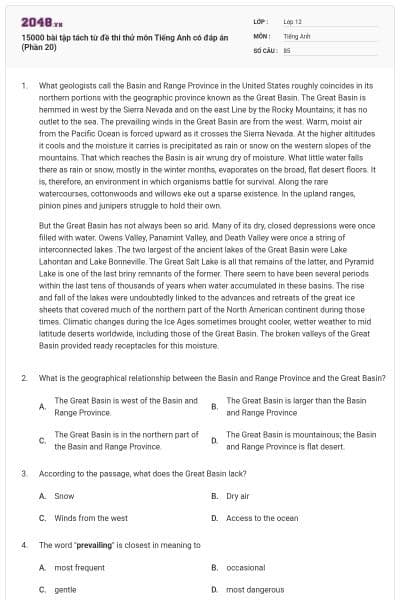
What geologists call the Basin and Range Province in the United States roughly coincides in its northern portions with the geographic province known as the Great Basin. The Great Basin is hemmed in west by the Sierra Nevada and on the east Line by the Rocky Mountains; it has no outlet to the sea. The prevailing winds in the Great Basin are from the west. Warm, moist air from the Pacific Ocean is forced upward as it crosses the Sierra Nevada. At the higher altitudes it cools and the moisture it carries is precipitated as rain or snow on the western slopes of the mountains. That which reaches the Basin is air wrung dry of moisture. What little water falls there as rain or snow, mostly in the winter months, evaporates on the broad, flat desert floors. It is, therefore, an environment in which organisms battle for survival. Along the rare watercourses, cottonwoods and willows eke out a sparse existence. In the upland ranges, pinion pines and junipers struggle to hold their own.
But the Great Basin has not always been so arid. Many of its dry, closed depressions were once filled with water. Owens Valley, Panamint Valley, and Death Valley were once a string of interconnected lakes .The two largest of the ancient lakes of the Great Basin were Lake Lahontan and Lake Bonneville. The Great Salt Lake is all that remains of the latter, and Pyramid Lake is one of the last briny remnants of the former. There seem to have been several periods within the last tens of thousands of years when water accumulated in these basins. The rise and fall of the lakes were undoubtedly linked to the advances and retreats of the great ice sheets that covered much of the northern part of the North American continent during those times. Climatic changes during the Ice Ages sometimes brought cooler, wetter weather to mid latitude deserts worldwide, including those of the Great Basin. The broken valleys of the Great Basin provided ready receptacles for this moisture.
What is the geographical relationship between the Basin and Range Province and the Great Basin?
The Great Basin is west of the Basin and Range Province.
The Great Basin is larger than the Basin and Range Province
The Great Basin is in the northern part of the Basin and Range Province.
The Great Basin is mountainous; the Basin and Range Province is flat desert.
C
Mối quan hệ địa lý giữa Basin và Range Province và Great Basin là gì?
A. Great Basin ở phía tây của Basin và Great Province.
B. Great Basin lớn hơn Basin và Great Province
C. Great Basin ở phần phía bắc của Basin và Great Province
D. Great Basin là địa hình núi; Basin và Great Province là sa mạc bằng phẳng.
Dẫn chứng: What geologists call the Basin and Range Province in the United States roughly coincides in its northern portions with the geographic province known as the Great Basin.
=>Chọn C
According to the passage, what does the Great Basin lack?
Snow
Dry air
Winds from the west
Access to the ocean
D
Theo bài đọc, Great Basin thiếu cái gì?
A. tuyết
B. không khí khô
C. những cơn gió từ phía tây
D. lối tiếp cận với đại dương
Dẫn chứng: The Great Basin is hemmed in west by the Sierra Nevada and on the east Line by the Rocky Mountains; it has no outlet to the sea.
=>Chọn D
The word "prevailing" is closest in meaning to
most frequent
occasional
gentle
most dangerous
A
Từ “prevailing” [ phổ biến/ thịnh hành] gần nghĩa nhất với
A. thường xuyên nhất
B. thường xuyên
C. nhẹ nhàng/ dịu dàng
D. nguy hiểm nhất
Prevailing = most frequently
Dẫn chứng: The prevailing winds in the Great Basin are from the west.
=>Chọn A
The word "it" refers to
Pacific Ocean
air
west
the Great Basin
B
Từ “it” ám chỉ đến
A.Thái Bình Dương
B. không khí
C. phía tây
D. Great Basin
Dẫn chứng: Warm, moist air from the Pacific Ocean is forced upward as it crosses the Sierra NevadA.
=>Chọn B
Why does the author mention cottonwoods and willows?
To demonstrate that certain trees require a little of water
To give examples of trees that are able to survive in a difficult environment
To show the beauty of the landscape of the Great Basin
To assert that there are more living organisms in the Great Basin than there used to be
B
Tại sao tác giả đề cập đến cây dương và cây liễu?
A. Để minh họa rằng những cây nhất định yêu cầu một ít nước
B. Để đưa ra ví dụ về các cây cái mà có thể sống sót ở những môi trường khó khăn.
C. Để cho thấy vẻ đẹp của quang cảnh của Great Basin.
D. Để đánh giá rằng có nhiều sinh vật sống ở Great Basin hơn trước đây.
Dẫn chứng:It is, therefore, an environment in which organisms battle for survival. Along the rare watercourses, cottonwoods and willows eke out a sparse existence.
=>Chọn B
The words "the former" refer to
Lake Bonneville
Lake Lahontan
the Great Salt Lake
Pyramid Lake
B
Từ “ the former” [ cái trước] ám chỉ đến
A. Hồ Bonneville
B. Hồ Lohontan
C. Hồ Great Salt
D. Hồ Pyramid
Dẫn chứng: The two largest of the ancient lakes of the Great Basin were Lake Lahontan and Lake Bonneville. The Great Salt Lake is all that remains of the latter, and Pyramid Lake is one of the last briny remnants of the former.
=>Chọn B
According to the passage, the Ice Ages often brought about
desert formation
warmer climates
broken valleys
wetter weather
D
Theo bài đọc, thời kỳ băng hà thường mang lại
A. sự hình thành sa mạc
B. khí hậu ấm hơn
C. các thung lũng bị sụp đổ
D. thời tiết ẩm hơn
Dẫn chứng: Climatic changes during the Ice Ages sometimes brought cooler, wetter weather to mid latitude deserts worldwide, including those of the Great Basin.
=>Chọn D
Coincident with concerns about the accelerating loss of species and habitats has been a growing appreciation of the importance of biological diversity, the number of species in a particular ecosystem, to the health of the Earth and human well-being. Much has been written about the diversity of terrestrial organisms, particularly the exceptionally rich life associated with tropical rain-forest habitats. Relatively little has been said, however, about diversity of life in the sea even though coral reef systems are comparable to rain forests in terms of richness of life.
An alien exploring Earth would probably give priority to the planet's dominant, most-distinctive feature ― the ocean. Humans have a bias toward land that sometimes gets in the way of truly examining global issues. Seen from far away, it is easy to realize that landmasses occupy only one-third of the Earth's surface. Given that two- thirds of the Earth's surface is water and that marine life lives at all levels of the ocean, the total three-dimensional living space of the ocean is perhaps 100 times greater than that of land and contains more than 90 percent of all life on Earth even though the ocean has fewer distinct species.
The fact that half of the known species are thought to inhabit the world's rain forests does not seem uprising, considering the huge numbers of insects that comprise the bulk of the species. One scientist found many different species of ants in just one tree from a rain forest. While every species is different from every other species, their genetic makeup constrains them to be insects and to share similar characteristics with 750,000 species of insects. If basic, broad categories such as phyla and classes are given more emphasis than differentiating between species, then the greatest diversity of life is unquestionably the sea. Nearly every major type of plant and animal has some representation there.
To appreciate fully the diversity and abundance of life in the sea, it helps to think small. Every spoonful of ocean water contains life, on the order of 100 to 100,000 bacterial cells plus assorted microscopic plants and animals, including larvae of organisms ranging from sponges and corals to starfish and clams and much more.
Why does the author compare rain forests and coral reefs in the first paragraph?
They are approximately the same size
They share many similar species.
Most of their inhabitants require water
Both have many different forms of life.
D
Tại sao tác giả so sánh những rừng mưa nhiệt đới và các rạng san hô ở đoạn văn 1?
A. Chúng có kích thước gần bằng nhau
B. Chúng có nhiều loại tương tự nhau.
C. Hầu hết cư dân của chúng đều cần nước.
D. Cả hai đều có nhiều hình thức đời sống khác nhau.
Dẫn chứng: Much has been written about the diversity of terrestrial organisms, particularly the exceptionally rich life associated with tropical rain-forest habitats. Relatively little has been said, however, about diversity of life in the sea even though coral reef systems are comparable to rain forests in terms of richness of life.
=>Chọn D
Dịch bài đọc
Trùng hợp với mối lo ngại về sự mất mát nhanh chóng của các loài và môi trường sống là sự đánh giá ngày càng tăng về tầm quan trọng của đa dạng sinh học, số lượng các loài trong một hệ sinh thái cụ thể, đối với sức khỏe của Trái đất và hạnh phúc của con người. Nhiều bài viết đã viết về sự đa dạng của các sinh vật trên cạn, đặc biệt là sự sống vô cùng phong phú gắn liền với môi trường sống của rừng mưa nhiệt đới. Tuy nhiên, tương đối ít bài viết đã nói về sự đa dạng của sự sống dưới biển mặc dù các hệ thống rạn san hô có thể so sánh với rừng mưa về mức độ phong phú của sự sống.
Một người ngoài hành tinh khám phá Trái đất có lẽ sẽ ưu tiên đặc điểm nổi trội và đặc biệt nhất của hành tinh này ― đại dương. Con người có xu hướng thiên về đất liền, đôi khi điều này cản trở việc thực sự xem xét các vấn đề toàn cầu. Nhìn từ xa, có thể dễ dàng nhận ra rằng các khối đất liền chỉ chiếm một phần ba bề mặt Trái đất. Với hai phần ba bề mặt Trái đất là nước và sinh vật biển sống ở mọi tầng của đại dương, tổng không gian sống ba chiều của đại dương có lẽ lớn hơn 100 lần so với đất liền và chứa hơn 90 phần trăm tất cả các loài sinh vật trên Trái đất mặc dù đại dương có ít loài riêng biệt hơn.
Thực tế là một nửa số loài đã biết được cho là sinh sống trong các khu rừng mưa trên thế giới dường như không có gì nổi bật, xét đến số lượng lớn côn trùng tạo nên phần lớn các loài. Một nhà khoa học đã tìm thấy nhiều loài kiến khác nhau chỉ trong một cây từ một khu rừng mưa. Mặc dù mỗi loài đều khác nhau, nhưng cấu tạo di truyền của chúng hạn chế chúng là côn trùng và có những đặc điểm tương tự với 750.000 loài côn trùng. Nếu các danh mục cơ bản, rộng như ngành và lớp được nhấn mạnh nhiều hơn là phân biệt giữa các loài, thì sự đa dạng lớn nhất của sự sống chắc chắn là biển. Hầu như mọi loại thực vật và động vật chính đều có một số đại diện ở đó.
Để đánh giá đầy đủ sự đa dạng và phong phú của sự sống trong biển, hãy suy nghĩ nhỏ. Mỗi thìa nước biển chứa sự sống, khoảng 100 đến 100.000 tế bào vi khuẩn cùng với nhiều loại thực vật và động vật cực nhỏ, bao gồm ấu trùng của các sinh vật từ bọt biển và san hô đến sao biển và trai và nhiều hơn nữa.
The word "bias" is closest in meaning to
concern
disadvantage
attitude
prejudice
D
Từ “bias” ( những định kiến) gần nghĩa nhất với
A. sự quan tâm
B. sự bất lợi
C. thái độ
D. định kiến
Dẫn chứng: Humans have a bias toward land that sometimes gets in the way of truly examining global issues.
=>Chọn D
The passage suggests that most rain forest species are
insects
bacteria
mammals
birds
A
Đoạn văn gợi ý rằng hầu hết các loài rừng mưa nhiệt đới là
A. côn trùng
B. vi khuẩn
C. động vật có vú
D. chim
Dẫn chứng: The fact that half of the known species are thought to inhabit the world's rain forests does not seem uprising, considering the huge numbers of insects that comprise the bulk of the species.
=>Chọn A
The word "there" refers to
the sea
the rain forests
a tree
the Earth's surface
A
Từ “ there” ám chỉ đến
A. biển
B. các rừng mưa nhiệt đới
C. cây
D. bề mặt Trái Đất
Dẫn chứng: If basic, broad categories such as phyla and classes are given more emphasis than differentiating between species, then the greatest diversity of life is unquestionably the seA. Nearly every major type of plant and animal has some representation there.
=>Chọn A
The author argues that there is more diversity of life in the sea than in the rain forests because
more phyla and classes of life are represented in the sea
there are too many insects to make meaningful distinctions
many insect species are too small to divide into categories
marine life-forms reproduce at a faster rate
A
Tác giả cho rằng đời sống dưới biển đa dạng hơn đời sống trong rừng mưa bởi vì
A. nhiều loài và tầng lớp đời sống hiện diện ở biển hơn
B. có quá nhiều côn trùng để tạo nên sự khác biệt có nghĩa
C. nhiều loài côn trùng quá nhỏ để phân chia vào các phân loại khác
D. các dạng đời sống dưới biển tái sinh sản với tốc độ nhanh hơn.
Dẫn chứng: If basic, broad categories such as phyla and classes are given more emphasis than differentiating between species, then the greatest diversity of life is unquestionably the sea.
=>Chọn A
Which of the following is NOT mentioned as an example of microscopic sea life?
Sponges
Coral
Starfish
Shrimp
D
Loài nào sau đây không được đề cập như là một ví dụ của đời sống dưới biển cực nhỏ
A. bọt biển
B. san hô
C. sao biển
D. tôm
Dẫn chứng: Every spoonful of ocean water contains life, on the order of 100 to 100,000 bacterial cells plus assorted microscopic plants and animals, including larvae of organisms ranging from sponges and corals to starfish and clams and much more.
=>Chọn D
Which of the following conclusions is supported by the passage?
Ocean life is highly adaptive.
More attention needs to be paid to preserving ocean species and habitats.
Ocean life is primarily composed of plants.
The sea is highly resistant to the damage done by pollutants.
B
Kết luận nào sau đây mà bài đọc ủng hộ?
A.Đời sống dưới biển có tính thích nghi cao.
B. Càn chú ý nhiều hơn đến việc giữ gìn các loài sinh vật biển và môi trường sống ở biển.
C. Đời sống dưới biển chủ yếu bao gồm thực vật.
D. Biển có khả năng chịu đựng cao đối với sự tàn phá do các nhân tố ô nhiễm gây rA.
=>Chọn B
The word "dominant" is closest in meaning to
imperious
chief
impotent
strange
B
Từ “ dominant” ( thống trị/ vượt trội/ chủ yếu) gần nghĩa nhất với
A.kiêu ngạo
B. chính/ chủ yếu
C. bất lực
D. lạ
=>Chọn B
Fifty-five delegates representing all thirteen states except Rhode Island attended the Constitutional Convention in Philadelphia from May to September 1787. The delegates had been instructed by the Continental Congress to revise the old Articles of Confederation, but most believed that a stronger central government was needed. There were differences, however, about what structure the government should take and how much influence large states should have.
Virginia was by far the most populous state, with twice as many as people as New York, four times as many as New Jersey, and ten times as many as Delaware. The leader of the Virginia delegation, James Madison, had already drawn up a plan for government, which became known as the Large State Plan. Its essence was that congressional representation would be based on population. It provided for two or more national executives. The smaller states feared that under this plan, a few large states would lord over the rest. New Jersey countered with the Small State Plan. It provided for equal representation for all states in a national legislature and for a single national executive. Angry debate, heightened by a stifling heat wave, led to deadlock.
A cooling of tempers seemed to come with lower temperatures. The delegates hammered out an agreement known as the Great Compromise- actually a bundle of shrewd compromises. They decided that Congress would consist of two houses. The larger states were granted representation based on population in the lower house, the House of Representatives. The smaller states were given equal representation in the upper house, the Senate, in which each state would have two senators regardless of population. It was also agreed that there would be a single executive, the president. This critical compromise broke the logjam, and from then on, success seemed within reach.
What is the main topic of the passage?
James Madison’s plan to create a stable structure for the government of the United States
A disagreement at the Constitutional Convention and a subsequent compromise
The differences in population and relative power between the original states
The most important points of the Small State Plan
B
Chủ đề chính của bài đọc là gì?
A. Kế hoạch của James Madison’s tạo ra kết cấu bền vững cho chính phủ Mỹ.
B. Sự không thỏa hiệp tại hội nghị lập pháp và sự thương lượng sau đó.
C. Những sự khác biệt về dân số và quyền lực có liên quan giữa các bang.
D. Những điểm quan trọng nhất của kế hoạch tiểu bang.
=>Chọn B
According to the passage, how many states were represented at the Constitutional Convention?
12
13
14
15
A
Theo bài đọc, có bao nhiêu bạn có mặt tại Hội nghi lập pháp?
Dẫn chứng: Fifty-five delegates representing all thirteen states except Rhode Island attended the Constitutional Convention in Philadelphia from May to September 1787.
=>Chọn A
It can be inferred from the passage that the Articles of Confederation
were supported by a majority of the delegates at the Convention
were revised and presented as the Large State Plan
allowed small states to dominate large ones
provided for only a weak central government
D
Có thể suy ra từ bài đọc rằng các điều khoản của Liên minh
A. được đa số các đoàn đại biểu tại hội nghị ủng hộ.
B. được xem xét và trình bày như kế hoạch bang rộng lớn.
C. cho phép các bang nhỏ thống trị các bang lớn.
D. cung cấp khoảng 1 tuần cho trung ương.
Dẫn chứng: The delegates had been instructed by the Continental Congress to revise the old Articles of Confederation, but most believed that a stronger central government was needed.
=>Chọn D
According to the passage, in 1787 which of the following states had FEWEST people?
Virginia
Delaware
New York
New Jersey
B
Theo bài đọc, năm 1787 bang nào có ít người nhất
A.Virginia B. Dealaware C. New York D. New Jersey
Dẫn chứng: Virginia was by far the most populous state, with twice as many as people as New York, four times as many as New Jersey, and ten times as many as Delaware.
=>Chọn B
The phrase “this plan” refers to
the Small State Plan
a plan suggested by the national legislature
the Large State Plan
a compromise plan
C
Cụm từ “ kế hoạch này” ám chỉ đến
A. Kế hoạc bang nhỏ
B. Một kế hoạch được đề xuất bởi cơ quan lập pháp quốc gia
C. Kế hoạch bang rộng lớn
D.Kế hoạch thương thuyết
Dẫn chứng:The leader of the Virginia delegation, James Madison, had already drawn up a plan for government, which became known as the Large State Plan. Its essence was that congressional representation would be based on population. It provided for two or more national executives. The smaller states feared that under this plan, a few large states would lord over the rest.
=>Chọn C
The word “shrewd” is closest in meaning to
practical
unfair
important
clever
D
Từ “ shrewd” (thông minh, sáng suốt) gần nghĩa nhất với
Practical: thực tế
Unfair: không công bằng
Important: quan trọng
Clever: thông minh
Dẫn chứng: The delegates hammered out an agreement known as the Great Compromise- actually a bundle of shrewd compromises.
=>Chọn D
Which of the following is NOT given in the passage as one of the provisions of the Great Compromise?
There would be only one national executive.
The President would be elected by popular vote.
Each state would have two senators.
Congress would be divided into two bodies.
B
Ý nào không được đề cập trong bài đọc như là một trong những điều khoản của Thương thuyết lớn?
A.Sẽ chỉ có một lãnh đạo cấp cao quốc gia
B. Tổng thống sẽ được bầu chọn bằng bầu cử phổ thông.
C. Mỗi bang sẽ có hai thượng nghị sĩ
D. Quốc hội sẽ được chia thành hai phần.
Dẫn chứng: They decided that Congress would consist of two houses. The larger states were granted representation based on population in the lower house, the House of Representatives. The smaller states were given equal representation in the upper house, the Senate, in which each state would have two senators regardless of population. It was also agreed that there would be a single executive, the president.
=>Chọn B
The biologist's role in society as well as his moral and ethical responsibility in the discovery and development of new ideas has led to a reassessment of his social and scientific value systems. A scientist can no longer ignore the consequences of his discoveries; he is as concerned with the possible misuses of his findings as he is with the basic research in which he is involved. This emerging social and political role of the biologist and all other scientists requires a weighing of values that cannot be done with the accuracy or the objectivity of a laboratory balance. As a member of society, it is necessary for a biologist now to redefine his social obligations and his functions, particularly in the realm of making judgments about such ethical problems as man's control of his environment or his manipulation of genes to direct further evolutionary development.
As a result of recent discoveries concerning hereditary mechanisms, genetic engineering, by which human traits are made to order, may soon be a reality. As desirable as it may seem to be, such an accomplishment would entail many value judgments. Who would decide, for example, which traits should be selected for change? In cases of genetic deficiencies and disease, the desirability of the change is obvious, but the possibilities for social misuse are so numerous that they may far outweigh the benefits.
Probably the greatest biological problem of the future, as it is of the present, will be to find ways to curb environmental pollution without interfering with man's constant effort to improve the quality of his life. Many scientists believe that underlying the spectra of pollution is the problem of surplus human population. A rise in population necessitates an increase in the operations of modern industry, the waste products of which increase the pollution of air, water, and soil. The question of how many people the resources of the Earth can support is one of critical importance.
Although the solutions to these and many other problems are yet to be found, they do indicate the need for biologists to work with social scientists and other members of society in order to determine the requirements necessary for maintaining a healthy and productive planet. For although many of man's present and future problems may seem to be essentially social, political, or economic in nature, they have biological ramifications that could affect the very existence of life itself.
According to the passage, a modern scientist should be more concerned about__________
the consequences of his discoveries
his basic research
his manipulation of genes
the development of new ideas
A
Theo bài đọc, một nhà khoa học hiện đại nên quan tâm nhiều hơn đến
A. những hậu quả của những khám phá của ông ấy.
B. nghiên cứu cơ bản
C. sự vận dụng của gen
D. sự phát triển những ý tưởng mới
Dẫn chứng: A scientist can no longer ignore the consequences of his discoveries;
=>Chọn A
The pronoun "it" in paragraph 2 refers to__________.
genetic engineering
an accomplishment
hereditary mechanism
a reality
A
Từ “it” ở đoạn 2 ám chỉ đến
A. việc cấy gen
B. một thành tựu
C. cơ chế di truyền
D. tính chân thật/ sự thật
Dẫn chứng: As a result of recent discoveries concerning hereditary mechanisms, genetic engineering, by which human traits are made to order, may soon be a reality. As desirable as it_may seem to be, such an accomplishment would entail many value judgments.
=>Chọn A
It is implied in the passage that genetic engineering__________.
will change all human traits
is no longer desirable
is the most desirable for life
may do us more harm than good
D
Bài đọc ngụ ý rằng công nghệ gen
A. sẽ thay đổi toàn bộ tính cách của con người
B. không còn đáng khao khát nước
C. được khao khát nhất trong cuộc đời
D. có nhiều cái hại hơn là cái lợi
Dẫn chứng: In cases of genetic deficiencies and disease, the desirability of the change is obvious, but the possibilities for social misuse are so numerous that they may far outweigh the benefits.
=>Chọn D
The pronoun "they" in paragraph 2 refers to__________.
possibilities for genetic deficiencies
cases of genetic deficiencies
discoveries concerning hereditary mechanisms
effects of genetic engineering misuse
D
Đại từ “they” ở đoạn 2 ám chỉ đến
A. những khả năng thiếu sót gen.
B. các trường hợp lỗi gen
C. những khám phá liên quan đến cơ chế di truyền
D. những ảnh hưởng của lạm dụng công nghệ gen
Dẫn chứng: In cases of genetic deficiencies and disease, the desirability of the change is obvious, but the possibilities for social misuse are so numerous that they may far outweigh the benefits.
=>Chọn D
The word "which" in paragraph 3 refers to __________.
the waste products dumped into our environment
serious environmental pollution
activities of surplus human population
activities of an overpopulated society's industry
D
Từ “ which” ở đoạn 3 ám chỉ đến
A. những sản phẩm bỏ đi được đưa vào môi trường
B. sự ô nhiễm môi trường nghiêm trọng
C. các hoạt động của sự quá tải dân số.
D. các hoạt động của nên công nghiệp trong xã hội dân số quá tải.
Dẫn chứng: A rise in population necessitates an increase in the operations of modern industry, the waste products of which increase the pollution of air, water, and soil.
=>Chọn D
According to the passage, to save our planet, biologists should work
with other social scientists
accurately and objectively
on social and political purposes
harder and harder
A
Theo bài đọc, để cứu lấy hành tinh của chúng ta, các nhà sinh học nên làm việc
A.với các nhà khoa học xã hội khác
B. chính xác và khách quan
C. vì mục đích chính trị và xã hội
D. ngày càng chăm chỉ hơn
Dẫn chứng: Although the solutions to these and many other problems are yet to be found, they do indicate the need for biologists to work with social scientists and other members of society in order to determine the requirements necessary for maintaining a healthy and productive planet.
=>Chọn A
Which of the following is closest in meaning to the word "ramifications" in paragraph 4?
effective techniques
latest developments
harmful consequences
useful experiments
C
Ý nào sau đây gần nghĩa nhất với từ “ ramifications” ( những hậu quả xấu) ở đoạn 4?
A.những kỹ thuật có hiệu quả
B. sự phát triển mới nhất
C. những hậu quả có hại
D. những thí nghiệm hữu ích
Dẫn chứng: For although many of man's present and future problems may seem to be essentially social, political, or economic in nature, they have biological ramifications that could affect the very existence of life itself.
=>Chọn C
What is the author's purpose in this passage?
To urge biologists to solve the problem of surplus human population
To conduct a survey of the biologist's role in society
To advise biologists to carry out extensive research into genetic engineering
To emphasize the biologist's role in solving the world's problems
D
Mục đích của tác giả trong bài đọc này là?
A.Để thúc giục các nhà sinh học giải quyết vấn đề quá tải dân số.
B. Để tiến hành khảo sát về vài trò của một nhà sinh học trong xã hội.
C. Để khuyên các nhà sinh học tiến hành nghiên cứu mở rộng vào công nghệ gen.
D. Để nhấn mạnh vai trò của nhà sinh học trong việc giải quyết vấn đề thế giới.
George Washington Carver showed that plant life was more than just food for animals and humans. Carver’s first step was to analyze plant parts to find out what they were made of. He then combined these simpler isolated substances with other substances to create new products.
The branch of chemistry that studies and finds ways to use raw materials from farm products to make industrial products is called chemurgy. Carver was one of the first and greatest chemurgists of all time. Today the science of chemurgy is better known as the science of synthetics. Each day people depend on and use synthetic materials made from raw materials. All his life Carver battled against the disposal of waste materials and warned of the growing need to develop substitutes for the natural substances being used up by humans.
Carver never cared about getting credit for the new products he created. He never tried to patent his discoveries or get wealthy from them. He turned down many offers to leave Tuskegee Institute to become a rich scientist in private industry. Thomas Edison, inventor of the electric light, offered him a laboratory in Detroit to carry out food research. When the United States government made him a collaborator in the Mycology and Plant Disease Survey of the Department of Agriculture, he accepted the position with the understanding that he wouldn’t have to leave Tuskegee. As an authority on plant diseases – especially of the fungus variety – Carver sent hundreds of specimens to the United States Department of Agriculture. At the peak of his career, Carver’s fame and influence were known on every continent.
With what topic is the passage mainly concerned?
The work and career of George Washington Carver.
The research conducted at Tuskegee Institute
The progress of the science of synthetics.
The use of plants as a source of nutrition
A
Bài đọc chủ yếu nói về nội dung gì?
A. Công việc và sự nghiệp của George Washington Carver.
B. Nghiên cứu được tiến hành ở viện Tuskegee
C. Tiến bộ của khoa học tổng hợp
D. Việc sử dụng thực vật như là nguồn dinh dưỡng.
=>Chọn A
The word “step” in paragraph 1 could best be replaced with
footprint
action
scale
stair
B
Từ “ step” ( bước) ở đoạn 1 có thể được thay thế tốt nhất bởi
A. dấu chân
B. hành động
C. cái cân
D. cầu thang
Dẫn chứng: Carver‘s first step was to analyze plant parts to find out what they were made of.
[ Bước tiến/ hành động đầu tiên của Carver là phân tích các bộ phận của thực vật để tìm ra chúng được làm từ cái gì ]
=>Chọn B
According to the passage, chemurgical can be defined as the
combination of chemistry and metallurgy
research on chemistry of the soil
study of the relationship between sunlight and energy
development of industrial products from farm products
D
Theo bài đọc, hóa hữu cơ có thể định nghĩa như là
A. sự kết hợp của hóa học và luyện kim
B. nghiên cứu về hóa học của đất
C. nghiên cứu mối quan hệ giữa ánh sáng mặt trời và năng lượng.
D. sự phát triển của các sản phẩm công nghiệp từ cá sản phẩm nông nghiệp.
Dẫn chứng:The branch of chemistry that studies and finds ways to use raw materials from farm products to make industrial products is called chemurgy.
=>Chọn D
The phrase “getting credit” in paragraph 3 can be best replaced with
taking responsibility
earning money
winning praise
advertising
C
Cụm từ “ getting credit” ở đoạn 3 có thể được thay thế tốt nhất bởi
A. chịu trách nhiệm
B. kiếm tiền
C. giành được sự khen ngợi/ ca tụng/ đề cao)
D. quảng cáo
Dẫn chứng: Carver never cared about getting credit for the new products he createD. [ Carver chưa bao giờ quan tâm đến việc nổi tiếng về những sản phẩm mới mà ông tạo ra]
=>Chọn C
Why does the author mention Thomas Edison’s offer to Carver?
To illustrate one of Carver’s many opportunities
To portray the wealth of one of Carver’s competitors
To contrast Edison’s contribution with that of Carver
To describe Carver’s dependence on industrial support
A
Tại sao tác giả đề cập đến lời đề nghị của Thomas Edition với Carver.
A. Để minh họa một trong những cơ hội của Carver.
B. Để phát thảo sự giàu có của các đối thủ cạnh tranh của Carvers.
C. Để tương phản đóng góp của Edison với đóng góp của Carver.
D. Để miêu tả sự phụ thuộc của Carver vào sự hỗ trợ của công nghiệp.
Dẫn chứng: He turned down many offers to leave Tuskegee Institute to become a rich scientist in private industry. Thomas Edison, inventor of the electric light, offered him a laboratory in Detroit to carry out food research.
=>Chọn A
Which of the following is NOT discussed in the passage as work done by Carver?
Research on electricity
Analysis of plant parts
Invention of new products
Research on plant diseases
A
Việc nào sau đây không được thảo luận trong bài đọc như công việc mà Carver đã làm?
A.Nghiên cứu về điện
B. Phân tích về các bộ phận của cây
C. Phát minh ra các sản phẩm mới
D. Nghiên cứu về các căn bệnh của cây
Dẫn chứng:
Carver‘s first step was to analyze plant parts to find out what they were made of. =>loại B
Carver was one of the first and greatest chemurgists of all time. =>loại C
As an authority on plant diseases – especially of the fungus variety – Carver sent hundreds of specimens to the United States Department of Agriculture.
=>Chọn A
One of Carver’s main concerns is most similar to which of the following present-day causes?
Preventive medicine
Recycling of used materials
Preservation of old buildings
Prevention of cruelty of animals.
B
Một trong những sự quan tâm của Carver gần giống nhất với cái nào sau đây của cá nguyên nhân nào gần đây?
A. thuốc phòng bệnh
B. việc tái chế các vật liệu cũ
C. sự bảo tồn các ngôi nhà cũ
D. sự ngăn cản sự tàn ác của động vật.
Dẫn chứng: All his life Carver battled against the disposal of waste materials and warned of the growing need to develop substitutes for the natural substances being used up by humans.
=>Chọn B
Atomic were once thought to be fundamental pieces of matter, but they are in turn made of smaller subatomic particles. There are three major subatomic particles neutrons, protons, and electronic. Protons and neutrons can be broken into even smaller units, but these smaller units do not occur naturally in nature and are thought to only be produced in manmade particle accelerators and perhaps in extreme stellar events like supernovas. The structure of an atom can best be described as a small solar system, with the neutrons at the center and the electrons circling them in various orbits, just as the planets circle the sun .In reality, the structure of an atom is far more complex, because the laws of physics are fundamentally different at the atomic level than of the level of the observable word. The true nature of atomic structure can only be expressed accurately through complex mathematical formulas .This explanation, however, is of little use to most average people.
Protons and neutrons have nearly equal mass and size, but protons carry a positive electrical charge, while neutrons carry no charge at all. Protons and neutrons are bound together by the strong nuclear force, one of the four basic forces in the universe. Protons and neutrons give atoms some of their most basic properties. Elements are defined by two numbers; their atomic number , which is equal to the number of protons they have, and their atomic weight , which is equal to total number of their neutrons and protons. In most lighter atoms , the number of neutrons and protons is equal , and the element is stable. In heavier atoms, however, there are more neutrons than protons , and the element is unstable, eventually losing neutrons through radioactive decay until a neutral state is reached.
Electrons are negatively charged particles. They are bound to their atoms through electromagnetic attraction. Opposite electrical charges attract one another, so the positive charge of the proton helps keep the negatively charged electron in orbit around the nucleus of the atom. Electrons are different from neutrons in that they cannot be broken down into smaller particles. They are also far smaller and lighter than neutrons and protons. An electron is about one thousandth of the diameter of a proton and an even smaller fraction of its mass. Electrons circle the protons and neutrons at the center of the atom in orbit. These orbits are often called electron shells. The closer the orbit is to the center of the atom, the lower its energy is. There are seven electron shells, and each higher level can hold more electron than the previous shell. Electrons naturally seek to occupy the lowest shell possible .So if there is space in a lower shell, an electron will drop down to occupy that space. At temperatures higher than a few hundred degrees, electrons will gain energy and move to a higher shell, but only momentarily. When the electrons drop back down to their natural shell, they emit light .This is why fires and other very hot objects seem to glow.
Electrons are also primarily responsible for many of the chemical properties of atoms. Since electrons seek to occupy the lowest electron shell possible, they will move from one atom to another if there is a space available in a lower electron shell. For example, if there is an atom with an open space in its third shell, and it comes into contact with an atom with electrons in its fourth shell, the first atom will take one of these electrons to complete its third shell. When this happens, the two atoms will be chemically bonded to form a molecule. Furthermore, atoms sometimes lose electrons in collisions with other atoms. When it happens, the radio of protons and electrons in the atom changes, and therefore, the overall electrical charge of the atom changes as well. These atoms are called isotopes, and they have significantly different chemical properties from their parent atoms.
In paragraph 1, why does the author compare the structure of an atom to a solar system?
To provide an explanation of atomic structure that will be easily understood.
To show that the complex mathematical formulas used to explain atomic structure are inaccurate.
To show the influence of atomic structure on the world at the observable level.
To contrast the size of atoms with the size of objects at the observable level.
A
Ở đoạn 1, tại sao tác giả so sánh cấu trúc của một nguyên tử với hệ mặt trời?
A. Để cung cấp lời giải thích của cấu trúc nguyên tử sẽ được hiểu một cách dễ dàng.
B. Để cho thấy rằng những công thức toán học phức tạp được sử dụng để giải thích cấu trúc nguyên tử là không đúng.
C. Để cho thấy sự ảnh hưởng của cấu trúc phân tử lên thế giới ở mức độ có thể quan sát đượC.
D. Để tương phản kích thước của nguyên tử với các vật thể ở mức độ có thể quan sát đượC.
=>Chọn A
According to paragraph 2, an atom’s atomic number is determined by
The sum of its protons and electrons.
The different in the mass of its neutrons and protons.
The strength of the bond between its protons and neutrons
The total number of protons it has.
D
Theo đoạn 2, số nguyên tử của một nguyên tử được xác định bởi
A. Tổng các hạt proton và electron
B. Số lượng notron và proton khác nhau.
C. Sức mạnh kết hợp giữa các hạt proton và notron.
D. Tổng số proton mà nó có.
Dẫn chứng: Elements are defined by two numbers; their atomic number , which is equal to the number of protons they have,
=>Chọn D
The word stable in paragraph 2 is closet in meaning to
Neutral
Unchanging
Heavy
Equal
B
Từ “stable” ( ổn định) ở đoạn 2 gần nghĩa nhất với
A. trung bình
B. không thay đổi
C. nặng
D. bình đẳng
Dẫn chứng: In most lighter atoms , the number of neutrons and protons is equal , and the element is stable. [ Trong các phân tử nhẹ hơn, số notron và proton bằng nhau, và thành phần ổn định.]
=>Chọn B
According to the information in paragraph 2, what will happen if an atom has more neutrons than protons?
It will not have enough of a positive electrical charge to keep its electrons in orbit.
Its nucleus will explode in a supernova.
It will slowly give off neutrons until the atom becomes stable.
Its extra neutrons will be converted into light energy.
. C
Theo thông tin ở đoạn 2, điều gì sẽ xảy ra nếu 1 nguyên tử có nhiều notron hơn proton?
A. Nó sẽ không có đủ điện cực dương để giữ các electron theo đúng quỹ đạo.
B. Hạt nhân của nó sẽ nổ ở dạng một siêu tân binh.
C. Nó sẽ mất dần notron cho đến khi nguyên tử trở nên cân bằng.
D. Những notron thừa sẽ bị chuyển đổi thành năng lượng ánh sáng.
Dẫn chứng: In heavier atoms, however, there are more neutrons than protons , and the element is unstable, eventually losing neutrons through radioactive decay until a neutral state is reacheD.
=>Chọn C
The phrase one another in paragraph 3 refers to
Particles
Electrical charges
Electrons
Atoms
B
Cụm từ “ one another” ở đoạn 3 ám chỉ đến
A. Các phân tử
B. Các điện cực
C. Các electron
D. Các nguyên tử
Dẫn chứng: Opposite electrical charges attract one another [ Những điện cực ngược nhau sẽ hút lẫn nhau]
=>Chọn B
According to paragraph 3, when does an atom produce light?
When it has more electrons than its electron shells can hold
When an electron drops back to its original electron shell
When an electron is transferred from one atom to another
When energy is added to the outermost electron shell
B
Theo đoạn 3, khi nào một nguyên tử sản sinh ra ánh sáng?
A. Khi nó có nhiều electron hơn vỏ electron nó có thể giữ
B. Khi một electron rơi trở lại vỏ electron ban đầu của nó.
C. Khi một electron được chuyển từ một nguyên tử này đến nguyên tử khác.
D. Khi năng lượng được thêm vào vỏ electron ngoài cùng
Dẫn chứng: When the electrons drop back down to their natural shell, they emit light .
=>Chọn B
According to the passage, all of the following are true of electrons EXCEPT
Their energy levels are fixed and unchanging.
They are kept in orbit by electromagnetic attraction
They are elementary particles and cannot be broken down
They are considerably smaller than neutrons or protons
A
Theo bài đọc, tất cả những ý nào sau đây đúng về electron NGOẠI TRỪ
A. Mức năng lượng của chúng là cố định và không đổi.
B. Chúng được giữ trong quỹ đạo bởi những lực hấp dẫn mang điện cực.
C. Chúng là những phân tử cơ bản và không thể bị phá vỡ
D. Chúng nhỏ hơn rất nhiều so với các notron và proton.
Dẫn chứng:
They are bound to their atoms through electromagnetic attraction. =>loại B
Electrons are different from neutrons in that they cannot be broken down into smaller particles. => loại C và D
=>Chọn A
According to paragraph 4, which property of electrons is responsible for chemical bonding?
Their ability to break free of their atom during a collision
Their electromagnetic attraction to protons
The fact that they cannot be broken into smaller particles
Their tendency to occupy the lowest possible electron shell
D
Theo đoạn 4, tính chất nào của electron chịu trách nhiệm cho liên kết hóa học?
A. Khả năng phá vỡ tự do của nguyên tử trong suốt đợt va chạm.
B. Lực hấp dẫn điện từ của chúng với các proton.
C. Chi tiết rằng chúng không thể phá vỡ thành các phân tử nhỏ hơn.
D. Xu hướng của nó chiếm đến vỏ electron thấp nhất có thể.
Dẫn chứng: Since electrons seek to occupy the lowest electron shell possible, they will move from one atom to another if there is a space available in a lower electron shell.
=>Chọn D
Animals have an intuitive awareness of quantities. They know without analysis the difference between a number of objects and a smaller number. In his book “ The natural History of Selboure ” (1786 ) , the naturalist Gilbert White tells how he surreptitiously removed one egg a day from a plover‟s nest , and how the mother laid another egg each day to make up for the missing one . He noted that other species of birds ignore the absence of a single egg but abandon their nests if more than one egg has been removed. It has also been noted by naturalists that a certain type of wasp always provides five – never four, never six - caterpillars for each of their eggs so that their young have something to eat when the eggs hatch . Research has also shown that both mice and pigeons can be taught to distinguish between odd and even numbers of food pieces.
These and similar accounts have led some people to infer that creatures other than humans can actually count. They also point to dogs that have been taught to respond to numerical questions with the correct number of barks, or to horses that seem to solve arithmetic problems by stomping their hooves the proper number of times.
Animals respond to quantities only when they are connected to survival as a species – as in the case of the eggs – or survival as individuals - as in the case of food. There is no transfer to other situations or from concrete reality to the abstract notion of numbers. Animals can “count” only when the objects are present and only when the numbers involved are small – not more than seven or eight. In lab experiments, animals trained to “count” one kind of object were unable to count any other type. The objects, not the numbers, are what interest them. Animals admittedly remarkable achievements simply do not amount to evidence of counting, nor do they reveal more than innate instincts, refined by the genes of successive generations, or the results of clever, careful conditioning by trainers
What is the main idea of this passage?
Although animals may be aware of quantities, they cannot actually count.
Of all animals, dogs and horses can count best.
Careful training is required to teach animals to perform tricks involving numbers
Animals cannot “count” more than one kind of object.
Đáp án A
Ý chính của bài đọc này là Although animals may be aware of quantities, they cannot actually count: Mặc dù động vật có thể có nhận thức về số lượng, thực chất chúng không biết đếm
- Đoạn đầu tiên là một số ví dụ về việc động vật có sự nhận thức về số lượng
- Đoạn thứ 3 là đưa ra kết luận, thứ làm động vật hứng thú, không phải là số lượng mà chính lànhững vật chất. Họ cũng đưa ra rằng ở các thí nghiệm, động vật có thể “đếm” vật này, nhưng lại không thể “đếm” một vật khác. Động vật có thể “đếm” có thể do gen, do sự thông minh, do sựhuấn luyện chứ động vật thực chất không thể đếm
Why does the author refer to Gilbert White‟s book in line 2?
To indicate that more research is needed in this field
To show how attitudes have changed since1786.
To provide evidence that some birds are aware of quantities.
To contradict the idea that animals can count.
Đáp án C
Mục đích của tác giả là đưa ra một số dẫn chứng chứng minh rằng, các loài chim có sự nhận thức về số lượng: the naturalist Gilbert White tells how he surreptitiously removed one egg a day from a plover‟s nest , and how the mother laid another egg each day to make up for the missing one. He noted that other species of birds ignore the absence of a single egg but abandon their nests if more than one egg has been removed
The word “surreptitiously” is closest in meaning to
quickly
occasionally
stubbornly
secretly
Đáp án D
"surreptitiously"= secretly: lén lút, vụng trộm, một cách bí mật
Quickly: nhanh chóng
Occasionally: thỉnh thoảng
Stubbornly: một cách cứng đầu
The word “odd” refers to which of the following?
numbers such as 1, 3, 5 and so on
lucky numbers
numbers such as 2, 4, 6 and so on
unusual numbers
Đáp án A
“odd” ở đây được hiểu với nghĩa "số lẻ" (ví dụ như 1,3,5,7, vv...)
Lucky numbers: con số may mắn
Unusual numbers: con số bất thường
The author mentions that all of the following are aware of quantities in some ways EXCEPT
wasps
Plovers
caterpillars
mice
Đáp án C
Thông tin ở đoạn đầu tiên:
- It has also been noted by naturalists that a certain type of wasp always provides five – never four, never six - caterpillars for each of their eggs so that their young have something to eat when the eggs hatch
- Research has also shown that both mice and pigeons can be taught to distinguish between odd and even numbers of food pieces
- the naturalist Gilbert White tells how he surreptitiously removed one egg a day from a plover's nest , and how the mother laid another egg each day to make up for the missing one
Chỉ có caterpillars (sâu bướm) là không được nhắc đến
The word “accounts” is closest in meaning to
reasons
reports
deceptions
invoices
Đáp án B
“accounts” = reports: báo cáo, tường trình, thuật lại, kể lại
Reasons: lý do
Deceptions: sự dối trá. Lừa gạt
Invoices: hoá đơn
How would the author probably characterize the people who are mentioned in the first line of the second paragraph
As foolish
As demanding
As clever
As mistaken
Đáp án D
Những người” ở câu đầu tiên đoạn 2 có thể được miêu tả là “as mistaken” (nhầm lẫn, nhầm tưởng)
Bởi những minh chứng ở đoạn 1 có thể khiến nhiều người nhầm tưởng rằng động vật có khả năng đếm
Life originated in the early seas less than a billion years after the Earth was formed. Yet another three billion years were to pass before the first plants and animals appeared on the continents. Life’s transition from the sea to the land was perhaps as much of an evolutionary challenge as was the genesis of life.
What forms of life were able to make such a drastic change in lifestyle? The traditional view of the first terrestrial organisms is based on mega fossils-relatively large specimens of essentially whole plants and animals. Vascular plants, related to modern seed plants and ferns, left the first comprehensive mega fossil record. Because of this, it has been commonly assumed that the sequence of terrestrialization reflected the evolution of modern terrestrial ecosystems. In this view, primitive vascular plants first colonized the margins of continental waters, followed by animals that feed on the plants, and lastly by animals that preyed on the plant-eaters. Moreover, the mega fossils suggest that terrestrial life appeared and diversified explosively near the boundary between the Silurian and the Devonian periods, a little more than 400 million years ago.
Recently, however, paleontologists have been taking a closer look at the sediments below this Silurian-Devonian geological boundary. It turns out that some fossils can be extracted from these sediments by putting the rocks in an acid bath. The technique has uncovered new evidence form sediments that were deposited near the shores of the ancient oceans- plant microfossils and microscopic pieces of small animals. In many instances the specimens are less than one-tenth of a millimeter in diameter. Although they were entombed in the rocks for hundreds of millions of years, many of them fossils consist of the organic remains of the organism.
These newly discovered fossils have not only revealed the existence of previously unknown organisms, but have also pushed back these dates for the invasion of land by multicellular organisms. Our views about the nature of the early plant and animal communities are now being revised. And with those revisions come new speculations about the first terrestrial life-forms
In what order did the organisms first appear on earth?
vascular plants, plant-eating animals, carnivores
carnivores, plant-eaters, megafossils
mega fossils, prey hunters, plant-eaters
seed plants, ferns, megafossils
Đáp án A
Các sinh vật đầu tiên xuất hiện trên trái đất theo trình tự là
A. Thực vật có mạch, động vật ăn cỏ, động vật ăn thịt
B. Động vật ăn thịt, động vật ăn cỏ, đại hóa thạch
C. Đại hóa thạch, động vật săn mồi, động vật ăn cỏ
D. Thực vật có hạt, cây dương xỉ, đại hóa thạch
Dẫn chứng: In this view, primitive vascular plants first colonized the margins of continental waters, followed by animals that feed on the plants, and lastly by animals that preyed on the plant-eaters
What can be inferred from the passage about the fossils mentioned in the third paragraph?
They have not been helpful in understanding the evolution of terrestrial life.
They were found in approximately the same numbers as vascular plant fossils.
They are older than the mega fossils.
They consist of modern life-forms.
Đáp án C
Có thế thấy được điều gì về những hóa thạch được đề cập trong đoạn văn thứ 3?
A. Chúng không giúp ích gì về việc tìm hiểu sự tiến hóa của quần thể trên cạn
B. Số lượng được tìm thấy xấp xỉ bằng hóa thạch của thực vật có mạch
C. Chúng già hơn các đại hóa thạch
D. Chúng gồm các dạng sinh thể hiện đại
Dẫn chứng : “Moreover, the mega fossils suggest that terrestrial life appeared and diversified explosively near the boundary between the Silurian and the Devonian periods, a little more than 400 million years ago” “Although they were entombed in the rocks for hundreds of millions of years, many of them fossils consist of the organic remains of the organism.”
According to the theory that the author calls “the traditional view” what was the first form of life to appear on land?
Bacteria
Meat-eating animals
Plant-eating animals
Vascular plants
Đáp án D
Theo như học thuyết tác giả gọi là “the traditional view” thì dạng sự sống đầu tiên xuất hiện trên cạn là gì?
A. Vi khuẩn
B. Động vật ăn thịt
C. Động vật ăn cỏ
D. Thực vật có mạch
Dẫn chứng: In this view, primitive vascular plants first colonized the margins of continental waters, followed by animals that feed on the plants, and lastly by animals that preyed on the plant-eaters.
What is the following paragraph likely to discuss?
the existence of previously unknown organisms
the revision of human views on the nature of early plant and animal communities
comparison and contrast between the first terrestrial life forms and newly discovered fossils
what the first terrestrial life forms might have been
Đáp án D
Đoạn văn tiếp theo có thể nói về ?
A. Sự tồn tại của sinh vật chưa từng được biết
B. Sự sửa đổi các quan điểm của con người về bản chất của cộng đồng thực vật và động vật cổ xưa
C. Sự so sánh và trái ngược giữa các dạng thể sống trên cạn và các hóa thạch mới được phát hiện
D. Những dạng thể sống đầu tiên trên cạn đầu tiên có thể có
The word “entombed” is closest in meaning to ______.
crushed
trapped
produced
excavated
Đáp án B
Từ “ entombed” gần với nghĩa nào?
A. Nghiền nát
B. Bị mắc vướng
C. Sản xuất
D. Đào, khai quật
“Although they were entombed in the rocks for hundreds of millions of years, many of them fossils consist of the organic remains of the organism.” Mặc dù chúng bị chôn vùi trong đá hàng trăm triệu năm nhưng nhiều hóa thạch vẫn sót lại một ít hữu cơ của các sinh vật
Emtomb= trap
Which of the following resulted from the discovery of microscopic fossils?
Which of the following resulted from the discovery of microscopic fossils?
Old techniques for analyzing fossils were found to have new uses
The origins of primitive sea life were explained.
Assumptions about the locations of ancient seas were changed.
Đáp án A
Điều gì có thể suy được từ việc phát hiện ra vi hóa thạch ?
A. Ước tính thời gian cho sự xuất hiện đầu tiên của mặt đất sống hình thức đã được thay đổi.
B. Kĩ thuật cũ để phân tích hóa thạch được cho là có những cách dùng mới
C. Giải thích được nguồn goccs ra đời của sinh thể biển nguyên thủy
D. Giả định về vị trí của vùng biển cổ đại đã được thay đổi.
Dẫn chứng:” These newly discovered fossils have not only revealed the existence of previously unknown organisms, but have also pushed back these dates for the invasion of land by multicellular organisms.”
With which of the following conclusions would the author probably agree?
The evolution of terrestrial life was as complicated as the origin of life itself.
The discovery of microfossils supports the traditional view of how terrestrial life evolved.
New species have appeared at the same rate over the course of the last 400 million years.
The technology used by paleontologists is too primitive to make accurate determinations about ages of fossils.
Đáp án A
Tác giả sẽ đồng ý với những kết luận nào sau đây?
A. Sự tiến hóa của sự sống trên cạn phức tạp như nguồn gốc của sự sống.
B. Việc phát hiện ra vi hóa thạch ủng hộ cho quan điểm truyền thống về việc sự sống trên cạn đã tiến hóa như thế nào.
C. Những loài mới xuất hiện với tốc độ tương tự nhau suốt quá trình 400 triệu năm về trước
D. Các công nghệ được sử dụng bởi các nhà khảo cổ quá thô sơ để đưa ra quyết định chính xác về tuổi của hóa thạch
According to the passage, what happened about 400 million years ago?
Many terrestrial life-forms died out
New life-forms on land developed at a rapid rate
The mega fossils were destroyed by floods.
Life began to develop in the ancient seas.
Đáp án B
Theo đoạn văn, điều gì đã diễn ra 400 năm về trước ?
A. Nhiều sinh thể trên cạn tiệt chủng
B. Nhiều dạng thể sống mới trên cạn phát triển với tốc độ nhanh
C. Đại hóa thạch bị hủy bởi bão lũ
D. Sự sống bắt đầu phát triển ở những biển cổ đại.
Dẫn chứng: “Moreover, the mega fossils suggest that terrestrial life appeared and diversified explosively near the boundary between the Silurian and the Devonian periods, a little more than 400 million years ago.” ( Hơn thế, nhiều đại hóa thạch đã thể hiện rằng sự sống trên cạn đã xuất hiện và đa dạng hóa trong khoảng giữa giai đoạn Silur và giai đoạn Devon, khoảng hơn 400 năm trước.)
Franklin D. Roosevelt, the 32nd president of the United States, was from a wealthy, well-known family. As a child, he attended private school, had private tutors, and traveled with his parents to Europe. He attended Harvard University, and afterward studied law. At age 39 Roosevelt suddenly developed polio, a disease that left him without the full use of his legs for the rest of his life. Even through the worst of his illness, however, he continued his life in politics. In 1924 he appeared at the Democratic National Convention to nominate Al Smith for president, and eight years after that he himself was nominated for the same office. Roosevelt was elected to the presidency during the Great Depression of the 1930s, at a time when more than 5,000 banks had failed and thousands of people were out of work. Roosevelt took action. First he declared a bank holiday that closed all the banks so no more could fail; then he reopened the banks little by little with government support. Roosevelt believed in using the full power of government to help what he called the "forgotten people." And it was these workers, the wage earners, who felt the strongest affection toward Roosevelt. There were others, however, who felt that Roosevelt's policies were destroying the American system of government, and they opposed him in the same intense way that others admired him.
In 1940 the Democrats nominated Roosevelt for an unprecedented third term. No president in American history had ever served three terms, but Roosevelt felt an obligation not to quit while the United States' entry into World War II was looming in the future. He accepted the nomination and went on to an easy victory.
What does the passage mainly discuss?
political aspects of Roosevelt's life
problems during the Great Depression
Roosevelt's upbringing
criticisms of Roosevelt's actions
Đáp án A
Đoạn văn trên đề cập chính đến điều gì ?
a- Mảng chính trị trong cuộc đời Roosevelt
b- Những vấn đề trong suốt thời khủng hoảng nặng nề
c- Sự giáo dục của Roosevelt
d- Sự chỉ trích các hành động của Roosevelt
=> Ta có thể thấy rất rõ ý chính qua bài dịch. Ba đáp án còn lại chỉ là một phần rất nhỏ trong ý chính về cuộc đời của Roosevelt
Which one of the following statements is NOT mentioned in the passage?
Roosevelt was elected during the Great Depression.
Roosevelt voted for Al Smith.
Roosevelt had difficulty walking during his presidency.
Roosevelt supported strong government powers.
Đáp án D
Điều nào không được đề cập trong đoạn văn?
a- Roosevelt được bầu trong suốt thời kì khủng hoảng => chuẩn luôn
b- Roosevelt từng bầu cho Al Smith => chi tiết có xuất hiện
c- Roosevelt gặp khó khăn trong việc đi lại trong khi làm tổng thống => có chi tiết này vì bài nêu rõ ông bị bại liệt trước đó)
d- Roosevelt ủng hộ mạnh mẽ quyền lực của chính phủ => Chưa nói rõ trong bài . Bài chỉ nói ông dùng triệt để quyền lực này để giúp đỡ mọi người
The phrase "took action" in lines 13 is used to illustrate the idea that Roosevelt
performed admirably
exerted himself physically
responded immediately
got assistance
Đáp án C
Cụm từ “ take action” ở dòng 13 được dùng để minh họa cho ý kiến rằng Roosevelt đã ..
a- Trình diễn một cách đáng ngưỡng mộ => không liên quan
b- Sử dụng sức lực bản thân => ahihi liên quan nhở
c- Đáp trả ngay lập tức => chuẩn luôn “ Take action” nghĩa là hành động mà
d- Có sự trợ giúp
It can be inferred from the passage that the people who liked Roosevelt best were
poor people
bankers
rich people
average workers
Đáp án D
a- Người nghèo
b- Chủ ngân hàng
c- Người giàu
d- Công nhân trung bình
=> Chọn D ( vì trong bài có đề cập “ these workers, wage earners”As used in line 10, the phrase "little by little" means that Roosevelt
opened the smaller banks first
opened the banks for minimal services
opened the banks a few at a time
opened the bank for a short time
Đáp án C
Như cách dùng ở dòng 10 thì cụm “ little by little “ nghĩa là Roosevelt đã ..
a- Mở cửa các ngân hàng nhỏ trước
b- Mở cửa các ngân hàng cho các dịch vụ tối thiểu
c- Chỉ Mở ít ngân hàng vào cùng một lúc
d- Mở các ngân hàng trong một thời gian ngắn
=> “little by little “ nghĩa là từng bước, thực hiện từng chút một => Chọn C
The word "unprecedented" in the passage could best be replaced by
nimportant
unheard of
unjustified
unhampered
Đáp án B
Chữ “ unprecedented” có thể thay thế bằng
a- Không quan trọng
b- Chưa nghe qua
c- Phi lí
d- Không bị trở ngại
The author uses the word "looming" to indicate a feeling of
reservation
threat
regret
determination
Đáp án D
Dòng 26, tác giả sử dụng từ “looming” để chỉ ra cảm giác
a- Sự hạn chế
b- Sự quyết tâm
c- Tiếc nuối
d- Đe dọa
Dịch bài:
Franklin D. Roosevelt, tổng thống thứ 32 của nước Mỹ, sinh ra trong một gia đình giàu có và nổi tiếng. Khi còn nhỏ, ông tham gia học tại một ngôi trường dân lập, có gia sư riêng và được đi du lịch cùng gia đình tới châu Âu. Ông từng học đại học Harvard và sau đó học luật.năm 39 tuổi,Roosevelt đột nhiên bị bại liệt , căn bệnh này đã ngăn không cho ông sử dụng 2 chân của mình trong suốt cả phần đời còn lại. Mặc cho điều tồi tệ nhất của căn bệnh , ông vẫn tiếp tục sống với ngành chính trị. Năm 1924 ông có mặt tại Hội nghị dân chủ quốc gia để đề cử Al Smith cho chức tổng thống và 8 năm sau đó chính ông cũng đã được đề cử tổng thống. Roosevelt đã được bầu làm tổng thống trong suốt thời kì khủng hoảng những năm 30 của thế kỉ 20 , thời điểm mà hơn 5000 ngân hàng phải đóng cửa và hàng ngàn con người lâm vào cảnh thất nghiệp. Roosevelt đã hành động. Trước hết, ông đưa ra một ngày nghỉ cho ngành ngân hàng ngày mà tất cả các ngân hàng dừng hoạt động để không một ngân hàng nào nữa bị phá sản. Sau đó, ông từng bước mở lại các ngân hàng với sự hỗ trợ của chính phủ. Ông tin vào việc sử dụng quyền lực tuyệt đối của chính phủ để giúp cái mà ông gọi là “ những con người bị lãng quên” . Đó là những người công nhân, những người làm công ăn lương, những người mà có ảnh hưởng mạnh mẽ nhất đối với ông. Tuy nhiên , vẫn có những con người khác, những người mà thấy rằng đảng của Roosevelt đã phá hủy hệ thống chính phủ và phản đối ông cũng mạnh mẽ như là những người khác ngưỡng mộ ông
Năm 1940, đảng dân chủ đã bổ nhiệm Roosevelt cho nhieemjkkif thứ 3 chưa từng có tiền nhiệm. Không một tổng thống nào trong lịch sử Hoa Kì từng phục vụ 3 nhiệm kì nhưng Roosevelt bắt buộc không thể như vậy khi Mĩ dường như sẽ tham chiến trong chiến tranh thế giới thứ 2. Ông chấp nhận sự bổ nhiệm và tiếp tục nhiệm kì thứ 3 với một chiến thắng dễ dàng.
After two decades of growing student enrollments and economic prosperity, business schools in the United States have started to face harder times. Only Harvard's MBA School has shown a substantial increase in enrollment in recent years. Both Princeton and Stanford have seen decreases in their enrollments. Since 1990, the number of people receiving Masters in Business Administration (MBA) degrees, has dropped about 3 percent to 75,000, and the trend of lower enrollment rates is expected to continue.
There are two factors causing this decrease in students seeking an MBA degree. The first one is that many graduates of four-year colleges are finding that an MBA degree does not guarantee a plush job on Wall Street, or in other financial districts of major American cities. Many of the entry-level management jobs are going to students graduating with Master of Arts degrees in English and the humanities as well as those holding MBA degrees. Students have asked the question, "Is an MBA degree really what I need to be best prepared for getting a good job?" The second major factor has been the cutting of American payrolls and the lower number of entry-level jobs being offered. Business needs are changing, and MBA schools are struggling to meet the new demands.
What is the main focus of this passage?
jobs on Wall Street
types of graduate degrees
changes in enrollment for MBA schools
how schools are changing to reflect the economy
Đáp án C
Ý chính của đoạn văn trên là .
a- Các công việc trên phố Wall
b- Các loại bằng tốt nghiệp
c- Sự thay đổi trong tuyển sinh của các trường quản trị kinh doanh
d- Các trường đang thay đổi như thế nào để phản ánh nền kinh tế
=> Chọn C ( đọc lại phần dịch nhé )
The word "prosperity" in line 1 could be best replaced by which of the following?
success
surplus
nurturing
education
Đáp án A
Từ “ prosperity” có thể được thay thế bởi .
a- Thành công
b- Dư thừa
c- Khuyến khích, ủng hộ
d- Giáo dục
Which of the following business schools has NOT shown a decrease in enrollment?
Princeton
Harvard
Stanford
Yale
Đáp án B
Đâu là trường học không bị giảm tuyển sinh?
a- Princeton
b- Harvard
c- Stanford
d- Yale
=> Chọn B ( trong bài nói rõ)
Which of the following descriptions most likely applies to Wall Street?
a center for international affairs
a major financial center
a shopping district
a neighborhood in New York
Đáp án B
Đâu là một mô tả cho phố Wall?
a- Một trung tâm của buôn bán quốc tế
b- Trung tâm tài chính
c- Điểm mua sắm
d- Gần New York
=> Chọn B ( trong bài có nói “plush job”)
According to the passage, what are two causes of declining business school enrollments?
lack of necessity for an MBA and an economic recession
low salary and foreign competition
fewer MBA schools and fewer entry-level jobs
declining population and economic prosperity
Đáp án A
Theo đoạn văn, đâu là 2 lí do gây ra sự giảm tuyển sinh ?
a- Thiếu sự cần thiết cho quản trị kinh doanh và suy thoái kinh tế
b- Lương thấp và cạnh tranh nước ngoài
c- Ít trường và ít công việc thử việc
d- Giảm dân số và sự thịnh vượng về kinh tế
=> Chọn A ( bài nói rõ )
The word "struggling" is closest in meaning to
evolving
plunging
starting
striving
Đáp án D
Từ “ struggling” gần nghĩa với
a- Rút ra, tiến triển, tiến hóa
b- Sự lao xuống
c- Sự bắt đầu
d- Sự đấu tranh
As used in line 7, the word "seeking" could best be replaced by which of the following?
examining
avoiding
seizing
pursuing
Đáp án D
Từ “ seeking” có thể được thay bởi
a- Kiểm tra
b- Tránh
c- Chộp, nắm lấy
d- Theo đuổi
Which of the following might be the topic of the paragraph?
MBA schools' efforts to change
future economic predictions
a history of the recent economic changes
descriptions of non-MBA graduate programs
Đáp án A
Đâu có thể là chủ đề của đoạn văn?
a- Nỗ lực của các trường quản trị kinh doanh để thay đổi
b- Dự đoán về kinh tế trong tương lai
c- Lịch sử của những sự thay đổi kinh tế gần đây
d- Mô tả về những chương trình tốt nghiệp không phải quản trị kinh doanh
Bài dịch:
Sau 2 thập kỉ của sự tăng tuyển sinh sinh viên cũng như thịnh vượng về kinh tế, các trường học liên quan đến thương mại ở Mĩ đang bắt đầu đối diện với khó khăn. Chỉ có trường Đại học quản trị kinh doanh Harvard thể hiện sự tăng lên đáng kể trong việc tuyển sinh những năm gần đây. Cả trường Princeton và Stanford đều nhìn rõ sự giảm sút trong tuyển sinh của họ. Từ năm 1990,số lượng người nhận bằng quản trị kinh doanh đã giảm, giảm khoảng 3 % , xuống còn 75000, xu hướng giảm tỉ lệ tuyển sinh được mong chờ là sẽ tiếp diễn
Có 2 nhân tố gây ra việc giảm này trong việc sinh viên tìm kiếm một tấm bằng quản trị kinh doanh. Đầu tiên là rằng có rất nhiều sinh viên tốt nghiệp sau 4 năm đại học nhận thấy một tấm bằng quản trị kinh doanh không đảm bảo một công việc xa hoa ở phố Wall hay trong những khu kinh thế của những thành phố chính của nước Mĩ. Nhiều việc thử việc liên quan quản trị được nhận bởi cả những sinh viên tốt nghiệp với bằng cấp về nghệ thuật , nhân văn học lẫn những sinh viên có bằng quản trị kinh doanh. Các sinh viên luôn đặt câu hỏi : “ Liệu có thực sự cần thiết để mình phải chuẩn bị tốt nhất để có một công việc tốt?”. Nhân tố thứ 2 là sự cắt giảm của tiền lương của người Mĩ và sự giảm đi của số lượng những công việc thử việc. Kinh doanh cần thay đổi và các trường quản trị kinh doanh đang gặp khó khăn để đáp ứng nhu cầu mới.
Dịch bài
Hầu hết các nơi ở Anh và Hoa Kỳ được tạo ra bởi con đường. Vài này được làm trên phương tiện chuyên chở công cộng nhưng hầu hết là bằng xe hơi riêng.
Ở Anh nhiều người dựa vào xe hơi của họ cho hoạt động ở địa phương hàng ngày, chẳng hạn như bắt tay vào việc, mua sắm, và ghé thăm bạn bè. Mọi người sống ở khu đô thị có thể sử dụng xe buýt, xe lửa hoặc, ở Luân Đôn, xe điện ngầm, để đến trung tâm thành phố, chủ yếu vì xe cộ thường đông đúc và khó tìm bất cứ nơi đâu để đậu xe. Một nơi nào đó trong đất nước này có thể có xe buýt chỉ hai hoặc ba lần một tuần để mọi người sống ở đó buộc lòng phải dựa vào xe hơi của họ.
Ở Hoa Kỳ thành phố lớn có hệ thống phương tiện giao thông công cộng tốt. Đường sắt El trong Chicago và xe điện ngầm hệ thống New York, Boston, San Francisco và Washington, Dc được sử dụng nhiều. Nơi khác, hầu hết người Mỹ muốn sử dụng xe hơi của họ. Gia đình thường có hai xe hơi và, bên ngoài thành phố lớn, phải đi đường dài đi học, văn phòng, cửa hàng, ngân hàng, v.v Nhiều trường cao đẳng và học sinh trung học thậm chí có xe hơi của riêng mình.
Du lịch đường dài trong Anh cũng là chủ yếu bằng con đường, cho dù đường sắt liên kết nhất tỉnh thành và thành phố. Hầu hết các những nơi được liên kết bằng xa lộ hay khác nhanh đường và nhiều người thà lái khi thuận tiện còn hơn là sử dụng xe lửa, cho dù họ có thể bị kẹt xe. Xe khách đường dài / dịch vụ xe buýt thường là giải pháp thay thế rẻ hơn đến xe lửa, nhưng họ lâu hơn và có thể là ít thoải mái hơn. Một số du lịch đường dài, nhất là tiến hành cho lý do kinh doanh, có thể là bằng đường hàng không. Có chuyến bay thông thường giữa sân bay khu vực, cũng như và từ Luân Đôn. Nhiều vận chuyển cũng là được phân phát bằng con đường, cho dù món đồ nặng hơn và nguyên liệu thường đi qua đường sắt. Ở Hoa Kỳ nhiều du lịch đường dài là bằng đường hàng không. Mỹ có hai chính đường dài xe buýt công ty, Greyhound và Trailways. Amtrak, mạng quốc gia, cung cấp dịch vụ đường sắt cho hành khách. Công ty đường sắt tư nhân như là Union Pacific bây giờ mang chỉ vận chuyển, cho dù thực ra trên 70% vận chuyển chạy bằng đường bộ.
Vấn đề chính liên quan đến vận tải đường bộ trong cả hai Anh và Hoa Kỳ là tình trạng tắc nghẽn giao thông và ô nhiễm. Nó được dự đoán là số xe hơi trên con đường Anh sẽ gia tăng bằng thứ ba trong một vài năm, làm cả những vấn đề này tệ hơn. Chính phủ Anh muốn người hơn sử dụng phương tiện chuyên chở công cộng, nhưng cho đến nay họ đã đạt thành công chút ít trong thuyết phục mọi người từ bỏ xe hơi của họ hoặc để chia sẻ cùng đi hàng xóm. Hầu hết mọi người nói rằng phương tiện chuyên chở công cộng hoàn toàn chẳng tốt đủ. Người Mỹ quá đã kháng cự lại yêu cầu chính quyền để chia sẻ xe hơi vì nó là ít tiện lợi hơn và hạn chế tự do của họ. Xăng là tương đối rẻ ở Hoa Kỳ và bên ngoài phương tiện chuyên chở công cộng thành phố lớn xấu, vì thế họ xem không lý do để ít sử dụng xe hơi của họ hơn.
Bạn có thích hoạt động này không?