15000 bài tập tách từ đề thi thử môn Tiếng Anh có đáp án (Phần 2)
72 câu hỏi
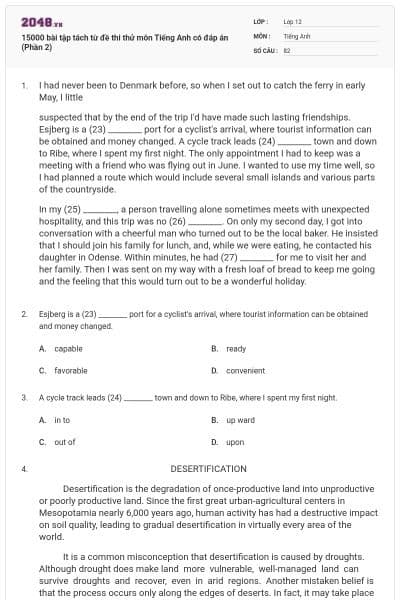
I had never been to Denmark before, so when I set out to catch the ferry in early May, I little
suspected that by the end of the trip I'd have made such lasting friendships. Esjberg is a (23) ________ port for a cyclist's arrival, where tourist information can be obtained and money changed. A cycle track leads (24) ________ town and down to Ribe, where I spent my first night. The only appointment I had to keep was a meeting with a friend who was flying out in June. I wanted to use my time well, so I had planned a route which would include several small islands and various parts of the countryside.
In my (25) ________, a person travelling alone sometimes meets with unexpected hospitality, and this trip was no (26) ________. On only my second day, I got into conversation with a cheerful man who turned out to be the local baker. He insisted that I should join his family for lunch, and, while we were eating, he contacted his daughter in Odense. Within minutes, he had (27) ________ for me to visit her and her family. Then I was sent on my way with a fresh loaf of bread to keep me going and the feeling that this would turn out to be a wonderful holiday.
capable
ready
favorable
convenient
Đáp án D
Câu hỏi từ vựng.
A. capable (adj): có khả năng
B. ready (adj): sắn sàng
C. favorable (adj): thuận lợi
D. convenient (adj): tiện lợi, thuận tiện
Dịch nghĩa: Esbjerg là một cảng thuận tiện cho người đi xe đạp, nơi có thể thu thập được thông tin du lịch và đổi được tiền.
in to
up ward
out of
upon
Đáp án C
Câu hỏi giới từ.
(to) lead out of town: dẫn ra ngoài thị trấn
Các đáp án còn lại:
A. in to: vào
B. up ward: lên cao
D. upon: trên
Dịch nghĩa: Một đường đi xe đạp dẫn ra khỏi thị trấn và xuống đến Ribe, nơi tôi đã trải qua đêm đầu tiên.
information
experience
knowledge
observation
Đáp án A
In one’s experience: theo kinh nghiệm của ai đó
Dịch nghĩa: Theo kinh nghiệm của tôi, một người đi du lịch một mình đôi khi gặp được sự hiếu khách bất ngờ...
exception
difference
change
contract
Đáp án A
Câu hỏi từ vựng.
A. exception (n) : ngoại lệ
B. difference (n): điểm khác nhau
C. change (n): sự thay đổi
D. contract (n): hợp đồng
Dịch nghĩa: Theo kinh nghiệm của tôi, một người đi du lịch một mình đôi khi gặp được sự hiếu khách bất ngờ và chuyến đi này cũng không ngoại lệ.
fixed
ordered
settled
arranged
Đáp án D
Câu hỏi từ vựng.
A. (to) fix : sửa chữa B. (to) order: đặt hàng
C. (to) settle: ổn định D. (to) arrange: sắp xếp
Dịch nghĩa: Trong vài phút, ông đã sắp xếp cho tôi thăm cô và gia đình của cô.
DESERTIFICATION
Desertification is the degradation of once-productive land into unproductive or poorly productive land. Since the first great urban-agricultural centers in Mesopotamia nearly 6,000 years ago, human activity has had a destructive impact on soil quality, leading to gradual desertification in virtually every area of the world.
It is a common misconception that desertification is caused by droughts. Although drought does make land more vulnerable, well-managed land can survive droughts and recover, even in arid regions. Another mistaken belief is that the process occurs only along the edges of deserts. In fact, it may take place in any arid or semiarid region, especially where poor land management is practiced. Most vulnerable, however, are the transitional zones between deserts and arable land; wherever human activity leads to land abuse in these fragile marginal areas, soil destruction is inevitable.
[1] Agriculture and overgrazing are the two major sources of desertification. [2] Large-scale farming requires extensive irrigation, which ultimately destroys lands by depleting its nutrients and leaching minerals into the topsoil. [3] Grazing is especially destructive to land because, in addition to depleting cover vegetation, herds of grazing mammals also trample the fine organic particles of the topsoil, leading to soil compaction and
erosion. [4] It takes about 500 years for the earth to build up 3 centimeters of topsoil. However, cattle ranching and agriculture can deplete as much as 2 to 3 centimeters of topsoil every 25 years - 60 to 80 times faster than it can be replaced by nature.
Salination is a type of land degradation that involves an increase in the salt content of the soil. This usually occurs as a result of improper irrigation practices. The greatest Mesopotamian empires- Sumer, Akkad and Babylon- were built on the surplus of the enormously productive soil of the ancient Tigris- Euphrates alluvial plain. After nearly a thousand years of intensive cultivation, land quality was in evident decline. In response, around 2800 BC the Sumerians began digging the huge Tigris-Euphrates canal system to irrigate the exhausted soil. A temporary gain in crop yield was achieved in this way, but over-irrigation was to have serious and unforeseen consequences. From as early as 2400 BC we find Sumerian documents referring to salinization as a soil problem. It is believed that the fall of the Akkadian Empire around 2150 BC may have been due to a catastrophic failure in land productivity; the soil was literally turned into salt. Even today, four thousand years later, vast tracks of salinized land between the Tigris and Euphrates rivers still resemble rock-hard fields of snow.
Soil erosion is another form of desertification. It is a self-reinforcing process; once the cycle of degradation begins, conditions are set for continual deterioration. As the vegetative cover begins to disappear, soil becomes more vulnerable to raindrop impact. Water runs off instead of soaking in to provide moisture for plans. This further diminishes plan cover by leaching away nutrients from the soil. As soil quality declines and runoff is increased, floods become more frequent and more severe. Flooding washes away topsoil, the thin, rich, uppermost layer of the earth’s soil, and leaves finer underlying particles more vulnerable to wind erosion. Topsoil contains the earth’s greatest concentration of organic matter and microorganisms, and is where most of the earth’s land-based biological activity occurs. Without this fragile coat of nutrient-laden material, plan life cannot exist. An extreme case of its erosion is found in the Sahel, a transitional zone between the Sahara Desert and the tropical African rain forests; home to some 56 million people. Overpopulation and overgrazing have opened the hyperarid land to wind erosion, which is stripping away the protective margin of the Sahel, and causing the desert to grow at an alarming rate. Between 1950 and 1975, the Sahara Desert spread 100 kilometers southward through the Sahel.
Which of the following statement is true about desertification?
It has a history as long as that of civilization.
It was just as serious in the past as it is today.
It is a fairy recent problem.
Ancient societies managed the problem well.
Đáp án A
It has a history as long as that of civilization.
Thông tin nằm ở đoạn 1: “Since the first great urban-agricultural centers in Mesopotamia nearly 6,000 years ago, human activity has had a destructive impact on soil quality, leading to gradual desertification in virtually every area of the world.”
The word “arable” in paragraph 2 is closet in meaning to _____.
cultivate
dry
settled
populated
Đáp án A
cultivate
- arable: (a) trồng trọt được = cultivate : (a) có thể trồng trột được
According to the passage, many people’s understanding of desertification is incorrect because _____.
they do not think of of it as a serious problem
they see it as being reversible
they do not see it as being caused by human activity
they think of it as a very slow process
Đáp án C
they do not see it as being caused by human activity
Thông tin nằm ở đoạn 2: “It is a common misconception that desertification is caused by droughts.
Although drought does make land more vulnerable, well-managed land can survive droughts and recover, even in arid regions. Another mistaken belief is that the process occurs only along the edges of deserts.”
According to the passage, agriculture furthers desertification through which of the following activities
The repetitive planting of the same crop
Irrigation
The stripping away of native vegetation
Over fertilization
Đáp án B
Irrigation
Thông tin nằm ở đoạn 3: “[2] Large-scale farming requires extensive irrigation, which ultimately destroys lands by depleting its nutrients and leaching minerals into the topsoil.”
The word “degradation” in paragraph 4 is closet in meaning to _____.
rejuvenation
deterioration
contribution
consumption
Đáp án B
deterioration
- degradation: (n) sự thoái hóa, sự xuống cấp = deterioration: (n) sự hư hỏng, xuống cấp
Paragraph 4 of the passage serves mainly to do which of the following?
Show the progress of desertification down through history.
Propose a method for dealing with the desertification problem.
Describe one progress that leads to desertification.
Đáp án C
Describe one progress that leads to desertification.
Thông tin nằm ở đoạn 4: “Salination is a type of land degradation that involves an increase in the salt content of the soil.”
The word “leaching” in paragraph 5 is closet in meaning to _____.
washing
depositing
concentrating
dispersing
Đáp án A
washing
- leach: (v) làm sói mòn = wassh: (v) cuốn, rửa trôi
(1) Iron production was revolutionized in the early eighteenth century when coke was first used instead of charcoal for refining iron ore. Previously the poor quality of the iron had restricted its use in architecture to items such as chains and tie bars for supporting arches, vaults, and walls. With the improvement in refining ore, it was now possible to make cast-iron beams, columns, and girders. During the nineteenth century further advances were made, notably Bessemer’s process for converting iron into steel, which made the material more commercially viable.
(2) Iron was rapidly adopted for the construction of bridges, because its strength was far greater than that of stone or timber, but its use in the architecture of buildings developed more slowly. By 1800 a complete internal iron skeleton for buildings had been developed in industrial architecture replacing traditional timber beams, but it generally remained concealed. Apart from its low cost, the appeal of iron as a building material lay in its strength, its resistance to fire, and its potential to span vast areas. As a result, iron became increasingly popular as a structural material for more traditional styles of architecture during the nineteenth century, but it was invariably concealed.
(3) Significantly, the use of exposed iron occurred mainly in the new building types spawned by the Industrial Revolution: in factories, warehouses, commercial offices, exhibition hall, and railroad stations, where its practical advantages far outweighed its lack of status. Designers of the railroad stations of the new age explored the potential of iron, covering huge areas with spans that surpassed the great vaults of medieval churches and cathedrals. Paxton’s Crystal Palace, designed to house the Great Exhibition of 1851, covered an area of 1.848 feet by 408 feet in prefabricated units of glass set in iron frames. The Paris Exhibition of 1889 included both the widest span and the greatest height achieved so far with the Halle Des Machines, spanning 362 feet, and the Eiffel Tower 1,000 feet high. However, these achievements were mocked by the artistic elite of Paris as expensive and ugly follies. Iron, despite its structural advantages, had little aesthetic status. The use of an exposed iron structure in the more traditional styles of architecture was slower to develop.
What does the passage mainly discuss?
Advances in iron processing in the eighteenth and nineteenth centuries.
The effects of the Industrial Revolution on traditional architectural styles.
Advantages of stone and timber over steel as a building material.
The evolution of the use of iron in architecture during the 1800’s.
Đáp án D
The evolution of the use of iron in architecture during the 1800’s.
Đoạn văn chủ yếu thảo luận về cái gì? – Sự phát triển và việc sử dụng sắt trong kiến trúc suốt những năm 1800.
Thông tin nằm ở câu chủ đề đầu đoạn 1: “Iron production was revolutionized in the early eighteenth century when coke was first used instead of charcoal for refining iron ore.”
Dịch bài đọc
(1) Sản xuất sắt đã có một cuộc cách mạng vào đầu thế kỷ thứ mười tám khi than cốc lần đầu tiên được sử dụng thay cho than củi để tinh chế quặng sắt. Trước đây, chất lượng kém của sắt đã hạn chế việc sử dụng nó trong kiến trúc chỉ ở các vật dụng như xích và thanh giằng để hỗ trợ vòm, hầm và tường. Với sự cải tiến trong tinh chế quặng, giờ đây có thể chế tạo dầm, cột và dầm bằng gang. Trong thế kỷ mười chín, những tiến bộ hơn nữa đã được thực hiện, đáng chú ý là quy trình Bessemer để chuyển đổi sắt thành thép, giúp vật liệu này khả thi hơn về mặt thương mại.
(2) Sắt đã nhanh chóng được sử dụng để xây dựng cầu, vì độ bền của nó lớn hơn nhiều so với đá hoặc gỗ, nhưng việc sử dụng nó trong kiến trúc của các tòa nhà phát triển chậm hơn. Đến năm 1800, một bộ khung sắt bên trong hoàn chỉnh cho các tòa nhà đã được phát triển trong kiến trúc công nghiệp thay thế cho các dầm gỗ truyền thống, nhưng nó thường vẫn được che giấu. Ngoài chi phí thấp, sức hấp dẫn của sắt như một vật liệu xây dựng nằm ở độ bền, khả năng chống cháy và khả năng trải dài trên các khu vực rộng lớn. Kết quả là, sắt ngày càng trở nên phổ biến như một vật liệu kết cấu cho các phong cách kiến trúc truyền thống hơn trong thế kỷ XIX, nhưng nó luôn được che giấu.
(3) Điều đáng chú ý là việc sử dụng sắt lộ thiên chủ yếu diễn ra trong các loại hình công trình mới do Cách mạng Công nghiệp tạo ra: trong các nhà máy, nhà kho, văn phòng thương mại, hội trường triển lãm và nhà ga xe lửa, nơi mà những lợi thế thực tế của nó vượt xa sự thiếu hụt về địa vị. Các nhà thiết kế nhà ga xe lửa của thời đại mới đã khám phá tiềm năng của sắt, bao phủ các khu vực rộng lớn với nhịp vượt xa các mái vòm lớn của các nhà thờ và nhà thờ lớn thời trung cổ. Cung điện Pha lê của Paxton, được thiết kế để tổ chức Triển lãm lớn năm 1851, bao phủ một khu vực rộng 1.848 feet x 408 feet trong các đơn vị kính đúc sẵn đặt trong khung sắt. Triển lãm Paris năm 1889 bao gồm cả nhịp rộng nhất và chiều cao lớn nhất đạt được cho đến nay với Halle Des Machines, dài 362 feet và Tháp Eiffel cao 1.000 feet. Tuy nhiên, những thành tựu này đã bị giới tinh hoa nghệ thuật của Paris chế giễu là những trò hề tốn kém và xấu xí. Sắt, mặc dù có những ưu điểm về mặt cấu trúc, nhưng lại có ít giá trị thẩm mỹ. Việc sử dụng kết cấu sắt lộ thiên trong các phong cách kiến trúc truyền thống hơn phát triển chậm hơn.
According to the passage, iron was NOT used for beams, columns, and girders prior to the early eighteenth century because _____.
all available iron was needed for other purposes
limited mining capability made iron too expensive
iron was considered too valuable for use in public buildings
the use of charcoal for refining ore produced poor quality iron
Đáp án D
the use of charcoal for refining ore produced poor quality iron
Thông tin nằm ở đoạn 1: “…instead of charcoal for refining iron ore. Previously the poor quality of the iron had restricted its use in architecture…”
Theo đoạn văn, sắt đã không được sử dụng cho xà, cột và dầm trước khi đến đầu thế kỷ 18 bởi việc sử dụng than củi để luyện quặng tạo ra sắt chất lượng kém.
Iron replaced stone and timber in the building of bridges because iron was considered _____.
more beautiful
new and modern
much stronger
easier to transport
Đáp án C
much stronger
Thông tin nằm ở câu đầu đoạn 2: “Iron was rapidly adopted for the construction of bridges, because its strength was far greater than that of stone or timber,…
The word “it” in paragraph 2 refers to_____.
industrial architecture
internal iron skeleton
stone
strength
Đáp án B
internal iron skeleton
Thông tin nằm ở đoạn 2: “By 1800 a complete internal iron skeleton for buildings had been developed in industrial architecture replacing traditional timber beams, but it generally remained concealed.”
=> it = internal iron skeleton
The word “surpassed” is closest in meaning to _____.
imitated
exceeded
approached
included
Đáp án B
exceeded
- surpass: trội hơn, vượt hơn = exceed
According to paragraph 3, the architectural significance of the Halle Des Machines was its _____.
wide span
great height
unequaled beauty
prefabricated unites of glass
Đáp án A
wide span
Thông tin nằm ở đoạn 3: “The Paris Exhibition of 1889 included both the widest span and the greatest height achieved so far with the Halle Des Machines, spanning 362 feet, and the Eiffel Tower 1,000 feet high.”
How did the artistic elite mentioned in the passage react to the buildings at the Paris Exhibition?
They tried to copy them.
They ridiculed them.
They praised them.
They refused to pay to see them.
Đáp án B
They ridiculed them.
Thông tin nằm ở đoạn 3: “…these achievements were mocked by the artistic elite of Paris…” (mock = ridicule)
– Tầng lớp nghệ sĩ được đề cập trong đoạn văn đã phản ứng như thế nào đối với kiến trúc xây dựng tại triển lãm Paris. Họ đã chế giếu chúng…
It can be inferred that the delayed use of exposed iron structures in traditional styles of architecture is best explained by the _____.
impracticality of using iron for small, noncommercial buildings
association of iron architecture with the problems of the Industrial Revolution
general belief that iron offered less resistance to fire and harsh weather than traditional materials
general perception that iron structures were not aesthetically pleasing
Đáp án D
general perception that iron structures were not aesthetically pleasing
Thông tin nằm ở đoạn 3: “Iron, despite its structural advantages, had little aesthetic status.”
Có thể suy ra việc sử dụng những kết cấu bằng sắt trong kiểu kiến trúc truyền thống được giải thích tốt nhất bởi… Sự nhận thức chung rằng các kết cấu bằng sắt không làm hài lòng về mặt thẩm mỹ.
(1) Interest is the sum charged for borrowing money for a fixed period of time. Principal is the term used for the money that is borrowed, and the rate of interest is the percent per year of the principal charged for its use. Most of the profits for a bank are derived from the interest that they charge for the use of their own or their depositor’s money.
(2) All problems in interest may be solved by using one general equation that may be stated as follows:
Interest = Principal X Rate X Time
(3) Any one of the four quantities – that is, interest, principal, rate, or time – may be found when the other three are known. The time is expressed in years. The rate is expressed as a decimal fraction. Thus, 6 percent interest means six cents charged for the use of $1 of principal borrowed for one year. Although the time may be less than, equal to, or greater than one year, most applications for loans are for periods of less than one year. For purpose of computing interest for short periods, the commercial year or 360 days is commonly used, but when large sums of money are involved, exact interest is computed on the basis of 365 days.
With what topic is this passage primarily concerned?
Đáp án C
A. Profits: Lợi nhuận
B. Rate: lãi suất
C. Interest: Tiền lãi
D. Principal: Tiền gửi
The word “fixed” in paragraph 1 is closest in meaning to
Đáp án A
A. definite ó fixed: Cố định
B. short: ngắn
C. repeated: lặp lại
D. trial: thử
At 4 percent interest for the use of $1 principal, how much would one pay?
Đáp án C
(2) “Interest = Principal X Rate X Time”
Interest = $1 x 4% x 1 = $ 0.04 = 4 cents
Which of the following would be a correct expression of an interest rate as stated in the equation for computing interest?
Đáp án B
(3) The rate is expressed as a decimal fraction
Most applications for loans are for
Đáp án B
(3) Although the time may be less than, equal to, or greater than one year, most applications for loans are for periods of less than one year
The word “periods” in paragraph 3 refers to
Đáp án A
A. time <-> period: khoảng thời gian
B. loans: tiền cho vay
C. application: ứng dụng
D. interest: lãi
A commercial year is used to compute
Đáp án D
(3) For purpose of computing interest for short periods, the commercial year or 360 days is commonly used
(1) The protozoans, minute, aquatic creatures each of which consists of a single cell of protoplasm, constitute a classification of the most primitive forms of animal life. They are fantastically diverse, but three major groups may be identified on the basis of their motility. The Mastigophora have one or more long tails, which they use to project themselves forward. The Ciliata, which use the same basic means for locomotion as the Mastigophora, have a larger number of short tails. The Sarcodina, which include amoebae, float or row themselves about on their crusted bodies.
(2) In addition to their form of movement, several other features discriminate among the three groups of protozoans. For example, at least two nuclei per cell have been identified in the Ciliata, usually a large nucleus that regulates growth but decomposes during reproduction, and a smaller one that contains the genetic code necessary to generate the large nucleus.
(3) Protozoans are considered animals because, unlike pigmented plants to which some protozoans are otherwise almost identical, they do not live on simple organic compounds. Their cell demonstrates all of the major characteristics of the cells of higher animals.
(4) Many species of protozoans collect into colonies, physically connected to each other and responding uniformly to outside stimulate. Current research into this phenomenon, along with investigations carried out with advanced microscopes may necessitate a redefinition of what constitutes protozoans, even calling into question the basic premise that they have only one cell. Nevertheless, with the current data available, almost 40,000 species of protozoans have been identified. No doubt, as the technology improves our methods of observation, better models of classification will be proposed.
Where do protozoans probably live?
Đáp án A
(1) The protozoans, minute, aquatic creatures each of which consists
Aquatic: sống ở nước
What is protoplasm?
(C) A primitive animal similar to a protozoan
Đáp án B
(1) The protozoans, minute, aquatic creatures each of which consists of a single cell of protoplasm
To which class of protozoans do the amoebae belong?
Đáp án C
(1) The Sarcodina, which include amoebae, float or row themselves about on their crusted bodies.
What is the purpose of the large nucleus in the Ciliata?
Đáp án C
(1) usually a large nucleus that regulates growth but decomposes during reproduction
Why are protozoans classified as animals?
Đáp án A
(1) Protozoans are considered animals because, unlike pigmented plants to which some protozoans are otherwise almost identical, they do not live on simple organic compounds
The word “uniformly” in paragraph 4 is closest in meaning to
Đáp án A
Uniformly -> in the same way: theo cùng một cách
once in a while: thỉnh thoảng
all of a sudden: một cách bất ngờ
in the long run: sau cùng, rốt cuộc là
The word “they” in paragraph 3 refers to
Đáp án A
(1) Protozoans are considered animals because, unlike pigmented plants to which some protozoans are otherwise almost identical, they (protozoans) do not live on simple organic compounds
Which of the following statements are NOT true of protozoans?
(C) They have a large cell and a smaller cell.
Đáp án C
A: (4) Nevertheless, with the current data available, almost 40,000 species of protozoans have been identified.
B: (1) The protozoans, minute, aquatic creatures each of which consists of a single cell of protoplasm, constitute a classification of the most primitive forms of animal life
D: (4) No doubt, as the technology improves our methods of observation, better models of classification will be proposed.
Reading to oneself is a modern activity which was almost unknown to the scholars of the classical and medieval worlds, while during the fifteenth century the term “reading” undoubtedly meant reading aloud. Only during the nineteenth century did silent reading become commonplace.
One should be wary, however, of assuming that silent reading came about simply because reading aloud was a distraction to others. Examinations of factors related to the historical development of silent reading have revealed that it became the usual mode of reading for most adults mainly because the tasks themselves changed in character.
The last century saw a steady gradual increase in literacy and thus in the number of readers. As the number of readers increased, the number of potential listeners declined and thus there was some reduction in the need to read aloud. As reading for the benefit of listeners grew less common, so came the flourishing of reading as a private activity in such public places as libraries, railway carriages and offices, where reading aloud would cause distraction to other readers.
Towards the end of the century, there was still considerable argument over whether books should be used for information or treated respectfully and over whether the reading of materials such as newspapers was in some way mentally weakening. Indeed, this argument remains with us still in education. However, whatever its virtues, the old shared literacy culture had gone and was replaced by the printed mass media on the one hand and by books and periodicals for a specialised readership on the other.
By the end of the twentieth century, students were being recommended to adopt attitudes to books and to use reading skills which were inappropriate, if not impossible, for the oral reader. The social, cultural and technological changes in the century had greatly altered what the term “reading” implied.
Reading aloud was more common in the medieval world because .
few people could read to themselves
there were few places available for private reading
silent reading had not been discovered
people relied on reading for entertainment
Đáp án A
Đoạn đầu có câu “Reading to oneself is a modern activity which was almost unknown to the scholars of the classical and medieval worlds” = Kỹ năng “reading to oneself” hầu như không được biết đến ở thời Trung cổ
The word “commonplace” in the first paragraph mostly means “___ ”.
attracting attention
for everybody’s use
most preferable
widely used
Đáp án D
commonplace = widely used: xảy ra thường xuyên với phạm vi rộng
The development of silent reading during the last century indicated .
an increase in the number of books
an increase in the average age of readers
a change in the status of literate people
a change in the nature of reading
Đáp án D
“Examinations of factors related to the historical development of silent reading have revealed that it became the usual mode of reading for most adults mainly because the tasks themselves changed in character” Ta thấy rằng “silent reading” phát triển là do sự thay đổi trong bản chất của việc đọc
Silent reading, especially in public places, flourished mainly because of ___.
the decreasing need to read aloud
the development of libraries
the increase in literacy
the decreasing number of listeners
Đáp án C
“The last century saw a steady gradual increase in literacy and thus in the number of readers. As the number of readers increased, the number of potential listeners declined and thus there was some reduction in the need to read aloud” Cả đoạn 2 lý giải việc tại sao “silent reading” ngày càng phổ biến và nguyên nhân cính cũng là nguyên nhân khởi đầu cho sự phát triển này chính là “a steady gradual increase in literary”
It can be inferred that the emergence of the mass media and specialised reading materials was an indication of ___.
a decline of standards of literacy
a change in the readers’ interest
an improvement of printing techniques
an alteration in educationalists’ attitudes
Đáp án B
“the old shared literacy culture had gone and was replaced by the printed mass media” ta có thế thấy sự xuất hiện của phương tiện truyền thông và các loại hình tài liệu chuyên ngành ra đời là do sự thay đổi về văn hóa đọc của độc giả
The phrase “a specialised readership” in paragraph 4 mostly means “ ”.
a status for readers specialised in mass media
a limited number of readers in a particular area of knowledge
a requirement for readers in a particular area of knowledge
a reading volume for particular professionals
Đáp án B
Readership là số người đọc của một tờ báo, specilised là chuyên dụng dành cho mục đích riêng, Cụm này được hiểu là số người đọc các tờ báo chuyên dụng và số lượng này là có giới hạn
All of the following might be the factors that affected the continuation of the old shared literacy culture EXCEPT .
the inappropriate reading skills
the printed mass media
the diversity of reading materials
the specialised readership
Đáp án A
“By the end of the twentieth century, students were being recommended to adopt attitudes to books and to use reading skills which were inappropriate, if not impossible, for the oral reader”. Như vậy một số kỹ năng đọc dù không phù hợp nhưng vẫn được khuyến khích để duy trì “oral reader” và cũng chính là “old shared literacy culture”
The Sun today is a yellow dwarf star. It is fueled by thermonuclear reactions near its center that convert hydrogen to helium. The Sun has existed in its present state for about four billion six hundred million years and is thousands of times larger than the Earth.
By studying other stars, astronomers can predict what the rest of the Sun’s life will be like. About five billion years from now, the core of the Sun will shrink and become hotter. The surface temperature will fall. The higher temperature of the center will increase the rate of thermonuclear reactions. The outer regions of the Sun will expand approximately 35 million miles, about the distance to Mercury, which is the closest planet to the Sun. The Sun will then be a red giant star. Temperatures on the Earth will become too high for life to exist.
Once the Sun has used up its thermonuclear energy as a red giant, it will begin to shrink. After it shrinks to the size of the Earth, it will become a white dwarf star. The Sun may throw off huge amounts of gases in violent eruptions called nova explosions as it changes from a red giant to a white dwarf.
After billions of years as a white dwarf, the Sun will have used up all its fuel and will have lost its heat. Such a star is called a black dwarf. After the Sun has become a black dwarf, the Earth will be dark and cold. If any atmosphere remains there, it will have frozen over the Earth’s surface.
It can be inferred from the passage that the Sun ___.
has been in existence for 10 billion years
is approximately halfway through its life as a yellow dwarf
will continue to be a yellow dwarf for another 10 billion years
is rapidly changing in size and brightness
Đáp án B
“The Sun today is a yellow dwarf star…The Sun has existed in its present state for about four billion six hundred million years “
Mặt trời đã tồn tại được hơn 4 tỉ năm với đặc tính là một ngôi sao lùn màu vàng
Đoạn tiếp sau có “About five billion years from now, the core of the Sun will shrink and become hotter” /Khoảng 5 tỉ năm sau, lõi mặt trời sẽ nhỏ lại và trở nên nóng hơn.
Như vậy dựa vào các thông tin trên, ta thấy mặt trờ đã trải qua gần 1 nửa thoài gian tồn tại là ngôi sao lùn màu vàng
When the Sun becomes a red giant, what will the atmosphere be like on the Earth?
It will become too hot for life to exist.
It will be enveloped in the expanding surface of the sun.
It will freeze and become solid.
It will be almost destroyed by nova explosions.
Đáp án B
“The Sun will then be a red giant star. Temperatures on the Earth will become too high for life to exist”
To shrink = to become smaller: nhỏ đi
Large amounts of gases may be released from the Sun at the end of its life as a .
white dwarf
red giant
yellow dwarf
black dwarf
Đáp án B
“The Sun may throw off huge amounts of gases in violent eruptions called nova explosions as it changes from a red giant to a white dwarf”
Ta thấy mặt trời thải ra một lượng lớn khí ga khi nó chuyển từ ngôi sao khổng lồ màu đỏ sang sao lùn màu trắng vì vậy hiện tượng này xuất hiện ở cuối giai đoạn sao đỏ
As a white dwarf, the Sun will be ___.
a cool and habitable planet
the same size as the planet Mercury
thousands of times smaller than it is today
around 35 million miles in diameter
Đáp án C
”After it shrinks to the size of the Earth, it will become a white dwarf star” và thông tin ở đoạn đầu “The Sun …is thousands of times larger than the Earth.”
Chứng tỏ khi trở thành ngôi sao lùn màu trắng, Mặt trời sẽ nhỏ hơn hàng ngàn lần so với hiện tại
The Sun will become a black dwarf when ___.
the outer regions of the Sun expand
it has used up all its fuel as a white dwarf
the Sun moves nearer to the Earth
the core of the Sun becomes hotter
Đáp án B
“After billions of years as a white dwarf, the Sun will have used up all its fuel and will have lost its heat. Such a star is called a black dwarf”
The word “there” in the last sentence of paragraph 4 refers to .
our own planet
the core of a black dwarf
the outer surface of the Sun
the planet Mercury
Đáp án A
“After the Sun has become a black dwarf, the Earth will be dark and cold. If any atmosphere remains there, it will have frozen over the Earth’s surface”
trong ngữ cảnh này, phó từ there thay thế cho “the Earth” ở câu trước và đó chính là hành tinh của chúng ta “our own planet”
This passage is intended to ___.
describe the changes that the Sun will go through
discuss conditions on the Earth in the far future
alert people to the dangers posed by the Sun
present a theory about red giant stars
Đáp án A
Cấu trúc của bài mô tả trạng thái hiện tại của Mặt trời, sau đó nêu lên các dự đoán về các thay đổi của nó trong khoảng thời gian 5 tỉ năm kể từ hiện tại. theo thứ tự mặt trời sẽ từ ngôi sao lùn màu vàng trở thành ngôi sao khổng lồ màu đỏ, rồi thành sao lùn màu trắng và cuối cùng là sao lùn màu đen. Đây chính là những thay đổi mà Mặt trời sẽ trải qua
The passage has probably been taken from ___.
a scientific chronicle
a news report
a work of science fiction
a scientific journal
Đáp án D
bài viết đưa ra các dự đoán khoa học về quá trình thay đổi của Mặt trời. Đây khổng phải là tác phẩm tiểu thuyết hư cấu, cũng không phải một bản báo cáo mới hay bản ghi chép những sự kiện khoa học. Đây là một đoạn trong một bài báo khoa học.
(1) The protozoans, minute, aquatic creatures each of which consists of a single cell of protoplasm, constitute a classification of the most primitive forms of animal life. They are fantastically diverse, but three major groups may be identified on the basis of their motility. The Mastigophora have one or more long tails, which they use to project themselves forward. The Ciliata, which use the same basic means for locomotion as the Mastigophora, have a larger number of short tails. The Sarcodina, which include amoebae, float or row themselves about on their crusted bodies.
(2) In addition to their form of movement, several other features discriminate among the three groups of protozoans. For example, at least two nuclei per cell have been identified in the Ciliata, usually a large nucleus that regulates growth but decomposes during reproduction, and a smaller one that contains the genetic code necessary to generate the large nucleus.
(3) Protozoans are considered animals because, unlike pigmented plants to which some protozoans are otherwise almost identical, they do not live on simple organic compounds. Their cell demonstrates all of the major characteristics of the cells of higher animals.
(4) Many species of protozoans collect into colonies, physically connected to each other and responding uniformly to outside stimulae. Current research into this phenomenon, along with investigations carried out with advanced microscopes may necessitate a redefinition of what constitutes protozoans, even calling into question the basic premise that they have only one cell. Nevertheless, with the current data available, almost 40,000 species of protozoans have been identified. No doubt, as the technology improves our methods of observation, better models of classification will be proposed.
With what topic is the passage primarily concerned?
Colonies of protozoans
Mastigophora
Motility in protozoans
Characteristics of protozoans
Đáp án D
(A) Colonies of protozoans: các loại sinh vật đơn bào
(B) Mastigophora: Nhóm Mastigophora
(C) Motility in protozoans: tính chất của sinh vật đơn bào
(D) Characteristics of protozoans: đặc điểm của sinh vật đơn bào
The word “minute” in paragraph 1 could best be replaced by
Very common
Very fast
Very old
Very small
Đáp án D
Minute -> very small: rất bé
Very common: rất phổ biến
Very fast: rất nhanh
Very old: rất già
Where do protozoans probably live?
Water
Sand
Grass
Wood
Đáp án A
(1) The protozoans, minute, aquatic creatures each of which consists Aquatic: sống ở nước
What is protoplasm?
A class of protozoan
The substance that forms the cell of a protozoan
A primitive animal similar to a protozoan
An animal that developed from a protozoan
Đáp án B
(1) The protozoans, minute, aquatic creatures each of which consists of a single cell of protoplasm
The word “uniformly” in paragraph 4 is closest in meaning to
in the same way
once in a while
all of a sudden
in the long run
Đáp án A
Uniformly <=> in the same way: theo cùng một cách
once in a while: thỉnh thoảng
all of a sudden: một cách bất ngờ
in the long run: sau cùng, rốt cuộc là
The word “they” in paragraph 3 refers to
protozoans
microscopes
investigations
colonies
Đáp án A
(1) Protozoans are considered animals because, unlike pigmented plants to which some protozoans are otherwise almost identical, they (protozoans) do not live on simple organic compounds
Which of the following statements are NOT true of protozoans?
There are approximately 40,000 species.
They are the most primitive forms of animal life.
They have a large cell and a smaller cell.
They are difficult to observe.
Đáp án C
A: (4) Nevertheless, with the current data available, almost 40,000 species of protozoans have been identified.
B: (1) The protozoans, minute, aquatic creatures each of which consists of a single cell of protoplasm, constitute a classification of the most primitive forms of animal life
D: (4) No doubt, as the technology improves our methods of observation, better models of classification will be proposed.
(1) It was the first photograph that I had ever seen, and it fascinated me. I can remember holding it at every angle in order to catch the flickering light from the oil lamp on the dresser. The man in the photograph was unsmiling, but his eyes were kind. I had never met him, but I felt that I knew him. One evening when I was looking at the photograph, as I always did before I went to sleep, I noticed a shadow across the man’s thin face. I moved the photograph so that the shadow lay perfectly around his hollow cheecks. How different he looked!
(2) That night I could not sleep, thinking about the letter that I would write. First, I would tell him that I was eleven years old, and that if he had a little girl my age, she could write to me instead of him. I knew that he was a very busy man. Then I would explain to him the real purpose of my letter. I would tell him how wonderful he looked with the shadow that I had seen across his photograph, and I would most carefully suggest that he grow whiskers.
(3) Four months later when I met him at the train station near my home in Westfield, New York, he was wearing a full beard. He was so much taller than I had imagined from my tiny photograph.
(4) “Ladies and gentlemen,” he said, “I have no speech to make and no time to make it in. I appear before you that I may see you and that you may see me.” Then he picked me right up and kissed me on both cheeks. The whiskers scratched. “Do you think I look better, my little friend?” he asked me.
(5) My name is Grace Bedell, and the man in the photograph was Abraham Lincoln.
What is the author’s main purpose in the passage?
To explain how Grace Bedell took a photograph of Abraham Lincoln
To explain why Abraham Lincoln wore a beard
To explain why the first photographs were significant in American life
To explain why Westfield is an important city
Đáp án C
Các đáp án A, B, D còn lại chỉ là ví dụ nhỏ trong câu không phải là mục đích chính của bài viết. Mục đích chính là giải thích tại sao các bức ảnh đầu tiên lại quan trong trong đời sống người Mỹ
The word “fascinated” in paragraph 1 could best be replaced by
interested
frightened
confused
disgusted
Đáp án A
fascinated = interested: gây hứng thú
frighten: làm sợ hãi
confuse: làm bối rối
disgust: làm chán ghét
The man in the photograph
was smiling
had a beard
had a round, fat face
looked kind
Đáp án D
Dòng 2 + 3 đoạn 1 “The man in the photograph was unsmiling, but his eyes were kind”
What did Grace Bedell do every night before she went to sleep?
She wrote letters.
She looked at the photograph.
She made shadow figures on the wall.
She read stories.
Đáp án B
Dòng 3 + 4 đoạn 1: “One evening when I was looking at the photograph, as I always did before I went to sleep”
The little girl could not sleep because she was
sick
excited
lonely
sad
Đáp án B
Dòng 1 đoạn 2: “That night I could not sleep, thinking about the letter that I would write”
Sick: ốm
Exited: hào hứng
Lonely: cô đơn
Sad: buồn
The word “it” in paragraph 4 refers to
Time
Speech
Photograph
Station
Đáp án B
“I have no speech to make and no time to make it in.” tôi không có bài diễn thuyết nào để thực hiện cả và cũng không có thời gian để diễn thuyết
Time: thời gian
Speech: bài diễn thuyết
Photograph: chụp ảnh
Station: sân ga
Why did the author wait until the last line to reveal the identity of the man in the photograph?
The author did not know it.
The author wanted to make the reader fell foolish.
The author wanted to build the interest and curiosity of the reader.
The author was just a little girl.
Đáp án C
(C) Tác giả muốn gây sự thu hút và tò mò từ phía người đọc
From this passage, it may be inferred that
Grace Bedell was the only one at the train station when Lincoln stopped at Westfield
There were many people waiting for Lincoln to arrive on the train
Lincoln made a long speech at the station in Westfield
Lincoln was offended by the letter
Đáp án B
““Ladies and gentlemen,” he said, “I have no speech to make and no time to make it in. I appear before you that I may see you and that you may see me” =>Có rất nhiều người đợi Lincoln ở ga tàu Lincoln đến, nên khi đến Lincoln chào mọi người “thưa các quý ông quý bà,…tôi xuất hiện trước mặt các bạn để tôi có thể thấy mọi người và mọi người có thể thấy tôi”
Very few people in the modern world obtain their food supply by hunting and gathering in the natural environment surrounding their homes. This method of harvesting from nature’s provision is the oldest subsistence strategy, and has been practiced for at least the last two million years. It was, indeed, the only way to obtain food until rudimentary farming and the domestication of wild animals were introduced about 10,000 years ago.
Because hunter-gatherers have fared poorly in comparison with their agricultural cousins, their numbers have dwindled, and they have been forced to live in marginal environments, such as deserts and arctic wastelands. In higher latitudes, the shorter growing season has restricted the availability of plant life. Such conditions have caused a greater independence on hunting, and along the coasts and waterways, on fishing. The abundance of vegetation in the lower latitudes of the tropics, on the other hand, has provided a greater opportunity for gathering a variety of plants. In short, the environmental differences have restricted the diet and have limited possibilities for the development of subsistence societies. Contemporary hunter-gatherers may help us understand our prehistoric ancestors. We know from observation of modern hunter-gatherers in both Africa and Alaska that society based on hunting and gathering must be very mobile. While the entire community camps in a central location, a smaller party harvests the food within a reasonable distance from the camp. When the food in the area is exhausted, the community moves on to exploit another site. We also notice seasonal migration on patterns evolving for most hunter-gatherers, along with a strict division of labor between sexes. These patterns of behavior may be similar to those practiced by mankind during the Paleolithic Period.
With which of the following topics is the passage primarily concerned?
The Paleolithic period
Subsistence farming
Hunter-gatherers
Marginal environment
Đáp án C
Đoạn văn chủ yếu nói về người sinh sống bằng nghề đi săn và hái lượm.
Ta đọc các câu đầu của đoạn văn tóm tắt ý chính của đoạn: “Very few people in the modern world obtain their food supply by hunting and gathering in the natural environment surrounding their homes”: Rất ít người trong thế giới hiện đại tìm nguồn thức ăn bằng cách đi săn bắn và hái lượm thức ăn từ môi trường tự nhiên xung quanh nhà, hay “Because hunter-gatherers have fared poorly in comparison with their agricultural cousins, their numbers have dwindled: Vì những người săn bắt hái lượm kiếm sống kém hơn so với những người làm nông nên số lượng những người săn bắt hái lượm ngày càng thu hẹp lại.
Các ý A, B, D chỉ là những ví dụ và phần nhỏ được nhắc đến trong bài: the Paleolithic period (thời kỳ đồ đá), subsistence farming (nông nghiệp mưu sinh), marginal environment (môi trường không thuận lợi cho việc trồng trọt)
Which is the oldest subsistence strategy?
Migrating
Domesticating animals
Farming
Hunting and gathering
Đáp án D
Phương pháp sinh tồn lâu đời nhất là gì? Các em scan chữ (tìm chữ) subsistence strategy trong đoạn văn và thấy xuất hiện ở dòng 3, đoạn 1: “Very few people in the modern world obtain their food supply by hunting and gathering in the natural environment surrounding their homes. This method of harvesting from nature’s provision is the oldest subsistence strategy”: Rất ít người trong thế giới hiện đại tìm nguồn thức ăn bằng cách đi săn bắn và hái lượm thức ăn từ môi trường tự nhiên xung quanh nhà. Phương pháp kiếm ăn từ nguồn cung của thiên nhiên này là phương pháp sinh tồn lâu đời nhất. Vậy nên đáp án là “hunting and gathering”: săn bắt và hái lượm
Các phương án còn lại: migrating (di cư), domesticating animals (thuần hoá động vật), farming (trồng trọt)
The word “rudimentary” is closet in meaning to _____.
rough
preliminary
ancient
backward
Đáp án B
Rudimentary ≈ preliminary: thô sơ, ban đầu
Các phương án khác: rough (lởm chởm, khắc nghiệt), ancient (cổ xưa, cũ), backward (lạc hậu)
When was hunting and gathering introduced?
1,000,000 years ago
2,000,000 years ago
10,000 years ago
2,000 years ago
Đáp án B
Nghề săn bắt và hái lượm ra đời khi nào? Đáp án tìm thấy ở dòng 2 + 3 đoạn 1: “This method of harvesting from nature’s provision is the oldest subsistence strategy, and has been practiced for at least the last two million years: Phương thức thu hoạch từ nguồn cung tự nhiên là cách thức sinh tồn lâu đời nhất và đã kéo dài ít nhất là 2 triệu năm.
What conditions exist in the lower latitude?
Greater dependence on hunting.
More coats and waterways for fishing.
A shorter growing season.
A large variety of plant life.
Đáp án D
Chúng ta scan chữ lower latitude trong đoạn văn để tìm ra đáp án. Đáp án nằm ở dòng 5 +6 đoạn 2: “The abundance of vegetation in the lower latitudes of the tropics, on the other hand, has provided a greater opportunity for gathering a variety of plants”: Trái lại sự phong phú rau trái ở các vĩ tuyến thấp hơn ở miền nhiệt đoái đã tạo nhiều cơ hội cho việc hái lượm nhiều loại rau quả khác nhau. Đáp án A nghìa là “sự đa dạng về các loài rau quả”
The word “mobile” in the passage can be replaced by _____.
transportable
carried
movable
portable
Đáp án C
Mobile ≈ movable: di động, có thể di chuyển
“We know from observation of modern hunter-gatherers in both Africa and Alaska that society based on hunting and gathering must be very mobile”: Từ việc quan sát những người săn bắt hái lượm thời nay ở châu Phi và Alaska chúng ta biết rằng xã hội tồn tại dựa trên săn bắt và hái lượm thường rất hay di chuyển.
Các phương án khác: transportable (có thể vận chuyển được), carried (được mang theo), portable (có thể mang theo)
Which of the following is not mentioned in the above passage?
More and more people in the modern time live on the food they gather in the natural environment around their homes.
The more vegetable in the lower latitude in the tropics there is, the greater opportunity for gathering plants there are.
Because of the shorter growing season in higher latitude, the availability of plants is limited.
The environmental differences result in restricted diet.
Đáp án A
Đáp án A không được để cập đến trong bài “More and more people in the modern time live on the food they gather in the natural environment around their homes.” Ngày càng nhiều người ở thời hiện đại sống dựa vào thức ăn họ thu thập được từ môi trường tự nhiên xung quanh nhà. Trong khi trong bài đề cập đến ý ngược lại, ý nằm ở dòng 1 +2 đoạn 1: ““Very few people in the modern world obtain their food supply by hunting and gathering in the natural environment surrounding their homes”. Rất ít người trong thế giới hiện đại tìm nguồn thức ăn bằng cách đi săn bắn và hái lượm thức ăn từ môi trường tự nhiên xung quanh nhà
Các phương án khác được tìm thấy trong bài như sau:
Phương án B: dòng 5 +6 đoạn 2: “The abundance of vegetation in the lower latitudes of the tropics, on the other hand, has provided a greater opportunity for gathering a variety of plants”
Phương án C: dòng 3 đoạn 2: “In higher latitudes, the shorter growing season has restricted the availability of plant life”
Phương án D: dòng 6 đoạn 2: “In short, the environmental differences have restricted the diet”
Bạn có thích hoạt động này không?