15000 bài tập tách từ đề thi thử môn Tiếng Anh có đáp án (Phần 11)
75 câu hỏi
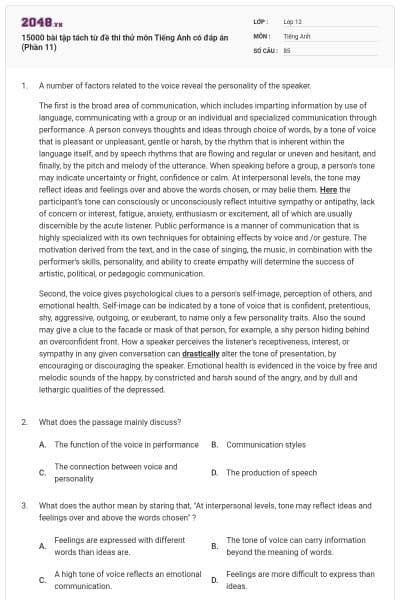
A number of factors related to the voice reveal the personality of the speaker.
The first is the broad area of communication, which includes imparting information by use of language, communicating with a group or an individual and specialized communication through performance. A person conveys thoughts and ideas through choice of words, by a tone of voice that is pleasant or unpleasant, gentle or harsh, by the rhythm that is inherent within the language itself, and by speech rhythms that are flowing and regular or uneven and hesitant, and finally, by the pitch and melody of the utterance. When speaking before a group, a person's tone may indicate uncertainty or fright, confidence or calm. At interpersonal levels, the tone may reflect ideas and feelings over and above the words chosen, or may belie them. Here the participant’s tone can consciously or unconsciously reflect intuitive sympathy or antipathy, lack of concern or interest, fatigue, anxiety, enthusiasm or excitement, all of which are.usually discernible by the acute listener. Public performance is a manner of communication that is highly specialized with its own techniques for obtaining effects by voice and /or gesture. The motivation derived from the text, and in the case of singing, the music, in combination with the performer's skills, personality, and ability to create empathy will determine the success of artistic, political, or pedagogic communication.
Second, the voice gives psychological clues to a person's self-image, perception of others, and emotional health. Self-image can be indicated by a tone of voice that is confident, pretentious, shy, aggressive, outgoing, or exuberant, to name only a few personality traits. Also the sound may give a clue to the facade or mask of that person, for example, a shy person hiding behind an overconfident front. How a speaker perceives the listener's receptiveness, interest, or sympathy in any given conversation can drastically alter the tone of presentation, by encouraging or discouraging the speaker. Emotional health is evidenced in the voice by free and melodic sounds of the happy, by constricted and harsh sound of the angry, and by dull and lethargic qualities of the depressed.
What does the passage mainly discuss?
The function of the voice in performance
Communication styles
The connection between voice and personality
The production of speech
Đáp án C
Đoạn văn chủ yếu thảo luận là gì?
A. Chức năng của chất giọng trong buổi biểu diễn
B. Kiểu giao tiếp
C. Sự kết nối giữa giọng nói và cá tính
D. Sản xuất lời nói
What does the author mean by staring that, "At interpersonal levels, tone may reflect ideas and feelings over and above the words chosen" ?
Feelings are expressed with different words than ideas are.
The tone of voice can carry information beyond the meaning of words.
A high tone of voice reflects an emotional communication.
Feelings are more difficult to express than ideas.
Đáp án B
Tác giả có ý gì khi nói: “Đối với mỗi người khác nhau , giai điệu có thể phản ánh ý tưởng và cảm xúc qua và trên các từ được chọn"?
A. Cảm xúc được thể hiện với những từ khác nhau hơn là ý tưởng.
B. Giọng điệu có thể mang thông tin vượt ra ngoài ý nghĩa của từ ngữ.
C. Một giọng nói cao phản ánh một giao tiếp cảm xúc.
D. Cảm giác khó diễn đạt hơn ý tưởng.
The word "Here" in line 9 refers to……………
At interpersonal levels
the tone
ideas and feelings
words chosen
Đáp án A
Từ "Here" trong dòng 9 ám chỉ:
A. cấp độ cá nhân
B. giai điệu
C. ý tưởng và cảm xúc
D. từ được chọn
Why does the author mention "artistic, political, or pedagogic communication" ?
As examples of public performance
As examples of basic styles of communication
To contrast them to singing
To introduce the idea of self-image
Đáp án A
Tại sao tác giả đề cập đến "giao tiếp nghệ thuật, chính trị hoặc sư phạm"?
A. Như ví dụ về hiệu suất công khai
B. Ví dụ về các kiểu giao tiếp cơ bản
C. Để đối chiếu chúng với ca hát
D. Để giới thiệu ý tưởng về hình ảnh
According to the passage, an exuberant tone of voice may be an indication of a person's………
general physical health
Personality
registered
obtained
Đáp án B
Một giọng nói cởi mở có thể là dấu hiệu của người:
A. có sức khỏe thể chất nói chung
B. cá tính
C. đã đăng ký, bảo đảm
D. thu được
According to the passage, an overconfident front may hide…………
hostility
shyness
friendliness
strength
Đáp án B
Một bộ mặt có vẻkhá tự tin có thể che giấu:
A. sự thù địch
B. sự nhút nhát
C. sự thân thiện
D. sức mạnh
The word "drastically" in line 21 is closest in meaning to……………
frequently
exactly
severely
easily
Đáp án C
Từ "drastically " trong dòng 21 gần nghĩa:
A. thường xuyên
B. chính xác
C. nghiêm trọng
D. dễ dàng
According to the passage, what does a constricted and harsh voice indicate?
Lethargy
Depression
Boredom
Anger
Đáp án D
Một giọng nói chặt chẽ và khắc nghiệt thể hiện ra điều gì?
A. sự thờ ơ
B. biểu hiện trầm cảm
C. sự chán nản
D. sự tức giận
Stars have been significant features in the design of many United States coins and their number has varied from one to forty-eight stars. Most of the coins issued from about 1799 to the early years of the twentieth century bore thirteen stars representing the thirteen original colonies.
Curiously enough, the first American silver coins, issued in 1794, had fifteen stars because by that time Vermont and Kentucky has joined the Union. At that time it was apparently the intention of mint officials to add a star for each new state. Following the admission of Tennessee in 1796, for example, some varieties of half dimes, dimes, and halfdollars were produced with sixteen stars.
As more states were admitted to the Union, however, it quickly became apparent that this scheme would not prove practical and the coins from A798 on were issued with only thirteen stars-one for each of the original colonies. Due to an error at the mint, one variety of the A828 half cent was issued with only twelve stars. There is also a variety of the large cent with only A2 stars, but this is the result of a die break and is not a true error.
What is the main topic of the passage?
Stars on American coins
The teaching of astronomy in state universities
The star as national symbol of the United States
Colonial stamps and coins
Đáp án A
Chủ đề chính của đoạn văn là gì?
A. Sao trên đồng tiền Mỹ
B. Việc giảng dạy thiên văn học trong các trường đại học nhà nước
C. Ngôi sao là biểu tượng quốc gia của Hoa Kỳ
D. Tem và tiền xu thuộc địa
The word “their” in line 1 refers to ______
Coins
features
colonies
stars
Đáp án D
Từ “họ” trong dòng 1 ám chỉ đến _______
A. Tiền xu
B. tính năng
C. thuộc địa
D. sao
The word “bore” in line 3 is closest in meaning to ________
Carried
drilled
symbolized
cost
Đáp án B
Từ “bore” trong dòng 3 gần nghĩa với ________
A. mang
B. khoan
C. tượng trưng
D. chi phí
Silver coins with fifteen stars appeared before coins with thirteen
Vermont and Kentucky joined the Union in 1794
Tennessee was the first state to use half dimes
No silver coins were issued until 1794
Đáp án A
Cụm từ “Curiously enough” được sử dụng bởi vì tác giả thấy lạ là _______
A. Tiền bạc với mười lăm sao xuất hiện trước tiền xu với mười ba
B. Vermont và Kentucky gia nhập Liên minh năm 1794
C. Tennessee là bang đầu tiên sử dụng nửa số giờ
D. Không có tiền bạc nào được phát hành cho đến năm 1794
Which of the following can be inferred about the order in which Kentucky, Tennessee, and Vermont joined the Union?
Vermont joined after Tennessee and Kentucky.
Kentucky joined before Tennessee and Vermont.
Tennessee joined Vermont and Kentucky.
Vermont and Kentucky joined at the same time.
Đáp án D
Điều nào sau đây có thể được suy ra về thứ tự mà Kentucky, Tennessee và Vermont gia nhập Liên minh?
A. Vermont gia nhập sau Tennessee và Kentucky.
B. Kentucky gia nhập trước Tennessee và Vermont.
C. Tennessee gia nhập Vermont và Kentucky.
D. Vermont và Kentucky tham gia cùng một lúc.
Half cent
Half-dollar
Half dime
Half nickel
Đáp án D
Điều nào sau đây KHÔNG được đề cập đến như là mệnh giá của một đồng tiền của Mỹ?
A. Nửa xu
B. Nửa đô la
C. Nửa xu
D. Nửa niken
There was a change in design policy.
There were twelve states at the time.
The mint made a mistake.
Tennessee had left the Union.
Đáp án C
Tại sao một đồng xu được sản xuất vào năm 1828 chỉ với mười hai sao?
A. Có sự thay đổi trong chính sách thiết kế.
B. Có mười hai tiểu bang vào thời điểm đó.
C. Các bạc hà đã làm sai.
D. Tennessee đã rời Liên minh.
Who talks more – men or women? Most people believe that women talk more. However, linguist Deborah Tannen, who has the studied the communication style of men and women, says that this is a stereotype. According to Tannen, women are more verbal – talk more – in private situations, where they use conversation as the “glue” to hold relationship together. But, she says, men talk more in public situations, where they use conversation to exchange information and gain status. Tannen points out that we can see these difference even in children. Little girls often play with one ‘best friend’ and their play includes a lot of conversation. Little boys often play games in groups, their play usually involves more doing than talking. In school, girls are often better at verbal skills, while boys are often better at mathematics.
A recent study at Emory University helps to shed light on the roots of this difference. Researchers studied conversation between children aged 3-6 and their parents. They found evidence that parents talk very differently to their sons than they do to their daughters. The startling conclusion was that parents use more language with their girls. Specifically, when parents talk with their daughters, they use more descriptive language and more details. There is also far more talk about emotions, especially with daughters than with sons.
Which sentence best expresses the main idea of the first paragraph?
Women talk more than men on the whole
Women’s talking is a stereotype
Women talk more in private, and men talk more in public
Little boys and little girls have different ways of playing
Đáp án C
Câu nào thể hiện ý tưởng chính của đoạn đầu tiên?
A. Phụ nữ nói nhiều hơn nam giới
B. Nói chuyện của phụ nữ là một khuôn mẫu
C. Phụ nữ nói chuyện riêng tư hơn và đàn ông nói nhiều hơn trước công chúng
D. Bé trai và bé gái có cách chơi khác nhau
Which word is similar in meaning to the word “glue”?
Games
sticky substance
rope
means
Đáp án B
Từ nào tương tự với từ “glue”?
A. trò chơi
B. chất dính
C. dây
D. có nghĩa là
Which of the following phrases best explains the meaning of the word “verbal”?
Deriving from verbs
Connected with use of spoken language
Using very loud noise
Being very talkative
Đáp án B
Cụm từ nào sau đây giải thích tốt nhất ý nghĩa của từ “verbal”?
A. Bắt nguồn từ động từ
B. Liên quan tới việc sử dụng ngôn ngữ nói
C. Sử dụng tiếng ồn rất lớn
The word “they” refers to ______
Situations
Men
Men and women
Women
Đáp án B
Từ “họ” đề cập đến ______.
A. Tình hình
B. Nam giới
C. Đàn ông và phụ nữ
D. Phụ nữ
Which of the following can be inferred from the first paragraph?
Men and women have different styles of talking, which may begin in childhood.
According to Deborah Tannen, the belief that women talk more is party right but most wrong.
Women talk more in some situations while men talk in others
Men are more sociable than women
Đáp án C
Điều nào sau đây có thể được suy ra từ đoạn đầu tiên?
A. Đàn ông và phụ nữ có các kiểu nói chuyện khác nhau, có thể bắt đầu từ thời thơ ấu.
B. Theo Deborah Tannen, việc phụ nữ nói nhiều hơn có phần đúng nhưng đa phần là sai
C. Phụ nữ nói nhiều hơn trong một số tình huống trong khi đàn ông thì nói trong những tình huống khác
D. Đàn ông hòa đồng hơn phụ nữ
Which sentence best expresses the main idea of the second paragraph?
Researchers have studied the conversations of children and their parents.
Parents do not much about sadness with their sons.
Study at Emory University can help to explain the differences between communication styles of boy and girls.
An Emory University study found than parent talk more with their daughters than with their sons.
Đáp án D
Câu nào thể hiện ý tưởng chính của đoạn thứ hai?
A. Các nhà nghiên cứu đã nghiên cứu các cuộc trò chuyện của trẻ em và cha mẹ của chúng.
B. Cha mẹ không nói nhiều về nỗi buồn với con trai của họ.
C. Học tại Đại học Emory có thể giúp giải thích sự khác biệt giữa phong cách giao tiếp của nam và nữ.
D. Một nghiên cứu của Đại học Emory cho rằng là cha mẹ nói chuyện nhiều hơn với con gái của họ hơn là với con trai
Which word can best replace the word “startling”?
Beginning
annoying
surprising
interesting
Đáp án D
Từ nào có thể thay thế chữ “startling”?
A. Bắt đầu
B. gây phiền nhiễu
C. đáng ngạc nhiên
D. thú vị
Which of the following statement is TRUE about the passage
Parents give more love to their daughters than to their sons
Boys don’t like to be with their parents as much as girls do
Parents use more language to talk with their daughters
Boys don’t like showing emotions
Đáp án C
Câu nào sau đây là đúng về đoạn văn?
A. Cha mẹ yêu thương con gái nhiều hơn là con trai của họ
B. Con trai không thích ở bên cha mẹ nhiều như con gái
C. Cha mẹ sử dụng nhiều ngôn ngữ hơn để nói chuyện với con gái của họ
D. Con trai không thích thể hiện cảm xúc
Lead poisoning in children is a major health concern. Both low and high doses of paint can have serious effects. Children exposed to high doses of lead often suffer permanent nerve damage, mental retardation, blindness, and even death. Low doses of lead can lead to mild mental retardation, short attention spans, distractibility, poor academic performance, and behavioral problems.
This is not a new concern. As early as 1904, lead poisoning in children was linked to lead- based paint. Microscopic lead particles from paint are absorbed into the bloodstream when children ingest flakes of chipped paint, plaster, or paint dust from sanding. Lead can also enter the body through household dust, nailbiting, thumb sucking, or chewing on toys and other objects painted with lead-based paint. Although American paint companies today must comply with strict regulations regarding the amount of lead used in their paint, this source of lead poisoning is still the most common and most dangerous. Children living in older, dilapidated houses are particularly at risk.
What is the main topic of the passage?
problems with household paint
major health concern for children
lead poisoning in children
lead paint in order homes
Đáp án C
Chủ đề chính của đoạn văn là gì?
A. vấn đề với sơn hộ gia đình
B. mối quan tâm sức khỏe lớn cho trẻ em
C. nhiễm độc chì ở trẻ em
D. sơn chì trong nhà
The phrase "exposed to" in line 2 could best be replaced by which of the following?
in contact with
familiar with
displaying
conducting
Đáp án A
Cụm từ "tiếp xúc với" trong dòng 2 có thể được thay thế bằng cách nào sau đây?
A. tiếp xúc với
B. quen thuộc với
C. hiển thị
D. tiến hành
Which of the following does the passage infer?
Paint companies can no longer use lead in their paint.
Paint companies must limit the amount of lead used in their paint.
Paint companies aren't required to limit the amount of lead used in their paint.
Paint companies have always followed restrictions regarding the amount of lead used in their paint.
Đáp án B
Nội dung nào sau đây đúng?
A. Công ty sơn không còn có thể sử dụng chì trong sơn của họ nữa.
B. Các công ty sơn phải hạn chế lượng chì được sử dụng trong sơn của họ.
C. Các công ty sơn không bắt buộc phải hạn chế lượng chì được sử dụng trong sơn của họ.
D. Các công ty sơn luôn tuân thủ các hạn chế về lượng chì được sử dụng trong sơn của họ.
The word "ingest" could best be replaced by which of the following
inhale
invest
inject
eat
Đáp án D
Từ "ingest" có thể được thay thế bằng cách nào sau đây?
A. hít
B. đầu tư
C. tiêm
D. ăn
The word "dilapidated" is closest in meaning to which of the following
unpainted
decorated
broken down
poorly painted
Đáp án C
Từ "dilapidated" gần nghĩa với từ nào sau đây?
A. không sơn
B. trang trí
C. làm hỏng
D. sơn xấu
According to the passage, what is the most common source of lead poisoning in children?
household dust
lead-based paint
painted toys
dilapidated houses
Đáp án B
Theo đoạn văn, nguồn nhiễm độc chì thường gặp nhất ở trẻ em là gì?
A. bụi gia đình
B. chì dựa trên sơn
C. sơn đồ chơi
D. nhà đổ nát
What does the author imply in the final sentence of the passage?
Old homes were painted with lead – based paint.
Lead-based paint chips off more easily than newer paints.
Poor people did not comply with the regulations
Old homes need to be rebuilt in order to be safe for children.
Đáp án A
Tác giả có ngụ ý gì trong câu cuối cùng của đoạn văn?
A. Nhà cũ được sơn bằng sơn có chất chì.
B. Các loại sơn sơn có chất chì dễ dàng hơn các loại sơn mới hơn.
C. Người nghèo không tuân thủ các quy định
D. Nhà cũ cần được xây dựng lại để an toàn cho trẻ em.
Political and family values within society have impacted upon the modern family structure. Traditionally, it has been the man’s role to be the breadwinner for the family- providing the funds to pay for food and shelter.
However, due to the many new and unique responsibilities placed upon families, in numerous cases both men and women- fathers and mothers- have had to enter the workforce. Generally, the reasons for both being involved in the workforce revolve around the need to add to the family’s current financial base. To a lesser extent, the need to interact with “adults” in a stimulating work environment is another popular reason. Whatever their reasons, for many families, the decision for father and mother to go out of home and join the labour force has led to a number of side effects within the home which, in turn, impact upon their performance as employees.
Many researchers agree that attitudes towards work are carried over into family life. This spillover can be positive or negative. Positive spillover refers to the spread of satisfaction and positive stimulation at work resulting in high levels of energy and satisfaction at home. If the amount of research is to be taken as an indication, it would seem that positive spillover is not a dominant occurrence in the workplace with most research focusing on the effects of negative spillover. Often pointing out the incompatible nature of work and family life, the research focuses on problems and conflict at work which has the effect of draining and preoccupying the individual, making it difficult for him or her to participate fully in family life.
Social scientists have devised a number of theories in an attempt to explain the work-family dynamic. Compensation theory is one which has been widely used. It assumes that the relationship between work and family is negative by pointing out that high involvement in one sphere- invariably the work sphere- leads to low involvement in the other. As an individual advances within a career, demands typically fluctuate from moderate to more demanding and if the advancing worker has younger children, this shift in work responsibilities will usually manifest itself in the form of less time spent with the family. Researchers subscribing to this theory point out that the drain on family time is significantly related to work-family conflict with an escalation in conflict, as the number of families increase.
What is the main focus of this passage?
Roles of husbands in a family
Relationships between family and job satisfaction
Positive attitude to work
Relationships between work itself and job satisfaction
Đáp án B
Trọng tâm chính của đoạn văn này là gì?
A. Vai trò của người chồng trong một gia đình
B. Mối quan hệ giữa sự hài lòng của gia đình và công việc
C. thái độ tích cực để làm việc
D. Mối quan hệ giữa bản thân công việc và sự hài lòng công việc
The main reason fathers and mothers join the workforce is ____________.
they want to escape the boring environment of home
they need the mature interaction that goes on between adults
they want to be able to retire comfortably
they need extra money
Đáp án D
Lý do chính mà cha và mẹ tham gia lực lượng lao động là ____________.
A. họ muốn thoát khỏi môi trường nhàm chán của gia đình
B. họ cần sự tương tác trưởng thành diễn ra giữa người lớn
C. họ muốn có thể nghỉ hưu thoải mái
D. họ cần thêm tiền
The word “draining” is closest in meaning to ____________.
waste
empty
make somebody weaker
make somebody stronger
Đáp án C
Từ “draining” gần nghĩa với ____________.
A. chất thải
B. rỗng
C. làm cho ai đó yếu hơn
D. làm cho ai đó mạnh mẽ hơn
The word "it" in the third paragraph refers to __________.
family life
family life
spillover
Compensation theory
Đáp án D
Từ "nó" trong đoạn thứ ba đề cập đến __________.
A. cuộc sống gia đình
B. cuộc sống gia đình
C. lan tràn
D. bồi thường
The following are the reasons why the fathers and mothers both go to work EXCEPT ________.
the need to work to earn money
the need to interact with “adults” in a stimulating work
the need to show the ability of working
the need to add to the family’s current financial base
Đáp án C
Sau đây là những lý do tại sao các ông bố và bà mẹ đều đi làm việc NGOẠI TRỪ ________.
A. sự cần thiết phải làm việc để kiếm tiền
B. sự cần thiết phải tương tác với "người lớn" trong công việc
C. sự cần thiết phải thể hiện khả năng làm việc
D. cần phải thêm vào cơ sở tài chính hiện tại của gia đình
The following are true EXCEPT ___________.
On the past, man earned money to provide the funds to pay for food and shelter for his family
The modern family structure has been affected by political and family values
The spread of satisfaction and positive stimulation at work result in high levels of energy and satisfaction at home
the advancing worker who has younger children spends more time with the family
Đáp án D
Điều nào sau đây là sai?
A. Trong quá khứ, người đàn ông kiếm được tiền để cung cấp tiền để trả lương thực và chỗ ở cho gia đình
B. Cấu trúc gia đình hiện đại đã bị ảnh hưởng bởi các giá trị chính trị và gia đình
C. Sự lây lan của sự hài lòng và kích thích tích cực trong công việc dẫn đến mức năng lượng cao và sự hài lòng ở nhà
D. nhân viên thăng tiến có con nhỏ dành nhiều thời gian hơn cho gia đình
The word “breadwinner” is closest in meaning to ____________.
earner
bread maker
winner
bread
Đáp án
Từ “breadwinner” gần nghĩa với ____________.
A. người kiếm tiền
B. hãng sản xuất bánh mì
C. người chiến thắng
D. bánh mì
According to the passage, positive spillover ______________.
is only a positive attitude toward work
is the conflict at work
refers to the spread of satisfaction at work resulting in high levels of satisfaction at home
assumes that the relationship between work and family is negative
Đáp án C
Theo đoạn văn, lan truyền tích cực:
A. chỉ là một thái độ tích cực đối với công việc
B. là xung đột tại nơi làm việc
C. đề cập đến sự lây lan của sự hài lòng trong công việc dẫn đến mức độ hài lòng cao ở nhà
D. giả định rằng mối quan hệ giữa công việc và gia đình là tiêu cực
The difference between the nuclear family and the extended family is that a nuclear family refers to a single basic family unit of parents and their children, whereas the extended family refers to their relatives such as grandparents, in-laws, aunts and uncles, etc. In many cultures, and particularly indigenous societies, the latter is the most common basic form of social organization.
A nuclear family is limited, according to Kristy Jackson of Colorado State University, to one or two parents (e.g. a father and mother) and their own child, or children, living together in a single house or other dwellings. In anthropology, they only must be related in this fashion; there is no upper or lower limit on the number of children in a nuclear family.
The extended family is a much more nebulous term, but in essence refers to kin or relations not covered by the above definition. In historical Europe and Asia as well as in Middle Eastern, African, and South American Aboriginal cultures, extended family groups were typically the most basic unit of social organization. The term can differ in specific cultural settings, but generally includes people related in age or by lineage. Anthropologically, the term “extended family” refers to such a group living together in a household, often with three generations living together (grandparents, parents, and children) and headed in patriarchal societies by the eldest man or by some other chosen leadership figure. However, in common parlance, the term “extended family” is often used by people simply to refer to their cousins, aunts, uncles, and so on, even though they are not living together in a single group.
Historically, most people in the world have lived in extended family groupings rather than in nuclear families. This was even true in Europe and in the early United States, where multiple generations often lived together for economic reasons. During the 20th century, average income rose high enough that living apart as nuclear families became a viable option for the vast majority of the American population. In contrast, many indigenous societies and residents of developing countries continue to have multiple generations living in the same household. The rise of the nuclear family in the modern West does not necessarily mean that family arrangements have stabilized, either. The rapid growth in single-parent households, for instance, also represents a substantial change in the traditional nuclear family. More couples are also choosing not to have children at all.
What is the passage mainly about?
The dominance of nuclear families over extended ones
The dominance of extended families over nuclear ones
A distinction between nuclear families and extended ones
The changes of family types over times
Đáp án C
Ý chính của bài là gì?
A. Sự áp đảo về số lượng những gia đình nhỏ với đại gia đình
B. Sự áp đảo về số lượng những đại gia đình với gia đình nhỏ
C. Một sự khác biệt giữa các gia đình nhỏ và những đại gia đình
D. Những thay đổi của các loại gia đình theo thời gian
The word “the latter” in paragraph 1 refers to _____
family unit
relatives
the nuclear family
the extended family
Đáp án D
Từ "the latter" trong đoạn 1 đề cập đến _____.
A. gia đình “đơn vị”
B. thân nhân
C. gia đình nhỏ
D. đại gia đình
Historically, extended families were the most basic unit of social organization in all
of the following places EXCEPT _____.
The Middle East
Asia
North America
Europe
Đáp án C
Về mặt lịch sử, các đại gia đình là đơn vị cơ bản nhất của tổ chức xã hội của những nơi sau đây trừ _____ ..
A. Trung Đông
B. Châu Á
C. Bắc Mỹ
D. Châu Âu
The word “patriarchal” in paragraph 3 is closest in meaning to _____.
ruled or controlled by men
equal for both men and women
simple with no rules and laws
modern with advanced facilities
Đáp án A
Từ “patriarchal” trong đoạn 3 gần nghĩa với _____.
A. cai trị hoặc kiểm soát bởi nam
B. công bằng cho cả nam giới và phụ nữ
C. đơn giản không có quy tắc và luật
D. hiện đại với tiện nghi cao cấp
According to the passage, single-parent households ________.
are not defined by anthropologists
are the existing trend of family arrangement
are included in the term “nuclear family”
are on the decrease
Đáp án C
Theo đoạn văn, các gia đình đơn thân ________.
A. không được định nghĩa bởi các nhà nhân chủng học
B. là xu hướng kiểu gia đình hiện tại
C. được bao gồm trong thuật ngữ "gia đình nhỏ"
D. đang giảm
The word “viable” in paragraph 4 could be best replaced by ________.
impossible
possible
explainable
fashionable
Đáp án B
Từ “viable” trong đoạn 4 có thể được thay thế bằng ________.
A. không thể
B. có thể
C. giải thích
D. thời trang
Which of the following is TRUE according to the passage?
Since the 20th century, more and more American couples have lived in extended families because of the financial burdens.
Nuclear families are the most basic form of social organization all over the world.
The popularity of nuclear families in western countries helps to stabilize family arrangement.
Traditional nuclear families have changed a lot over times.
Đáp án D
Điều nào sau đây là đúng theo đoạn văn?
A. Từ thế kỷ 20, ngày càng có nhiều cặp vợ chồng người Mỹ sống trong các đại gia đình vì gánh nặng tài chính.
B. Gia đình nhỏ là hình thức cơ bản nhất của tổ chức xã hội trên toàn thế giới.
C. Sự phổ biến của các gia đình nhỏ ở các nước phương Tây giúp ổn định sự sắp xếp gia đình.
D. Các gia đình nhỏ truyền thống đã thay đổi rất nhiều lần.
What can be inferred from the reading passage?
Indigenous communities have been completely eradicated all over the world.
In the future, all extended families will be replaced by nuclear ones.
Anthropology is a science concerning human race and its development.
Couples with no children can’t be defined as families.
Đáp án C
Điều gì có thể được suy ra từ đoạn văn?
A. Các cộng đồng bản địa đã bị loại trừ hoàn toàn trên toàn thế giới.
B. Trong tương lai, tất cả các gia đình mở rộng sẽ được thay thế bằng gia đình nhỏ.
C. Nhân chủng học là một khoa học liên quan đến loài người và sự phát triển của loài người.
D. Các cặp vợ chồng không có con không thể được định nghĩa là gia đình.
The weather is a national obsession in Britain, perhaps because it is so changeable. It's the national talking point, and most people watch at least one daily weather forecast. Most of the viewers imagine that the presenter does little more than arrive at the studio a few minutes before the broadcast, read the weather, and then go home.
In fact, this image is far from the truth. The two-minute bulletin which we all rely on when we need to know tomorrow's weather is the result of a hard day's work by the presenter, who is actually a highly-qualified meteorologist.
Every morning, after a weather forecaster arrives at the TV studios, his/her first task of the day is to collect the latest data from the National Meteorological Office. The information is very detailed and includes predictions, satellite and radar pictures, as well as more technical data. After gathering all the relevant material from this office, the forecaster has to translate the scientific terminology and maps into images and words which viewers can easily understand. The final broadcast is then carefully planned. The presenter decides what to say and in what order to say it. Next a “story board” is drawn up which lays out the script word for word.
The time allocated for each broadcast can also alter. This is because the weather report is screened after the news, which can vary in length. The weather forecaster doesn't always know how much time is available, which means that he/she has to be thoroughly prepared so that the material can be adapted to the time available.
What makes weather forecasting more complicated is that it has to be a live broadcast and cannot be prerecorded. Live shows are very nerve-racking for the presenter because almost anything can go wrong. Perhaps the most worrying aspect for every weather forecaster is getting the following day's predictions wrong. Unfortunately for them, this is not an unusual occurrence; the weather is not always possible to predict accurately.
These days, a weather forecaster's job is even more complicated because they are relied upon to predict other environmental conditions. For example, in the summer the weather forecast has to include the pollen count for hay fever sufferers. Some also include reports on ultraviolet radiation intensity to help people avoid sunburn. The job of a weather forecaster is certainly far more sophisticated than just pointing at a map and describing weather conditions. It's a job for professionals who can cope with stressful and challenging conditions.
The passage is mainly about _________.
weather forecast in England
a weather forecaster’s job
the most widely watched TV programme
the competition between weather forecast and other TV programmes
Đáp án B
Nội dung chính của bài là về _________.
A. dự báo thời tiết ở Anh
B. công việc của một dự báo thời tiết
C. chương trình truyền hình được xem nhiều nhất
D. sự cạnh tranh giữa dự báo thời tiết và các chương trình truyền hình khác
The word “bulletin” in paragraph 2 is closest in meaning to _________.
show
advertisement
report
forecast
Đáp án C
Từ “bulletin” trong đoạn 2 gần nhất có nghĩa là _________.
A. hiển thị
B. quảng cáo
C. báo cáo
D. dự báo
In Britain, people's attitude to the weather_________.
is a national problem
depends on the prediction being for a sunny or rainy day
is quite neglectful
makes it a top discussion topic
Đáp án D
Ở Anh, thái độ của người dân đối với thời tiết_________.
A. là một vấn đề quốc gia
B. phụ thuộc vào dự đoán là cho một ngày nắng hoặc mưa
C. khá là lơ là
D. làm cho nó trở thành một chủ đề thảo luận hàng đầu
What does the word “this” in paragraph 5 refer to?
the weather forecaster's worry
the complication of a live broadcast
giving a forecast that doesn't come true
an accurate prediction
Đáp án C
Từ "this" trong đoạn 5 đề cập đến điều gì?
A. lo lắng về thời tiết của người dự báo
B. sự phức tạp của một chương trình phát sóng trực tiếp
C. đưa ra một dự báo không đúng sự thật
D. dự đoán chính xác
Creating a weather report is complex because_________.
the information includes unreliable predictions
radar pictures are technical
maps have to be drawn
a lot of data has to be interpreted
Đáp án A
Tạo báo cáo thời tiết phức tạp vì __________.
A. thông tin bao gồm các dự đoán không đáng tin cậy
B. hình ảnh radar là kỹ thuật
C. bản đồ phải được vẽ
D. rất nhiều dữ liệu phải được diễn giải
Weather forecasters have to know the material well because________
the forecast may be incorporated into the news broadcast
they sometimes need to change it to meet the time limitation
the broadcast is pre-recorded
they don’t make the bulletins by themselves
Đáp án B
Các nhà dự báo thời tiết phải biết rõ về việc này vì __________.
A. dự báo có thể được đưa vào chương trình phát sóng tin tức
B. đôi khi họ cần phải thay đổi nó để đáp ứng giới hạn thời gian
C. chương trình phát sóng được ghi âm trước
D. họ không tự mình tạo bản tin
What can be inferred from the passage?
British people are concerned with weather because it affects their economy.
Weather forecasting is among demanding jobs.
TV reporters need to learn by heart what to say.
To become a weather forecaster, you must graduate from a prestigious university.
Đáp án B
Điều gì có thể suy ra từ đoạn văn?
A. Người Anh quan tâm đến thời tiết bởi vì nó ảnh hưởng đến nền kinh tế của họ.
B. Dự báo thời tiết nằm trong số các công việc đòi hỏi khắt khe.
C. Phóng viên truyền hình cần phải học bằng trái tim những gì để nói.
D. Để trở thành một người dự báo thời tiết, bạn phải tốt nghiệp từ một trường đại học uy tín.
Living things include both the visible world of animals, plants, and fungi as well as the invisible world of bacteria and viruses. On a basic level, we can say that life is ordered. Organisms have an enormously complex organization. We're all familiar with the intricate systems of the basic unit of life, the cell. Life can also "work." Living creatures can take in energy from the environment. This energy, in the form of food, is transformed to maintain metabolic processes and for survival. Life grows and develops. This means more than just replicating or getting larger in size. Living organisms also have the ability to rebuild and repair themselves when injured. Life can reproduce. Think about the last time you accidentally stubbed your toe. Almost instantly, you moved back in pain. Finally, life can adapt and respond to the demands placed on it by the environment. There are three basic types of adaptations that can occur in higher organisms.
Reversible changes occur as a response to changes in the environment. Let's say you live near sea level and you travel to a mountainous area. You may begin to experience difficulty breathing and an increase in heart rate as a result of the change in altitude. These symptoms go away when you go back down to sea level. Body-related changes occur as a result of prolonged changes in the environment. Using there previous example, if you were to stay in the mountainous area for a long time, you would notice that your heart rate would begin to slow down and you would begin to breath normally. These changes are also reversible. Genotypic changes (caused by genetic mutation) take place within the genetic makeup of the organism and are not reversible. An example would be the development of resistance to pesticides by insects and spiders.
In what way is life organized?
Hard
Difficult
Complicated
Problematic
Đáp án C
Tạo hóa được tổ chức theo cách nào?
A. Cứng
B. Khó
C. Phức tạp
D. Có vấn đề
Which of the following is NOT a feature of life?
Getting a job
Giving birth
Getting larger and left- repairing
Reacting to the environment
Đáp án A
Điều nào sau đây KHÔNG phải là đặc điểm của tự nhiên?
A. Bắt một công việc
B. Sinh con
C. Trở nên lớn hơn
D. Phản ứng với môi trường
What is the energy for living things called?
Food
Metabolic process
Green energy
Environment
Đáp án A
Năng lượng cho sinh vật được gọi là gì?
A. Thực phẩm
B. Quá trình trao đổi chất
C. Năng lượng xanh
D. Môi trường
You see life respond most clearly when you_______.
intentionally hurt yourself
move part of your body due to threat
look at your toe
feel hurt
Đáp án A
Bạn thấy phản ứng sống rõ ràng nhất khi bạn _______.
A. cố tình làm tổn thương chính mình
B. di chuyển một phần cơ thể của bạn do đe dọa
C. nhìn vào ngón chân của bạn
D. cảm thấy đau
Which type of living creatures can adapt to the changes in the environment?
More visible
Lower
Higher
More human
Đáp án C
Loại sinh vật nào có thể thích ứng với những thay đổi trong môi trường?
A. Hữu hình hơn
B. Cấp thấp hơn
C. Cấp cao hơn
D. Mang tính “người” hơn
What does the word “reversible” in the passage mean?
Changeable
Visible
Fitful
Irregular
Đáp án A
Từ "reversible" trong đoạn văn có nghĩa là gì?
A. Có thể thay đổi
B. Hữu hình
C. Phù hợp
D. Không thường xuyên
Which type of adaption is permanent?
Body-related
Reversible
Genotypic
Environmental
Đáp án C
Loại thích ứng nào là vĩnh viễn?
A. Những thay đổi liên quan đến thể xác
B. Những thay đổi có thể đảo ngược
C. Kiểu gen
D. Môi trường
Đối với nhiều sinh viên đại học Mỹ, kỳ nghỉ nghỉ xuân kéo dài một tuần đồng nghĩa với sự khởi đầu của bữa tiệc bất tận trên một bãi biển đầy nắng ở Florida hoặc Mexico. Tại Panama City Beach ở Florida, một thành phố có dân số khoảng 36.000 người, hơn nửa triệu sinh viên đại học đến vào tháng 3 để chơi và tổ chức tiệc tùng, làm cho nó trở thành điểm đến mùa xuân số một tại Hoa Kỳ. Không phải đối với tất cả mọi người, tuy nhiên, ngày càng có nhiều sinh viên đại học Mỹ tìm ra cách để tận hưởng kì nghỉ xuân. Đối với họ, tham gia hoặc lãnh đạo một nhóm tình nguyện viên đi du lịch tại địa phương hoặc quốc tế và làm việc để giảm bớt các vấn đề như đói nghèo, vô gia cư hoặc thiệt hại về môi trường làm cho kì nghỉ mùa xuân trở thành trải nghiệm học tập độc đáo mà sinh viên đại học có thể cảm thấy tốt hơn.
Trong một kỳ nghỉ xuân tại Đại học James Madison ở Virginia đã tham gia 15 chuyến nghỉ xuân được thay thế bằng các chuyến đi đến các tiểu bang lân cận, ba chuyến đi đến nhiều nơi xa xôi hơn của Hoa Kỳ và năm chuyến đi quốc tế. Một nhóm sinh viên JMU đến Bogalusa, Louisiana để giúp đỡ. Một nhóm khác đã đi đến Mississippi để tổ chức các hoạt động sáng tạo cho trẻ em sống trong khu ổ chuột, khu người vô gia cư. Một nhóm học sinh đã đi làm rã rời chân tay ở Florida nhưng không được phép nằm trên cát. Họ làm việc giống như những người kiểm lâm rào và phá hủy các loài thực vật xâm lấn đe dọa hệ sinh thái vùng Florida.
Học sinh tham gia vào các dự án kì nghỉ mùa xuân khác biệt thấy chúng rất bổ ích. Trong khi hầu hết sinh viên đại học phải lấy bằng cấp trước khi họ có thể bắt đầu giúp đỡ mọi người, sinh viên tình nguyện viên có thể giúp mọi người ngay bây giờ. Mặt khác, xung quanh các phòng ở rất an toàn. Học sinh thường ngủ trên sàn nhà của một trường học hoặc nhà thờ, hoặc dành cả tuần cắm trại trong lều. Nhưng sinh viên chỉ trả khoảng 250 đô la cho các bữa ăn và giao thông, ít hơn nhiều so với một số đồng nghiệp của họ dành để đi đến các điểm nóng kì nghỉ mùa xuân truyền thống
Các chuyến đi nghỉ xuân khác biệt dường như ngày càng phổ biến ở các trường đại học trên khắp Hoa Kỳ. Học sinh trích dẫn một số lý do để tham gia. Một số đánh giá cao cơ hội để giao tiếp và gặp gỡ những người bạn mới. Những người khác muốn thực hiện mong muốn của họ về nghĩa vụ của công dân phục vụ nhân loại và làm cho thế giới trở thành một nơi tốt đẹp hơn. Bất kể lý do của họ là gì, những sinh viên này đã khám phá ra một điều gì đó mang lại cho họ phần thưởng phong phú cùng với một khoảng thời gian thư giãn từ công việc học.
For many American university students, the weeklong spring break holiday means on endless party on a sunny beach in Florida or Mexico. In Panama City Beach in Florida, a city with permanent population of around 36.000, more than half a million university students arrive during the month of March to play and party, making it the number one spring break destination in the United States A weeklong drinking binge is not for everyone, however and a growing number of American university students have found a way to make spring break matter. For them, joining or leading a group of volunteers to travel locally or internationally and work to alleviate problems such as poverty, homelessness, or environmental damage makes spring break a unique learning experience that university students can feel good about.
During one spring break students at James Madison University in Virginia participated in 15 alternative spring break" trips to nearby states, three others to more distant parts of the United States and five international trips. One group of JMU students travelled to Bogalusa, Louisiana to help rebuild homes damaged by Hurricane Katrina. Another group traveled to Mississippi to organize creative activities for children living in homeless shelter. One group of students did go to exhausting physical labor such Florida. but not to lie on the sand. They performed as maintaining hiker rails and destroying invasive plant species that threaten the native Florida ecosystem.
Students who participate in alternative spring break projects find them very rewarding. While most university students have to get their degrees before they can start helping people, students volunteers are able to help people now. On the other hand, the accommodations are far from glamorous. Students often sleep on he floor of a school or church, or spend the week camping in tents. But students only pay around $250 for meals and transportation, which is much less than some their peers spend to travel to more traditional spring break hotspots
Alternative spring break trips appear to be growing in popularity at universities across the United States. Students cite a number of reasons for participating. Some appreciate the opportunity to socialize and meet new friends. Others want to exercise their beliefs about peoples obligation to serve humanity and make the world a better place. Whatever their reasons, these students have discovered something that gives them rich rewards along with a break from school work.
How many university students travel to Panama Beach City every March for spring break?
Around 500.000
Around 10.000
Around 36.000
Around 50.000
Đáp án A
Có bao nhiêu sinh viên đại học du lịch đến Panama Beach City mỗi tháng để nghỉ xuân?
A. Khoảng 500.000
B. Khoảng 10.000
C. Khoảng 36.000
D. Khoảng 50.000
The article is mainly about___________.
sleeping on the floor or camping in tents.
alternative spring break trips
drinking problems among university students
spring break in Florida and Mexico
Đáp án B
Bài báo chủ yếu là về___________.
A. ngủ trên sàn nhà hoặc cắm trại trong lều.
B. chuyến đi nghỉ xuân khác biệt
C. vấn đề uống rượu giữa các sinh viên đại học
D. nghỉ xuân tại Florida và Mexico
The word “ binge” in the second paragraph probably means ___.
having very little alcohol
refusing to do something
studying for too long
doing too much of something.
Đáp án D
Từ “binge” trong đoạn thứ hai có nghĩa là ___.
A. có rất ít rượu
B. từ chối làm điều gì đó
C. học quá lâu
D. làm quá nhiều thứ.
Which of the following is NOT mentioned as a problem that alternative spring break trips try to help solve?
Alcoholism
Environmental damage
Poverty
Homelessness
Đáp án A
Điều nào sau đây KHÔNG được đề cập đến như một vấn đề mà các chuyến đi nghỉ xuân khác biệt cố gắng giải quyết?
A. nghiện rượu
B. thiệt hại môi trường
C. đói nghèo
D. vô gia cư
Which of the following gives the main idea of the third paragraph?
One group of JMU students worked on homes damaged by a hurricane.
Some students work to help the environment on alternative spring break trips.
Children living in homeless shelters enjoy creative activities.
University students do may different types of work on alternative spring break trips.
Đáp án D
Điều nào sau đây là ý tưởng chính của đoạn thứ ba?
A. Một nhóm sinh viên JMU làm việc trên những căn nhà bị hư hại do bão.
B. Một số học sinh làm việc để giúp môi trường trong các chuyến đi nghỉ xuân thay thế.
C. Trẻ em sống trong những nơi trú ẩn vô gia cư tận hưởng các hoạt động sáng tạo.
D. Sinh viên đại học có thể thực hiện các loại công việc khác nhau trong các chuyến đi nghỉ xuân.
The article implies that university students ____
many take fewer alternative spring break trips in the future.
would prefer to wait until they have their degrees to start helping people.
complain about the accommodations on alternative spring break trips.
spend more than $250 for traditional spring break trips.
Đáp án B
Bài viết ngụ ý rằng sinh viên đại học ____
A. nhiều người có ít chuyến đi nghỉ xuân khác biệt trong tương lai.
B. muốn chờ cho đến khi họ có bằng cấp để bắt đầu giúp đỡ mọi người.
C. phàn nàn về chỗ ở trên các chuyến đi nghỉ xuân.
D. chi tiêu nhiều hơn $ 250 cho các chuyến đi nghỉ xuân truyền thống.
The word “ them” in paragraph 4 refers to ______
degrees
projects
people
students
Đáp án B
Từ “chúng” trong đoạn 4 là ______
A. bằng cấp
B. dự án
C. người
D. sinh viên
Which of the following is mentioned as a reason for participating in alternative spring break trips?
The hope of earning more money
A personal opinion that people must help other people.
A desire to travel to glamorous places
A wish to get away from family and friends.
Đáp án B
Điều nào sau đây được đề cập như một lý do để tham gia vào các chuyến đi nghỉ xuân khác biệt?
A. Hy vọng kiếm thêm tiền
B. Một ý kiến cá nhân cho rằng mọi người phải giúp đỡ người khác.
C. Một mong muốn đi du lịch đến những nơi quyến rũ
D. Một mong muốn thoát khỏi gia đình và bạn bè.
Một số lượng lớn các phát minh phải trải qua nhiều năm khó khăn nghiên cứu và phát triển trước khi chúng được hoàn thiện. Ví dụ, Thomas Edison đã phải thực hiện hơn 1.000 nỗ lực để phát minh ra bóng đèn sợi đốt để dẫn tới thành công. Lịch sử có rất nhiều câu chuyện của những con người đầy nghị lực khác, vấp ngã, thất bại nhiều lần trước khi họ thành công. Tuy nhiên, một số phát minh thì không phải trải qua những giai đoạn khó khăn, mà chỉ đơn giản là do tai nạn tạo ra.
Trong hầu hết các trường hợp đó, khi nhà phát minh vô tình phát minh ra thứ gì đó, thực ra họ đã cố tạo ra thứ gì đó khác. Ví dụ, trong những năm 1930, nhà hóa học Roy Plunkett đã cố gắng tạo ra một chất mới có thể được sử dụng để làm lạnh các vật phẩm. Ông trộn lẫn một số hóa chất với nhau. Sau đó, ông đặt chúng vào một bình chứa áp lực và làm mát hỗn hợp. Vào thời điểm thí nghiệm của ông ấy hoàn tất, ông ấy đã có một phát minh mới. Nó không phải là một chất mới có thể được sử dụng để làm lạnh. Thay vào đó, ông đã phát minh ra Teflon, ngày nay được sử dụng phổ biến nhất để sản xuất chảo và chảo không dính. Tương tự như vậy, nhiều thập kỷ trước đó, John Pemberton là một dược sĩ ở Atlanta, Georgia. Anh đang cố gắng tạo ra một loại thuốc bổ mà mọi người có thể sử dụng bất cứ khi nào họ bị đau đầu. Trong khi anh không thành công trong nỗ lực đó, anh đã xoay xở để phát minh ra Coca-Cola, loại nước ngọt có ga nổi tiếng thế giới.
Các nhà khoa học cũng đã vô tình khám phá ra những phát hiện quan trọng khi họ tiến hành các thí nghiệm. Năm 1928, Alexander Fleming phát hiện penicillin, một loại kháng sinh, theo cách này. Ông đã phát hiện một số nấm mốc đang phát triển trong một món ăn với một số vi khuẩn. Ông nhận thấy rằng vi khuẩn dường như tránh nấm mốc. Khi ông điều tra thêm, ông đã xác định một số tính chất hữu ích của penicillin, đã cứu hàng triệu mạng sống trong vài thập kỷ qua. Tương tự như vậy, vào năm 1946, nhà khoa học Percy Spencer đã tiến hành một thí nghiệm với vi sóng. Anh ta có một thanh kẹo trong túi, và anh nhận thấy nó đột nhiên tan chảy. Anh ta điều tra và tìm hiểu lý do tại sao điều đó lại xảy ra. Ngay sau đó, ông đã chế tạo một thiết bị có thể sử dụng vi sóng để hâm nóng thức ăn.
A large number of inventions require years of arduous research and development before they are perfected. For instance, Thomas Edison had to make more than 1,000 attempts to invent the incandescent light bulb before he finally succeeded. History is replete with numerous other examples of people trying, yet failing to make inventions before they eventually succeeded. Yet some inventions have come about not through hard work but simply by accident.
In most cases, when someone unintentionally invented something, the inventor was attempting to create something else. For example, in the 1930s, chemist Roy Plunkett was attempting to make a new substance that could be used to refrigerate items. He mixed some chemicals together. Then, he put them into a pressurized container and cooled the mixture. By the time his experiment was complete, he had a new invention. It was not a new substance that could be used for refrigeration though. Instead, he had invented Teflon, which is today most commonly used to make nonstick pots and pans. Similarly, decades earlier, John Pemberton was a pharmacist in Atlanta, Georgia. He was attempting to create a tonic that people could use whenever they had headaches. While he was not successful in that endeavor, he managed to invent Coca -Cola, the world - famous carbonated soft drink.
Scientists have also made crucial discoveries by accident when they were conducting experiments. In 1928, Alexander Fleming discovered penicillin, an antibiotic, in this manner. He discovered some mold growing in a dish with some bacteria. He noticed that the bacteria seemed to be avoiding the mold. When he investigated further, he determined some of the many useful properties of penicillin, which has saved millions of lives over the past few decades. Likewise, in 1946, scientist Percy Spencer was conducting an experiment with microwaves. He had a candy bar in his pocket, and he noticed that it suddenly melted. He investigated and learned the reason why that had happened. Soon afterward, he built a device that could utilize microwaves to heat food. the microwave oven.
constant
tough
specific
detailed
Đáp án B
Trong đoạn 1, từ “arduous” gần nghĩa _______.
A. liên tục
B. khó khăn
C. cụ thể
D. chi tiết
History's Most Important Inventions
Accidental Inventions and Discoveries
You Don't Always Get What You Want
How to Become a Great Inventor
Đáp án B
Tiêu đề nào tóm tắt ý tưởng chính của đoạn văn tốt nhất?
A. Những phát minh quan trọng nhất trong lịch sử
B. Phát minh và khám phá ngẫu nhiên
C. Bạn không phải lúc nào cũng có được những gì bạn muốn
D. Làm thế nào để trở thành một nhà phát minh vĩ đại
What does the author imply about penicillin?
It is an invaluable medical supply.
Mold combines with bacteria to make it.
Some people are not affected by it.
Doctors seldom use it nowadays.
Đáp án A
Tác giả nghĩ gì về penicillin?
A. Nó là một nguồn cung cấp y tế vô giá.
B. Nấm mốc kết hợp với vi khuẩn đã tạo nó.
C. Một số người không bị ảnh hưởng bởi nó.
D. Các bác sĩ hiếm khi sử dụng nó ngày nay.
In paragraph 2, the word endeavor is closest in meaning to _______.
request
attempt
research
dream
Đáp án B
Trong đoạn 2, endeavor gần nghĩa _______.
A. yêu cầu
B. cố gắng
C. nghiên cứu
D. giấc mơ
The author uses Alexander Fleming as an example of ________.
a person who made an accidental scientific discovery
one of the most famous inventors in history
someone who became a millionaire from his invention
a man who dedicated his life to medical science
Đáp án A
Tác giả sử dụng Alexander Fleming làm ví dụ về ________.
A. một người đã khám phá công trình khoa học một cách ngẫu nhiên
B. một trong những nhà phát minh nổi tiếng nhất trong lịch sử
C. một người đã trở thành một triệu phú từ phát minh của mình
D. một người đã cống hiến cuộc đời mình cho khoa học y khoa
Who was John Pemberton
The person who made Teflon
The creator of Coca-Cola
The man who discovered penicillin
The inventor of the microwave
Đáp án B
John Pemberton là ai?
A. Người tạo ra Teflon
B. Người tạo ra Coca-Cola
C. Người phát hiện ra penicillin
D. Người phát minh ra lò vi sóng
What does the author say about Teflon?
It is used for kitchenware nowadays.
It was created many years before Coca-Cola.
The man who made it was a pharmacist.
People first used it as a refrigeration device.
Đáp án A
Tác giả nói gì về Teflon?
A. Nó được sử dụng cho đồ dùng nhà bếp ngày nay.
B. Nó được tạo ra nhiều năm trước Coca-Cola.
C. Một dược sĩ đã phát minh ra nó.
D. Đầu tiên nó được sử dụng như một thiết bị làm lạnh.
Bạn có thích hoạt động này không?