(Viên chức Mầm non) bài tập tiếng Anh theo chủ đề có đáp án - Unit 4
88 câu hỏi
I. Underlined the stressed syllables in each of the italics.
My favorite subjects at school were science, especially chemistry and biology. I‘ve always been good with numbers, so I was good at mathematics. I didn‘t really like social science subjects like sociology and history, and that‘s strange because when I went to university I did geography. I didn‘t like foreign languages and literature, but they are core subjects, which are compulsory in the national school-leaving examinations.
My favorite subjects at school were science, especially chemistry and biology. I‘ve always
been good with numbers, so I was good at mathematics. I didn‘t really like social science
subjects like sociology and history, and that‘s strange because
when I went to university I did geography. I didn‘t like foreignlanguages and literature,
but they are core subjects, which are compulsory in the national school- leaving
examinations.
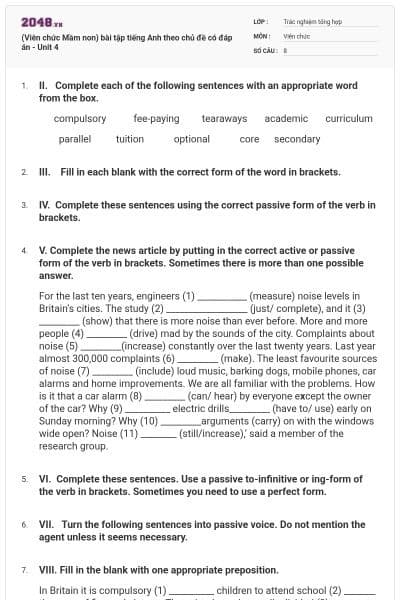
II. Complete each of the following sentences with an appropriate word from the box.
compulsory fee-paying tearaways academic curriculum
parallel tuition optional core secondary
The _____________ year at Oxford University runs from October to June.
They all have to study French because it‘s on the _____________ .
Primary education is _______ for all children from 6 to 11 years old.
compulsory
_________ school is for young people between the ages of 11 and 16 or 18.
Many parents believe that ________ schools provide a better standard of education.
His car was wrecked by a couple of young ________ .
In geometry, ______________ lines are lines in a plane which do not meet.
parallel
University of Washington would increase _______ by 16 percent a year for the next two years.
With a wide range of _________ activities on offer, you can try a different activity every day!
optional
core
III. Fill in each blank with the correct form of the word in brackets.
You have to do well _________ to get into medical school. (academic)
Jane is a _________ girl. She always do things in a careful and logical way. (method).
methodical
She has the _________ to pass the exam first time round providing she works hard. (able)
When he became a teenager he wanted to be more _________ from his parents. (depend)
The UK education system has been _____________ into four segments: primary, secondary, further and higher education. (category)
After ____________ of further Studies in the UK, you can opt for higher studies. (complete)
In years past, it was unusual for women to be more highly ____________ than men. (educate)
Educated
We should be able to get them to cooperate without using ____________ _. (compel)
GCSE is a British _______ taken by students in England and Wales and some other countries, usually around the age of 16. (examine)
IV. Complete these sentences using the correct passive form of the verb in brackets.
You _______ (give) the questions in two weeks.
will be given
All the equipment of this machine_________ (manufacture) by the Boron Group in Germany.
was manufactured
In the middle of the village there is a church which ________(restore) at the moment.
is being restored
The tower is the oldest part of the church. It_________(believe) to be over 600 years old.
is believed
You‘ll hardly recognize our flat. It_________ (redecorate) since your last visit.
has been redecorated
As my car_______ (repair) last Friday, I _________(give) a lift to work by a colleague.
The air-conditioning system _________ (install) before the first heat of the summer arrived.
had been installed
The ancient language of Aramaic_________ (speak) in only three villages in Syria and_________(overtake) gradually by Arabic nowadays.
Could violence_________(control) more effectively if the police carried guns?
be controlled
For the last ten years the Hall _________(use) as a home for City Arts Center.
has been used
V. Complete the news article by putting in the correct active or passive form of the verb in brackets. Sometimes there is more than one possible answer.
For the last ten years, engineers (1) ___________ (measure) noise levels in Britain‘s cities. The study (2) __________________ (just/ complete), and it (3) _________ (show) that there is more noise than ever before. More and more people (4) _________ (drive) mad by the sounds of the city. Complaints about noise (5) _________(increase) constantly over the last twenty years. Last year almost 300,000 complaints (6) _________ (make). The least favourite sources of noise (7) _________ (include) loud music, barking dogs, mobile phones, car alarms and home improvements. We are all familiar with the problems. How is it that a car alarm (8) _________ (can/ hear) by everyone except the owner of the car? Why (9) __________ electric drills_________ (have to/ use) early on Sunday morning? Why (10) _________arguments (carry) on with the windows wide open? Noise (11) ________ (still/increase),‘ said a member of the research group.
have been measuring/ have measured
has just been completed
are being driven
have been increasing/ have increased
were made
include/ included
can be heard
do ... have to be used
are ... carried
Noise (11) ________ (still/increase),‘ said a member of the research group.
is still increasing
VI. Complete these sentences. Use a passive to-infinitive or ing-form of the verb in brackets. Sometimes you need to use a perfect form.
It‘s important for the figures ____________ (update) regularly.
to be updated
The men wanted to avoid __________ (see) on security cameras.
being seen
Alice is hoping ___________ (promote) soon.
to be promoted
The goods ought _________ (deliver) two weeks ago.
to have been delivered
The system was adopted without _____ (test) two weeks ago.
being tested/ having been tested
I‘d like the money _________(transfer) immediately, please.
to be transferred
The Chief Executive insisted on ____________ (inform) of every detail.
being informed
As well as _____________ (move) to a less important job, Emily had suffered a drop in salary.
being moved/ having been moved
When I woke up in hospital, I remembered _______ (bite) by the snake but nothing after that.
being bitten
Changes to the taxation are expected_________ (propose) by the government.
to be proposed
VII. Turn the following sentences into passive voice. Do not mention the agent unless it seems necessary.
We know the Prime Minister has bought a holiday home.
__________________________________________________________________________
It is known that the Prime Minister has bought a holiday home./ The Prime Minister is known to have bought a holiday home.
The decision has deprived many people of the right to vote.
__________________________________________________________________________
Many people have been deprived of the right to vote.
The farmer prevented walkers from crossing the field after he fenced it off.
__________________________________________________________________________
Walkers were prevented from crossing the field after it was fenced off (by the farmer).
They will announce the President’s arrival to the waiting journalists.
__________________________________________________________________________
The President‘s arrival will be announced to the waiting journalists.
People are spending far more money on food now than they spent ten years ago.
__________________________________________________________________________
Far more money is being spent on food now than was spent ten years ago.
The New Arts Gallery is to exhibit my paintings for the first time.
__________________________________________________________________________
My paintings are to be exhibited for the first time by the New Arts Gallery.
He expected us to offer him a job.
__________________________________________________________________________
He expected to be offered a job.
Normally men sweep this street every day, but nobody swept it yesterday.
__________________________________________________________________________
Normally this street is swept every day, but yesterday it wasn‘t swept.
They recommended opening new factories in the depressed are a.
__________________________________________________________________________
They recommended that new factories should be opened in the depressed area.
After the government had spent a million pounds on the scheme, they gave it up.
__________________________________________________________________________
We added up the money and found that it was correct.
__________________________________________________________________________
The money was added up and was found to be correct.
The official estimate 200 people were killed by the pollution.
__________________________________________________________________________
200 people are estimated to have been killed by the pollution.
The government won‘t let the refugees get a job.
__________________________________________________________________________
The refugees won‘t be allowed/ aren‘t allowed to get a job.
We believe that he has special knowledge which may be useful to the police.
__________________________________________________________________________
He is believed to have special knowledge which may be useful to the police.
It‘s little too loose; you had better ask your tailor to take it in.
__________________________________________________________________________
It‘s little too loose; you‘d better have it taken in.
VIII. Fill in the blank with one appropriate preposition.
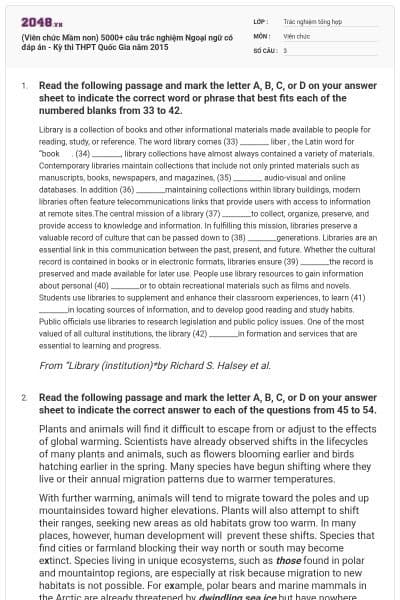
In Britain it is compulsory (1) __________ children to attend school (2) _______ the ages of five and sixteen. The school year is usually divided (3) _______ three terms. Each term is about 13 weeks, and each week pupils study about ten subjects. (4) _______ the end of the school year they take an exam (5) _______ each subject.
Under the old system, children receive their primary education (6) _______ an infant school and then a junior school, or a primary school that combines the two. (7) _______ eleven they had to sit (8) _______ the eleven-plus examination which consisted (9) _______ tests in English, Arithmetic and intelligence tests. Those (10) _______ the highest marks (about 20% of the children) were allowed to go to grammar school. The others were sent (11) _______ technical schools.
for
between
Into
At
at
At
For
The others were sent (11) _______ technical schools.
Đáp án: to
IX. Complete the second sentence so that it has a similar meaning to the first.
That‘s correct. The new ring road will be built through the wood.
The government confirmed ___________________________
The government confirmed that the new ring road would be built through the wood.
The architect has drawn plans for an extension to the house.
Plans _____________________________________
Plans for an extension to the house have been drawn (by the architect).
The heavy snow made it impossible for them to have their picnic.
They were prevented ________________________________
They were prevented from having their picnic by the heavy snow.
Everybody has agreed that changes to the scheme are necessary.
Changes __________________________________
Changes to the scheme have been agreed to be necessary.
My father didn‘t return to his hometown until the war ended.
Not until_________________________________
Not until the war (had) ended did my father return to his hometown.
He promised not to report me to the police.
I________________________________________
I was promised not to be reported to the police.
After twenty-five years of hard work, he made a decision to retire.
After he__________________________________
After he had worked hard for twenty years, he made a decision to retire.
They are going to rebuild our kitchen next week.
We_______________________________________
We are going to have our kitchen rebuilt next week.
Oh, just a minute, was it Leonardo or Michelangelo who painted the Mona Lisa?‘
He couldn‘t remember ______________________________
He couldn‘t remember if it was Leonardo or Michelangelo who painted/ had pained the Mona Lisa.
The Presidential visit attracted such an enormous crowd that all traffic came to a standstill.
So many people turned______________________________
So many people turned out to see the President that all traffic came to a standstill.