(Viên chức Mầm non) bài tập tiếng Anh theo chủ đề có đáp án - Test yourself
55 câu hỏi
I. Choose the word that has the underlined part pronounced differently from that of the others.
bride
confine
oblige
determine
interviewed
performed
finished
delivered
break
mean
weight
raise
II. Choose the word that has the main stress placed on the second syllable.
mischievous
informality
contractual
confidence
II. Choose the word that has the main stress placed on the second syllable.
sacrifice
diversity
wrongdoing
counterpart
III. Choose the word or phrase - a, b, c or d - that best completes the sentence.
We complained______ the landlord _____ the condition of the house.
on - about
at - for
with - of
to - about
I apologize being late, but I missed the bus.
In
For
On
To
How is Jane?
How does Jane like?
What does Jane look like?
Who does Jane look like?
special occasions such as weddings, gifts are an expected part of courtesy.
In
For
On
To
The Vietnamese have a very strong sense of so they always welcome their guests warmly.
hospitality
socialising
humour
communication
When he passed me in the street, he _______ a hand in greeting.
clapped
raised
shook
held
Since you’ve asked me why ________ there, I’ll tell you.
I went
did I go
had I gone
I was going
convenient
absolute
practical
customary
minds
objects
refuses
argues
did he prefer
that he preferred
if he prefers
whether he preferred
otherwise
moreover
therefore
however
We _____ go to the concert if the rain stops. We don't know for sure.
mustn’t
have to
might
wouldn’t
Tom said that he _______ nothing to upset Daisy the day before.
does
did
had done
was doing
people stay
people to stay
people staying
people will stay
Yes, please
No, thanks
Yes, I would
No, I wouldn‘t
IV. Give the correct form or tense of the verb in brackets.
Let the boy ___________ (try) it himself before you offer to help.
We had considerable difficulty ________ (find) anywhere to park.
finding
I _____ (go) there once a long time ago and _________ (not be) back since.
went - have not been
Our newest franchise ________ (open) in two months, so we need to start hiring new employees.
Some people believe the universe _________ (create) by a big explosion.
was created
V. Give the correct form of the word in brackets.
apologized
The best way to teach kids to be _____ is to encourage them! (obey)
obedient
You will need ________ and strength to complete this martial arts course. (determine)
determination
Schools play an important part in the ______________ of our children. (socialize)
The passengers push toward the edge of the platform and wait _________. (patient)
VI. Identify the one underlined word or phrase - A, B, C or D - that must be changed for the sentence to be correct.
When Jenny phoned last week, she said that she will be arriving this
A B C
morning, but she hasn‘t turned up.
D
The meeting scheduling for this morning has been canceled.
A B C D
I would rather that they do not travel during the bad weather, but they insist
A B C
that they must return home today.
D
Palm-sized computers that connect to the Internet are become very popular.
A B C D
My mother reminded me to remember to water her house plants.
A B C D
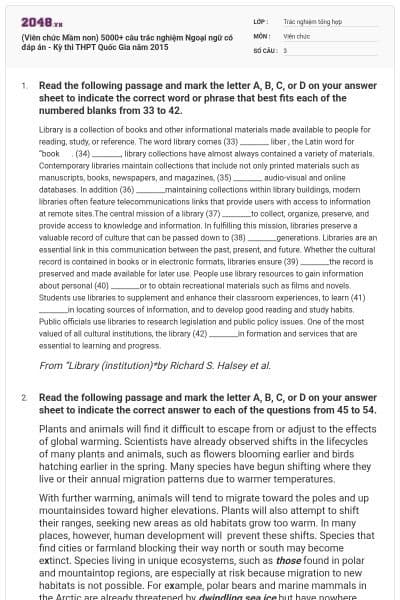
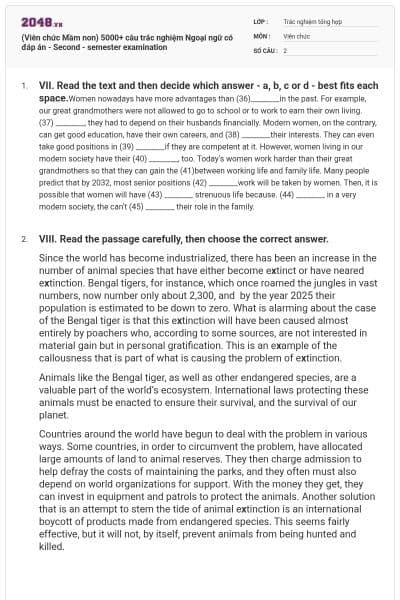
VII. Choose the word or phrase - a, b, c or d - that best fits the blank space in the following passage.
A very good friend of mine who is a British Asian, once summed this subject up very well for me. The difference between Asian and Western Culture he said, could be described in one word - FAMILY.
To the Asian culture, family is the most important thing. They tend to have more children than their Western (36) _________, they tend to live together or close together in what we Westerners would call a more old-fashioned (37) _________ family, and if you look around, there are very few Asian old people in Homes or Care Centres, because their families will always (38) _________ them in their old age.
If you look around your own circle of friends in the Western world (39) _________ you will almost certainly find that things are quite different. People usually move (40) _________ home to study, and quite possibly then make their own lives in their new, adopted city, - buying homes and having children some good way from their parents and childhood (41) _________. As the pressures of raising their own children and fulfilling their own careers grows bigger, they visit Mum and Dad less and less each year, until it is not (42) _________ for a man to visit his elderly parents only once a year. To an Asian family this is monstrous and disgusting. A work colleague of mine, (43) _________ is first generation British Asian, just cannot understand why her elderly, British neighbours receive maybe only two visits a year from their two children. The (44) _________ of keeping the family together, and of respecting your elders is generally (45) _________ stronger in Asian cultures.
partners
counterparts
colleagues
shareholders
extended
nuclear
Adoptive
immediate
get on
take in
look after
put down
moreover
consequently
therefore
however
away from
up to
back to
in on
experiences
homes
memories
years
common
uncommon
popular
unpopular
she
that
who
which
attitude
concept
opinion
situation
few
so
little
far
VIII. Read the passage carefully, then choose the correct answer.
Many people think that we can learn a lot about the culture of a foreign country simply by living in that country. However, this is not necessarily true. Often, the longer we stay in a foreign country, the more we realize how little we actually know about the culture of that country.
Books and talks about other people‘s culture can even be dangerous because they concentrate on cultural differences and exaggerate national character, and sometimes a lot of information they contain is untrue.
In a study recently carried out in Britain, people were asked to make a list of anything that they thought was typical of Britain and would interest a foreign visitor there. Most mentioned Shakespeare, the Queen, villages inns, English folk dancing, English castles, and fish chips wrapped in newspaper. Although all of these characters can be found in British culture, they do not show the real interests of ordinary British people: (They are, in fact, simply stereotype - that is, general character which people wrongly think are typical.) What is surprising is that they were suggested by British people themselves as representing their culture. If people have such a wrong impression of their own culture, how much false would their impression of other culture be!
we will sometimes forget about culture of our own country
we can often learn a lot about the culture of the foreign country
we will usually realize our own ignorance about its culture
we can seldom find out anything at all about its culture
concentrate on the dangers of the foreign
exaggerate national character
take no notice of culture difference
contain little information about culture.
When asked about their own culture, many British people _______
argued they knew little about British culture
said they themselves were not typical of British people
gave incorrect answers
were surprised by the question asked.
It can be inferred from the last paragraph that it‘s easy to __________ .
know a lot about your own country‘s culture
know the culture of other countries
give exact information about your own country
describe stereotypes of your country
Which of the following is true?
The culture of a foreign country can not be learned by reading books.
It‘s easy to assimilate the culture of a foreign country.
Visitors to a country are soon assimilated into its culture.
British people understand their own culture more than other culture.
IX. Choose the sentences - a, b, c or d - which is closest in meaning to the printed one.
“Why don‘t you have your house redecorated, Mike? said John.
John requested Mike to redecorate his house himself.
John asked why Mike didn‘t redecorate his house.
John suggested that Mike should have his house redecorated.
John persuaded Mike to have his house redecorated.
I‘m sorry that I didn‘t finish my homework last night.
If only I had finished my homework last night.
I promise to finish all my homework from now on.
I regret to say that I finished my homework last night.
I wish I didn‘t have to do my homework last night.
She asked if I had passed the English test the week before.
“Had you passed the English test the week before? she asked.
“Have you passed the English test the week before? she asked.
“Were you passed the English test last week, she asked.
“Did you pass the English test last week? she asked.
X. From the words or phrases - a, b, c or d - choose the one that best completes the sentences.
Rarely this professor has cancelled
Has this professor rarely cancelled
Has cancelled this professor rarely
Rarely has this professor cancelled
Please let me know _______ .
when is it time to go
when it is time to go
when time it is to go
when to go it is time