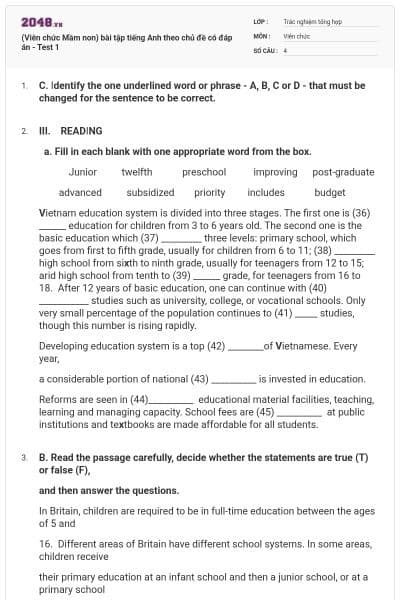
(Viên chức Mầm non) bài tập tiếng Anh theo chủ đề có đáp án - Test 1
60 câu hỏi
I. PRONUNCIATION
Choose the word that has the main stress placed differently from that of the others.
education
compulsory
academic
independent
secondary
primary
category
certificate
Algebra
History
Statistics
Chemistry
Geography
university
technology
methodical
general
separate
educate
October
II. LANGUAGE FOCUS
a. Choose the one word or phrase - a, b, c or d - that best completes the sentences.
Education in England is divided __________ primary, secondary, further and higher education.
in
into
up
with
On
To
In
At
at
from
between
by
enforced
compulsory
obliged
made
learning
studying
academic
educative
We acquire much of our world knowledge through __________ .
education
graduation
condition
examination
pass
make
take
follow
reached
completed
obtained
achieved
curriculums
subjects
schedules
syllabuses
The academic year in England runs from September to July and is divided into three __________ .
terms
semesters
seminars
systems
B. Choose the one word or phrase - a, b, c or d - that best completes the sentences.
a debate has
a debate was
has a debate
was a debate
is increasing
increased
has increased
has been increased
reported to have found
are reported to have found
are reported having found
are reported they have found
distribute
be distributing
be distributed
have distributed
repair
to repair
repairing
repaired
enveloped
was enveloped
has enveloped
has been enveloped
consider
are considering
are considered
had considered
has found
has been found
had been found
had found
have not yet determined
has not yet determined
have not yet been determined
has not yet determined
be frozen
must be frozen
frozen
it must be frozen
Roberta was the first person ________to speak at the meeting.
asked
to ask
to be asked
who asked
raises
will raise
raised
is raised
to be
being
there are
they are
have warned
warned
were warned
had warned
will react
reacts
is reacting
is reacted
C. Identify the one underlined word or phrase - A, B, C or D - that must be changed for the sentence to be correct.
Education is a subject which many British people deeply care about it.
A B C D
Most people believe that the state should provide education free in charge
A B C
and to a high standard.
D
Recently, there has been a lot of debate about students have to pay
A B C
their own fees at university.
D
Some people are afraid that poorer students will not be received enough
A B
financial help and will be discouraged from going on to higher education.
C D
A smaller percentage of British students go on to farther or higher
A B C
education than in any other European country.
D
III. READING
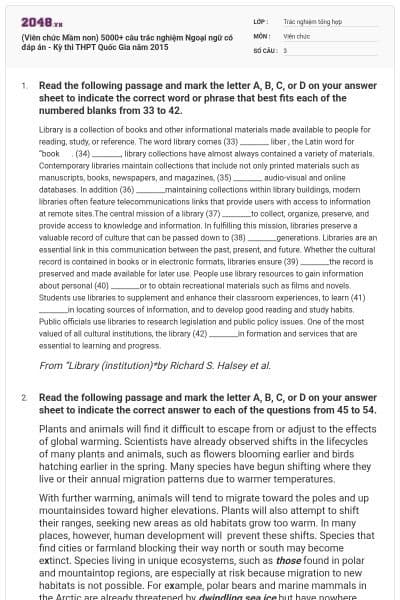
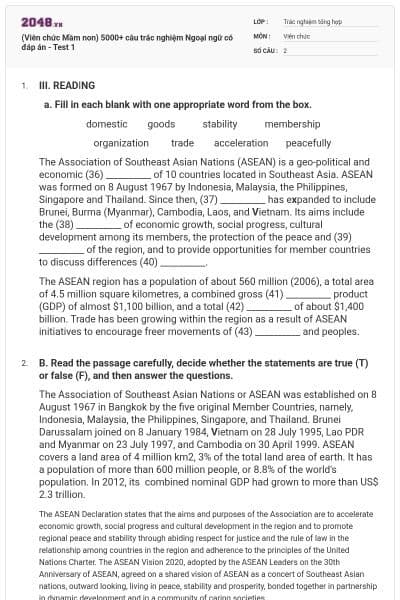
a. Fill in each blank with one appropriate word from the box.
Junior twelfth preschool improving post-graduate
advanced subsidized priority includes budget
Vietnam education system is divided into three stages. The first one is (36) ______ education for children from 3 to 6 years old. The second one is the basic education which (37) _________ three levels: primary school, which goes from first to fifth grade, usually for children from 6 to 11; (38) _________ high school from sixth to ninth grade, usually for teenagers from 12 to 15; arid high school from tenth to (39) ______ grade, for teenagers from 16 to 18. After 12 years of basic education, one can continue with (40) ___________ studies such as university, college, or vocational schools. Only very small percentage of the population continues to (41) _____ studies, though this number is rising rapidly.
Developing education system is a top (42) ________of Vietnamese. Every year,
a considerable portion of national (43) __________ is invested in education.
Reforms are seen in (44)__________ educational material facilities, teaching, learning and managing capacity. School fees are (45) __________ at public institutions and textbooks are made affordable for all students.
includes
Only very small percentage of the population continues to (41) _____studies, though this number is rising rapidly.
School fees are (45) __________ at public institutions and textbooks are made affordable for all students.
B. Read the passage carefully, decide whether the statements are true (T) or false (F),
and then answer the questions.
In Britain, children are required to be in full-time education between the ages of 5 and
16. Different areas of Britain have different school systems. In some areas, children receive
their primary education at an infant school and then a junior school, or at a primary school
that combines the two. At about 11 they begin their secondary education at a comprehensive
school, a grammar school or a high school. In other areas children go to a first school at age
5, a middle school at 8 and an upper school from 13 onwards.
Most children go to state schools. Until 1988 these were all responsible to a Local
Education Authority (LEA). LEAs obtain their funding from central government and the
council tax. In 1988 secondary schools and larger primary schools were encouraged to opt
out of LEA control and become grant-maintained.
Some children go to independent schools run by private organizations, for which their parents have to pay fees. A few go to public schools, such as Eton and Harrow. Younger children may attend a private preparatory school until the age of 13. Some parents may send their children to private schools, even if this is against their principles, because they think that their children will receive a better education.
The British education system aims to educate the whole person, so that each child develops his or her personality as well as gaining academic knowledge. Most primary and secondary schools offer a range of extra-curricular activities, including sports, music, community service and trips to places of interest. Secondary schools also give careers advice and help students to prepare for having a job by arranging short periods of work experience with local businesses.
True or false?
There are two parallel school systems in Britain.
Some English children receive their primary education at the age of 8.
Since 1988, most state schools have received money direct from central government.
Independent schools receive no money from the government.
Many activities outside normal lessons are offered at school in Britain.
School leavers in Britain are often ill-prepared for employment.
What's the school-leaving age in Britain?
It‘s sixteen.
What is the difference between a state school and an independent school?
A state school gets money from the government; an independent school depends on fee-paying students.
Why do some parents send their children to private schools?
Because they believe private schools provide a better education than state schools.
What is the purpose of the British education system?
The British education system aims to educate the whole person, so that each child develops his or her personality as well as gaining academic knowledge.
IV. WRITING
Choose the sentence - a, b, c or d - which is closest in meaning to the printed one.
It is said that two men were arrested after the explosion.
People said two men be arrested after the explosion.
Two men are said to be arrested after the explosion.
Two men are said to have been arrested after the explosion.
Two men were said to be arrested after the explosion.
The court found a murdered man and his wife.
The court decided that the man had killed his wife.
The man was found murdered by his wife.
The man was judged not guilty of killing his wife.
No sooner had the plane landed than the storm broke.
The plane had to land because of the outbreak of the storm.
Only when the storm broke had the plane landed.
The storm broke before the plane landed.
Don‘t let her treat you like that.
She isn‘t let treat you like that.
You are riot let be treated by her like that.
Don‘t allow you to be treated like that by her.
Don‘t let yourself be treated by her like that.
Only customers with coupons may use the service.
The service is available for coupons only.
The service is restricted to customers in possession of coupons.
Only rich customers can use the service.
Only customers with coupons are serviced here.