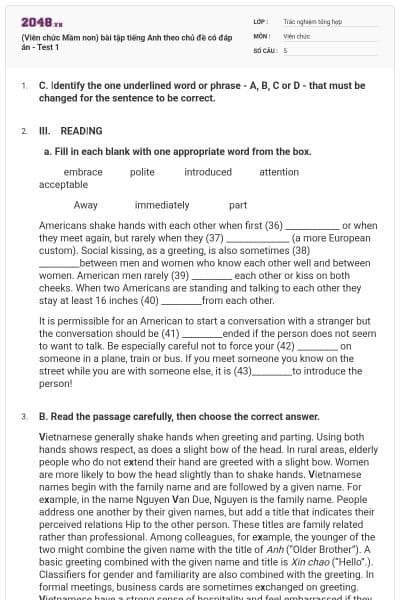
(Viên chức Mầm non) bài tập tiếng Anh theo chủ đề có đáp án - Test 1
60 câu hỏi
approach
attract
decent
install
marvelous
assistant
maximum
argument
apologetic
communicate
attention
appropriate
verbal
polite
common
social
compliment
absolute
fashionable
suppose
to - about
with - for
to - at
with - on
on
to
of
from
on
out
at
up
verbal
non-verbal
formal
informal

Học thông minh hơn mỗi ngày
Xem toàn bộ 60 câu hỏi và nhiều hơn nữa với tài khoản miễn phí
objections
refusals
resistances
disagreements
notice
care
mind
attention
attract
raise
catch
meet
agreements
assistance
compliments
arguments
sensitive
impolite
informal
polite
normal
common
wide
complete
can the children
whether the children could
if the children can
could the children
will telephone
have telephoned
would phoned.
had phoned
is - will travel
were - would travel
was - would have traveled
had been - would have traveled
already paid
have already paid
had already paid
was already paid
whether have you got
that you‘ve got
if you‘ve got
how you‘ve got
don‘t sit
not sit
not to sit
to not sit
to know
knowing
for knowing
that they know
the following day
the next day
the day after tomorrow
the previous day
he had borrowed
had he borrowed
did he borrowed
he would borrow
remember to pay
not to forget to pay
to pay
of paying
will be - are feeling
was - was felt
would be - would feel
would be - was feeling
whether was my father working
if my father was working
whether my father had been working
was my father working
am not going to go
was not going to go
would not go
was not able to go
was leaving
had left
would leaved
would have left
would check
checks
had checked
was checked
Part
Attention
In most cases, Vietnamese greet each other with a handshake.
To show respect, they do a slight bow while using both hands to shake.
Vietnamese women never shake hands, so they bow the head slightly when greeting.
Elderly people in rural areas do not often shake hands when greeting and saying good-bye.
A family name, a given name, and then a middle name
A given name, middle name, and then a family name
A middle name, a given name, and then a family name
A family name, a middle name, and then a given name
with their family name in formal situations
with their given name, even in formal situations
with their given name and a title “Mr.” or “Mrs.”
with their full name and a title which is family related
they often feel worried about what other people will think
they cannot show their guests full respect
they do not like to be visited unexpectedly
they always prepare for their arrival
often offer gifts to the hosts on their visit
sometimes give the host‘s children gifts
usually welcome guests with flowers
always require gifts for their children or their parents
You‘re too kind.
That‘s a nice compliment!
You‘ve got to be kidding!
Oh, thank you very much.
It‘s nice of you to say so.
It‘s my pleasure,
You‘re welcome
That‘s okay.
When have you got this beautiful dress?
You‘ve just bought this beautiful dress, haven‘t you?
How a beautiful dress you‘re wearing!
That‘s a beautiful dress you have on!
It‘s my pleasure.
I‘m glad you like it.
I guess you‘re right.
Sure, I‘ll be glad to.
Thanks a lot.
I‘m sorry I don‘t like it.
I hate it.
That‘s a nice compliment
John told Jane to help him with the washing-up.
John asked if Jane should help him with the washing-up.
John suggested helping Jane with the washing-up.
John offered to help Jane with the washing-up.
He asked me what will I do if I have ten days off school.
He asked what I will do if I have ten days off school.
He asked me what I would do if I had ten days off school.
He asked what would I do if I had ten days off school.
My friend advised me to apologize for being so rude.
My friend offered me to apologize for being so rude.
My friend warned me to apologize for being so rude.
My friend suggested me apologizing for being so rude.
Henry said good morning Mary and asked how was she.
Henry greeted Mary and asked how is she.
Henry said good morning and asked Mary how she is.
Henry greeted Mary and asked how she was.
Sarah told us -do not leave until she comes back.
Sarah asked us not leave until she came back.
Sarah told us hot to leave until she came back.
Sarah said to us to not leave until she comes back.
The students asked how the final test was difficult.
The students exclaimed that the final test was so difficult.
The students wondered if it was a difficult final test.
The students said that how difficult the final‘ test was.
I warned him to be careful as the steps were very slippery.
I suggested being careful as the steps were very slippery.
I threatened him to be careful and said the steps were very slippery.
I told him be careful and the steps were very slippery.
Bạn có thích hoạt động này không?
Hãy lưu hoặc chia sẻ nội dung này đến mọi người.
Gợi ý cho bạn

Ý tưởng của bạn, bài học của bạn
Tự thiết kế đề thi, bài giảng hoặc flashcard theo cách riêng.


Học liệu phổ biến Trắc nghiệm tổng hợp
Trắc nghiệm tổng hợp
Bài tập vừa sức, đúng lớp
Chọn nội dung phù hợp và tạo hoạt động cho lớp của bạn.