(Viên chức Mầm non) bài tập tiếng Anh theo chủ đề có đáp án - Second - semester examination
55 câu hỏi
I. Choose the word that has the underlined part pronounced differently from that of the other.
cause
abroad
appall
involve
I. Choose the word that has the underlined part pronounced differently from that ofthe other.
efficient
Christianity
unsure
initiate
I. Choose the word that has the underlined part pronounced differently from that ofthe other.
composed
stressed
noticed
researched
II. Choose the word that has the main stress placed differently from that of theothers.
vulnerable
epidemic
intellectual
integration
II. Choose the word that has the main stress placed differently from that of theothers.
survive
digest
advocate
discriminate
II. Choose the word that has the main stress placed differently from that of theothers.
More than half of the population are suffering __________malnutrition.
With
in
from
by
build up
make up
stand for
turndown
take after
take place
take in
takeout
run out
catch up
turned in
taken over
so that not to
so not to
so as not to
so that not
association
institution
organization
corporation
Sorry, you can‘t
Yes, please
Yes, of course
It‘s OK, thanks
As
Unless
When
Though
Must
mustn't
shouldn't
needn't
Therefore
However
Consequently
But
Found
Founding
Having Founded
Founded
Who
whose
whom
which
as popular as
more popular than
the most popular
most popular
Even though
Because of
Due to
Despite
You‘re welcome
That‘s a good idea
Oh, I didn‘t realize it
Well, actually I‘d rather you didn‘t
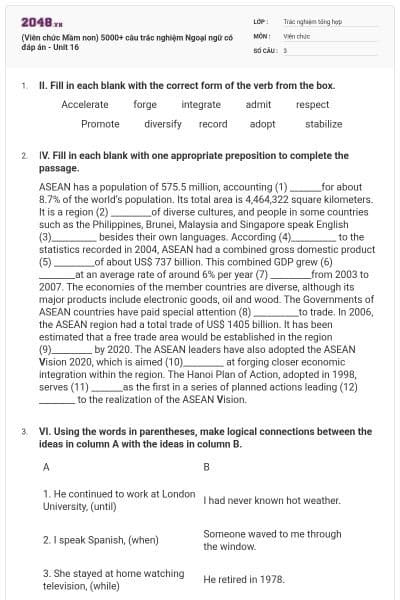
IV. Give the correct form or tense of the verb in brackets.
Every man, woman, and child__________ (protect) under the law.
is protected
Henry __________ (be) a rich man today if he had been more careful in the past.
would be
When we met John last year, he__________ (graduate) from Harvard already.
had graduated
Please stop__________ (cry) and tell me what‘s wrong.
We are considering__________ (buy) a new car. Do you know any car dealer?
Buying
V. Give the correct form of the word in brackets.
A legal ban on the hunting of wildlife is not strictly__________. (force)
A mobile phone makes you__________ wherever you are. (contact)
contactable
Many drivers are__________ of the dangers of using cell phones while driving. (aware)
Many__________ organizations have tried to fight against child abuse. (humane)
Humanitarian
ASEAN has__________ worked to improve the socio-economic situation. (act)
VI. Choose the underlined word or phrase - a, b, c or d - that needs correcting.
The teacher told the students to not discuss the take-home exam with each other.
A B C D
They are not old enough to take part this program of the World Health Organization.
A B C D
She asked whether I have passed my driving test the week before .
A B C D
Because the torrential rain that had devastated the area, the governor sent the National Guard to assist in the clean-up operation.
A B C D
A new law prohibits one to use a mobile phone while driving.
A B C D
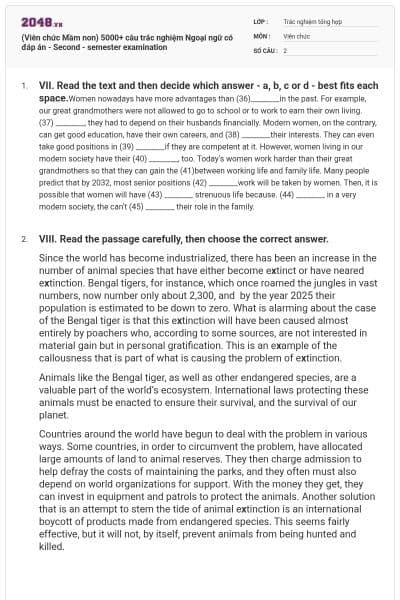
VII. Read the text and then decide which answer - a, b, c or d - best fits each space.
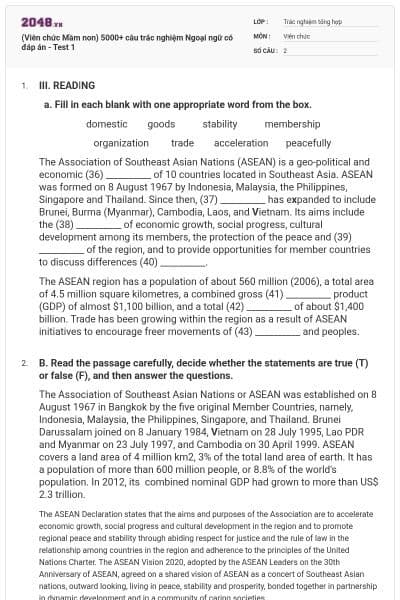
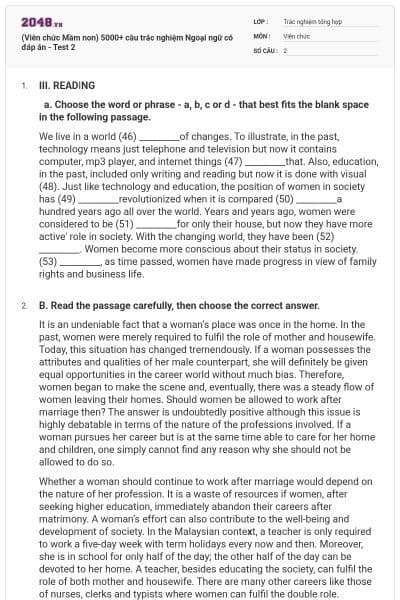
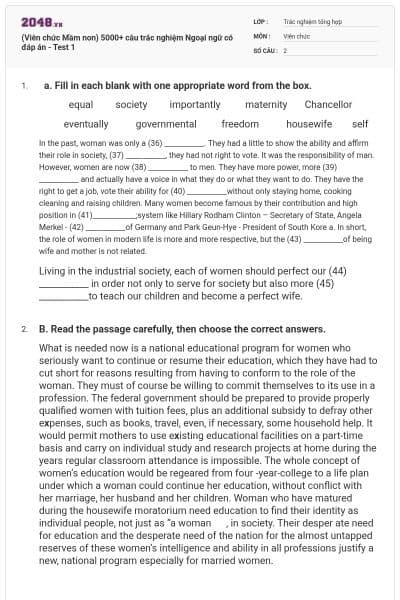
Women nowadays have more advantages than (36)________in the past. For example,
our great grandmothers were not allowed to go to school or to work to earn their own living.
(37) ________, they had to depend on their husbands financially. Modern women, on the
contrary, can get good education, have their own careers, and (38) ________their interests.
They can even take good positions in (39) ________if they are competent at it. However,
women living in our modern society have their (40) ________, too. Today‘s women work
harder than their great grandmothers so that they can gain the (41)between working life and
family life. Many people predict that by 2032, most senior positions (42) ________work will be taken by women. Then, it is possible that women will have (43) ________ strenuous life because. (44) ________ in a very modern society, the can‘t (45) ________ their role in the family.
them
that
these
those
Furthermore
However
As a result
Although
pursue
share
promote
adopt
politician
politics
politic
political
advantanges
matters
profits
problems
equality
stability
balance
steadiness
at
in
for
of
much
many
more
most
though
even
ever
never
the can‘t (45) ________ their role in the family.
provide
play
fulfill
neglect
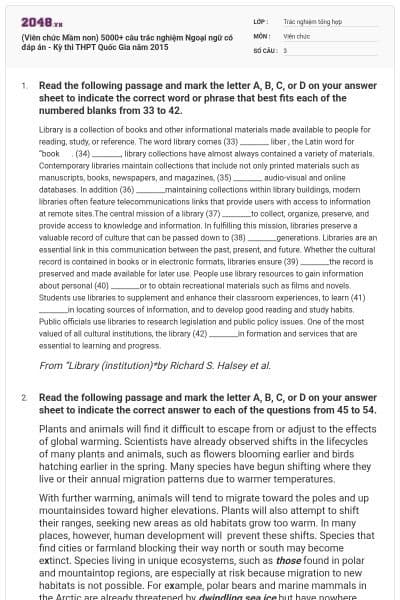
VIII. Read the passage carefully, then choose the correct answer.
Since the world has become industrialized, there has been an increase in the number of animal species that have either become extinct or have neared extinction. Bengal tigers, for instance, which once roamed the jungles in vast numbers, now number only about 2,300, and by the year 2025 their population is estimated to be down to zero. What is alarming about the case of the Bengal tiger is that this extinction will have been caused almost entirely by poachers who, according to some sources, are not interested in material gain but in personal gratification. This is an example of the callousness that is part of what is causing the problem of extinction.
Animals like the Bengal tiger, as well as other endangered species, are a valuable part of the world‘s ecosystem. International laws protecting these animals must be enacted to ensure their survival, and the survival of our planet.
Countries around the world have begun to deal with the problem in various ways. Some countries, in order to circumvent the problem, have allocated large amounts of land to animal reserves. They then charge admission to help defray the costs of maintaining the parks, and they often must also depend on world organizations for support. With the money they get, they can invest in equipment and patrols to protect the animals. Another solution that is an attempt to stem the tide of animal extinction is an international boycott of products made from endangered species. This seems fairly effective, but it will not, by itself, prevent animals from being hunted and killed.
What is the main topic of the passage?
the Bengal tiger
international boycotts
endangered species
problems with industrialization
a problem and a solution
a statement and an illustration
a comparison and a contrast
specific and general information
endangered species that are increasing
poachers who seek personal gratification
Bengal tigers that are decreasing
sources that may not be accurate
Since the world. ..down to zero.
What is alarming...personal gratification,
Country around. ..for support.
With the money...dangered species.
Which of the following best describes the author‘s attitude?
Forgiving
Critical
Concerned
Surprised
IX. From the words or phrases - a, b, c or d - choose the one that best completes the sentences.
They suggested________.
everyone to write a letter to the governor
everyone writes a letter to the governor
that everyone could write a letter to the governor
that everyone should write a letter to the governor
it was difficult for her to arrive on time
she was unable to arrive on time
it was impossible for her to arrive on time
her being late was intolerable
in the same amount of information
and have the same amount of information
the information is the same as
the same amount of information as
X. Choose the sentences - a, b, c or d - which is closest in meaning to the printed one.
‘Will you please water the plants while I‘m away?‘
He begged me to water the plants while he was away.
He persuaded me to water the plants while he was away.
He asked me to water the plants while he was away.
He wanted to know if I would water the plants while he was away.
As I get older, I want to travel less.
I‘m getting older and older, so I don‘t want to travel more.
The more I get old, the less I want to travel.
I don‘t want to travel because of my old age.
The older I get, the less I want to travel.