(Viên chức Mầm non) bài tập tiếng Anh theo chủ đề có đáp án - Kì thi THPT Quốc Gia năm 2015
69 câu hỏi
SECTION A (8 points)
deal
teach
break
clean
Mark the letter A, B, C, or D on your answer sheet to indicate the word whose underlined part differs from the other three in pronunciation in each of the following questions.
supported
approached
noticed
finished
Mark the letter A, B, C, or D on your answer sheet to indicate the word that differs from the other three in the position of primary stress in each of the following questions.
recipe
candidate
instrument
commitment
Mark the letter A, B, C, or D on your answer sheet to indicate the word that differs from the other three in the position of primary stress in each of the following questions.
conceal
contain
conserve
conquer
Mark the letter A, B, C, or D on your answer sheet to indicate the word that differs from the other three in the position of primary stress in each of the following questions.
advantageous
oceanic
compulsory
influential
Mark the letter A, B, C, or D on your answer sheet to indicate the correct answer toeach of the following questions.
whose
whom
who
that
needn’t
oughtn’t
couldn’t
haven’t
Despite
Although
And
But
will build
will be built
are being built
will be building
to go
having gone
gone
going
produced
hadn‘t produced
didn‘t produce
don‘t produce
at
on
in
by
in
for
of
With
composed
created
included
consisted
nice brown wooden
brown wooden nice
nice wooden brown
wooden brown nice
of
to
in
from
out of order
out of mind
out of work
out of reach
catch up with
look up to
come up to
put up with
twice many as
as twice many
as many twice
twice as many
Familiar
typical
ordinary
common
Such characters as fairies or witches in Walt Disney animated cartoons are purely________
Imaginary
imagining
imaginative
imaginable
We had arrived hardly
We have hardly arrived
Hardly we had arrived
Hardly had we arrived
Mike and Lane are university students. They are talking about Lane‘s upcoming high - school reunion. Select the most suitable response to fill in the blank.
Mike: “So, you have your fifth high -school reunion coming up?
Lane: “ ________
Oh, the school reunion was wonderful.
The food at the reunion was excellent.
Yeah. I‘m really looking forward to it.
No. You‘re in no mood for the event.
Ken: “Where is our study group going to meet next weekend?
Tom: “ ________
We are too busy on weekdays.
The library would be best.
Why don‘t you look at the atlas?
Studying in a group is great fun.
Mark the letter A, B, C, or D on your answer sheet to indicate the word(s) CLOSEST in meaning to the underlined word(s) in each of the following questions.
When Susan invited us to dinner, she really showed off her culinary talents. She prepared a feast - a huge selection of dishes that were simply mouth-watering.
concerning nutrition and health
involving hygienic conditions and diseases
relating to medical knowledge
having to do with food and cooking
very tired
refreshed
completely wet
cleansed
”It‘s no use talking to me about metaphysics. It‘s a closed book to me .
an object that I really love
a book that is never opened
a subject that I don‘t understand
a theme that I like to discuss
Mark the letter A, B, C, or D on your answer sheet to indicate the underlined part that needs correction in each of the following questions.
It is common knowledge that solar heating for a large office building is technicallydifferent from a single-family home.
A B C D
The number of homeless people in Nepal have increased sharply due to the recent severe earthquake .
A B C D
All the candidates for the scholarship will be equally treated regarding of their age, sex, or nationality .
A B C D
Since poaching is becoming more seriously, the government has imposed stricter laws to prevent it.
A B C D
Reminding not to miss the 15:20 train, the manager set out for the station in a hurry .
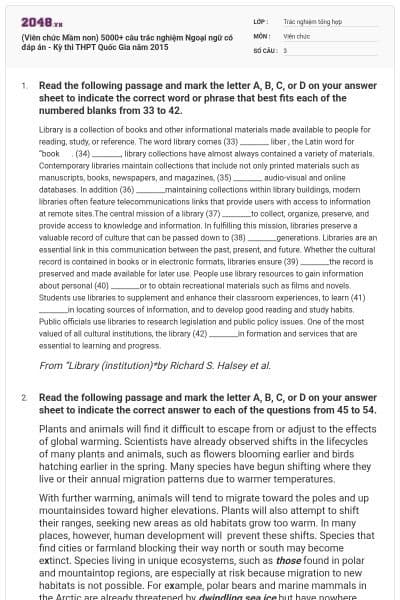
A B C DRead the following passage and mark the letter A, B, C, or D on your answer sheet to indicate the correct word or phrase that best fits each of the numbered blanks from 33 to 42.
From “Library (institution)*by Richard S. Halsey et al.
from
in
to
out
Despite
However
Therefore
Instead
only if
as well
or else
but also
on
to
in
from
are
is
have
has
succeeding
succeed
successful
success
what
which
who
that
profits
attractions
interests
appeals
abilities
skills
talents
capacities
relates
applies
supplies
digests
Mark the letter A, B, C, or D on your answer sheet to indicate the word(s) OPPOSITE in meaning to the underlined word(s) in each of the following questions.
“Don‘t be such a pessimist. I‘m sure you‘ll soon get over it. Cheer up!
Activist
feminist
optimist
hobbyist
“Be quick! We must speed up if we don‘t want to miss the flight.
turn down
look up
slow down
put forward
Read the following passage and mark the letter A, B, C, or D on your answer sheet to indicate the correct answer to each of the questions from 45 to 54.
Plants and animals will find it difficult to escape from or adjust to the effects of global warming. Scientists have already observed shifts in the lifecycles of many plants and animals, such as flowers blooming earlier and birds hatching earlier in the spring. Many species have begun shifting where they live or their annual migration patterns due to warmer temperatures.
With further warming, animals will tend to migrate toward the poles and up mountainsides toward higher elevations. Plants will also attempt to shift their ranges, seeking new areas as old habitats grow too warm. In many places, however, human development will prevent these shifts. Species that find cities or farmland blocking their way north or south may become extinct. Species living in unique ecosystems, such as those found in polar and mountaintop regions, are especially at risk because migration to new habitats is not possible. For example, polar bears and marine mammals in the Arctic are already threatened by dwindling sea ice but have nowhere farther north to go.
Projecting species extinction due to global warming is extremely difficult. Some scientists have estimated that 20 to 50 percent of species could be committed to extinction with 2 to 3 Celsius degrees of further warming. The rate of warming, not just the magnitude, is extremely important for plants and animals. Some species and even entire ecosystems, such as certain types of forest, may not be able to adjust quickly enough and may disappear.
Ocean ecosystems, especially fragile ones like coral reefs, will also be affected by global warming. Warmer ocean temperatures can cause coral to “bleach , a state which if prolonged will lead to the death of the coral. Scientists estimate that even 1 Celsius degree of additional warming could lead to widespread bleaching and death of coral reefs around the world. Also, increasing carbon dioxide in the atmosphere enters the ocean and increases the acidity of ocean waters. This acidification further stresses ocean ecosystems.
From “Global Warming" by Michael Mastrandrea and Stephen H. Schneider
die instantly
bloom earlier
become lighter
lose color
According to paragraph 2, when their habitats grow warmer, animals tend to move________.
south-eastwards and down mountainsides toward lower elevations
north-westwards and up mountainsides toward higher elevations
toward the North Pole and down mountainsides toward lower elevations
toward the poles and up mountainsides toward higher elevations
The pronoun “those” in paragraph 2 refers to ________
Species
ecosystems
habitats
areas
The phrase “dwindling sea ice in paragraph 2 refers to ________.
the frozen water in the Arctic
the violent Arctic Ocean
the melting ice in the Arctic
the cold ice in the Arctic
It is mentioned in the passage that if the global temperature rose by 2 or 3 Celsius degrees, ________ .
half of the earth‘s surface would be flooded
the sea level would rise by 20 centimeters
water supply would decrease by 50 percent
20 to 50 percent of species could become extinct
According to the passage, if some species are not able to adjust quickly to warmer temperatures,.
they may be endangered
they can begin to develop
they will certainly need water
they move to tropical forests
very large
easily damaged
rather strong
pretty hard
the water absorption of coral reefs
the quick growth of marine mammals
the blooming phase of sea weeds
the slow death of coral reefs
The level of acidity in the ocean is increased, by ________.
the rising amount of carbon dioxide entering the ocean
the decrease of acidity of the pole waters
the extinction of species in coastal areas
the loss of acidity in the atmosphere around the earth
What does the passage mainly discuss?
Influence of climate changes on human lifestyles
Effects of global warming on animals and plants
Global warming and possible solutions
Global warming and species migration
Read the following passage and mark the letter A, B, C, or D on your answer sheet to indicate the correct answer to each of the questions from 55 to 64.
Overpopulation, the situation of having large numbers of people with too few resources and too little space, is, closely associated with poverty. It can result from high population density, or from low amounts of resources, or from both. Excessively high population densities put stress on available resources. Only a certain number of people can be supported on a given area of land, and that number depends on how much food and other resources the land can provide. In countries where people live primarily by means of simple farming. gardening, herding, hunting, and gathering, even large areas of land can support only small numbers of people because these labor-intensive subsistence activities produce only small amounts of food.
In developed countries such as the United States, Japan, and the countries of Western Europe, overpopulation generally is not considered a major cause of poverty. These countries produce large quantities of food through mechanized farming, which depends on commercial fertilizers, large-scale irrigation, and agricultural machinery. This form of production provides enough food to support the high densities of people in metropolitan areas.
A country's level of poverty can depend greatly on its mix of population density and agricultural productivity. Bangladesh, for example, has one of the world's highest population densities, with 1,147 persons per sq km. A large majority of the people of Bangladesh engage in low-productivity manual farming, which contributes to the country's extremely high level of poverty. Some of the smaller countries in Western Europe, such as the Netherlands and Belgium, have high population densities as well. These countries practice mechanized farming and are involved in high-tech industries, however, and therefore have high standards of living.
At the other end of the spectrum, many countries in sub-Saharan Africa have population densities of less than 30 persons per sq km. Many people in these countries practice manual subsistence farming; these countries also have infertile land, and lack the economic resources and technology to boost productivity. As a consequence, these nations are very poor. The United States has both relatively low population density and high agricultural productivity; it is one of the world's wealthiest nations.
High birth rates contribute to overpopulation in many developing countries. Children are assets to many poor families because they provide labor, usually for farming. Cultural norms in traditionally rural societies commonly sanction the value of large families. Also, the governments of developing countries often provide little or no support, financial or political, for family planning, even people who wish to keep their families small have difficulty doing so. For all these reasons, developing countries tend to have high rates of population growth.
From Poverty by Thomas J. Corbett
Which of the following is given a definition in paragraph 1?
Overpopulation
Population density
Simple farming
Poverty
What will suffer when there are excessively high population densities?
Available resources
Skilled labor
Farming methods
Land area
The phrase “that number in paragraph 1 refers to the number of ________.
people
densities
resources
countries
In certain countries, large areas of land can only yield small amounts of food because ________.
there is lack of mechanization
there are small numbers of laborers
there is an abundance of resources
there is no shortage of skilled labor
Bangladesh is a country where the level of poverty depends greatly on ________.
its population density only
both population density and agricultural productivity
population density in metropolitan areas
its high agricultural productivity
The phrase “engage in in paragraph 3 is closest in meaning to ________.
escape from
look into
give up
participate in
The word “infertile in paragraph 4 probably means ________.
Disused
impossible
unproductive
inaccessible
Which of the following is TRUE, according to the passage?
In certain developed countries, mechanized farming is applied.
In sub-Saharan African countries, productivity is boosted by technology.
There is no connection between a country‘s culture and overpopulation.
All small countries in Western Europe have high population densities.
Which of the following is a contributor to overpopulation in many developing countries?
High-tech facilities
Economic resources
Sufficient financial support
High birth rates
Which of the following could be the best title for the passage?
High Birth Rate and its Consequences
Overpopulation: A Cause of Poverty
Overpopulation: A Worldwide Problem
Poverty in Developing Countries
SECTION B (2 points)
I. Finish each of the following sentences in such a way that it means the same as the sentence printed before it. Write your answers on your answer sheet.
If John does not change his working style, he will be sacked soon.
Unless ______________________________________________________________
Unless John changes his working style, he will be sacked soon.
“Would you like to come to my 18th birthday party? he asked me.
He invited ______________________________________________________________
He invited me (to come) to his 18th birthday party.
People believe that this new teaching method is more effective than the old one.
This new teaching method ____________________________________________________
This new teaching method is believed to be more effective than the old one.
He did not realize how difficult the task was until he was halfway through it.
Not until ______________________________________________________________
Not until he was halfway through the task did he realize how difficult it was./ Not until he was halfway through it did he realize how difficult the task was.
It was wrong of you to leave the class without asking for your teacher‘s permission.
You should not ____________________________________________________________
You should not have left the class without asking for your teacher‘s permission.