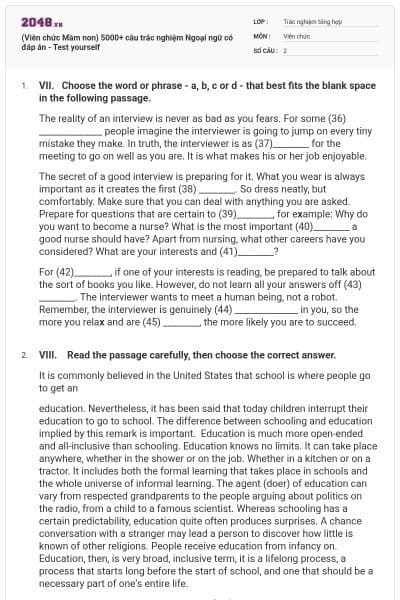
(Viên chức Mầm non) 5000+ câu trắc nghiệm Ngoại ngữ có đáp án - Test yourself
55 câu hỏi
I. Choose the word that has the underlined part pronounced differently from that of the others.
manufacture
future
nursery
secure
I. Choose the word that has the underlined part pronounced differently from that of the others.
certificate
central
decision
social
I. Choose the word that has the underlined part pronounced differently from that of the others.
interviewed
finished
worked
dressed
application
university
economic
enthusiasm
proficient
preference
argument
interviewer
with
on
in
from
in
on
for
about
carry out
turn out
carry on
keep on
injuring
injured
to be injured
who injured
I don‘t too
either don‘t I
neither don’t I
neither do I
did I intend
I intended
would I intend
I had intended
Provided
In case
Should
Had
on account of
in spite of
in addition for
because of
sources
vacancies
aspects
prospects
provides
is provided
which provides
providing it
was rushing
were rushing
were rushed
was rushed
Don‘t say that.
That‘s right.
You‘re welcome.
Never mind.
self-conscious
self-confident
self-satisfied
selfish
you were looking for
which you were looking
for that you were looking
you were looking
Best wishes!
Good idea.
Congratulation!
With pleasure.
IV. Give the correct form or tense of the verb in brackets.
My boss had his assistant _____ (send) the document to him while he was away on business.
I‘m really tired today. I wish I __________ (not stay) late at the party last night.
We were late because of the traffic jam. By the time we ____ (get) to the train station, Susan __________ (wait) for us more than two hours.
got - had been waiting
It __________ (be) a much more serious accident had she been driving fast at the time.
It‘s twenty years since I _______ (work) in Germany and my German is pretty rusty now.
worked
V. Give the correct form of the word in brackets.
What kind of job __________ do you have?‘ the manager asked the applicant. (qualify)
At the end of the interview, the __________ asked if he could be shown around the company. (interview)
We couldn‘t go on holidays last year because I was __________ for ten months. (employ)
unemployed
Artists must be _________; otherwise they just repeat what they see or hear. (create)
Representatives __________ supported her comments on the need to reform family law. (enthusiast)
enthusiastically
VI. Identify the one underlined word or phrase - A, B, C or D - that must be changed for the sentence to be correct.
Both the red and the white poppy grows wild in mountainous areas that receive a lot of sun.
A B C D
The windmill, which has been used for hundreds of years to pump water
A B C
and grind grains, it is now being redesigned to produce electricity.
D
An interview is a meeting in that you are asked questions to see if you are suitable for doing a job.
A B C D
Small computers need only a small number of power, which means that they will run on small batteries.
A B C D
The average American college costs more than eight thousands dollars per year.
A B C D
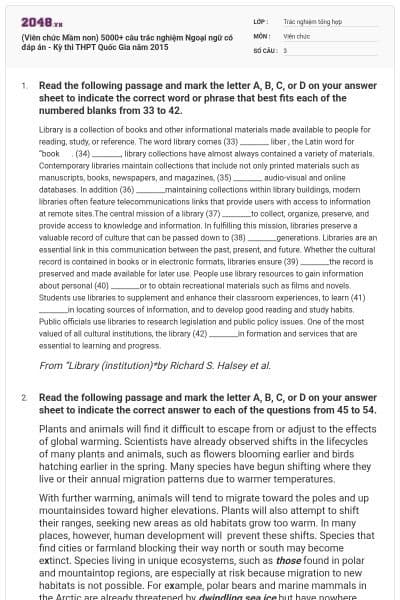
VII. Choose the word or phrase - a, b, c or d - that best fits the blank space in the following passage.
The reality of an interview is never as bad as you fears. For some (36) ______________ people imagine the interviewer is going to jump on every tiny mistake they make. In truth, the interviewer is as (37)________ for the meeting to go on well as you are. It is what makes his or her job enjoyable.
The secret of a good interview is preparing for it. What you wear is always important as it creates the first (38) ________. So dress neatly, but comfortably. Make sure that you can deal with anything you are asked. Prepare for questions that are certain to (39)________, for example: Why do you want to become a nurse? What is the most important (40)________ a good nurse should have? Apart from nursing, what other careers have you considered? What are your interests and (41)________?
For (42)________, if one of your interests is reading, be prepared to talk about the sort of books you like. However, do not learn all your answers off (43) ________. The interviewer wants to meet a human being, not a robot. Remember, the interviewer is genuinely (44) ______________ in you, so the more you relax and are (45) ________, the more likely you are to succeed.
reasons
ideas
explanations
excuses
willing
likely
keen
scary
impression
attraction
expression
understanding
carry on
turn down
get through
come up
quality
education
activity
attention
entertains
hobbies
challenges
excitement
request
Question
acceptance
instance
continually
by heart
naturally
by yourself
excited
regarded
interested
wondered
yourself
you
your
yours
VIII. Read the passage carefully, then choose the correct answer.
It is commonly believed in the United States that school is where people go to get an
education. Nevertheless, it has been said that today children interrupt their education to go to school. The difference between schooling and education implied by this remark is important. Education is much more open-ended and all-inclusive than schooling. Education knows no limits. It can take place anywhere, whether in the shower or on the job. Whether in a kitchen or on a tractor. It includes both the formal learning that takes place in schools and the whole universe of informal learning. The agent (doer) of education can vary from respected grandparents to the people arguing about politics on the radio, from a child to a famous scientist. Whereas schooling has a certain predictability, education quite often produces surprises. A chance conversation with a stranger may lead a person to discover how little is known of other religions. People receive education from infancy on. Education, then, is very broad, inclusive term, it is a lifelong process, a process that starts long before the start of school, and one that should be a necessary part of one‘s entire life.
Schooling, on the other hand, is a specific, formalized process, whose general pattern varies little from one setting to the next.
Throughout a country, children arrive at school at about the same time, take the assigned seats, are taught by an adult, use similar textbooks, do homework, take exams, and so on. The pieces of reality that are to be learned, whether they are the alphabet or an understanding of the workings of government, have been limited by the subjects being taught. For example, high school students know that they are not likely to find out in their classes the truth about political problems in their society or what the newest filmmakers are experimenting with. There are clear and undoubtful conditions surrounding the formalized process of schooling.
gives examples of different school
provides information about an excellent all-round education
lists and discusses several education problems
tells the difference between the meanings of two related words
Which of the following statements does the passage support?
Education systems need to be changed as soon as possible.
Without formal education, people won‘t be able to read and write.
Going to school is only part of how people become educated.
Schooling is of no use because students do similar things every day.
What does the writer mean by using the expression “children interrupt their education to go to school in paragraph 1?
All of life is an education.
Learning takes place everywhere.
Education is totally ruined -by schooling.
Schooling prevents people from discovering new things.
What‘s the main idea of this passage?
The best schools teach a variety of subjects.
Education and schooling are quite different experience.
The more years students go to school the better their education is.
Students benefit from schools, which require long hours and homework.
Education is a necessary part of one‘s life.
Schooling is a part of education people receive.
Only at school can people get a good all-round education
People receive education before the start of school.
IX. Choose the sentences - a, b, c or d - which is closest in meaning to the printed one.
If I have enough money I will go on holiday.
If I had enough money I would go on holiday.
If I had got enough money I would have gone on holiday.
If I had had enough money I would go on holiday.
“Why can‘t you do your work more carefully?” said Henry‘s boss.
Henry‘s boss asked him not to do his job with care.
Henry‘s boss suggested doing the job more carefully.
Henry‘s boss warned him to do the job carefully.
Henry‘s boss criticized him for doing his job carelessly.
Who wrote the novel “Gone With the Wind?
Who was the novel “Gone With the Wind written?
By who was the novel “Gone With the Wind written?
By whom was the novel “Gone With the Wind written?
Whose the novel “Gone With the Wind was written?
X. From the words or phrases - a, b, c or d - choose the one that best completes the sentences.
several conclusions could be made by the scientist
the scientist could make several conclusions
the scientist spent little time to reach several conclusions
several conclusions were drawn from the scientists‘ discussion
She will be ill ________.
if she takes a few days‘ rest
provided she takes a rest for a few days
in case she takes a rest for a few days
unless she takes a few days‘ rest