(Viên chức Mầm non) 5000+ câu trắc nghiệm Ngoại ngữ có đáp án - Test 2
65 câu hỏi
I. PRONUNCIATION
a. Choose the word that has the underlined part pronounced differently from that of the others.
swallow
taste
pages
detail
a. Choose the word that has the underlined part pronounced differently from that of the others.
please
reading
cheap
pleasure
a. Choose the word that has the underlined part pronounced differently from that of the others.
conclusion
measure
resource
usually
a. Choose the word that has the underlined part pronounced differently from that of the others.
swallow
knowledge
slowly
following
a. Choose the word that has the underlined part pronounced differently from that of the others.
queue
quick
Question
request
B. Choose the word that has the main stress placed differently from that of the others.
amazing
fascinating
incredible
advantage
B. Choose the word that has the main stress placed differently from that of the others.
digest
survive
swallow
unnoticed
B. Choose the word that has the main stress placed differently from that of the others.
reunite
recommend
understand
wilderness
B. Choose the word that has the main stress placed differently from that of the others.
imaginary
personality
scientific
entertainment
B. Choose the word that has the main stress placed differently from that of the others.
knowledge
pleasure
character
biography
II. LANGUAGE FOCUS
a. Choose the word or phrase - a, b, c or d - that best completes the sentence.
with
to
for
from
in
on
at
of
for
in
to
of
looking over
looking up
looking for
looking at
appearance
quality
distinction
personality
biography
autobiography
romance
historical novel
skim
surf
flick
swallow
taste
chew
skip
digest
knowledge
material
completion
achievement
Rates
Pressures
Rhymes
Paces
here and there
from cover to cover
from the start
from the top to the end
drop away
drop behind
drop out
drop off
by the book
on the books
like a book
in good books
advantage
essence
benefit
assistance
image
imagery
imaginary
imagination
B. Choose the word or phrase - a, b, c or d - that best completes the sentences.
to collect
collecting
with collecting
on collecting
tried
had tried
was trying
have been trying
brought
was brought
have brought
have been brought
read
having read
being read
I have read
restricts
will restrict
has restricted
is restricted
is being promoted
promoted
was promoted
has been promoted
hired
has hired
had hired
was hired
last saw
has last seen
was last seen
was seeing last
are done
were done
has been done
have been done
travels
travel
is traveling
have traveled
explained
had explained
was explaining
was explained
affects
affect
is affected
are affected
have taken
were takers
were taking
had taken
train
training
to train
trained
to be lost
have lost
by losing
to lose
C. Identify the one underlined word or phrase - A, B, C or D - that must be changed for the sentence to be correct.
In the late nineteenth century, many important theories in both the
A
biological and the physical science have been produced.
B C D
At present, solar cells are too expensive and inefficient to use in the commercial generation of electricity.
A B C D
One characteristic of the poems of Emily Dickins on is the sharp of her images.
A B C D
Listening to recorded books while driving is a mean of utilizing time wisely.
A B C D
Edgar Allan Poe, creation of the detective story, claimed to prefer writingpoetry to writing prose.
A B C D
III. READING
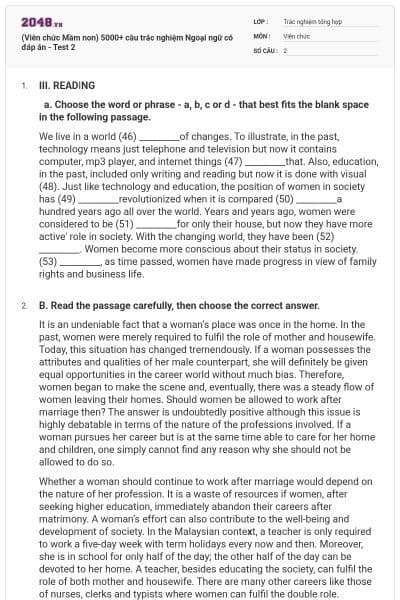
a. Choose the word or phrase - a, b, c or d - that best fits the blank space in the following passage.
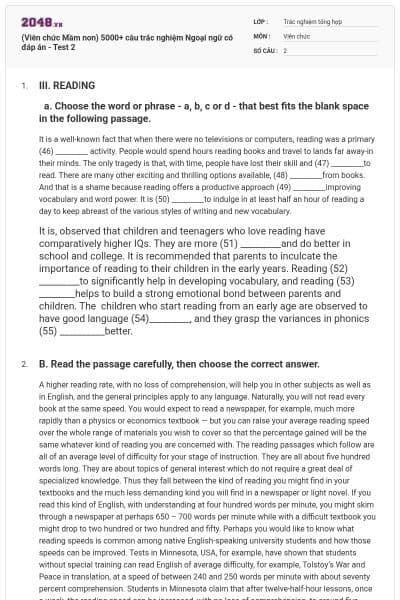
It is, observed that children and teenagers who love reading have comparatively higher IQs. They are more (51) _________and do better in school and college. It is recommended that parents to inculcate the importance of reading to their children in the early years. Reading (52) _________to significantly help in developing vocabulary, and reading (53) ________helps to build a strong emotional bond between parents and children. The children who start reading from an early age are observed to have good language (54)_________, and they grasp the variances in phonics (55) __________better.
outdoor
physical
leisure
social
passion
ambition
awareness
knowledge
except
in addition
besides
aside
for
of
to
in
advice
advisable
advising
advisory
creative
generous
hard
productive
says
is said
said
saying
silently
avidly
aloud
alone
activities
resources
advantages
skills
much
more
little
further
B. Read the passage carefully, then choose the correct answer.
only in your reading of physics textbook
improve your understanding of an economics textbook
not only in your language study but also in other subjects
choose the suitable materials to read.
read carefully
read quickly
read slowly
read avidly
Which of the following does not describe the types of reading materials mentioned in the second paragraph?
Those beyond one‘s reading comprehension.
Those concerned with common knowledge.
Those without much demand for specialized knowledge.
Those with the length of about five hundred words
The average speed of untrained native speakers in the University of Minnesota is _________.
about 300 words per minute
about 245 words per minute
about 650 - 770 words per minute
about 500 words per minute
You can increase your reading speed by three times.
No real increase in reading speed can be achieved.
You can increase your reading speed by four times.
You can double your reading speed.
IV. WRITING
Choose the sentences - a, b, c or d - which is closest in meaning to the printed one.
The house is so luxurious that we don‘t want to buy it.
The house cannot be afforded by us.
The house is too expensive for us to buy.
It was such a luxurious house that we can‘t buy it.
This work must be finished by six o‘clock.
This work could be finished by six o‘clock.
This work might be finished by six o‘clock.
This work need be finished by six o‘clock.
If you don‘t have proof identity, your cheques won‘t be accepted.
Your cheques will be accepted only if you have proof identity.
You shouldn‘t accept cheques with proof of identity.
Never accept cheques without proof of identity.
If I didn‘t lose my passport last week, I wouldn‘t be having so much trouble now.
If I hadn‘t lost my passport last week, I wouldn‘t have had so much trouble now.
If I didn‘t lose my passport last week, I wouldn‘t have had so much trouble now.
If I hadn‘t lost my passport last week, I wouldn‘t be having so much trouble now.
Regardless of whatever problems, we must continue our efforts.
In spite of having problems, we must continue our efforts.
Unless there are problems, we must continue our efforts.
But for our problems, we must continue our efforts.