(Viên chức Mầm non) 5000+ câu trắc nghiệm Ngoại ngữ có đáp án - Test 2
65 câu hỏi
I. PRONUNCIATION
a. Choose the word that has the underlined part pronounced differently from that of the others.
attract
clap
wave
hand
a. Choose the word that has the underlined part pronounced differently from that of the others.
signal
slightly
polite
excite
a. Choose the word that has the underlined part pronounced differently from that of the others.
allowed
passed
argued
raised
a. Choose the word that has the underlined part pronounced differently from that of the others.
discuss
jump
argument
public
a. Choose the word that has the underlined part pronounced differently from that of the others.
excited
excuse
exchange
example
B. Choose the word that has the main stress placed differently from that of the others.
approach
social
discuss
consider
B. Choose the word that has the main stress placed differently from that of the others.
impolite
informality
appropriate
situation
B. Choose the word that has the main stress placed differently from that of the others.
compliment
terrible
perfectly
attract
B. Choose the word that has the main stress placed differently from that of the others.
assistance
marvelous
argument
fashionable
B. Choose the word that has the main stress placed differently from that of the others.
signal
install
decent
verbal
II. LANGUAGE FOCUS
a. Choose the word or phrase - a, b, c or d - that best completes the sentence.
to
against
at
in
to
on
for
about
on
to
about
with
get through
wait on
turn up
walk out
Work it out
Look into it
Talk over it
Talk it over
approach
acceptant
assistance
access
polite
impolite
politeness
impoliteness
Phone me before ten; _________ I‘ll be too busy to talk to you.
otherwise
however
unless
moreover
formation
instance
formality
informality
nodding
clapping
waving
bowing
sights
signals
symbols
hints
direct
regular
verbal
non-verbal
observant
attentive
careful
delicate
amenity
attraction
leisure
recreation
appropriate
marvelous
acceptable
appreciated
B. Choose the word or phrase - a, b, c or d - that best completes the sentences.
for waiting
me about waiting
about having to wait
that they have to wait
would do - the day before
would do – the following day
had done — the following day
was doing - the day before
is proved
will be proved
are proved
have been proved
got
was got
had got
would got
to have ever been
have ever been
having been ever
ever having been
has studied
has been studying
had been studying
would have studied
me not drink
I don‘t drink
me not drinking
me not to drink
she learned
she has been learning
had she learned
she had been learning
don‘t leave
not leave
not to leave
didn‘t leave
how her father looked like
how did her father look like
whom her father looks like
what her father looked like
him to wear
he should wear
he must wear
that he wears
had already left - must have arrived
already left - had to arrive
had already left - should have arrived
would leave already - was supposed to arrive
if I saw
whether I have seen
if I had seen
whether had I seen
why the meeting postponed
why was the meeting postponed
why did the meeting postpone
why the meeting was postponed
what did his story mean
what his story meant
his story meant what
what was his story‘s meaning
C. Identify the one underlined word or phrase - A, B, C or D - that must be changed for the sentence to be correct.
In his letter, he said he had seen Penny at the theater a couple of days ago.
A B C D
Ron said that he wasn‘t sure, but the storm might stop already.
A B C D
For many years people have wondered that life exists elsewhere in the universe.
A B C D
Public health experts say that the money one spent avoiding illness is less than the cost of being sick.
A B C D
The woman accused to shoplift was found not guilty and was acquitted.
A B C D
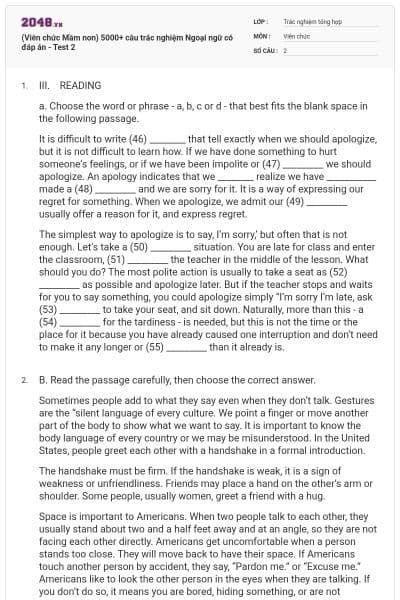
III. READING
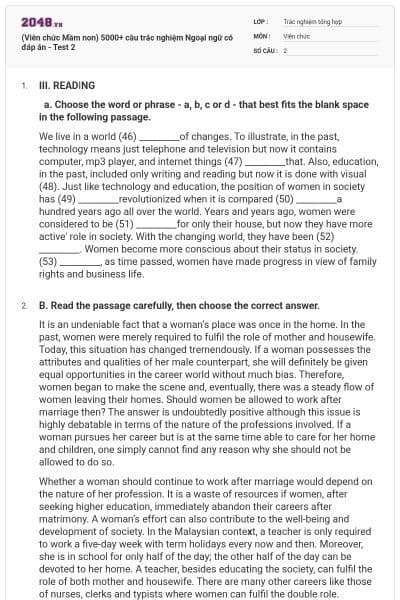
a. Choose the word or phrase - a, b, c or d - that best fits the blank space in the following passage.
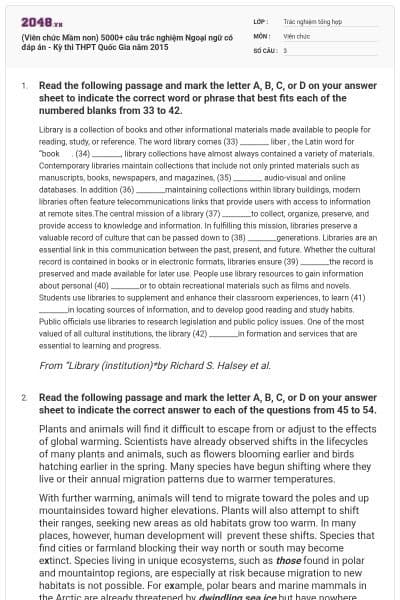
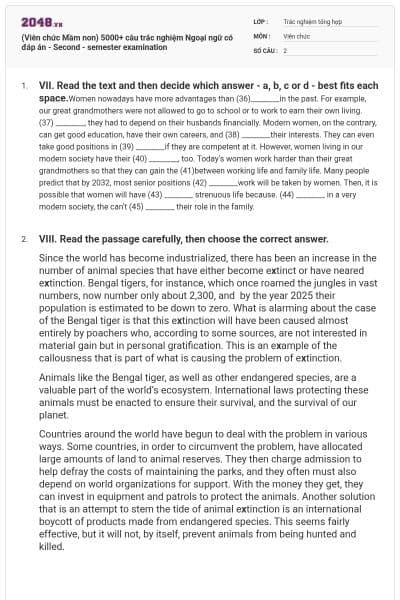
It is difficult to write (46) ________ that tell exactly when we should apologize, but it is not difficult to learn how. If we have done something to hurt someone‘s feelings, or if we have been impolite or (47) _________ we should apologize. An apology indicates that we ________ realize we have ___________ made a (48) _________ and we are sorry for it. It is a way of expressing our regret for something. When we apologize, we admit our (49) _________ usually offer a reason for it, and express regret.
The simplest way to apologize is to say, I‘m sorry,‘ but often that is not enough. Let‘s take a (50) _________ situation. You are late for class and enter the classroom, (51) _________ the teacher in the middle of the lesson. What should you do? The most polite action is usually to take a seat as (52) _________ as possible and apologize later. But if the teacher stops and waits for you to say something, you could apologize simply “I‘m sorry I‘m late, ask (53) _________ to take your seat, and sit down. Naturally, more than this - a (54) _________ for the tardiness - is needed, but this is not the time or the place for it because you have already caused one interruption and don‘t need to make it any longer or (55) _________ than it already is.
rules
times
reasons
examples
disrespect
rude
disappointed
angry
decency
regret
guilt
mistake
cruelty
blame
wrongdoing
comment
popular
common
rude
general
interrupting
holding
confusing
breaking
much
long
quietly
firmly
allowance
permission
acceptance
approval
reason
signal
compliment
apology
better
best
worst
worse
B. Read the passage carefully, then choose the correct answer.
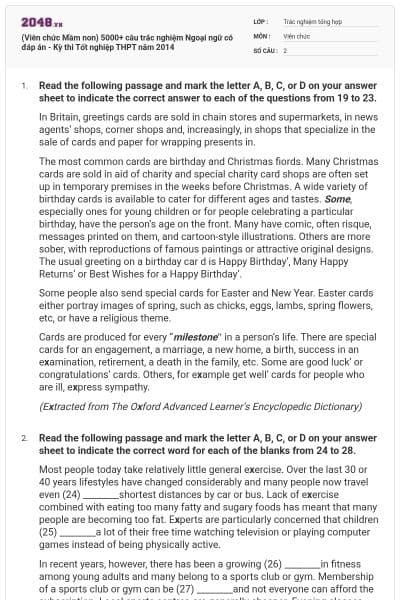
Sometimes people add to what they say even when they don‘t talk. Gestures are the “silent language of every culture. We point a finger or move another part of the body to show what we want to say. It is important to know the body language of every country or we may be misunderstood. In the United States, people greet each other with a handshake in a formal introduction.
The handshake must be firm. If the handshake is weak, it is a sign of weakness or unfriendliness. Friends may place a hand on the other’s arm or shoulder. Some people, usually women, greet a friend with a hug.
Space is important to Americans. When two people talk to each other, they usually stand about two and a half feet away and at an angle, so they are not facing each other directly. Americans get uncomfortable when a person stands too close. They will move back to have their space. If Americans touch another person by accident, they say, “Pardon me.” or “Excuse me.” Americans like to look the other person in the eyes when they are talking. If you don’t do so, it means you are bored, hiding something, or are not interested. But when you stare at someone, it is not polite. For Americans, thumbs-up means yes, very good, or well done. Thumbs down means the opposite. To call a waiter, raise one hand to head level or above. To show you want the check, make a movement with your hands as if you are signing a piece of paper. It is all right to point at things but not at people with the hand and index finger. Americans shake their index finger at children when they scold them and pat them on the head when they admire them. Learning a culture’s body language is sometimes confusing. If you don’t know what to do, the safest thing to do is to smile.
From the passage we can learn that ______________
gestures don‘t mean anything while talking
gestures can help us to express ourselves
American people often use body language in communication
It‘s confusing to understand a culture‘s body language
greet him with a hug
place a hand on his shoulder
shake his hand weakly
shake his hand firmly
show their friendship by touching each other
glance at each other when they are talking
get uncomfortable when you stand or sit too close to them
say “Pardon me. to each other when they are talking
shows his rudeness to you
shows his anger to you
expresses his worries about you
expresses his satisfaction to you
Pointing at someone is usually considered rude.
It‘s rude to stare at the other person.
It‘s impolite to look the other person in the eyes while talking.
It‘s all right to raise your hand slightly when you want to attract the waiter‘s attention.
IV. WRITING
From the words or phrases - a, b, c or d - choose the one that best completes the sentences.
So confusing the map was
So confusing was the map
So was confusing the map
Such confusing was the map
she would leave the tickets at home
she left the tickets at home
she would have left the tickets at home
she had left the tickets at home
what time does the film start
what time the film starts
what time did the film start
what time the film started
what does the center of the earth consist of
what the center of the earth consists of
the center of the earth consist of what
what of the center of the earth Consists
He recommended _________
me reading the book before seeing the movie
I would read the book before seeing the movie
I should read the book before seeing the movie
to read the book before seeing the movie