(Viên chức Mầm non) 5000+ câu trắc nghiệm Ngoại ngữ có đáp án - Test 2
65 câu hỏi
I. PRONUNCIATION
a. Choose the word that has the underlined part pronounced differently from that of the others.
biologist
shift
trick
decision
a. Choose the word that has the underlined part pronounced differently from that of the others.
support
pressure
discuss
mischievous
a. Choose the word that has the underlined part pronounced differently from that of the others.
thought
threaten
thunder
themselves
a. Choose the word that has the underlined part pronounced differently from that of the others.
tricks
leftovers
depths
roofs
a. Choose the word that has the underlined part pronounced differently from that of the others.
cook
school
soup
noon
B. Choose the word that has the main stress placed differently from that of the others.
project
support
secure
believe
B. Choose the word that has the main stress placed differently from that of the others.
obedience
mischievous
biologist
decision
B. Choose the word that has the main stress placed differently from that of the others.
confidence
suitable
responsible
secondary
B. Choose the word that has the main stress placed differently from that of the others.
leftover
household
garbage
attempt
B. Choose the word that has the main stress placed differently from that of the others.
secret
university
separately
interesting
II. LANGUAGE FOCUS
a. Choose the word or phrase - a, b, c or d - that best completes the sentence.
to
in
about
for
since
from
during
for
bringing into
caring for
taking on
bearing up
put up with
put away
put off
put up
relations
relatives
relationships
relation
joint
closed
nuclear
extended
active
action
activity
activeness
caring
uncared
careful
careless
enjoyable
funny
outgoing
lively
housing
housework
household
housemate
plan
idea
project
scheme
free
hard
single
family
Strong family ties provide us the love and ______ we need for a happy life.
secure
securing
security
securely
confident
supportive
obedient
expressive
No matter
However
Despite
Because of
B. Choose the word or phrase - a, b, c or d - that best completes the sentences.
are interviewing
had interviewed
have been interviewing
interviewed
met - have studied
met - were studying
has met - studied
met - had been studying
didn‘t see - met
haven‘t seen - have met
haven‘t seen - met
didn‘t see - have met
doesn‘t win
didn‘t win
hasn‘t won
hadn‘t won
is coming
are coming
have come
was come
__________ to the language center when I saw you yesterday morning?
Have you gone
Had you gone
Did you go
Were you going
are working
have worked
worked
had worked
have become
became
will become
are becoming
The number of students __________ limited and a number of books available to them in library.
is - is
is - are
are - are
are - is
wrote
has written
was written
had written
wash
to wash
to be washed
washed
had been won
is won
will be won
have been won
she understands
she could understand
could she understand
she did understand
__________ When the power went out, the clerks __________ the reports for the meeting.
have copied
she could understand
could she understand
she did understand
wrote
has written
was writing
had written
C. Identify the one underlined word or phrase - A, B, C or D that must be changed for the sentence to be correct.
While the teacher was explaining the sum on the blackboard, the children
A B
threw paper aeroplanes around the classroom.
C D
These children bad need a stable and secure home life.
A B C D
This is the first time Janet has taken so difficult class, but she plans to complete it.
A B C D
The computer, one of man‘s most recent creations, have revolutionized the world of information processing.
A B C D
His teacher, together with his parents, object to his behavior both in school and at home.
A B C D
III. READING
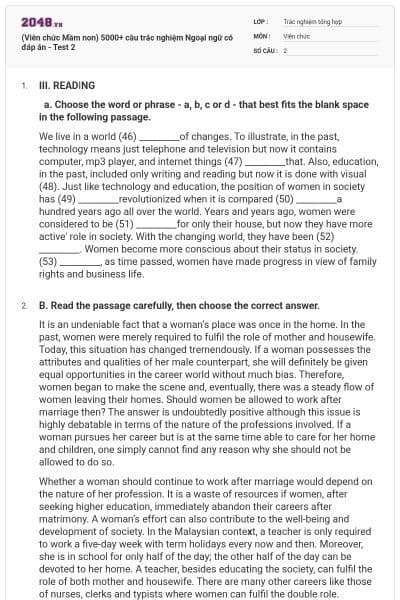
a. Choose the word or phrase - a, b, c or d - that best fits the blank space in the following passage.
right
dream
way
priority
hopeless
meaningful
helpful
useless
whatever
whenever
wherever
however
equipment
fact
tool
result
since
if
because
as
other
each other
each
others
all
for
off
out of
contribute
dispense
distribute
concentrate
caring
careless
cared
careful
manage
apply
divide
deal
B. Read the passage carefully, then choose the correct answer.
The traditional American family
The nuclear family
The current American family
The ideal family
there have always been a wide variety of family arrangement in the United States
racial, ethnic, and religious groups have preserved the traditional family structure
the ideal American family is the best structure
fewer married couples are having children
typical
present
perfect
traditional
30 percent of households
20 percent of households
7 percent of households
3 percent of households
A single man in his twenties
An elderly man
A single woman in her late sixties
A divorced woman
IV. WRITING
From the words or phrases -a, b, c or d- choose the one that best completes the sentences.
So quietly she spoke
So quietly did she speak
So did she speak quietly
She spoke so quiet
nor local residents did
so did local residents
neither did local residents
either didn‘t local residents
The concept of family
As the concept of family
The concept of family that
Because the concept of family
so they were content
for, their content
they were content
but they were content
The table was _____________ .
too heavy that, one person couldn‘t carry
so heavy that one person could carry
too heavy for one person to carry
enough heavy for one person to carry