(Viên chức Mầm non) 5000+ câu trắc nghiệm Ngoại ngữ có đáp án - Test 1
55 câu hỏi
Choose the word that has the underlined part pronounced differently from that of the others.
disaster
appall
wartime
quarter
Choose the word that has the underlined part pronounced differently from that of the others.
mount
wounded
found
without
Choose the word that has the underlined part pronounced differently from that of the others.
appeal
treatment
peace
bearing
Choose the word that has the underlined part pronounced differently from that of the others.
mission
result
disaster
hesitation
Choose the word that has the underlined part pronounced differently from that of the others.
wounded
dedicated
appealed
adopted
II. LANGUAGE FOCUS
a. Choose the one word or phrase - a, b, c or d - that best completes the sentences.
in
at
on
to
The Red Cross is aimed ________ providing medical aid and other help to victims of natural disasters.
in
at
to
for
on
in
for
of
They have launched a(n) ________ to send food to the flood victims.
aid
proposal
appeal
attraction
human
humane
humanistic
humanitarian
research
invention
initiative
inspiration
challenges
disasters
commodities
disadvantages
Protests died down when they realized that the new tax ________ to only 50p a week.
added
reached
approached
amounted
drought
epidemic
famine
flood
dedicated
serious
willful
determined
B. Choose the one word or phrase - a, b, c or d - that best completes the sentences or has the closest meaning to the underlined part.
get
let
look
tear
in – over
on - out
up – down
off - on
I ran into my old friend when I was on my way home from work.
collected
phoned
crashed
met
“To give someone a ring is to ________ .
call him up
marry him
tie him down
pick him up
take over
put off
call off
turn down
Let‘s wait here for her; I‘m sure she‘ll turn up before long.
return
visit
arrive
enter
turned over
got in
took off
put on
You need more exercise; you should ________ golf.
take up
look over
keep on
carry out
The firemen fought for three hours before they managed to ________ the fire.
give up
put out
break off
cut back
Although they are poor, they have ________ five children well.
grown up
taken up
brought up
pulled up
postponed
cancelled
changed
took
set off
went on
left out
moved up
lit up
switched of
went out
turned down
He ________ the boys for making so much noise.
brought up
put down
took back
told off
care for
cut back
let down
miss out
C. Identify the one underlined word or phrase - A, B, C or D - that must be changedfor the sentence to be correct.
Instead of calling off the meeting, maybe we can just put it over until next month.
A B C D
If you don‘t know the meaning of a word, you can look up it in a dictionary.
A B C D
I wrote a letter of complaint and the airline has promised to look the matter into.
A B C D
I know I let Andy down when I forgot picking his suit up from the dry cleaner‘s.
A B C D
They have set up a research project to investigating the harmful effects of air pollution
A B C D
III. READING
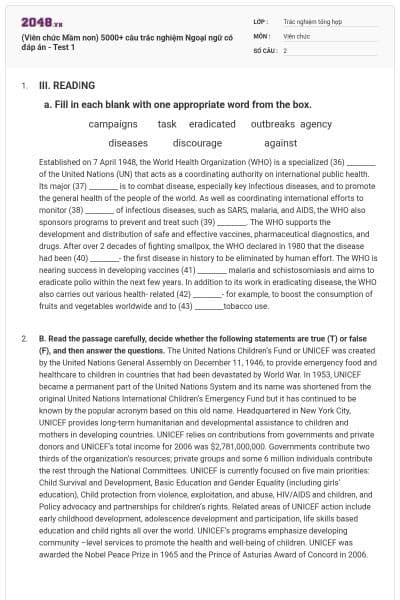
a. Fill in each blank with one appropriate word from the box.
campaigns task eradicated outbreaks agency
diseases discourage against
True or false?
UNICEF is a part of the United Nations.
UNICEF was originally named The United Nations Children's Fund.
UNICEF works for the survival, protection and development of all children worldwide.
UNICEF is a voluntarily funded agency.
The National Committees collectively raise around two-thirds of UNICEF's annual income.
Answer the Questions.
What are the UNICEF's five main priorities?
IV. WRITING
From the words or phrases - a, b, c or d - choose the one that best completes the sentences.
Glass that has been tempered may be up to ________.
as hard as ordinary glass five times
five times as hard as ordinary glass
hard as ordinary glass five times
ordinary glass as hard as five times
________, I would never have believed it.
If you didn't tell me
Since you hadn't told me
Had you not told me
Unless you told me
Tell me where ________. Which hairdresser?
did you have your hair cut
have you cut your hair
you cut your hair
you had your hair cut
_________ to speak to him, but she also vowed never to see him again.
Even though she refused
She refused
Not only did she refuse
Hardly did she refuse
buying your tickets well in advance so that you can
to buy your tickets well in advance in order
you to buy your tickets well in advance in order that
buying your tickets well in advance if you want