(Viên chức Mầm non) 5000+ câu trắc nghiệm Ngoại ngữ có đáp án - Test 1
55 câu hỏi
I. PRONUNCIATION
Choose the word that has the underlined part pronounced differently from that of the others.
desert
crest
stretch
species
Choose the word that has the underlined part pronounced differently from that of the others.
expedition
excitement
exploration
expectation
Choose the word that has the underlined part pronounced differently from that of the others.
reach
steep
season
ocean
Choose the word that has the underlined part pronounced differently from that of the others.
crest
camel
center
cactus
Choose the word that has the underlined part pronounced differently from that of the others.
growth
route
loose
through
II. LANGUAGE FOCUS
a. Choose the one word or phrase - a, b, c or d - that best completes the sentences.
of
to
as
after
In
To
From
On
in
to
into
down
developed
reached
comprised
stretched
crest
dune
slope
hummock
expedition
travel
voyage
excursion
spinifex
eucalyptus
cactus
date palm
empty
barren
balmy
plain
unpopular
uninhabited
deserted
barren
He had led an ________ expedition of the western Sonoran Desert.
explore
exploring
exploration
exploratory
B. Choose the one word or phrase - a, b, c or d - that best completes the sentences.
Due to
Because
Since
Despite
however
moreover
therefore
since
even so
unless
however
without
whereas
because
though
consequently
Moreover
Consequently
However
Nevertheless
but
and
so
then
since
as if
unless
so that
so
but
however
then
There was a bomb scare in the resort, and ___________ tourists stayed away.
however
while
consequently
though
However
Likewise
Therefore
But
Moreover
Nevertheless
Therefore
Consequently
for
so
yet
and
moreover
however
nevertheless
therefore
as well
in addition
but also
though
whereas
while
despite
in order to
C. Identify the one underlined word or phrase - A, B, C or D - that must be changed for the sentence to be correct.
When Jenkins will submit his report tomorrow morning, the governer
A
will have all the information needed to make a decision.
B C D
Last night‘s storm damaged the power lines. Consequent, the town was withoutelectric for several hours.
A B C D
If the personal computer had not been invented, will the information age have arrived by the other means ?
A B C D
In much of Alaska, the growing season is too short that crops can‘t be raised.
A B C D
We still haven‘t got a sponsor even though the fact that we‘ve written to dozens of companies.
A B C D
III. READING
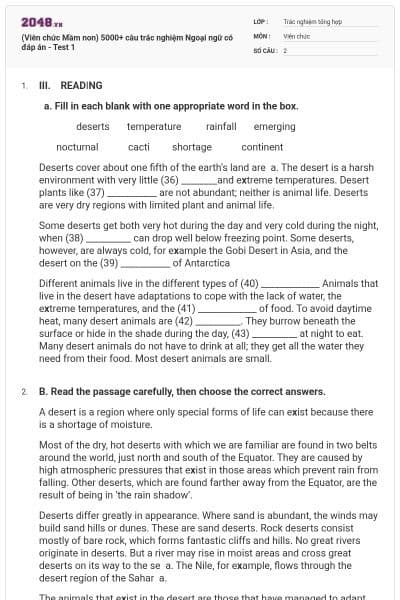
a. Fill in each blank with one appropriate word in the box.
deserts temperature rainfall emerging
nocturnal cacti shortage continent
Deserts cover about one fifth of the earth‘s land are a. The desert is a harsh environment with very little (36) ________and extreme temperatures. Desert plants like (37) ___________ are not abundant; neither is animal life. Deserts are very dry regions with limited plant and animal life.
Some deserts get both very hot during the day and very cold during the night, when (38) __________ can drop well below freezing point. Some deserts, however, are always cold, for example the Gobi Desert in Asia, and the desert on the (39) ___________ of Antarctica
Different animals live in the different types of (40) _____________ Animals that live in the desert have adaptations to cope with the lack of water, the extreme temperatures, and the (41) _____________ of food. To avoid daytime heat, many desert animals are (42) __________. They burrow beneath the surface or hide in the shade during the day, (43) __________ at night to eat. Many desert animals do not have to drink at all; they get all the water they need from their food. Most desert animals are small.
B. Read the passage carefully, then choose the correct answers.
A desert is a region where only special forms of life can exist because there is a shortage of moisture.
Most of the dry, hot deserts with which we are familiar are found in two belts around the world, just north and south of the Equator. They are caused by high atmospheric pressures that exist in those areas which prevent rain from falling. Other deserts, which are found farther away from the Equator, are the result of being in ‘the rain shadow’.
Deserts differ greatly in appearance. Where sand is abundant, the winds may build sand hills or dunes. These are sand deserts. Rock deserts consist mostly of bare rock, which forms fantastic cliffs and hills. No great rivers originate in deserts. But a river may rise in moist areas and cross great deserts on its way to the se a. The Nile, for example, flows through the desert region of the Sahar a.
The animals that exist in the desert are those that have managed to adapt themselves to its conditions. They must be able to do without water for long periods, or be able to reach water holes at great distances. The camel, for example, is highly adapted to desert life. It has padded feet to walk on sand, a water-storing stomach, humps of fat as a reserve supply of energy, and nostrils that can be closed to keep out sand during windstorms. Many of the smaller desert creatures need to drink no water at all. They get what liquid they need from the sap of food plants and from night dew on leaves or stones.
there is no plant and animal life
the sun beats down mercilessly
there is a lack of moisture
the air is hot and humid
Which of the following is the reason why a desert is dry?
There are high atmospheric pressures in the are a.
It has a high annual rainfall.
It lies on or close to the equator.
special forms of life exist there.
different
unlimited
existing
plentiful
Both sand and rock deserts are ______________ .
sandy
hilly
windy
rocky.
Which of the following sources of water is not found in the desert?
Rivers
Seas
Water holes
Dew
Which parts of the camel make it suitable for desert life?
padded feet
water-storing stomach
humps of fat
all are correct
Why are food plants important to smaller desert animals?
Because the desert animals depend on the sap of the plants for liquid.
Because food plants are nutritious.
Because the desert animals live on vegetable food
Because plants are a ready food supply for the desert animals.
IV. WRITING
Choose the sentences - a, b, c or d - which is closest in meaning to the printed one.
Mark ate lots of ice cream and now he has a stomachache.
If Mark didn‘t eat much ice cream, he wouldn‘t have a stomachache.
If Mark hadn‘t eaten much ice cream, he wouldn‘t have a stomachache.
If Mark hadn‘t eaten much ice cream, he wouldn‘t have had a stomachache.
If Mark didn‘t eat much ice cream, he wouldn‘t have had a stomachache.
You can try as hard as you like but you won‘t succeed.
However hard you try, you won‘t succeed.
You can try your best if you won‘t succeed.
You won‘t succeed because you can‘t try as hard.
Although you won‘t succeed, you can try as hard as you like.
So great the demand for the ticket was that people queued night and day.
So great was that the demand for the ticket people queued night and day.
Such was the demand for the ticket that people queued night and day.
Such great was demand for the ticket that people queued night and day.
Don‘t borrow money from friends even though you absolutely have to.
Borrow money from friends only if you absolutely have to.
Unless you absolutely have to, borrow money from friends.
Don‘t borrow money from friends even if you don‘t absolutely have to.
The little boy pretended to be sick although he stayed home from school.
The little boy pretended to be sick because he would stay home from school.
The little boy pretended to be sick whereas he wanted to stay home from school.
The little boy pretended to be sick so that he could stay home from school.