(Viên chức Mầm non) 5000+ câu trắc nghiệm Ngoại ngữ có đáp án - Test 1
60 câu hỏi
I. PRONUNCIATION
Choose the word that has the main stress placed differently from that of the others.
approach
attract
decent
install
Choose the word that has the main stress placed differently from that of the others.
marvelous
assistant
maximum
argument
Choose the word that has the main stress placed differently from that of the others.
apologetic
communicate
attention
appropriate
Choose the word that has the main stress placed differently from that of the others.
verbal
polite
common
social
Choose the word that has the main stress placed differently from that of the others.
compliment
absolute
fashionable
suppose
II. LANGUAGE FOCUS
a. Choose the one word or phrase - a, b, c or d - that best completes the sentences.
to - about
with - for
to - at
with - on
on
to
of
from
It‘s rude to point: _______ someone!
on
out
at
up
verbal
non-verbal
formal
informal
objections
refusals
resistances
disagreements
notice
care
mind
attention
attract
raise
catch
meet
agreements
assistance
compliments
arguments
sensitive
impolite
informal
polite
normal
common
wide
complete
B. Choose the one word or phrase - a, b, c or d - that best completes the sentences.
can the children
whether the children could
if the children can
could the children
will telephone
have telephoned
would phone
had phoned
is - will travel
were - would travel
was - would have traveled
had been - would have traveled
already paid
have already paid
had already paid
was already paid
whether have you got
that you‘ve got
if you‘ve got
how you‘ve got
don‘t sit
not sit
not to sit
to not sit
to know
knowing
for knowing
that they know
the following day
the next day
the day after tomorrow
the previous day
he had borrowed
had he borrowed
did he borrowed
he would borrow
remember to pay
not to forget to pay
to pay
of paying
will be - are feeling
was - was felt
would be - would feel
would be - was feeling
whether was my father working
if my father was working
whether my father had been working
was my father working
am not going to go
was not going to go
would not go
was not able to go
was leaving
had left
would leave
would have left
would check
checks
had checked
was checked
C. Identify the one underlined word or phrase - A, B, C or D - that must be changed for the sentence to be correct.
She says that she would have to close the shop unless business improves.
A B C D
Every teacher I‘ve spoken to tell me that standards of spelling are in decline.
A B C D
They asked me how long did it take to get to Paris by train.
A B C D
My mother told me to watch the milk and don‘t let it boil over.
A B C D
Some engineers have predicted that, within twenty years, automobiles will be make almost completely of plastic.
A B C D
III. READING
a. Fill in each blank with one appropriate word from the box.
embrace polite introduced attention acceptable
Away immediately part
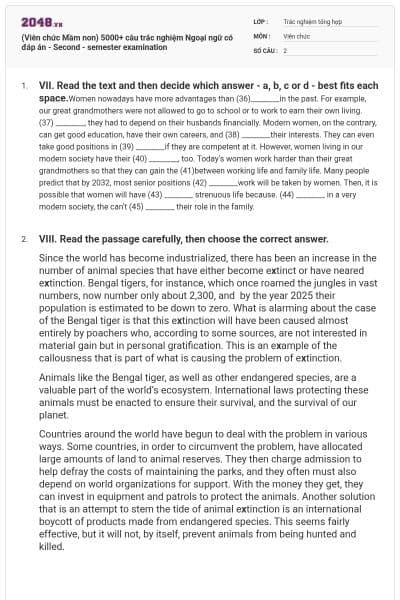
Americans shake hands with each other when first (36) ____________ or when they meet again, but rarely when they (37) ______________ (a more European custom). Social kissing, as a greeting, is also sometimes (38) _________between men and women who know each other well and between women. American men rarely (39) _________ each other or kiss on both cheeks. When two Americans are standing and talking to each other they stay at least 16 inches (40) _________from each other.
It is permissible for an American to start a conversation with a stranger but the conversation should be (41) _________ended if the person does not seem to want to talk. Be especially careful not to force your (42) _________ on someone in a plane, train or bus. If you meet someone you know on the street while you are with someone else, it is (43)_________to introduce the person!
B. Read the passage carefully, then choose the correct answer.
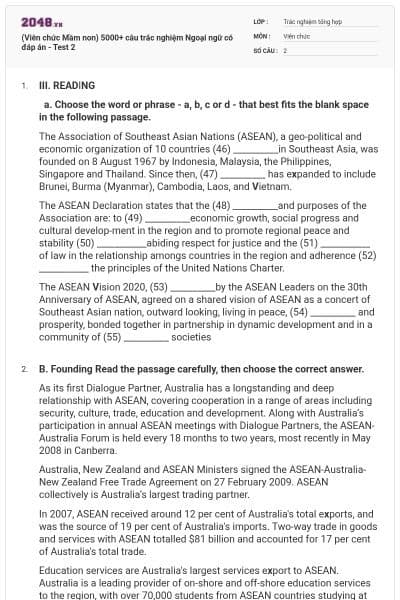
Vietnamese generally shake hands when greeting and parting. Using both hands shows respect, as does a slight bow of the head. In rural areas, elderly people who do not extend their hand are greeted with a slight bow. Women are more likely to bow the head slightly than to shake hands. Vietnamese names begin with the family name and are followed by a given name. For example, in the name Nguyen Van Due, Nguyen is the family name. People address one another by their given names, but add a title that indicates their perceived relations Hip to the other person. These titles are family related rather than professional. Among colleagues, for example, the younger of the two might combine the given name with the title of Anh (“Older Brother”). A basic greeting combined with the given name and title is Xin chao (“Hello”.). Classifiers for gender and familiarity are also combined with the greeting. In formal meetings, business cards are sometimes exchanged on greeting. Vietnamese have a strong sense of hospitality and feel embarrassed if they cannot show their guests full respect by preparing for their arrival. Therefore, it is inappropriate to visit a home without having been invited. Gifts are not required, Taut are appreciated. Flowers, incense, or tea may be appropriate gifts for the hosts. Hosts also appreciate a small gift for their children or elderly parents.
In most cases, Vietnamese greet each other with a handshake.
To show respect, they do a slight bow while using both hands to shake.
Vietnamese women never shake hands, so they bow the head slightly when greeting.
Elderly people in rural areas do not often shake hands when greeting and saying good-bye.
A family name, a given name, and then a middle name
A given name, middle name, and then a family name
A middle name, a given name, and then a family name
A family name, a middle name, and then a given name
with their family name in formal situations
with their given name, even in formal situations
with their given name and a title “Mr.” or “Mrs.”
with their full name and a title which is family related
they often feel worried about what other people will think
they cannot show their guests full respect
they do not like to be visited unexpectedly
they always prepare for their arrival
often offer gifts to the hosts on their visit
sometimes give the host‘s children gifts
usually welcome guests with flowers
always require gifts for their children or their parents
IV. SPEAKING
Choose the phrase or sentence — a, b, c or d - that best completes the conversation.
B: ________ I‘m an awful dancer!
You‘re too kind.
That‘s a nice compliment!
You‘ve got to be kidding!
Oh, thank you very much.
B: _________
It‘s nice of you to say so.
It‘s my pleasure,
You‘re welcome
That‘s okay.
B: Oh, thank you. I just got it yesterday.
When have you got this beautiful dress?
You‘ve just bought this beautiful dress, haven‘t you?
How a beautiful dress you‘re wearing!
That‘s a beautiful dress you have on!
B: _________It‘s called yakitori, and it‘s made with chicken livers.
It‘s my pleasure.
I‘m glad you like it.
I guess you‘re right.
Sure, I‘ll be glad to.
B: _________I think it makes me look 10 years older!
Thanks a lot.
I‘m sorry I don‘t like it.
I hate it.
That‘s a nice compliment
V. WRITING
Choose the sentence - a, b, c or d - which is closest in meaning to the printed one.
John told Jane to help him with the washing-up.
John asked if Jane should help him with the washing-up.
John suggested helping Jane with the washing-up.
John offered to help Jane with the washing-up.
He asked me what will I do if I have ten days off school.
He asked what I will do if I have ten days off school.
He asked me what I would do if I had ten days off school.
He asked what would I do if I had ten days off school.
My friend advised me to apologize for being so rude.
My friend offered me to apologize for being so rude.
My friend warned me to apologize for being so rude.
My friend suggested me apologizing for being so rude.
Henry said good morning Mary and asked how was she.
Henry greeted Mary and asked how is she.
Henry said good morning and asked Mary how she is.
Henry greeted Mary and asked how she was.
Sarah told us -do not leave until she comes back.
Sarah asked us not leave until she came back.
Sarah told us hot to leave until she came back.
Sarah said to us to not leave until she comes back.
The students asked how the final test was difficult.
The students exclaimed that the final test was so difficult.
The students wondered if it was a difficult final test.
The students said that how difficult the final‘ test was.
I warned him to be careful as the steps were very slippery.
I suggested being careful as the steps were very slippery.
I threatened him to be careful and said the steps were very slippery.
I told him be careful and the steps were very slippery.