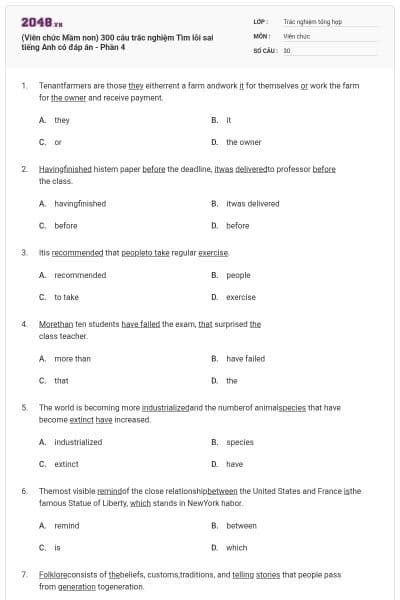
(Viên chức Mầm non) 300 câu trắc nghiệm Tìm lỗi sai tiếng Anh có đáp án - Phần 4
30 câu hỏi
Tenantfarmers are those they eitherrent a farm andwork it for themselves or work the farm for the owner and receive payment.
they
it
or
the owner
Chọn đáp án A
Sửa thành “who”
Giải thích: Ở đây ta cần một đại từ quan hệ thay thế cho “tenant farmers” (chỉ người) và đóng vai trò là chủ ngữ của vế đằng sau.
Havingfinished histem paper before the deadline, itwas deliveredto professor before the class.
havingfinished
itwas delivered
before
before
Chọn đáp án C
Sửa thành “he delivered it”
Giải thích: Đọc 2 vế ta thấy chúng có chung chủ ngữ do vế 1 đang ở dạng rút gọn chủ động, nên vế 2 chủ ngữ cũng phải chỉ người (chủ động).
Itis recommended that peopleto take regular exercise.
recommended
people
to take
exercise
Chọn đáp án C
Sửa thành “take”
Giải thích: Cấu trúc câu giả định: It + be + n (recommendation, importance …)
Morethan ten students have failed the exam, that surprised the class teacher.
more than
have failed
that
the
Chọn đáp án C
Sửa thành “which”
Giải thích: Trong mệnh đề quan hệ chưa dấu phẩy ta không dùng “that”.
The world is becoming more industrializedand the numberof animalspecies that have become extinct have increased.
industrialized
species
extinct
have
Chọn đáp án D
Sửa thành “has”
Giải thích: The number of + V (chia theo số ít – he, she, it) và A number of + V (chia theo số nhiều - they, we …)
Themost visible remindof the close relationshipbetween the United States and France isthe famous Statue of Liberty, which stands in NewYork habor.
remind
between
is
which
Chọn đáp án A
Sửa thành ‘reminder”
Giải thích: remind (v) gợi nhớ. Nhưng trong câu này ở vị trí của A ta cần danh từ để làm chủ ngữ, mang nghĩa là vật gợi nhớ (reminder).
Folkloreconsists of thebeliefs, customs,traditions, and telling stories that people pass from generation togeneration.
Folklore
the
telling stories
generation
Chọn đáp án B
Sửa thành “stories telling”
Giải thích: Đây là kiến thức liên quan đến sự tương đương trong câu. Ta thấy 2 cụm bên trên đều là danh từ, nên cụm cuối cũng phải là danh từ
Thebones of the elderly are more proneto fractures than of young people.
the elderly
more
to
of
Chọn đáp án D
Sửa thành “those of”
Giải thích: Trong so sánh, để tránh lặp từ ta thường dùng “that” hoặc “those” với đối tượng thứ 2 chứ không được bỏ hẳn nó đi. Và ở câu này đối tượng được mang ra só sánh là “the bones” (danh từ đếm được số nhiều) nên ta dùng “those”.
My pen has very few ink in it, so could you give mesome
has
fewink
could
some
Chọn đáp án B
Sửa thành “little ink”
Giải thích: little + N không đếm được và few + N đếm được (cả 2 đều mang nghĩa là còn rất ít, hầu như không có)
NeitherWilliam or his brother stole the rambutans from our orchard.
or
stole
from
our orchard
Chọn đáp án A
Sửa thành “nor”
Giải thích: Neither … nor ….. (cả 2 đều không)
Tom said that he was trying to carry outsome campaigns to protect environment andwillencourage others to do so.
he was trying
some
campaigns
will
Chọn đáp án D
Sửa thành “would”
Giải thích: Ngay từ đầu câu đã có dấu hiệu của câu gián tiếp (Tom said that) nên đằng sau ta phải lùi thì.
My eldersisters, both of them were doctors, said theywere too busy to pick me up.
elder
both of them
too busy
to pick
Chọn đáp án B
Sửa thành “both of whom”
Giải thích: Vị trí của B ta cần trạng từ quan hệ (thay thế tân ngữ) để đặt trong mệnh đề quan hệ.
It is very difficult for her to prevent him for smoking in her house.
very
for
prevent
for smoking
Chọn đáp án D
Giải thích: Cấu trúc: prevent sb from Ving (ngăn cản ai làm gì)
My sistertold me that she had met my teacher atthe supermarket yesterday.
My sister told
B had met
at the supermarket
yesterday
Chọn đáp án D
Sửa thành “the day before”
Giải thích: Ngay từ đầu câu đã có dấu hiệu của câu gián tiếp (My sister told me that..) nên trnajg từ thời gian “yesterday” cũng phải biến đổi.
If you takethe train, it wouldbe much more convenient.
if
the train
would be
much
Chọn đáp án C
Sửa thành “will be”
Giải thích: Đây là câu điều kiện loại I vì giải định hoàn toàn có thể xảy ra ở hiện tại và tương lai. Ngoài cách đổi trên, ta có thể sửa “would be”
Sửa thành “can be” hoặc “may be”.
Some of his favouritesubjectsatschoolare Maths, English andGeographical.
some
subjects
are
Geographical
Chọn đáp án D
Sửa thành “Geography”
Giải thích: Đây là kiến thức liên quan đến sự tương đương trong câu. Ta thấy 2 từ bên trên đều là danh từ chỉ môn học, nên cụm cuối cũng phải là danh từ.
Could you tell mehowcan I get to the city library, please?
Could
me
how can I
the
Chọn đáp án C
Sửa thành “how I can”
Giải thích: Thành phần hỏi chính của câu là “Could you tell me” nên phần sau cấu trúc vẫn như một câu khẳng định bình thường.
The number of studentsattendinguniversities to study economics have increased steadily in the last fewyears.
of students
attending
economics
have
Chọn đáp án D
Sửa thành “has”
Giải thích: The number of + V (chia theo số ít – he, she, it) và A number of + V (chia theo số nhiều - they, we …)
My teacheris verystrict and he alwaysmakes us to finish all the exercises before leavingschool.
is
strict
to finish
leaving school
Chọn đáp án C
Sửa thành “finish”
Giải thích: make sb + Vinf (làm cho ai đó làm gì)
Although most species of small birdsgather in groups at feeders providedby bird-watchers, the brightredcardinalsusually appearsalone or with its mate.
at
cardinals
or
its
Chọn đáp án D
Sửa thành “theirs”
Giải thích: chủ ngữ là “the bright red cardinals” (đếm được số nhiều)
Henry DavidThoreauwas an Americanwriter who isrememberedfor his faithin religioussignificance of the nature.
an
is
for
the nature
Chọn đáp án D
Sửa thành “nature”
Giải thích: Danh từ chung không cần “the”
Proteins are made up of folded irregularly chains, the links ofwhich areamino acids.
made up of
folded irregularly
the links
which
Chọn đáp án B
Sửa thành “irregularly folded”
Giải thích: Trạng từ đứng trước tính từ để bổ sung nghĩa cho tính từ
A smilecan be observed, described, and reliablyidentify, it can also be elicited and manipulated under experimentalconditions.
identify
experimental
can also
A smile
Chọn đáp án A
Sửa thành “identified”
Giải thích: Đây là kiến thức liên quan đến sự tương đương trong câu. Ta thấy 2 cụm bên trên đều là Ved, nên cụm cuối cũng phải là Ved.
Each of the members of the groupwere made towrite areport everyweek.
were
members
to write
week
Chọn đáp án A
Sửa thành “was”
Giải thích: “each + …. “ + V (chia như ngôi 3 số ít)
The harder he tried, the worsthe danced before the large audience .
worst
the
before
tried
Chọn đáp án A
Sửa thành “worse”
Giải thích: Cấu trúc so sánh “càng …. càng” như sau: The + so sánh hơn, the + so sánh hơn.
My father asked mewhere hadI gone the night before.
the
asked me
had I
before
Chọn đáp án C
Sửa thành “I had”
Giải thích: Đây là câu gián tiếp, tường thuật lại nên phần câu hỏi sẽ giống như một câu khẳng định về vị trí các
Sửa thành phần câu.
Ancient people made a clay potterybecause they needed itfor their survival.
a clay pottery
because
it
their survival
Chọn đáp án A
Sửa thành “a pottery clay”
Giải thích: “pottery” với nghĩa là những cái lọ, thau bằng đất thì là danh từ không đếm được, nên ta không dùng “a” trước đó mà phải chuyển
Sửa thành “a clay pottery” là dụng cụ làm từ đất sét.
Students suppose to read all the questionscarefully and find outthe answersto them.
suppose
all the
all the questions
them
Chọn đáp án A
Sửa thành “are supposed”
Giải thích: tobe suppposed toV (được cho là làm cái gì đó)
If they took their language lessonseriously, they would be able to communicatewith the locals now.
took
seriously
would be
with the locals
Chọn đáp án A
Sửa thành “had taken”
Neither of the men arrestingas terroristswould reveal informationabout his group.
neither
arresting
would reveal
his group
Chọn đáp án B
Sửa thành “arrested”
Giải thích: Vị trí của B là rút gọn mệnh đề quan hệ nhưng trong trường hợp này ta phải dùng dạng bị động (Ved)