(Viên chức Mầm non) 300 câu trắc nghiệm Tìm lỗi sai tiếng Anh có đáp án - Phần 10
30 câu hỏi
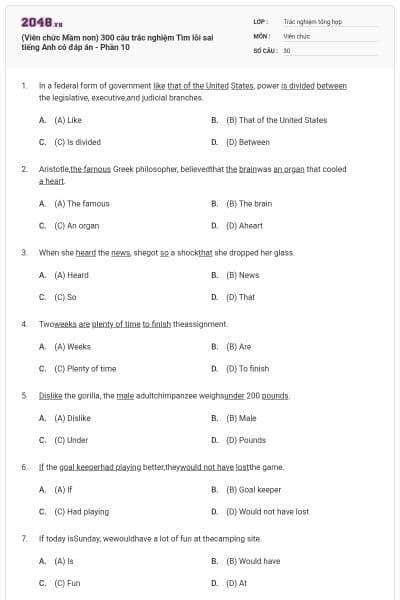
In a federal form of government like that of the United States, power is divided between the legislative, executive,and judicial branches.
(A) Like
(B) That of the United States
(C) Is divided
Chọn đáp án D ⇒ into
Giải thích: cấu trúc be divided into: được chia
Sửa thành
Aristotle,the famous Greek philosopher, believedthat the brainwas an organ that cooled a heart.
(A) The famous
(B) The brain
(C) An organ
Chọn đáp án A ⇒ a famous
Giải thích: Danh từ nhắc đến lần đầu tiên trong câu chưa xác định nên không dùng the mà chỉ dùng “a”
When she heard the news, shegot so a shockthat she dropped her glass.
(A) Heard
(B) News
(C) So
Chọn đáp án C ⇒ such
Giải thích: cấu trúc such (a/an) adj N that mệnh đề: quá...đến nỗi mà..
Twoweeks are plenty of time to finish theassignment.
(A) Weeks
(B) Are
Chọn đáp án A ⇒ is
Giải thích: chủ ngữ là một số lượng, 1 khoảng thòi gian thì động từ chia số ít
Dislike the gorilla, the male adultchimpanzee weighsunder 200 pounds.
(A) Dislike
(B) Male
(C) Under
Chọn đáp án A⇒ unlike
Giải thích: cấu trúc unlike + N: khác với
If the goal keeperhad playing better,theywould not have lostthe game.
(A) If
(B) Goal keeper
(C) Had playing
Chọn đáp án C ⇒ had played
Giải thích: cấu trúc câu điều kiện loại 3: If + S + Had PII, S would have PII
If today isSunday, wewouldhave a lot of fun at thecamping site.
(A) Is
(B) Would have
(C) Fun
Chọn đáp án A ⇒ were
Giải thích: cấu trúc câu điều kiện loại 2 với tobe: If S + were + adj/N, S would V
To reduce pollution, we have to stop using many things that makes our life comfortable.
(A) To reproduce pollution
(B) Using
(C) Makes
Chọn đáp án C ⇒ make
Giải thích: Mệnh đề quan hệ “that makes our life comfortable” bổ nghĩa cho many things, nên make phải chia ở dạng số nhiều.
My mother doesn’t care how much does the washing machine cost because she is goingto buy it anyway.
(A) Doesn’t care
(B) Does the washing machine cost
(C) Because
Chọn đáp án B ⇒ the washing machine costs
Giải thích: mệnh đề danh ngữ: WH-ques + S + V làm chủ ngữ hoặc tân ngữ trong câu.
It is very difficult for human beingsfightingpollution.
(A) Difficult
(B) For
(C) Beings
Chọn đáp án D ⇒ to fight
Giải thích: cấu trúc it + be + adj + to V: thật là như thế nào khi làm gì
Reading several books on that subject, Billconsidered himself an expert.
(A) Reading
(B) Books on
(C) Considered himself
Chọn đáp án A ⇒ having read
Giải thích: Ta thấy động từ vế sau ở thời quá khứ “Bill tự coi mình là một chuyên gia”, nên việc đọc sách đã xảy ra trước đó, cần chia ở dạng having PII để diễn tả sự lệch thời
Ralphwishes that he went to the bankthis morningbefore hewent towork.
(A) Wishes that
(B) Went
(C) Before
Chọn đáp án B ⇒ had been
Giải thích: cấu trúc câu ước quá khứ với wish: S wish(es) + (that) + S + V(qkht)
The companydid notwant to hire aman that his experiment was so limited.
(A) The
(B) Want to hire
(C) That his
Chọn đáp án C ⇒ whose
Giải thích: mệnh đề quan hệ sở hữu whose. Ta không dùng that hay which + tính từ sở hữu trước danh từ mà phải dùng whose
Mrs. Alienwasconcerned about me having to drive so far every day.
(A) About
(B) Me having
(C) So far
Chọn đáp án B ⇒ my having
Giải thích: Ving được hiểu là một danh động từ, mà trước danh động từ ta cần dùng tính từ sở hữu.
In veryearly times, people around the fire were entertained by storytellerswith stories of heroes’wonderfulactionsand victory.
(A) Times
(B) Around
(C) Were entertained
Chọn đáp án D ⇒ victories
Giải thích: Các danh từ nối với nhau bỏi “and” cần ở cùng dạng thức. Ta thấy actions số nhiều nên ta cần chueyenr victories về dạng số nhiều theo nguyên tác song song
The children next door are a real nuisance.Theirfootball is alwayscoming on thefence and damaging the flowersin my garden.
(A) Next door
(B) A real nuisance
(C) On
Chọn đáp án C ⇒ over
Giải thích: on nghĩa là “ở trên”, là giới từ chỉ vị trí tĩnh, không đi với come. Ở đây quả bóng bay qua hàng rào, nên giới từ over là phù hợp.
Mai and Lan have a rowbecause they have misunderstood one another.
(A) Have
(B) Because
(C) Misunderstood
Chọn đáp án D ⇒ each other
Giải thích: each other: lẫn nhau (trong số 2 người/vật)
Theworkers are buildinga newbridgewhich is150 meters in high
(A) Building
(B) A new bridge
(C) Which
Chọn đáp án D ⇒ height
Giải thích: sau giới từ là danh từ
When you arewritingor speakingEnglishit is important to use language that includes both men andwomenequally the same.
(A) Are
(B) To use
(C) Both
Chọn đáp án D ⇒ equally
Giải thích: Vì equally và the same có cùng trường nghĩa (equally: một cách công bằng, ngang hàng – the same: giống nhau), nên ta không sử dụng cả 2 từ trong cùng một câu.
The Oxford English Dictionaryiswellknown for including many different meaningsof words and to give real examples.
(A) Well known
(B) Many
(C) Meaning of words
Chọn đáp án D ⇒ giving
Giải thích: Cấu trúc song song, hai động từ “including” và “giving” cùng đi sau giới từ “for” nên to give phải được chuyển về dạng Ving
A novel is a story long enough to fill a completebook, in that the characters and events are usuallyimaginary.
(A) Is
(B) Long enough
(C) In that
Chọn đáp án C ⇒ in which
Giải thích: Trong mệnh đề quan hệ, giới từ không đi với that
The studentmust have herassessment form fill in bythe examiner during the oral exam.
(A) The student
(B) Fill in
(C) The
Chọn đáp án B ⇒ filled in
Giải thích: cấu trúc bị động đặc biệt sb have st done: để cho cái gì được làm gì
When precipitation occurs, some of it evaporates, some runs offthe surfaceit strikes, and some sinkinginto the ground.
(A) When
(B) It
(C) Runs off
Chọn đáp án D ⇒ sinks
Giải thích: Cấu trúc song song, 2 vế trước động từ đều chia ở dạng thức thời hiện tại đơn nên sinking phải được chuyển
Sửa thành sinks
Of all the art-related reference and research library in North America, that of theMetropolitan Museum of Art in New York City is amongthelargest andmost complete.
(A) Of all
(B) Reference and research
(C) Library
Chọn đáp án C ⇒ libraries
Giải thích: Cấu trúc sau “of all” là danh từ số nhiều, nghĩa: trong số tất cả
A warning printed on a makeshiftlifebuoysays: “This is not a life-saving device.Children should be accompany by their parents.”
(A) Printed
(B) Makeshift lifebuoy
(C) Device
Chọn đáp án A ⇒ accompanied
Giải thích: Cấu trúc câu bị động Be + PII + be sb/st
I like the fresh air and green trees of the village which I spent my vacation lastyear.
(A) I like
(B) Which
(C) Spent
Chọn đáp án B ⇒ where/ in which
Giải thích: Mệnh đề quan hệ chỉ nơi chốn. Ta thấy which thường thay cho danh từ chỉ vật làm chủ ngữ hoặc tân ngữ trong câu, ở đây vế sau đã đầy đủ chủ-vị nên ta cần một trạng ngữ.
Some people often say that using cars is not as convenientthan using motorbikes.
(A) Some
(B) Say
Chọn đáp án C ⇒ as
Giải thích: cấu trúc so sánh bằng: Be as adj as N
It was not untilthe end of prehistorictimes that the firstwheeledvehicles appearing
(A) It was
(B) Prehistoric
(C) wheeled vehicles
Chọn đáp án A ⇒ appeared
Giải thích: Cấu trúc it + be + not until + thời gian + that + mệnh đề: không...cho đến tận khi...
In the early 1900's, Pennsylvania'sindustries grew rapidly, a growthsometimes accompanied by disputes labor.
(A)The early 1900’s
(B) Industries
(C) Accompanied by
Chọn đáp án C ⇒ was accompanied by
Giải thích: Đây là câu bị động thời quá khứ đơn, cấu trúc S + be(was/were) PII + by sb/st
Lookingfrom afar, the village resemblesa smallgreen spotdottedwith tiny fireballs.
(A) Looking
(B) The village
(C) Dotted
Chọn đáp án A ⇒ looked
Giải thích: Cụm hiện tại phân từ thuộc về chủ ngữ “the village”, ngôi làng được nhìn thấy chứ không thể tự nhìn, nên câu cần phân từ bị động