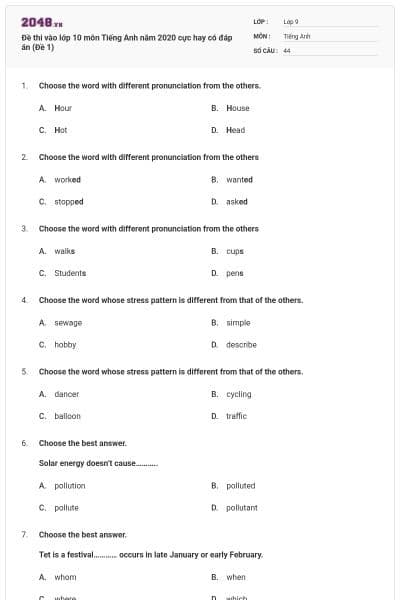
Đề thi vào lớp 10 môn Tiếng Anh năm 2020 cực hay có đáp án (Đề 1)
44 câu hỏi
Choose the word with different pronunciation from the others.
Hour
House
Hot
Head
Đáp án A
Choose the word with different pronunciation from the others
worked
wanted
stopped
asked
Đáp án B
Choose the word with different pronunciation from the others
walks
cups
Students
pens
Đáp án D
Choose the word whose stress pattern is different from that of the others.
sewage
simple
hobby
describe
Đáp án D
Choose the word whose stress pattern is different from that of the others.
dancer
cycling
balloon
traffic
Đáp án C
Choose the best answer.
Solar energy doesn’t cause………..
pollution
polluted
pollute
pollutant
Đáp án
A
Choose the best answer.
Tet is a festival………… occurs in late January or early February.
whom
when
where
which
Đáp án
D
Choose the best answer.
It’s raining. …………….., Mr. Nam has to go to work.
Although
So
Therefore
However
Đáp án
D
Choose the best answer.
If I ………….rich, I ……………………….around the world.
will be - travel
am - will travel
were - would travel
would be – traveled
Đáp án
C
Choose the best answer.
The girl wishes she………………… in Hue for the festival next week.
had stayed
was staying
stay
could stay
Đáp án
D
Choose the best answer.
You don’t like watching this film, …………………?
don’t you
are you
do you
did you
Đáp án
C
Choose the best answer.
When he lived in the city, he …………… to the theater twice a week.
uses to go
has gone
used to go
was going
Đáp án
C
Choose the best answer.
My house………….. in 1999
is built
was building
was built
has been built
Đáp án
C
Choose the best answer.
The entrance examination will be held………………….June 22nd 2012.
in
on
at
to
Đáp án
B
Choose the best answer.
Hoa: I suggest going camping next Sunday.- Lan: …………………………..
That’s a fine day
That’s a good idea
That’s a reason
That’s a good trip
Đáp án
B
Put the verbs in the brackets into the correct tense or form
The weather is terrible today. If the weather (1.be)……… good, I (2. go).....................for a walk.
Đáp án
were – would go
Put the verbs in the brackets into the correct tense or form
Yesterday, when we (3.visit)…………………. them, they (4. have)………….. dinner.
Đáp án
visited – were having
Put the verbs in the brackets into the correct tense or form
I (5.write )............ to my pen pal 2 months ago, but I (6.not receive) ……....... his reply since then.
Đáp án
wrote – haven’t received
Put the verbs in the brackets into the correct tense or form
We would rather (7. stay)...........................at home than go out on rainy days.
Đáp án
stay
Put the verbs in the brackets into the correct tense or form
I enjoy (8. teach)...................................., but I don't want ( 9. do)......................all my life
Đáp án
teaching – to do
Put the verbs in the brackets into the correct tense or form
My house (10. build)………………………………………..at present.
Đáp án
is being built
Supply the correct form of the words in brackets to complete the following sentences.
The accident happened because he drove …………………………... (care)
Đáp án: carelessly
Giải thích:
Kiến thức: Cấu tạo từ
Vị trí cần điền là một trạng từ bổ nghĩa cho động từ thường “drove”.
care (v): quan tâm
carefully (adv): một cách cẩn thận
carelessly (adv): một cách bất cẩn
Dựa vào nghĩa, dùng “carelessly”.
Dịch: Tai nạn xảy ra do anh ta lái xe bất cẩn.
Supply the correct form of the words in brackets to complete the following sentences
Air …………….……is one of the problems that people have deal to with. (pollute)
Đáp án
pollution
Supply the correct form of the words in brackets to complete the following sentences.
Traditional ………………..…... are a good source of fun and entertainment. (celebrate)
Đáp án
celebrations
Supply the correct form of the words in brackets to complete the following sentences.
You should buy this book . It’s very…………………………….. (inform)
Đáp án
informative
Supply the correct form of the words in brackets to complete the following sentences.
(Tradition)………….………................……., people eat sticky rice cakes at Tet
Đáp án
Traditionally
Read the text. Then choose the right sentence A, B, C or D
Last year, we had a nice holiday. My friend and I went to the seaside for a month. I had been to the seaside several times before, but this was the first time for my friend. Naturally, it was the great event for him. Finally, the day came. It was a fine morning. We got up very early because we wanted to leave home after breakfast. We made the journey by car. We reached the seaside at noon. We spent many hours on the beach. We enjoyed making castles and channels in the sand. People said we ought to spend at least a few weeks at the seaside. If we could stay longer, so much the better.
How long did the writer and his friend spend at the seaside?
week
A few weeks
A month
A few months
Đáp án
C
Read the text. Then choose the right sentence A, B, C or D
Last year, we had a nice holiday. My friend and I went to the seaside for a month. I had been to the seaside several times before, but this was the first time for my friend. Naturally, it was the great event for him. Finally, the day came. It was a fine morning. We got up very early because we wanted to leave home after breakfast. We made the journey by car. We reached the seaside at noon. We spent many hours on the beach. We enjoyed making castles and channels in the sand. People said we ought to spend at least a few weeks at the seaside. If we could stay longer, so much the better.
Who went to the seaside the first time?
The writer
The writer and his friend.
The writer's family
The writer's friend.
Đáp án
D
Read the text. Then choose the right sentence A, B, C or D
Last year, we had a nice holiday. My friend and I went to the seaside for a month. I had been to the seaside several times before, but this was the first time for my friend. Naturally, it was the great event for him. Finally, the day came. It was a fine morning. We got up very early because we wanted to leave home after breakfast. We made the journey by car. We reached the seaside at noon. We spent many hours on the beach. We enjoyed making castles and channels in the sand. People said we ought to spend at least a few weeks at the seaside. If we could stay longer, so much the better.
What was the weather like on the day they started their journey to the seaside?
It was bad
It was rainy
It was snowy
It was nice.
Đáp án
D
Read the text. Then choose the right sentence A, B, C or D
Last year, we had a nice holiday. My friend and I went to the seaside for a month. I had been to the seaside several times before, but this was the first time for my friend. Naturally, it was the great event for him. Finally, the day came. It was a fine morning. We got up very early because we wanted to leave home after breakfast. We made the journey by car. We reached the seaside at noon. We spent many hours on the beach. We enjoyed making castles and channels in the sand. People said we ought to spend at least a few weeks at the seaside. If we could stay longer, so much the better.
How did they travel to the seaside?
By car
By train
By bus
By air
Đáp án
A
Read the text. Then choose the right sentence A, B, C or D
Last year, we had a nice holiday. My friend and I went to the seaside for a month. I had been to the seaside several times before, but this was the first time for my friend. Naturally, it was the great event for him. Finally, the day came. It was a fine morning. We got up very early because we wanted to leave home after breakfast. We made the journey by car. We reached the seaside at noon. We spent many hours on the beach. We enjoyed making castles and channels in the sand. People said we ought to spend at least a few weeks at the seaside. If we could stay longer, so much the better.
When did they reach the seaside?
At 8 o'clock
At 12 o'clock
At 4 p.m
At 9 p.m
Đáp án
B
Read the passage and answer the following questions
Alexander Fleming was born in 1881 in Scotland. He went to a small school in a village, and when he left school he didn’t go to university. He worked for five years in an office. But his brother, Tom, was a doctor and helped Fleming to go to university and study medicine. So he went to London University and in 1906 he became a doctor. In 1915, Fleming married Sarah McElroy, an Irish woman. They had one son. During the First World War, many soldiers died in hospital because they didn’t have the right medicines. So after the war, Fleming tried to find a drug that could help them. He worked for many years and in 1928 he discovered a new drug and he called it “penicillin”. He later worked with an Australian and a German scientist to develop a drug that doctors could use. In 1945, they won the Nobel Prize in medicine for their work on penicillin.
Where was Alexander Fleming born?
Đáp án
(He was born) in Scotland
Read the passage and answer the following questions
Alexander Fleming was born in 1881 in Scotland. He went to a small school in a village, and when he left school he didn’t go to university. He worked for five years in an office. But his brother, Tom, was a doctor and helped Fleming to go to university and study medicine. So he went to London University and in 1906 he became a doctor. In 1915, Fleming married Sarah McElroy, an Irish woman. They had one son. During the First World War, many soldiers died in hospital because they didn’t have the right medicines. So after the war, Fleming tried to find a drug that could help them. He worked for many years and in 1928 he discovered a new drug and he called it “penicillin”. He later worked with an Australian and a German scientist to develop a drug that doctors could use. In 1945, they won the Nobel Prize in medicine for their work on penicillin.
Did he work in an office before he went to university?
Đáp án
Yes, (he did.)
Read the passage and answer the following questions
Alexander Fleming was born in 1881 in Scotland. He went to a small school in a village, and when he left school he didn’t go to university. He worked for five years in an office. But his brother, Tom, was a doctor and helped Fleming to go to university and study medicine. So he went to London University and in 1906 he became a doctor. In 1915, Fleming married Sarah McElroy, an Irish woman. They had one son. During the First World War, many soldiers died in hospital because they didn’t have the right medicines. So after the war, Fleming tried to find a drug that could help them. He worked for many years and in 1928 he discovered a new drug and he called it “penicillin”. He later worked with an Australian and a German scientist to develop a drug that doctors could use. In 1945, they won the Nobel Prize in medicine for their work on penicillin.
What did he study at university?
Đáp án
He studied medicine
Read the passage and answer the following questions
Alexander Fleming was born in 1881 in Scotland. He went to a small school in a village, and when he left school he didn’t go to university. He worked for five years in an office. But his brother, Tom, was a doctor and helped Fleming to go to university and study medicine. So he went to London University and in 1906 he became a doctor. In 1915, Fleming married Sarah McElroy, an Irish woman. They had one son. During the First World War, many soldiers died in hospital because they didn’t have the right medicines. So after the war, Fleming tried to find a drug that could help them. He worked for many years and in 1928 he discovered a new drug and he called it “penicillin”. He later worked with an Australian and a German scientist to develop a drug that doctors could use. In 1945, they won the Nobel Prize in medicine for their work on penicillin.
When did he win the Nobel Prize in medicine?
Đáp án
(He won the Nobel Prize in medicine) in 1945.
Complete the second sentences without changing the meaning of the first sentences.
He has never been late for work.
- Never……………………………………………………………………………………
Đáp án
Never has he been late for work.
Complete the second sentences without changing the meaning of the first sentences.
The man is my new boss. He is talking to the lady over there.
- The man …………………………………………………………………………………
Đáp án
The man who is talking to the lady over there is my new boss
Complete the second sentences without changing the meaning of the first sentences
“Does Mr. Pike live here?” the postman asked the boy.
- The postman asked the boy ……………………………………….…………………….
Đáp án
The postman asked the boy if Mr Pike lived there
Complete the second sentences without changing the meaning of the first sentences.
They will build a new school next month.
- A new school……………………………………………………..…………
Đáp án
A new school will be built next month.
Complete the second sentences without changing the meaning of the first sentences.
Finding an apartment in a big city is not easy.
- It is ….........................................
Đáp án
It is not easy to find an apartment in a big city.
Write complete sentences.
we /not/ see/ each other/ for/ 5 years.
……………………………………………………………………………………………
Đáp án
We haven’t seen each other for 5 years.
Write complete sentences
Mr Bill/ used/ go /swimming/ when/ he/ young.
……………………………………………………………………………………….……
Đáp án
Mr Bill used to go swimming when he was young.
Write complete sentences.
She / be / best / student / class.
…………………………………………………………………………………………
Đáp án
She is the best student in her class.
Write complete sentences
How long / it / take / you / go / school / everyday
…………………………………………………………………………………………
Đáp án
How long does it take you to go to school everyday?
Bạn có thích hoạt động này không?