Bộ 40 đề thi Tiếng Anh vào 10 có đáp án - Đề 40
40 câu hỏi
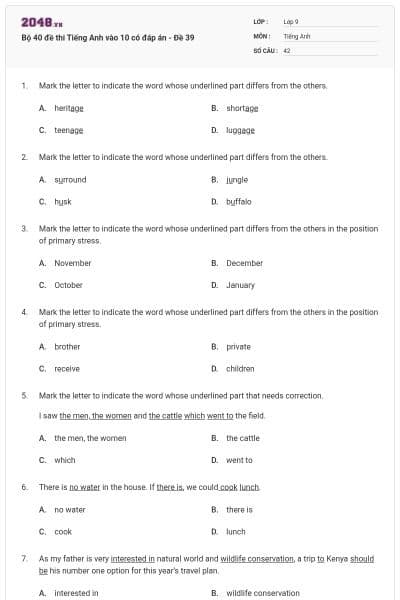
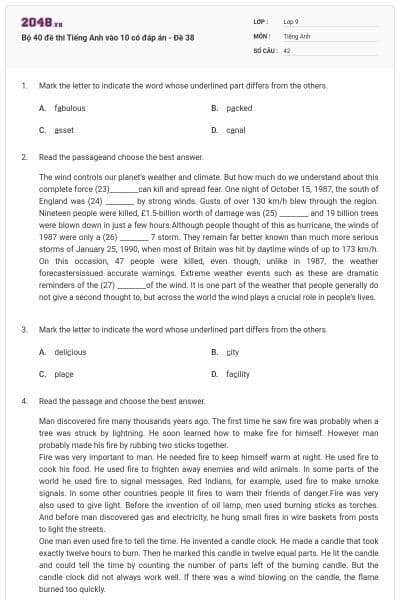
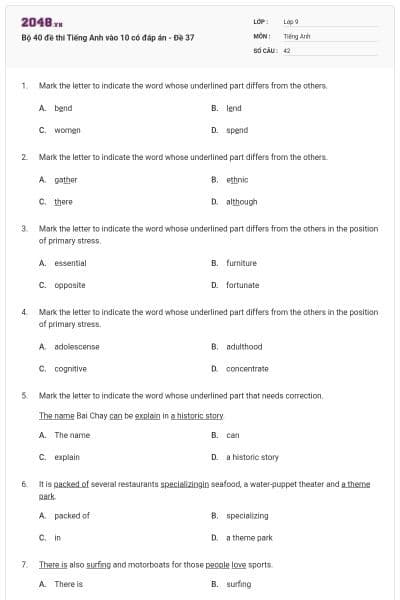
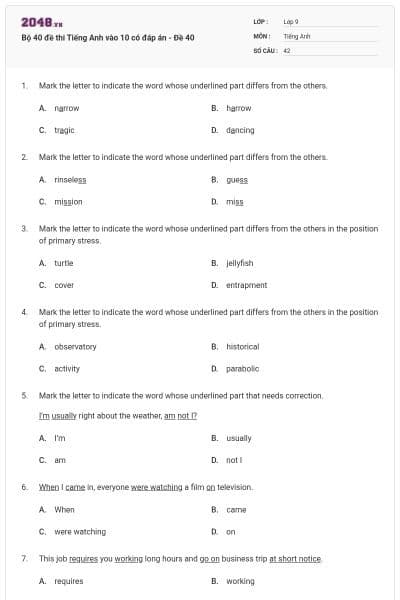
narrow
harrow
tragic
dancing
Đáp án D
rinseless
guess
mission
miss
Đáp án C
Mark the letter to indicate the word whose underlined part differs from the others in the position of primary stress.
turtle
jellyfish
cover
entrapment
Đáp án D
Mark the letter to indicate the word whose underlined part differs from the others in the position of primary stress.
observatory
historical
activity
parabolic
Đáp án D
I’m usually right about the weather, am not I?
I’m
usually
am
not I
Đáp án C
am -> aren't
When
came
were watching
on
Đáp án C
requires
working
go on
at short notice
Đáp án B
working -> to work
Mark the letter to indicate the correct answer.
circular
parabolic
straight
oval
Đáp án B
route
distance
way
behaviour
Đáp án C
adding
compulsory
optional
additional
Đáp án B
paying
to pay
paid
to paying
Đáp án A
from
at
of
with
Đáp án C
where
which
what
when
Đáp án B
.…………..is the act of cutting down or burning the trees in an area.
Forestation
Deforestation
Afforestation
Reforestation
Đáp án B
The bamboo used to make conical hats must be split into very thin strings and then put into water…………...they can avoid tearing and any breakage.
because
although
so that
therefore
Đáp án C
get on with
look forward to
face up to
keep up with
Đáp án A
Mark the letter to indicate the most suitable response.
It’s much cheaper
Which one? This one?
Sorry, it is out of stock
Can I help you?
Đáp án B
I’m pleased you like it
Not at all
Go ahead.
Come on.
Đáp án A
record
shine
categorize
diversify
Đáp án C
She is always diplomatic when she deals with angry students.
strict
outspoken
firm
tactful
Đáp án D
Mark the letter to indicate the word(s) OPPOSITE in meaning to the underlined word(s).
remake
empty
replenish
repeat
Đáp án B
He was so insubordinate that he lost his job within a week.
fresh
disobedient
obedient
understanding
Đáp án C
Read the passage and choose the best answer.
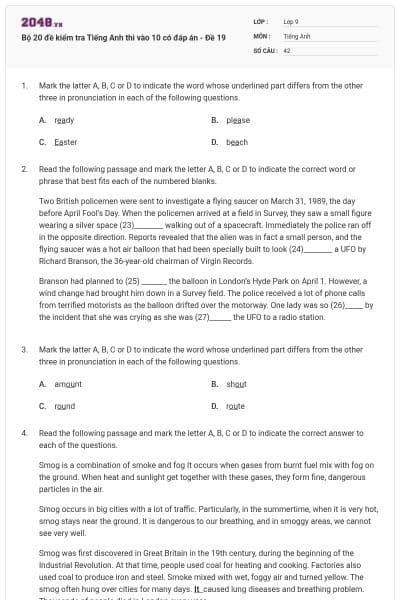
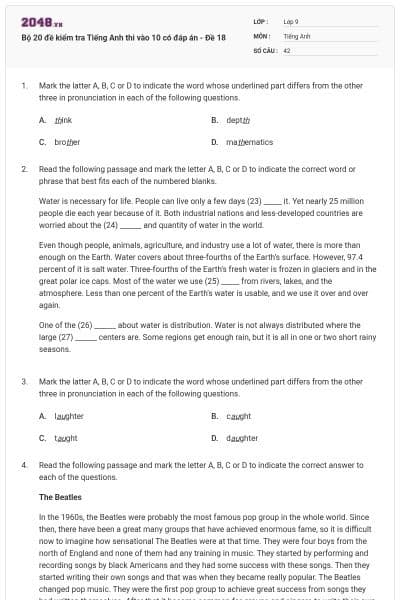
Air (23)…………..is caused of ill-health in human beings. In a lot of countries, there are laws limiting the amount of smoke which factories can (24)…………..although there is not enough information on the effects of smoke on the atmosphere. Doctors have proved that air pollution causes lung diseases. The gases from the exhausts of cars also (25)………….. air pollution in most cities. The lead in petrol produces a poisonous gas, which is often (26)…………..in busy streets circled by buildings. Children who live in areas where there is (27)…………..lead in the atmosphere cannot think as quickly as other children, and are clumsy when they use their hands.
Air (23)…………..is caused of ill-health in human beings.
pollute
pollution
polluted
polluting
Đáp án B
Giải thích:
1. in a lot of countries: ở nhiều nước
2. doctors: các bác sĩ
3. thì hiện tại hoàn thành: S + have/has Vp2
4. a lot of + N (danh từ không đếm được/danh từ đếm được số nhiều): rất nhiều
Dịch: Ô nhiễm không khí là nguyên nhân gây ra bệnh tật ở con người. Ở nhiều quốc gia có luật hạn chế lượng khói mà các nhà máy có thể thải ra mặc dù không có đủ thông tin về tác động của khói lên bầu khí quyển. Các bác sĩ đã chứng minh rằng ô nhiễm không khí gây ra các bệnh về phổi. Các khí từ ống xả của ô tô cũng gia tăng ô nhiễm không khí ở hầu hết các thành phố. Chì trong xăng tạo ra khí độc, thường tích tụ ở những con phố đông đúc xung quanh là các tòa nhà cao tầng. Trẻ em sống ở những khu vực có rất nhiều chì trong khí quyển không thể suy nghĩ nhanh như những đứa trẻ khác và vụng về khi sử dụng tay.
to produce
produced
producing
produce
Đáp án D
increased
increasing
to increase
increase
Đáp án A
collected
collect
collecting
collects
Đáp án A
lots of
a lot of
a lots
a lots of
Đáp án B
Read the passage and choose the best answer.
Thousands of years before Columbus came to the New World, the American Indians entered North America by crossing a narrow strip of land that once connected Alaska and Siberia. The migrants entered a new world in which there were no people at all. But there were many animals to hunt, and there were forests where nuts, roots, and berries could be gathered.
When the Europeans came to the New World, the Indians, at first, taught the settlers how to plant corn, bake fish, make canoes, and smoke tobacco. In return, the white introduced horses, guns, gunpowder, and alcohol. But at last, there were struggles for land, and the struggles could have only one result – war. When the wars were over, all Indians were moved to large tracts of land called reservations. Now, some of them, embittered by mistreatment, are determined to preserve their tribal life; some wish to modernize the reservations. These alternatives, with many variations, are what most Indians have chosen – a future in modern technology and education, or the revival of ancient tradition and treaties.
The Indians entered North America
before Columbus.
with Columbus.
after Columbus’s arrival.
in the 18th century.
Đáp án A
once settled by Europeans.
inhabited by primitive men.
inhabited in by American migrants.
completely uninhabited by other people.
Đáp án D
were hostile to the Indians
were taught a lot of things by the Indians
didn’t treat the Indians in a friendly way
traded with the Indians friendly
Đáp án B
most Indians reject modern culture and technology
some Indians preserve conventional life style
some Indians have adopted modern culture and technology
both B and C
Đáp án D
struggling for land
contemporary tribal life
making canoes
the revival of their tradition
Đáp án C
Finish the second sentences so that it has a similar meaning to the first one.
She would rather watch TV than read books
She would rather watch TV rather than read books
She would rather watch TV to reading books
She would rather watching TV than read books
Đáp án: A
Giải thích:
Cấu trúc: prefer doing something to doing something = would rather do something than do something: thích làm gì hơn làm gì
Đáp án A đúng ngữ pháp.
Dịch: Cô ấy thích xem TV hơn đọc sách.
If I was you, wouldn’t buy a new house here
If I were you, would buy a new house here
If I were you, wouldn’t buy a new house here
If I were you, won’t buy a new house here
Đáp án C
Would you mind if I come to the club with you tonight?
Would you mind if I coming to the club with you tonight?
Would you mind if I came to the club with you tonight?
Do you mind if I came to the club with you tonight?
Đáp án C
The car driver was said to driving very fast at the time of the crash
The car driver was said to drive very fast at the time of the crash
The car driver were said to be driving very fast at the time of the crash
The car driver was said to be driving very fast at the time of the crash
Đáp án D
Combine two sentences into a new one using the given words in brackets.
Have you been shown what do?
Have you been shown what to do?
Have you been shown what to doing?
Have you been show what to do?
Đáp án B
Because it rained heavily, we were late for school
Because it rains heavy, we were late for school
Because it rains heavily, we were late for school
Because it rain heavily, we were late for school
Đáp án A
The woman whom wants my advice wrote to me
The woman which wants my advice wrote to me
The woman whose wants my advice wrote to me
The woman who wants my advice wrote to me
Đáp án D
Thses tests were prepare by Mr Buong last month
Thses tests were prepared by Mr Buong last month
Thses tests was prepared by Mr Buong last month
Thses tests were prepared last month by Mr Buong
Đáp án D
Bạn có thích hoạt động này không?