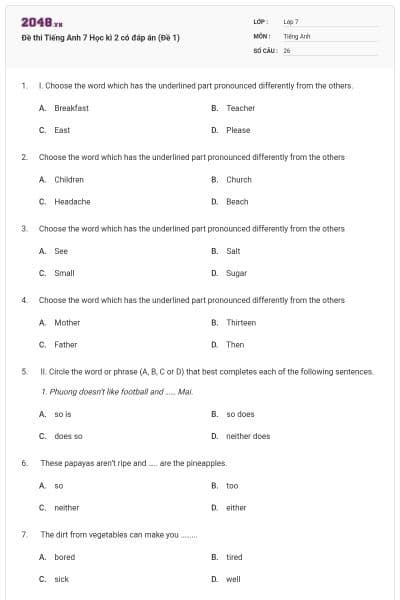
Đề thi Tiếng Anh 7 Học kì 2 có đáp án (Đề 1)
26 câu hỏi
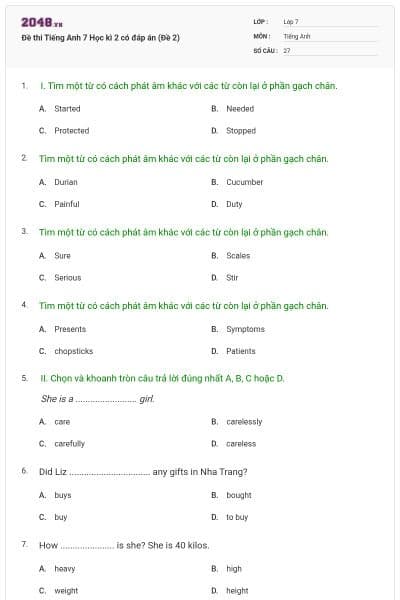
I. Choose the word which has the underlined part pronounced differently from the others.
Breakfast
Teacher
East
Please
Đáp án A
Choose the word which has the underlined part pronounced differently from the others
Children
Church
Headache
Beach
Đáp án C
Choose the word which has the underlined part pronounced differently from the others
See
Salt
Small
Sugar
Đáp án D
Choose the word which has the underlined part pronounced differently from the others
Mother
Thirteen
Father
Then
Đáp án B
II. Circle the word or phrase (A, B, C or D) that best completes each of the following sentences.
1. Phuong doesn’t like football and …… Mai.
so is
so does
does so
neither does
Đáp án D
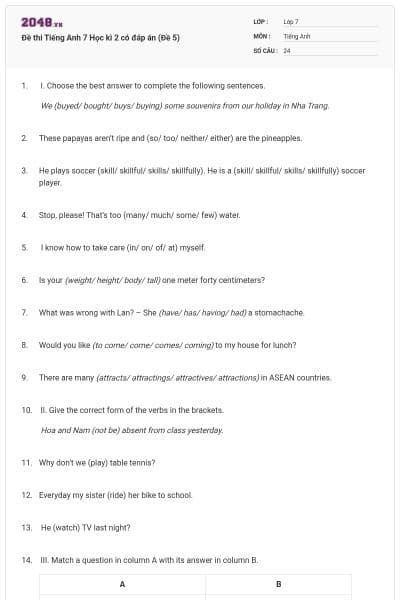
These papayas aren’t ripe and ….. are the pineapples.
so
too
neither
either
Đáp án C
The dirt from vegetables can make you ……...
bored
tired
sick
well
Đáp án C
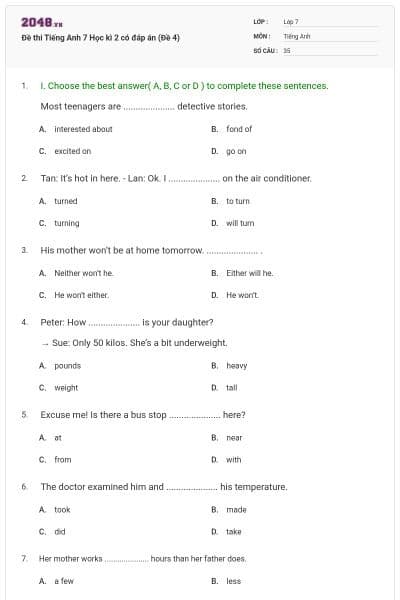
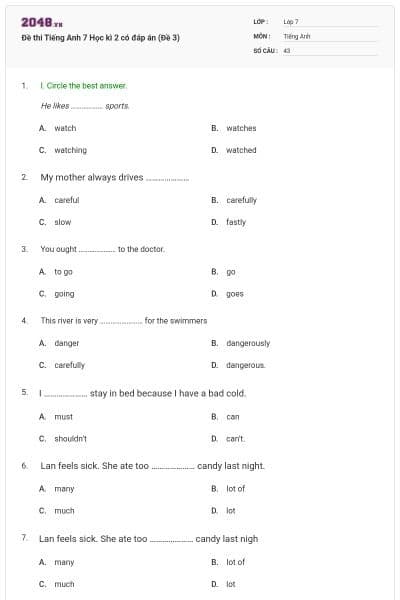
You must do your homework more ……. in the future.
careful
care
careless
carefully
Đáp án D
You should ……. early if you want to do morning exercise.
get up
getting up
to get up
to getting up
Đáp án A
Hoa is a ….. worker.
hardly
hard
more hard
most hard
Đáp án B
Last night we didn’t watch the film on TV because it was ……..
bore
bored
boring
boredom
Đáp án C
Mai enjoys ….. seafood with her parents.
to eat
eating
eat
to eating
Đáp án B
III. Supply the correct forms of the verbs in brackets.
He (wash)………………………….the dishes everyday
Đáp án: washes
We (play)…………………………volleyball tomorrow
Đáp án: will/shall play
She (not watch) …………………TV last night.
Đáp án: didn’t watch
……… they (go) …………………….to school now?
Đáp án: Are ... going?
IV. Write the sentences. Use the cue words.
I /not like/ read books
I don’t like reading books.
He / be/ good/ soccer/ player./ He/ play/ soccer/ good.
He is a good soccer player. He plays soccer well.
Mai / prefer/ meat/ fish.
Mai prefers meat to fish
They /prefer/ listen/ music/ watch / TV
They prefer listening to music to watching TV
He /do/ homework/ last night.
He did his homework last night.
Hoa/ not go/ school/ yesterday/ because/ she/ be/ sick.
Hoa didn’t go to school yesterday because she was sick
In 1960s, most people in Vietnam did not have a TV set. In the evening, the neighbors gathered around the TV. They watched until the TV programs finished. The children might play with their friends and the older people might talk together. Vietnam is different now. Many families have a TV set at home and the neighbors don’t spend much time together.
Did most people have a TV set in 1960s?
No, they didn’t.
In 1960s, most people in Vietnam did not have a TV set. In the evening, the neighbors gathered around the TV. They watched until the TV programs finished. The children might play with their friends and the older people might talk together. Vietnam is different now. Many families have a TV set at home and the neighbors don’t spend much time together.
How long did they watch TV programs?
They watched until the TV programs finished
In 1960s, most people in Vietnam did not have a TV set. In the evening, the neighbors gathered around the TV. They watched until the TV programs finished. The children might play with their friends and the older people might talk together. Vietnam is different now. Many families have a TV set at home and the neighbors don’t spend much time together.
What might the children do?
The children might play with their friends.
In 1960s, most people in Vietnam did not have a TV set. In the evening, the neighbors gathered around the TV. They watched until the TV programs finished. The children might play with their friends and the older people might talk together. Vietnam is different now. Many families have a TV set at home and the neighbors don’t spend much time together.
What might the older people do?
The older people might talk together