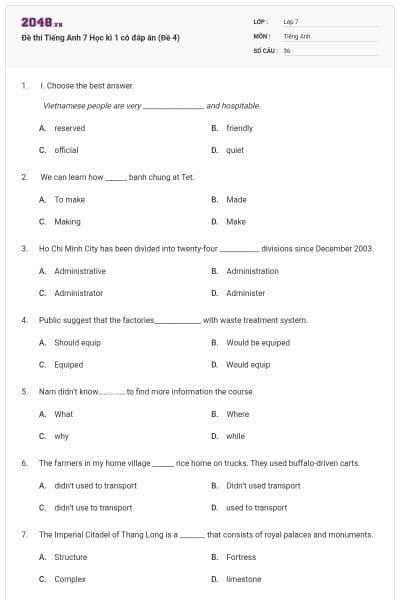
Đề thi Tiếng Anh 7 Học kì 1 có đáp án (Đề 4)
36 câu hỏi
I. Choose the best answer.
Vietnamese people are very _________________ and hospitable.
reserved
friendly
official
quiet
Đáp án: B
We can learn how ______ banh chung at Tet.
To make
Made
Making
Make
Đáp án:A
Ho Chi Minh City has been divided into twenty-four ___________ divisions since December 2003.
Administrative
Administration
Administrator
Administer
Đáp án: A
Public suggest that the factories_____________ with waste treatment system.
Should equip
Would be equiped
Equiped
Would equip
Đáp án:A
Nam didn’t know…………….to find more information the course.
What
Where
why
while
Đáp án:B
The farmers in my home village ______ rice home on trucks. They used buffalo-driven carts.
didn’t used to transport
Didn’t used transport
didn’t use to transport
used to transport
Đáp án: C
The Imperial Citadel of Thang Long is a _______ that consists of royal palaces and monuments.
Structure
Fortress
Complex
limestone
Đáp án: C
Giải thích:
Kiến thức: Từ vựng
A. structure (n): cấu trúc
B. fortress (n): pháo đài
C. complex (n): tổ hợp, phức hợp
D. limestone (n): đá vôi
Dựa vào nghĩa câu, chọn C.
Dịch: Hoàng thành Thăng Long là một quần thể bao gồm các cung điện và di tích hoàng gia.
At night they used to entertain ______ by telling and acting out stories.
Themselves
Them
Their
Themself
Đáp án:A
It ………………….that They are quieter and cheaper than taxi.
said
Are said
Is said
Say
Đáp án: C
The children in my home village used to go _____, even in winter. Now they all have shoes.
Bare-footed
Played around
Playing around
On foot
Đáp án:A
Mary asked me Where I…………………from
Coming
come
To come
came
Đáp án: D
I wish people in the world ______ conflicts and lived in peace.
Don’t have
Didn’t have
Didn’t had
Doesn’t have
Đáp án B
In Viet Nam, ______ often refers to age and social position, not to wealth.
Culture
Seniority
Generation
Tradition
Đáp án B
Tom ‘’Thanks for the nice gift’ Daisy
I am glad you like it
You are welcome
I myself don’t like it
I’m happy
Đáp án: B
A ______ is used to make the sound much louder so that many people can hear it from a distance.
Radio
Computer
Loudspeaker
Television
Đáp án: C
Traditional craft has …………………….from generation to generation
Passed
passed down
pass
Been passed down
Đáp án: D
My mother doesn’t work ………………….. Saturday
On
in
At
for
Đáp án:A
It is ……………Ha long bay was recognized as a word Heritage site by UNESCO
Knew
To know
known
knowing
Đáp án:C
II. Choose the word whose underline part is pronounced differently from the others.
measure
conduct
stuck
frustrated
Đáp án:A
Choose the word whose underline part is pronounced differently from the others
impolite
night
tradition
slight
Đáp án: C
III. Choose a word in each line that has different stress pattern.
people
enough
picture
father
Đáp án:B
Choose a word in each line that has different stress pattern
depend
begin
agree
happen
Đáp án:D
IV. Read the passage, and choose the best answer.
Good manners are a treasure to the people who possess them, as well as to the community they live in. Manners are taught, learnt, and passed from generation to generation.
Even hundreds of years ago, children were taught to behave responsibly. They learnt to respect seniority. When they passed an object to another person, they had to use both hands. When they entered a room, they had to bow and greet the oldest person first. Boys learnt to work hard to support their families. Girls learnt to do housework, and to take care of others. Loyalty and honesty were highly appreciated. When they made a mistake, they would not let another person be punished for it. That would be cowardly and mean. They were taught that families were strong, and everybody should stick together in adversity. (tai họa, nghịch cảnh)
Fortunately, many of these values have been well preserved. They have contributed to making the unique Vietnamese culture, and strengthening our society.
Good manners are _______________________.
of great value
of the community
traditional
only for the old
Đáp án:A
Good manners are a treasure to the people who possess them, as well as to the community they live in. Manners are taught, learnt, and passed from generation to generation.
Even hundreds of years ago, children were taught to behave responsibly. They learnt to respect seniority. When they passed an object to another person, they had to use both hands. When they entered a room, they had to bow and greet the oldest person first. Boys learnt to work hard to support their families. Girls learnt to do housework, and to take care of others. Loyalty and honesty were highly appreciated. When they made a mistake, they would not let another person be punished for it. That would be cowardly and mean. They were taught that families were strong, and everybody should stick together in adversity. (tai họa, nghịch cảnh)
Fortunately, many of these values have been well preserved. They have contributed to making the unique Vietnamese culture, and strengthening our society.
What was a boy’s main duty?
to respect seniority
to support his family
to do housework
to share good things
Đáp án:B
Good manners are a treasure to the people who possess them, as well as to the community they live in. Manners are taught, learnt, and passed from generation to generation.
Even hundreds of years ago, children were taught to behave responsibly. They learnt to respect seniority. When they passed an object to another person, they had to use both hands. When they entered a room, they had to bow and greet the oldest person first. Boys learnt to work hard to support their families. Girls learnt to do housework, and to take care of others. Loyalty and honesty were highly appreciated. When they made a mistake, they would not let another person be punished for it. That would be cowardly and mean. They were taught that families were strong, and everybody should stick together in adversity. (tai họa, nghịch cảnh)
Fortunately, many of these values have been well preserved. They have contributed to making the unique Vietnamese culture, and strengthening our society.
The sentence: “When they made a mistake, they would not let another person be punished for it,” means they would _______________________.
deny their mistake
admit their mistake
keep it a secret
be punished
Đáp án:B
Good manners are a treasure to the people who possess them, as well as to the community they live in. Manners are taught, learnt, and passed from generation to generation.
Even hundreds of years ago, children were taught to behave responsibly. They learnt to respect seniority. When they passed an object to another person, they had to use both hands. When they entered a room, they had to bow and greet the oldest person first. Boys learnt to work hard to support their families. Girls learnt to do housework, and to take care of others. Loyalty and honesty were highly appreciated. When they made a mistake, they would not let another person be punished for it. That would be cowardly and mean. They were taught that families were strong, and everybody should stick together in adversity. (tai họa, nghịch cảnh)
Fortunately, many of these values have been well preserved. They have contributed to making the unique Vietnamese culture, and strengthening our society.
What contributed to making the unique Vietnamese culture?
tradition
generations
good manners
seniority
Đáp án:C
Good manners are a treasure to the people who possess them, as well as to the community they live in. Manners are taught, learnt, and passed from generation to generation.
Even hundreds of years ago, children were taught to behave responsibly. They learnt to respect seniority. When they passed an object to another person, they had to use both hands. When they entered a room, they had to bow and greet the oldest person first. Boys learnt to work hard to support their families. Girls learnt to do housework, and to take care of others. Loyalty and honesty were highly appreciated. When they made a mistake, they would not let another person be punished for it. That would be cowardly and mean. They were taught that families were strong, and everybody should stick together in adversity. (tai họa, nghịch cảnh)
Fortunately, many of these values have been well preserved. They have contributed to making the unique Vietnamese culture, and strengthening our society.
This passage is about_______________________.
people who possess good manners
what bad manners children in the past had
the preservation of bad values
good manners and their value
Đáp án: D
V. Read the passage and choose the best answer.
Listed as a World Heritage Site in 1999, Hoi An is the (28) …………..……. main port of Viet Nam dating back to the 16th century. Today, most of its historic (29)………………….... have been preserved as landmarks. There are many things you can do there. For example, you can walk down the streets, (30) …………….……… by the atmosphere of times gone by. You should (31)............... the town during the full moon, when the shop owners turn off the lights and decorate the streets with candle lanterns. You can also take a sampan ride down the Song Do River, hunting traces of foreign traders such as the Japanese, Chinese, and Dutch who made Hoi An a centre of (32) ………………..……..in old Viet Nam.
Question 28
former
form
older
elder
Đáp án:A
Listed as a World Heritage Site in 1999, Hoi An is the (28) …………..……. main port of Viet Nam dating back to the 16th century. Today, most of its historic (29)………………….... have been preserved as landmarks. There are many things you can do there. For example, you can walk down the streets, (30) …………….……… by the atmosphere of times gone by. You should (31)............... the town during the full moon, when the shop owners turn off the lights and decorate the streets with candle lanterns. You can also take a sampan ride down the Song Do River, hunting traces of foreign traders such as the Japanese, Chinese, and Dutch who made Hoi An a centre of (32) ………………..……..in old Viet Nam.
Question 29
structure
building
structures
buildings
Đáp án:C
Listed as a World Heritage Site in 1999, Hoi An is the (28) …………..……. main port of Viet Nam dating back to the 16th century. Today, most of its historic (29)………………….... have been preserved as landmarks. There are many things you can do there. For example, you can walk down the streets, (30) …………….……… by the atmosphere of times gone by. You should (31)............... the town during the full moon, when the shop owners turn off the lights and decorate the streets with candle lanterns. You can also take a sampan ride down the Song Do River, hunting traces of foreign traders such as the Japanese, Chinese, and Dutch who made Hoi An a centre of (32) ………………..……..in old Viet Nam.
Question 30
around
round
surround
surrounded
Đáp án:D
Listed as a World Heritage Site in 1999, Hoi An is the (28) …………..……. main port of Viet Nam dating back to the 16th century. Today, most of its historic (29)………………….... have been preserved as landmarks. There are many things you can do there. For example, you can walk down the streets, (30) …………….……… by the atmosphere of times gone by. You should (31)............... the town during the full moon, when the shop owners turn off the lights and decorate the streets with candle lanterns. You can also take a sampan ride down the Song Do River, hunting traces of foreign traders such as the Japanese, Chinese, and Dutch who made Hoi An a centre of (32) ………………..……..in old Viet Nam.
Question 31
visit
visiting
to visit
be visited
Đáp án: A
Listed as a World Heritage Site in 1999, Hoi An is the (28) …………..……. main port of Viet Nam dating back to the 16th century. Today, most of its historic (29)………………….... have been preserved as landmarks. There are many things you can do there. For example, you can walk down the streets, (30) …………….……… by the atmosphere of times gone by. You should (31)............... the town during the full moon, when the shop owners turn off the lights and decorate the streets with candle lanterns. You can also take a sampan ride down the Song Do River, hunting traces of foreign traders such as the Japanese, Chinese, and Dutch who made Hoi An a centre of (32) ………………..……..in old Viet Nam.
Question 32
cultural
culture
tradition
traditional
Đáp án:B
VI. Write the complete sentences, using the the words/ phrases given.
I / suggest/ that/the government/ limit/ the number / daily visitors.
Đáp án:
I suggest that the government should limit the number of daily visitors
She/ wish/she/ can/communicate/ her pet.
Đáp án:
She wishes she could communicate with her pet.
VII. Arrange the following words/phrases in the correct order to make a meaningful sentence.
didn’t/ young people/ use to/ in / computer games / the past/ play /
Đáp án:
Young people didn’t used to play computer games in the past.
Viet Nam/reported/ the /Thien Duong/ it is/ longest cave/ in /that/is
Đáp án:
It is reported that Thien Duong is the longest cave in Viet Nam.