Đề thi cuối kì 1 Tiếng Anh 9 phòng GD&ĐT Ba Đình năm học 2024-2025 có đáp án
35 câu hỏi
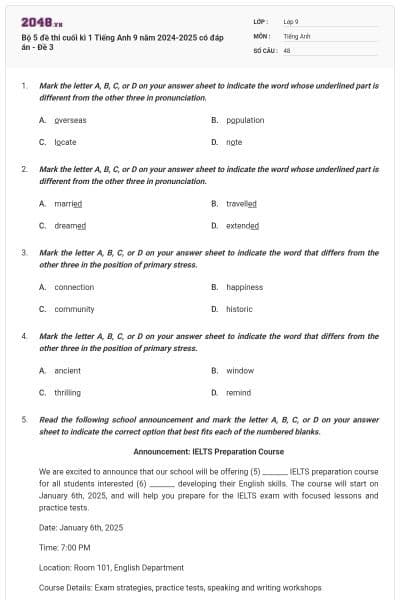
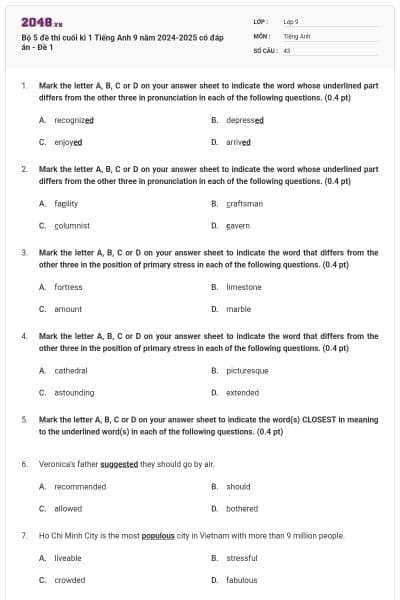
Mark the letter A, B, C or D on your answer sheet to indicate the word whose underlined part differs from the other three in pronunciation in each of the following questions. (0.4 pt)
recognized
depressed
enjoyed
arrived
Hướng dẫn giải:
Đáp án đúng: B
Đáp án B phát âm là /t/, các đáp án khác phát âm là /d/
Mark the letter A, B, C or D on your answer sheet to indicate the word whose underlined part differs from the other three in pronunciation in each of the following questions. (0.4 pt)
facility
craftsman
columnist
cavern
Hướng dẫn giải:
Đáp án đúng: A
Đáp án A phát âm là /s/, các đáp án khác phát âm là /k/
Mark the letter A, B, C or D on your answer sheet to indicate the word that differs from the other three in the position of primary stress in each of the following questions. (0.4 pt)
fortress
limestone
amount
marble
Hướng dẫn giải:
Đáp án đúng: C
Đáp án C nhấn âm 2, các đáp án khác nhấn âm 1
Mark the letter A, B, C or D on your answer sheet to indicate the word that differs from the other three in the position of primary stress in each of the following questions. (0.4 pt)
cathedral
picturesque
astounding
extended
Hướng dẫn giải:
Đáp án đúng: B
Đáp án B nhấn âm 3, các đáp án khác nhấn âm 2
Mark the letter A, B, C or D on your answer sheet to indicate the word(s) CLOSEST in meaning to the underlined word(s) in each of the following questions. (0.4 pt)
recommended
should
allowed
bothered
Hướng dẫn giải:
Đáp án đúng: D
Suggested (v) = recommended (v) đề xuất, gợi ý
Hướng dẫn dịch: Bố của Veronica đề xuất rằng họ nên đi máy bay.
liveable
stressful
crowded
fabulous
Hướng dẫn giải:
Đáp án đúng: D
Populous (a) = Crowded (a): đông đúc
Hướng dẫn dịch: Thành phố Hồ Chí Minh là thành phố đông dân nhất Việt Nam với hơn 9 triệu dân.
Mark the letter A, B, C or D on your answer sheet to indicate the word(s) OPPOSITE in meaning to the underlined word(s) in each of the following questions. (0.4 pt)
support
present
assist
refuse
Hướng dẫn giải:
Đáp án đúng: D
Accept (v) chấp nhận >< Refuse (v) từ chối
Hướng dẫn dịch: Thuyết phục cô ấy chấp nhận lời mời của chúng ta thì rất là khó.
present
natural
human
ancient
Hướng dẫn giải:
Đáp án đúng: D
Modern (a) hiện đại >< Ancient (a) cổ xưa
Hướng dẫn dịch: Học sinh liên tục đặt câu hỏi hỏi về sự liên quan của việc học lịch sử hiện đại khi họ đang sống ở thời điểm hiện tại.
Mark the letter A, B, C or D on your answer sheet to indicate the correct answer to each of the following questions. (1.0 pt)
I wish I ________ foot on every corner of Viet Nam.
can set
could set
will set
have set
Hướng dẫn giải:
Đáp án đúng: B
Câu mong ước ở hiện tại: S + wish + S + V(quá khứ đơn)
Hướng dẫn dịch: Tôi ước rằng tôi có thể đặt chân được trên khắp mọi ngóc ngách của Việt Nam.
were claimed
is claimed
have been claimed
claims
Hướng dẫn giải:
Đáp án đúng: B
Câu bị động dạng đặc biệt: It is said/believed/claimed/thought + that + S + V
Hướng dẫn dịch: Người ta cho rằng một số bác sĩ làm việc 80 giờ mỗi tuần.
to eating
not to eat
to eat
not eat
Hướng dẫn giải:
Đáp án đúng: C
Used + to V: diễn tả thói quen hoặc hành động đã từng xảy ra trong quá khứ.
Hướng dẫn dịch: Khi cô ấy còn là một cô bé, cô ấy thường ăn nhiều kẹo.
passed back
passed away
passed by
passed down
Hướng dẫn giải:
Đáp án đúng: D
Passed down: truyền lại
Hướng dẫn dịch: Nghề thủ công truyền thống của làng được truyền lại qua các thế hệ.
But
Despite
Because
Although
Hướng dẫn giải:
Đáp án đúng: D
Although + S + V, S + V: mặc dù…
Hướng dẫn dịch: Mặc dù Tim mệt, anh ấy vẫn hoàn thành xong phần việc của mình trong dự án nhóm.
Mark the letter A, B, C or D on your answer sheet to indicate the most suitable response to complete each of the following exchanges. (0.4 pt)
How cool!
Certainly. Here you are.
Some coffee, please.
No, I don’t like it.
Hướng dẫn giải:
Đáp án đúng: C
Hướng dẫn dịch: Mình sẽ pha nước uống. Bạn thích uống gì? - Cà phê, làm ơn.
Poor you!
That’s a good idea.
Thanks a lot.
It’s your turn.
Hướng dẫn giải:
Đáp án đúng: B
Hướng dẫn dịch: Hay là chọn một kỳ quan thiên nhiên của Việt Nam cho bài thuyết trình của chúng ta? - Ý kiến hay đấy.
Read the following passage and mark the letter A, B, C, or D on your answer sheet to indicate the correct answer to each of the following questions. (1.0 pt)
Cyberbullying is the (16) _____ of technology to annoy, threaten, or embarrass other people. Online threats and aggressions, or rude texts, posts, or messages all count. So does posting personal information, pictures, or videos designed to hurt or embarrass someone else. (17) _____ comments often focus on things like a person’s gender, religion, race, or physical differences.
Online bullying can be particularly damaging and upsetting (18) _____ it is usually anonymous or hard to find. People can suffer (19) _____ a 24/7 basis – every time they leave their cellphone or computer.
The first thing to do to solve the problem is to tell an adult you trust. You also can talk to your school counselor or a trusted teacher or a family member. Ignoring bullies is the (20) _____ way to take away their power, but it isn’t always easy to do – in the real world or online.
control
purpose
advantage
use
Hướng dẫn giải:
Đáp án đúng: D
Control (n) kiểm soát
Purpose (n) mục đích
Advantage (n) lợi thế
Use (n) sử dụng
Hướng dẫn dịch: Bắt nạt trên mạng là việc sử dụng công nghệ để làm phiền, đe dọa, làm xấu hổ hoặc nhắm vào người khác.
(17) _____ comments often focus on things like a person’s gender, religion, race, or physical differences.
Sudden
Rude
Polite
Simple
Hướng dẫn giải:
Đáp án đúng: B
Sudden (a) bất chợt
Rude (a) thô lỗ
Polite (a) lịch sự
Simple (a) đơn giản
Hướng dẫn dịch: Những bình luận thô lỗ thường tập trung vào những thứ như giới tính, tôn giáo, chủng tộc hoặc sự khác biệt về ngoại hình của một người.
so
because
due to
but
Hướng dẫn giải:
Đáp án đúng: B
So: nên
Because: bởi vì
Due to: do
But: nhưng
Hướng dẫn dịch: Bắt nạt trực tuyến có thể đặc biệt gây tổn hại và khó chịu vì thường ẩn danh hoặc khó tìm.
People can suffer (19) _____ a 24/7 basis – every time they leave their cellphone or computer.
at
on
of
from
Hướng dẫn giải:
Đáp án đúng: D
Suffer from: chịu đựng
Hướng dẫn dịch: Mọi người có thể phải chịu đựng 24/7 - mỗi khi họ kiểm tra điện thoại di động hoặc máy tính của mình.
Ignoring bullies is the (20) _____ way to take away their power, but it isn’t always easy to do – in the real world or online.
good
best
well
more
Hướng dẫn giải:
Đáp án đúng: B
Hướng dẫn dịch: Phớt lờ những kẻ bắt nạt là cách tốt nhất để tước đi quyền lực của chúng, nhưng không phải lúc nào cũng dễ thực hiện - trong thế giới thực hoặc trực tuyến.
Dịch bài đọc:
Bắt nạt trên mạng là việc sử dụng công nghệ để làm phiền, đe dọa, làm xấu hổ hoặc nhắm vào người khác. Các mối đe dọa trực tuyến và các văn bản, bài đăng hoặc tin nhắn hung hăng hoặc thô lỗ đều được tính. Cũng như việc đăng thông tin cá nhân, hình ảnh hoặc video được thiết kế để làm tổn thương hoặc làm xấu hổ người khác. Những bình luận thô lỗ thường tập trung vào những thứ như giới tính, tôn giáo, chủng tộc hoặc sự khác biệt về ngoại hình của một người.
Bắt nạt trực tuyến có thể đặc biệt gây tổn hại và khó chịu vì thường ẩn danh hoặc khó tìm. Mọi người có thể phải chịu đựng 24/7 - mỗi khi họ kiểm tra điện thoại di động hoặc máy tính của mình.
Điều đầu tiên cần làm để giải quyết vấn đề là nói với người lớn mà bạn tin tưởng. Bạn cũng có thể nói chuyện với cố vấn học đường hoặc giáo viên hoặc thành viên gia đình đáng tin cậy. Phớt lờ những kẻ bắt nạt là cách tốt nhất để tước đi quyền lực của chúng, nhưng không phải lúc nào cũng dễ thực hiện - trong thế giới thực hoặc trực tuyến.
Read the following passage and mark the letter A, B, C, or D on your answer sheet to indicate the correct answer to each of the following questions. (1.0 pt)
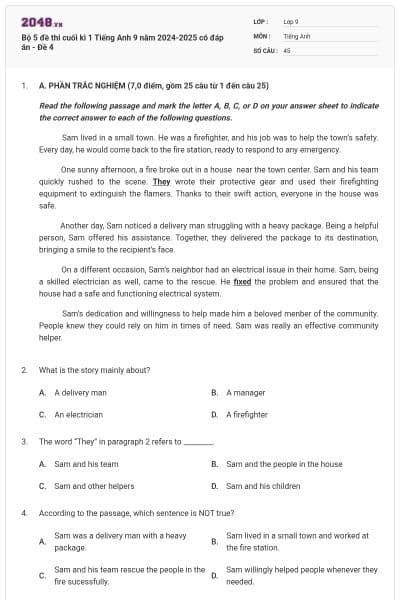
Growing up in the early 2000s, a period when technology began to enter our lives, I remembered my childhood in two distinct parts. In elementary school, my friends and I spent our free time after school playing outside. We would go to different street vendors to eat junk food and buy cheap toys. Sometimes, we would watch cartoons together. But there were few channels back then; we didn’t spend too much time in front of the TV. Everything gradually changed when I started secondary school. The Internet had become more popular, so I began spending more time at Internet cafes. I used to play games online and chat with my friends. Cable channel was also on the rise at that time. There were channels airing cartoons all day, every day. Watching TV became a routine for many kids my age. At the time, I didn’t give much thought about the changes. Now, I realize that I miss those old days hanging out with my friends, eating junk food, and sharing toys.
In the 1990s
In the 1980s
In the 1970s
In the 2000s
Hướng dẫn giải:
Đáp án đúng: D
Thông tin: Growing up in the early 2000s, a period when technology began to enter our lives, I remembered my childhood in two distinct parts.
Hướng dẫn dịch: Lớn lên vào đầu những năm 2000, thời kỳ công nghệ bắt đầu len lỏi vào cuộc sống, tôi nhớ về tuổi thơ của mình theo hai phần riêng biệt.
How did the writer and friends spend their free time in elementary school?
They went to different street vendors to watch cartoons together.
They went to different street vendors to eat junk food and buy cheap toys and watched cartoons together.
They went to different street vendors to eat junk food and buy cheap toys and read comics together.
They went to different street vendors to drink juice and buy comics and watched cartoons together.
Hướng dẫn giải:
Đáp án đúng: B
Thông tin: In elementary school, my friends and I spent our free time after school playing outside. We would go to different street vendors to eat junk food and buy cheap toys. Sometimes, we would watch cartoons together.
Hướng dẫn dịch: Hồi tiểu học, tôi và bạn bè thường dành thời gian rảnh rỗi sau giờ học để chơi ngoài trời. Chúng tôi thường đến những quán ăn vặt ven đường để ăn đồ ăn vặt và mua đồ chơi giá rẻ. Thỉnh thoảng, chúng tôi cùng nhau xem phim hoạt hình.
What did the writer do at Internet Café when coming to secondary school?
Drinking coffee and chatting with his/hẻ friends.
Playing games online and chatting with his/ her friends.
Drinking coffee and reading books.
Playing games online and drinking coffee.
Hướng dẫn giải:
Đáp án đúng: B
Thông tin: Everything gradually changed when I started secondary school. The Internet had become more popular, so I began spending more time at Internet cafes. I used to play games online and chat with my friends.
Hướng dẫn dịch: Mọi thứ dần thay đổi khi tôi bắt đầu học trung học. Internet đã trở nên phổ biến hơn, vì vậy tôi bắt đầu dành nhiều thời gian hơn ở các quán cà phê Internet. Tôi thường chơi game trực tuyến và trò chuyện với bạn bè.
Cable cars
Digital channel
Digital cars
Cable channel
Hướng dẫn giải:
Đáp án đúng: D
Thông tin: Cable channel was also on the rise at that time.
Hướng dẫn dịch: Kênh truyền hình cáp cũng đang phát triển vào thời điểm đó.
What does the writer miss now?
The old days hanging out with his/ her friends and watching TV.
The old days chatting with his/ her friends.
The old days hanging out with his/ her friends, eating junk food, and sharing toys.
The old days hanging out with his/ her friends and reading comics.
Hướng dẫn giải:
Đáp án đúng: C
Thông tin: Now, I realize that I miss those old days hanging out with my friends, eating junk food, and sharing toys.
Hướng dẫn dịch: Giờ đây, tôi nhận ra rằng tôi nhớ những ngày xưa tụ tập với bạn bè, ăn đồ ăn vặt và chia sẻ đồ chơi.
Dịch bài đọc:
Lớn lên vào đầu những năm 2000, thời kỳ công nghệ bắt đầu len lỏi vào cuộc sống, tôi nhớ về tuổi thơ của mình theo hai phần riêng biệt. Hồi tiểu học, tôi và bạn bè thường dành thời gian rảnh rỗi sau giờ học để chơi ngoài trời. Chúng tôi thường đến những quán ăn vặt ven đường để ăn đồ ăn vặt và mua đồ chơi giá rẻ. Thỉnh thoảng, chúng tôi cùng nhau xem phim hoạt hình. Nhưng hồi đó có rất ít kênh truyền hình; chúng tôi không dành quá nhiều thời gian trước TV. Mọi thứ dần thay đổi khi tôi bắt đầu học trung học. Internet đã trở nên phổ biến hơn, vì vậy tôi bắt đầu dành nhiều thời gian hơn ở các quán cà phê Internet. Tôi thường chơi game trực tuyến và trò chuyện với bạn bè. Kênh truyền hình cáp cũng đang phát triển vào thời điểm đó. Có những kênh phát sóng phim hoạt hình suốt ngày, mỗi ngày. Xem TV đã trở thành thói quen của nhiều đứa trẻ ở độ tuổi của tôi. Vào thời điểm đó, tôi không nghĩ nhiều về những thay đổi. Giờ đây, tôi nhận ra rằng tôi nhớ những ngày xưa tụ tập với bạn bè, ăn đồ ăn vặt và chia sẻ đồ chơi.
Mark the letter A, B, C or D on your answer sheet to indicate the underlined part that needs correction in each of the following questions. (0.4 pt)
built
Temple of Literature
the 11th century
is saying
Hướng dẫn giải:
Đáp án đúng: D
Sửa lại: is saying => is said
Hướng dẫn dịch: Người ta nói rằng Văn Miếu được xây dựng vào thế kỉ 11.
after
to set off
will
that
Hướng dẫn giải:
Đáp án đúng: C
Sửa lại: will => would
Trong câu tường thuật, động từ tường thuật “said” ở quá khứ nên thì của mệnh đề sau phải lùi lại.
Hướng dẫn dịch: Họ nói rằng họ sẽ phải khởi hành ngay sau nửa đêm.
Mark the letter A, B, C, or D on your answer sheet to indicate the sentence that is closest in meaning to the original sentence in each of the following questions. (0.8 pt)
Classical music is more interesting as folk music.
Classical music is so interesting than folk music.
Classical music is more interesting than folk music.
Classical music is as interesting as folk music.
Hướng dẫn giải:
Đáp án đúng: D
Cấu trúc so sánh bằng: S1 + V + as + adj/adv + as + S2 + V
Hướng dẫn dịch: Nhạc cổ điển thú vị như nhạc dân gian.
“Can I borrow your car, Kurt?” said Mary.
Mary asked Kurt if she could borrow his car.
Mary said to Kurt if she can borrow his car.
Mary asked Kurt she can borrow his car.
Mary asked Kurt if she can borrow his car.
Hướng dẫn giải:
Đáp án đúng: A
Câu tường thuật dạng câu hỏi: S + asked/wanted… + if/whether + S + V
Hướng dẫn dịch: Mary hỏi Kurt xem cô ấy có thể mượn xe của anh ấy được không.
"Why don't we travel to Phu Quoc Island by ferry?" they said.
They wanted to travel to Phu Quoc Island by ferry.
They asked why we didn't travel to Phu Quoc Island by ferry.
They wished that we travelled to Phu Quoc Island by ferry.
They suggested travelling to Phu Quoc Island by ferry.
Hướng dẫn giải:
Đáp án đúng: D
Why don’t + we = S + suggested + Ving: gợi ý, đề xuất làm gì
Hướng dẫn dịch: Họ gợi ý đi đến đảo Phú Quốc bằng phà.
It’s a pity I can’t cook as well as my mom.
I wish I had cooked as well as my mom.
I wish I could cook as well as my mom.
I wish I have cooked as well as my mom.
I wish I can cook as well as my mom.
Hướng dẫn giải:
Đáp án đúng: B
Câu mong ước ở hiện tại: S + wish + S + V(quá khứ đơn)
Hướng dẫn dịch: Tôi ước mình có thể nấu ăn giỏi như mẹ tôi.
Mark the letter A, B, C, or D to indicate the sentence that is best written from the words/phrases given. (0.8 pt)
We lost, so we stopped and ask a policeman for direction.
We are lost, so we stopped asking a policeman about direction.
We were lost, so we stopped to asking a policeman for direction.
We were lost, so we stopped to ask a policeman for direction.
Hướng dẫn giải:
Đáp án đúng: D
Stop + to V: dừng lại để làm gì
Hướng dẫn dịch: Chúng tôi bị lạc, nên đã dừng lại để hỏi đường một cảnh sát.
I/wish/can/go camping/you/next week
I wish I could go camping with you next week.
I wish I can go camping with you next week.
I wish I could going to camp with you next week.
I wish I can go to the camp with you next week.
Hướng dẫn giải:
Đáp án đúng: A
Câu mong ước ở hiện tại: S + wish + S + V(quá khứ đơn)
Hướng dẫn dịch: Tôi ước mình có thể đi cắm trại với bạn vào tuần tới.
My Dad/suggest/I/learn/Spanish.
My Dad suggested that I should learn Spanish.
My Dad suggest that I should learn Spanish.
My Dad suggested that I learns Spanish.
My Dad suggested that I'm learning Spanish.
Hướng dẫn giải:
Đáp án đúng: A
Cấu trúc: S + suggested that + S + V: gợi ý nên làm gì
Hướng dẫn dịch: Bố tôi gợi ý rằng tôi nên học tiếng Tây Ban Nha.
What/you/use to do/free time/a child?
What did you use to do in your free time as a child?
What did you used to do in your free time as a child?
What were you used to do in your free time as a child?
What do you used to do in your free time when a child?
Hướng dẫn giải:
Đáp án đúng: A
Thì quá khứ đơn dạng câu nghi vấn: Từ để hỏi + trợ động từ “did” + S + V?
Hướng dẫn dịch: Khi còn nhỏ, bạn thường làm gì vào thời gian rảnh?