Đề kiểm tra Tổng và hiệu của hai vectơ lớp 10 (có lời giải) - Đề 1
22 câu hỏi
\(\overrightarrow {AB} = \overrightarrow {OA} - \overrightarrow {AB} \)
\(\overrightarrow {CO} - \overrightarrow {OB} = \overrightarrow {BA} \)
\(\overrightarrow {AB} - \overrightarrow {AD} = \overrightarrow {AC} \)
\(\overrightarrow {AO} + \overrightarrow {OD} = \overrightarrow {CB} \)
Chọn B

\[\vec a + \vec b = \vec b + \vec a\].
\[\left( {\vec a + \vec b} \right) + \vec c = \vec a + \left( {\vec b + \vec c} \right)\].
\[\vec a + \overrightarrow 0 = \vec a\].
\[\overrightarrow 0 + \vec a = \overrightarrow 0 \].
Chọn D
\[\overrightarrow 0 + \vec a = \vec a\].
\(\overrightarrow {CA} \).
\(\overrightarrow {BD} \).
\(\overrightarrow {AC} \).
\(\overrightarrow {DB} \).
Chọn A
\[\overrightarrow {CB} + \overrightarrow {CD} = \overrightarrow {CA} \].
\[\overrightarrow {AB} + \overrightarrow {BC} = \overrightarrow {AC} \].
\[\overrightarrow {AC} + \overrightarrow {CB} = \overrightarrow {AB} \].
\[\overrightarrow {CA} + \overrightarrow {BC} = \overrightarrow {BA} \].
\[\overrightarrow {CB} + \overrightarrow {AC} = \overrightarrow {BA} \].
Chọn D
\[\overrightarrow {CB} + \overrightarrow {AC} = \overrightarrow {AB} \].
M ở vị trí bất kì
M là trung điểm của AB
Không tìm được M
M nằm trên đường trung trực của AB
Chọn B
\(M\)là trung điểm \(AB\).
\(M\) trùng \(A\).
\(M\) trùng \(B\).
\(A\) là trung điểm \(MB\).
Chọn D
\[\overrightarrow {MA} + \overrightarrow {BA} = \overrightarrow O \]\[ \Leftrightarrow \overrightarrow {AM} + \overrightarrow {AB} = \overrightarrow O \]\( \Leftrightarrow A\) là trung điểm \(MB\).
\[I\]là trung điểm \(AB\).
\(I\)thuộc đường trung trực của \(AB\).
Không có điểm \(I\).
Có vô số điểm\(I\).
Chọn D
\[\overrightarrow {IA} \] và \[\overrightarrow {CB} \] cùng phương nên\(AI\)//\(CB\). Suy ra có vô số điểm\(I\).
\(M\)là trung điểm \(AB\).
\(M\)thuộc đường trung trực của\(AB\).
Không có điểm \(M\).
Có vô số điểm\(M\).
Chọn C
\[\overrightarrow {MA} - \overrightarrow {MB} = \overrightarrow O \]\[ \Leftrightarrow \overrightarrow {BA} = \overrightarrow O \](vô lý).
4
8
\(2\sqrt {13} \)
\(\sqrt {13} \)
Chọn C
Ta có:\(AC = \sqrt {B{C^2} - A{B^2}} = 4 \Rightarrow AI = 2;\left| {\overrightarrow {BA} + \overrightarrow {BC} } \right| = 2\left| {\overrightarrow {BI} } \right| = 2\sqrt {A{B^2} + A{I^2}} = 2\sqrt {13} \).

Học thông minh hơn mỗi ngày
Xem toàn bộ 22 câu hỏi và nhiều hơn nữa với tài khoản miễn phí
\(a\sqrt 3 \)
\(2a\sqrt 5 \)
\(a\sqrt 5 \)
\(a\sqrt 2 \)
Chọn B
\(\left| {\overrightarrow {CB} - \overrightarrow {AD} + \overrightarrow {AC} } \right| = \left| {\overrightarrow {CB} + \overrightarrow {DA} + \overrightarrow {AC} } \right| = \left| {\overrightarrow {CB} + \overrightarrow {DC} } \right| = \left| {\overrightarrow {DB} } \right| = \sqrt {B{H^2} + D{H^2}} = 2a\sqrt 5 \)
\(3\left( {\sqrt 7 + \sqrt 5 } \right)\)
\(3\left( {\sqrt 7 + \sqrt 3 } \right)\)
\(6\left( {\sqrt 5 + 3} \right)\)
\(\frac{1}{2}\left( {2\sqrt 3 + \sqrt {51} } \right)\)
Chọn B
Dựng \(\overrightarrow {OA} = \overrightarrow a ;\overrightarrow {OB} = \overrightarrow b \)Dựng hình bình hành OACB \( \Rightarrow \overrightarrow a + \overrightarrow b = \overrightarrow {OC} ;\overrightarrow a - \overrightarrow b = \overrightarrow {BA} \)
\( \Rightarrow \Delta OAB\) vuông tại \(B \Rightarrow IB = \frac{{AB}}{2} = \frac{{3\sqrt 3 }}{2}\)
\(OI = \sqrt {O{B^2} + I{B^2}} = \frac{{\sqrt {63} }}{2} \Rightarrow OC = \sqrt {63} \Rightarrow \left| {\overrightarrow a + \overrightarrow b } \right| + \left| {\overrightarrow a - \overrightarrow b } \right| = \sqrt {63} + 3\sqrt 3 \).
\(\left| {\overrightarrow {OB} + \overrightarrow {OC} } \right| = 3a\)
\(\left| {\overrightarrow {OB} + \overrightarrow {OC} } \right| = a\)
\(\left| {\overrightarrow {OB} + \overrightarrow {OC} } \right| = \frac{{3a}}{2}\)
\(\left| {\overrightarrow {OB} + \overrightarrow {OC} } \right| = 0\)
Chọn B
\(\left| {\overrightarrow {OB} + \overrightarrow {OC} } \right| = \left| {\overrightarrow {OA} + \overrightarrow {AB} + \overrightarrow {OD} + \overrightarrow {DC} } \right| = \left| {\overrightarrow {AB} + \overrightarrow {DC} } \right| \Rightarrow \left| {\overrightarrow {AB} } \right| + \left| {\overrightarrow {DC} } \right| = 3a\)
(vì \(\overrightarrow {AB} \) và \(\overrightarrow {DC} \) cùng hướng)
|
a) Đúng |
b) Sai |
c) Sai |
d) Đúng |
Ta có: \(\overrightarrow {CB} + \overrightarrow {CD} = \overrightarrow {CA} \) (quy tắc hình bình hành).
Ta có: \(\overrightarrow {AC} + \overrightarrow {DA} = \overrightarrow {DC} \)(quy tắc ba điểm)
\(\overrightarrow {BA} - \overrightarrow {BC} + \overrightarrow {AD} = \overrightarrow {BA} + \overrightarrow {CB} + \overrightarrow {AD} \)
\( = (\overrightarrow {CB} + \overrightarrow {BA} ) + \overrightarrow {AD} = \overrightarrow {CA} + \overrightarrow {AD} = \overrightarrow {CD} \) (quy tắc ba điểm).
|
a) Sai |
b) Đúng |
c) Đúng |
d) Đúng |
Ta có: \(\overrightarrow {AB} + \overrightarrow {CD} = \overrightarrow {AD} + \overrightarrow {CB} \)
\( \Leftrightarrow \overrightarrow {AB} + \overrightarrow {CD} - \overrightarrow {AD} - \overrightarrow {CB} = \vec 0\)
\( \Leftrightarrow \overrightarrow {AB} + \overrightarrow {CD} + \overrightarrow {DA} + \overrightarrow {BC} = \vec 0\)
\( \Leftrightarrow (\overrightarrow {AB} + \overrightarrow {BC} ) + (\overrightarrow {CD} + \overrightarrow {DA} ) = \vec 0\)
\( \Leftrightarrow \overrightarrow {AC} + \overrightarrow {CA} = \vec 0\) (luôn đúng).
Ta có: \(\overrightarrow {AB} - \overrightarrow {CD} = \overrightarrow {AC} + \overrightarrow {DB} \Leftrightarrow \overrightarrow {AB} - \overrightarrow {CD} - \overrightarrow {AC} - \overrightarrow {DB} = \overrightarrow 0 \)
\( \Leftrightarrow \overrightarrow {AB} + \overrightarrow {DC} + \overrightarrow {CA} + \overrightarrow {BD} = \vec 0\)
\( \Leftrightarrow (\overrightarrow {AB} + \overrightarrow {BD} ) + (\overrightarrow {DC} + \overrightarrow {CA} ) = \vec 0 \Leftrightarrow \overrightarrow {AD} + \overrightarrow {DA} = \vec 0{\rm{ }}\)(luôn đúng)
|
a) Đúng |
b) Đúng |
c) Sai |
d) Đúng |
|
a) Đúng |
b) Sai |
c) Sai |
d) Đúng |
Ta có: \(\overrightarrow {RJ} = \overrightarrow {RA} + \overrightarrow {AJ} ,\overrightarrow {IQ} = \overrightarrow {IB} + \overrightarrow {BQ} ,\overrightarrow {PS} = \overrightarrow {PC} + \overrightarrow {CS} \).
Khi đó: \(\overrightarrow {RJ} + \overrightarrow {IQ} + \overrightarrow {PS} \)
\( = (\overrightarrow {RA} + \overrightarrow {AJ} ) + (\overrightarrow {IB} + \overrightarrow {BQ} ) + (\overrightarrow {PC} + \overrightarrow {CS} )\)\(\)
\(\begin{array}{l} = (\overrightarrow {RA} + \overrightarrow {CS} ) + (\overrightarrow {AJ} + \overrightarrow {IB} ) + (\overrightarrow {BQ} + \overrightarrow {PC} )\\ = (\overrightarrow {SC} + \overrightarrow {CS} ) + (\overrightarrow {BI} + \overrightarrow {IB} ) + (\overrightarrow {CP} + \overrightarrow {PC} )\\ = \overrightarrow {SS} + \overrightarrow {BB} + \overrightarrow {CC} = \vec 0\end{array}\)
Vậy \(\overrightarrow {RJ} + \overrightarrow {IQ} + \overrightarrow {PS} = \vec 0\).
Ta có \(|\overrightarrow {PB} + \overrightarrow {PA} - \overrightarrow {PC} | = |\overrightarrow {PB} + \overrightarrow {PC} - \overrightarrow {PA} |\) tương đương với \(|\overrightarrow {PB} + \overrightarrow {CA} | = |\overrightarrow {PB} + \overrightarrow {AC} |\),
hai vectơ \(\overrightarrow {PB} \) và \(\overrightarrow {AC} \) có giá vuông góc hay hai đường thẳng \(PB\)
và \(AC\) vuông góc. Tương tự điều kiện \(|\overrightarrow {PC} + \overrightarrow {PB} - \overrightarrow {PA} | = |\overrightarrow {PC} + \overrightarrow {PA} - \overrightarrow {PB} |\) tương đương \(|\overrightarrow {PC} + \overrightarrow {AB} | = |\overrightarrow {PC} + \overrightarrow {BA} |\), suy ra hai vectơ \(\overrightarrow {PC} \) và \(\overrightarrow {AB} \) có giá vuông góc hay
hai đường thẳng \(PC\) và \(AB\) vuông góc. Từ đó \(P\) là trực tâm tam giác \(ABC\),
suy ra hai vectơ \(\overrightarrow {PA} \) và \(\overrightarrow {BC} \) có giá vuông góc, tương tự cách làm Bài 4 ta suy ra
\(|\overrightarrow {PA} + \overrightarrow {BC} | = |\overrightarrow {PA} - \overrightarrow {BC} |\) hay \(|\overrightarrow {PA} + \overrightarrow {PC} - \overrightarrow {PB} | = |\overrightarrow {PA} + \overrightarrow {PB} - \overrightarrow {PC} |\)
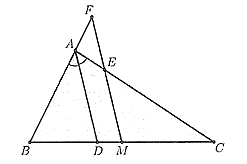
Ta có: \(\overrightarrow {CM} - \overrightarrow {EM} = \overrightarrow {CM} + \overrightarrow {ME} = \overrightarrow {CE} \)
Ta có: \(ME\parallel AD \Rightarrow \frac{{CE}}{{CA}} = \frac{{CM}}{{CD}}\left( 1 \right)\); \(AD\parallel MF \Rightarrow \frac{{BA}}{{BF}} = \frac{{BD}}{{BM}}\left( 2 \right)\)
Nhân theo vế (1), (2) với \(BM = CM\), ta được: \(\frac{{CE}}{{BF}} \cdot \frac{{AB}}{{AC}} = \frac{{BD}}{{CD}}(3)\).
Theo giả thiết, \(AD\) là phân giác của góc \(A\) nên \(\frac{{BD}}{{CD}} = \frac{{AB}}{{AC}}\) (4).
Từ (3) và (4) suy ra \(\frac{{CE}}{{BF}} = 1 \Rightarrow CE = BF\) (5).
Từ (2): \(\frac{{BA}}{{BF}} = \frac{{BD}}{{BM}} = \frac{3}{4} \Rightarrow BF = \frac{4}{3}BA = \frac{4}{3} \cdot 6 = 8\) (6).
Từ (5) và (6) suy ra \(CE = BF = 8\).
Vậy \(|\overrightarrow {CM} - \overrightarrow {EM} | = |\overrightarrow {CE} | = CE = 8\).
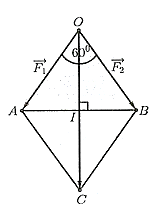
Chọn các điểm \(A,B\) thỏa mãn \(\overrightarrow {{F_1}} = \overrightarrow {OA} ,\overrightarrow {{F_2}} = \overrightarrow {OB} \) (hình vẽ). Gọi điểm \(C\) là một đỉnh của hình bình hành \(OACB\), khi đó ta có \(\overrightarrow {{F_1}} + \overrightarrow {{F_2}} = \overrightarrow {OA} + \overrightarrow {OB} = \overrightarrow {OC} \)(quy tắc hình bình hành).
Cường độ tổng hợp hai lực là: \(\left| {\overrightarrow {{F_1}} + \overrightarrow {{F_2}} } \right| = \left| {\overrightarrow {OC} } \right| = OC\)
Xét tam giác \(OAB\) có \(OA = OB = 100\) và \(\widehat {AOB} = 60^\circ \) nên tam giác \(OAB\) đều.
Gọi \(I\) là tâm hình bình hành \(OACB\), khi đó \(OI\) cũng là đường cao tam giác đều \(OAB\).
Do đó \(OI = \frac{{100\sqrt 3 }}{2} = 50\sqrt 3 \), suy ra \(OC = 2OI = 100\sqrt 3 \).
Vậy hợp lực của \({\vec F_1},{\vec F_2}\) có độ lớn là \(100\sqrt 3 N\).

Gọi \(\overrightarrow {{v_1}} ,\overrightarrow {{v_2}} \) lần lượt là vectơ vận tốc của dòng nước đối với bờ và ca nô đối với dòng nước. Khi đó vận tốc của ca nô đối với bờ chính là tổng \(\overrightarrow {{v_1}} + \overrightarrow {{v_2}} \). Đặt \(\overrightarrow {{v_1}} = \overrightarrow {AD} ,\overrightarrow {{v_2}} = \overrightarrow {AB} \) với \(A\) là vị trí của ca nô.
Vẽ hình bình hành \(ABCD\), ta có: \(\overrightarrow {{v_1}} + \overrightarrow {{v_2}} = \overrightarrow {AB} + \overrightarrow {AD} = \overrightarrow {AC} {\rm{. }}\)
Theo định lí Py-ta-go: \(AC = \sqrt {{{10}^2} + {{35}^2}} = 5\sqrt {53} \approx 36,4\;km/h{\rm{. }}\)
Vậy vận tốc của ca nô đối với bờ là xấp xỉ \(36,4\;km/h\).
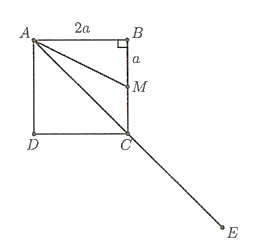
Ta có: \(|\overrightarrow {AB} + \overrightarrow {BM} | = |\overrightarrow {AM} | = AM\).
Theo định lí Py-ta-go: \(A{M^2} = A{B^2} + B{M^2} = {\left( {2a} \right)^2} + {a^2} = 5{a^2} \Rightarrow AM = a\sqrt 5 \)
Vậy \(\left| {\overrightarrow {AB} + \overrightarrow {BM} } \right| = AM = a\sqrt 5 \)
Ta có: \(\overrightarrow {AB} + \overrightarrow {AC} + \overrightarrow {AD} \) \( = (\overrightarrow {AB} + \overrightarrow {AD} ) + \overrightarrow {AC} = \overrightarrow {AC} + \overrightarrow {AC} \)
Gọi \(E\) đối xứng với \(A\) qua \(C\), suy ra \(\overrightarrow {AC} = \overrightarrow {CE} \).
Khi đó: \(\overrightarrow {AB} + \overrightarrow {AC} + \overrightarrow {AD} = \overrightarrow {AC} + \overrightarrow {AC} = \overrightarrow {AC} + \overrightarrow {CE} = \overrightarrow {AE} \).
Ta có: \(AE = 2AC = 2.2a\sqrt 2 = 4a\sqrt 2 \) (do \(AC\) là đường chéo của hình vuông cạnh \(2a\) ). Vậy \(|\overrightarrow {AB} + \overrightarrow {AC} + \overrightarrow {AD} | = AE = 4a\sqrt 2 \).
Bạn có thích hoạt động này không?
Hãy lưu hoặc chia sẻ nội dung này đến mọi người.
Gợi ý cho bạn

Ý tưởng của bạn, bài học của bạn
Tự thiết kế đề thi, bài giảng hoặc flashcard theo cách riêng.