17 câu hỏi
|
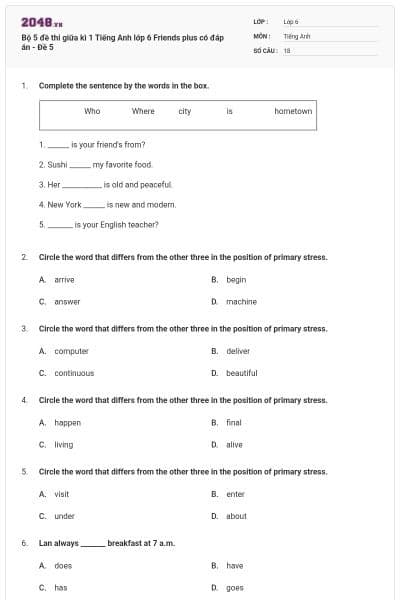
1. Where 1. Where is your friend's from? (Bạn của bạn từ đâu đến?) |
2. is 2. Sushi is my favorite food. (Sushi là món ăn yêu thích của tôi.) |
3. hometown 3. Her hometown is old and peaceful. (Quê hương của cô ấy xưa cũ và yên bình.) |
4. city 4. New York city is new and modern. (Thành phố New York mới mẻ và hiện đại.) |
5. Who 5. Who is your English teacher? (Giáo viên tiếng Anh mới của bạn là ai?) |
Phương pháp:
where: ở đâu
Chủ ngữ số ít + is
hometown: quê nhà
city: thành phố
who: ai
arrive
begin
answer
machine
arrive /əˈraɪv/
begin /bɪˈɡɪn/
answer /ˈɑːnsə(r)/
machine /məˈʃiːn/
Phương án C có trọng âm 1, các phương án còn lại có trọng âm 2.
computer
deliver
continuous
beautiful
computer /kəmˈpjuːtə(r)/
deliver /dɪˈlɪvə(r)/
continuous /kənˈtɪnjuəs/
beautiful /ˈbjuːtɪfl/
Phương án D có trọng âm 1, các phương án còn lại có trọng âm 2.
happen
final
living
alive
happen /ˈhæpən/
final /ˈfaɪnl/
living /ˈlɪvɪŋ/
alive /əˈlaɪv/
Phương án D có trọng âm 2, các phương án còn lại có trọng âm 1.
visit
enter
under
about
visit /ˈvɪzɪt/
enter /ˈentə(r)/
under /ˈʌndə(r)/
about /əˈbaʊt/
Phương án D có trọng âm 2, các phương án còn lại có trọng âm 1.
does
have
has
goes
Kiến thức: Thì hiện tại đơn & từ vựng
Phương pháp:
Cụm từ: have breakfast (ăn sáng)
Thì hiện tại đơn, dạng khẳng định, chủ ngữ “Lan” số ít nên have => has
Lan always has breakfast at 7 a.m.
(Lan luôn ăn sáng lúc 7 giờ.)
Chọn C
go
study
have
do
Kiến thức: Từ vựng
Phương pháp:
go: đi
study: học
have: có
do: làm
I usually study in the library after school.
(Tôi thường học trong thư viện sau giờ học.)
Chọn B

Học thông minh hơn mỗi ngày
Xem toàn bộ 17 câu hỏi và nhiều hơn nữa với tài khoản miễn phí
play
goes
does
plays
Kiến thức: Thì hiện tại đơn và từ vựng
Phương pháp:
Cụm từ: play video games (chơi trò chơi điện tử)
Thì hiện tại đơn, dạng khằng định, chủ ngữ Nam số ít nên động từ thêm “-s” => plays
Nam never plays video games on weekdays.
(Nam chưa bao giờ chơi trò chơi điện tử vào các ngày trong tuần.)
Chọn D
are
is
am
be
Kiến thức: Thì hiện tại đơn với động từ “be”
Phương pháp:
Thì hiện tại đơn với động từ “be”:
I + am
Chủ ngữ số ít + is
Chủ ngữ số nhiều + are
“the cinema” (rạp chiếu phim) là chủ ngữ số ít => is
The cinema is between the supermarket and the bookshop.
(Rạp chiếu phim ở giữa siêu thị và nhà sách.)
Chọn B
but
and
or
then
Kiến thức: Liên từ
Phương pháp:
but: nhưng
and: và
or: hoặc
then: sau đó
Lisa is into dancing but she isn't into drawing.
(Lisa thích nhảy múa nhưng cô ấy không thích vẽ.)
Chọn A
|
1. False Sue and Noel Radford have 7 grandchildren. (Sue and Noel Radford có 7 người cháu.) => Sai Thông tin: … they've also got four grandchildren. (… họ cũng có 4 người cháu.) |
2. False Noel never has breakfast. (Noel không bao giờ ăn sáng.) => Sai Thông tin: Noel gets up at 4.45 a.m., has breakfast and goes to work. (Noel thức dậy lúc 5:45 sáng, ăn sáng và đi làm.) |
3. True The Radfords don't usually go out for eat. (Gia đình Radfords không thường ra ngoài ăn.) => Đúng Thông tin: The Radfords don't usually go to restaurants because it's expensive. (Gia đình Radfords không thường xuyên đến các nhà hang vì nó đắt tiền.) |
4. True Sue doesn't work in the office. (Sue không làm việc trong văn phòng.) => Đúng Thông tin: Sue works at home. (Sue làm việc tại nhà.) |
5. False The older child goes to bed at 10 p.m. (Những đứa trẻ lớn hơn đi ngủ lúc 10 giờ tối.) => Sai Thông tin: The young children normally go to bed at 7 p.m., the older ones at 8 pm. or 9 p.m. (… Những đứa trẻ nhỏ thường đi ngủ lúc 7 giờ tối, những đứa trẻ lớn hơn lúc 8 hoặc 9 giờ tối.) |
Tạm dịch bài đọc:
Sue và Noel Radford có 12 con trai và con gái và họ cũng có 4 cháu. Đó là một gia đình lớn và họ rất có tổ chức.
Noel dậy lúc 4h45, ăn sáng và đi làm. Bọn trẻ dậy lúc 6 giờ 45 sáng.
Sue làm việc tại nhà. Con gái lớn của cô đôi khi phụ giúp việc nhà. Những đứa trẻ nhỏ hơn không giúp đỡ. Họ xem TV với anh chị em của họ. Sue không xem TV nhiều. Gia đình Radfords không thường đến nhà hàng vì nó đắt tiền.
Trẻ nhỏ thường đi ngủ lúc 7 giờ tối, trẻ lớn hơn lúc 8 giờ tối. hoặc 9 giờ tối Và cha mẹ của họ đi ngủ ngay trước 10 giờ tối.
|
1. the There are lots of things to do on the cruise ship. (Có nhiều thứ để làm trên tàu hải trình.) Giải thích: Danh từ “cruise ship” (tàu hải trình) là danh từ số ít nên bắt buộc phải dùng mạo từ. |
2. the I go running in the park near my house. (Tôi chạy bộ trong công việc gần nhà.) Giải thích: Danh từ “park” (công viên) là danh từ số ít nên bắt buộc phải dùng mạo từ. |
3. x I think x climbing is an exciting sport. (Tôi nghĩ bơi là một môn thể thao thú vị.) Giải thích: Trước danh động từ (V-ing) không dùng mạo từ. |
4. x My dad likes cooking x Italian food. (Bố tôi thích nấu món ăn Ý.) Giải thích: Trước tên riêng “Italian food” (món ăn Ý) không dùng mạo từ. |
5. x There are lots of boats at x Cai Rang floating market. (Có nhiều thuyền trên chợ nổi Cái Răng.) Giải thích: Trước tên riêng “Cai Rang floating market” (món ăn Ý) không dùng mạo từ |
That girl is my new classmate.
(Cô gái đó là bạn cùng lớp mới của tôi.)
We have got a book about flowers.
(Chúng tôi có quyển sách về những bông hoa.)
My new laptop is very small.
(Chiếc máy tính xách tay mới của tôi rất nhỏ.)
This birthday present is for you.
(Món quà sinh nhật này là dành cho bạn.)
David's pencil case is in the drawer.
(Hộp bút của David ở trong ngăn kéo.)
Bạn có thích hoạt động này không?
Ý kiến của bạn sẽ giúp chúng tôi đề xuất nội dung phù hợp hơn.
![[Năm 2022] Đề thi thử môn Vật lí THPT Quốc gia có lời giải - Đề số 21](/_next/image?url=https%3A%2F%2Fvideo.vietjack.com%2Fupload%2Fimages%2Fvj-image%2Fimage-3izficdefgfoel0s9j8s-1786772791.jpg&w=3840&q=75)
![[Năm 2022] Đề thi thử môn Vật lí THPT Quốc gia có lời giải - Đề số 20](/_next/image?url=https%3A%2F%2Fvideo.vietjack.com%2Fupload%2Fimages%2Fvj-image%2Fimage-emy0gtcksawvorajezvv-1786772460.jpg&w=3840&q=75)