Bộ 5 đề thi Giữa kì 1 Tiếng Anh 9 Friends Plus có đáp án (Đề 5)
40 câu hỏi
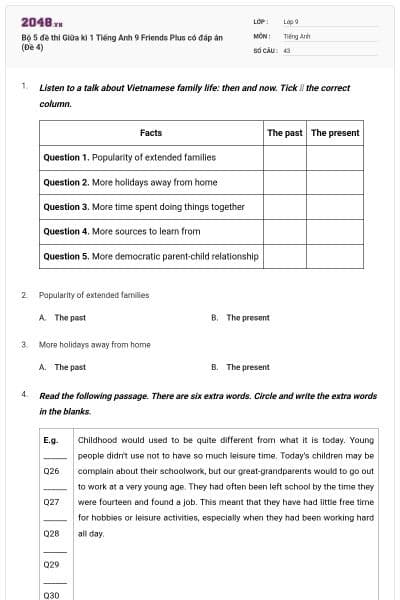
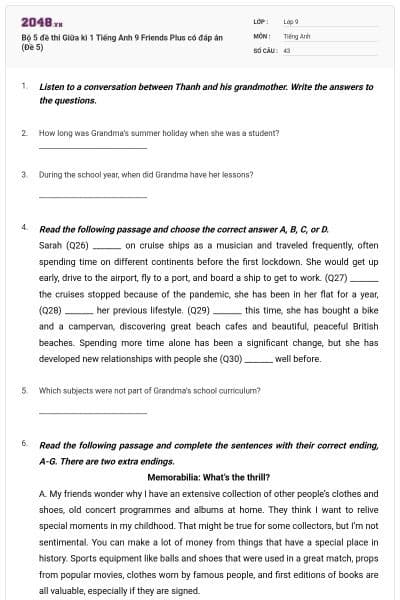
How long was Grandma’s summer holiday when she was a student?
______________________________
During the school year, when did Grandma have her lessons?
______________________________
Which subjects were not part of Grandma’s school curriculum?
______________________________
How did Grandma and her classmates travel to school?
______________________________
Name two traditional games Grandma played during break time?
______________________________
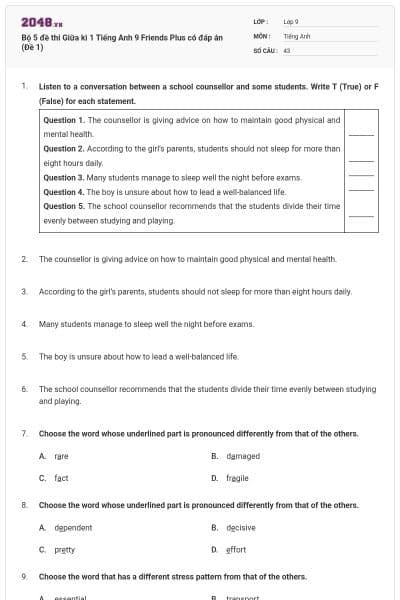
damaged
fact
fragile
rare
D là đáp án đúng
decisive
dependent
effort
pretty
around
commute
essential
transport
advantage
benefit
business
probably
do you
don’t you
will you
won’t you
Kiến thức câu hỏi đuôi đặc biệt:
Trong câu đề nghị, mệnh lệnh hay lời mời, câu hỏi đuôi thường được thêm vào để nghe lịch sự hoặc thân thiện hơn.
Câu hỏi đuôi cho dạng này dùng các trợ động từ will, can, could, would và luôn ở dạng khẳng định ? chọn C.
________ are used in military training to create a realistic virtual world where soldiers can interact and perform actions as if in the real world.
Satellite links
Satellite TVs
VR headsets
VR programs
Kiến thức từ vựng:
satellite link (n): đường dẫn vệ tinh
satellite TV (n): truyền hình vệ tinh
VR headset (n): kính thực tế ảo
VR program (n): chương trình thực tế ảo
owned
was owning
have owned
had owned
Kiến thức dùng thì:
QKĐ diễn tả một hành động đã xảy ra trong quá khứ; ‘own’ là động từ tình thái nên không dùng ở thể tiếp diễn vì không phải miêu tả hành động ? loại B;
Câu không có điều kiện cụ thể hay sự kiện nào khác nên không có cơ sở để dùng HTHT hay QKHT ? loại C, D.
Cấu trúc thể khẳng định QKĐ: S + V2/ed.
Think twice
Take your time
Don’t bother
Try out things
Kiến thức kết hợp từ, cụm động từ:
Think twice: Suy nghĩ cho kỹ
Take your time: Từ từ không phải vội
Don’t bother: Đừng bận tâm
Try out sth (phr.v): thử cái gì, thử làm gì
Amazingly
Luckily
Sadly
Thankfully
Kiến thức từ vựng:
Amazingly (adv): Thật ngạc nhiên
Luckily (adv): Thật may mắn
Sadly (adv): Thật đáng buồn
Thankfully (adv): Rất may là
The sun ________ and the birds ________. Lisa opened the window and looked out.
shone – sang
was shining – were singing
had shone – had sung
shone – were singing
Kiến thức dùng thì:
QKTD diễn tả hai hay nhiều hành động đang xảy ra đồng thời trong quá khứ. Trong câu có vế sau chia QKĐ vì hành động mở cửa và nhìn ra ngoài chỉ diễn ra ngay tại thời điểm đó, không có ý miêu tả tiếp diễn.
Cấu trúc thể khẳng định: S + was/were + V-ing.
commit to
go for
lean towards
rush into
Kiến thức cụm động từ:
commit to sth (phr.v): cam kết gắn bó, thực hiện cái gì
go for sth (phr.v): chọn cái gì
lean towards sth (phr.v): nghiêng về lựa chọn nào
rush into sth (phr.v): vội vàng làm cái gì
rains
is raining
has rained
has been raining
Kiến thức dùng thì:
HTHTTD diễn tả một hành động được bắt đầu ở quá khứ, diễn ra liên tục trong một khoảng thời gian dài và vẫn chưa kết thúc ở hiện tại.
Trong câu không có dấu hiệu thường thấy của HTHTTD là ‘for’ hoặc ‘since’ để nhấn mạnh tính liên tục của hành động, tuy nhiên có miêu tả ‘I hate this weather’ và ‘all week’ ám chỉ sự việc đã diễn ra trong thời gian dài gây khó chịu.
Cấu trúc thể khẳng định: S + have/has + been + V-ing.
Choose the correct answer to rewrite the sentence: ‘An equal number of people thought that it is better to educate boys and girls in separate schools.’
Some people argued that boys and girls should not be educated in the same schools.
Many people felt that educating boys and girls together is more beneficial.
A same number of people agree that boys and girls must attend the same schools.
The same number of people believed that boys and girls should be taught in single-sex schools.
Kiến thức viết lại câu:
Câu gốc: ‘Có cùng số người như vậy cho rằng nên tách riêng nam và nữ ra để giáo dục.’
A. Một số người cho rằng nam nữ không nên được học cùng một trường ? Sai về nghĩa, không diễn đạt được ý ‘an equal number of people’.
B. Nhiều người cảm thấy giáo dục con trai và con gái cùng nhau sẽ có lợi hơn ? Sai, ý trái ngược câu gốc.
C. Một số người đồng ý rằng nam và nữ phải học cùng trường ? Sai, ý trái ngược câu gốc.
D. Cùng một lượng người tin rằng nam nữ nên được dạy trong các trường học phân giới tính ? Đúng.
What can be inferred from this message?
Homeowner,
you have failed to comply with our demands. Be advised that unless you do, we will be forced to take extreme action. Please surrender your home and brains to us at once.
Sincerely,
Dr. Edgar Zomboss
The homeowner has complied with Dr. Zomboss’s demands.
Dr. Zomboss is giving the homeowner a second chance to comply.
Dr. Zomboss has been happy with the homeowner’s actions.
The homeowner is about to ignore Dr. Zomboss’s demands once again.
Có thể suy ra điều gì từ tin nhắn?
Chủ nhà,
bạn đã không tuân thủ các yêu cầu của chúng tôi. Lưu ý rằng trừ khi bạn tuân thủ, chúng tôi sẽ buộc phải thực hiện hành động cực đoan. Hãy giao lại ngôi nhà và toàn bộ não của bạn cho chúng tôi ngay lập tức.
Trân trọng,
Tiến sĩ Edgar Zomboss
A. Chủ nhà đã tuân thủ các yêu cầu của Tiến sĩ Zomboss.
B. Tiến sĩ Zomboss đang cho chủ nhà cơ hội thứ hai để thực hiện yêu cầu.
C. Tiến sĩ Zomboss rất hài lòng với hành động của chủ nhà.
D. Chủ nhà sắp phớt lờ yêu cầu của Tiến sĩ Zomboss một lần nữa.
What does this notice mean?

The swimming pool is free to people who go to the Water Fitness Classes.
The Water Fitness Classes are free to people who swim ten times a month.
This month, you can go to WFC and use the swimming pool ten times without paying.
If you attend one WFC, you can use the swimming pool ten times at no cost.
Thông báo có ý nghĩa gì?
ƯU ĐÃI ĐẶC BIỆT
Nếu bạn dùng dịch vụ hồ bơi 10 lần trong một tháng, bạn có thể tham gia một Lớp Thể dục dưới nước hoàn toàn miễn phí.
A. Những người tham gia Lớp thể dục dưới nước được sử dụng hồ bơi miễn phí.
B. Lớp thể dục dưới nước được miễn phí cho những người đi bơi mười lần một tháng.
C. Tháng này, bạn có thể tham gia Lớp thể dục dưới nước và sử dụng hồ bơi mười lần mà không phải trả tiền.
D. Nếu bạn tham gia một Lớp Thể dục dưới nước, bạn có thể sử dụng hồ bơi mười lần miễn phí.
uncommon (adj): không phổ biến
Sau động từ to-be cần điền tính từ bổ nghĩa cho chủ ngữ của câu.
astonishing (adj): đáng kinh ngạc
Trước danh từ cần có tính từ bổ nghĩa.
eventful (adj): có nhiều hoạt động thú vị xảy ra
Trước danh từ cần có tính từ bổ nghĩa.
helpless (adj): bất lực
Cấu trúc so sánh nhất ‘the most + adj (+ N)’.
undecided (adj): phân vân chưa quyết
Sau động từ to-be cần điền tính từ.
Read the following passage and choose the correct answer A, B, C, or D.
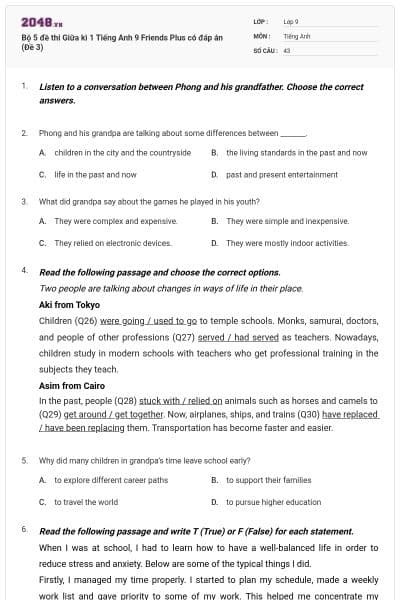
Sarah (Q26) _______ on cruise ships as a musician and traveled frequently, often spending time on different continents before the first lockdown. She would get up early, drive to the airport, fly to a port, and board a ship to get to work. (Q27) _______ the cruises stopped because of the pandemic, she has been in her flat for a year, (Q28) _______ her previous lifestyle. (Q29) _______ this time, she has bought a bike and a campervan, discovering great beach cafes and beautiful, peaceful British beaches. Spending more time alone has been a significant change, but she has developed new relationships with people she (Q30) _______ well before.
used to work
would work
was working
had worked
A là đáp án đúng
By the time
Since
When
Until
a slight difference to
similar to
a huge contrast to
the same as
For
In
At
During
Q30.
not used to know
hasn’t known
didn’t know
hadn’t known
D là đáp án đúng
Bài hoàn chỉnh:
Sarah used to work on cruise ships as a musician and traveled frequently, often spending time on different continents before the first lockdown. She would get up early, drive to the airport, fly to a port, and board a ship to get to work. Since the cruises stopped because of the pandemic, she has been in her flat for a year, a huge contrast to her previous lifestyle. During this time, she has bought a bike and a campervan, discovering great beach cafes and beautiful, peaceful British beaches. Spending more time alone has been a significant change, but she has developed new relationships with people she hadn’t known well before. | Sarah từng làm nhạc sĩ trên du thuyền và thường xuyên đi du lịch ở các châu lục khác nhau trước đợt giãn cách đầu tiên. Sarah sẽ dậy sớm, lái xe đến sân bay, bay đến cảng và lên tàu để đi làm. Kể từ khi các chuyến du thuyền buộc phải tạm ngừng vì đại dịch, Sarah đã ở trong căn hộ của cô được một năm rồi, một sự khác biệt quá lớn so với lối sống trước đây của cô. Trong thời gian này, Sarah đã mua một chiếc xe đạp và xe cắm trại để đi khám phá những quán cà phê xinh đẹp trên những bãi biển yên bình ở Anh. Dành nhiều thời gian ở một mình hơn là một thay đổi lớn, nhưng Sarah đã phát triển những mối quan hệ mới với những người mà trước đây cô chưa từng biết rõ. |
Read the following passage and complete the sentences with their correct ending, A-G. There are two extra endings.
Memorabilia: What’s the thrill?
A. My friends wonder why I have an extensive collection of other people’s clothes and shoes, old concert programmes and albums at home. They think I want to relive special moments in my childhood. That might be true for some collectors, but I’m not sentimental. You can make a lot of money from things that have a special place in history. Sports equipment like balls and shoes that were used in a great match, props from popular movies, clothes worn by famous people, and first editions of books are all valuable, especially if they are signed.
B. There are a few different ways you can find this sort of memorabilia. First, you can buy it at an auction. It’s expensive, but if you are lucky, it will be worth it because memorabilia can suddenly increase in value, and you could make a lot of money. For example, a baseball signed by Babe Ruth sold for over $77,000. In 2017, just four years later, a similar one sold for $180,000, over twice as much! Imagine if you had enough money to buy that!
C. I can’t possibly buy that kind of memorabilia, but it is possible to buy part of it. Some companies look for rare items from around the world that they think will increase in value. People can buy a share of the memorabilia and buy and sell their shares over time. That’s a great way to make money without spending a fortune, and for a little while, you can be the part-owner of a piece of history, although you can’t take it home!
The author’s friends believe that his collection is about..._______
One way to get valuable memorabilia is through..._______
Owning a share of memorabilia means..._______
Memorabilia items that have high value include..._______
The potential profit from memorabilia can be large if..._______
A. participating in auctions and winning the bid. B. the memorabilia becomes more valuable over time. C. those related to significant historical events. D. sharing it with others who have similar interests. E. having a connection to famous personalities. F. reliving important moments from his past. G. you do not get to keep the item at home. |
F
The author’s friends believe that his collection is about F. reliving important moments from his past.
- Thông tin: “My friends wonder why I have an extensive collection [...]. They think I want to relive special moments in my childhood.” (đoạn A)A
One way to get valuable memorabilia is through A. participating in auctions and winning the bid.
- Thông tin: “There are a few different ways you can find this sort of memorabilia. First, you can buy it at an auction.” (đoạn B)
G
Owning a share of memorabilia means G. you do not get to keep the item at home.
- Thông tin: “...you can be the part-owner of a piece of history, although you can’t take it home!” (đoạn C)C
Memorabilia items that have high value include C. those related to significant historical events.
- Thông tin: “You can make a lot of money from things that have a special place in history.” (đoạn A)B
The potential profit from memorabilia can be large if B. the memorabilia becomes more valuable over time.
- Thông tin: “It’s expensive, but if you are lucky, it will be worth it because memorabilia can suddenly increase in value...” (đoạn B)Dịch bài đọc:
A. My friends wonder why I have an extensive collection of other people’s clothes and shoes, old concert programmes and albums at home. They think I want to relive special moments in my childhood. That might be true for some collectors, but I’m not sentimental. You can make a lot of money from things that have a special place in history. Sports equipment like balls and shoes that were used in a great match, props from popular movies, clothes worn by famous people, and first editions of books are all valuable, especially if they are signed. B. There are a few different ways you can find this sort of memorabilia. First, you can buy it at an auction. It’s expensive, but if you are lucky, it will be worth it because memorabilia can suddenly increase in value, and you could make a lot of money. For example, a baseball signed by Babe Ruth sold for over $77,000. In 2017, just four years later, a similar one sold for $180,000, over twice as much! Imagine if you had enough money to buy that! C. I can’t possibly buy that kind of memorabilia, but it is possible to buy part of it. Some companies look for rare items from around the world that they think will increase in value. People can buy a share of the memorabilia and buy and sell their shares over time. That’s a great way to make money without spending a fortune, and for a little while, you can be the part-owner of a piece of history, although you can’t take it home! | A. Bạn bè tôi thường thắc mắc tại sao tôi lại có một bộ sưu tập đầy những quần áo và giày dép của người khác, các chương trình hòa nhạc và album cũ ở nhà. Họ nghĩ tôi muốn sống lại những khoảnh khắc đặc biệt của tuổi thơ. Điều đó có thể đúng với một số nhà sưu tập, nhưng tôi không phải người đa cảm. Bạn có thể kiếm được kha khá từ những vật có ý nghĩa đặc biệt trong lịch sử. Bóng thi đấu và giày của cầu thủ dùng trong một trận đấu lớn, đạo cụ từ các bộ phim nổi tiếng, quần áo người nổi tiếng từng mặc hay ấn bản sách đầu tiên đều là những kỷ vật có giá trị, đặc biệt nếu chúng có chữ ký. B. Có một vài cách bạn có thể tìm được những kỷ vật như vậy. Thứ nhất, bạn có thể mua tại một cuộc đấu giá. Sẽ đắt tiền nhưng nếu bạn may mắn thì khoản tiền bỏ ra sẽ là xứng đáng vì kỷ vật có thể tăng giá trị đột ngột và bạn có thể kiếm được rất nhiều tiền. Ví dụ, một quả bóng chày có chữ ký của Babe Ruth được bán với giá hơn 77.000 USD (2 tỷ VND). Đến năm 2017, chỉ bốn năm sau, một chiếc tương tự được bán với giá 180.000 USD (gần 4 tỷ rưỡi VND), hơn gấp đôi số tiền cũ! C. Tôi không đủ khả năng mua như vậy, nhưng có thể mua một phần của nó. Một số công ty tìm kiếm những món đồ quý hiếm từ khắp nơi trên thế giới mà họ cho rằng sau này sẽ tăng giá trị. Mọi người có thể mua một phần món đồ và bán lại cổ phần của mình theo thời gian. Đó là một cách tuyệt vời để kiếm thêm tiền mà không cần chi trước quá nhiều tiền và trong một thời gian ngắn, bạn có thể sở hữu một phần của một món kỷ vật, dù bạn không được mang nó về nhà! |
This is my first experience of flying alone.time
?It is the first __________________________ alone.It is the first time I’ve (ever) flown alone.
HTHT dùng để nói về một kinh nghiệm, trải nghiệm của ai đó, thường đi kèm với so sánh hơn nhất, các cụm từ ‘the first/ second/ last/…’, và số đếm ‘once, twice, three times,...”
Cấu trúc thể khẳng định: S + have/ has + V3/ed
This town has a lot more cinemas than it had in the past.used
?This town __________________________ so many cinemas.This town used not to / never used to have so many cinemas.
Cấu trúc ‘used to + V(nguyên thể)’ dùng để nói về một hành động từng xảy ra trong quá khứ mà không còn ở hiện tại.
Thể phủ định: ‘used not to + V(nguyên thể)’ hoặc thêm trạng từ phủ định ‘never used to’
Pat really enjoyed the match even though she was beaten.of
?In __________________________, Pat really enjoyed the match.In spite of being beaten, Pat really enjoyed the match.
Cấu trúc chỉ sự tương phản ‘in spite of / despite + N/ V-ing’ = ‘though/ although/ even though + mệnh đề’.
Sending messages around the world instantly is no longer unusual.used
?We have __________________________ messages around the world instantly.We have got used to sending messages around the world instantly.
Cấu trúc kết hợp từ ‘get used to + N/ V-ing’: quen với cái gì, việc gì.
They bought the tickets and later they heard about the cheaper flight. before
?They __________________________ they heard about the cheaper flight.They had bought the tickets before they heard about the cheaper flight.
QKHT dùng để diễn tả một hành động đã xảy ra trước một hành động khác trong quá khứ. Dấu hiệu nhận biết có ‘before + mệnh đề QKĐ’.
Cấu trúc thể khẳng định: S + had + V3/ed