Bộ 40 đề thi Tiếng Anh vào 10 có đáp án - Đề 14
40 câu hỏi
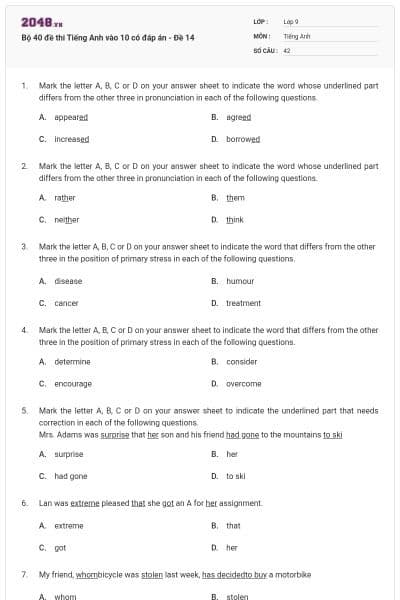
Mark the letter A, B, C or D on your answer sheet to indicate the word whose underlined part differs from the other three in pronunciation in each of the following questions.
appeared
agreed
increased
borrowed
Đáp án C
Mark the letter A, B, C or D on your answer sheet to indicate the word whose underlined part differs from the other three in pronunciation in each of the following questions.
rather
them
neither
think
Đáp án D
disease
humour
cancer
treatment
Đáp án A
Mark the letter A, B, C or D on your answer sheet to indicate the word that differs from the other three in the position of primary stress in each of the following questions.
determine
consider
encourage
overcome
Đáp án D
Mark the letter A, B, C or D on your answer sheet to indicate the underlined part that needs correction in each of the following questions.
Mrs. Adams was surprise that her son and his friend had gone to the mountains to ski
surprise
her
had gone
to ski
Đáp án: A
Giải thích:
"Was" là động từ to be, theo sau nó phải là tính từ, nhưng "surprise" là danh từ/động từ.
Sửa: surprise → surprised
Dịch: Bà Adams ngạc nhiên rằng con trai bà và bạn của cậu ấy đã lên núi để trượt tuyết.
extreme
that
got
her
Đáp án A
whom
stolen
has decided
to buy
Đáp án A
Mark the letter A, B, C or D on your answer sheet to indicate the correct answer to each of the following questions.
What will you do if you __________ the final examinations?
will pass
would pass
pass
passed
Đáp án C
under
without
in
at
Giải thích:
be under control: dưới tầm kiểm soát
Dịch: Đừng lo lắng, mọi thứ đều trong tầm kiểm soát.
unknown
unidentified
unable
unimaginary
Đáp án B
since
and
although
or
Đáp án A
giving up
looking for
turning on
going on
Đáp án B
right
truth
information
fact
Đáp án: B
Giải thích:
Kiến thức: Từ vựng
A. right (adj): phải, đúng; (n): quyền lợi
B. truth (n): sự thật
C. information (n): thông tin
D. fact (n): thực tế
Vị trí cần điền là một danh từ đứng sau mạo từ “the”, dựa vào nghĩa chọn B.
Cụm từ: tell the truth: nói sự thật
Dịch: Giáo viên bảo học sinh luôn phải nói sự thật.
will be
is
were
has been
Đáp án C
sleepy
sleepless
sleeplessness
asleep
Đáp án C
does he
isn’t he
aren’t they
don’t they
Đáp án D
alive
performing
busy
active
Đáp án D
few
any
much
some
Đáp án B
Mark the letter A, B, C or D on your answer sheet to indicate the most suitable response to complete each of the following exchanges.
- Anna:Would you like to have lunch with us?
- Laura: _______.
All right
Yes, I would
No, I wouldn’t like
Yes, I’d love to
Đáp án D
- John: Shall I get a taxi for you?
- John’s lecturer: ______.Yes, I’d love to
Oh, that would be nice
Let’s do
Yes, why not?
Đáp án B
Mark the letter A, B, C or D on your answer sheet to indicate the word CLOSEST in meaning to the underlined word in each of the following questions.
Button decided to continue with his studies for another two years.
get on
go on
carry out
turn off
Đáp án B
light
huge
tiring
difficult
Đáp án B
Mark the letter A, B, C or D on your answer sheet to indicate the word(s)OPPOSITE in meaning to the underlined word(s)in each of the following questions.
I’ll have to whisper to you, otherwise he will hear what we are saying.
shout
whistle
talk
say
Đáp án A
dissatisfied
excited
shocked
interested
Đáp án A
Read the following passage and mark the letter A, B, C, or D on your answer sheet to indicate the correct word or phrase that best fits each of the numbered blanks.
Face-to-face conversation is a two-way process:You speak to me, I reply to you and so on. Two-way (25)_______ depends on having a coding system that is understood by both sender and (26)_______, and an agreed convention about signaling the beginning and end of the message. In speech, the coding system is the language like English or Spanish; the convention that one person speaks at a time may seem too obvious to mention. In fact, the signals (27)_______ in conversation and meetings are often verbal. For example, lowering the pitch of the voice may mean the end of a sentence, a sharp intake of breath may signal the desire to interrupt, catching the chairman’s eye may indicate the desire to speak in a formal setting like a debate, a clenched fist may indicate anger. When (28)_______ visual signals are not possible, more formal signals may be needed.
Two-way (25)_______ depends on having a coding system that is understood by both sender
exchange
interchange
communication
correspondence
Đáp án D
announcer
receiver
messenger
transmitter
Đáp án B
use
are used
using
used
Đáp án D
their
these
this
that
Đáp án B
Read the following passage and mark the letter A, B, C, or D on your answer sheet to indicate the correct answer to each of the questions.
Over the past 600 years, English has grown from a language of few speakers to become the dominant language of international communication. English as we know it today emerged around 1350, after having incorporated many elements of French that were introduced following the Norman invasion of 1066. Until the 1600s, English was, for the most part, spoken only in England and had not extended even as far as two centuries, English began to spread around the globe as a result of exploration, trade (including slave trade), colonization, and missionary work. Thus, small enclaves of English speakers became established and grew in various parts of the world. As these communities proliferated, English gradually became the primary language of international business, banking and diplomacy.
Currently, about 80 percent of the information stored on computer systems worldwide is English. Two - thirds of the world’s science writing is in English, and English is the main language of technology, advertising, media, international airports, and air traffic controllers - Today there are more than 700 million English users in the world, and over half of these are nonnative speakers, constituting the largest number of nonnative users than any other language in the world.
What is the main topic of this passage?
The French influence on the English Language.
The English history.
The expansion of English as an international language.
The use of English for science and Technology.
Đáp án C
in 1066
around 1350
before 1600
after 1600
Đáp án D
the slave trade
the Norman invasion
missionaries
colonization
Đáp án B
communities
organizations
regions
countries
Đáp án A
Mark letter A, B, C or D on your answer sheet to indicate the sentence that is closest in meaning to the original sentence in each of the following questions.
“Why do you come here late?”, she asked me.
She asked me why I came there late.
She asked me why did I come there late.
She asked me why he came here late.
She asked me why he did come there late.
Đáp án A
You can be rich if you listen to the radio.
Listening to the radio makes you know less.
Listening to the radio enables you to be rich.
Listening to the radio can make you know more .
Đáp án D
He did his homework two hours ago.
He finished his homework two hours ago.
He had his homework done in two hours.
He spent two hours doing his homework.
Đáp án: D
Giải thích:
take somebody time to do something: ai đó mất bao lâu để làm gì
= somebody spend time doing something
have something done: có cái gì được làm bởi ai (nhờ ai làm cái gì cho)
Dịch: Anh ấy mất hai giờ để làm bài tập về nhà.
A. Anh ấy đã làm bài tập về nhà hai giờ trước.
B. Anh ấy đã hoàn thành bài tập về nhà hai giờ trước.
C. Anh ấy đã nhờ người làm bài tập cho mình trong hai tiếng đồng hồ.
D. Anh ấy đã dành hai giờ để làm bài tập về nhà.
Chọn D.
He hadn't tested his eyes for a year.
He didn't have any tests on his eyes in a year.
He hasn't had his eyes tested for a year.
The last time he tested his eyes was a year ago
Đáp án C
Only the seven-year-old boy saw the accident.
No one at all saw the seven-year-old boy's accident.
The seven-year-old boy saw no one in the accident.
No one in the accident saw the seven-year-old boy.
Đáp án A
A person is more likely to get a cold in winter than in summer.
More people have summer colds than winter colds.
People get colder in summer than in winter.
Winter is much colder than summer.
Đáp án A
He didn't have enough money for the flat.
He had never afforded for the flat.
He couldn't stay in the flat because of having much money.
He wouldn't buy the flat despite having much money.
Đáp án A
If the weather had not been terrible, I wouldn't be so depressed now.
If the weather were not terrible, I wouldn't be so depressed now.
Unless the weather were terrible, I wouldn't have been so depressed now.
Had the weather been terrible, I would be depressed now.
Đáp án B
Bạn có thích hoạt động này không?