Bộ 30 Đề thi giữa học kì 2 môn Tiếng Anh lớp 11 có đáp án - Đề số 14
40 câu hỏi
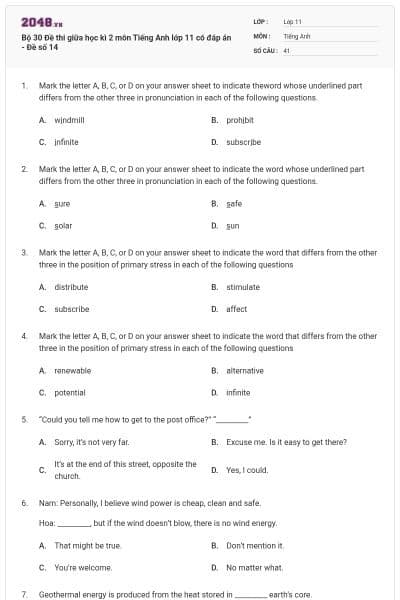
Mark the letter A, B, C, or D on your answer sheet to indicate theword whose underlined part differs from the other three in pronunciation in each of the following questions.
windmill
prohibit
infinite
subscribe
Đáp án đúng là: D
Giải thích: Đáp án D phát âm là /aɪ/, các từ còn lại phát âm là /ɪ/.
Mark the letter A, B, C, or D on your answer sheet to indicate the word whose underlined part differs from the other three in pronunciation in each of the following questions.
sure
safe
solar
sun
Đáp án đúng là: A
Giải thích: Đáp án A phát âm là /ʃ/, các từ còn lại phát âm là /s/.
Mark the letter A, B, C, or D on your answer sheet to indicate the word that differs from the other three in the position of primary stress in each of the following questions
distribute
stimulate
subscribe
affect
Đáp án đúng là: B
Giải thích: Đáp án B có trọng âm rơi vào âm tiết thứ nhất, các từ còn lại trọng âm rơi vào âm tiết thứ hai.
Mark the letter A, B, C, or D on your answer sheet to indicate the word that differs from the other three in the position of primary stress in each of the following questions
renewable
alternative
potential
infinite
Đáp án đúng là: D
Giải thích: Đáp án D có trọng âm rơi vào âm tiết thứ nhất, các từ còn lại trọng âm rơi vào âm tiết thứ hai.
“Could you tell me how to get to the post office?” “_________”
Sorry, it’s not very far.
Excuse me. Is it easy to get there?
It’s at the end of this street, opposite the church.
Yes, I could.
Đáp án: C
Giải thích:
Dịch: “Bạn có thể chỉ cho tôi cách đến bưu điện không?”
“_________”
A. Xin lỗi, không xa lắm.
B. Xin lỗi. Có dễ đến đó không?
C. Nó ở cuối phố này, đối diện nhà thờ.
D. Có, tôi có thể.
Dựa vào nghĩa câu, đáp án C phù hợp nhất.
Nam: Personally, I believe wind power is cheap, clean and safe.
Hoa: _________, but if the wind doesn’t blow, there is no wind energy.
That might be true.
Don’t mention it.
You’re welcome.
No matter what.
Đáp án đúng là: A
Giải thích: Phản hồi thích hợp nhất.
Dịch: Nam: Cá nhân tôi tin rằng năng lượng gió thì rẻ, sạch và an toàn.
Hoa: Điều đó có thể đúng, nhưng nếu gió không thổi thì không có năng lượng gió.Ø
the
an
a
Đáp án đúng là: B
Giải thích: Dùng mạo từ “the” trước những danh từ chỉ sự vật là duy nhất, chỉ có 1.
Dịch: Năng lượng địa nhiệt được tạo ra từ nhiệt tích trữ trong lõi trái đất.
A lot of ____ from several countries competed in many Asian Game.
spectators
viewers
athletes
audience
Đáp án đúng là: C
Giải thích: A. spectators: người đang xem một sự kiện, đặc biệt là một sự kiện thể thao
B. viewers: người đang xem truyền hình hoặc video trên internet
C. athletes: vận động viên
D. audience: 1 người khán giả => loại vì “a lot of” + N đếm được, số nhiều
Dịch: Rất nhiều vận động viên đến từ nhiều quốc gia đã tham gia thi đấu trong nhiều trận đấu tại Asian Game.
Listener is a person _________ to a concert or music program.
listened
to listen
being listened
listening
Đáp án đúng là: D
Giải thích: Rút gọn mệnh đề quan hệ về dạng: V-ing nếu mệnh đề mang nghĩa chủ động.
Dịch: Thính giả là người đang nghe buổi hòa nhạc hoặc chương trình âm nhạc.
The mother _________son was caught by the police was very sad.
which
whose
whom
who
Đáp án đúng là: B
Giải thích: Trong mệnh đề quan hệ, dùng: whose + N: … của … => chỉ sự sở hữu
Vì sau chỗ trống là danh từ “son” => cần đại từ chỉ sự sở hữu giữa “mother” & “son”.
Dịch: Người mẹ mà con trai của cô ấy đã bị cảnh sát bắt thì rất buồn.
It’s necessary that all high buildings be equipped _________ smoke detectors.
in
with
by
for
Đáp án đúng là: B
Giải thích: be equipped with something: được trang bị với những thiết bị gì
Dịch: Điều cần thiết là tất cả các tòa nhà cao tầng phải được trang bị đầu báo khói.
Peter, _________ lives about three miles away, was my former teacher.
whom
that
who
whose
Đáp án đúng là: C
Giải thích: Sau chỗ trống là động từ “live” => cần điền đại từ quan hệ có thể làm chủ ngữ, có thể đứng sau dấu phẩy (who).
Dịch: Peter, người mà sống cách đây khoảng 3 dặm, thì là thầy giáo cũ của mình.
This is the bus_________ we’ll go to school.
in that
on which
by which
from which
Đáp án đúng là: C
Giải thích: Trong mệnh đề quan hệ, có thể dùng: giới từ + which: cái mà …
go by + tên phương tiện: đi bằng phương tiện gì
Dịch: Đây là chiếc xe buýt mà chúng ta sẽ đi đến trường.
The woman _________ we are talking is a professor.
about whom
who
whom
from whom
Đáp án đúng là: A
Giải thích: Trong mệnh đề quan hệ, có thể dùng: giới từ + whom: người mà …
talk about sb: nói về/đến ai đó
Dịch: Người phụ nữ mà chúng ta đang nói đến là một giáo sư đấy.
Water power gives us energy _________ pollution.
without
of
in
with
Đáp án đúng là: A
Giải thích: A. without: mà không
B. of: của
C. in: trong
D. with: với
Dịch: Năng lượng nước cho chúng ta năng lượng mà không có ô nhiễm.
In Vietnam, many species have become _______ due to the irresponsible activities of people.
endangered
endanger
dangerous
danger
Đáp án đúng là: A
Giải thích: Sau động từ liên kết / hệ từ “become” cần điền tính từ.
endangered (adj): nguy cấp
Dịch: Tại Việt Nam, nhiều loài đã trở nên nguy cấp do những hoạt động thiếu trách nhiệm của con người.
He is the youngest athlete _________the prize in this field.
winning
won
to win
to be won
Đáp án đúng là: C
Giải thích: Mệnh đề có thể rút gọn về dạng “to V” nếu trước mệnh đề quan hệ là các từ chỉ thứ tự hoặc so sánh nhất. Đây là mệnh đề chủ động
Dịch: Anh là vận động viên trẻ nhất giành được giải thưởng trong phạm vi này.
The Asian Games ______________ place every four years.
taking
take
took
taken
Đáp án đúng là: B
Giải thích: take place = happen: xảy ra, diễn ra
“every four years” (4 năm 1 lần) => động từ trong chia thì hiện tại đơn
Dịch: Đại hội thể thao châu Á diễn ra bốn năm một lần.
Mark the letter A, B, C, or D on your answer sheet to indicate the sentence that is closest in meaning to each of the following sentences.
I am not 16 years old, so my parents don't allow me to ride a motorbike.
Unless I am 16 years old, my parents wouldn’t allow me to ride a motorbike.
If I am 16 years old, my parents will allow me to ride a motorbike.
Unless I were 16 years, old my parents would allow me to ride a motorbike.
If I were 16 years old, my parents would allow me to ride a motorbike.
Đáp án đúng là: D
Giải thích: Câu điều kiện loại 2: If + S + V-quá khứ đơn, S + would (not) + V-nguyên thể: Nếu .. thì ..
Unless + S + were (not) / didn’t V-nguyên thể, S + would (not) + V-nguyên thể: Nếu … không … thì …
Dịch: Nếu tôi 16 tuổi, bố mẹ sẽ cho phép tôi đi xe máy.
Nam refused to go to the cinema with me. He hated action films.
Nam, that hated action films, refused to go to the cinema with me.
Nam, of whom hated action films, refused to go to the cinema with me.
Nam, who hated action films, refused to go to the cinema with me.
Nam, whose hated action films, refused to go to the cinema with me.
Đáp án đúng là: C
Giải thích: refuse to V: từ chối làm gì
S1, who + V, V1: …, người mà …
of whom: của người mà …
Dịch: Nam, người ghét phim hành động, đã từ chối đi xem phim cùng tôi.
The boy is standing in the yard. He was punished by his teacher.
The teacher who was punished the boy is standing in the yard.
Standing in the yard, the teacher punished the boy.
The boy punished by his teacher is standing in the yard.
The boy was standing in the yard was punished by his teacher.
Đáp án đúng là: C
Giải thích: Rút gọn mệnh đề quan hệ mang nghĩa bị động: dùng quá khứ phân từ (bỏ đại từ quan hệ, bỏ tobe).
Dịch: Cậu bé mà bị cô giáo phạt thì đang đứng dưới sân.
Explosives are used for catching fish and other sea animals.
People use explosives to catch fish and other sea animals.
People catch fish and other sea animals by use explosives.
Fish and other sea animals are caught explosives used.
Fish and other sea animals are caught to use explosives.
Đáp án đúng là: A
Giải thích: Cấu trúc câu chủ động thì hiện tại đơn: S + V + O.
cấu trúc câu bị động tương ứng: O + is/are/am + P2 (by S).
Dịch: Người ta dùng chất nổ để đánh bắt cá và các động vật biển khác.
The police caught the burglar climbing over the garden wall.
The police caught the burglar and they climbed over the garden wall.
The police caught the burglar who is climbing over the garden wall.
The police were catching the burglar who was climbing over the garden wall.
The burglar who was climbing over the garden wall was caught by the police.
Đáp án: D
Giải thích:
Câu gốc ở thể chủ động: “The police caught the burglar climbing over the garden wall.” (Cảnh sát bắt tên trộm khi hắn đang trèo qua tường.)
Cách chuyển sang câu bị động:
§ Tân ngữ (the burglar) trở thành chủ ngữ.
§ Động từ (caught) chuyển sang dạng bị động (was caught).
§ Bổ ngữ (climbing over the garden wall) giữ nguyên.
§ Chủ ngữ (the police) thêm vào cuối với ‘by’ (by the police).
Câu đúng: The burglar who was climbing over the garden wall was caught by the police.
Dịch: Tên trộm đang trèo qua tường đã bị cảnh sát bắt.
Mark the letter A, B, C, or D on your answer sheet to indicate the word(s) CLOSEST in meaning to the underlined word(s) in each of the following questions
We can start our journey towards the mountain at dawn.
set out
take off
go away
turn round
Đáp án: A
Giải thích:
Kiến thức: Từ vựng – Cụm động từ
start (v): bắt đầu
Xét các đáp án:
A. set out: khởi hành
B. take off: cất cánh
C. go away: đi mất
D. turn around: quay lại
=> start = set out
Dịch: Chúng ta có thể bắt đầu hành trình hướng tới ngọn núi vào lúc bình minh.
Mark the letter A, B, C, or D on your answer sheet to indicate the word(s) CLOSEST in meaning to the underlined word(s) in each of the following questions
I don’t think a horse can ever stay at the same speed as a car.
keep pace with
get on with
run away from
look up at
Đáp án đúng là: A
Giải thích: stay at the same speed as = keep pace with: bắt kịp với, cùng tốc độ với
Dịch: Tôi không nghĩ là một con ngựa có thể bắt kịp với một chiếc xe ô tô.
Mark the letter A, B, C, or D on your answer sheet to indicate the word(s) OPPOSITE in meaning to the underlined word(s) in each of the following questions
The pollution problem is complicated because much pollution is caused by things that benefit people.
completed
enormous
sophisticated
simple
Đáp án đúng là: D
Giải thích: complicated (adj): phức tạp >< simple (adj): đơn giản
Dịch: Những vấn đề ô nhiễm rất phức tạp vì nhiều ô nhiễm gây ra bởi những thứ mang lại lợi ích cho con người.
Mark the letter A, B, C, or D on your answer sheet to indicate the word(s) OPPOSITE in meaning to the underlined word(s) in each of the following questions
Factories discharge much of the material that pollutes the air and water, but factories give employment to a large number of people.
unload
burn
give off
take in
Đáp án đúng là: D
Giải thích: discharge (v): xả thải >< take in (phrasal verb): hấp thụ, hấp thu
Dịch: Những nhà máy xả ra những chất gây ô nhiễm không khí và nước nhưng nhà máy lại tạo lượng lớn việc làm cho người dân.
Mark the letter A, B, C, or D on your answer sheet to indicate the underlined part that needs correction in each of the following questions.
Most of the food what elephants eat is brought to their mouths by their trunks.
Most
what
is brought
by
Đáp án đúng là: B
Giải thích: Trong mệnh đề quan hệ, để thay thế cho danh từ đứng trước có thể dùng “which”, “that” chứ không được dùng “what” vì nó chỉ là đại từ để hỏi
Sửa: what → which
Dịch: Hầu hết thức ăn mà voi ăn được đưa vào miệng chúng bằng chiếc vòi.
Many species have become extinction because of the interferences of human beings.
Many species
extinction
of
interferences
Đáp án đúng là: B
Giải thích: Đứng sau “become” phải là một tính từ
extinction (n): sự tuyệt chủng
extinct (adj): tuyệt chủng
Dịch: Nhiều loài đang gần bị tuyệt chủng bởi vì sự can thiệp của con người.
Thank you for your letter, in that you invited me to your birthday party.
for
in that
to
birthday party
Đáp án đúng là: B
Giải thích: Không sử dụng “that” đằng sau giới từ. Trong mệnh đề quan hệ, giới từ có thể đi với “which” hoặc “whom”
Sửa: in that → in which
Dịch: Cảm ơn vì lá thư, cái mà cậu mời tớ đến dự sinh nhật.
The text is about the ____.
Games in Manila
Far Eastern Championship Games
origin of the Asian Games
relationship of Japan, the Philippines, and China
Đáp án đúng là: C
Giải thích: Dựa vào câu: The Asian Games owes its origins to small Asian multi-sport competitions.
Dịch: Thế vận hội châu Á bắt nguồn từ những cuộc thi nhỏ đa môn thể thao ở châu Á.
The Far Eastern Championship Games ____.
were held in Japan
were held in Manila after World War II
were attended by all countries in Asia
had the participation of only three nations
Đáp án đúng là: D
Giải thích: Dựa vào câu: The Far Eastern Championship Games were created to show unity and cooperation among three nations: Japan, the Philippines and China.
Dịch: Đại hội Thể thao Vô địch Viễn Đông được thành lập để thể hiện sự đoàn kết và hợp tác giữa ba quốc gia: Nhật Bản, Philippines và Trung Quốc.
The word “it” in bold refers to_______.
The Asian Games
The Asian Athletic Federation
The Far Eastern Championship Games
The 14th Olympic Game
Đáp án đúng là: A
Giải thích: Dựa vào câu: Other Asian nations participated after it was organized.
The Asian Games được dùng như một chủ ngữ số ít → chia động từ
The Far Eastern Championship Games được dùng như một chủ ngữ số nhiều → không chia động từ
Vì sau “it”, động từ tobe ở dạng quá khứ chia “was” nên “it” phải thay thế cho The Asian Games
Dịch: Các quốc gia châu Á khác tham gia sau khi Thế vận hội châu Á được tổ chức.
The 14th Olympic Games took place ____.
before the World War IIin 1913
in 1913
in August 1948
In February 1949
Đáp án đúng là: C
Giải thích: In August 1948, during the 14th Olympic Game in London, …
Dịch: Vào tháng Tám năm 1948, trong Thế vận hội Olympic thứ 14 tại Luân Đôn,...
The Asian Games were ____.
held in the same year of the 14th Olympic Games
suggested establishing by a Londoner
first held in India
first held in China
Đáp án đúng là: C
Giải thích: Dựa vào câu: It was decided to hold the first Asian Games in 1951 in New Delhi the capital of India.
Dịch: Nó đã được quyết định rằng sẽ tổ chức Thế vận hội Châu Á đầu tiên vào năm 1951 tại New Delhe thủ đô nước Ấn Độ.
Read the following passage and mark the letter A, B, C, or D on your answer sheet to indicate the correct word or phrase that best fits each of the numbered blanks from 36 to 40.
Coal, oil, and natural gas supply modern civilization (36)______ most of its power. However, not only are supplies of these fuels limited, but they are a major source of pollution. If the energy demands of the future are to be met without seriously harming the environment, existing (37)______energy sources must be improved or further explored and developed. These include nuclear, water, solar, wind, and geothermal power, as well as energy from new, (38)______ types of fuels. Each of these alternatives, however, has advantages and disadvantages.
Nuclear power plants efficiently produce large amounts of electricity without polluting the atmosphere; however, they are costly to build and maintain, and they pose the daunting problem of what to do with nuclear wastes. Hydroelectric power is (39)______ and environmentally safe, but impractical for communities located far from moving water. Harnessing energy from tides and waves has similar drawbacks. Solar power holds great promise for the future but methods of collecting and concentrating sunlight are as yet (40)______, as are methods of harnessing wind power.
Coal, oil, and natural gas supply modern civilization (36)______ most of its power. However, not only are supplies of these fuels limited, but they are a major source of pollution.
on
for
with
of
Đáp án đúng là: C
Giải thích:
supply somebody with something: cung cấp cho ai cái gì
Dịch: Than đá, dầu và khí đốt cung cấp cho xã hội hiện đại hầu hết năng lượng của nó.alternate
alternatively
alternative
alter
Đáp án đúng là: C
Giải thích:
alternate (v): luân phiên, xen kẽ
alternatively (adv): như một sự lựa chọn, mang tính thay thế
alternative (adj): có thể thay thế
alter (v): thay đổi
Dịch: Nếu nhu cầu năng lượng trong tương lai đồng nghĩa với việc gây tổn hại nghiêm trọng tới môi trường, việc tồn tại nguồn năng lượng có thể thay thế là điều bắt buộc phải được cải thiện hoặc khám phá và phát triển xa hơn.
polluted
pollution
nonpolluting
polluting
Đáp án đúng là: C
Giải thích:
polluted (adj): ô nhiễm
pollution (n): sự ô nhiễm
nonpolluting (adj): không gây ô nhiễm
polluting (V-ing): làm, gây ô nhiễm
Chỗ trống cần điền một tính từ để bổ nghĩa cho “types of fuels” (loại nhiên liệu) phía sau
Dịch: Điều này bao gồm năng lượng hạt nhân, nước, mặt trời, gió và địa nhiệt, cũng như là năng lượng từ loại nhiên liệu sạch và không gây ô nhiễm.
expensively
inexpensively
inexpensive
expensive
Đáp án đúng là: C
Giải thích:
expensively (adv): đắt
inexpensively (adv): theo một cách không đắt
inexpensive (adj): không đắt
expensive (adj): đắt
Chỗ trống cần điền tính từ vì đứng sau động từ tobe “is”
Dịch: Năng lượng thủy điện không đắt và an toàn cho môi trường, nhưng…
Solar power holds great promise for the future but methods of collecting and concentrating sunlight are as yet (40)______, as are methods of harnessing wind power.
efficient
efficiently
inefficient
inefficiently
Đáp án đúng là: C
Giải thích:
efficient (adj): có hiệu quả
efficiently (adv): một cách hiệu quả
inefficient (adj): không hiệu quả
inefficiently (adv): một cách không hiệu quả
Chỗ trống cần điền tính từ vì đứng sau động từ tobe “are”
Dịch: Năng lượng mặt trời mang lại hứa hẹn lớn cho tương lai nhưng cách thức gom và tập trung ánh nắng lại chưa hiệu quả, giống như cách thức khai thác năng lượng gió.