Bộ 20 đề thi Tiếng Anh vào 10 có đáp án cực hay (Đề 18)
40 câu hỏi
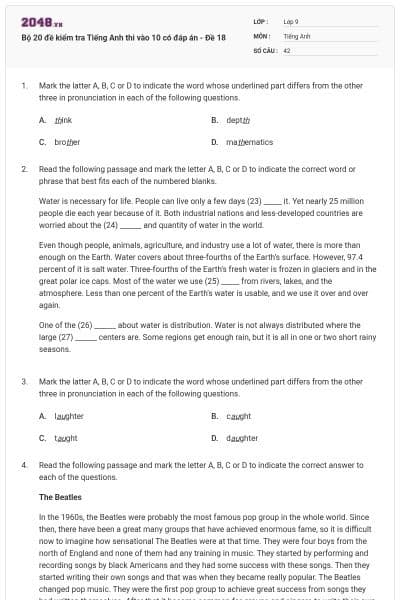
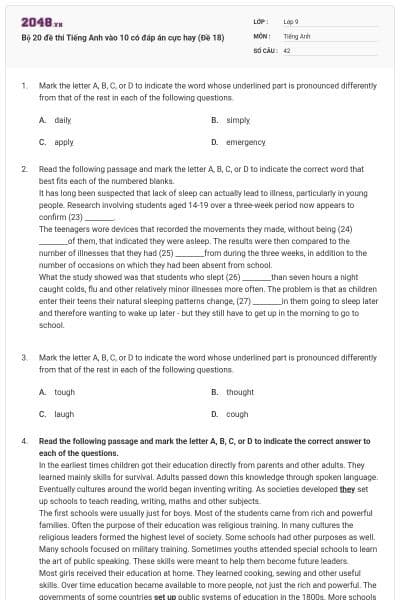
daily
simply
apply
emergency
Đáp án C
tough
thought
laugh
cough
Đáp án B
responsive
bilingual
attendance
operate
Đáp án D
deceive
sector
mission
burden
Đáp án A
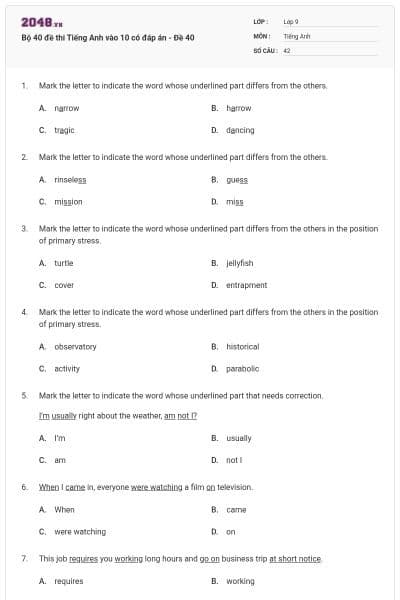
The number of visitors to the exhibition dropped considerable in the second week.
number
visitors
exhibition
considerable
Đáp án D
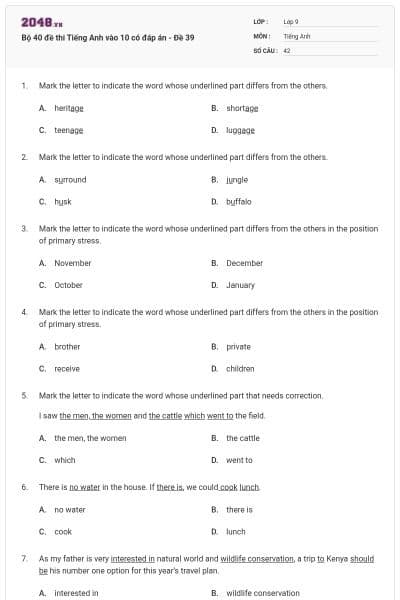
When too many firms enter competitive markets, their share of profits will fell.
too many
competitive
their shape
will fell
Đáp án D
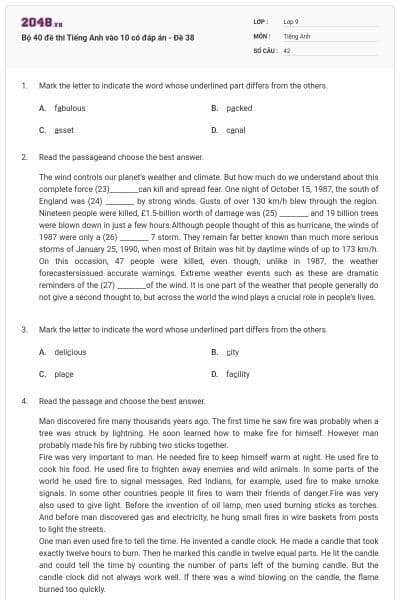
The term “middle class” describes people between the upper and the low social classes.
describes
between
the low
classes
Đáp án C
Mark the letter A, B, C, or D to indicate the correct answer to each of the following questions.
Don’t blame me. I______ him only if he hadn’t been driving so fast.
will have followed
had followed
would have been able to follow
could follow
Đáp án: C
Giải thích:
Kiến thức: Câu điều kiện loại 3
Câu này thuộc câu điều kiện loại 3 (diễn tả một tình huống trong quá khứ không thể thay đổi). Cấu trúc của câu điều kiện loại 3 là:
If + S + had + V3/V-ed, S + would/could/might + have + V3/V-ed
Trong câu này:
Mệnh đề "if he hadn’t been driving so fast" là mệnh đề điều kiện ở quá khứ hoàn thành.
Động từ trong mệnh đề chính cần ở dạng "would have been able to follow" để diễn tả khả năng có thể làm gì đó trong quá khứ nếu điều kiện khác xảy ra.
Chọn C. would have been able to follow.
Dịch: Đừng trách tôi. Tôi chỉ có thể theo dõi anh ấy nếu anh ấy không lái xe quá nhanh.
The panda’s______ habitat is the bamboo forest.
nature
natural
naturalized
naturally
Đáp án B
Could you please ______an appointment for me to see Mr. Smith?
do
take
make
get
Đáp án C
We have had the roof of our house______.
replace
replaced
to replace
been replaced
Đáp án B
If everyone of us ______ the traffic rules, the road will be much safer.
obey
obeys
obeyed
will obey
Đáp án: B
Giải thích:
- Câu này là câu điều kiện loại 1: diễn tả điều kiện có thể xảy ra trong hiện tại hoặc tương lai.
- Cấu trúc:
If + chủ ngữ + V(hiện tại đơn), chủ ngữ + will + V (nguyên mẫu)
→ "If everyone of us obeys..., the road will be..." - Everyone là đại từ số ít, nên động từ phải chia là obeys (thêm -s).
Dịch: Nếu mọi người trong chúng ta tuân thủ các quy tắc giao thông, con đường sẽ an toàn hơn nhiều.
There are far______ students in this school than in that school.
fewer
less
fewest
least
Đáp án A
Susan rarely stays up late,______?
is she
isn't she
does she
doesn’t she
Đáp án C
— “Tom wasn't there last night?”
- “No,______.”
I wasn't either
either was I
I wasn't too
neither I was
Đáp án A
Most rodents eat grain, seeds and nuts.______.
but some eat almost anything
instead a few doesn't eat grain
while some eat those things
contrary few eat anything
Đáp án A
“Let me help you with the box.” - “_______”
Yes. That's very kind of you.
I'm sorry. I'm busy now.
What can I do for you?
No. You must not touch it.
Đáp án A
“How far is your house from here” - “_______”
Is there a bus from here?
No. it isn't.
Yes, it's very far.
Two kilometers, at least.
Đáp án D
Mark the letter A, B, C, or D to indicate the word(s) CLOSEST in meaning to the underlined word(s) in each of the following questions.
After her parents' death, her chief inheritance was an old Bible, which she read and valued.
pursuit
possession
mistrust
misery
Đáp án B
They need to cut back on eating a lot of salt and sugary foods. They're not good for their health.
reduce
begin
speed up
carry out
Đáp án A
Mark the letter A, B, C, or D to indicate the word(s) OPPOSITE in meaning to the underlined word(s) in each of the following questions.
I find playing sports, like badminton, an exciting way to exercise.
stimulating
regular
normal
boring
Đáp án D
come up
stay unchanged
remain unstable
go down
Đáp án B
It has long been suspected that lack of sleep can actually lead to illness, particularly in young people. Research involving students aged 14-19 over a three-week period now appears to confirm (23) ________.
The teenagers wore devices that recorded the movements they made, without being (24) ________of them, that indicated they were asleep. The results were then compared to the number of illnesses that they had (25) ________from during the three weeks, in addition to the number of occasions on which they had been absent from school.
What the study showed was that students who slept (26) ________than seven hours a night caught colds, flu and other relatively minor illnesses more often. The problem is that as children enter their teens their natural sleeping patterns change, (27) ________in them going to sleep later and therefore wanting to wake up later - but they still have to get up in the morning to go to school.
this
that
these
those
Đáp án A
awake
aware
familiar
sensitive
Đáp án B
The results were then compared to the number of illnesses that they had (25)________from during the three weeks, in addition to the number of occasions on which they had been absent from school.
caught
affected
suffered
experienced
Đáp án C
What the study showed was that students who slept (26)________than seven hours a night caught colds, flu and other relatively minor illnesses more often
more
smaller
longer
fewer
Đáp án D
The problem is that as children enter their teens their natural sleeping patterns change, (27)________in them going to sleep later and therefore wanting to wake up later - but they still have to get up in the morning to go to school.
resulting
producing
finishing
forcing
Đáp án A
In the earliest times children got their education directly from parents and other adults. They learned mainly skills for survival. Adults passed down this knowledge through spoken language. Eventually cultures around the world began inventing writing. As societies developed they set up schools to teach reading, writing, maths and other subjects.
The first schools were usually just for boys. Most of the students came from rich and powerful families. Often the purpose of their education was religious training. In many cultures the religious leaders formed the highest level of society. Some schools had other purposes as well. Many schools focused on military training. Sometimes youths attended special schools to learn the art of public speaking. These skills were meant to help them become future leaders.
Most girls received their education at home. They learned cooking, sewing and other useful skills. Over time education became available to more people, not just the rich and powerful. The governments of some countries set up public systems of education in the 1800s. More schools opened to girls.
During the 1900s marks, or grades, became a new measure of learning. Testing became a regular part of formal education. As education became more important to people, teachers' colleges opened. The requirements for becoming a teacher became stricter. Teaching became a highly respected profession.
In the earliest times, children learned mainly skills so that they could________.
continue to exist
pass this knowledge down
invent writing
make societies develop
Đáp án: A
Giải thích:
Dịch: Vào thời kỳ đầu, trẻ em chủ yếu học các kỹ năng để chúng có thể ________.
A. tiếp tục tồn tại
B. truyền đạt kiến thức này
C. phát minh ra chữ viết
D. làm cho xã hội phát triển
Thông tin ở: “In the earliest times children got their education directly from parents and other adults. They learned mainly skills for survival.”
(Vào thời kỳ đầu, trẻ em được giáo dục trực tiếp từ cha mẹ và người lớn khác. Chúng chủ yếu học các kỹ năng để sinh tồn.)
cultures
societies
schools
subjects
Đáp án: A
Giải thích:
Dịch: Từ “they” trong đoạn văn ám chỉ đến ________.
A. văn hóa
B. xã hội
C. trường học
D. môn học
Thông tin ở: “As societies developed they set up schools to teach reading, writing, maths and other subjects.”
(Khi xã hội phát triển, họ - xã hội thành lập các trường học để dạy đọc, viết, toán và các môn học khác.)
Which of the following is NOT true according to the passage?
The first schools were usually just for boys from rich and powerful families.
Art of public speaking was one of the skills that help youths become future leaders.
During the 1900s, testing became a regular part of formal education.
In the earliest times, knowledge was passed down through written records.
Đáp án: D
Giải thích:
Dịch: Theo đoạn văn, câu nào sau đây KHÔNG đúng?
A. Những ngôi trường đầu tiên thường chỉ dành cho các bé trai từ những gia đình giàu có và quyền lực.
B. Nghệ thuật diễn thuyết trước công chúng là một trong những kỹ năng giúp thanh thiếu niên trở thành những nhà lãnh đạo tương lai.
C. Trong những năm 1900, kiểm tra đã trở thành một phần thường xuyên của giáo dục chính quy.
D. Vào thời kỳ đầu, kiến thức được truyền lại thông qua các hồ sơ viết.
Xét các đáp án:
A. The first schools were usually just for boys from rich and powerful families.
Đúng, vì bài viết có nhắc đến "The first schools were usually just for boys. Most of the students came from rich and powerful families."
B. Art of public speaking was one of the skills that helped youths become future leaders.
Đúng, vì bài viết nói "Sometimes youths attended special schools to learn the art of public speaking. These skills were meant to help them become future leaders."
C. During the 1900s, testing became a regular part of formal education.
Đúng, vì bài viết có câu "During the 1900s marks, or grades, became a new measure of learning. Testing became a regular part of formal education."
D. In the earliest times, knowledge was passed down through written records.
Sai, vì thời kỳ đầu kiến thức được truyền qua ngôn ngữ nói, không phải qua văn bản.
Chọn D.
The phrase “set up” in the passage could be best replaced by________.
made
based
founded
built
Đáp án: D
Giải thích:
Dịch: Theo đoạn văn, câu nào sau đây KHÔNG đúng?
A. Những ngôi trường đầu tiên thường chỉ dành cho các bé trai từ những gia đình giàu có và quyền lực.
B. Nghệ thuật diễn thuyết trước công chúng là một trong những kỹ năng giúp thanh thiếu niên trở thành những nhà lãnh đạo tương lai.
C. Trong những năm 1900, kiểm tra đã trở thành một phần thường xuyên của giáo dục chính quy.
D. Vào thời kỳ đầu, kiến thức được truyền lại thông qua các hồ sơ viết.
Xét các đáp án:
A. The first schools were usually just for boys from rich and powerful families.
Đúng, vì bài viết có nhắc đến "The first schools were usually just for boys. Most of the students came from rich and powerful families."
B. Art of public speaking was one of the skills that helped youths become future leaders.
Đúng, vì bài viết nói "Sometimes youths attended special schools to learn the art of public speaking. These skills were meant to help them become future leaders."
C. During the 1900s, testing became a regular part of formal education.
Đúng, vì bài viết có câu "During the 1900s marks, or grades, became a new measure of learning. Testing became a regular part of formal education."
D. In the earliest times, knowledge was passed down through written records.
Sai, vì thời kỳ đầu kiến thức được truyền qua ngôn ngữ nói, không phải qua văn bản.
Chọn D.
The best title for the passage could be________.
Education in the Earliest Times
The Development of Education
Education in Modern Times
Testing - a Regular Part of Education
Đáp án: B
Giải thích:
Dịch: Tiêu đề hay nhất cho đoạn văn có thể là ________.
A. Giáo dục trong thời kỳ đầu
B. Sự phát triển của giáo dục
C. Giáo dục trong thời hiện đại
D. Kiểm tra - một phần thường xuyên của giáo dục
Bài đọc trình bày sự phát triển của giáo dục từ thời kỳ đầu, khi trẻ em học kỹ năng sinh tồn từ cha mẹ, đến khi chữ viết xuất hiện, trường học được thành lập, giáo dục mở rộng cho nhiều người hơn, và cuối cùng là hệ thống giáo dục hiện đại với các kỳ thi và tiêu chuẩn khắt khe hơn.
Chọn B. The Development of Education.
Dịch bài đọc
Từ thời kỳ đầu, trẻ em nhận được sự giáo dục trực tiếp từ cha mẹ và những người lớn khác. Chúng chủ yếu học các kỹ năng để sinh tồn. Người lớn truyền đạt kiến thức này thông qua ngôn ngữ nói. Cuối cùng, các nền văn hóa trên thế giới bắt đầu phát minh ra chữ viết. Khi xã hội phát triển, họ lập ra trường học để dạy đọc, viết, toán và các môn học khác.
Những trường học đầu tiên thường chỉ dành cho con trai. Hầu hết học sinh đến từ các gia đình giàu có và quyền lực. Mục đích giáo dục của họ thường là đào tạo tôn giáo. Trong nhiều nền văn hóa, các nhà lãnh đạo tôn giáo thuộc tầng lớp cao nhất trong xã hội. Một số trường học có những mục đích khác. Nhiều trường tập trung vào huấn luyện quân sự. Đôi khi, thanh niên theo học tại các trường đặc biệt để học nghệ thuật diễn thuyết. Những kỹ năng này giúp họ trở thành những nhà lãnh đạo tương lai.
Hầu hết các bé gái đều được giáo dục tại nhà. Họ học nấu ăn, may vá và các kỹ năng hữu ích khác. Theo thời gian, giáo dục trở nên phổ biến hơn, không chỉ dành cho những người giàu có và quyền lực. Chính phủ của một số quốc gia đã thiết lập hệ thống giáo dục công lập vào những năm 1800. Nhiều trường học bắt đầu mở cửa cho nữ sinh.
Trong suốt thế kỷ 20, điểm số trở thành một thước đo mới cho việc học tập. Kiểm tra trở thành một phần thường xuyên của giáo dục chính quy. Khi giáo dục trở nên quan trọng hơn đối với mọi người, các trường đào tạo giáo viên được thành lập. Các yêu cầu để trở thành giáo viên ngày càng khắt khe hơn. Nghề dạy học trở thành một nghề được tôn trọng cao.
my/ opinion/ wear/ uniforms/ encourage/ students/ proud/ school//.
In my opinion, wear uniforms encourages students to be proud of their school.
In my opinion, wearing uniforms encourages students to be proud of their school.
In my opinion, to wear uniforms encourages students to be proud of their school.
In my opinion, to wearing uniforms encourages students to be proud of their school.
Đáp án: B
Khi động từ thường đứng làm chủ ngữ, ta dùng dạng V-ing.
Dịch: Theo ý kiến của tôi, việc mặc đồng phục khuyến khích học sinh tự hào về trường của mình.
The holiday was so disappointing that they decided to ask for their money back.
The holiday was such disappointing that they decided to ask for their money back.
The holiday was too disappointing that they decided to ask for their money back
The holiday was enough disappointing that they decided to ask for their money back.
Đáp án A
If there is too much exhaust fume in the air, more and more people will cope with respiratory problem.
If there will be too much exhaust fume in the air, more and more people will cope with respiratory problem.
If there are too much exhaust fume in the air, more and more people will cope with respiratory problem.
If there was too much exhaust fume in the air, more and more people will cope with respiratory problem.
Đáp án A
Do you know the name of the lecturer whom talked about natural disasters at the workshop two days ago?
Do you know the name of the lecturer whose talked about natural disasters at the workshop two days ago?
Do you know the name of the lecturer which talked about natural disasters at the workshop two days ago?
Do you know the name of the lecturer who talked about natural disasters at the workshop two days ago?
Đáp án D
I feel safe when I travel by air
I’ve never travel buy because some times feel nervous
Travelling by air always makes me nervous
I always feel nervous, so I never travel by air
Đáp án C
Jane suggested going on a walking
Jane wanted us to going on a walking
Jane suggested to go on a walking
Jane allow us to go on a walking
Đáp án A
Despite his legs to be broken, he managed to get out of the car before it exploded.
Despite his broken legs, he was able to get out of the car before exploding.
Despite his legs were broken, he managed to get out of the car before it exploded.
Despite his broken legs, he was able to get out of the car before it exploded.
Đáp án D
This is the first time I"ve eaten this kind of food.
I haven"t eaten this kind of food already.
This is the first kind of food I have eaten.
Even before I have not eaten this kind of food.
Đáp án A
Bạn có thích hoạt động này không?