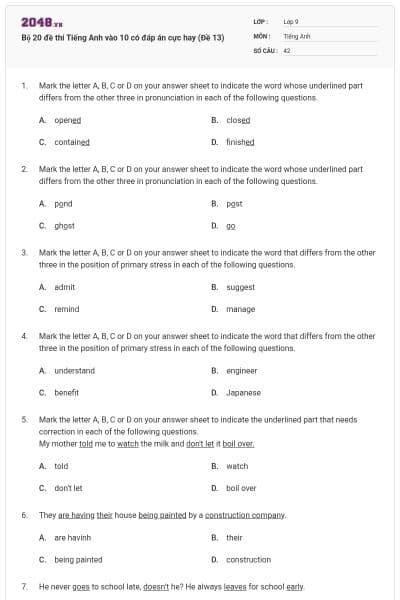
Bộ 20 đề thi Tiếng Anh vào 10 có đáp án cực hay (Đề 13)
40 câu hỏi
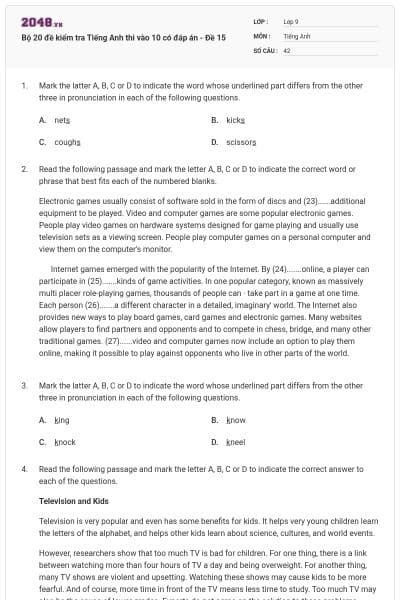
opened
closed
contained
finished
Đáp án D
pond
post
ghost
go
Đáp án D
admit
suggest
remind
manage
Đáp án D
understand
engineer
benefit
Japanese
Đáp án C
My mother told me to watch the milk and don't let it boil over.
told
watch
don't let
boil over
Đáp án C
are havinh
their
being painted
construction
Đáp án: C
Giải thích:
Cấu trúc:
have something done by someone: có cái gì được làm bởi ai
= have someone do something: có/thuê/nhờ ai làm cho cái gì
Sửa: being painted → painted
Dịch: Họ đang thuê một công ty xây dựng sơn lại ngôi nhà của họ.
goes
doesn't
leaves
early
Đáp án B
who
which
where
Who
Đáp án B
by
on
for
with
Đáp án B
to wait
wait
waiting
waited
Đáp án A
travelless
passengers
drivers
conductors
Đáp án B
try
would try
will try
can try
Đáp án B
came
will come
would come
would have come
Đáp án D
Therefore
However
Although
So
Đáp án B
physics
physically
physical
Physic
Đáp án C
fewer work
less work
little work
least work
Đáp án B
French cotton flowered
cotton French flowered
flowered cotton French
flowered French cotton
Đáp án A
must
should
can
could
Đáp án A
A man and a woman are talking at the station.
Man: “Can I help you with your luggage. Madam?"
Woman: “______”
Oh, thank you.
Oh, you're night.
It must be boring. I'm afraid
Poor you!
Đáp án A
Student 1: “Excuse me, is anybody sitting here?”
Student 2: “____________”
No, thanks.
Yes, I am so glad.
Sorry, the seat is taken.
Yes, yes. You can sit here.
Đáp án C
They decided to postpone their journey till the end of the month because of the epidemic.
take up
turn round
put off
do with
Đáp án: C
Giải thích:
Kiến thức: Từ vựng – Cụm động từ đồng nghĩa
postpone (v): hoãn lại
Xét các đáp án:
A. take up: bắt đầu một sở thích hoặc hoạt động mới
B. turn round: quay lại, quay đầu
C. put off: hoãn lại
D. do with: liên quan đến, cần, muốn
→ postpone = put off
Dịch: Họ quyết định hoãn chuyến đi đến cuối tháng vì dịch bệnh.
unfamiliar
race
customary
occasional
Đáp án C
We ought to keep these proposals secret from the chairman for the time being.
revealed
frequented
accessible
lively
Đáp án A
failed to pay
paid in full
had a bad personality
was paid much money
Đáp án B
Read the following passage and mark the letter A, B, C, or D on your answer sheet to indicate the correct word or phrase that best fits each of the numbered blanks.
Drought is a condition that becomes when average rainfall for a fertile area drops far below the normal (25)_______ for a long period of time. In areas (26)_______ are not irritated, the lack of rain causes farm crops to wither and dead. Higher than normal temperatures ussually accompany periods of drought . They add to the crop damage. Forest fires start easily during drought . The soil of a drought area becomes dry and crumbles. Often the rich topsoil is (27)_______ away by the hot, dry winds . Streams, ponds, and wells often dry up during a drought, and animals suffer and may even die (28)_______ the lack of water.
Drought is a condition that becomes when average rainfall for a fertile area drops far below the normal (25)_______ for a long period of time.
average
number
amount
rainfall
Đáp án: C
Giải thích:
A. average /ˈævərɪdʒ/ (n): số trung bình → sai vì ở đây ta cần nói về lượng mưa chứ không phải giá trị trung bình của nó.
B. number /ˈnʌmbə(r)/ (n): số lượng → sai vì từ này thường đi với danh từ đếm được, không phù hợp cho lượng mưa.
C. amount/əˈmaʊnt/ (n): lượng → đúng vì từ này phù hợp với danh từ không đếm được như “rainfall” (lượng mưa).
D. rainfall /ˈreɪnfɔːl/ (n): lượng mưa → sai vì lặp lại từ “rainfall” đã có trong câu.
Dịch: Hạn hán là tình trạng xảy ra khi lượng mưa trung bình của một khu vực màu mỡ giảm xuống thấp hơn nhiều so với lượng mưa bình thường trong một khoảng thời gian dài.
In areas (26)_______ are not irrigated, the lack of rain causes farm crops to wither and die.
who
what
which
where
Đáp án: C
Giải thích:
A. “who” là đại từ quan hệ chỉ người, nhưng “areas” (những khu vực) là danh từ chỉ địa điểm, nên không thể dùng “who” → A sai.
B. “what” = “the thing(s) that”, dùng để thay thế “điều mà, cái mà”, và không đi kèm danh từ phía trước → B sai.
C. “which” là đại từ quan hệ thay thế cho “areas” và đóng vai trò làm chủ ngữ của mệnh đề quan hệ, phù hợp với ngữ cảnh của câu → C đúng.
D. “where” là đại từ quan hệ được sử dụng để chỉ địa điểm. Nếu dùng “where”, thì phần sau “are not irrigated” bị thiếu chủ ngữ, dẫn đến câu sai ngữ pháp → D sai.
Dịch: Ở những khu vực không được tưới tiêu, việc thiếu mưa khiến cây trồng trên đồng ruộng héo úa và chết.
Often the rich topsoil is (27)_______ away by the hot, dry winds.
to blow
blew
blowing
blown
Đáp án: D
Giải thích:
Có thể thấy câu gốc là một câu bị động. Sau “is” trong câu bị động, chúng ta cần dạng quá khứ phân từ của động từ “blow” (thổi), đó chính là “blown”.
A. to blow: dạng nguyên thể có “to” của động từ và không phù hợp với cấu trúc câu bị động.
B. blew: động từ ở thì quá khứ đơn dùng cho câu chủ động, không phù hợp với câu bị động.
C. blowing: dạng hiện tại phân từ dùng cho câu chủ động, không phù hợp trong ngữ cảnh này.
D. blown: dạng quá khứ phân từ của “blow” (thổi) → đúng vì phù hợp với ngữ cảnh của câu này nói về việc lớp đất màu mỡ bị thổi bay bởi những cơn gió nóng và khô.
Dịch: Thường thì lớp đất màu mỡ trên bề mặt bị gió nóng, khô cuốn đi.
Streams, ponds, and wells often dry up during a drought, and animals suffer and may even die (28)_______ the lack of water.
because
because of
for
as
Đáp án: B
Giải thích:
A. because + mệnh đề (S + V): bởi vì (diễn tả nguyên nhân, lý do).
B. because of + N/ NP: bởi vì (diễn tả nguyên nhân, lý do).
C. for + N/ NP: cho, vì, để (diễn tả mục đích, lý do)
D. as + N/ NP: như là, với tư cách là (dùng để mô tả vai trò, chức năng hoặc đặc điểm của ai đó hoặc cái gì đó).
- Ta có “the lack of water” (sự thiếu nước) là một cụm danh từ. Vì vậy, chúng ta cần một từ hoặc cụm từ có thể kết hợp với cụm danh từ để diễn tả nguyên nhân → “Because of” là cụm từ phù hợp nhất, vì nó theo sau là danh từ hoặc cụm danh từ và dùng để diễn tả nguyên nhân.
- “For” (vì) đôi khi có thể chỉ lý do, nhưng nó thường được dùng để diễn tả mục đích, người nhận, khoảng thời gian, hoặc sự trao đổi một cách trực tiếp hơn là diễn tả nguyên nhân của một sự kiện tiêu cực như động vật chết vì thiếu nước.
Dịch: Suối, ao hồ và giếng thường cạn kiệt trong hạn hán, khiến động vật chịu cảnh thiếu nước và thậm chí có thể chết.
Dịch bài đọc:
Hạn hán là tình trạng xảy ra khi lượng mưa trung bình của một khu vực màu mỡ giảm xuống thấp hơn nhiều so với lượng mưa bình thường trong một khoảng thời gian dài. Ở những khu vực không được tưới tiêu, việc thiếu mưa khiến cây trồng trên ruộng héo úa và chết. Nhiệt độ cao hơn mức bình thường thường đi kèm với các giai đoạn hạn hán. Chúng làm gia tăng thiệt hại đối với cây trồng. Cháy rừng cũng dễ xảy ra trong thời kỳ hạn hán. Đất ở những khu vực bị hạn hán trở nên khô cằn và vỡ vụn. Thường thì lớp đất màu mỡ trên bề mặt bị gió nóng, khô cuốn đi. Suối, ao hồ và giếng thường cạn kiệt trong hạn hán, khiến động vật chịu cảnh thiếu nước và thậm chí có thể chết.
The country is more beautiful than a town and pleasant to live in. Many people think so and go to the country for the summer holidays though they can not live there all the year round. Some have a cottage built in a village so that they can go there whenever they can find the time. Almost every village has a church, the round or square tower of which can be seen from many miles around. Surrounding the church is the churchyard where people are buried.
The Village green is a wide stretch of grass. Houses or cottages are built round it. Country life is now fairly comfortable and many villages have the water brought through pipes into house.
Most villages are so close to some small towns that people can go there to buy what they can't find in the village shops.
a church
a tower
a shop
a cottage
Đáp án A
Many villagers now have water inside their homes.
People are buried near the village church.
Many English people prefer living in the country.
People can buy anything from the village shops.
Đáp án C
grass
a cottage
a house
the village green
Đáp án D
What is the best title for the passage?
The English countryside
Advantages of country life
Things in an English village
Summer holidays in England
Đáp án A
“Tsunami” is a Japanese word. This word means “harbor wave”.
“Tsunami” is a Japanese word which it means “harbor wave”.
“Tsunami” is a Japanese word it means “harbor wave”
“Tsunami” is a Japanese word which means “harbor wave”.
“Tsunami” means “harbor wave” is a Japanese word.
Đáp án: C
Giải thích:
Để nối hai câu thành một câu phức, ta có thể dùng which để thay thế this word, tạo thành:
"Tsunami" is a Japanese word which means "harbor wave".
Xét các đáp án khác:
A. which it means → Sai vì which đã thay thế this word, không cần thêm it.
B. it means → Sai vì it không thể đứng riêng như vậy, thiếu liên kết giữa hai mệnh đề.
D. “Tsunami” means “harbor wave” is a Japanese word. → Sai về trật tự từ, gây khó hiểu.
Chọn C. “Tsunami” is a Japanese word which means “harbor wave”.
Dịch: “Tsunami” là một từ tiếng Nhật có nghĩa là “sóng cảng”.
He said to me that I can’t do that test.
He said to me that I couldn’t do this test.
He said to me that he couldn’t do this test.
He said to me that he couldn’t do that test.
Đáp án D
Although the traffic was bad yesterday, I arrived at the meeting on time.
So bad was the traffic yesterday that I arrived at the meeting on time
Because the traffic was bad yesterday, I arrived at the meeting on time.
In spite of the traffic was bad yesterday, I arrived at the meeting on time.
Despite the bad traffic yesterday, I arrived at the meeting on time.
Đáp án: D
Giải thích:
- Câu gốc sử dụng liên từ “although” thể hiện sự tương phản. => loại A, B.
- “In spite of” và “Despite” đều có nghĩa là “mặc dù” và theo sau bởi (cụm) danh từ hoặc V-ing. => C sai cấu trúc.
ðDespite + danh từ (cụm danh từ) là cấu trúc đúng, thể hiện sự tương phản.
Dịch: Mặc dù giao thông hôm qua tệ, tôi vẫn đến cuộc họp đúng giờ.
We used to write to each other for three years.
We have written to each other for three years.
We wrote to each other since three years.
We used to write to each other in three years.
Đáp án B
It was not late when I called you.
It was late, so I did not call you.
It was late, but I called you.
It was not late but I did not call you
Đáp án B
This flat is not enough big for my family.
This flat is not big enough for my family.
This flat is not very big for my family.
This flat is not rather big for my family.
Đáp án B
It's impossible to buy a house in this city.
It's difficult to find a house in this city.
It's very difficult to build a house in this city.
It costs a lot to rent a house in this city .
Đáp án B
No one has been invited to the party.
She has invited nobody to the party. "
Nobody has given a party to her.
She hasn't been invited to the party.
Đáp án D
Bạn có thích hoạt động này không?