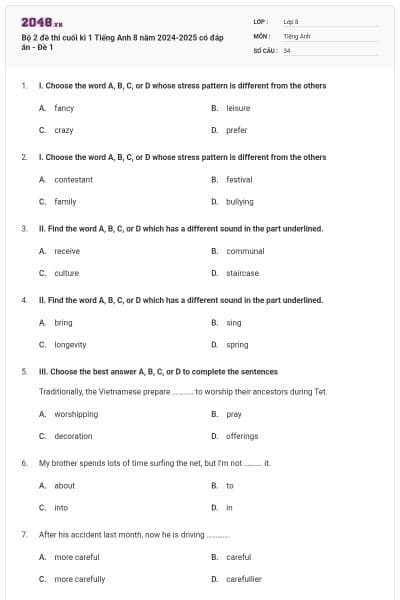
Bộ 2 đề thi cuối kì 1 Tiếng Anh 8 năm 2024-2025 có đáp án - Đề 1
32 câu hỏi
I. Choose the word A, B, C, or D whose stress pattern is different from the others
fancy
leisure
crazy
prefer
Hướng dẫn giải:
Đáp án đúng: D
Đáp án D nhấn âm 2, các đáp án khác nhấn âm 1
I. Choose the word A, B, C, or D whose stress pattern is different from the others
contestant
festival
family
bullying
Hướng dẫn giải:
Đáp án đúng: A
Đáp án A nhấn âm 2, các đáp án khác nhấn âm 1
II. Find the word A, B, C, or D which has a different sound in the part underlined.
receive
communal
culture
staircase
Hướng dẫn giải:
Đáp án đúng: A
Đáp án A phát âm là /s/, các đáp án khác phát âm là /k/
II. Find the word A, B, C, or D which has a different sound in the part underlined.
bring
sing
longevity
spring
Hướng dẫn giải:
Đáp án đúng: C
Đáp án C phát âm là /dʒ/, các đáp án khác phát âm là /ŋ/
III. Choose the best answer A, B, C, or D to complete the sentences
Traditionally, the Vietnamese prepare ………… to worship their ancestors during Tet.
worshipping
pray
decoration
offerings
Hướng dẫn giải:
Đáp án đúng: D
worshipping (v) thờ cúng
pray (v) cầu nguyện
decoration (n) sự trang trí
offerings (n) lễ vật, đồ cúng
Hướng dẫn dịch: Theo truyền thống, người Việt Nam chuẩn bị lễ vật để thờ cúng tổ tiên của họ trong dịp Tết.
about
to
into
in
Hướng dẫn giải:
Đáp án đúng: C
Be not into sth: không hứng thú với việc gì
Hướng dẫn dịch: Anh trai tôi dành rất nhiều thời gian để lướt ạng, nhưng tôi thì không hứng thú với việc đó.
more careful
careful
more carefully
carefullier
Hướng dẫn giải:
Đáp án đúng: C
So sánh hơn với tính từ, trạng từ dài: S1 + V1 + more + adj/adv + than + S2 + V2
Hướng dẫn dịch: Sau vụ tai nạn của anh ấy vào tháng trước, bây giờ anh ấy lái xe cẩn thận hơn rồi.
so
however
and
therefore
Hướng dẫn giải:
Đáp án đúng: B
so: nên
however: tuy nhiên
and: và
therefore: vì vậy
Hướng dẫn dịch: Tôm học tập chăm chỉ hơn Mi, tuy nhiên anh ấy nhận được kết quả tệ trong bài kiểm tra.
my way of
the
opinion of
way
Hướng dẫn giải:
Đáp án đúng: A
To someone’s way of thinking: theo quan điểm, cách suy nghĩ của ai đó
Hướng dẫn dịch: Theo quan điểm của tôi, có nhiều dịch vụ tốt hơn ở thành phố.
a
an
How
zero article
Hướng dẫn giải:
Đáp án đúng: D
Hướng dẫn dịch: Nhiều người thăm thú làng hoa để chụp những bức ảnh đẹp.
IV. Fill in each blank with the suitable form of the word given.
People………….bamboo poles with small bells and lanterns for New Year. (decoration)
Hướng dẫn giải:
Đáp án đúng: decorate
Sau chủ ngữ là động từ
decorate (v) trang trí
Hướng dẫn dịch: Mọi người trang trí cọc tre với những chiếc chuông nhỏ và đèn lồng cho dịp năm mới.
IV. Fill in each blank with the suitable form of the word given.
The ………… of shishi-mai are excellent at acrobatics. (perform)
Hướng dẫn giải:
Đáp án đúng: performers
Cách dùng mạo từ the: The + N + of + N
Hướng dẫn dịch: Người biểu diễn shishi-mai rất giỏi nhào lộn.
Hướng dẫn giải:
Đáp án đúng: fishing
Hướng dẫn dịch: Họ kiếm sống bằng nghề nông, đánh bắt cá và sản xuất các sản phẩm thủ công mỹ nghệ.
The Khmer live harmoniously with other ethnic groups in the Mekong Delta, while keeping their (14)………..culture and lifestyle.
Hướng dẫn giải:
Đáp án đúng: unique
unique (a) độc đáo
Hướng dẫn dịch: Người Khmer sống hòa thuận với các dân tộc khác ở Đồng bằng sông Cửu Long, đồng thời vẫn giữ được nét văn hóa và lối sống độc đáo của mình.
Hướng dẫn giải:
Đáp án đúng: their
Hướng dẫn dịch: Chùa không chỉ là nơi để người Khmer thực hành tín ngưỡng mà còn là trường học của làng.
Hướng dẫn giải:
Đáp án đúng: before
Hướng dẫn dịch: Từ năm 12 tuổi, các bé trai Khmer đến sống và học tập tại chùa trong nhiều năm trước khi trưởng thành.
They (17)……….. basic knowledge of their traditional culture.
Hướng dẫn giải:
Đáp án đúng: learn
Hướng dẫn dịch: Các em được học những kiến thức cơ bản về văn hóa truyền thống của dân tộc mình.
Dịch bài đọc:
Người Khmer sinh sống ở các tỉnh phía Nam như Sóc Trăng, Trà Vinh và Cần Thơ. Họ kiếm sống bằng nghề nông, đánh bắt cá và sản xuất các sản phẩm thủ công mỹ nghệ. Người Khmer sống hòa thuận với các dân tộc khác ở Đồng bằng sông Cửu Long, đồng thời vẫn giữ được nét văn hóa và lối sống độc đáo của mình.
Người Khmer theo đạo Phật. Mỗi làng đều có một ngôi chùa. Chùa không chỉ là nơi để người Khmer thực hành tín ngưỡng mà còn là trường học của làng. Từ năm 12 tuổi, các bé trai Khmer đến sống và học tập tại chùa trong nhiều năm trước khi trưởng thành. Ở đó, các em được học về Phật giáo, đọc và viết tiếng Khmer. Các em cũng được học cách cư xử với ông bà, cha mẹ, thầy cô, người già và những người khác trong cộng đồng. Các em được học những kiến thức cơ bản về văn hóa truyền thống của dân tộc mình.
Hướng dẫn giải:
Đáp án đúng: (Binh An Village holds it/They hold it) on the fifth day of Tet.
Thông tin: On the fifth day of Tet, Binh An Village holds a longevity celebration for elderly people over 70.
Hướng dẫn dịch: Vào ngày mùng 5 Tết, làng Bình An tổ chức lễ mừng thọ cho những người cao tuổi trên 70 tuổi.
Hướng dẫn giải:
Đáp án đúng: (The elderly/ They wear) traditional ao dai, (according to the tradition).
Thông tin: According to tradition, the elderly wear traditional ao dai.
Hướng dẫn dịch: Theo truyền thống, người cao tuổi mặc áo dài truyền thống.
Hướng dẫn giải:
Đáp án đúng: Yes, they do.
Thông tin: Then, each family takes photographs with their elders
Hướng dẫn dịch: Sau đó, mỗi gia đình chụp ảnh lưu niệm với người cao tuổi.
Hướng dẫn giải:
Đáp án đúng: The family members (do/cook at the home party).
Thông tin: It is customary for the family members to cook for their elders.
Hướng dẫn dịch: Theo phong tục, các thành viên trong gia đình sẽ nấu ăn cho người cao tuổi.
Hướng dẫn giải:
Đáp án đúng: Because it is an opportunity for them to show their respect to the elders and a great time for family gatherings.
Thông tin: It is an opportunity for them to show their respect to the elders and a great time for family gatherings.
Hướng dẫn dịch: Đây là cơ hội để họ thể hiện lòng kính trọng đối với người cao tuổi và là thời gian tuyệt vời cho các cuộc tụ họp gia đình.
Dịch bài đọc:
Vào ngày mùng 5 Tết, làng Bình An tổ chức lễ mừng thọ cho những người cao tuổi trên 70 tuổi. Truyền thống này đã được duy trì qua nhiều thế kỷ tại làng.
Buổi sáng, mọi người ăn mặc chỉnh tề và đi đến đình làng. Theo truyền thống, người cao tuổi mặc áo dài truyền thống. Họ ngồi ở vị trí trang trọng nhất. Trưởng làng chúc mừng họ. Họ trao cho mỗi người cao tuổi một "lá cờ mừng thọ" và một bó hoa. Sau đó, mỗi gia đình chụp ảnh lưu niệm với người cao tuổi. Vào buổi trưa, các gia đình tổ chức tiệc tại gia cho người cao tuổi. Theo phong tục, các thành viên trong gia đình sẽ nấu ăn cho người cao tuổi. Các món ăn truyền thống được phục vụ bao gồm xôi ngũ sắc, gà hấp, gỏi cuốn và cá chiên giòn.
Lễ mừng thọ rất quan trọng đối với tất cả dân làng. Đây là cơ hội để họ thể hiện lòng kính trọng đối với người cao tuổi và là thời gian tuyệt vời cho các cuộc tụ họp gia đình.
VII. Rewrite each sentence so that the meaning stays the same. Use the word in brackets and you mustn’t change it.
We travelled to Hue on the train. (by)
=> …………………………………………………………
Hướng dẫn giải:
Đáp án đúng: We travelled to Hue by train.
Hướng dẫn dịch: Chúng tôi đi đến Huế bằng tàu hoả.
VII. Rewrite each sentence so that the meaning stays the same. Use the word in brackets and you mustn’t change it.
Mai is the head of the music club, so she knows the members very well. (therefore)
=> …………………………………………………………
Hướng dẫn giải:
Đáp án đúng: Mai is the head of the music club; therefore, she knows the members very well.
so = therefore: vì vậy, do đó
Hướng dẫn dịch: Mai là chủ nhiệm của một câu lạc bộ âm nhạc; do đó, cô ấy biết rất rõ các thành viên của câu lạc bộ.
VII. Rewrite each sentence so that the meaning stays the same. Use the word in brackets and you mustn’t change it.
A lot of people in remote areas travel on foot. (Many)
=> …………………………………………………………Hướng dẫn giải:
Đáp án đúng: Many people in remote areas travel on foot.
a lot of = many: nhiều
Hướng dẫn dịch: Nhiều người ở những vùng xa xôi thường di chuyển bằng cách đi bộ.
VII. Rewrite each sentence so that the meaning stays the same. Use the word in brackets and you mustn’t change it.
Mai doesn’t dance as beautifully as Hoa. (more)
=> …………………………………………………………
Hướng dẫn giải:
Đáp án đúng: Hoa dances more beautifully than Mai.
Cấu trúc câu so sánh hơn với tính từ/trạng từ dài: S1 + V1 + more + adj/adv + than + S2 + V2
Hướng dẫn dịch: Hoa nhảy đẹp hơn Mai.
VIII. Change the sentences into questions, using the given word(s)
Women play an important role in a Jrai family.
Do …………………………………………………………………?Hướng dẫn giải:
Đáp án đúng: Do women play an important role in a Jrai family?
Cấu trúc câu nghi vấn thì hiện tại đơn: Do/Does + S + V + …?
Hướng dẫn dịch: Phụ nữ có đóng vai trò quan trọng trong gia đình người Jrai không?
VIII. Change the sentences into questions, using the given word(s)
I attended the Ban Flower Festival in Dien Bien last year.
Did …………………………………………………………...?Hướng dẫn giải:
Đáp án đúng: Did you attend the Ban Flower Festival in Dien Bien last year?
Cấu trúc câu nghi vấn thì quá khứ đơn: Did + S + V + …?
Hướng dẫn dịch: Năm ngoái bạn có tham gia lễ hội Hoa Ban ở Điện Biên không?
VIII. Change the sentences into questions, using the given word(s)
There are about 74,000 Katu people in Viet Nam.
How many…………………………………………………………………?Hướng dẫn giải:
Đáp án đúng: How many Katu people are there in Viet Nam?
How many + danh từ đếm được số nhiều + trợ động từ/động từ to be + S + V?: có bao nhiêu…
Hướng dẫn dịch: Có bao nhiêu người Katu ở Việt Nam?
VIII. Change the sentences into questions, using the given word(s)
We can find the most beautiful terraced fields in Mu Cang Chai.
Where …………………………………………………………..?Hướng dẫn giải:
Đáp án đúng: Where can you/we find the most beautiful terraced fields?
Hướng dẫn dịch: Chúng tôi có thể tìm thấy những thửa ruộng bậc thang đẹp nhất ở đâu?
IX. Rearrange the given words / phrases to make meaningful sentences.
you/ Perhaps/ start / the/ eating/ host/ should/ wait for/ to/ .
=> …………………………………………………………
Hướng dẫn giải:
Đáp án đúng: Perhaps you should wait for the host to start eating.
Cấu trúc: Perhaps + S + V
Hướng dẫn dịch: Có lẽ bạn nên đợi chủ nhà bắt đầu ăn.
IX. Rearrange the given words / phrases to make meaningful sentences.
is/ to teach / for / children / parents / It / a good idea / to cook / .
=> …………………………………………………………
Hướng dẫn giải:
Đáp án đúng: It is a good idea for parents to teach children to cook.
Hướng dẫn dịch: Nó là một ý tưởng hay khi cha mẹ dạy con họ nấu ăn.
V. Complete the passage with the words in the box.
unique fishing before their learn
The Khmer live in the southern provinces of Soc Trang, Tra Vinh, and Can Tho. They earn a living by farming, (13)……….. and producing handicraft products. The Khmer live harmoniously with other ethnic groups in the Mekong Delta, while keeping their (14)………..culture and lifestyle.
The Khmer are Buddhists. There is a temple in every village. The temples are not only places for the Khmer to practise (15)……….. religion. They are the village schools too. At the age of 12, Khmer boys come to live and study in a temple for several years (16)……….. they become adults. There, they learn about Buddhism, and to read and write the Khmer language. They also learn how to behave towards their grandparents, parents, teachers, old people, and others in their community. They (17)……….. basic knowledge of their traditional culture.
VI. Read the passage and answer the questions below.
On the fifth day of Tet, Binh An Village holds a longevity celebration for elderly people over 70. This tradition has continued for centuries in the village.
In the morning, everyone dresses nicely and walks to the village temple. According to tradition, the elderly wear traditional ao dai. They sit at the most honourable place. The village leaders congratulate them. They offer each elder a "longevity flag" and a bunch of flowers. Then, each family takes photographs with their elders. At noon, families hold a home party for their elders. It is customary for the family members to cook for their elders. The traditional dishes served are five-colour sticky rice, steamed chicken, spring rolls, and deep-fried fish.
The longevity celebration is important to all villagers. It is an opportunity for them to show their respect to the elders and a great time for family gatherings.