Bài tập trắc nghiệm Unit 10 - Reading đọc hiểu có đáp án
10 câu hỏi
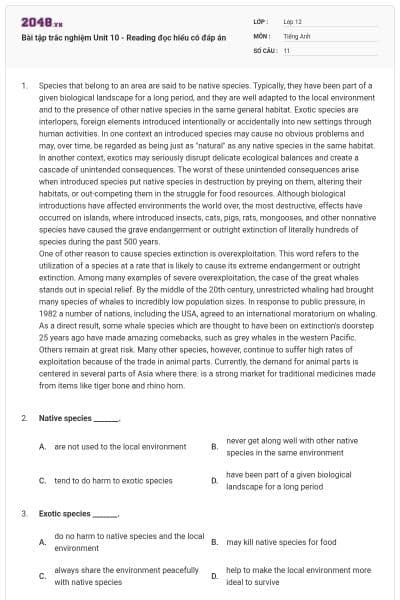
One of other reason to cause species extinction is overexploitation. This word refers to the utilization of a species at a rate that is likely to cause its extreme endangerment or outright extinction. Among many examples of severe overexploitation, the case of the great whales stands out in special relief. By the middle of the 20th century, unrestricted whaling had brought many species of whales to incredibly low population sizes. In response to public pressure, in 1982 a number of nations, including the USA, agreed to an international moratorium on whaling. As a direct result, some whale species which are thought to have been on extinction's doorstep 25 years ago have made amazing comebacks, such as grey whales in the western Pacific. Others remain at great risk. Many other species, however, continue to suffer high rates of exploitation because of the trade in animal parts. Currently, the demand for animal parts is centered in several parts of Asia where there. is a strong market for traditional medicines made from items like tiger bone and rhino horn.
Native species _______.
are not used to the local environment
never get along well with other native species in the same environment
tend to do harm to exotic species
have been part of a given biological landscape for a long period
A. không thường ở môi trường địa phương
B. không bao giờ hòa thuận với loài bản địa khác trong một môi trường
C. có xu hướng gây hại cho các loài ngoại lai
D. là một phần của hệ sinh thái nhất định trong một thời gian dài
Thông tin: Typically, they have been part of a given biological landscape for a long period, and they are well adapted to the local environment and to the presence of other native species in the same general habitat.
Tạm dịch: Thông thường, chúnglà một phần của hệ sinh thái nhất định trong một thời gian dài, và chúng thích nghi tốt với môi trường địa phương và sự hiện diện của các loài bản địa khác trong cùng một môi trường sống chung.
Đáp án cần chọn là: D
Exotic species _______.
do no harm to native species and the local environment
may kill native species for food
always share the environment peacefully with native species
help to make the local environment more ideal to survive
A. không gây hại cho các loài bản địa và môi trường địa phương
B. có thể giết chết các loài bản địa để làm thức ăn
C. luôn chia sẻ môi trường một cách hòa bình với các loài bản địa
D. giúp làm cho môi trường địa phương trở nên lý tưởng hơn để sinh tồn
Thông tin: The worst of these unintended consequences arise when introduced species put native species in destructionby preying on them, altering their habitats, or out-competing them in the struggle for food resources.
Tạm dịch: Điều tồi tệ nhất của những hậu quả không mong muốn này nảy sinh khi các loài ngoại lai hủy diệt những loài bản địabằng cách săn bắt chúng, thay đổi môi trường sống của chúng hoặc cạnh tranh để lấy nguồn thức ăn.
Đáp án cần chọn là: B
According to the first paragraph, _______.
non-native species have caused badly damage to native ones
introducing new exotic species to local environments is necessary
exotic species have never been introduced on islands
very few native species have been damaged by exotic species
A. các loài không phải là loài bản địa đã gây ra những thiệt hại cho loài bản địa
B. việc giới thiệu các loài mới cho môi trường địa phương là cần thiết
C. loài kì lạ chưa bao giờ được giới thiệu trên đảo
D. rất ít loài bản địa bị thiệt hại bởi các loài ngoại lai
Thông tin: The worst of these unintended consequences arise when introduced species put native species in destructionby preying on them,…
Tạm dịch: Điều tồi tệ nhất của những hậu quả không mong muốn này nảy sinh khi các loài xâm lấn đẩy loài bản địa vào sự diệt chủngbằng cách săn bắt chúng,...
Đáp án cần chọn là: A
According to the second paragraph, by the middle of the 20th century ___.
whale population was the most crowded in marine life
whale hunting was illegal
whale population increased dramatically
whaling was not restricted
A. số lượng cá voi đông đúc nhất trong các loài sinh vật biển
B. săn các voi là bất hợp pháp
C. số lượng cá voi tăng lên đáng kể
D. săn bắt cá voi không bị hạn chế
Thông tin: By the middle of the 20th century, unrestricted whalinghad brought many species of whales to incredibly low population sizes.
Tạm dịch: Vào giữa thế kỷ 20, nạn săn bắn cá voi bừa bãiđã khiến nhiều loài cá voi còn lại số lượng cực thấp.
Đáp án cần chọn là: D
Tiger bone and rhino horn _______.
are not popular in Asian markets
are never in the trade of animal parts
are used for making traditional medicines
cannot be found in As
A. không phổ biến ở thị trường Châu Á
B. không bao giờ buôn bán các bộ phận động vật
C. được sử dụng để làm thuốc cổ truyền
D. không thể tìm thấy ở thị trường Châu Á
Thông tin: Currently, the demand for animal parts is centered in several parts of Asia where there is a strong market for traditional medicines made from items like tiger bone and rhino horn.
Tạm dịch: Hiện nay, nhu cầu về các bộ phận động vật được tập trung ở một số khu vực của châu Á, nơi có một thị trường mạnh mẽ cho các loại thuốc truyền thống được làm từ các mặt hàng như xương hổ và sừng tê giác.
Đáp án cần chọn là: C
Read the following passage and mark the letter A. B. C or D your answer sheet to indicate the correct answer to each of the questions.
CAN ANIMALS TALK?
In 1977, a young Harvard graduate named Irene Pepperberg brought a one-year-old African gray parrot into her lab, and attempted something very unusual. At a time when her fellow scientists thought that animals could only communicate on a very basic level, Irene set out to discover what was on a creature's mind by talking to it. The bird, named Alex, proved to be a very good pupil.
Scientists at the time believed that animals were incapable of any thought. They believed that animals only reacted to things because they were programmed by nature to react that way, not because they had the ability to think or feel. Any pet owner would probably disagree. Pepperberg disagreed, too, and started her work with Alex to prove themwrong.
Pepperberg bought Alex in a pet store. She let the store's assistant pick him out because she didn't want other scientists saying later that she'd deliberatelychosen an especially smart bird for her work. Most researchers thought that Pepperberg's attempt to communicate with Alex would end in failure.
However, Pepperberg's experiment did not fail. In fact, over the next few years, Alex learned to imitate almost one hundred and fifty English words, and was even able to reason and use those words on a basic level to communicate. For example, when Alex was shown an object and was asked about its shape, color, or material, he could label it correctly. He could understand that a key was a key no matter what its size or color, and could figure out how the key was different from others.
Pepperberg was careful not to exaggerate Alex's success and abilities. She did not claim that Alex could actually “use” language. Instead, she said that Alex had learned to use a two-way communication code. Alex seemed to understand the turn-taking pattern of communication.
The reading passage is mainly about __________.
how animals communicate with humans
one woman's successful experiment to communicate with a bird
how parrots are smarter than other animals
how Irene Pepperberg proved her fellow scientists wrong
A. cách động vật giao tiếp với con người
B. thí nghiệm thành công của một người phụ nữ trong việc giao tiếp với một con chim
C. vẹt thông minh hơn động vật khác như thế nào
D. làm thế nào Irene Pepperberg chứng minh các nhà khoa học rằng đồng nghiệp của mình sai
Thông tin:At a time when her fellow scientists thought that animals could only communicate on a very basic level, Irene set out to discover what was on a creature's mind by talking to it… However, Pepperberg's experiment did not fail. In fact, over the next few years, Alex learned to imitate almost one hundred and fifty English words, and was even able to reason and use those words on a basic level to communicate.
Tạm dịch: Vào thời điểm các nhà khoa học đồng nghiệp của bà nghĩ rằng động vật chỉ có thể giao tiếp ở mức độ rất cơ bản, Irene đã bắt đầu khám phá những thứ trên trí não của một sinh vật bằng cách nói chuyện với nó… Tuy nhiên, thí nghiệm của Pepperberg đã không thất bại. Thực tế, sau vài năm, Alex đã học cách bắt chước gần một trăm năm mươi từ tiếng Anh, và thậm chí có thể suy luận và sử dụng những từ đó ở cấp độ cơ bản để giao tiếp.
Đáp án cần chọn là: B
According to the reading, other scientists believed that animals ________.
could only communicate in nature
had the ability to communicate with pet owners
could communicate if they were programmed to do so
didn't have the ability to think
A. chỉ có thể giao tiếp trong tự nhiên
B. có khả năng giao tiếp với chủ vật nuôi
C. có thể giao tiếp nếu chúng được lập trình để làm như vậy
D. không có khả năng suy nghĩ
Thông tin:Scientists at the time believed that animals were incapable of any thought.
Tạm dịch: Các nhà khoa học lúc đó tin rằng động vật không có khả năng suy nghĩ.
Đáp án cần chọn là: D
In paragraph 3, "deliberately" is closest in meaning to _______.
naturally
intentionally
cleverly
honestly
deliberately (adv): cố ý
A. naturally (adv): tự nhiên
B. intentionally (adv): cố ý
C. cleverly (adv): khéo léo, tài giỏi
D. honestly (adv): trung thực, thành thật
Thông tin:She let the store's assistant pick him out because she didn't want other scientists saying later that she'd deliberatelychosen an especially smart bird for her work.
Tạm dịch: Bà đã để trợ lý của cửa hàng chọn chú vẹt vì bà không muốn các nhà khoa học khác nói rằng sau đó bà đã cố tình chọn một con chim đặc biệt thông minh cho nghiên cứu của mình.
Đáp án cần chọn là: B
The word "them" in paragraph 2 refers to ________.
animals
scientists
pet owners
things
A. animals (n): động vật
B. scientists (n): nhà khoa học
C. pet owners (n): chủ vật nuôi
D. things (n): vật
Thông tin:Scientists at the time believed that animals were incapable of any thought. They believed that animals only reacted to things because they were programmed by nature to react that way, not because they had the ability to think or feel. Any pet owner would probably disagree. Pepperberg disagreed, too, and started her work with Alex to prove themwrong.
Tạm dịch: Các nhà khoa họclúc đó tin rằng động vật không có khả năng suy nghĩ. Họ tin rằng động vật chỉ phản ứng với mọi thứ vì chúng được lập trình bởi tự nhiên để phản ứng theo cách đó chứ không phải vì chúng có khả năng suy nghĩ hoặc cảm nhận. Bất kỳ người chủ sở hữu vật nuôi có thể sẽ không đồng ý. Pepperberg cũng không đồng ý và bắt đầu công việc của mình với Alex để chứng minh họsai.
Đáp án cần chọn là: B
Which of the following is NOT true about Irene's parrot Alex?
He learned to use almost 150 English words.
He could label a number of objects.
He was able to have complicated conversations.
He could understand how one object was different from others.
A. Chú vẹt đã học cách sử dụng gần 150 từ tiếng Anh.
B. Chú vẹt có thể dán nhãn một số đối tượng.
C. Chú vẹt đã có thể có những cuộc trò chuyện phức tạp.
D. Chú vẹt có thể hiểu làm thế nào một đối tượng khác với những thứ khác.
Thông tin:In fact, over the next few years, Alex learned to imitate almost one hundred and fifty English words, and was even able to reason and use those words on a basic level to communicate.
Tạm dịch: Thực tế, sau vài năm, Alex đã học cách bắt chước gần một trăm năm mươi từ tiếng Anh, và thậm chí có thể suy luận và sử dụng những từ đó ở cấp độ cơ bản để giao tiếp
Đáp án cần chọn là: C
Bạn có thích hoạt động này không?