Bài tập ôn tập Toán 10 Kết nối tri thức Chương 4 có đáp án
55 câu hỏi
\(\overrightarrow {AB} = \overrightarrow {CD} \).
\(\overrightarrow {OA} = \overrightarrow {OC} \).
\(\overrightarrow {AB} = \overrightarrow {BC} \).
\(\overrightarrow {AD} = \overrightarrow {BC} \).
Vì \(ABCD\) là hình vuông nên \(\overrightarrow {AD} = \overrightarrow {BC} \). Chọn D.

\(\overrightarrow {IA} = - \overrightarrow {IB} \).
\(\overrightarrow {IA} = \overrightarrow {IB} \).
\(\overrightarrow {AI} = \overrightarrow {BI} \).
\(\overrightarrow {IA} = \overrightarrow {IB} \).
Cho ba điểm \(A,B,C\) như hình vẽ

Biết rằng \(k\) là số thực thỏa mãn \(\overrightarrow {AB} = k\overrightarrow {CB} \). Tìm \(k\).
\(\frac{3}{7}\).
\( - \frac{3}{7}\).
\(\frac{7}{3}\).
\( - \frac{7}{3}\)
Ta có \(\overrightarrow {AB} \) và \(\overrightarrow {CB} \) ngược hướng.
Lại có \(\frac{{AB}}{{CB}} = \frac{3}{7}\). Suy ra \(\overrightarrow {AB} = - \frac{3}{7}\overrightarrow {CB} \). Vậy \(k = - \frac{3}{7}\). Chọn B.
\(40\).
\( - 40\).
\(0\).
\(20\).
\(\overrightarrow a \cdot \overrightarrow b = \left| {\overrightarrow a } \right| \cdot \left| {\overrightarrow b } \right| \cdot \cos \left( {\overrightarrow a ,\overrightarrow b } \right) = 8 \cdot 5 \cdot \cos 0^\circ = 40\). Chọn A.
\(\overrightarrow {IA} \) và \(\overrightarrow {IB} \) là hai vectơ đối.
\(\overrightarrow {CG} \) và \(\overrightarrow {GI} \) là hai vectơ cùng hướng.
\(\overrightarrow {GC} \) và \(\overrightarrow {IG} \) là hai vectơ cùng phương.
\(\overrightarrow {IA} \) và \(\overrightarrow {IG} \) là hai vectơ bằng nhau.

\(\overrightarrow {IA} \) và \(\overrightarrow {IG} \) là hai vectơ bằng nhau là khẳng định sai. Chọn D.
\(\overrightarrow {IJ} = \overrightarrow {KB} \).
\(\overrightarrow {KJ} = \frac{1}{2}\overrightarrow {AB} \).
\(\overrightarrow {IJ} = 2\overrightarrow {BC} \).
\(\overrightarrow {IK} = \frac{1}{2}\overrightarrow {AC} \).

Hai vectơ \(\overrightarrow {IK} \) và \(\overrightarrow {AC} \) cùng hướng và \(IK = \frac{1}{2}AC\) nên \(\overrightarrow {IK} = \frac{1}{2}\overrightarrow {AC} \). Chọn D.
\(\overrightarrow {AM} = \frac{1}{4}\overrightarrow {BA} \).
\(\overrightarrow {AM} = 2\overrightarrow {MB} \).
\(\overrightarrow {AM} = \frac{1}{3}\overrightarrow {MB} \).
\(\overrightarrow {AB} = 4\overrightarrow {MA} \).

Có \(\overrightarrow {AM} \) và \(\overrightarrow {MB} \) cùng hướng.
Vì \(AM = \frac{1}{4}AB\) nên \(AM = \frac{1}{3}MB\). Suy ra \(\overrightarrow {AM} = \frac{1}{3}\overrightarrow {MB} \). Chọn C.
\(\overrightarrow {BC} \).
\(\overrightarrow {CB} \).
\(\overrightarrow {AC} \).
\(\overrightarrow {CA} \).
Vì \(G\) là trọng tâm \(\Delta ABC\) nên \(\overrightarrow {GA} + \overrightarrow {GB} + \overrightarrow {GC} = \overrightarrow 0 \).
\(\overrightarrow {GA} + \overrightarrow {GB} + \overrightarrow {GC} + \overrightarrow {AB} - \overrightarrow {AC} = \overrightarrow {AB} - \overrightarrow {AC} = \overrightarrow {CB} \). Chọn B.
\(\overrightarrow {NM} \) và \(\overrightarrow {AC} \) là hai vectơ cùng phương.
\(\overrightarrow {NM} \) và \(\overrightarrow {AC} \) là hai vectơ đối nhau.
\(\overrightarrow {NM} \) và \(\overrightarrow {AC} \) cùng hướng.
\(\overrightarrow {NM} \) và \(\overrightarrow {AC} \) là hai vectơ bằng nhau.

Vì \(MN//AC\) (do \(MN\) là đường trung bình của tam giác \(ABC\)) nên \(\overrightarrow {NM} \) và \(\overrightarrow {AC} \) là hai vectơ cùng phương. Chọn A.

Học thông minh hơn mỗi ngày
Xem toàn bộ 55 câu hỏi và nhiều hơn nữa với tài khoản miễn phí
\(\overrightarrow {AM} = \frac{1}{2}\overrightarrow {AN} + \frac{2}{3}\overrightarrow {AP} \).
\(\overrightarrow {AM} = \frac{3}{4}\overrightarrow {AN} + \frac{1}{4}\overrightarrow {AP} \).
\(\overrightarrow {AM} = \frac{3}{4}\overrightarrow {AN} + \frac{5}{4}\overrightarrow {AP} \).
\(\overrightarrow {AM} = \frac{3}{2}\overrightarrow {AN} + \frac{3}{4}\overrightarrow {AP} \).

Ta có \(\overrightarrow {AM} = \frac{1}{2}\overrightarrow {AB} + \frac{1}{2}\overrightarrow {AC} \)\( = \frac{3}{2}\overrightarrow {AN} + \frac{1}{2} \cdot \frac{3}{2}\overrightarrow {AP} = \frac{3}{2}\overrightarrow {AN} + \frac{3}{4}\overrightarrow {AP} \). Chọn D.
\(\cos \left( {\overrightarrow {AC} ,\overrightarrow {CB} } \right) = \frac{1}{2}\).
\(\cos \left( {\overrightarrow {AC} ,\overrightarrow {CB} } \right) = - \frac{{\sqrt 2 }}{2}\).
\(\cos \left( {\overrightarrow {AC} ,\overrightarrow {CB} } \right) = \frac{{\sqrt 2 }}{2}\).
\(\cos \left( {\overrightarrow {AC} ,\overrightarrow {CB} } \right) = - \frac{{\sqrt 3 }}{2}\).

Ta có \(\left( {\overrightarrow {AC} ,\overrightarrow {CB} } \right) = \left( {\overrightarrow {CE} ,\overrightarrow {CB} } \right) = 180^\circ - \widehat {ACB} = 180^\circ - 45^\circ = 135^\circ \)
\(\cos \left( {\overrightarrow {AC} ,\overrightarrow {CB} } \right) = \cos 135^\circ = - \frac{{\sqrt 2 }}{2}\). Chọn B.
\(2\sqrt 3 a\).
\(4a\).
\(\sqrt 3 a\).
\(2\sqrt 2 a\).

Ta có \({\left( {\overrightarrow {BA} + 2\overrightarrow {BM} } \right)^2} = {\overrightarrow {BA} ^2} + 4\overrightarrow {BA} \cdot \overrightarrow {BM} + 4{\overrightarrow {BM} ^2}\)\( = {\overrightarrow {BA} ^2} + 4\left| {\overrightarrow {BA} } \right| \cdot \left| {\overrightarrow {BM} } \right| \cdot \cos \left( {\overrightarrow {BA} ,\overrightarrow {BM} } \right) + 4{\overrightarrow {BM} ^2}\)
\( = 4{a^2} + 4 \cdot 2a \cdot a \cdot \cos 60^\circ + 4{a^2}\)\( = 12{a^2}\)\( \Rightarrow \left| {\overrightarrow {BA} + 2\overrightarrow {BM} } \right| = 2a\sqrt 3 \). Chọn A.
\(\sqrt {26} \).
\(8\).
\(5\sqrt 2 \).
\(\sqrt 6 \).
Ta có \(\overrightarrow {MN} = \left( {7; - 1} \right)\). Khi đó \(MN = \sqrt {{7^2} + {{\left( { - 1} \right)}^2}} = 5\sqrt 2 \). Chọn C.
\(D\left( {4; - 7} \right)\).
\(D\left( {6; - 7} \right)\).
\(D\left( {6; - 13} \right)\).
\(D\left( { - 6;13} \right)\).
Gọi \(D\left( {x;y} \right)\). Khi đó \(\overrightarrow {AB} = \left( { - 3;7} \right),\overrightarrow {DC} = \left( {3 - x; - 6 - y} \right)\).
Do \(ABCD\) là hình bình hành nên \(\overrightarrow {AB} = \overrightarrow {DC} \)\( \Leftrightarrow \left\{ \begin{array}{l}3 - x = - 3\\ - 6 - y = 7\end{array} \right.\)\( \Leftrightarrow \left\{ \begin{array}{l}x = 6\\y = - 13\end{array} \right. \Rightarrow D\left( {6; - 13} \right)\). Chọn C.
\(60^\circ \).
\(135^\circ \).
\(120^\circ \).
\(45^\circ \).
Ta có \(\overrightarrow {AB} = \left( { - 3;3} \right),\overrightarrow {AC} = \left( {6;0} \right)\)
Ta có \(\cos \widehat {BAC} = \frac{{\overrightarrow {AB} \cdot \overrightarrow {AC} }}{{\left| {\overrightarrow {AB} } \right| \cdot \left| {\overrightarrow {AC} } \right|}} = \frac{{\left( { - 3} \right) \cdot 6 + 3 \cdot 0}}{{\sqrt {{{\left( { - 3} \right)}^2} + {3^2}} \cdot \sqrt {{6^2} + {0^2}} }} = \frac{{ - 18}}{{18\sqrt 2 }}\)\( \Rightarrow \widehat {BAC} = 135^\circ \). Chọn B.
\( - 13\).
\(\left( {2; - 15} \right)\).
\(17\).
\(\sqrt {65} \).
\(\overrightarrow a \cdot \overrightarrow b = \left( { - 2} \right) \cdot \left( { - 1} \right) + 3 \cdot \left( { - 5} \right) = - 13\). Chọn A.
\(M\left( { - 1;1} \right)\).
\(M\left( { - 2;2} \right)\).
\(M\left( {4; - 5} \right)\).
\(M\left( { - 4;5} \right)\).
Tọa độ trung điểm \(M\) của đoạn thẳng \(EF\) là \(\left\{ \begin{array}{l}x = \frac{{ - 3 - 5}}{2} = - 4\\y = \frac{{4 + 6}}{2} = 5\end{array} \right. \Rightarrow M\left( { - 4;5} \right)\). Chọn D.
\(6\).
\(12\).
\(3\).
\(9\).
Có 6 vectơ là \(\overrightarrow {AB} ,\overrightarrow {BA} ,\overrightarrow {AC} ,\overrightarrow {CA} ,\overrightarrow {BC} ,\overrightarrow {CB} \). Chọn A.
\(\left( {3;5} \right)\).
\(\left( { - 3; - 5} \right)\).
\(\left( { - 3;5} \right)\).
\(\left( {5; - 3} \right)\).
\(\overrightarrow u = - 3\overrightarrow i + 5\overrightarrow j \)\( \Rightarrow \overrightarrow u = \left( { - 3;5} \right)\). Chọn C.
\(\frac{{\sqrt 5 }}{2}a\).
\(2\sqrt 2 a\).
\(2\sqrt 5 a\).
\(\sqrt 5 a\).
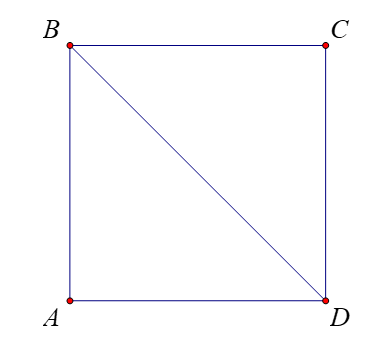
Ta có \({\left( {\overrightarrow {DA} + \overrightarrow {DB} } \right)^2} = {\overrightarrow {DA} ^2} + 2\overrightarrow {DA} \cdot \overrightarrow {DB} + {\overrightarrow {DB} ^2}\)\( = {\overrightarrow {DA} ^2} + 2\left| {\overrightarrow {DA} } \right| \cdot \left| {\overrightarrow {DB} } \right| \cdot \cos \left( {\overrightarrow {DA} ,\overrightarrow {DB} } \right) + {\overrightarrow {DB} ^2}\)
\( = 4{a^2} + 2 \cdot 2a \cdot 2\sqrt 2 a \cdot \cos 45^\circ + 8{a^2}\)\( = 20{a^2}\)\( \Leftrightarrow \left| {\overrightarrow {DA} + \overrightarrow {DB} } \right| = 2\sqrt 5 a\). Chọn C.
\(M\left( {5;4} \right)\).
\(M\left( { - 5;4} \right)\).
\(M\left( { - 5; - 4} \right)\).
\(M\left( {5; - 4} \right)\).
Ta có \(\overrightarrow {AB} = \left( {1; - 6} \right),\overrightarrow {AC} = \left( {3; - 1} \right)\). Khi đó \(\overrightarrow {AB} - 2\overrightarrow {AC} = \left( { - 5; - 4} \right)\).
Gọi \(M\left( {x;y} \right) \Rightarrow \overrightarrow {OM} = \left( {x;y} \right)\).
Vì \(\overrightarrow {OM} = \overrightarrow {AB} - 2\overrightarrow {AC} \) nên \(\left\{ \begin{array}{l}x = - 5\\y = - 4\end{array} \right. \Rightarrow M\left( { - 5; - 4} \right)\). Chọn C.
\(3\).
\( - 6\).
\(6\).
\( - \frac{3}{2}\).
Để \(\overrightarrow a \bot \overrightarrow b \) thì \(\overrightarrow a \cdot \overrightarrow b = 0\)\( \Leftrightarrow 1 \cdot \left( { - 3} \right) + \left( { - 2} \right) \cdot y = 0 \Leftrightarrow y = - \frac{3}{2}\). Chọn D.
\(C\left( {5; - 4} \right)\).
\(C\left( { - 5; - 4} \right)\).
\(C\left( {5;4} \right)\).
\(C\left( { - 5;4} \right)\).
Tọa độ điểm \(C\) là \(\left\{ \begin{array}{l}{x_C} = 3{x_G} - {x_A} - {x_B}\\{y_C} = 3{y_G} - {y_A} - {y_B}\end{array} \right.\)\( \Leftrightarrow \left\{ \begin{array}{l}{x_C} = 3 \cdot \frac{1}{3} - \left( { - 3} \right) - 9 = - 5\\{y_C} = 3 \cdot 0 - 6 - \left( { - 10} \right) = 4\end{array} \right.\)\( \Rightarrow C\left( { - 5;4} \right)\). Chọn D.
Cho tam giác \(ABC\). Gọi \(M,N\) lần lượt là trung điểm của \(AB\) và \(AC\). Cặp vectơ nào sau đây là hai vectơ cùng hướng?

\(\overrightarrow {MN} ,\overrightarrow {CB} \).
\(\overrightarrow {AB} ,\overrightarrow {AC} \).
\(\overrightarrow {MN} ,\overrightarrow {BC} \).
\(\overrightarrow {MA} ,\overrightarrow {AB} \).
\(\overrightarrow {MN} ,\overrightarrow {BC} \) cùng hướng. Chọn C.
\(\overrightarrow {AB} + \overrightarrow {AC} = \overrightarrow {AM} \).
\(\overrightarrow {AB} + \overrightarrow {AC} = 3\overrightarrow {AG} \).
\(\overrightarrow {GA} + \overrightarrow {GB} + \overrightarrow {GC} = 3\overrightarrow {GM} \).
\(\overrightarrow {MA} + \overrightarrow {MB} + \overrightarrow {MC} = \overrightarrow 0 \).

Ta có \(\overrightarrow {AB} + \overrightarrow {AC} = 2\overrightarrow {AM} \).
\(\overrightarrow {AB} + \overrightarrow {AC} = 2\overrightarrow {AM} = 2 \cdot \frac{3}{2}\overrightarrow {AG} = 3\overrightarrow {AG} \).
\(\overrightarrow {GA} + \overrightarrow {GB} + \overrightarrow {GC} = \overrightarrow 0 \).
\(\overrightarrow {MA} + \overrightarrow {MB} + \overrightarrow {MC} = 3\overrightarrow {MG} \). Chọn B.
\(\overrightarrow a \) và \(\overrightarrow b \) ngược hướng và \(\left| {\overrightarrow a } \right| = - 3\left| {\overrightarrow b } \right|\).
\(\overrightarrow a \) và \(\overrightarrow b \) cùng hướng.
\(\overrightarrow a \) và \(\overrightarrow b \) ngược hướng và \(\left| {\overrightarrow a } \right| = 3\left| {\overrightarrow b } \right|\).
\(\overrightarrow a \) và \(\overrightarrow b \) có giá song song.
\(\overrightarrow a \) và \(\overrightarrow b \) ngược hướng và \(\left| {\overrightarrow a } \right| = 3\left| {\overrightarrow b } \right|\). Chọn C.
\(2\).
\(4\).
\(6\).
\(12\).

Gọi \(I\) là trung điểm của \(BC\).
Khi đó \(\overrightarrow {GB} - \overrightarrow {CG} \)\( = \overrightarrow {GB} + \overrightarrow {GC} = 2\overrightarrow {GI} = \frac{2}{3}\overrightarrow {AI} \).
Suy ra \(\left| {\overrightarrow {GB} - \overrightarrow {CG} } \right| = \frac{2}{3}\left| {\overrightarrow {AI} } \right| = \frac{2}{3} \cdot \frac{1}{2}BC = 4\). Chọn B.
\({M_1}\left( { - 1; - 2} \right)\).
\({M_1}\left( {1; - 2} \right)\).
\({M_1}\left( {2;1} \right)\).
\({M_1}\left( { - 1;2} \right)\).
Điểm \({M_1}\left( {1; - 2} \right)\) là điểm đối xứng với điểm \(M\left( {1;2} \right)\) qua trục hoành. Chọn B.
\(\left( {2; - 10} \right)\).
\(\left( {2; - 6} \right)\).
\(\left( {2;6} \right)\).
\(\left( {0; - 8} \right)\).
Ta có \(\overrightarrow u = 2\overrightarrow a - \overrightarrow b \)\( = \left( {2 \cdot 1 - 0;2 \cdot \left( { - 4} \right) - 2} \right) = \left( {2; - 10} \right)\). Chọn A.
\(\left( {\overrightarrow {AB} ,\overrightarrow {AC} } \right) = 60^\circ \).
\(\left( {\overrightarrow {AB} ,\overrightarrow {DA} } \right) = 30^\circ \).
\(\overrightarrow {DA} \cdot \overrightarrow {DC} = 3\).
\(\overrightarrow {OB} \cdot \overrightarrow {BA} = - 3\).

\(ABCD\) là hình thoi, \(\widehat B = 60^\circ \) nên \(\Delta ABC\) đều. Suy ra \(\widehat {BAC} = 60^\circ \).
Khi đó \(\left( {\overrightarrow {AB} ,\overrightarrow {AC} } \right) = \widehat {BAC} = 60^\circ \).
\(\overrightarrow {MA} = \frac{2}{7}\overrightarrow {AB} \).
\(\overrightarrow {MA} = - \frac{5}{7}\overrightarrow {AB} \).
\(\overrightarrow {MA} = - \frac{2}{7}\overrightarrow {AB} \).
\(\overrightarrow {MA} = - \frac{5}{2}\overrightarrow {AB} \).
Vì \(M\)thuộc đoạn thẳng \(AB\) nên \(\overrightarrow {MA} \) và \(\overrightarrow {MB} \) ngược hướng.
Lại có \(2MA = 5MB\) nên \(MA = \frac{5}{7}AB\). Do đó \(\overrightarrow {MA} = - \frac{5}{7}\overrightarrow {AB} \). Chọn B.
Góc giữa hai vectơ \(\overrightarrow {AB} \) và \(\overrightarrow {AC} \) bằng \(30^\circ \).
\(\overrightarrow {AC} \cdot \overrightarrow {BD} = 0\).
\(\overrightarrow {AE} \cdot \overrightarrow {CD} = \overrightarrow {AD} \cdot \overrightarrow {CD} + \overrightarrow {DE} \cdot \overrightarrow {CD} \).
\(\overrightarrow {AD} \cdot \overrightarrow {AC} = 144\).

a) Do \(ABCD\) là hình vuông nên \(\left( {\overrightarrow {AB} ,\overrightarrow {AC} } \right) = \widehat {BAC} = 45^\circ \).
b) Do \(ABCD\) là hình vuông nên \(AC \bot BD\)\( \Rightarrow \overrightarrow {AC} \cdot \overrightarrow {BD} = 0\).
c) \(\overrightarrow {AE} \cdot \overrightarrow {CD} = \left( {\overrightarrow {AD} + \overrightarrow {DE} } \right) \cdot \overrightarrow {CD} = \overrightarrow {AD} \cdot \overrightarrow {CD} + \overrightarrow {DE} \cdot \overrightarrow {CD} \).
d) \(\overrightarrow {AD} \cdot \overrightarrow {AC} = \left| {\overrightarrow {AD} } \right| \cdot \left| {\overrightarrow {AC} } \right| \cdot \cos \left( {\overrightarrow {AD} ,\overrightarrow {AC} } \right) = 12 \cdot 12\sqrt 2 \cdot \cos 45^\circ = 144\).
Đáp án: a) Sai; b) Đúng; c) Đúng; d) Đúng.
\(\overrightarrow {AC} + \overrightarrow {CB} = \overrightarrow {AB} \).
Độ dài của vectơ \(\overrightarrow {BC} + \overrightarrow {CA} + \overrightarrow {AB} \) bằng 6.
Độ dài của vectơ \(\overrightarrow {BA} - \overrightarrow {BC} \) bằng 2.
Độ dài của vectơ \(\overrightarrow {BA} + \overrightarrow {BC} \) bằng \(\sqrt 3 \).
a) \(\overrightarrow {AC} + \overrightarrow {CB} = \overrightarrow {AB} \).
b) \(\overrightarrow {BC} + \overrightarrow {CA} + \overrightarrow {AB} \)\( \Leftrightarrow \overrightarrow {BA} + \overrightarrow {AB} = \overrightarrow 0 \). Suy ra \(\left| {\overrightarrow {BC} + \overrightarrow {CA} + \overrightarrow {AB} } \right| = 0\).
c) \(\overrightarrow {BA} - \overrightarrow {BC} = \overrightarrow {CA} \). Suy ra \[\left| {\overrightarrow {BA} - \overrightarrow {BC} } \right| = \left| {\overrightarrow {CA} } \right| = 2\].
d) \({\left( {\overrightarrow {BA} + \overrightarrow {BC} } \right)^2} = {\overrightarrow {BA} ^2} + 2\overrightarrow {BA} \cdot \overrightarrow {BC} + {\overrightarrow {BC} ^2}\)\( = {\overrightarrow {BA} ^2} + 2\left| {\overrightarrow {BA} } \right| \cdot \left| {\overrightarrow {BC} } \right| \cdot \cos \left( {\overrightarrow {BA} ,\overrightarrow {BC} } \right) + {\overrightarrow {BC} ^2}\)
\( = {2^2} + 2 \cdot 2 \cdot 2 \cdot \cos 60^\circ + {2^2} = 12\).
Suy ra \(\left| {\overrightarrow {BA} + \overrightarrow {BC} } \right| = 2\sqrt 3 \).
Đáp án: a) Đúng; b) Sai; c) Đúng; d) Sai.
Tọa độ của \(\overrightarrow {BC} \) là \(\left( {0; - 4} \right)\).
Tọa độ trung điểm của \(AB\) là \(\left( {\frac{3}{2};1} \right)\).
\(\overrightarrow {AB} \cdot \overrightarrow {AC} = - 9\).
Gọi \(D\left( {a;b} \right)\) là chân đường phân giác trong kẻ từ đỉnh \(A\) lên \(BC\). Khi đó \(a + b = 2,5\).
a) \(\overrightarrow {BC} = \left( {0; - 4} \right)\).
b) Tọa độ trung điểm của \(AB\) là \(\left\{ \begin{array}{l}x = \frac{{0 + 3}}{2} = \frac{3}{2}\\y = \frac{{1 + 1}}{2} = 1\end{array} \right.\).
c) Có \(\overrightarrow {AB} = \left( {3;0} \right),\overrightarrow {AC} = \left( {3; - 4} \right)\).
Suy ra \(\overrightarrow {AB} \cdot \overrightarrow {AC} = 3 \cdot 3 + 0 \cdot \left( { - 4} \right) = 9\).
d)
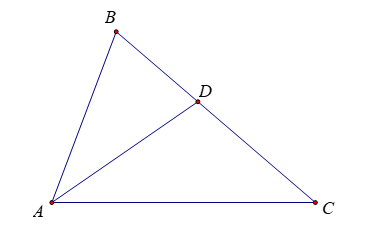
Theo tính chất tia phân giác, \(\frac{{DB}}{{DC}} = \frac{{AB}}{{AC}} = \frac{3}{5}\).
Mà \(\overrightarrow {DB} \) và \(\overrightarrow {DC} \) là hai vectơ ngược hướng nên \(\overrightarrow {DB} = - \frac{3}{5}\overrightarrow {DC} \)\( \Leftrightarrow \left\{ \begin{array}{l}3 - a = - \frac{3}{5}\left( {3 - a} \right)\\1 - b = - \frac{3}{5}\left( { - 3 - b} \right)\end{array} \right.\)\( \Leftrightarrow \left\{ \begin{array}{l}a = 3\\b = - \frac{1}{2}\end{array} \right.\).
Suy ra \(a + b = 2,5\).
Đáp án: a) Đúng; b) Đúng; c) Sai; d) Đúng.
\(\overrightarrow {CA} - \overrightarrow {CB} = \overrightarrow {AB} \).
\(\overrightarrow {AB} + \overrightarrow {AC} + \overrightarrow {AM} = 3\overrightarrow {AM} \).
\(\overrightarrow {BA} \cdot \overrightarrow {BC} = 9\).
Độ dài vectơ \(\overrightarrow u = 2\overrightarrow {AB} + \overrightarrow {AC} \) bằng \(2\sqrt {13} \).
a) \(\overrightarrow {CA} - \overrightarrow {CB} = \overrightarrow {BA} \).
b) \(\overrightarrow {AB} + \overrightarrow {AC} + \overrightarrow {AM} = 2\overrightarrow {AM} + \overrightarrow {AM} = 3\overrightarrow {AM} \).
c) Xét \(\Delta ABC\) vuông tại \(A,\) có \(BC = \sqrt {A{B^2} + A{C^2}} = \sqrt {{3^2} + {4^2}} = 5\); \(\cos B = \frac{{AB}}{{BC}} = \frac{3}{5}\)
Khi đó \(\overrightarrow {BA} \cdot \overrightarrow {BC} = \left| {\overrightarrow {BA} } \right| \cdot \left| {\overrightarrow {BC} } \right| \cdot \cos \left( {\overrightarrow {BA} ,\overrightarrow {BC} } \right) = 3 \cdot 5 \cdot \frac{3}{5} = 9\).
d) Ta có \({\left( {2\overrightarrow {AB} + \overrightarrow {AC} } \right)^2} = 4{\overrightarrow {AB} ^2} + 4\overrightarrow {AB} \cdot \overrightarrow {AC} + {\overrightarrow {AC} ^2}\)\( = 4{\overrightarrow {AB} ^2} + {\overrightarrow {AC} ^2}\)\( = 4 \cdot {3^2} + {4^2} = 52\).
Suy ra \(\left| {\overrightarrow u } \right| = \sqrt {52} = 2\sqrt {13} \).
Đáp án: a) Sai; b) Đúng; c) Đúng; d) Đúng.
\(\overrightarrow {AB} = \left( { - 6;5} \right)\).
Hình chiếu vuông góc kẻ từ \(A\) xuống \(BC\) là \(H\left( { - 1; - 4} \right)\).
\(\cos \widehat {BAC} = - \frac{{\sqrt 5 }}{5}\).
Tọa độ điểm \(M\) thỏa mãn \(\overrightarrow {MA} + 2\overrightarrow {AB} - \overrightarrow {AC} = \overrightarrow 0 \) là \(\left( { - 7;0} \right)\).
a) \(\overrightarrow {AB} = \left( {0; - 3} \right)\).
b) Gọi \(H\left( {x;y} \right)\). Ta có \(\overrightarrow {AH} = \left( {x + 3;y - 4} \right),\overrightarrow {BC} = \left( {4;1} \right),\overrightarrow {BH} = \left( {x + 3;y - 1} \right)\).
Vì \(H\) là hình chiếu vuông góc kẻ từ \(A\) xuống \(BC\) nên \(AH \bot BC\) và \(B,H,C\) thẳng hàng.
Khi đó ta có hệ \(\left\{ \begin{array}{l}\overrightarrow {AH} \cdot \overrightarrow {BC} = 0\\\overrightarrow {BH} = k\overrightarrow {BC} \end{array} \right.\)\( \Leftrightarrow \left\{ \begin{array}{l}4\left( {x + 3} \right) + \left( {y - 4} \right) = 0\\x + 3 = 4k\\y - 1 = k\end{array} \right.\)\( \Leftrightarrow \left\{ \begin{array}{l}x = - \frac{{39}}{{17}}\\y = \frac{{20}}{{17}}\end{array} \right.\)\( \Rightarrow H\left( { - \frac{{39}}{{17}};\frac{{20}}{{17}}} \right)\).
c) Ta có \(\overrightarrow {AC} = \left( {4; - 2} \right)\)
\(\cos \widehat {BAC} = \frac{{\overrightarrow {AB} \cdot \overrightarrow {AC} }}{{\left| {\overrightarrow {AB} } \right| \cdot \left| {\overrightarrow {AC} } \right|}}\)\( = \frac{{0 \cdot 4 + \left( { - 3} \right) \cdot \left( { - 2} \right)}}{{\sqrt {{0^2} + {{\left( { - 3} \right)}^2}} \cdot \sqrt {{4^2} + {{\left( { - 2} \right)}^2}} }} = \frac{6}{{6\sqrt 5 }} = \frac{{\sqrt 5 }}{5}\).
d) Gọi \(M\left( {x;y} \right)\). Khi đó \(\overrightarrow {MA} = \left( { - 3 - x;4 - y} \right)\).
Khi đó \(\overrightarrow {MA} + 2\overrightarrow {AB} - \overrightarrow {AC} = \left( { - 7 - x; - y} \right)\).
Vì \(\overrightarrow {MA} + 2\overrightarrow {AB} - \overrightarrow {AC} = \overrightarrow 0 \) nên \(\left\{ \begin{array}{l} - 7 - x = 0\\ - y = 0\end{array} \right.\)\( \Leftrightarrow \left\{ \begin{array}{l}x = - 7\\y = 0\end{array} \right.\)\( \Rightarrow M\left( { - 7;0} \right)\).
Đáp án: a) Sai; b) Sai; c) Sai; d) Đúng.
Điểm \(M\) nằm giữa hai điểm \(A\) và \(B\).
\(\overrightarrow {AM} = \frac{3}{5}\overrightarrow {AB} \).
\(\overrightarrow {CM} = - \frac{2}{5}\overrightarrow {AC} + \frac{3}{5}\overrightarrow {AB} \).
\(\overrightarrow {CA} \cdot \overrightarrow {CM} = \frac{{17}}{5}{a^2}\).

a) \(2\overrightarrow {MA} + 3\overrightarrow {MB} = \overrightarrow 0 \) nên \(\overrightarrow {MA} ,\overrightarrow {MB} \) là hai vectơ ngược hướng.
Suy ra điểm \(M\) nằm giữa hai điểm \(A\) và \(B\).
b) \(2\overrightarrow {MA} + 3\overrightarrow {MB} = \overrightarrow 0 \)\( \Leftrightarrow \overrightarrow {MA} = - \frac{3}{2}\overrightarrow {MB} \)\( \Leftrightarrow \overrightarrow {AM} = \frac{3}{2}\overrightarrow {MB} \)\( \Leftrightarrow \overrightarrow {AM} = \frac{3}{5}\overrightarrow {AB} \).
c) \(\overrightarrow {CM} = \overrightarrow {CA} + \overrightarrow {AM} = - \overrightarrow {AC} + \frac{3}{5}\overrightarrow {AB} \).
d) \(\overrightarrow {CA} \cdot \overrightarrow {CM} = \overrightarrow {CA} \left( { - \overrightarrow {AC} + \frac{3}{5}\overrightarrow {AB} } \right)\)\( = {\overrightarrow {AC} ^2} - \frac{3}{5}\overrightarrow {AC} \cdot \overrightarrow {AB} \)\( = {\overrightarrow {AC} ^2} - \frac{3}{5}\left| {\overrightarrow {AC} } \right| \cdot \left| {\overrightarrow {AB} } \right| \cdot \cos \left( {\overrightarrow {AC} ,\overrightarrow {AB} } \right)\)
\( = 4{a^2} - \frac{3}{5} \cdot 2a \cdot a \cdot \cos 60^\circ \)\( = 4{a^2} - \frac{3}{5}{a^2} = \frac{{17}}{5}{a^2}\).
Đáp án: a) Đúng; b) Đúng; c) Sai; d) Đúng.
\(MN = BC\).
\(\left| {\overrightarrow {MP} } \right| = \left| {\overrightarrow {BC} } \right|\).
\[\overrightarrow {MN} \] và \[\overrightarrow {BC} \] ngược hướng.
\(\overrightarrow {MP} = \overrightarrow {BC} \).

a) \(M\) và \(N\) lần lượt là trung điểm của \(AB\) và \(AC\) nên \(MN\) là đường trung bình của \(\Delta ABC\).
Suy ra \(MN//BC\) và \(MN = \frac{1}{2}BC\).
b) \(P\) đối xứng với điểm\(M\) qua \(N\) nên \(MP = 2MN = BC\).
Suy ra \(\left| {\overrightarrow {MP} } \right| = \left| {\overrightarrow {BC} } \right|\).
c) \[\overrightarrow {MN} \] và \[\overrightarrow {BC} \] cùng hướng.
d) Vì \[\overrightarrow {MN} \] và \[\overrightarrow {BC} \] cùng hướng và \(\left| {\overrightarrow {MP} } \right| = \left| {\overrightarrow {BC} } \right|\) nên \(\overrightarrow {MP} = \overrightarrow {BC} \).
Đáp án: a) Sai; b) Đúng; c) Sai; d) Đúng.
Tam giác \(ABC\) vuông tại \(A\).
Tích vô hướng của \(\overrightarrow {BA} \) và \(\overrightarrow {BC} \) bằng \( - 41\).
Chân đường cao \(H\) của đường cao kẻ từ đỉnh \(A\) của tam giác \(ABC\) là trung điểm cạnh \(BC\).
Chân đường cao \(H\) của đường cao kẻ từ đỉnh \(A\) của tam giác \(ABC\) có hoành độ âm.
a) Ta có \(\overrightarrow {AB} = \left( { - 4;5} \right),\overrightarrow {AC} = \left( {5;4} \right)\).
Khi đó \(\overrightarrow {AB} \cdot \overrightarrow {AC} = \left( { - 4} \right) \cdot 5 + 5 \cdot 4 = 0\). Do đó \(AB \bot AC\). Do đó \(\Delta ABC\) vuông tại \(A\).
b) Có \(\overrightarrow {BA} = \left( {4; - 5} \right)\), \(\overrightarrow {BC} = \left( {9; - 1} \right)\).
Khi đó \(\overrightarrow {BA} \cdot \overrightarrow {BC} = 4 \cdot 9 + \left( { - 5} \right) \cdot \left( { - 1} \right) = 41\).
c) Có \(AB = AC = \sqrt {41} \) và \(\Delta ABC\) vuông tại \(A\) nên \(\Delta ABC\) vuông cân tại \(A\).
Suy ra chân đường cao \(H\) của đường cao kẻ từ đỉnh \(A\) của tam giác \(ABC\) là trung điểm cạnh \(BC\).
d) Gọi \(H\left( {x;y} \right)\).
Vì \(H\) là trung điểm của \(BC\) nên \(\left\{ \begin{array}{l}x = \frac{{ - 1 + 8}}{2} = \frac{7}{2}\\y = \frac{{3 + 2}}{2} = \frac{5}{2}\end{array} \right.\).
Điểm \(H\) có hoành độ dương.
Đáp án: a) Đúng; b) Sai; c) Đúng; d) Sai.
\(A\left( {1; - 1} \right),B\left( {3;4} \right),C\left( { - 5;0} \right)\).
Nếu \(ABCD\) là hình bình hành thì điểm \(D\) có tọa độ là \(D\left( { - 3;5} \right)\).
\(\overrightarrow {AB} = \left( {2;5} \right)\).
Giả sử \(M\left( {a;b} \right)\) là điểm đối xứng của \(A\) qua \(B\). Khi đó \(2a - b = 1\).
a) \(\overrightarrow {OA} = \overrightarrow i - \overrightarrow j \)\( \Rightarrow A\left( {1; - 1} \right)\); \(\overrightarrow {OB} = 3\overrightarrow i + 4\overrightarrow j \Rightarrow B\left( {3;4} \right)\); \(\overrightarrow {OC} = - 5\overrightarrow i \Rightarrow C\left( { - 5;0} \right)\).
b) Gọi \(D\left( {x;y} \right)\). Có \(\overrightarrow {AD} = \left( {x - 1;y + 1} \right),\overrightarrow {BC} = \left( { - 8; - 4} \right)\).
Vì \(ABCD\) là hình bình hành nên \(\left\{ \begin{array}{l}x - 1 = - 8\\y + 1 = - 4\end{array} \right.\)\( \Leftrightarrow \left\{ \begin{array}{l}x = - 7\\y = - 3\end{array} \right.\)\( \Rightarrow D\left( { - 7; - 3} \right)\).
c) \(\overrightarrow {AB} = \left( {2;5} \right)\).
d) \(M\left( {a;b} \right)\) là điểm đối xứng của \(A\) qua \(B\) nên \(B\) là trung điểm của \(MA\).
Khi đó \(\left\{ \begin{array}{l}{x_M} = 2{x_B} - {x_A}\\{y_M} = 2{y_B} - {y_A}\end{array} \right.\)\( \Leftrightarrow \left\{ \begin{array}{l}a = 2 \cdot 3 - 1\\b = 2 \cdot 4 - \left( { - 1} \right)\end{array} \right.\)\( \Leftrightarrow \left\{ \begin{array}{l}a = 5\\b = 9\end{array} \right.\).
Khi đó \(2a - b = 1\).
Đáp án: a) Đúng; b) Sai; c) Đúng; d) Đúng.
Cho hai lực \(\overrightarrow {{F_1}} ,\overrightarrow {{F_2}} \) cùng tác động vào một chất điểm \(M\). Biết cường độ lực \(\overrightarrow {{F_1}} \) bằng 150 N, cường độ lực \(\overrightarrow {{F_2}} \) bằng 100 N và góc tọa bởi hai lực \(\overrightarrow {{F_1}} ,\overrightarrow {{F_2}} \) bằng \(120^\circ \). Gọi \(\overrightarrow F = \overrightarrow {{F_1}} + \overrightarrow {{F_2}} \) là lực tổng hợp tác động vào chất điểm \(M\). Tính cường độ của lực tổng hợp \(\overrightarrow F \) (theo đơn vị N) (làm tròn kết quả đến hàng đơn vị).
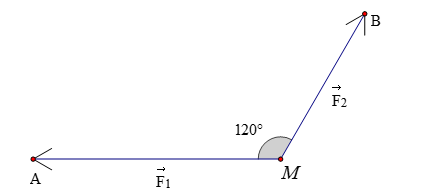
Có \({\left( {\overrightarrow {{F_1}} + \overrightarrow {{F_2}} } \right)^2} = {\overrightarrow {{F_1}} ^2} + 2\overrightarrow {{F_1}} \cdot \overrightarrow {{F_2}} + {\overrightarrow {{F_2}} ^2}\)\( = {\overrightarrow {{F_1}} ^2} + 2\left| {\overrightarrow {{F_1}} } \right| \cdot \left| {\overrightarrow {{F_2}} } \right| \cdot \cos \left( {\overrightarrow {{F_1}} ,\overrightarrow {{F_2}} } \right) + {\overrightarrow {{F_2}} ^2}\)
\( = {150^2} + 2 \cdot 150 \cdot 100 \cdot \cos 120^\circ + {100^2}\)\( = 17500\).
Khi đó \(\left| {\overrightarrow F } \right| = \sqrt {17500} \approx 132\) (N).
Theo đề ta có hệ phương trình \(\left\{ \begin{array}{l}{a^2} + {b^2} = {\left( {8 - a} \right)^2} + {\left( {4 - b} \right)^2}\\{a^2} + {b^2} = {\left( {7 - a} \right)^2} + {\left( {7 - b} \right)^2}\end{array} \right.\)\( \Leftrightarrow \left\{ \begin{array}{l}16a + 8b = 80\\14a + 14b = 98\end{array} \right.\)\( \Leftrightarrow \left\{ \begin{array}{l}a = 3\\b = 4\end{array} \right.\).
Khi đó \(a + b = 7\).
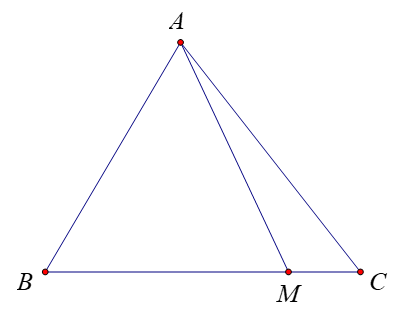
Có \(\overrightarrow {MB} \) và \(\overrightarrow {MC} \) ngược hướng và \(MB = 4MC\) nên \(\overrightarrow {MB} = - 4\overrightarrow {MC} \). Suy ra \(\overrightarrow {BM} = \frac{4}{5}\overrightarrow {BC} \).
Khi đó \(\overrightarrow {AM} = \overrightarrow {AB} + \overrightarrow {BM} = \overrightarrow {AB} + \frac{4}{5}\overrightarrow {BC} = \overrightarrow {AB} + \frac{4}{5}\left( {\overrightarrow {AC} - \overrightarrow {AB} } \right)\)\( = \frac{1}{5}\overrightarrow {AB} + \frac{4}{5}\overrightarrow {AC} \).
Suy ra \(m = \frac{1}{5};n = \frac{4}{5}\). Vậy \(6m + n = 2\).

Vì \(G\) là trọng tâm \(\Delta ABC\) nên \(\overrightarrow {GA} + \overrightarrow {GB} + \overrightarrow {GC} = \overrightarrow 0 \).
Ta có \(\overrightarrow {CA} - \overrightarrow {BG} \)\( = \overrightarrow {GA} - \overrightarrow {GC} + \overrightarrow {GB} \)\( = \overrightarrow {GA} + \overrightarrow {GC} + \overrightarrow {GB} - 2\overrightarrow {GC} \)\( = - 2\overrightarrow {GC} \).
Gọi \(I\) là trung điểm của \(AB\). Khi đó \(CG = \frac{2}{3}CI = \frac{2}{3} \cdot \frac{{5\sqrt 3 \cdot \sqrt 3 }}{2} = 5\).
Vậy \(\left| {\overrightarrow {CA} - \overrightarrow {BG} } \right| = \left| { - 2\overrightarrow {GC} } \right| = 2 \cdot 5 = 10\).
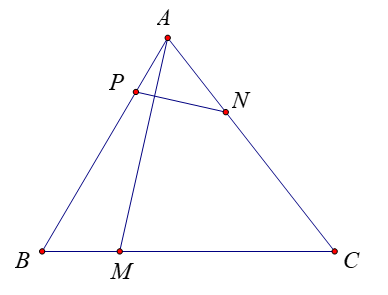
Ta có \(\overrightarrow {AM} = \overrightarrow {AB} + \overrightarrow {BM} = \overrightarrow {AB} + k\overrightarrow {BC} = \overrightarrow {AB} + k\overrightarrow {AC} - k\overrightarrow {AB} \)\( = k\overrightarrow {AC} + \left( {1 - k} \right)\overrightarrow {AB} \).
\(\overrightarrow {PN} = \overrightarrow {AN} - \overrightarrow {AP} = \frac{1}{3}\overrightarrow {AC} - \frac{4}{{15}}\overrightarrow {AB} \).
Để \(AM \bot PN\) thì \(\overrightarrow {AM} \cdot \overrightarrow {PN} = 0\)\( \Leftrightarrow \left( {k\overrightarrow {AC} + \left( {1 - k} \right)\overrightarrow {AB} } \right)\left( {\frac{1}{3}\overrightarrow {AC} - \frac{4}{{15}}\overrightarrow {AB} } \right) = 0\)
\( \Leftrightarrow \frac{k}{3}{\overrightarrow {AC} ^2} - \frac{{4k}}{{15}}\overrightarrow {AC} \cdot \overrightarrow {AB} + \frac{{1 - k}}{3} \cdot \overrightarrow {AB} \cdot \overrightarrow {AC} - \frac{{4\left( {1 - k} \right)}}{{15}}{\overrightarrow {AB} ^2} = 0\)
\( \Leftrightarrow \left[ {\frac{k}{3} - \frac{{4\left( {1 - k} \right)}}{{15}}} \right]{\overrightarrow {AC} ^2} + \left( {\frac{{1 - k}}{3} - \frac{{4k}}{{15}}} \right)\left| {\overrightarrow {AC} } \right| \cdot \left| {\overrightarrow {AB} } \right| \cdot \cos 60^\circ = 0\)\( \Leftrightarrow \left[ {\frac{k}{3} - \frac{{4\left( {1 - k} \right)}}{{15}}} \right]{\overrightarrow {AC} ^2} + \left( {\frac{{1 - k}}{6} - \frac{{4k}}{{30}}} \right){\left| {\overrightarrow {AC} } \right|^2} = 0\)
\( \Leftrightarrow \left( {\frac{k}{3} - \frac{{4\left( {1 - k} \right)}}{{15}} + \frac{{1 - k}}{6} - \frac{{4k}}{{30}}} \right){\left| {\overrightarrow {AC} } \right|^2} = 0\)
\( \Leftrightarrow \frac{k}{3} - \frac{{4\left( {1 - k} \right)}}{{15}} + \frac{{1 - k}}{6} - \frac{{4k}}{{30}} = 0\)\( \Leftrightarrow \frac{{3k}}{{10}} = \frac{1}{{10}}\)\( \Leftrightarrow k = \frac{1}{3}\).
Suy ra \(a = 1;b = 3\). Do đó \(2a + b = 5\).
Tọa độ trung điểm \(M\) là \(\left\{ \begin{array}{l}x = \frac{{5 + \left( { - 3} \right)}}{2} = 1\\y = \frac{{3 + \left( { - 1} \right)}}{2} = 1\end{array} \right.\)\( \Rightarrow M\left( {1;1} \right)\).
Khi đó \(\overrightarrow {BM} = \left( {0; - 4} \right)\). Vậy \(BM = \sqrt {{0^2} + {{\left( { - 4} \right)}^2}} = 4\).
Gọi \(I\left( {x;y} \right)\) là điểm sao cho \(\overrightarrow {IA} + 2\overrightarrow {IB} + 3\overrightarrow {IC} = \overrightarrow 0 \).
Ta có \(\overrightarrow {IA} = \left( {1 - x; - 4 - y} \right),\overrightarrow {IB} = \left( { - 2 - x;2 - y} \right),\overrightarrow {IC} = \left( { - 5 - x;4 - y} \right)\).
Theo bài ta có \(\overrightarrow {IA} + 2\overrightarrow {IB} + 3\overrightarrow {IC} = \overrightarrow 0 \) nên \(\left\{ \begin{array}{l}1 - x + 2\left( { - 2 - x} \right) + 3\left( { - 5 - x} \right) = 0\\ - 4 - y + 2\left( {2 - y} \right) + 3\left( {4 - y} \right) = 0\end{array} \right.\)\( \Leftrightarrow \left\{ \begin{array}{l}1 - x - 4 - 2x - 15 - 3x = 0\\ - 4 - y + 4 - 2y + 12 - 3y = 0\end{array} \right.\)
\( \Leftrightarrow \left\{ \begin{array}{l} - 6x - 18 = 0\\ - 6y + 12 = 0\end{array} \right.\)\( \Leftrightarrow \left\{ \begin{array}{l}x = - 3\\y = 2\end{array} \right.\)\( \Rightarrow I\left( { - 3;2} \right)\).
Ta có \(\overrightarrow {MA} + 2\overrightarrow {MB} + 3\overrightarrow {MC} = \overrightarrow {MI} + \overrightarrow {IA} + 2\overrightarrow {MI} + 2\overrightarrow {IB} + 3\overrightarrow {MI} + 3\overrightarrow {IC} \)\( = 6\overrightarrow {MI} + \overrightarrow {IA} + 2\overrightarrow {IB} + 3\overrightarrow {IC} = 6\overrightarrow {MI} \).
Do \(\left| {\overrightarrow {MA} + 2\overrightarrow {MB} + 3\overrightarrow {MC} } \right| = 6\left| {\overrightarrow {MI} } \right|\) nhỏ nhất khi \(MI\) nhỏ nhất.
Lại có \(M \in Ox\) nên \(MI\) nhỏ nhất khi \(M\) là hình chiếu của \(I\left( { - 3;2} \right)\) trên \(Ox\).
Suy ra tọa độ \(M\left( { - 3;0} \right)\). Vậy \(T = - 6\).
Công sinh bởi lực \(\overrightarrow F \) được tính bằng công thức
\(A = \overrightarrow F \cdot \overrightarrow d = \left| {\overrightarrow F } \right| \cdot \left| {\overrightarrow d } \right| \cdot \cos \left( {\overrightarrow F ,\overrightarrow d } \right) = 90 \cdot 100 \cdot \cos 60^\circ = 4500\) (J).
Vậy công sinh bởi lực \(\overrightarrow F \) có độ lớn bằng 4500 J.
Có \(\overrightarrow {AM} = \left( {x - 1;y - 3} \right)\); \(\overrightarrow {AB} = \left( { - 2; - 1} \right)\).
Vì \(M\left( {x;y} \right)\) thuộc tia \(AB\) nên \(\overrightarrow {AM} = k\overrightarrow {AB} ,k > 0\).
Theo đề ta có hệ \(\left\{ \begin{array}{l}\frac{{x - 1}}{{ - 2}} = \frac{{y - 3}}{{ - 1}}\\{\left( {x - 1} \right)^2} + {\left( {y - 3} \right)^2} = 80\end{array} \right.\)\( \Leftrightarrow \left\{ \begin{array}{l}x = 2y - 5\\{\left( {2y - 6} \right)^2} + {\left( {y - 3} \right)^2} = 80\end{array} \right.\)\( \Leftrightarrow \left\{ \begin{array}{l}x = 2y - 5\\5{y^2} - 30y - 35 = 0\end{array} \right.\)
\( \Leftrightarrow \left\{ \begin{array}{l}x = 2y - 5\\\left[ \begin{array}{l}y = 7\\y = - 1\end{array} \right.\end{array} \right.\)\( \Rightarrow \left[ \begin{array}{l}\left\{ \begin{array}{l}x = - 7\\y = - 1\end{array} \right. \Rightarrow \overrightarrow {AM} = \left( { - 8; - 4} \right)\\\left\{ \begin{array}{l}x = 9\\y = 7\end{array} \right. \Rightarrow \overrightarrow {AM} = \left( {8;4} \right)\end{array} \right.\).
\(\overrightarrow {AM} = k\overrightarrow {AB} ,k > 0\) nên \(M\left( { - 7; - 1} \right)\). Do đó \(x = - 7;y = - 1\). Vậy \(x + y = - 8\).
Vì vật đứng yên nên \(\overrightarrow {{F_1}} + \overrightarrow {{F_2}} + \overrightarrow {{F_3}} = \overrightarrow 0 \)\( \Leftrightarrow \overrightarrow {{F_3}} = - \left( {\overrightarrow {{F_1}} + \overrightarrow {{F_2}} } \right)\).
Ta có \({\left( {\overrightarrow {{F_1}} + \overrightarrow {{F_2}} } \right)^2} = {\overrightarrow {{F_1}} ^2} + 2\overrightarrow {{F_1}} \cdot \overrightarrow {{F_2}} + {\overrightarrow {{F_2}} ^2}\)\( = {\overrightarrow {{F_1}} ^2} + 2\left| {\overrightarrow {{F_1}} } \right| \cdot \left| {\overrightarrow {{F_2}} } \right| \cdot \cos \left( {\overrightarrow {{F_1}} ,\overrightarrow {{F_2}} } \right) + {\overrightarrow {{F_2}} ^2}\)
\( = {70^2} + 2 \cdot 70 \cdot 70 \cdot \cos 60^\circ + {70^2} = 14700\).
Suy ra \(\left| {\overrightarrow {{F_3}} } \right| = \left| {\overrightarrow {{F_1}} + \overrightarrow {{F_2}} } \right| = \sqrt {14700} = 70\sqrt 3 \).
Do đó \(a = 70;b = 3\). Vậy \(a + b = 73\).

a) Có \(\overrightarrow {AB} \cdot \overrightarrow {AC} = \left| {\overrightarrow {AB} } \right| \cdot \left| {\overrightarrow {AC} } \right| \cdot \cos \left( {\overrightarrow {AB} ,\overrightarrow {AC} } \right) = 2 \cdot 3 \cdot \cos 60^\circ = 3\).
\(\overrightarrow {AB} \cdot \overrightarrow {BC} = \overrightarrow {AB} \cdot \left( {\overrightarrow {AC} - \overrightarrow {AB} } \right) = \overrightarrow {AB} \cdot \overrightarrow {AC} - {\overrightarrow {AB} ^2} = 3 - {2^2} = - 1\).
b) Có \(\overrightarrow {MN} = \overrightarrow {MA} + \overrightarrow {AN} = - \frac{1}{2}\overrightarrow {AB} + \frac{2}{3}\overrightarrow {AC} \).
Có \(\overrightarrow {MP} = \overrightarrow {MB} + \overrightarrow {BP} = \frac{1}{2}\overrightarrow {AB} + 2\overrightarrow {BC} = \frac{1}{2}\overrightarrow {AB} + 2\left( {\overrightarrow {AC} - \overrightarrow {AB} } \right) = - \frac{3}{2}\overrightarrow {AB} + 2\overrightarrow {AC} \).
Do đó \(\overrightarrow {MN} = \frac{1}{3}\overrightarrow {MP} \). Suy ra \(M,N,P\) thẳng hàng.

a) Vì \(\Delta ABC\) vuông tại \(A\), ta có:
\(BC = \sqrt {A{B^2} + A{C^2}} = \sqrt {{1^2} + {{\left( {\sqrt 3 } \right)}^2}} = 2\).
\(\cos \left( {\overrightarrow {BA} ,\overrightarrow {BC} } \right) = \cos \widehat {ABC} = \frac{{AB}}{{BC}} = \frac{1}{2} \Rightarrow \widehat {ABC} = 60^\circ \Rightarrow \widehat {ACB} = 30^\circ \).
\(\cos \left( {\overrightarrow {AC} ,\overrightarrow {CB} } \right) = \cos \left( {\overrightarrow {CD} ,\overrightarrow {CB} } \right) = \cos \widehat {BCD} = \cos 150^\circ = - \frac{{\sqrt 3 }}{2}\).
b) \(\overrightarrow {BA} \cdot \overrightarrow {BC} \)\( = \left| {\overrightarrow {BA} } \right| \cdot \left| {\overrightarrow {BC} } \right| \cdot \cos \left( {\overrightarrow {BA} ,\overrightarrow {BC} } \right) = 1 \cdot 2 \cdot \frac{1}{2} = 1\).
\(\overrightarrow {AC} \cdot \overrightarrow {CB} = \left| {\overrightarrow {AC} } \right| \cdot \left| {\overrightarrow {CB} } \right| \cdot \cos \left( {\overrightarrow {AC} ,\overrightarrow {CB} } \right) = \sqrt 3 \cdot 2 \cdot \left( { - \frac{{\sqrt 3 }}{2}} \right) = - 3\).
a) \(\overrightarrow {AB} = \left( {5;2} \right),\overrightarrow {AB} = \sqrt {25 + 4} = \sqrt {29} \).
b) Tọa độ trọng tâm \(G\) là \(\left\{ \begin{array}{l}{x_G} = \frac{{ - 3 + 2 + 1}}{3} = 0\\{y_G} = \frac{{2 + 4 - 2}}{3} = \frac{4}{3}\end{array} \right.\)\( \Rightarrow G\left( {0;\frac{4}{3}} \right)\).
c) Ta có \(A\) và \(C\) khác phía so với trục hoành nên \(AM + MC\) ngắn nhất khi \(A,M,C\) thẳng hàng.
Gọi \(M\left( {x;0} \right)\) thuộc trục hoành , ta có \(\overrightarrow {AM} = \left( {x + 3; - 2} \right),\overrightarrow {AC} = \left( {4; - 4} \right)\) cùng phương nên \(\frac{{x + 3}}{4} = \frac{{ - 2}}{{ - 4}} \Leftrightarrow x = - 1\). Vậy \(M\left( { - 1;0} \right)\).
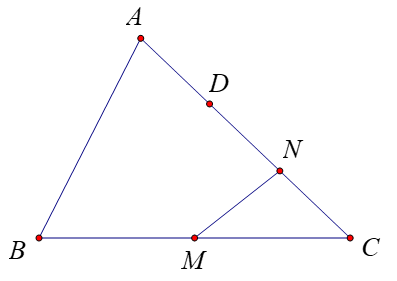
a) Ta có \(\overrightarrow {DA} \) và \(\overrightarrow {AC} \) là hai vectơ ngược hướng nhau và \(AC = 3DA\) nên \(\overrightarrow {AC} = - 3\overrightarrow {DA} \)\( \Leftrightarrow \overrightarrow {AC} + 3\overrightarrow {DA} = \overrightarrow 0 \).
b) Ta có \(\overrightarrow {MN} = \overrightarrow {MC} + \overrightarrow {CN} = \frac{1}{2}\overrightarrow {BC} + \frac{1}{3}\overrightarrow {CA} \)\( = \frac{1}{2}\left( {\overrightarrow {AC} - \overrightarrow {AB} } \right) - \frac{1}{3}\overrightarrow {AC} \)\( = \frac{1}{2}\overrightarrow {AC} - \frac{1}{2}\overrightarrow {AB} - \frac{1}{3}\overrightarrow {AC} = \frac{1}{6}\overrightarrow {AC} - \frac{1}{2}\overrightarrow {AB} \).
Một chất điểm \(A\) chịu tác dụng của ba lực \(\overrightarrow {{F_1}} ,\overrightarrow {{F_2}} ,\overrightarrow {{F_3}} \) như hình vẽ. Biết chất điểm \(A\) đang ở trạng thái cân bằng (như hình vẽ); lực \(\overrightarrow {{F_1}} \) có độ lớn 12 N. Độ lớn của các lực \(\overrightarrow {{F_3}} \) bằng bao nhiêu Niutơn?


Đặt \(\overrightarrow {{F_1}} = \overrightarrow {AB} ,\overrightarrow {{F_2}} = \overrightarrow {AD} ,\overrightarrow {{F_3}} = \overrightarrow {AE} \). Vẽ hình chữ nhật \(ABCD\).
Vật ở trạng thái cân bằng nên \(\overrightarrow {{F_1}} + \overrightarrow {{F_2}} + \overrightarrow {{F_3}} = \overrightarrow 0 \)\( \Rightarrow \overrightarrow {{F_3}} = - \left( {\overrightarrow {{F_1}} + \overrightarrow {{F_2}} } \right) = - \left( {\overrightarrow {AB} + \overrightarrow {AD} } \right) = - \overrightarrow {AC} \).
Ta có \(AB = 12,\widehat {CAD} = 180^\circ - 120^\circ = 60^\circ \Rightarrow \widehat {BAC} = 30^\circ \).
Tam giác \(ABC\) vuông tại \(B\), ta có \(\cos \widehat {BAC} = \frac{{AB}}{{AC}} \Rightarrow AC = \frac{{AB}}{{\cos \widehat {BAC}}} = \frac{{12}}{{\cos 30^\circ }} = 8\sqrt 3 \).
Vậy \(\left| {{F_3}} \right| = \left| {\overrightarrow {AC} } \right| = AC = 8\sqrt 3 \) (N).
Bạn có thích hoạt động này không?
Hãy lưu hoặc chia sẻ nội dung này đến mọi người.
Gợi ý cho bạn

Ý tưởng của bạn, bài học của bạn
Tự thiết kế đề thi, bài giảng hoặc flashcard theo cách riêng.