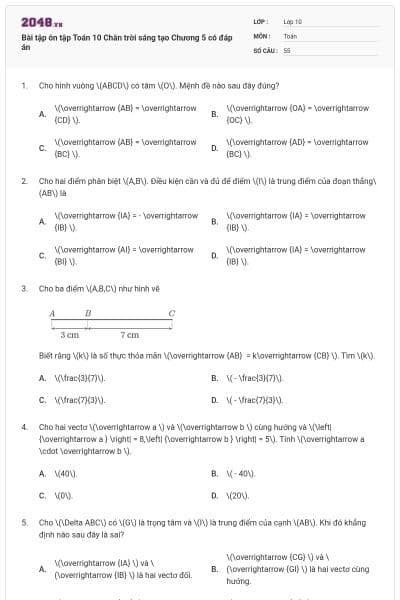
Bài tập ôn tập Toán 10 Chân trời sáng tạo Chương 5 có đáp án
55 câu hỏi
\(\overrightarrow {AB} = \overrightarrow {CD} \).
\(\overrightarrow {OA} = \overrightarrow {OC} \).
\(\overrightarrow {AB} = \overrightarrow {BC} \).
\(\overrightarrow {AD} = \overrightarrow {BC} \).
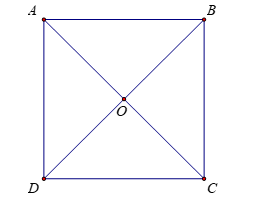
Vì \(ABCD\) là hình vuông nên \(\overrightarrow {AD} = \overrightarrow {BC} \). Chọn D.
\(\overrightarrow {IA} = - \overrightarrow {IB} \).
\(\overrightarrow {IA} = \overrightarrow {IB} \).
\(\overrightarrow {AI} = \overrightarrow {BI} \).
\(\overrightarrow {IA} = \overrightarrow {IB} \).
Điều kiện cần và đủ để điểm \(I\) là trung điểm của đoạn thẳng\(AB\) là \(\overrightarrow {IA} = - \overrightarrow {IB} \). Chọn A.
Cho ba điểm \(A,B,C\) như hình vẽ
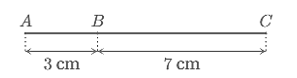
Biết rằng \(k\) là số thực thỏa mãn \(\overrightarrow {AB} = k\overrightarrow {CB} \). Tìm \(k\).
\(\frac{3}{7}\).
\( - \frac{3}{7}\).
\(\frac{7}{3}\).
\( - \frac{7}{3}\).
Ta có \(\overrightarrow {AB} \) và \(\overrightarrow {CB} \) ngược hướng.
Lại có \(\frac{{AB}}{{CB}} = \frac{3}{7}\). Suy ra \(\overrightarrow {AB} = - \frac{3}{7}\overrightarrow {CB} \). Vậy \(k = - \frac{3}{7}\). Chọn B.
\(40\).
\( - 40\).
\(0\).
\(20\).
\(\overrightarrow a \cdot \overrightarrow b = \left| {\overrightarrow a } \right| \cdot \left| {\overrightarrow b } \right| \cdot \cos \left( {\overrightarrow a ,\overrightarrow b } \right) = 8 \cdot 5 \cdot \cos 0^\circ = 40\). Chọn A.
\(\overrightarrow {IA} \) và \(\overrightarrow {IB} \) là hai vectơ đối.
\(\overrightarrow {CG} \) và \(\overrightarrow {GI} \) là hai vectơ cùng hướng.
\(\overrightarrow {GC} \) và \(\overrightarrow {IG} \) là hai vectơ cùng phương.
\(\overrightarrow {IA} \) và \(\overrightarrow {IG} \) là hai vectơ bằng nhau.
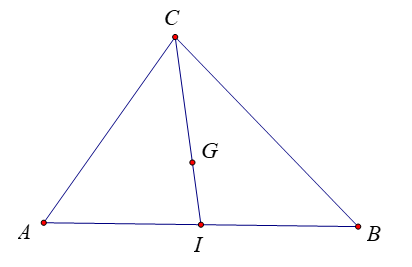
\(\overrightarrow {IA} \) và \(\overrightarrow {IG} \) là hai vectơ bằng nhau là khẳng định sai. Chọn D.
\(\overrightarrow {IJ} = \overrightarrow {KB} \).
\(\overrightarrow {KJ} = \frac{1}{2}\overrightarrow {AB} \).
\(\overrightarrow {IJ} = 2\overrightarrow {BC} \).
\(\overrightarrow {IK} = \frac{1}{2}\overrightarrow {AC} \).
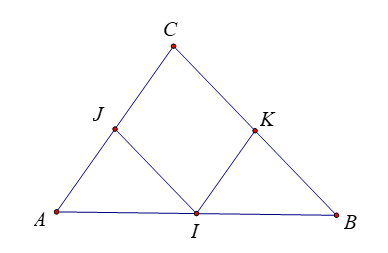
Hai vectơ \(\overrightarrow {IK} \) và \(\overrightarrow {AC} \) cùng hướng và \(IK = \frac{1}{2}AC\) nên \(\overrightarrow {IK} = \frac{1}{2}\overrightarrow {AC} \). Chọn D.
\(\overrightarrow {AM} = \frac{1}{4}\overrightarrow {BA} \).
\(\overrightarrow {AM} = 2\overrightarrow {MB} \).
\(\overrightarrow {AM} = \frac{1}{3}\overrightarrow {MB} \).
\(\overrightarrow {AB} = 4\overrightarrow {MA} \).

Có \(\overrightarrow {AM} \) và \(\overrightarrow {MB} \) cùng hướng.
Vì \(AM = \frac{1}{4}AB\) nên \(AM = \frac{1}{3}MB\). Suy ra \(\overrightarrow {AM} = \frac{1}{3}\overrightarrow {MB} \). Chọn C.
\(\overrightarrow {BC} \).
\(\overrightarrow {CB} \).
\(\overrightarrow {AC} \).
\(\overrightarrow {CA} \).
Vì \(G\) là trọng tâm \(\Delta ABC\) nên \(\overrightarrow {GA} + \overrightarrow {GB} + \overrightarrow {GC} = \overrightarrow 0 \).
\(\overrightarrow {GA} + \overrightarrow {GB} + \overrightarrow {GC} + \overrightarrow {AB} - \overrightarrow {AC} = \overrightarrow {AB} - \overrightarrow {AC} = \overrightarrow {CB} \). Chọn B.
\(\overrightarrow {NM} \) và \(\overrightarrow {AC} \) là hai vectơ cùng phương.
\(\overrightarrow {NM} \) và \(\overrightarrow {AC} \) là hai vectơ đối nhau.
\(\overrightarrow {NM} \) và \(\overrightarrow {AC} \) cùng hướng.
\(\overrightarrow {NM} \) và \(\overrightarrow {AC} \) là hai vectơ bằng nhau.
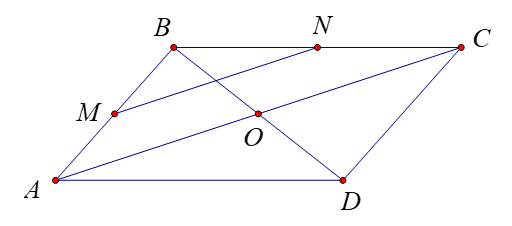
Vì \(MN//AC\) (do \(MN\) là đường trung bình của tam giác \(ABC\)) nên \(\overrightarrow {NM} \) và \(\overrightarrow {AC} \) là hai vectơ cùng phương. Chọn A.

Học thông minh hơn mỗi ngày
Xem toàn bộ 55 câu hỏi và nhiều hơn nữa với tài khoản miễn phí
\(\overrightarrow {AM} = \frac{1}{2}\overrightarrow {AN} + \frac{2}{3}\overrightarrow {AP} \).
\(\overrightarrow {AM} = \frac{3}{4}\overrightarrow {AN} + \frac{1}{4}\overrightarrow {AP} \).
\(\overrightarrow {AM} = \frac{3}{4}\overrightarrow {AN} + \frac{5}{4}\overrightarrow {AP} \).
\(\overrightarrow {AM} = \frac{3}{2}\overrightarrow {AN} + \frac{3}{4}\overrightarrow {AP} \).
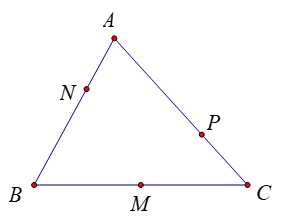
Ta có \(\overrightarrow {AM} = \frac{1}{2}\overrightarrow {AB} + \frac{1}{2}\overrightarrow {AC} \)\( = \frac{3}{2}\overrightarrow {AN} + \frac{1}{2} \cdot \frac{3}{2}\overrightarrow {AP} = \frac{3}{2}\overrightarrow {AN} + \frac{3}{4}\overrightarrow {AP} \). Chọn D.
\(\cos \left( {\overrightarrow {AC} ,\overrightarrow {CB} } \right) = \frac{1}{2}\).
\(\cos \left( {\overrightarrow {AC} ,\overrightarrow {CB} } \right) = - \frac{{\sqrt 2 }}{2}\).
\(\cos \left( {\overrightarrow {AC} ,\overrightarrow {CB} } \right) = \frac{{\sqrt 2 }}{2}\).
\(\cos \left( {\overrightarrow {AC} ,\overrightarrow {CB} } \right) = - \frac{{\sqrt 3 }}{2}\).
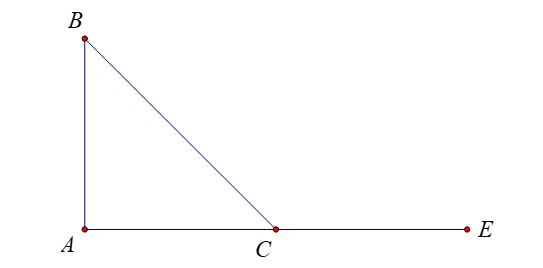
Ta có \(\left( {\overrightarrow {AC} ,\overrightarrow {CB} } \right) = \left( {\overrightarrow {CE} ,\overrightarrow {CB} } \right) = 180^\circ - \widehat {ACB} = 180^\circ - 45^\circ = 135^\circ \)
\(\cos \left( {\overrightarrow {AC} ,\overrightarrow {CB} } \right) = \cos 135^\circ = - \frac{{\sqrt 2 }}{2}\). Chọn B.
\(2\sqrt 3 a\).
\(4a\).
\(\sqrt 3 a\).
\(2\sqrt 2 a\).
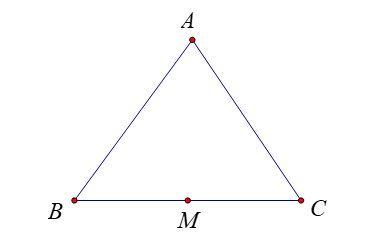
Ta có \({\left( {\overrightarrow {BA} + 2\overrightarrow {BM} } \right)^2} = {\overrightarrow {BA} ^2} + 4\overrightarrow {BA} \cdot \overrightarrow {BM} + 4{\overrightarrow {BM} ^2}\)\( = {\overrightarrow {BA} ^2} + 4\left| {\overrightarrow {BA} } \right| \cdot \left| {\overrightarrow {BM} } \right| \cdot \cos \left( {\overrightarrow {BA} ,\overrightarrow {BM} } \right) + 4{\overrightarrow {BM} ^2}\)
\( = 4{a^2} + 4 \cdot 2a \cdot a \cdot \cos 60^\circ + 4{a^2}\)\( = 12{a^2}\)\( \Rightarrow \left| {\overrightarrow {BA} + 2\overrightarrow {BM} } \right| = 2a\sqrt 3 \). Chọn A.
\(6\).
\(12\).
\(3\).
\(9\).
Có 6 vectơ là \(\overrightarrow {AB} ,\overrightarrow {BA} ,\overrightarrow {AC} ,\overrightarrow {CA} ,\overrightarrow {BC} ,\overrightarrow {CB} \). Chọn A.
\(\frac{{\sqrt 5 }}{2}a\).
\(2\sqrt 2 a\).
\(2\sqrt 5 a\).
\(\sqrt 5 a\).
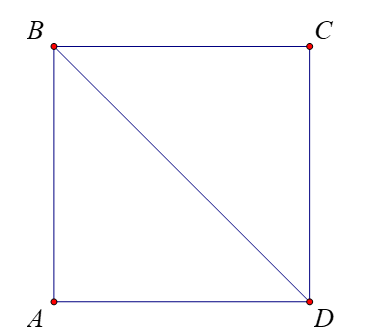
Ta có \({\left( {\overrightarrow {DA} + \overrightarrow {DB} } \right)^2} = {\overrightarrow {DA} ^2} + 2\overrightarrow {DA} \cdot \overrightarrow {DB} + {\overrightarrow {DB} ^2}\)\( = {\overrightarrow {DA} ^2} + 2\left| {\overrightarrow {DA} } \right| \cdot \left| {\overrightarrow {DB} } \right| \cdot \cos \left( {\overrightarrow {DA} ,\overrightarrow {DB} } \right) + {\overrightarrow {DB} ^2}\)
\( = 4{a^2} + 2 \cdot 2a \cdot 2\sqrt 2 a \cdot \cos 45^\circ + 8{a^2}\)\( = 20{a^2}\)\( \Leftrightarrow \left| {\overrightarrow {DA} + \overrightarrow {DB} } \right| = 2\sqrt 5 a\). Chọn C.
Cho tam giác \(ABC\). Gọi \(M,N\) lần lượt là trung điểm của \(AB\) và \(AC\). Cặp vectơ nào sau đây là hai vectơ cùng hướng?
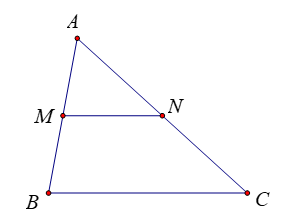
\(\overrightarrow {MN} ,\overrightarrow {CB} \).
\(\overrightarrow {AB} ,\overrightarrow {AC} \).
\(\overrightarrow {MN} ,\overrightarrow {BC} \).
\(\overrightarrow {MA} ,\overrightarrow {AB} \).
\(\overrightarrow {MN} ,\overrightarrow {BC} \) cùng hướng. Chọn C.
\(\overrightarrow {AB} + \overrightarrow {AC} = \overrightarrow {AM} \).
\(\overrightarrow {AB} + \overrightarrow {AC} = 3\overrightarrow {AG} \).
\(\overrightarrow {GA} + \overrightarrow {GB} + \overrightarrow {GC} = 3\overrightarrow {GM} \).
\(\overrightarrow {MA}+ \overrightarrow {MB}+ \overrightarrow {MC}= \overrightarrow 0 \).
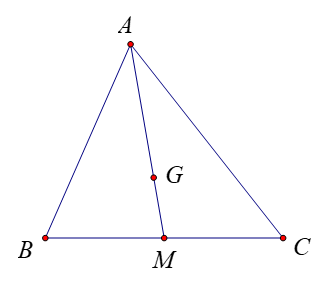
Ta có \(\overrightarrow {AB} + \overrightarrow {AC} = 2\overrightarrow {AM} \).
\(\overrightarrow {AB} + \overrightarrow {AC} = 2\overrightarrow {AM} = 2 \cdot \frac{3}{2}\overrightarrow {AG} = 3\overrightarrow {AG} \).
\(\overrightarrow {GA} + \overrightarrow {GB} + \overrightarrow {GC} = \overrightarrow 0 \).
\(\overrightarrow {MA} + \overrightarrow {MB} + \overrightarrow {MC} = 3\overrightarrow {MG} \). Chọn B.
\(\overrightarrow a \) và \(\overrightarrow b \) ngược hướng và \(\left| {\overrightarrow a } \right| = - 3\left| {\overrightarrow b } \right|\).
\(\overrightarrow a \) và \(\overrightarrow b \) cùng hướng.
\(\overrightarrow a \) và \(\overrightarrow b \) ngược hướng và \(\left| {\overrightarrow a } \right| = 3\left| {\overrightarrow b } \right|\).
\(\overrightarrow a \) và \(\overrightarrow b \) có giá song song.
\(\overrightarrow a \) và \(\overrightarrow b \) ngược hướng và \(\left| {\overrightarrow a } \right| = 3\left| {\overrightarrow b } \right|\). Chọn C.
\(2\).
\(4\).
\(6\).
\(12\).
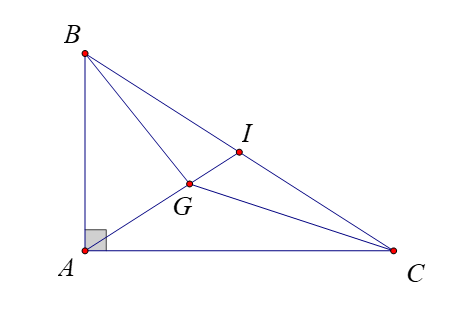
Gọi \(I\) là trung điểm của \(BC\).
Khi đó \(\overrightarrow {GB} - \overrightarrow {CG} \)\( = \overrightarrow {GB} + \overrightarrow {GC} = 2\overrightarrow {GI} = \frac{2}{3}\overrightarrow {AI} \).
Suy ra \(\left| {\overrightarrow {GB} - \overrightarrow {CG} } \right| = \frac{2}{3}\left| {\overrightarrow {AI} } \right| = \frac{2}{3} \cdot \frac{1}{2}BC = 4\). Chọn B.
\(\overrightarrow {MA} = \frac{2}{7}\overrightarrow {AB} \).
\(\overrightarrow {MA} = - \frac{5}{7}\overrightarrow {AB} \).
\(\overrightarrow {MA} = - \frac{2}{7}\overrightarrow {AB} \).
\(\overrightarrow {MA} = - \frac{5}{2}\overrightarrow {AB} \).
Vì \(M\)thuộc đoạn thẳng \(AB\) nên \(\overrightarrow {MA} \) và \(\overrightarrow {MB} \) ngược hướng.
Lại có \(2MA = 5MB\) nên \(MA = \frac{5}{7}AB\). Do đó \(\overrightarrow {MA} = - \frac{5}{7}\overrightarrow {AB} \). Chọn B.
Hai vectơ cùng phương.
Hai vectơ đối nhau.
Hai vectơ ngược hướng.
Hai vectơ bằng nhau
Hai vectơ có cùng độ dài và cùng hướng gọi là hai vectơ bằng nhau. Chọn D.
\(\overrightarrow {MN} = - 7\overrightarrow a \).
\(\overrightarrow {MN} = - 5\overrightarrow a \).
\(\overrightarrow {MN} = 5\overrightarrow a \).
\(\overrightarrow {MN} = 7\overrightarrow a \).
Ta có \(\overrightarrow {MN} = \overrightarrow {ON} - \overrightarrow {OM} = - 4\overrightarrow a - 3\overrightarrow a = - 7\overrightarrow a \). Chọn A.
\(\overrightarrow a \cdot \overrightarrow b = \left| {\overrightarrow a } \right| \cdot \left| {\overrightarrow b } \right| \cdot \sin \left( {\overrightarrow a ,\overrightarrow b } \right)\).
\(\overrightarrow a \cdot \overrightarrow b = \left| {\overrightarrow a } \right| \cdot \left| {\overrightarrow b } \right| \cdot \cos \left( {\overrightarrow a ,\overrightarrow b } \right)\).
\(\overrightarrow a \cdot \overrightarrow b = \left| {\overrightarrow a } \right| \cdot \left| {\overrightarrow b } \right|\).
\(\overrightarrow a \cdot \overrightarrow b = \left| {\overrightarrow a \cdot \overrightarrow b } \right| \cdot \sin \left( {\overrightarrow a ,\overrightarrow b } \right)\).
\(\overrightarrow a \cdot \overrightarrow b = \left| {\overrightarrow a } \right| \cdot \left| {\overrightarrow b } \right| \cdot \cos \left( {\overrightarrow a ,\overrightarrow b } \right)\). Chọn B.
\(M\) là trọng tâm \(\Delta ABC\).
\(M\) là trực tâm \(\Delta ABC\).
\(M\) là tâm đường tròn ngoại tiếp \(\Delta ABC\).
\(M\)là trung điểm của \(AB\).
\(M\) là điểm thỏa mãn \(\overrightarrow {MA} + \overrightarrow {MB} + \overrightarrow {MC} = \overrightarrow 0 \) thì \(M\) là trọng tâm \(\Delta ABC\). Chọn A.
Điểm \(B\) thuộc đoạn \(AC\).
Điểm \(A\) thuộc đoạn \(BC\).
Điểm \(C\) thuộc đoạn \(AB\).
Điểm \(A\) nằm ngoài đoạn \(BC\).
Cectơ \(\overrightarrow {AB} ,\overrightarrow {BC} \) cùng hướng khi và chỉ khi điểm \(B\) thuộc đoạn \(AC\). Chọn A.
\(\overrightarrow {AB} \cdot \overrightarrow {AC} = 1\).
\(\overrightarrow {AB} \cdot \overrightarrow {AC} = 2\).
\(\overrightarrow {AB} \cdot \overrightarrow {AC} = - 1\).
\(\overrightarrow {AB} \cdot \overrightarrow {AC} = \sqrt 3 \).
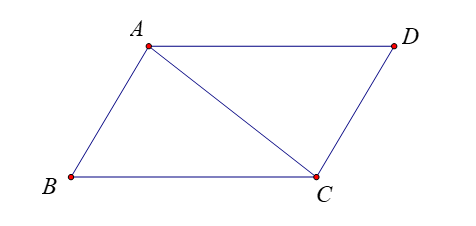
Ta có \(\overrightarrow {AB} \cdot \overrightarrow {AC} = \overrightarrow {AB} \cdot \left( {\overrightarrow {AB} + \overrightarrow {AD} } \right) = {\overrightarrow {AB} ^2} + \overrightarrow {AB} \cdot \overrightarrow {AD} \)\( = {\overrightarrow {AB} ^2} + \left| {\overrightarrow {AB} } \right| \cdot \left| {\overrightarrow {AD} } \right| \cdot \cos \left( {\overrightarrow {AB} ,\overrightarrow {AD} } \right)\)
\( = {1^2} + 1 \cdot 2 \cdot \cos 60^\circ = 2\). Chọn B.
\(\overrightarrow {AG} = \frac{1}{2}\overrightarrow {AB} + \frac{1}{2}\overrightarrow {AC} \).
\(\overrightarrow {AG} = \frac{1}{3}\overrightarrow {AB} + \frac{1}{3}\overrightarrow {AC} \).
\(\overrightarrow {AG} = \frac{1}{2}\overrightarrow {AB} + \frac{1}{3}\overrightarrow {AC} \).
\(\overrightarrow {AG} = \frac{1}{3}\overrightarrow {AB} + \frac{1}{2}\overrightarrow {AC} \).
Gọi \(M\) là trung điểm của \(BC\).
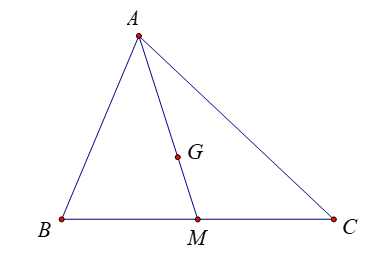
Ta có \(\overrightarrow {AG} = \frac{2}{3}\overrightarrow {AM} = \frac{2}{3}\left( {\frac{1}{2}\overrightarrow {AB} + \frac{1}{2}\overrightarrow {AC} } \right) = \frac{1}{3}\overrightarrow {AB} + \frac{1}{3}\overrightarrow {AC} \). Chọn B.
\(\overrightarrow {MB} \).
\(\overrightarrow {MA} \).
\(\overrightarrow {AM} \).
\(\overrightarrow {PN} \).
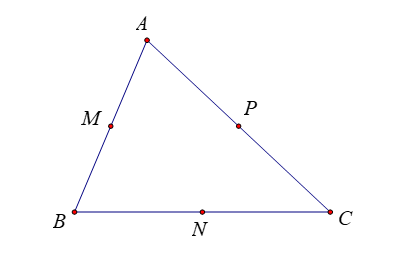
Có \(\overrightarrow {MA} \) và \(\overrightarrow {AB} \) ngược hướng nên \(\overrightarrow {MA} = - \frac{1}{2}\overrightarrow {AB} \). Chọn B.
\(P = 2{a^2}\).
\(P = - {a^2}\).
\(P = {a^2}\).
\(P = - 2{a^2}\).
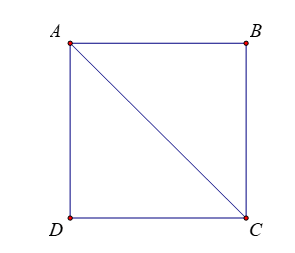
\(\overrightarrow a \cdot \left( {\overrightarrow b \cdot \overrightarrow c } \right) = \left( {\overrightarrow a \cdot \overrightarrow b } \right) \cdot \overrightarrow c \).
\(\overrightarrow a \cdot \overrightarrow b = \overrightarrow b \cdot \overrightarrow a \).
\(\overrightarrow a \cdot \left( {\overrightarrow b + \overrightarrow c } \right) = \overrightarrow a \cdot \overrightarrow b + \overrightarrow a \cdot \overrightarrow c \).
\({\overrightarrow a ^2} = {\left| {\overrightarrow a } \right|^2}\).
\(\overrightarrow a \cdot \left( {\overrightarrow b \cdot \overrightarrow c } \right) = \left( {\overrightarrow a \cdot \overrightarrow b } \right) \cdot \overrightarrow c \) là khẳng định sai. Chọn A.
\(\overrightarrow u = - 3\overrightarrow b \).
\(\overrightarrow u = 6\overrightarrow a \).
\(\overrightarrow u = - 2\overrightarrow a + 3\overrightarrow b \).
\(\overrightarrow u = 3\overrightarrow b \).
\(\overrightarrow u = 2\overrightarrow a - 3\left( {\overrightarrow a - \overrightarrow b } \right) + \overrightarrow a \)\( = 2\overrightarrow a - 3\overrightarrow a + 3\overrightarrow b + \overrightarrow a \)\( = 3\overrightarrow b \). Chọn D.
Góc giữa hai vectơ \(\overrightarrow {AB} \) và \(\overrightarrow {AC} \) bằng \(30^\circ \).
\(\overrightarrow {AC} \cdot \overrightarrow {BD} = 0\).
\(\overrightarrow {AE} \cdot \overrightarrow {CD} = \overrightarrow {AD} \cdot \overrightarrow {CD} + \overrightarrow {DE} \cdot \overrightarrow {CD} \).
\(\overrightarrow {AD} \cdot \overrightarrow {AC} = 144\).
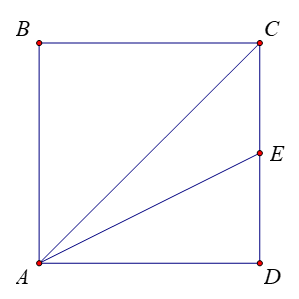
b) Do \(ABCD\) là hình vuông nên \(AC \bot BD\)\( \Rightarrow \overrightarrow {AC} \cdot \overrightarrow {BD} = 0\).
c) \(\overrightarrow {AE} \cdot \overrightarrow {CD} = \left( {\overrightarrow {AD} + \overrightarrow {DE} } \right) \cdot \overrightarrow {CD} = \overrightarrow {AD} \cdot \overrightarrow {CD} + \overrightarrow {DE} \cdot \overrightarrow {CD} \).
d) \(\overrightarrow {AD} \cdot \overrightarrow {AC} = \left| {\overrightarrow {AD} } \right| \cdot \left| {\overrightarrow {AC} } \right| \cdot \cos \left( {\overrightarrow {AD} ,\overrightarrow {AC} } \right) = 12 \cdot 12\sqrt 2 \cdot \cos 45^\circ = 144\).
Đáp án: a) Sai; b) Đúng; c) Đúng; d) Đúng.
\(\left( {\overrightarrow {AB} ,\overrightarrow {AC} } \right) = 60^\circ \).
\(\left( {\overrightarrow {AB} ,\overrightarrow {DA} } \right) = 30^\circ \).
\(\overrightarrow {DA} \cdot \overrightarrow {DC} = 3\).
\(\overrightarrow {OB} \cdot \overrightarrow {BA} = - 3\).
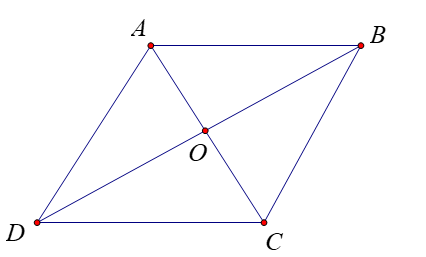
a) \(ABCD\) là hình thoi, \(\widehat B = 60^\circ \) nên \(\Delta ABC\) đều. Suy ra \(\widehat {BAC} = 60^\circ \).
Khi đó \(\left( {\overrightarrow {AB} ,\overrightarrow {AC} } \right) = \widehat {BAC} = 60^\circ \).
b) \(\left( {\overrightarrow {AB} ,\overrightarrow {DA} } \right) = \left( {\overrightarrow {DC} ,\overrightarrow {DA} } \right) = \widehat {ADC} = 60^\circ \).
c) \(\overrightarrow {DA} \cdot \overrightarrow {DC} = \left| {\overrightarrow {DA} } \right| \cdot \left| {\overrightarrow {DC} } \right| \cdot \cos \left( {\overrightarrow {DA} ,\overrightarrow {DC} } \right) = 2 \cdot 2 \cdot \cos 60^\circ = 2\).
d) Do \(ABCD\) là hình thoi nên \(AC \bot BD\).
Do \(\Delta ABC\) đều cạnh 2 nên \(BO = \frac{{2\sqrt 3 }}{2} = \sqrt 3 \).
\(\overrightarrow {OB} \cdot \overrightarrow {BA} = - \overrightarrow {BO} \cdot \overrightarrow {BA} = - \left| {\overrightarrow {BO} } \right| \cdot \left| {\overrightarrow {BA} } \right| \cdot \cos \left( {\overrightarrow {BO} ,\overrightarrow {BA} } \right) = - \sqrt 3 \cdot 2 \cdot \cos 30^\circ = - 3\).
Đáp án: a) Đúng; b) Sai; c) Sai; d) Đúng.
\(MN = BC\).
\(\left| {\overrightarrow {MP} } \right| = \left| {\overrightarrow {BC} } \right|\).
\[\overrightarrow {MN} \] và \[\overrightarrow {BC} \] ngược hướng.
\(\overrightarrow {MP} = \overrightarrow {BC} \).
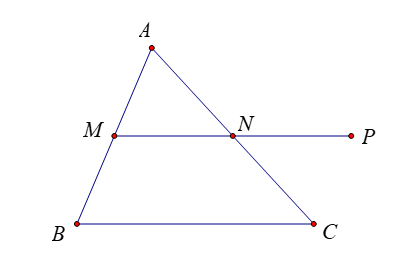
a) \(M\) và \(N\) lần lượt là trung điểm của \(AB\) và \(AC\) nên \(MN\) là đường trung bình của \(\Delta ABC\).
Suy ra \(MN//BC\) và \(MN = \frac{1}{2}BC\).
b) \(P\) đối xứng với điểm\(M\) qua \(N\) nên \(MP = 2MN = BC\).
Suy ra \(\left| {\overrightarrow {MP} } \right| = \left| {\overrightarrow {BC} } \right|\).
c) \[\overrightarrow {MN} \] và \[\overrightarrow {BC} \] cùng hướng.
d) Vì \[\overrightarrow {MN} \] và \[\overrightarrow {BC} \] cùng hướng và \(\left| {\overrightarrow {MP} } \right| = \left| {\overrightarrow {BC} } \right|\) nên \(\overrightarrow {MP} = \overrightarrow {BC} \).
Đáp án: a) Sai; b) Đúng; c) Sai; d) Đúng.
Điểm \(M\) nằm giữa hai điểm \(A\) và \(B\).
\(\overrightarrow {AM} = \frac{3}{5}\overrightarrow {AB} \).
\(\overrightarrow {CM} = - \frac{2}{5}\overrightarrow {AC} + \frac{3}{5}\overrightarrow {AB} \).
\(\overrightarrow {CA} \cdot \overrightarrow {CM} = \frac{{17}}{5}{a^2}\).
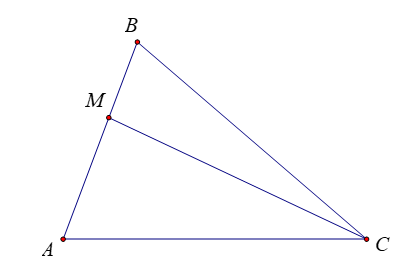
a) \(2\overrightarrow {MA} + 3\overrightarrow {MB} = \overrightarrow 0 \) nên \(\overrightarrow {MA} ,\overrightarrow {MB} \) là hai vectơ ngược hướng.
Suy ra điểm \(M\) nằm giữa hai điểm \(A\) và \(B\).
b) \(2\overrightarrow {MA} + 3\overrightarrow {MB} = \overrightarrow 0 \)\( \Leftrightarrow \overrightarrow {MA} = - \frac{3}{2}\overrightarrow {MB} \)\( \Leftrightarrow \overrightarrow {AM} = \frac{3}{2}\overrightarrow {MB} \)\( \Leftrightarrow \overrightarrow {AM} = \frac{3}{5}\overrightarrow {AB} \).
c) \(\overrightarrow {CM} = \overrightarrow {CA} + \overrightarrow {AM} = - \overrightarrow {AC} + \frac{3}{5}\overrightarrow {AB} \).
d) \(\overrightarrow {CA} \cdot \overrightarrow {CM} = \overrightarrow {CA} \left( { - \overrightarrow {AC} + \frac{3}{5}\overrightarrow {AB} } \right)\)\( = {\overrightarrow {AC} ^2} - \frac{3}{5}\overrightarrow {AC} \cdot \overrightarrow {AB} \)\( = {\overrightarrow {AC} ^2} - \frac{3}{5}\left| {\overrightarrow {AC} } \right| \cdot \left| {\overrightarrow {AB} } \right| \cdot \cos \left( {\overrightarrow {AC} ,\overrightarrow {AB} } \right)\)
\( = 4{a^2} - \frac{3}{5} \cdot 2a \cdot a \cdot \cos 60^\circ \)\( = 4{a^2} - \frac{3}{5}{a^2} = \frac{{17}}{5}{a^2}\).
Đáp án: a) Đúng; b) Đúng; c) Sai; d) Đúng.
\(\overrightarrow {AC} + \overrightarrow {CB} = \overrightarrow {AB} \).
Độ dài của vectơ \(\overrightarrow {BC} + \overrightarrow {CA} + \overrightarrow {AB} \) bằng 6.
Độ dài của vectơ \(\overrightarrow {BA} - \overrightarrow {BC} \) bằng 2.
Độ dài của vectơ \(\overrightarrow {BA} + \overrightarrow {BC} \) bằng \(\sqrt 3 \).
a) \(\overrightarrow {AC} + \overrightarrow {CB} = \overrightarrow {AB} \).
b) \(\overrightarrow {BC} + \overrightarrow {CA} + \overrightarrow {AB} \)\( \Leftrightarrow \overrightarrow {BA} + \overrightarrow {AB} = \overrightarrow 0 \). Suy ra \(\left| {\overrightarrow {BC} + \overrightarrow {CA} + \overrightarrow {AB} } \right| = 0\).
c) \(\overrightarrow {BA} - \overrightarrow {BC} = \overrightarrow {CA} \). Suy ra \[\left| {\overrightarrow {BA} - \overrightarrow {BC} } \right| = \left| {\overrightarrow {CA} } \right| = 2\].
d) \({\left( {\overrightarrow {BA} + \overrightarrow {BC} } \right)^2} = {\overrightarrow {BA} ^2} + 2\overrightarrow {BA} \cdot \overrightarrow {BC} + {\overrightarrow {BC} ^2}\)\( = {\overrightarrow {BA} ^2} + 2\left| {\overrightarrow {BA} } \right| \cdot \left| {\overrightarrow {BC} } \right| \cdot \cos \left( {\overrightarrow {BA} ,\overrightarrow {BC} } \right) + {\overrightarrow {BC} ^2}\)
\( = {2^2} + 2 \cdot 2 \cdot 2 \cdot \cos 60^\circ + {2^2} = 12\).
Suy ra \(\left| {\overrightarrow {BA} + \overrightarrow {BC} } \right| = 2\sqrt 3 \).
Đáp án: a) Đúng; b) Sai; c) Đúng; d) Sai.
\(\overrightarrow {CA} - \overrightarrow {CB} = \overrightarrow {AB} \).
\(\overrightarrow {AB} + \overrightarrow {AC} + \overrightarrow {AM} = 3\overrightarrow {AM} \).
\(\overrightarrow {BA} \cdot \overrightarrow {BC} = 9\).
Độ dài vectơ \(\overrightarrow u = 2\overrightarrow {AB} + \overrightarrow {AC} \) bằng \(2\sqrt {13} \).
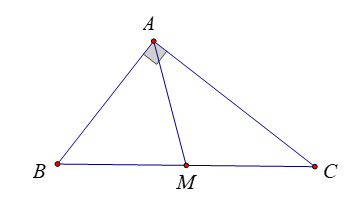
a) \(\overrightarrow {CA} - \overrightarrow {CB} = \overrightarrow {BA} \).
b) \(\overrightarrow {AB} + \overrightarrow {AC} + \overrightarrow {AM} = 2\overrightarrow {AM} + \overrightarrow {AM} = 3\overrightarrow {AM} \).
c) Xét \(\Delta ABC\) vuông tại \(A,\) có \(BC = \sqrt {A{B^2} + A{C^2}} = \sqrt {{3^2} + {4^2}} = 5\); \(\cos B = \frac{{AB}}{{BC}} = \frac{3}{5}\)
Khi đó \(\overrightarrow {BA} \cdot \overrightarrow {BC} = \left| {\overrightarrow {BA} } \right| \cdot \left| {\overrightarrow {BC} } \right| \cdot \cos \left( {\overrightarrow {BA} ,\overrightarrow {BC} } \right) = 3 \cdot 5 \cdot \frac{3}{5} = 9\).
d) Ta có \({\left( {2\overrightarrow {AB} + \overrightarrow {AC} } \right)^2} = 4{\overrightarrow {AB} ^2} + 4\overrightarrow {AB} \cdot \overrightarrow {AC} + {\overrightarrow {AC} ^2}\)\( = 4{\overrightarrow {AB} ^2} + {\overrightarrow {AC} ^2}\)\( = 4 \cdot {3^2} + {4^2} = 52\).
Suy ra \(\left| {\overrightarrow u } \right| = \sqrt {52} = 2\sqrt {13} \).
Đáp án: a) Sai; b) Đúng; c) Đúng; d) Đúng.
\(\left| {\overrightarrow {AB} } \right| = a\).
\(\overrightarrow {AB} = \overrightarrow {AC} \).
Có 3 vectơ khác \(\overrightarrow 0 \) có điểm đầu và điểm cuối là các đỉnh của \(\Delta ABC\).
\(\overrightarrow {OB} + \overrightarrow {OC} = 2\overrightarrow {MO} \).
a) \(\left| {\overrightarrow {AB} } \right| = a\).
b) \(\overrightarrow {AB} \) và \(\overrightarrow {AC} \) không bằng nhau vì chúng không cùng hướng.
c) Có 6 vectơ khác \(\overrightarrow 0 \) có điểm đầu và điểm cuối là các đỉnh của \(\Delta ABC\) là \(\overrightarrow {AB} ,\overrightarrow {BA} ,\overrightarrow {AC} ,\overrightarrow {CA} ,\overrightarrow {BC} ,\overrightarrow {CB} \).
d) Vì \(M\) là trung điểm của \(BC\) nên \(\overrightarrow {OB} + \overrightarrow {OC} = 2\overrightarrow {OM} \).
Đáp án: a) Đúng; b) Sai; c) Sai; d) Sai.
Hai vectơ \(\overrightarrow {FI} \) và \(\overrightarrow {ID} \) ngược hướng.
\(\overrightarrow {DC} + \overrightarrow {DE} = \overrightarrow {FD} \).
\(\overrightarrow {FG} + \overrightarrow {DE} = \overrightarrow {HE} \).
\(\left| {\overrightarrow {FG} + \overrightarrow {HE} } \right| = \sqrt {17} \).
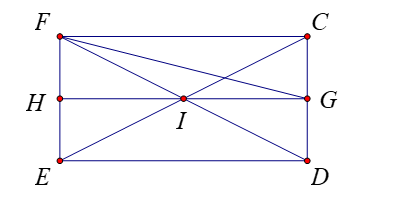
a) Hai vectơ \(\overrightarrow {FI} \) và \(\overrightarrow {ID} \) cùng hướng.
b) Theo quy tắc hình bình hành \(\overrightarrow {DC} + \overrightarrow {DE} = \overrightarrow {DF} \).
c) Vì \(FCDE\) là hình chữ nhật nên \(\overrightarrow {DE} = \overrightarrow {CF} \).
Khi đó \(\overrightarrow {FG} + \overrightarrow {DE} = \overrightarrow {FG} + \overrightarrow {CF} = \overrightarrow {FG} - \overrightarrow {FC} = \overrightarrow {CG} = \overrightarrow {HE} \).
d) Có \(FCDE\) là hình chữ nhật, \(G,H\) là trung điểm của \(CD,EF\), \(I\) là tâm của hình chữ nhật nên \(I\) là trung điểm của \(HG\).
Có \(\overrightarrow {FG} + \overrightarrow {HE} = \overrightarrow {FG} + \overrightarrow {FH} = 2\overrightarrow {FI} \).
Suy ra \(\left| {\overrightarrow {FG} + \overrightarrow {HE} } \right| = 2\left| {\overrightarrow {FI} } \right| = FD = \sqrt {F{C^2} + C{D^2}} = \sqrt {{4^2} + {1^2}} = \sqrt {17} \).
Đáp án: a) Sai; b) Sai; c) Đúng; d) Đúng.
\(\overrightarrow {OB} + \overrightarrow {CD} + \overrightarrow {BC} + \overrightarrow {DO} = 2\overrightarrow {OC} \).
\(\left( {\overrightarrow {GB} ,\overrightarrow {GD} } \right) = 135^\circ \).
\(\overrightarrow {OB} \cdot \overrightarrow {CO} = - 36{a^2}\).
\(\overrightarrow {OB} \cdot \overrightarrow {CD} = 24{a^2}\).
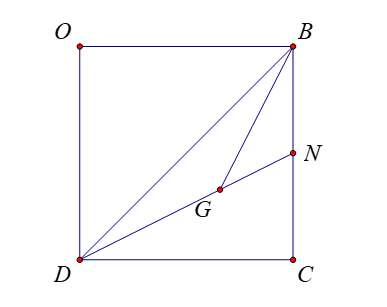
a) Do \(OBCD\) là hình vuông nên \(\overrightarrow {OB} = - \overrightarrow {CD} ;\overrightarrow {BC} = - \overrightarrow {DO} \).
Do đó \(\overrightarrow {OB} + \overrightarrow {CD} + \overrightarrow {BC} + \overrightarrow {DO} = \overrightarrow 0 \).
b) \(\left( {\overrightarrow {GB} ,\overrightarrow {GD} } \right) = \widehat {BGD} = 180^\circ - 2\widehat {BDG}\) (do \(\Delta BGD\) cân tại \(G\)).
Lại có \(\widehat {BDG} = 45^\circ - \widehat {NDC}\).
Xét \(\Delta DCN\) vuông tại \(C\), có \(\tan \widehat {NDC} = \frac{{NC}}{{CD}} = \frac{{3a}}{{6a}} = \frac{1}{2} \Rightarrow \widehat {NDC} \approx 26,5^\circ \).
Do đó \(\widehat {BDG} = 45^\circ - 26,5^\circ = 18,5^\circ \).
Vậy \(\left( {\overrightarrow {GB} ,\overrightarrow {GD} } \right) = \widehat {BGD} = 180^\circ - 2 \cdot 18,5^\circ = 143^\circ \).
c) \(\overrightarrow {OB} \cdot \overrightarrow {CO} = - \overrightarrow {OB} \cdot \overrightarrow {OC} = - \left| {\overrightarrow {OB} } \right| \cdot \left| {\overrightarrow {OC} } \right| \cdot \cos \left( {\overrightarrow {OB} ,\overrightarrow {OC} } \right)\)\( = - 6a \cdot 6a\sqrt 2 \cdot \cos 45^\circ = - 36{a^2}\).
d) \(\overrightarrow {OB} \cdot \overrightarrow {CD} = \left| {\overrightarrow {OB} } \right| \cdot \left| {\overrightarrow {CD} } \right| \cdot \cos \left( {\overrightarrow {OB} ,\overrightarrow {CD} } \right)\)\( = 6a \cdot 6a \cdot \cos 180^\circ = - 36{a^2}\).
Đáp án: a) Sai; b) Sai; c) Đúng; d) Sai.
\(\overrightarrow {AB} \cdot \overrightarrow {CA} = {a^2}\).
\(\overrightarrow {AM} \cdot \overrightarrow {AC} = \frac{{{a^2}}}{3}\).
\(\overrightarrow {AD} \cdot \overrightarrow {BD} + \overrightarrow {OM} \cdot \overrightarrow {AC} = \frac{{{a^2}}}{2}\).
\(\left( {\overrightarrow {AB} + \overrightarrow {AD} } \right)\left( {\overrightarrow {BD} + \overrightarrow {BC} } \right) = {a^2}\).
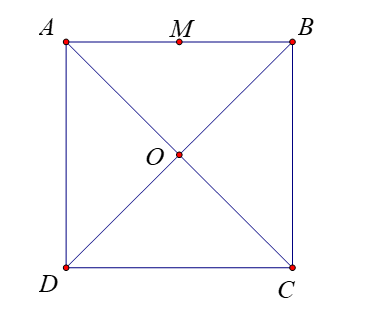
a) \(\overrightarrow {AB} \cdot \overrightarrow {CA} = - \overrightarrow {AB} \cdot \overrightarrow {AC} = - \left| {\overrightarrow {AB} } \right| \cdot \left| {\overrightarrow {AC} } \right| \cdot \cos \left( {\overrightarrow {AB} ,\overrightarrow {AC} } \right)\)\( = - a \cdot a\sqrt 2 \cdot \cos 45^\circ = - {a^2}\).
b) \[\overrightarrow {AM} \cdot \overrightarrow {AC} = \left| {\overrightarrow {AM} } \right| \cdot \left| {\overrightarrow {AC} } \right| \cdot \cos \left( {\overrightarrow {AM} ,\overrightarrow {AC} } \right)\]\[ = \frac{a}{2} \cdot a\sqrt 2 \cdot \cos 45^\circ = \frac{{{a^2}}}{2}\].
c) Do \(ABCD\) là hình vuông nên \(\overrightarrow {AD} = \overrightarrow {BC} \).
Vì \(O,M\) lần lượt là trung điểm của \(BD,AB\) nên \(OM = \frac{1}{2}AD\) và \(\overrightarrow {OM} ,\overrightarrow {AD} \) ngược hướng nên \(\overrightarrow {OM} = - \frac{1}{2}\overrightarrow {AD} \).
Khi đó \(\overrightarrow {AD} \cdot \overrightarrow {BD} + \overrightarrow {OM} \cdot \overrightarrow {AC} = \overrightarrow {BC} \cdot \overrightarrow {BD} - \frac{1}{2}\overrightarrow {AD} \cdot \overrightarrow {AC} \)
\[ = \left| {\overrightarrow {BC} } \right| \cdot \left| {\overrightarrow {BD} } \right| \cdot \cos \left( {\overrightarrow {BC} ,\overrightarrow {BD} } \right) - \frac{1}{2}\left| {\overrightarrow {AD} } \right| \cdot \left| {\overrightarrow {AC} } \right| \cdot \cos \left( {\overrightarrow {AD} ,\overrightarrow {AC} } \right)\]
\[ = a \cdot a\sqrt 2 \cdot \cos 45^\circ - \frac{1}{2}a \cdot a\sqrt 2 \cdot \cos 45^\circ \]\[ = \frac{1}{2}a \cdot a\sqrt 2 \cdot \cos 45^\circ = \frac{{{a^2}}}{2}\].
d) Theo quy tắc hình bình hành có \(\overrightarrow {AB} + \overrightarrow {AD} = \overrightarrow {AC} \).
Khi đó \(\left( {\overrightarrow {AB} + \overrightarrow {AD} } \right)\left( {\overrightarrow {BD} + \overrightarrow {BC} } \right) = \overrightarrow {AC} \left( {\overrightarrow {BD} + \overrightarrow {BC} } \right)\)\( = \overrightarrow {AC} \cdot \overrightarrow {BD} + \overrightarrow {AC} \cdot \overrightarrow {BC} \)\( = \overrightarrow {AC} \cdot \overrightarrow {BC} \)
\( = \overrightarrow {AC} \cdot \overrightarrow {AD} \)\( = \left| {\overrightarrow {AC} } \right| \cdot \left| {\overrightarrow {AD} } \right| \cdot \cos \left( {\overrightarrow {AC} ,\overrightarrow {AD} } \right)\)\( = a\sqrt 2 \cdot a \cdot \cos 45^\circ = {a^2}\).
Đáp án: a) Sai; b) Sai; c) Đúng; d) Đúng.
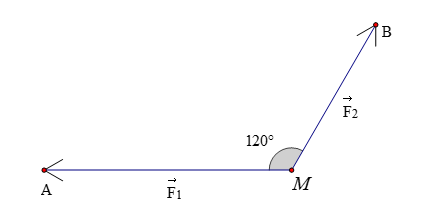
Có \({\left( {\overrightarrow {{F_1}} + \overrightarrow {{F_2}} } \right)^2} = {\overrightarrow {{F_1}} ^2} + 2\overrightarrow {{F_1}} \cdot \overrightarrow {{F_2}} + {\overrightarrow {{F_2}} ^2}\)\( = {\overrightarrow {{F_1}} ^2} + 2\left| {\overrightarrow {{F_1}} } \right| \cdot \left| {\overrightarrow {{F_2}} } \right| \cdot \cos \left( {\overrightarrow {{F_1}} ,\overrightarrow {{F_2}} } \right) + {\overrightarrow {{F_2}} ^2}\)
\( = {150^2} + 2 \cdot 150 \cdot 100 \cdot \cos 120^\circ + {100^2}\)\( = 17500\).
Khi đó \(\left| {\overrightarrow F } \right| = \sqrt {17500} \approx 132\) (N).
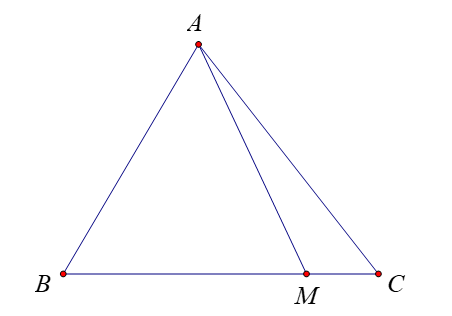
Có \(\overrightarrow {MB} \) và \(\overrightarrow {MC} \) ngược hướng và \(MB = 4MC\) nên \(\overrightarrow {MB} = - 4\overrightarrow {MC} \). Suy ra \(\overrightarrow {BM} = \frac{4}{5}\overrightarrow {BC} \).
Khi đó \(\overrightarrow {AM} = \overrightarrow {AB} + \overrightarrow {BM} = \overrightarrow {AB} + \frac{4}{5}\overrightarrow {BC} = \overrightarrow {AB} + \frac{4}{5}\left( {\overrightarrow {AC} - \overrightarrow {AB} } \right)\)\( = \frac{1}{5}\overrightarrow {AB} + \frac{4}{5}\overrightarrow {AC} \).
Suy ra \(m = \frac{1}{5};n = \frac{4}{5}\). Vậy \(6m + n = 2\).
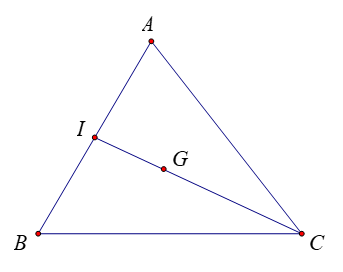
Vì \(G\) là trọng tâm \(\Delta ABC\) nên \(\overrightarrow {GA} + \overrightarrow {GB} + \overrightarrow {GC} = \overrightarrow 0 \).
Ta có \(\overrightarrow {CA} - \overrightarrow {BG} \)\( = \overrightarrow {GA} - \overrightarrow {GC} + \overrightarrow {GB} \)\( = \overrightarrow {GA} + \overrightarrow {GC} + \overrightarrow {GB} - 2\overrightarrow {GC} \)\( = - 2\overrightarrow {GC} \).
Gọi \(I\) là trung điểm của \(AB\). Khi đó \(CG = \frac{2}{3}CI = \frac{2}{3} \cdot \frac{{5\sqrt 3 \cdot \sqrt 3 }}{2} = 5\).
Vậy \(\left| {\overrightarrow {CA} - \overrightarrow {BG} } \right| = \left| { - 2\overrightarrow {GC} } \right| = 2 \cdot 5 = 10\).
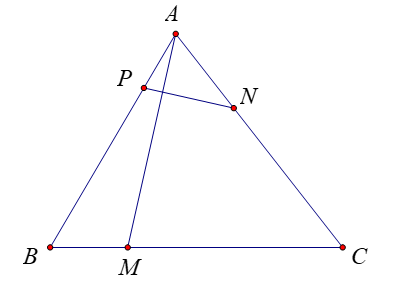
\(\overrightarrow {PN} = \overrightarrow {AN} - \overrightarrow {AP} = \frac{1}{3}\overrightarrow {AC} - \frac{4}{{15}}\overrightarrow {AB} \).
Để \(AM \bot PN\) thì \(\overrightarrow {AM} \cdot \overrightarrow {PN} = 0\)\( \Leftrightarrow \left( {k\overrightarrow {AC} + \left( {1 - k} \right)\overrightarrow {AB} } \right)\left( {\frac{1}{3}\overrightarrow {AC} - \frac{4}{{15}}\overrightarrow {AB} } \right) = 0\)
\( \Leftrightarrow \frac{k}{3}{\overrightarrow {AC} ^2} - \frac{{4k}}{{15}}\overrightarrow {AC} \cdot \overrightarrow {AB} + \frac{{1 - k}}{3} \cdot \overrightarrow {AB} \cdot \overrightarrow {AC} - \frac{{4\left( {1 - k} \right)}}{{15}}{\overrightarrow {AB} ^2} = 0\)
\( \Leftrightarrow \left[ {\frac{k}{3} - \frac{{4\left( {1 - k} \right)}}{{15}}} \right]{\overrightarrow {AC} ^2} + \left( {\frac{{1 - k}}{3} - \frac{{4k}}{{15}}} \right)\left| {\overrightarrow {AC} } \right| \cdot \left| {\overrightarrow {AB} } \right| \cdot \cos 60^\circ = 0\)\( \Leftrightarrow \left[ {\frac{k}{3} - \frac{{4\left( {1 - k} \right)}}{{15}}} \right]{\overrightarrow {AC} ^2} + \left( {\frac{{1 - k}}{6} - \frac{{4k}}{{30}}} \right){\left| {\overrightarrow {AC} } \right|^2} = 0\)
\( \Leftrightarrow \left( {\frac{k}{3} - \frac{{4\left( {1 - k} \right)}}{{15}} + \frac{{1 - k}}{6} - \frac{{4k}}{{30}}} \right){\left| {\overrightarrow {AC} } \right|^2} = 0\)
\( \Leftrightarrow \frac{k}{3} - \frac{{4\left( {1 - k} \right)}}{{15}} + \frac{{1 - k}}{6} - \frac{{4k}}{{30}} = 0\)\( \Leftrightarrow \frac{{3k}}{{10}} = \frac{1}{{10}}\)\( \Leftrightarrow k = \frac{1}{3}\).
Suy ra \(a = 1;b = 3\). Do đó \(2a + b = 5\).
Công sinh bởi lực \(\overrightarrow F \) được tính bằng công thức
\(A = \overrightarrow F \cdot \overrightarrow d = \left| {\overrightarrow F } \right| \cdot \left| {\overrightarrow d } \right| \cdot \cos \left( {\overrightarrow F ,\overrightarrow d } \right) = 90 \cdot 100 \cdot \cos 60^\circ = 4500\) (J).
Vậy công sinh bởi lực \(\overrightarrow F \) có độ lớn bằng 4500 J.
Vì vật đứng yên nên \(\overrightarrow {{F_1}} + \overrightarrow {{F_2}} + \overrightarrow {{F_3}} = \overrightarrow 0 \)\( \Leftrightarrow \overrightarrow {{F_3}} = - \left( {\overrightarrow {{F_1}} + \overrightarrow {{F_2}} } \right)\).
Ta có \({\left( {\overrightarrow {{F_1}} + \overrightarrow {{F_2}} } \right)^2} = {\overrightarrow {{F_1}} ^2} + 2\overrightarrow {{F_1}} \cdot \overrightarrow {{F_2}} + {\overrightarrow {{F_2}} ^2}\)\( = {\overrightarrow {{F_1}} ^2} + 2\left| {\overrightarrow {{F_1}} } \right| \cdot \left| {\overrightarrow {{F_2}} } \right| \cdot \cos \left( {\overrightarrow {{F_1}} ,\overrightarrow {{F_2}} } \right) + {\overrightarrow {{F_2}} ^2}\)
\( = {70^2} + 2 \cdot 70 \cdot 70 \cdot \cos 60^\circ + {70^2} = 14700\).
Suy ra \(\left| {\overrightarrow {{F_3}} } \right| = \left| {\overrightarrow {{F_1}} + \overrightarrow {{F_2}} } \right| = \sqrt {14700} = 70\sqrt 3 \).
Do đó \(a = 70;b = 3\). Vậy \(a + b = 73\).
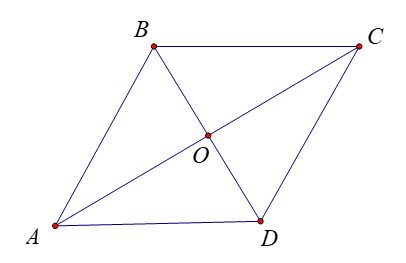
Do \(ABCD\) là hình thoi nên \(AB = AD\) mà \(\widehat A = 60^\circ \) nên \(\Delta ABD\) đều cạnh 1.
Suy ra \(AO = \frac{{\sqrt 3 }}{2} \approx 0,9\).
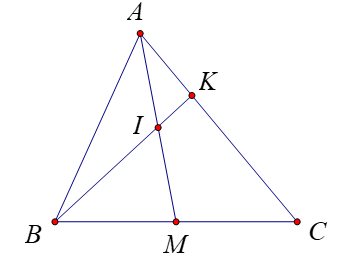
Vì \(I\) là trung điểm của \(AM\) nên \(\overrightarrow {BI} = \frac{1}{2}\overrightarrow {BA} + \frac{1}{2}\overrightarrow {BM} \)\( = \frac{1}{2}\left( {\overrightarrow {BK} + \overrightarrow {KA} } \right) + \frac{1}{2}\left( {\overrightarrow {BK} + \overrightarrow {KM} } \right)\)
\[ = \overrightarrow {BK} + \frac{1}{2}\overrightarrow {KA} + \frac{1}{2}\overrightarrow {KM} \]\[ = \overrightarrow {BK} + \frac{1}{2}\overrightarrow {KA} + \frac{1}{2}\left( {\frac{1}{2}\overrightarrow {KB} + \frac{1}{2}\overrightarrow {KC} } \right)\]\[ = \overrightarrow {BK} - \frac{1}{4}\overrightarrow {BK} + \frac{1}{2}\overrightarrow {KA} + \frac{1}{4}\overrightarrow {KC} \]
\[ = \frac{3}{4}\overrightarrow {BK} - \frac{1}{6}\overrightarrow {AC} + \frac{1}{6}\overrightarrow {AC} = 0,75\overrightarrow {BK} \].
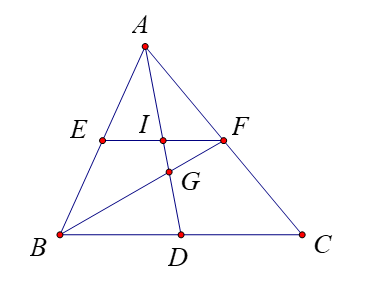
Có \(E,F\) là trung điểm của \(AB,AC\) nên \(EF\) là đường trung bình của \(\Delta ABC\).
Suy ra \(EF//BC\) mà \(EF\) cắt \(AD\) tại \(I\) nên \(I\) là trung điểm của \(AD\).
Khi đó \(\overrightarrow {AI} = \frac{1}{2}\overrightarrow {AD} = \frac{1}{2}\left( {\frac{1}{2}\overrightarrow {AB} + \frac{1}{2}\overrightarrow {AC} } \right)\)\( = \frac{1}{2}\left( {\frac{1}{2} \cdot 2\overrightarrow {AE} + \frac{1}{2} \cdot 2\overrightarrow {AF} } \right) = \frac{1}{2}\overrightarrow {AE} + \frac{1}{2}\overrightarrow {AF} \)\( = \frac{1}{2}\overrightarrow u + \frac{1}{2}\overrightarrow v \).
Suy ra \(a = \frac{1}{2};b = \frac{1}{2}\).
Vậy \(S = a + b = 1\).
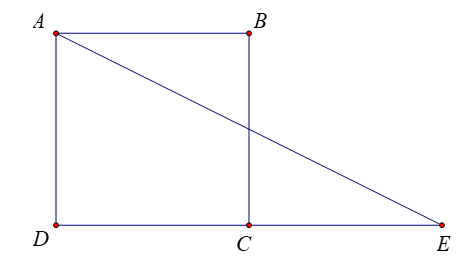
Ta có \(\overrightarrow {AE} \cdot \overrightarrow {CD} \)\( = \left( {\overrightarrow {AD} + \overrightarrow {DE} } \right) \cdot \overrightarrow {CD} \)\( = \overrightarrow {AD} \cdot \overrightarrow {CD} + \overrightarrow {DE} \cdot \overrightarrow {CD} \)\( = \overrightarrow {DE} \cdot \overrightarrow {CD} \)\[ = \left| {\overrightarrow {DE} } \right| \cdot \left| {\overrightarrow {CD} } \right| \cdot \cos \left( {\overrightarrow {DE} ,\overrightarrow {CD} } \right)\]
\[ = 6 \cdot 3 \cdot \cos 180^\circ = - 18\].
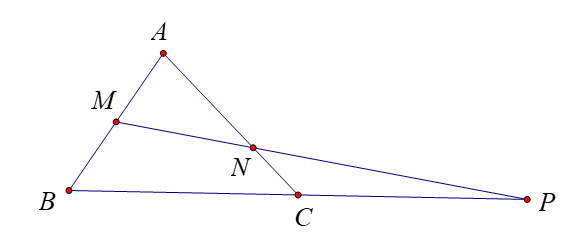
a) Có \(\overrightarrow {AB} \cdot \overrightarrow {AC} = \left| {\overrightarrow {AB} } \right| \cdot \left| {\overrightarrow {AC} } \right| \cdot \cos \left( {\overrightarrow {AB} ,\overrightarrow {AC} } \right) = 2 \cdot 3 \cdot \cos 60^\circ = 3\).
\(\overrightarrow {AB} \cdot \overrightarrow {BC} = \overrightarrow {AB} \cdot \left( {\overrightarrow {AC} - \overrightarrow {AB} } \right) = \overrightarrow {AB} \cdot \overrightarrow {AC} - {\overrightarrow {AB} ^2} = 3 - {2^2} = - 1\).
b) Có \(\overrightarrow {MN} = \overrightarrow {MA} + \overrightarrow {AN} = - \frac{1}{2}\overrightarrow {AB} + \frac{2}{3}\overrightarrow {AC} \).
Có \(\overrightarrow {MP} = \overrightarrow {MB} + \overrightarrow {BP} = \frac{1}{2}\overrightarrow {AB} + 2\overrightarrow {BC} = \frac{1}{2}\overrightarrow {AB} + 2\left( {\overrightarrow {AC} - \overrightarrow {AB} } \right) = - \frac{3}{2}\overrightarrow {AB} + 2\overrightarrow {AC} \).
Do đó \(\overrightarrow {MN} = \frac{1}{3}\overrightarrow {MP} \). Suy ra \(M,N,P\) thẳng hàng.
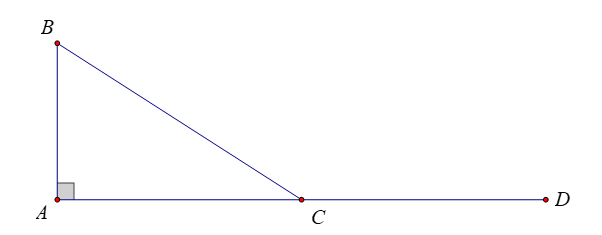
a) Vì \(\Delta ABC\) vuông tại \(A\), ta có:
\(BC = \sqrt {A{B^2} + A{C^2}} = \sqrt {{1^2} + {{\left( {\sqrt 3 } \right)}^2}} = 2\).
\(\cos \left( {\overrightarrow {BA} ,\overrightarrow {BC} } \right) = \cos \widehat {ABC} = \frac{{AB}}{{BC}} = \frac{1}{2} \Rightarrow \widehat {ABC} = 60^\circ \Rightarrow \widehat {ACB} = 30^\circ \).
\(\cos \left( {\overrightarrow {AC} ,\overrightarrow {CB} } \right) = \cos \left( {\overrightarrow {CD} ,\overrightarrow {CB} } \right) = \cos \widehat {BCD} = \cos 150^\circ = - \frac{{\sqrt 3 }}{2}\).
b) \(\overrightarrow {BA} \cdot \overrightarrow {BC} \)\( = \left| {\overrightarrow {BA} } \right| \cdot \left| {\overrightarrow {BC} } \right| \cdot \cos \left( {\overrightarrow {BA} ,\overrightarrow {BC} } \right) = 1 \cdot 2 \cdot \frac{1}{2} = 1\).
\(\overrightarrow {AC} \cdot \overrightarrow {CB} = \left| {\overrightarrow {AC} } \right| \cdot \left| {\overrightarrow {CB} } \right| \cdot \cos \left( {\overrightarrow {AC} ,\overrightarrow {CB} } \right) = \sqrt 3 \cdot 2 \cdot \left( { - \frac{{\sqrt 3 }}{2}} \right) = - 3\).
Cho tam giác \(ABC\), \(M\) là trung điểm của cạnh \(BC\), điểm \(N\) nằm trêm cạnh \(AC\) sao cho \(NA = 2NC\), \(D\) là trung điểm của \(AN\).
a) Chứng minh \(\overrightarrow {AC} + 3\overrightarrow {DA} = \overrightarrow 0 \).
b) Phân tích vectơ \(\overrightarrow {MN} \) theo hai vectơ \(\overrightarrow {AB} \) và \(\overrightarrow {AC} \).
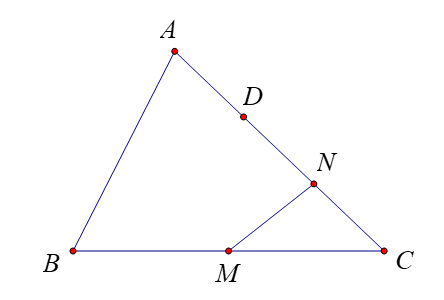
a) Ta có \(\overrightarrow {DA} \) và \(\overrightarrow {AC} \) là hai vectơ ngược hướng nhau và \(AC = 3DA\) nên \(\overrightarrow {AC} = - 3\overrightarrow {DA} \)\( \Leftrightarrow \overrightarrow {AC} + 3\overrightarrow {DA} = \overrightarrow 0 \).
b) Ta có \(\overrightarrow {MN} = \overrightarrow {MC} + \overrightarrow {CN} = \frac{1}{2}\overrightarrow {BC} + \frac{1}{3}\overrightarrow {CA} \)\( = \frac{1}{2}\left( {\overrightarrow {AC} - \overrightarrow {AB} } \right) - \frac{1}{3}\overrightarrow {AC} \)\( = \frac{1}{2}\overrightarrow {AC} - \frac{1}{2}\overrightarrow {AB} - \frac{1}{3}\overrightarrow {AC} = \frac{1}{6}\overrightarrow {AC} - \frac{1}{2}\overrightarrow {AB} \).
Một chất điểm \(A\) chịu tác dụng của ba lực \(\overrightarrow {{F_1}} ,\overrightarrow {{F_2}} ,\overrightarrow {{F_3}} \) như hình vẽ. Biết chất điểm \(A\) đang ở trạng thái cân bằng (như hình vẽ); lực \(\overrightarrow {{F_1}} \) có độ lớn 12 N. Độ lớn của các lực \(\overrightarrow {{F_3}} \) bằng bao nhiêu Niutơn?
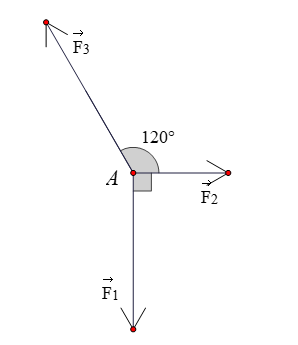
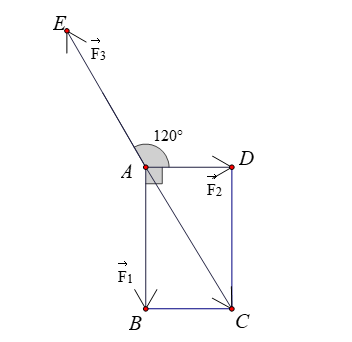
Đặt \(\overrightarrow {{F_1}} = \overrightarrow {AB} ,\overrightarrow {{F_2}} = \overrightarrow {AD} ,\overrightarrow {{F_3}} = \overrightarrow {AE} \). Vẽ hình chữ nhật \(ABCD\).
Vật ở trạng thái cân bằng nên \(\overrightarrow {{F_1}} + \overrightarrow {{F_2}} + \overrightarrow {{F_3}} = \overrightarrow 0 \)\( \Rightarrow \overrightarrow {{F_3}} = - \left( {\overrightarrow {{F_1}} + \overrightarrow {{F_2}} } \right) = - \left( {\overrightarrow {AB} + \overrightarrow {AD} } \right) = - \overrightarrow {AC} \).
Ta có \(AB = 12,\widehat {CAD} = 180^\circ - 120^\circ = 60^\circ \Rightarrow \widehat {BAC} = 30^\circ \).
Tam giác \(ABC\) vuông tại \(B\), ta có \(\cos \widehat {BAC} = \frac{{AB}}{{AC}} \Rightarrow AC = \frac{{AB}}{{\cos \widehat {BAC}}} = \frac{{12}}{{\cos 30^\circ }} = 8\sqrt 3 \).
Vậy \(\left| {{F_3}} \right| = \left| {\overrightarrow {AC} } \right| = AC = 8\sqrt 3 \) (N).
Cho hình vuông \(ABCD\) có độ dài cạnh \(AC = a\sqrt 2 \). Gọi \(O\) là giao điểm của \(AC\) và \(BD\). Gọi \(M\) là trung điểm cạnh \(BC\). Chứng minh rằng \(\overrightarrow {AB} \cdot \overrightarrow {OC} = 2\left( {O{C^2} - O{M^2}} \right)\).
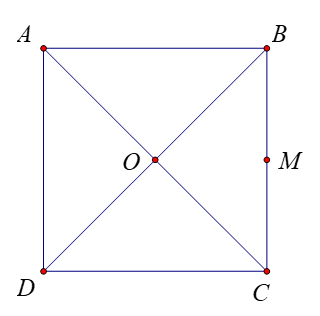
Hình vuông \(ABCD\) có độ dài cạnh \(AC = a\sqrt 2 \). Suy ra cạnh hình vuông bằng \(a\), \(AO = OC = \frac{{a\sqrt 2 }}{2}\)
Ta có \(\overrightarrow {AB} \cdot \overrightarrow {OC} = \overrightarrow {AB} \cdot \overrightarrow {AO} = \left| {\overrightarrow {AB} } \right| \cdot \left| {\overrightarrow {AO} } \right| \cdot \cos \left( {\overrightarrow {AB} ,\overrightarrow {AO} } \right)\)\( = a \cdot \frac{{a\sqrt 2 }}{2} \cdot \cos 45^\circ \)\( = a \cdot \frac{{a\sqrt 2 }}{2} \cdot \frac{{\sqrt 2 }}{2} = \frac{{{a^2}}}{2}\) (1).
Vì \(O,M\) là trung điểm của \(BD,BC\) nên \(OM\) là đường trung bình của \(\Delta BCD\).
Suy ra \(OM = \frac{{DC}}{2} = \frac{a}{2}\).
Ta có \(2\left( {O{C^2} - O{M^2}} \right) = 2\left[ {{{\left( {\frac{{a\sqrt 2 }}{2}} \right)}^2} - {{\left( {\frac{a}{2}} \right)}^2}} \right] = \frac{{{a^2}}}{2}\) (2).
Từ (1) và (2), suy ra \(\overrightarrow {AB} \cdot \overrightarrow {OC} = 2\left( {O{C^2} - O{M^2}} \right)\).
Bạn có thích hoạt động này không?
Hãy lưu hoặc chia sẻ nội dung này đến mọi người.
Gợi ý cho bạn

Ý tưởng của bạn, bài học của bạn
Tự thiết kế đề thi, bài giảng hoặc flashcard theo cách riêng.