Trắc nghiệm Tiếng Anh 8 Global Success Unit 12 Writing (có đáp án)
20 câu hỏi
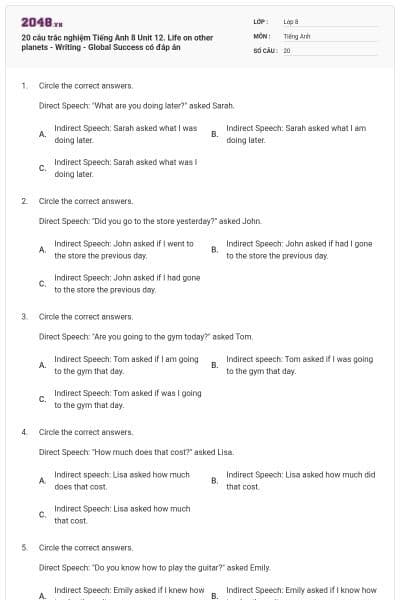
Circle the correct answers.
Direct Speech: "What are you doing later?" asked Sarah.
Indirect Speech: Sarah asked what I was doing later.
Indirect Speech: Sarah asked what I am doing later.
Indirect Speech: Sarah asked what was I doing later.
Đáp án đúng: A
Giải thích: "Are you doing" (hiện tại tiếp diễn) chuyển sang "was doing" (quá khứ tiếp diễn) khi tường thuật. Không đảo trợ động từ như trong câu hỏi trực tiếp.
Dịch nghĩa:
Câu trực tiếp: Sarah hỏi: "Bạn sẽ làm gì sau đó?"
Câu gián tiếp: Sarah hỏi tôi rằng tôi sẽ làm gì sau đó.
Circle the correct answers.
Direct Speech: "Did you go to the store yesterday?" asked John.
Indirect Speech: John asked if I went to the store the previous day.
Indirect Speech: John asked if had I gone to the store the previous day.
Indirect Speech: John asked if I had gone to the store the previous day.
Đáp án đúng: C
Giải thích: "Did you go" (quá khứ đơn) → chuyển thành "had gone" (quá khứ hoàn thành).
"Yesterday" → chuyển thành "the previous day". Đây là câu hỏi Yes/No → dùng "if".
Dịch nghĩa:
Câu trực tiếp: John hỏi: "Hôm qua bạn có đi đến cửa hàng không?"
Câu gián tiếp: John hỏi tôi liệu tôi đã đi đến cửa hàng vào ngày hôm trước chưa.
Circle the correct answers.
Direct Speech: "Are you going to the gym today?" asked Tom.
Indirect Speech: Tom asked if I am going to the gym that day.
Indirect speech: Tom asked if I was going to the gym that day.
Indirect Speech: Tom asked if was I going to the gym that day.
Đáp án đúng: B
Giải thích: "Are you going" (hiện tại tiếp diễn) → chuyển thành "was going" (quá khứ tiếp diễn).
"Today" → đổi thành "that day". Câu hỏi Yes/No → dùng "if".
Dịch nghĩa:
Câu trực tiếp: Tom hỏi: "Hôm nay bạn có đi đến phòng tập không?"
Câu gián tiếp: Tom hỏi tôi liệu tôi có đang đi đến phòng tập vào ngày hôm đó không.
Circle the correct answers.
Direct Speech: "How much does that cost?" asked Lisa.
Indirect speech: Lisa asked how much does that cost.
Indirect Speech: Lisa asked how much did that cost.
Indirect Speech: Lisa asked how much that cost.
Đáp án đúng: C
Giải thích: "Does that cost" (hiện tại đơn) → chuyển thành "that cost" (quá khứ đơn)
Dịch nghĩa:
Câu trực tiếp: Lisa hỏi: "Cái đó giá bao nhiêu?"
Câu gián tiếp: Lisa hỏi cái đó giá bao nhiêu.
Circle the correct answers.
Direct Speech: "Do you know how to play the guitar?" asked Emily.
Indirect Speech: Emily asked if I knew how to play the guitar.
Indirect Speech: Emily asked if I know how to play the guitar.
Indirect Speech: Emily asked ifI had knew how to play the guitar.
Đáp án đúng: A
Giải thích: "Do you know" (hiện tại đơn) → chuyển thành "knew" (quá khứ đơn). Câu Yes/No → dùng "if".
Dịch nghĩa:
Câu trực tiếp: Emily hỏi: "Bạn có biết chơi guitar không?"
Câu gián tiếp: Emily hỏi tôi liệu tôi có biết chơi guitar hay không.
Circle the correct answers.
Direct Speech: Which university did you attend?" asked Mark.
Indirect Speech: Mark asked which university I had attended.
Indirect Speech: Mark asked which university I attended.
Indirect Speech: Mark asked which university I did attended.
Đáp án đúng: A
Giải thích: "Did you attend" (quá khứ đơn) → chuyển thành "had attended" (quá khứ hoàn thành).
Dịch nghĩa:
Câu trực tiếp: Mark hỏi: "Bạn học đại học nào?"
Câu gián tiếp: Mark hỏi tôi đã học đại học nào.
Circle the correct answers.
Direct Speech: "Have you met the new employee yet?" asked the boss.
Indirect Speech: The boss asked if I had met the new employee yet.
Indirect Speech: The boss asked if I had meet the new employee yet
Indirect Speech: The boss asked if had Imct the new employee yet.
Đáp án đúng: A
Giải thích: "Have you met" (hiện tại hoàn thành) → chuyển thành "had met" (quá khứ hoàn thành). Câu hỏi Yes/No → dùng "if".
Dịch nghĩa:
Câu trực tiếp: Sếp hỏi: "Bạn đã gặp nhân viên mới chưa?"
Câu gián tiếp: Sếp hỏi tôi liệu tôi đã gặp nhân viên mới chưa.
Circle the correct answers.
Direct Speech: "What's your favourite book?" asked Jane.
Indirect Speech: Jane asked what my favourite book is.
Indirect Speech: Jane asked what your favourite book was.
Indirect Speech: Jane asked what my favourite book was.
Đáp án đúng: C
Giải thích: "What is" → chuyển thành "what...was". Đại từ "your" → đổi thành "my".
Dịch nghĩa:
Câu trực tiếp: Jane hỏi: "Cuốn sách yêu thích của bạn là gì?"
Câu gián tiếp: Jane hỏi cuốn sách yêu thích của tôi là gì.
Circle the correct answers.
Direct Speech: "Where did you grow up?" asked Peter.
Indirect Speech: Peter asked where I grown up.
Indirect Speech: Peter asked where I had grown up.
Indirect Speech: Peter asked where you had grown up.
Đáp án đúng: B
Giải thích: "Did you grow up" (quá khứ đơn) → chuyển thành "had grown up" (quá khứ hoàn thành).
Dịch nghĩa:
Câu trực tiếp: Peter hỏi: "Bạn lớn lên ở đâu?"
Câu gián tiếp: Peter hỏi tôi đã lớn lên ở đâu.
Circle the correct answers.
Direct Speech: "Would you like anything to drink?" asked the waiter.
Indirect Speech: The waiter asked if you would like anything to drink.
Indirect Speech: The waiter asked if would you like anything to drink.
Indirect speech: The waiter asked if I would like anything to drink.
Đáp án đúng: C
Giải thích: "Would you like" giữ nguyên thì, không cần đổi thì trong câu gián tiếp với "would". Dùng "if" vì đây là câu hỏi Yes/No.
Dịch nghĩa:
Câu trực tiếp: Người phục vụ hỏi: "Bạn có muốn uống gì không?"
Câu gián tiếp: Người phục vụ hỏi tôi liệu tôi có muốn uống gì không.
Choose the sentence that has the same meaning as the first.
Minh said, "I am a watching a programme about Jupiter now."
Minh said he was watching a programme about Jupiter then.
Minh told me that he was watching a programme about Jupiter now.
Minh said that he watched a programme about Jupiter then.
Đáp án đúng: A
Giải thích: "am watching" → chuyển thành "was watching" (thì hiện tại tiếp diễn → quá khứ tiếp diễn). "now" → chuyển thành "then" trong câu tường thuật.
Dịch nghĩa: Minh nói rằng anh ấy đang xem một chương trình về sao Mộc lúc đó.
Choose the sentence that has the same meaning as the first.
Peter asked me, "Have you ever seen any space buggies?"
I asked Peter if he had ever seen any space buggies.
Peter asked me if I had ever seen any space buggies.
Peter asked if he had ever seen any space buggies.
Đáp án đúng: B
Giải thích: Have you seen → had seen (hiện tại hoàn thành → quá khứ hoàn thành). Câu hỏi Yes/No nên dùng "if"
Dịch nghĩa: Peter hỏi tôi rằng tôi đã từng thấy xe thăm dò không gian bao giờ chưa.
Choose the sentence that has the same meaning as the first.
Jane told me that she had read a scientific book the previous day.
I told Jane, "She read a scientific book yesterday".
Jane said to me, "She read a scientific book yesterday."
Jane said to me, "She read a scientific book yesterday."
Đáp án đúng: C
Giải thích: "had read" → "read" (quá khứ hoàn thành → quá khứ đơn), "the previous day" → "yesterday"
Dịch nghĩa: Jane nói với tôi: "Cô ấy đã đọc một quyển sách khoa học vào hôm qua."
Choose the sentence that has the same meaning as the first.
He needs to interact with his group members in order to prepare well for the preparation.
If he wants to prepare well for the preparation, he won't need to interact with his group members.
If he wants to prepare well for the preparation, he will need to interact with his group members.
If he wants to interact with his group members, he will need to prepare well for the preparation.
Đáp án đúng: B
Giải thích: Đây là câu điều kiện loại 1: “If + hiện tại đơn, will + V-inf” diễn tả điều kiện thực tế trong tương lai gần.
Dịch nghĩa: Nếu anh ấy muốn chuẩn bị tốt cho bài thuyết trình, anh ấy sẽ cần tương tác với các thành viên trong nhóm.
Choose the sentence that has the same meaning as the first.
Food and medical supplies had been delivered when clothes were gathered.
After clothes were gathered, they delivered food and medical supplies.
They delivered clothes after gathering food and medical supplies.
They gathered clothes after delivering food and medical supplies.
Đáp án đúng: C
Giải thích: "had been delivered" xảy ra trước → hành động đó đã hoàn thành trước khi thu gom quần áo.
Dịch nghĩa: Họ thu gom quần áo sau khi đã phân phát thực phẩm và thuốc men.
Choose the sentence that has the same meaning as the first.
Tom said, "I will join the robotics workshop tomorrow."
Tom said he would join the robotics workshop the next day.
Tom said he will join the robotics workshop the next day.
Tom said he joined the robotics workshop tomorrow.
Tom said he would have joined the robotics workshop the next day.
Đáp án đúng: A
Giải thích: will → would, tomorrow → the next day.
Dịch nghĩa: Tom nói rằng anh ấy sẽ tham gia hội thảo về robot vào ngày hôm sau.
Choose the sentence that has the same meaning as the first.
Anna asked, "Do you know how this AI system works?"
Anna asked if I knew how this AI system works.
Anna asked if I know how this AI system worked.
Anna asked if I knew how that AI system worked.
Anna asked if I had known how that AI system worked.
Đáp án đúng: C
Giải thích: Do you know → if I knew; this → that; works → worked.
Dịch nghĩa: Anna hỏi tôi rằng tôi có biết hệ thống trí tuệ nhân tạo đó hoạt động như thế nào không.
Choose the sentence that has the same meaning as the first.
"We are testing the new solar panel model," the scientists said.
The scientists said they were testing the new solar panel model.
The scientists said they are testing the new solar panel model.
The scientists said they had tested the new solar panel model.
The scientists said we were testing the new solar panel model.
Đáp án đúng: A
Giải thích: are testing → were testing; giữ nguyên “they”.
Dịch nghĩa: Các nhà khoa học nói rằng họ đang thử nghiệm mẫu pin mặt trời mới.
Choose the sentence that has the same meaning as the first.
"Have you ever visited the science museum?" she asked me.
She asked me if I have ever visited the science museum.
She asked me if I had ever visited the science museum.
She asked me whether had I visited the science museum.
She asked me if I ever visited the science museum.
Đáp án đúng: B
Giải thích: Have you ever → if I had ever.
Dịch nghĩa: Cô ấy hỏi tôi rằng tôi đã từng thăm viện bảo tàng khoa học chưa.
Choose the sentence that has the same meaning as the first.
"Can renewable energy help protect the environment?" the teacher asked.
The teacher asked if renewable energy can help protect the environment.
The teacher asked whether renewable energy could help protect the environment.
The teacher asked can renewable energy help protect the environment.
The teacher asked whether can renewable energy help protect the environment.
Đáp án đúng: B
Giải thích: "can" → "could"
Dịch nghĩa: Giáo viên hỏi liệu năng lượng tái tạo có thể giúp bảo vệ môi trường không.