Trắc nghiệm Biến đổi đơn giản và rút gọn biểu thức chứa căn thức bậc hai lớp 9 (có đúng sai, trả lời ngắn)
20 câu hỏi
Khử mẫu biểu thức \(\sqrt {\frac{3}{7}} \) ta được
\(\frac{3}{7}\).
\(\frac{{3\sqrt 7 }}{7}\).
\(\frac{3}{{\sqrt 7 }}\).
\(\frac{{\sqrt {21} }}{7}\).
Đáp án đúng là: D
Ta có \[\sqrt {\frac{3}{7}} = \frac{{\sqrt 3 }}{{\sqrt 7 }} = \frac{{\sqrt 3 .\sqrt 7 }}{{\sqrt 7 .\sqrt 7 }} = \frac{{\sqrt {27} }}{7}\].
Đưa thừa số ra ngoài dấu căn của \(\sqrt {96} \), ta được
\(4\sqrt 6 \).
\(3\sqrt 8 \).
\(5\sqrt 6 \).
\(3\sqrt {10} \).
Đáp án đúng là: A
Ta có \(\sqrt {96} = \sqrt {16 \cdot 6} = \sqrt {16} \cdot \sqrt 6 = 4\sqrt 6 \).
Đưa thừa số vào trong dấu căn của \(3\sqrt {11} \) ta được
\(\sqrt {33} \).
\(\sqrt {99} \).
\(\sqrt {22} \).
\(\sqrt {14} \).
Đáp án đúng là: B
Ta có \[3\sqrt {11} = \sqrt {{3^2}.11} = \sqrt {9.11} = \sqrt {99} \].
Cho biểu thức \(A < 0,\,\,B \ge 0\), khẳng định nào sau đây đúng?
\(\sqrt {{A^2}B} = A\sqrt B \).
\(\sqrt {{A^2}B} = - A\sqrt B \).
\(\sqrt {{A^2}B} = - B\sqrt A \).
\(\sqrt {{A^2}B} = B\sqrt A \).
Đáp án đúng là: B
Ta có \(\sqrt {{A^2}B} = \sqrt {{A^2}} .\sqrt B = \left| A \right|\sqrt B = - A\sqrt B \) (do \(A < 0\)).
Chọn phát biểu sai trong các phát biểu sau:
Nếu \(a\) là một số dương và \(b\) là một số không âm thì \(\sqrt {{a^2}b} = a\sqrt b \).
Nếu \(a\) và \(b\) là hai số không âm thì \(\sqrt {{a^2}b} = a\sqrt b \).
Nếu hai số \(a,b\) không âm thì \(a\sqrt b = - \sqrt {{a^2}b} \).
Với các biểu thức \(A,B\) và \(B > 0\), ta có: \(\frac{A}{{\sqrt B }} = \frac{{A\sqrt B }}{B}\).
Đáp án đúng là: C
Với hai số \(a,b\) không âm thì \(a\sqrt b = \sqrt {{a^2}b} \) nên khẳng định C là khẳng định sai.
Giá trị của biểu thức \(\sqrt {200\sqrt 3 - 100} \) là
\(100\sqrt {\sqrt 3 - 1} \).
\(10\sqrt {2\sqrt 3 - 1} \).
\(100\sqrt {\sqrt 3 + 1} \).
\(10\sqrt {2\sqrt 3 + 1} \).
Đáp án đúng là: B
Ta có \(\sqrt {200\sqrt 3 - 100} \)
\( = \sqrt {100.2\sqrt 3 - 100} \)
\( = \sqrt {100.\left( {2\sqrt 3 - 1} \right)} \)
\( = \sqrt {100} .\sqrt {2\sqrt 3 - 1} \)
\( = 10\sqrt {2\sqrt 3 - 1} \).
Trục căn thức ở mẫu của \(\frac{{x + \sqrt 5 }}{{\sqrt x }}\) ta được
\(\sqrt x + 5\).
\(\frac{{\sqrt x + \sqrt 5 }}{x}\).
\(\frac{{x + \sqrt 5 }}{x}\).
\(\frac{{\sqrt x \left( {x + \sqrt 5 } \right)}}{x}\).
Đáp án đúng là: D
Ta có \[\frac{{x + \sqrt 5 }}{{\sqrt x }} = \frac{{\left( {x + \sqrt 5 } \right)\sqrt x }}{{\sqrt x \cdot \sqrt x }} = \frac{{\sqrt x \left( {x + \sqrt 5 } \right)}}{x}\].
Rút gọn biểu thức \(\sqrt {128{a^4}{b^4}} - 5{b^2}\) ta được
\({b^2}\left( {8\sqrt 2 {a^2} - 5} \right)\).
\(8\sqrt 2 {a^2} - 5\).
\({b^2}\left( {64\sqrt 2 {a^2} - 5} \right)\).
\(64\sqrt 2 {a^2} - 5\).
Đáp án đúng là: A
Ta có \(\sqrt {128{a^4}{b^4}} - 5{b^2}\)
\( = \sqrt {2.64{a^4}{b^4}} - 5{b^2}\)
\( = \sqrt {2.{{\left( {8{a^2}{b^2}} \right)}^2}} - 5{b^2}\)
\( = \sqrt 2 .\sqrt {{{\left( {8{a^2}{b^2}} \right)}^2}} - 5{b^2}\)
\( = \sqrt 2 .8{a^2}{b^2} - 5{b^2}\)
\( = {b^2}\left( {8\sqrt 2 {a^2} - 5} \right)\).
Giá trị của biểu thức \(3\sqrt 5 - \sqrt {6 - 2\sqrt 5 } \) là
\(2\sqrt 5 + 1\).
\(2\sqrt 5 - 1\).
\(\sqrt 5 - 1\).
\(\sqrt 5 + 1\).
Đáp án đúng là: A
Ta có \(3\sqrt 5 - \sqrt {6 - 2\sqrt 5 } \)
\( = 3\sqrt 5 - \sqrt {{1^2} - 2.1.\sqrt 5 + {{\left( {\sqrt 5 } \right)}^2}} \)
\( = 3\sqrt 5 - \sqrt {{{\left( {1 - \sqrt 5 } \right)}^2}} \)
\( = 3\sqrt 5 - \left| {1 - \sqrt 5 } \right|\)
\( = 3\sqrt 5 - \left( {\sqrt 5 - 1} \right)\)
\( = 2\sqrt 5 + 1\).
Trong các biểu thức sau đây, biểu thức có giá trị bằng với biểu thức \(\frac{1}{{2 + \sqrt x }} - \frac{1}{{2 - \sqrt x }}\) là
\( - \frac{{2\sqrt x }}{{4 - x}}\).
\( - \frac{{2\sqrt x }}{{4 - {x^2}}}\).
\( - \frac{{2\sqrt x }}{{2 - x}}\).
\( - \frac{{2\sqrt x }}{{4 + x}}\).
Đáp án đúng là: B
ĐKXĐ: \(x \ge 0,x \ne 4\).
Ta có \(\frac{1}{{2 + \sqrt x }} - \frac{1}{{2 - \sqrt x }}\)
\( = \frac{{2 - \sqrt x - \left( {2 + \sqrt x } \right)}}{{\left( {2 + \sqrt x } \right)\left( {2 - \sqrt x } \right)}}\)
\( = \frac{{ - 2\sqrt x }}{{{2^2} - {{\left( {\sqrt x } \right)}^2}}}\)\( = - \frac{{2\sqrt x }}{{4 - {x^2}}}\).
Cho biểu thức \(A = \frac{{15\sqrt x - 19}}{{x + 2\sqrt x - 3}} - \frac{{3\sqrt x - 2}}{{1 - \sqrt x }} - \frac{{2\sqrt x + 3}}{{\sqrt x + 3}}\). Khi đó:
Điều kiện xác định của A là \(x \ge 0,\,\,x \ne 1,\,\,x \ne 9\).
Rút gọn \(A = \frac{{\sqrt x + 22}}{{\sqrt x + 3}}\).
Để \(A\) nhận giá trị nguyên thì \(\sqrt x + 3 \in \)Ư(19).
Không có giá trị nào của \(x\) thỏa mãn để \(A\) nguyên.
a) Sai.
Với mọi \(x \ge 0\), ta có điều kiện xác định của biểu thức \(A\) là:
• \(x + 2\sqrt x - 3 \ne 0\) hay \(\left( {\sqrt x + 3} \right)\left( {\sqrt x - 1} \right) \ne 0\) suy ra \(\sqrt x + 3 \ne 0\) (luôn đúng) và \(\sqrt x - 1 \ne 0\).
Do đó \(x \ne 1\).
• \(\sqrt x - 1 \ne 0\) suy ra \(x \ne 1\).
• \(\sqrt x + 3 \ne 0\) (luôn đúng với \(x \ge 0\)).
Vậy điều kiện xác định của \(A\) là \(x \ge 0,\,\,x \ne 1\).
b) Đúng.
Với \(x \ge 0,\,\,x \ne 1\), ta có:
\(A = \frac{{15\sqrt x - 19}}{{x + 2\sqrt x - 3}} - \frac{{3\sqrt x - 2}}{{1 - \sqrt x }} - \frac{{2\sqrt x + 3}}{{\sqrt x + 3}}\)
\( = \frac{{15\sqrt x - 19}}{{\left( {\sqrt x + 3} \right)\left( {\sqrt x - 1} \right)}} + \frac{{\left( {3\sqrt x - 2} \right)\left( {\sqrt x + 3} \right)}}{{\left( {\sqrt x + 3} \right)\left( {\sqrt x - 1} \right)}} - \frac{{\left( {2\sqrt x + 3} \right)\left( {\sqrt x - 1} \right)}}{{\left( {\sqrt x + 3} \right)\left( {\sqrt x - 1} \right)}}\)
\( = \frac{{15\sqrt x - 19 + 3x + 7\sqrt x - 6 - 2x - \sqrt x + 3}}{{\left( {\sqrt x + 3} \right)\left( {\sqrt x - 1} \right)}}\)
\( = \frac{{x + 21\sqrt x - 22}}{{\left( {\sqrt x + 3} \right)\left( {\sqrt x - 1} \right)}}\)
\( = \frac{{\left( {\sqrt x - 1} \right)\left( {\sqrt x + 22} \right)}}{{\left( {\sqrt x + 3} \right)\left( {\sqrt x - 1} \right)}}\)
\( = \frac{{\sqrt x + 22}}{{\sqrt x + 3}}\)
Vậy \(A = \frac{{\sqrt x + 22}}{{\sqrt x + 3}}\) với \(x \ge 0,\,\,x \ne 1\).
c) Đúng.
Ta có: \(A = \frac{{\sqrt x + 22}}{{\sqrt x + 3}} = 1 + \frac{{19}}{{\sqrt x + 3}}\) với \(x \ge 0,\,\,x \ne 1\).
Để \(A\) nhận giá trị nguyên thì \(\frac{{19}}{{\sqrt x + 3}}\) nguyên.
Suy ra \(\sqrt x + 3\) là Ư(19).
d) Sai.
Mà Ư(19)\( = \left\{ {1;\,\,19;\,\, - 1;\,\, - 19} \right\}\).
Nhận thấy \(\sqrt x + 3 \ge 3\) với \(x \ge 0,\,\,x \ne 1\).
Suy ra \(\sqrt x + 3\) = 19 hay \(x = 256\) (thỏa mãn).
Vậy \(x = 256\) thì \(A\) nhận giá trị nguyên.
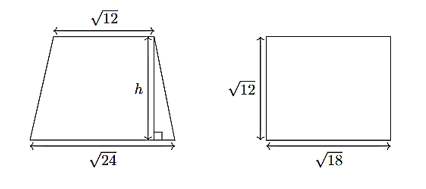
Biết rằng hình thang và hình chữ nhật như hình dưới đây có diện tích bằng nhau.
Khi đó:
Diện tích hình chữ nhật là \({S_1} = 6\sqrt 6 \).
Diện tích hình thang là \({S_2} = \frac{{\left( {\sqrt {12} + \sqrt {24} } \right).h}}{2}\).
Phương trình biểu diễn diện tích hai hình bằng nhau là: \(\frac{{\left( {\sqrt {12} + \sqrt {24} } \right).h}}{2} = 6\sqrt 6 \).
Chiều cao của hình thang là \(h = 12 + 6\sqrt 2 \).
a) Đúng.
Diện tích hình chữ nhật \({S_1} = \sqrt {12} .\sqrt {18} = \sqrt {12.18} = 6\sqrt 6 .\)
b) Đúng.
Diện tích hình thang \({S_2} = \frac{{\left( {\sqrt {12} + \sqrt {24} } \right).h}}{2}\).
c) Đúng.
Phương trình biểu diễn bài toán trên là: \({S_1} = {S_2}\)
Hay \(\frac{{\left( {\sqrt {12} + \sqrt {24} } \right).h}}{2} = 6\sqrt 6 \)
d) Sai.
Ta có: \(\frac{{\left( {\sqrt {12} + \sqrt {24} } \right).h}}{2} = 6\sqrt 6 \)
Suy ra \(\left( {\sqrt {12} + \sqrt {24} } \right).h = 12\sqrt 6 \)
Do đó, \(h = \frac{{12\sqrt 6 }}{{\left( {\sqrt {12} + \sqrt {24} } \right)}}\)
\(h = \frac{{12\sqrt 6 \left( {\sqrt {24} - \sqrt {12} } \right)}}{{\left( {\sqrt {12} + \sqrt {24} } \right)\left( {\sqrt {24} - \sqrt {12} } \right)}}\)
\(h = \frac{{12\sqrt 6 .\sqrt {24} - 12\sqrt 6 .\sqrt {12} }}{{{{\left( {\sqrt {24} } \right)}^2} - {{\left( {\sqrt {12} } \right)}^2}}}\)
\(h = \frac{{12\sqrt {6.24} - 12\sqrt {6.12} }}{{12}}\)
\(h = \sqrt {144} - \sqrt {72} \)
\(h = 12 - 6\sqrt 2 \).
Cho biểu thức \(C = \frac{a}{{a - 16}} - \frac{2}{{\sqrt a - 4}} - \frac{2}{{\sqrt a + 4}}\). Khi đó
Điều kiện xác định của \(C\) là \(a > 0,\,\,a \ne 16\).
Rút gọn biểu thức được \(C = \frac{{\sqrt a }}{{\sqrt a + 4}}\).
Biểu thức \(C\) luôn nhận giá trị nhỏ hơn 1 với mọi \(x\) thuộc tập xác định.
Giá trị của \(C = 9 - 4\sqrt 5 \) tại \(a = 9 - 4\sqrt 5 .\)
a) Sai.
Với mọi \(a \ge 0\), ta có:
• \(a - 16 \ne 0\) nên \(a \ne 16.\)
• \(\sqrt a + 4 \ne 0\) (luôn đúng)
• \(\sqrt a - 4 \ne 0\) nên \(\sqrt a \ne 4\) suy ra \(a \ne 16.\)
Vậy điều kiện xác định của \(C\) là \(a \ge 0,{\rm{ }}a \ne 16\).
b) Đúng.
Với \(a \ge 0,{\rm{ }}a \ne 16\), ta có:
\(C = \frac{a}{{a - 16}} - \frac{2}{{\sqrt a - 4}} - \frac{2}{{\sqrt a + 4}}\)
\[ = \frac{a}{{\left( {\sqrt a - 4} \right)\left( {\sqrt a + 4} \right)}} - \frac{{2\left( {\sqrt a + 4} \right)}}{{\left( {\sqrt a - 4} \right)\left( {\sqrt a + 4} \right)}} - \frac{{2\left( {\sqrt a - 4} \right)}}{{\left( {\sqrt a + 4} \right)\left( {\sqrt a - 4} \right)}}\]
\[ = \frac{{a - 2\sqrt a - 8 - 2\sqrt a + 8}}{{\left( {\sqrt a - 4} \right)\left( {\sqrt a + 4} \right)}}\]
\[ = \frac{{a - 4\sqrt a }}{{\left( {\sqrt a - 4} \right)\left( {\sqrt a + 4} \right)}}\]
\[ = \frac{{\sqrt a \left( {\sqrt a - 4} \right)}}{{\left( {\sqrt a - 4} \right)\left( {\sqrt a + 4} \right)}}\]
\[ = \frac{{\sqrt a }}{{\sqrt a + 4}}.\]
Vậy với \(a \ge 0,{\rm{ }}a \ne 16\) có \[C = \frac{{\sqrt a }}{{\sqrt a + 4}}.\]
c) Đúng.
Ta có \[C = \frac{{\sqrt a }}{{\sqrt a + 4}} < \frac{{\sqrt a + 4}}{{\sqrt a + 4}}\] với mọi \(a \ge 0,{\rm{ }}a \ne 16\).
Do đó, \(C < 1\) với mọi x thuộc tập xác định.
b) Đúng.
Ta có: \(a = 9 - 4\sqrt 5 = 5 - 2 \cdot 2 \cdot \sqrt 5 + 4 = {\left( {\sqrt 5 - 2} \right)^2}\).
Thay vào \[C,\] ta được:
\[C = \frac{{\sqrt a }}{{\sqrt a + 4}} = \frac{{\sqrt {{{\left( {\sqrt 5 - 2} \right)}^2}} }}{{\sqrt {{{\left( {\sqrt 5 - 2} \right)}^2}} + 4}} = \frac{{\sqrt 5 - 2}}{{\sqrt 5 + 2}} = \frac{{{{\left( {\sqrt 5 - 2} \right)}^2}}}{{\left( {\sqrt 5 + 2} \right)\left( {\sqrt 5 - 2} \right)}} = \frac{{9 - 4\sqrt 5 }}{{5 - 4}} = 9 - 4\sqrt 5 \].
Vậy giá trị của \(C = 9 - 4\sqrt 5 \) tại \(a = 9 - 4\sqrt 5 .\)
Cho biểu thức \[T = \left( {\frac{{a\sqrt a - 1}}{{a - \sqrt a }} - \frac{{a\sqrt a + 1}}{{a + \sqrt a }}} \right):\frac{{a + 1}}{{a - 1}}\]. Khi đó:
Điều kiện xác định của \[T\] là \[a > 0,{\rm{ }}a \ne 1\].
Thu gọn biểu thức \[T\] được \[T = \frac{{2\left( {a - 1} \right)}}{{a + 1}}\].
Giá trị của biểu thức \[T\] tại \[a = 1\] bằng 0.
Với \[a = 3\] thì giá trị của \[T\] là một số nguyên.
a) Đúng.
Với mọi \[a \ge 0\], ta có:
• \[a - \sqrt a \ne 0\] suy ra \[\sqrt a \left( {\sqrt a - 1} \right) \ne 0\], do đó \[a \ne 0\] và \[a \ne 1.\]
• \[a + \sqrt a \ne 0\] suy ra \[\sqrt a \left( {\sqrt a + 1} \right) \ne 0\], do đó \[a \ne 0\].
• \[a - 1 \ne 0\] suy ra \[a \ne 1.\]
Do đó, điều kiện xác định của \[T\] là \[a > 0,{\rm{ }}a \ne 1\].
b) Đúng.
Với \[a > 0,{\rm{ }}a \ne 1\], ta có:
\[T = \left( {\frac{{a\sqrt a - 1}}{{a - \sqrt a }} - \frac{{a\sqrt a + 1}}{{a + \sqrt a }}} \right):\frac{{a + 1}}{{a - 1}}\]
\[ = \left[ {\frac{{a\sqrt a - 1}}{{\left( {\sqrt a - 1} \right)\sqrt a }} - \frac{{a\sqrt a + 1}}{{\left( {\sqrt a + 1} \right)\sqrt a }}} \right] \cdot \frac{{a - 1}}{{a + 1}}\]
\[ = \left[ {\frac{{\left( {a\sqrt a - 1} \right)\left( {\sqrt a + 1} \right)}}{{\left( {\sqrt a + 1} \right)\left( {\sqrt a - 1} \right)\sqrt a }} - \frac{{\left( {a\sqrt a + 1} \right)\left( {\sqrt a - 1} \right)}}{{\left( {\sqrt a + 1} \right)\left( {\sqrt a - 1} \right)\sqrt a }}} \right] \cdot \frac{{a - 1}}{{a + 1}}\]
\[ = \frac{{\left( {a\sqrt a - 1} \right)\left( {\sqrt a + 1} \right) - \left( {a\sqrt a + 1} \right)\left( {\sqrt a - 1} \right)}}{{\left( {\sqrt a + 1} \right)\left( {\sqrt a - 1} \right)\sqrt a }} \cdot \frac{{a - 1}}{{a + 1}}\]
\[ = \frac{{{a^2} + a\sqrt a - \sqrt a - 1 - {a^2} + a\sqrt a - \sqrt a + 1}}{{\left( {\sqrt a + 1} \right)\left( {\sqrt a - 1} \right)\sqrt a }} \cdot \frac{{a - 1}}{{a + 1}}\]
\[ = \frac{{2a\sqrt a - 2\sqrt a }}{{\left( {a + 1} \right)\sqrt a }}\]
\[ = \frac{{2\left( {a - 1} \right)}}{{a + 1}}\].
Vậy với \[a > 0,{\rm{ }}a \ne 1\] ta được \[T = \frac{{2\left( {a - 1} \right)}}{{a + 1}}\].
c) Sai.
Vì biểu thức \[T\] có điều kiện xác định là \[a > 0,{\rm{ }}a \ne 1\], tức là tại \[a = 1\] thì biểu thức \[T\] không có giá trị.
d) Đúng.
Thay \[a = 3\] (thỏa mãn điều kiện) vào \[T\], ta được: \[T = \frac{{2\left( {3 - 1} \right)}}{{3 + 1}} = \frac{{2.2}}{4} = 1.\]
Cho các biểu thức \(A = \frac{{\sqrt x + 5}}{{\sqrt x - 3}}\) và \(B = \frac{4}{{\sqrt x + 3}} + \frac{{2x - \sqrt x - 13}}{{x - 9}} - \frac{{\sqrt x }}{{\sqrt x - 3}}\) với \(x \ge 0;\,\,x \ne 9\). Biết rằng, biểu thức \(P = \frac{B}{A}\). Khi đó:
Rút gọn \(B = \frac{{x - 25}}{{x - 9}}\).
Biểu thức \(P = \frac{{\sqrt x - 5}}{{\sqrt x + 3}}.\)
Có duy nhất một giá trị nguyên của \(x = 25\) thỏa mãn \(P\) nguyên.
Gía trị của \(P = 0\) khi \(x = 25\).
a) Đúng.
Với \(x \ge 0;\,\,x \ne 9\), ta có:
\(B = \frac{4}{{\sqrt x + 3}} + \frac{{2x - \sqrt x - 13}}{{x - 9}} - \frac{{\sqrt x }}{{\sqrt x - 3}}\)
\( = \frac{{4\left( {\sqrt x - 3} \right)}}{{\left( {\sqrt x + 3} \right)\left( {\sqrt x - 3} \right)}} + \frac{{2x - \sqrt x - 13}}{{\left( {\sqrt x + 3} \right)\left( {\sqrt x - 3} \right)}} - \frac{{\sqrt x \left( {\sqrt x + 3} \right)}}{{\left( {\sqrt x + 3} \right)\left( {\sqrt x - 3} \right)}}\)
\( = \frac{{4\sqrt x - 12 + 2x - \sqrt x - 13 - x - 3\sqrt x }}{{\left( {\sqrt x + 3} \right)\left( {\sqrt x - 3} \right)}}\)
\( = \frac{{x - 25}}{{\left( {\sqrt x + 3} \right)\left( {\sqrt x - 3} \right)}} = \frac{{x - 25}}{{x - 9}} = \frac{{\left( {\sqrt x + 5} \right)\left( {\sqrt x - 5} \right)}}{{\left( {\sqrt x + 3} \right)\left( {\sqrt x - 3} \right)}}\).
b) Đúng.
Ta có: \(P = \frac{B}{A} = \frac{{\left( {\sqrt x + 5} \right)\left( {\sqrt x - 5} \right)}}{{\left( {\sqrt x + 3} \right)\left( {\sqrt x - 3} \right)}}:\frac{{\sqrt x + 5}}{{\sqrt x - 3}}\)
\( = \frac{{\left( {\sqrt x + 5} \right)\left( {\sqrt x - 5} \right)}}{{\left( {\sqrt x + 3} \right)\left( {\sqrt x - 3} \right)}} \cdot \frac{{\sqrt x - 3}}{{\sqrt x + 5}} = \frac{{\sqrt x - 5}}{{\sqrt x + 3}}\).
c) Sai.
Ta có: \(P = \frac{{\sqrt x - 5}}{{\sqrt x + 3}} = 1 - \frac{8}{{\sqrt x + 3}}\).
Để \(P\) đạt giá trị nguyên thì \(\frac{8}{{\sqrt x + 3}}\) nhận giá trị nguyên.
Suy ra \(\sqrt x + 3\) là Ư(8).
Nhận thấy \(\sqrt x + 3 \ge 3\) với \(x \ge 0;\,\,x \ne 9\).
Do đó, \(\sqrt x + 3 \in {\rm{\{ }}4;\,\,8\} \)
Với \(\sqrt x + 3 = 4\) thì \(x = 1\) (thỏa mãn).
Với \(\sqrt x + 3 = 8\) thì \(x = 25\) (thỏa mãn).
Do đó, có hai giá trị nguyên của \(x\) để \(P\) nguyên.
d) Đúng.
Thay \(x = 25\) (thỏa mãn) vào \(P\) được \(P = \frac{{\sqrt {25} - 5}}{{\sqrt {25} + 3}} = \frac{{5 - 5}}{{5 + 3}} = \frac{0}{8} = 0\).
Với \(x = 2\), biểu thức \(5\sqrt {3x} - \sqrt {12x} + \sqrt {75x} - 15\) bằng \(a\sqrt {bx} - c\). Khi đó, giá trị của biểu thức \(S = a + b + c\) bằng bao nhiêu?
Đáp án: 27
Với \(x = 2\), ta có:
\(5\sqrt {3x} - \sqrt {12x} + \sqrt {75x} - 15\)
\( = 5\sqrt {3.2} - \sqrt {12.2} + \sqrt {75.2} - 15\)
\( = 5\sqrt 6 - \sqrt {24} + \sqrt {150} - 15\)
\( = 5\sqrt 6 - \sqrt {4.6} + \sqrt {25.6} - 15\)
\( = 5\sqrt 6 - \sqrt 4 .\sqrt 6 + \sqrt {25} .\sqrt 6 - 15\)
\( = 5\sqrt 6 - 2.\sqrt 6 + 5.\sqrt 6 - 15\)
\( = \sqrt 6 .\left( {5 - 2 + 5} \right) - 15\)
\( = 8\sqrt 6 - 15\)\( = 8\sqrt {3.2} - 15\)
Suy ra \[a = 8,\,\,b = 3,\,\,c = 15\].
Vậy \(S = a + b + c = 9 + 3 + 15 = 27\).
Cho biểu thức \(A = \frac{{\sqrt x + 15}}{{x - 9}} - \frac{x}{{x - 3\sqrt x }} + \frac{{2\sqrt x + 5}}{{\sqrt x + 3}}\) với \(x > 0,\,\,x \ne 9\). Hỏi có bao nhiêu giá trị của \(x\) để \(A\) nhận giá trị là số nguyên?
Đáp án: 0
Với \(x > 0,\,\,x \ne 9\), ta có:
\(A = \frac{{\sqrt x + 15}}{{x - 9}} - \frac{x}{{x - 3\sqrt x }} + \frac{{2\sqrt x + 5}}{{\sqrt x + 3}}\)
\(A = \frac{{\left( {\sqrt x + 15} \right)\sqrt x }}{{\sqrt x \left( {\sqrt x + 3} \right)\left( {\sqrt x - 3} \right)}} - \frac{{x\left( {\sqrt x + 3} \right)}}{{\sqrt x \left( {\sqrt x - 3} \right)\left( {\sqrt x + 3} \right)}} + \frac{{\left( {2\sqrt x + 5} \right)\sqrt x \left( {\sqrt x - 3} \right)}}{{\sqrt x \left( {\sqrt x - 3} \right)\left( {\sqrt x + 3} \right)}}\)
\(A = \frac{{x + 15\sqrt x - x\sqrt x - 3x + 2x\sqrt x + 5x - 6x - 15\sqrt x }}{{\sqrt x \left( {\sqrt x + 3} \right)\left( {\sqrt x - 3} \right)}}\)
\(A = \frac{{x\sqrt x - 3x}}{{\sqrt x \left( {\sqrt x - 3} \right)\left( {\sqrt x + 3} \right)}} = \frac{{x\left( {\sqrt x - 3} \right)}}{{\sqrt x \left( {\sqrt x - 3} \right)\left( {\sqrt x + 3} \right)}} = \frac{{\sqrt x }}{{\sqrt x + 3}}\).
Với \(A = \frac{{\sqrt x }}{{\sqrt x + 3}} > 0\)
Lại có: \(A = 1 - \frac{3}{{\sqrt x + 3}} < 1\).
Do đó \(0 < A < 1\).
Vậy \(x > 0,\,\,x \ne 9\) không tồn tại giá trị của \(x\) để \(A\) nhận giá trị là số nguyên.
Tính giá trị của biểu thức \(D = \left( {\frac{{\sqrt {22} - \sqrt {11} }}{{1 - \sqrt 2 }} + \frac{{\sqrt {21} - \sqrt 7 }}{{1 - \sqrt 3 }}} \right)\left( {\sqrt 7 - \sqrt {11} } \right)\).
Đáp án: 4
\(D = \left( {\frac{{\sqrt {22} - \sqrt {11} }}{{1 - \sqrt 2 }} + \frac{{\sqrt {21} - \sqrt 7 }}{{1 - \sqrt 3 }}} \right)\left( {\sqrt 7 - \sqrt {11} } \right)\)
\[ = \left[ {\frac{{\left( {\sqrt {22} - \sqrt {11} } \right)\left( {1 + \sqrt 2 } \right)}}{{\left( {1 - \sqrt 2 } \right)\left( {1 + \sqrt 2 } \right)}} + \frac{{\left( {\sqrt {21} - \sqrt 7 } \right)\left( {\sqrt 3 + 1} \right)}}{{\left( {1 - \sqrt 3 } \right)\left( {\sqrt 3 + 1} \right)}}} \right]\left( {\sqrt 7 - \sqrt {11} } \right)\]
\[ = \left[ {\frac{{\left( {\sqrt {22} - \sqrt {11} } \right)\left( {1 + \sqrt 2 } \right)}}{{ - 1}} - \frac{{\left( {\sqrt {21} - \sqrt 7 } \right)\left( {\sqrt 3 + 1} \right)}}{2}} \right]\left( {\sqrt 7 - \sqrt {11} } \right)\]
\[ = \left[ { - \left( {\sqrt {44} - \sqrt {22} + \sqrt {22} - \sqrt {11} } \right) - \frac{{\sqrt {21} - \sqrt 7 + \sqrt {63} - \sqrt {21} }}{2}} \right]\left( {\sqrt 7 - \sqrt {11} } \right)\]
\[ = \left[ { - \sqrt {44} + \sqrt {11} - \frac{{\sqrt 7 \left( {\sqrt 9 - 1} \right)}}{2}} \right]\left( {\sqrt 7 - \sqrt {11} } \right)\]
\[ = \left[ { - 2\sqrt {11} + \sqrt {11} - \sqrt 7 } \right]\left( {\sqrt 7 - \sqrt {11} } \right)\]
\[ = \left( { - \sqrt {11} - \sqrt 7 } \right)\left( {\sqrt 7 - \sqrt {11} } \right)\]
\[ = - \left( {\sqrt {11} + \sqrt 7 } \right)\left( {\sqrt 7 - \sqrt {11} } \right)\]
\[ = - \left[ {{{\left( {\sqrt 7 } \right)}^2} - {{\left( {\sqrt {11} } \right)}^2}} \right]\]
\[ = - \left( { - 4} \right) = 4\].
Cho biểu thức \(P = \left( {\frac{{2\sqrt {xy} }}{{x - y}} - \frac{{\sqrt x + \sqrt y }}{{2\sqrt x - 2\sqrt y }}} \right).\frac{{2\sqrt x }}{{\sqrt x - \sqrt y }}\)\(\left( {x,\,y \ge 0,\,\,x \ne y} \right)\). Tính giá trị của \(P\), biết \(\frac{x}{y} = \frac{4}{9}\). (Kết quả viết dưới dạng số thập phân)
Đáp án: −0,4
Ta có: \(P = \left( {\frac{{2\sqrt {xy} }}{{x - y}} - \frac{{\sqrt x + \sqrt y }}{{2\sqrt x - 2\sqrt y }}} \right).\frac{{2\sqrt x }}{{\sqrt x - \sqrt y }}\)
\( = \left[ {\frac{{4\sqrt {xy} }}{{2\left( {\sqrt x - \sqrt y } \right)\left( {\sqrt x + \sqrt y } \right)}} - \frac{{\sqrt x + \sqrt y }}{{2\left( {\sqrt x - \sqrt y } \right)}}} \right].\frac{{2\sqrt x }}{{\sqrt x - \sqrt y }}\)
\( = \left[ {\frac{{4\sqrt {xy} }}{{2\left( {\sqrt x - \sqrt y } \right)\left( {\sqrt x + \sqrt y } \right)}} - \frac{{\left( {\sqrt x + \sqrt y } \right)\left( {\sqrt x + \sqrt y } \right)}}{{2\left( {\sqrt x - \sqrt y } \right)\left( {\sqrt x + \sqrt y } \right)}}} \right].\frac{{2\sqrt x }}{{\sqrt x - \sqrt y }}\)
\( = \frac{{4\sqrt {xy} - {{\left( {\sqrt x + \sqrt y } \right)}^2}}}{{2\left( {\sqrt x - \sqrt y } \right)\left( {\sqrt x + \sqrt y } \right)}}.\frac{{2\sqrt x }}{{\sqrt x - \sqrt y }}\)
\( = \frac{{4\sqrt {xy} - x - 2\sqrt {xy} - y}}{{\left( {\sqrt x - \sqrt y } \right)\left( {\sqrt x + \sqrt y } \right)}}.\frac{{2\sqrt x }}{{\sqrt x - \sqrt y }}\)
\( = \frac{{ - \left( {x + 2\sqrt {xy} + y} \right)}}{{2\left( {\sqrt x - \sqrt y } \right)\left( {\sqrt x + \sqrt y } \right)}}.\frac{{2\sqrt x }}{{\sqrt x - \sqrt y }}\)
\( = \frac{{ - {{\left( {\sqrt x + \sqrt y } \right)}^2}}}{{2\left( {\sqrt x - \sqrt y } \right)\left( {\sqrt x + \sqrt y } \right)}}.\frac{{2\sqrt x }}{{\sqrt x - \sqrt y }}\)
\( = \frac{{ - \sqrt x }}{{\sqrt x + \sqrt y }}\)
Với \(\frac{x}{y} = \frac{4}{9}\) suy ra \(y = \frac{{9x}}{4}\).
Do đó, \(P = \frac{{ - \sqrt x }}{{\sqrt x + \sqrt y }} = \frac{{ - \sqrt x }}{{\sqrt x + \frac{3}{2}\sqrt x }} = \frac{{ - \sqrt x }}{{\frac{5}{2}\sqrt x }} = - \frac{2}{5} = - 0,4\).
Cho biểu thức \(A = \left( {\frac{1}{{\sqrt x }} + \frac{{\sqrt x }}{{\sqrt x + 1}}} \right):\frac{{\sqrt x }}{{x + \sqrt x }}\) với \(x > 0\). Tính giá trị nhỏ nhất của \(A.\)
Đáp án: 3
Với \(x > 0\), ta có:
\(A = \left( {\frac{1}{{\sqrt x }} + \frac{{\sqrt x }}{{\sqrt x + 1}}} \right):\frac{{\sqrt x }}{{x + \sqrt x }}\)
\( = \left[ {\frac{{\sqrt x + 1}}{{\sqrt x \left( {\sqrt x + 1} \right)}} + \frac{{\sqrt x .\sqrt x }}{{\sqrt x \left( {\sqrt x + 1} \right)}}} \right]:\frac{{\sqrt x }}{{x + \sqrt x }}\)
\( = \frac{{\sqrt x + 1 + x}}{{\sqrt x \left( {\sqrt x + 1} \right)}}.\frac{{\sqrt x \left( {\sqrt x + 1} \right)}}{{\sqrt x }}\) \[\]
\( = \frac{{\sqrt x + 1 + x}}{{\sqrt x }}\).
Với \(x > 0\), \(P = \frac{{\sqrt x + 1 + x}}{{\sqrt x }} = \frac{{\sqrt x }}{{\sqrt x }} + \frac{1}{{\sqrt x }} + \frac{x}{{\sqrt x }} = 1 + \frac{1}{{\sqrt x }} + \sqrt x \)
Vì \(x > 0\), áp đụng BĐT Cauchy, ta có:
\(\frac{1}{{\sqrt x }} + \sqrt x \ge 2\sqrt {\frac{1}{{\sqrt x }}.\sqrt x } \) hay \(1 + \frac{1}{{\sqrt x }} + \sqrt x \ge 1 + 2\) hay \(A \ge 3\).
Vậy GTNN của \(A = 3\) khi \(\frac{1}{{\sqrt x }} = \sqrt x \) hay \(x = 1\).