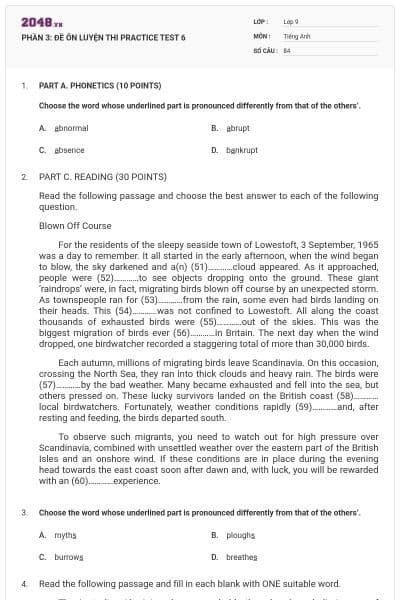
PHẦN 3: ĐỀ ÔN LUYỆN THI PRACTICE TEST 6

81 câu hỏi
abnormal
abrupt
absence
bankrupt
Chọn B
myths
ploughs
burrows
breathes
Chọn A
confine
conceal
convention
concentrate
Chọn D
explosion
exploration
expertise
expedition
Chọn A
bathing
breathtaking
smoothie
worthy
Chọn B


Học thông minh hơn mỗi ngày
Xem toàn bộ 81 câu hỏi và nhiều hơn nữa với tài khoản miễn phí
breakout
breakthrough
outburst
outgrow
Chọn D
reference
picturesque
episode
consonant
Chọn B
establish
acknowledge
conjunction
instrument
Chọn D
problematic
exacerbate
triangular
alternative
Chọn A
contradictory
auditorium
beneficiary
impenetrab
Chọn D
has been improving - have got
will have improved - get
had improved - would get
improves - will be getting
Chọn B
are conveying
is transferring
is conveying
are transferring
Chọn C
redundant
unnecessary
ineffective
abundant
Chọn A
adding
add
to be adding
to add
Chọn D
worked out
held up
kept off
worn out
Chọn D
would have decorated
would decorate
had been decorating
used to decorating
Chọn B
employee
attendant
officer
assistant
Chọn B
to have migrated
having migrated
migrating
to be migrating
Chọn A
out of season
out of reach
out of question
out of place
Chọn C
weren’t taking
hadn’t had to take
didn’t have to take
didn’t take
Chọn B
That we refer to it
What we refer to
To which we refer
What do we refer to
Chọn B
his young age
young
been young
he was young
Chọn B
crumple
contract
shrink
dwindle
Chọn A
led
initiated
presented
introduced
Chọn C
OK, I won’t use it.
Thanks. I’ll put it in a safe place.
You’re welcome. See you.
Thank you. I’ll keep it for you.
Chọn B
Thanks °for the field of linguistics we know 26little about the development of the 5,000 plus languages in 27exist today. We can describe their grammar and pronunciation and see how their spoken and 28writing forms have changed over time. For example, we understand the origins of the Indo-European group of languages, which includes Norwegian, Hindi and English, and can trace them 29down to tribes in eastern Europe in about 3000 BC.
So, we have mapped out a great 30number of the history of language, but there are still areas we know little about. Experts are beginning to look to the field of evolutionary biology to find out 31what the human species developed to be able to use language. So far, there are far more questions and half-theories than answers.
We know that human language is far more complex than 32those of even our nearest and most intelligent relatives like chimpanzees. We can express complex thoughts, convey subtle emotions and communicate about abstract 33concept such as past and future. And we do this following a set of structural rules, 34called as grammar. Do only humans use an innate system of rules to govern the order of words? Perhaps not, as some research may suggest dolphins share this capability 35so they are able to recognize when these rules are broken.
|
26. little→much |
27. exist → existence |
28. writing → written |
29. down →back |
30. number → deal |
|
31. what → how |
32. those → that |
33.concept → concepts |
34. called → known HOẶC as → Ø |
35. so → because |
confidence
weird
unusual
odd
abnormal
Chọn B
unexpected
forced
delighted
astonished
Chọn D
shelter
protection
avoidance
home
Chọn A
phenomenon
practice
trouble
problem
Chọn A
dropping
falling
stepping
jumping
Chọn B
noted
recorded
written
jotted
Chọn B
disoriented
unleaded
misguided
indiverted
Chọn A
in view of
with regard to
on the interest of
to the delight of
Chọn D
bettered
increased
raised
improved
Chọn D
uncomfortable
uneasy
unforgettable
undamaged
Chọn C
frequently results in confusion among the people it is supposed to help
involves more effort than some organizations are prepared to make
may create problems where previously there had not been any problems
is something that some organizations should not attempt to do
Chọn B
may be very good even if management is poor
cannot be accurately measured by any box-ticking exercise
is related to their knowledge of the organization as a whole
is not as unpredictable as some managers believe it to be
Chọn C
It was not really interested in measuring the effectiveness of employees.
The targets that it set for staff were unrealistic.
It failed to understand the real needs of its employees.
The data that it collected did not measure what it was supposed to measure.
Chọn D
purposes
goals
motives
reasons
Chọn B
It made what should have been an easy task into a complicated one.
It failed to foresee the consequences of an instruction.
It misunderstood why a new approach was required.
It refused to take into account the views of employees.
Chọn B
Employees did not believe that it had been introduced for their benefit.
Employees felt that it was in fact a way of making their jobs even harder.
The reason given for introducing it was not the real reason why it was introduced.
It was an inappropriate kind of programme for this particular organization.
Chọn A
not sincere
without real value
empty
deep
Chọn B
was too demanding for managers to maintain long-term
was treated as a self-contained exercise by managers
involved some strange ideas on how managers could improve
cause managers to believe that their previous methods had been better
Chọn B
senior management
improving things in things in the organiztion
organization
the need
Chọn B
[80A]
[80B]
[80C]
[80D]
Chọn B
Suggested paragraph:
It is widely accepted that family members nowadays tend to become less close than they were in the past for several reasons. The primary cause of the decline in the closeness of families is their busy lifestyles in the modern world. Obviously, both parents and children today have to work long hours during the day; hence, they do not have much time to spend with each other as they used to in the past. Consequently, parents and children have little chance to share their feelings, problems and give each other advice. The other reason contributing to the gap among family members may be put down to the priority placed on people’s privacy in the modern society. Undoubtedly, individuals now tend to live independently of each other and do not want others' interference in their lives. Last but not least, it is the advanced technology that made people be more interested in their virtual relationships than interacting with their family in their free time. In conclusion, busy lifestyles, privacy preference and modern technology are causing family relationship to become less fortified than ever before.
Bạn có thích hoạt động này không?
Hãy lưu hoặc chia sẻ nội dung này đến mọi người.
Gợi ý cho bạn

Ý tưởng của bạn, bài học của bạn
Tự thiết kế đề thi, bài giảng hoặc flashcard theo cách riêng.