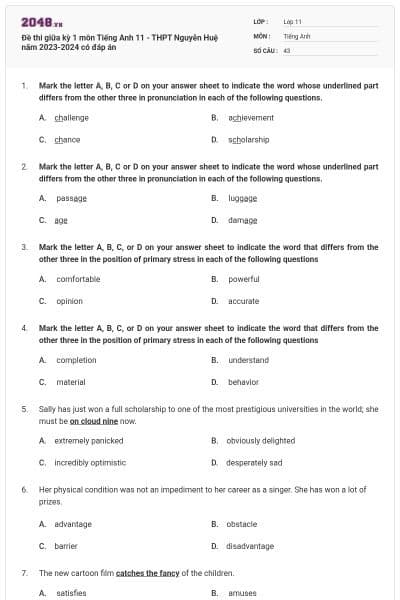
Đề thi giữa kỳ 1 môn Tiếng Anh 11 - THPT Nguyễn Huệ năm 2023-2024 có đáp án
40 câu hỏi
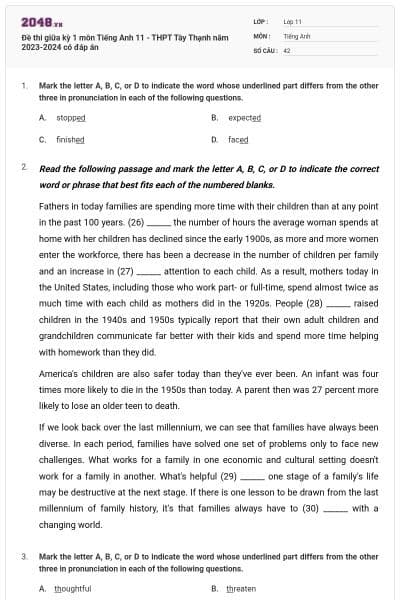
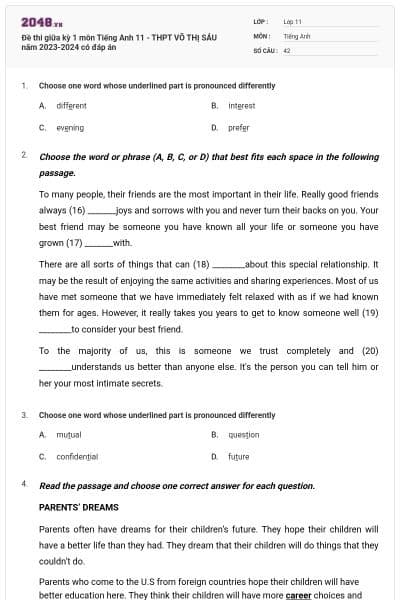
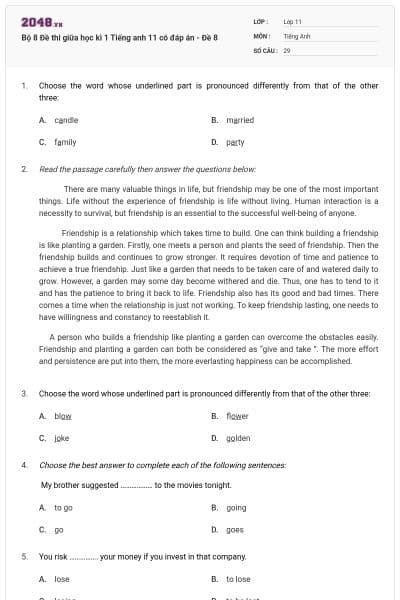
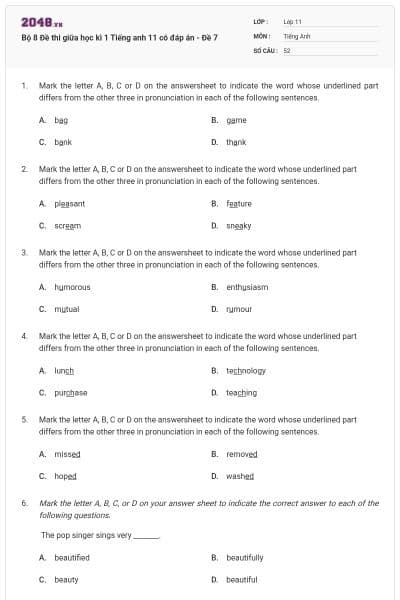
Mark the letter A, B, C or D on your answer sheet to indicate the word whose underlined part differs from the other three in pronunciation in each of the following questions.
challenge
achievement
chance
scholarship
D là đáp án đúng
Kiến thức: ngữ âm
Giải thích: Đáp án D phát âm là /k/, các đáp án còn lại phát âm là /tʃ/.Mark the letter A, B, C or D on your answer sheet to indicate the word whose underlined part differs from the other three in pronunciation in each of the following questions.
passage
luggage
age
damage
C là đáp án đúng
Kiến thức: ngữ âm
Giải thích: Đáp án C phát âm là /eɪ/, các đáp án còn lại phát âm là /ɪ/.
Mark the letter A, B, C, or D on your answer sheet to indicate the word that differs from the other three in the position of primary stress in each of the following questions
comfortable
powerful
opinion
accurate
C là đáp án đúng
Kiến thức: trọng âm
Giải thích: Đáp án C trọng âm số 2, các đáp án còn lại trọng âm số 1.Mark the letter A, B, C, or D on your answer sheet to indicate the word that differs from the other three in the position of primary stress in each of the following questions
completion
understand
material
behavior
B là đáp án đúng
Kiến thức: trọng âm
Giải thích: Đáp án B trọng âm số 3, các đáp án còn lại trọng âm số 2.Sally has just won a full scholarship to one of the most prestigious universities in the world; she must be on cloud nine now.
extremely panicked
obviously delighted
incredibly optimistic
desperately sad
D là đáp án đúng
Kiến thức: đồng nghĩa – trái nghĩa
Giải thích:
on cloud nine (vui, sung sướng) >< desperately sad (buồn tuyệt vọng)
Các đáp án còn lại:
- extremely panicked: cực kì hoảng loạn
- obviously delighted: rõ ràng rất vui
- incredibly optimistic: vô cùng lạc quan
Dịch nghĩa: Sally vừa giành được học bổng toàn phần vào một trong những trường đại học danh tiếng nhất thế giới; bây giờ chắc cô ấy đang rất vui sướng.advantage
obstacle
barrier
disadvantage
A là đáp án đúng
Kiến thức: đồng nghĩa – trái nghĩa
Giải thích:
impediment (trở ngại) >< advantage (thuận lợi)
Các đáp án còn lại: obstacle = barrier = disadvantage: trở ngại, rào cản
Dịch nghĩa: Tình trạng thể chất của cô không phải là trở ngại cho sự nghiệp ca sĩ của cô. Cô đã giành được rất nhiều giải thưởng.The new cartoon film catches the fancy of the children.
satisfies
amuses
attracts
surprises
C là đáp án đúng
Kiến thức: đồng nghĩa – trái nghĩa
Giải thích:
catch the fancy = attract: thu hút
Các đáp án còn lại:
- satisfy: hài lòng
- amuse: làm cho vui vẻ
- suprise: làm cho bất ngờ
Dịch nghĩa: Bộ phim hoạt hình mới thu hút bọn trẻ.The kidnapper gave himself up to the police.
confided himself
surrendered
accommodated himself
went up
B là đáp án đúng
Kiến thức: đồng nghĩa – trái nghĩa
Giải thích:
give sb up = surrend: đầu hàng, đầu thú
Các đáp án còn lại:
- confide oneself: tiết lộ bí mật
- accommodate oneself: làm cho thích nghi
- go up: tăng lên
Dịch nghĩa: Kẻ bắt cóc trẻ em đã đầu thú với cảnh sát.Kelly: “It’s was very kind of you to give me a lift home”.
- Mark: “_______________________”
As a matter of fact, you’re pretty nice.
Oh, don’t do that. I was coming past your house any way.
I’m not pleased.
Oh, don’t mention it. I was coming past your house any way.
D là đáp án đúng
Kiến thức: chức năng giao tiếp
Giải thích:
Kelly: “Bạn thật tốt bụng khi đã đưa tôi về nhà”.
Mark: “Không có gì. Đằng nào cũng tôi cũng đi qua nhà bạn mà.”
Các đáp án còn lại:
A. Thực tế là bạn khá tốt.
B. Ồ, đừng làm thế. Dù sao thì tôi cũng đang đi ngang qua nhà bạn.
C. Tôi không hài lòng.
Two students are talking about the school curriculum.
- Hoa: “Swimming should be taught in the school.”
- Nam: “___________. It is an essential life skill.”
Oh, that’s a problem.
I can’t agree with you more.
Not at all.
You can make it.
B là đáp án đúng
Kiến thức: chức năng giao tiếp
Giải thích:
Hoa: “Bơi nên được dạy ở trường.”
Nam: “Không thể đồng ý hơn. Nó là một kỹ năng cuộc sống cần thiết.”
Các đáp án còn lại:
A. Ồ, đó là một vấn đề.
C. Không hề.
D. Bạn có thể làm được.
turn up
get on
get out
turn down
B là đáp án đúng
Kiến thức: cụm động từ
Giải thích:
- turn up: xuất hiện, vặn to lên
- get on: leo lên, đi lên, tiến bộ
- get out: đi ra
- turn down: từ chối, vặn nhỏ xuống
Dịch nghĩa: Nhiều bậc cha mẹ có xu hướng thúc đẩy con cái vì họ tin rằng giáo dục tốt sẽ giúp chúng tiến bộ trong tương lai.cold and cold
cold and colder
more and more cold
colder and colder
D là đáp án đúng
Kiến thức: so sánh kép
Giải thích: cấu trúc so sánh lũy tiến với tính từ ngắn: adj-er and adj-er
Dịch nghĩa: Trời ngày càng lạnh khi mùa đông đang đến.far-reaching
far-gone
far-off
far-flung
A là đáp án đúng
Kiến thức: tính từ ghép
Giải thích:
- far-reaching (adj): Có ảnh hưởng sâu rộng, tác động lớn
- far-gone (adj): ốm rất nặng, say mềm
- far-off (adj): xa xôi, xa xưa
- far-flung (adj): xa, trải rộng bao la
Dịch nghĩa: Tổ chức đã trải qua những cuộc cải cách lớn.due to
bound to
about to
on the point of
B là đáp án đúng
Kiến thức: tính từ ghép
Giải thích:
- be due to V: mong đợi xảy ra tại thời điểm cụ thể nào đó trong tương lai (có kèm thời gian)
- due to + V-ing/N: bởi vì
- be bound to + V: chắc chắn xảy ra
- be about to + V: sắp sửa làm gì đó
- be on the point of + V-ing: sắp sửa làm gì đó
Dịch nghĩa: Cuộc thi hoa hậu chắc chắn sẽ bắt đầu lúc 8 giờ 30 sáng thứ 2 tuần sau theo giờ của chúng ta.would be
will be
would have been
had been
A là đáp án đúng
Kiến thức: câu điều kiện
Giải thích:
Cấu trúc câu điều kiện loại 2: If + S + Vqk, S + would/could + V
Dịch nghĩa: Nếu mọi người chú ý hơn tới môi trường, trái đất sẽ xanh hơn.does he
doesn’t he
do they
don’t they
C là đáp án đúng
Kiến thức: câu hỏi đuôi
Giải thích:
- Chủ ngữ “nobody” => đuôi hỏi thay bằng đại từ “they” => loại A, B
- “nobody” (không có ai) mang nghĩa phủ định, mà đuôi hỏi ngược với mệnh đề chính => đuôi hỏi để dạng khẳng định => loại D
Dịch nghĩa: Không có ai đến đó phải không?imagination
imaginable
imaginative
imaginary
C là đáp án đúng
Kiến thức: từ loại
Giải thích: bổ nghĩa cho “to be” và sau trạng từ “very” ở đây cần một tính từ
Xét các đáp án:
- imagination (n): sự tưởng tượng
- imaginabe (adj): có thể tưởng tượng
- imaginative (adj): giàu trí tưởng tượng
- imaginary (adj): trong tưởng tượng
Dịch nghĩa: Giáo viên thích bài văn của cô ấy vì nó rất giàu trí tưởng tượng.accustomed
unconscious
familiar
aware
A là đáp án đúng
Kiến thức: cấu trúc giới từ
Giải thích:
- accustomed to Ving/N: quen với cái gì
- unconscious of Ving/N: mất ý thức làm gì
- familiar with st/Ving: quen với việc gì
- aware of Ving/N: có nhận thức về việc gì
Dịch nghĩa: Tôi đã sống ở thành phố này lâu rồi nên tôi đã quen với tiếng ồn của xe cộ.permit
omit
submit
admit
C là đáp án đúng
Kiến thức: từ vựng
Giải thích:
- permit: cho phép
- omit: bỏ quên
- submit: nộp
- admit: thừa nhận
Dịch nghĩa: Tất cả các ứng viên phải nộp 1 bản CV đầy đủ cùng với đơn xin việc trước ngày 1 tháng 10.that she lived
that she lived among them
among whom she lived
where she lived among them
C là đáp án đúng
Kiến thức: mệnh đề quan hệ
Giải thích:
Dùng đại từ quan hệ “whom” để thay thế cho danh từ trước nó (the people in Samoa) đóng vai trò làm tân ngữ trong mệnh đề quan hệ, giới từ có thể chuyển lên trước “whom”
Cấu trúc: (giới từ) + whom + S + V
Dịch nghĩa: Cuốn sách đó nói về những người ở Samoa mà cô đã sống cùng trong hai năm.have been married
had been married
will been married
will have been married
B là đáp án đúng
Kiến thức: thì động từ
Giải thích: Dùng thì quá khứ hoàn thành để diễn tả hành động xảy ra trước và kéo dài tới một hành động khác trong quá khứ (cụ thể ở đây là khi đứa con đầu lòng được sinh ra)
Dịch nghĩa: Khi đứa con đầu lòng được sinh ra thì họ ra kết hôn được ba năm rồi.as
the same
all the more
the more
C là đáp án đúng
Kiến thức: thì động từ
Giải thích:
- as: như (dùng trong so sánh bằng)
- the same + N: cùng, giống ... (dùng trong so sánh bằng)
- the more + adj/ adv: càng ... (dùng trong so sánh kép)
- all the more + adj ~ even more ... (than before): càng/ thậm chí còn ...hơn (so với trước)
Dịch nghĩa: Cô gái này không tiết lộ quá nhiều về bản thân, và điều này càng khiến cô ấy trở nên thu hút hơn.Read the following passage and mark the letter A, B, C, or D on your answer sheet to indicate the correct word or phrase that best fits each of the numbered blanks from 23 to 27.
The Microscope
One of the most important inventions in the development of science and medicine was the microscope. It was (23) _________ the principle that light could be “refracted” or bent, by a glass lens. It was soon discovered that tiny objects could be magnified (24) _________ size when viewed through a glass lens that had been ground and polished in a specific (25) _________. Although the principle was known to the Chinese as early as 1000 A. D, it was not until the 13th and 14th centuries in Europe (26) _________ it was put to practical use in the form of eyeglasses.
In Europe the first microscope was invented by brothers Zacharias and Hans Janssen, two Dutch eyeglass-makers, around 1590. They built a “compound” microscope, so called because of its two lenses. The most significant development and use of the microscope during this period, however, belongs to another Dutch optician, Antonie van Leeuwenhoek. Born in Delft, Holland, he became skilled at (27) _________ very sharp and accurate magnifying lenses.
based upon
based by
based in
based at
A là đáp án đúng
Kiến thức: cụm động từ
Giải thích: be based on/ upon: được dựa vào, căn cứ vào
Dịch nghĩa: Nó dựa trên nguyên lý ánh sáng có thể bị “khúc xạ” hoặc bẻ cong bởi một thấu kính thủy tinh.by
on
in
with
C là đáp án đúng
Kiến thức: cụm động từ
Giải thích: be magnified in size: phóng đại kích thước
Dịch nghĩa: Người ta sớm phát hiện ra rằng những vật nhỏ có thể được phóng đại về kích thước khi nhìn qua thấu kính thủy tinh.procedure
manner
fashion
character
B là đáp án đúng
Kiến thức: từ vựng
Giải thích:
- procedure (n): phương pháp, cách thức, thủ tục
- manner (n): cách, kiểu
+ in + a/ an + adj + manner: theo cách ...
- fashion (n): kiểu cách, thời trang
+ in fashion: đúng mốt, hợp thời trang
- character (n): tính cách
Dịch nghĩa: Người ta sớm phát hiện ra rằng các vật thể nhỏ có thể được phóng đại về kích thước khi nhìn qua một thấu kính thủy tinh đã được mài và đánh bóng theo một cách cụ thể.when
than
then
that
D là đáp án đúng
Kiến thức: Cấu trúc “It was not until”
Giải thích: Cấu trúc “It was not until”: It was not until + S + V2/ed + that + ... : mãi cho đến khi
Dịch nghĩa: Mặc dù nguyên lý này đã được người Trung Quốc biết đến từ năm 1000 sau Công nguyên nhưng phải đến thế kỷ 13 và 14 ở châu Âu, nó mới được đưa vào sử dụng thực tế dưới dạng kính đeo mắt.granting
grinding
scraping
rubbing
B là đáp án đúng
Kiến thức: từ vựng
Giải thích:
A. grant (v): cho, cấp
B. grind (v): mài. dũa
C. scrape (v): nạo, gọt
D. rub (v): cọ xát
Dịch nghĩa: Sinh ra ở Delft, Hà Lan, ông trở nên thành thạo trong việc mài các thấu kính phóng đại rất sắc nét và chính xác.
Dịch bài đọc:
Kính hiển vi
Một trong những phát minh quan trọng nhất trong sự phát triển của khoa học và y học là kính hiển vi. Nó dựa trên nguyên lý ánh sáng có thể bị “khúc xạ” hoặc bẻ cong bởi một thấu kính thủy tinh. Người ta sớm phát hiện ra rằng các vật thể nhỏ có thể được phóng đại về kích thước khi nhìn qua một thấu kính thủy tinh đã được mài và đánh bóng theo một cách cụ thể. Mặc dù nguyên lý này đã được người Trung Quốc biết đến từ năm 1000 sau Công nguyên nhưng phải đến thế kỷ 13 và 14 ở châu Âu, nó mới được đưa vào sử dụng thực tế dưới dạng kính đeo mắt.
Ở châu Âu, chiếc kính hiển vi đầu tiên được phát minh bởi anh em Zacharias và Hans Janssen, hai nhà sản xuất kính mắt người Hà Lan, vào khoảng năm 1590. Họ đã chế tạo một chiếc kính hiển vi “hỗn hợp”, được gọi như vậy vì nó có hai thấu kính. Tuy nhiên, sự phát triển và ứng dụng quan trọng nhất của kính hiển vi trong thời kỳ này lại thuộc về một chuyên gia nhãn khoa người Hà Lan khác, Antonie van Leeuwenhoek. Sinh ra ở Delft, Hà Lan, ông trở nên thành thạo trong việc mài các thấu kính phóng đại rất sắc nét và chính xác.
Read the following passage and mark the letter A, B, C, or D on your answer sheet to indicate the correct answer to each of the questions from 28 to 34.
Carnegie Hall, which is a famous concert hall in New York City, has again undergone a restoration. While this is not the first, it is certainly the most extensive in the building’s history. As a result of this new restoration, Carnegie Hall once again has the quality of sound that it had when it was first built.
Carnegie Hall owes its existence to Andrew Carnegie, the wealthy owner of a steel company in the late 1800s. The hall was finished in 1891 and quickly gained a reputation as an excellent performing arts hall where accomplished musicians gained fame. Despite its reputation, the concert hall suffered from several detrimental renovations over the years. During the Great Depression, when fewer people could afford to attend performances, the directors sold part of the building to commercial businesses. As a result, a coffee shop was opened in one comer of the building, for which the builders replaced the brick and terra cotta walls with windowpanes. A renovation in 1946 seriously damaged the acoustical quality of the hall when the makers of the film Carnegie Hall cut a gaping hole in the dome of the ceiling to allow for lights and air vents. The hole was later covered with short curtains and a fake ceiling, but the hall never sounded the same afterwards.
In 1960, the violinist Isaac Stem became involved in restoring the hall after a group of real estate developers unveiled plans to demolish Carnegie Hall and build a high-rise office building on the site. This threat spurred Stem to rally public support for Carnegie Hall and encourage the City of New York to buy the property. The movement was successful, and the concert hall is now owned by the city. In the current restoration, builders tested each new material for its sound qualities, and they replaced the hole in the ceiling with a dome. The builders also restored the outer walls to their original appearance and closed the coffee shop. Carnegie has never sounded better, and its prospects for the future have never looked more promising.Changes to Carnegie Hall
The appearance of Carnegie Hall
Carnegie Hall’s history during the Great Depression
Damage to the ceiling in Carnegie Hall
A là đáp án đúng
Kiến thức: đọc hiểu
Giải thích: Bài đọc nói về nhiều lần trùng tu Carnegie Hall, kể chi tiết những sự thay đổi trong các lần trùng tu đó
A. Những thay đổi ở Carnegie Hall
B. Sự xuất hiện của Carnegie Hall
C. Lịch sử của Carnegie Hall trong thời kỳ Đại suy thoái
D. Trần nhà ở Carnegie Hall bị hư hại
In the second paragraph, what is the meaning of the word “detrimental”?
Dangerous
Significant
Extreme
Harmful
D là đáp án đúng
Kiến thức: từ đồng nghĩa
Giải thích: detrimental = harmful (có hại)
Các đáp án còn lại:
A. Dangerous(adj): nguy hiểm
B. Significant(adj): đáng chú ý
C. Extreme (adj): cực đoan
Dịch nghĩa: Bất chấp danh tiếng của nó, phòng hòa nhạc đã phải trải qua nhiều lần cải tạo bất lợi trong những năm qua.What major change happened to the hall in 1946?
The acoustic dome was damaged.
Space in the building was sold to commercial businesses.
The walls were damaged in an earthquake.
The stage was renovated.
A là đáp án đúng
Kiến thức: đọc hiểu
Giải thích: Thông tin: A renovation in 1946 seriously damaged the acoustical quality of the hall when the makers of the film Carnegie Hall cut a gaping hole in the dome of the ceiling to allow for lights and air vents.
Dịch nghĩa: Một cuộc cải tạo vào năm 1946 đã làm hư hỏng nghiêm trọng chất lượng âm thanh của hội trường khi các nhà làm phim Carnegie Hall khoét một lỗ hở trên mái vòm trần nhà để chiếu sáng và thông gió.A violinist
An architect
A steel mill owner
The mayor of New York City
C là đáp án đúng
Kiến thức: đọc hiểu
Giải thích: Thông tin: Carnegie Hall owes its existence to Andrew Carnegie, the wealthy owner of a steel company in the late 1800s.
Dịch nghĩa: Carnegie Hall có được sự tồn tại của nó nhờ Andrew Carnegie, chủ sở hữu giàu có của một công ty thép vào cuối những năm 1800.He made the movie “Carnegie Hall” in 1946.
He performed on opening night in 1891.
He tried to save the hall, beginning in 1960.
He opened a coffee shop in Carnegie Hall during the Depression.
C là đáp án đúng
Kiến thức: đọc hiểu
Giải thích: Thông tin: In 1960, the violinist Isaac Stem became involved in restoring the hall after a group of real estate developers unveiled plans to demolish Carnegie Hall and build a high-rise office building on the site.
Dịch nghĩa: Năm 1960, nghệ sĩ vĩ cầm Isaac Stem tham gia khôi phục hội trường sau khi một nhóm nhà phát triển bất động sản tiết lộ kế hoạch phá bỏ Carnegie Hall và xây dựng một tòa nhà văn phòng cao tầng trên địa điểm.Restoring the outer wall
Expanding the lobby
Restoring the plaster trim
Repairing the ceiling
D là đáp án đúng
Kiến thức: đọc hiểu
Giải thích: Thông tin: In the current restoration, builders tested each new material for its sound qualities, and they replaced the hole in the ceiling with a dome.
Dịch nghĩa: Trong lần trùng tu hiện tại, các nhà xây dựng đã kiểm tra chất lượng âm thanh của từng loại vật liệu mới và họ đã thay lỗ trên trần nhà bằng một mái vòm.Which of the following is closest in meaning to the word “unveiled” in the last paragraph?
Announced
Restricted
Overshadowed
Located
A là đáp án đúng
Kiến thức: từ đồng nghĩa
Giải thích: unveiled = announced (thông báo)
Các đáp án còn lại:
B. Restrict (v): hạn chế
C. Overshadow (v): lu mờ
D. Locate (v): tọa lạc
Dịch nghĩa: Năm 1960, nghệ sĩ vĩ cầm Isaac Stem tham gia khôi phục hội trường sau khi một nhóm nhà phát triển bất động sản thông báo kế hoạch phá bỏ Carnegie Hall và xây dựng một tòa nhà văn phòng cao tầng trên địa điểm.
Dịch bài đọc:
Carnegie Hall, phòng hòa nhạc nổi tiếng ở thành phố New York, lại một lần nữa được trùng tu. Mặc dù đây không phải là lần đầu tiên nhưng chắc chắn đây là lần mở rộng nhất trong lịch sử tòa nhà. Kết quả của lần trùng tu mới này là Carnegie Hall một lần nữa có được chất lượng âm thanh như khi mới được xây dựng lần đầu.
Carnegie Hall có được sự tồn tại của nó nhờ Andrew Carnegie, chủ sở hữu giàu có của một công ty thép vào cuối những năm 1800. Hội trường được hoàn thành vào năm 1891 và nhanh chóng nổi tiếng là hội trường biểu diễn nghệ thuật xuất sắc, nơi các nhạc sĩ thành đạt nổi tiếng. Bất chấp danh tiếng của nó, phòng hòa nhạc đã phải trải qua nhiều lần cải tạo bất lợi trong những năm qua. Trong thời kỳ Đại suy thoái, khi ít người có đủ khả năng đến tham dự các buổi biểu diễn, các giám đốc đã bán một phần tòa nhà cho các doanh nghiệp thương mại. Kết quả là, một quán cà phê đã được mở ở một góc của tòa nhà, nơi những người xây dựng đã thay thế những bức tường gạch và đất nung bằng những ô cửa sổ. Một cuộc cải tạo vào năm 1946 đã làm hư hỏng nghiêm trọng chất lượng âm thanh của hội trường khi các nhà làm phim Carnegie Hall khoét một lỗ hở trên mái vòm trần nhà để chiếu sáng và thông gió. Cái lỗ sau đó được che lại bằng những tấm rèm ngắn và trần giả, nhưng sau đó hội trường không bao giờ phát ra âm thanh như cũ nữa.
Năm 1960, nghệ sĩ vĩ cầm Isaac Stem tham gia khôi phục hội trường sau khi một nhóm nhà phát triển bất động sản tiết lộ kế hoạch phá bỏ Carnegie Hall và xây dựng một tòa nhà văn phòng cao tầng trên địa điểm. Mối đe dọa này đã thúc đẩy Stem huy động sự ủng hộ của công chúng đối với Carnegie Hall và khuyến khích Thành phố New York mua bất động sản này. Phong trào đã thành công và phòng hòa nhạc hiện thuộc sở hữu của thành phố. Trong lần trùng tu hiện tại, các nhà xây dựng đã kiểm tra chất lượng âm thanh của từng loại vật liệu mới và họ đã thay lỗ trên trần nhà bằng một mái vòm. Những người xây dựng cũng khôi phục lại các bức tường bên ngoài như ban đầu và đóng cửa quán cà phê. Carnegie chưa bao giờ có vẻ tốt hơn và triển vọng tương lai của nó chưa bao giờ hứa hẹn hơn thế.
Read the following passage and mark the letter A, B, C, or D on your answer sheet to indicate the correct answer to each of the questions from 35 to 40.
Happiness and sadness are experienced by people in all cultures around the world, but how can we tell when other people are happy or despondent? It turns out that the expression of many emotions may be universal. Smiling is apparently a universal sign of friendliness and approval. Baring the teeth in a hostile way, as noted by Charles Darwin in the nineteenth century, may be a universal sign of anger. As the originator of the theory of evolution, Darwin believed that the universal recognition of facial expressions would have survival value. For example, facial expressions could signal the approach of enemies (or friends) in the absence of language.
Most investigators concur that certain facial expressions suggest the same emotions in all people. Moreover, people in diverse cultures recognize the emotions manifested by the facial expressions. In classic research Paul Ekman took photographs of people exhibiting the emotions of anger, disgust, fear, happiness, and sadness. He then asked people around the world to indicate what emotions were being depicted in them. Those queried ranged from European college students to members of the Fore, a tribe that dwells in the New Guinea highlands. All groups, including the Fore, who had almost no contact with Western culture, agreed on the portrayed emotions. The Fore also displayed familiar facial expressions when asked how they would respond if they were the characters in stories that called for basic emotional responses. Ekman and his colleagues more recently obtained similar results in a study of ten cultures in which participants were permitted to report that multiple emotions were shown by facial expressions. The participants generally agreed on which two emotions were being shown and which emotion was more intense.
Psychological researchers generally recognize that facial expressions reflect emotional states. In fact, various emotional states give rise to certain patterns of electrical activity in the facial muscles and in the brain. The facial-feedback hypothesis argues, however, that the causal relationship between emotions and facial expressions can also work in the opposite direction. According to this hypothesis, signals from the facial muscles (“feedback) are sent back to emotion centers of the brain, and so a person’s facial expression can influence that person’s emotional state. Consider Darwin’s words: “The free expression by outward signs of an emotion intensifies it. On the other hand, the repression, as far as possible, of all outward signs softens our emotions.” Can smiling give rise to feelings of good will, for example, and frowning to anger?
Psychological research has given rise to some interesting findings concerning the facial-feedback hypothesis. Causing participants in experiments to smile, for example, leads them to report more positive feelings and to rate cartoons (humorous drawings of people or situations) as being more humorous. When they are caused to frown, they rate cartoons as being more aggressive.
What are the possible links between facial expressions and emotion? One link is arousal, which is the level of activity or preparedness for activity in an organism. Intense contraction of facial muscles, such as those used in signifying fear, heightens arousal. Self-perception of heightened arousal then leads to heightened emotional activity. Other links may involve changes in brain temperature and the release of neurotransmitters (substances that transmit nerve impulses.) The contraction of facial muscles both influences the internal emotional state and reflects it. Ekman has found that the so-called Duchenne smile, which is characterized by “crow’s feet” wrinkles around the eyes and a subtle drop in the eye cover fold so that the skin above the eye moves down slightly toward the eyeball, can lead to pleasant feelings.
Ekman’s observation may be relevant to the British expression “keep a stiff upper lip” as a recommendation for handling stress. It might be that a “stiff” lip suppresses emotional response - as long as the lip is not quivering with fear or tension. But when the emotion that leads to stiffening the lip is more intense, and involves strong muscle tension, facial feedback may heighten emotional response.
The word “despondent” in the passage is closest in meaning to ____________.
Curious
Unhappy
Thoughtful
Uncertain
B là đáp án đúng
Kiến thức: từ đồng nghĩa
Giải thích: despondent = unhappy: chán nản
Dịch nghĩa: Mọi người ở mọi nền văn hóa trên thế giới đều trải qua hạnh phúc và nỗi buồn, nhưng làm sao chúng ta có thể biết được khi nào người khác vui hay chán nản?The author mentions “Baring the teeth in a hostile way” in order to__________.
Differentiate one possible meaning of a particular facial expression from other meanings of its
Support Darwin’s theory of evolution
Provide an example of a facial expression whose meaning is widely understood
Contrast a facial expression that is easily understood with other facial expressions
C là đáp án đúng
Kiến thức: đọc hiểu
Giải thích: Thông tin: It turns out that the expression of many emotions may be universal. Smiling is apparently a universal sign of friendliness and approval. Baring the teeth in a hostile way, as noted by Charles Darwin in the nineteenth century, may be a universal sign of anger.
Dịch nghĩa: Hóa ra biểu hiện của nhiều cảm xúc có thể phổ quát. Mỉm cười có vẻ là một dấu hiệu chung cho sự thân thiện và sự đồng tình. Nhe răng một cách thù địch, như Darwin đã ghi nhận vào thế kỉ 19, có thể là một dấu hiệu chung cho sự tức giận.The word “them” in the passage refers to __________.
Emotions
People
Photographs
Cultures
C là đáp án đúng
Kiến thức: đọc hiểu
Giải thích: Thông tin: In classic research Paul Ekman look photographs of people exhibiting the emotions of anger, disgust, fear, happiness, and sadness. He then asked people around the world to indicate what emotions were being depicted in them,
Dịch nghĩa: Trong nghiên cứu kinh điển, Paul Ekman đã chụp những bức ảnh về con người biểu lộ sự tức giận, sợ hãi, hạnh phúc và buồn bã. Sau đó, ông ấy yêu cầu mọi người khắp thế giới chỉ ra những cảm xúc gì đang được miêu tả trong các bức ảnh.According to paragraph 2, which of the following was TRUE about the Fore people of New Guinea?
They did not want to be shown photographs.
They were famous for their story-telling skills.
They knew very little about Western culture.
They did not encourage the expression of emotions.
C là đáp án đúng
Kiến thức: đọc hiểu
Giải thích: Thông tin: All groups, including the Fore, who had almost no contact with Western culture, agreed on the portrayed emotions.
Dịch nghĩa: Tất cả các nhóm, bao gồm cả tộc Fore mà gần như không tiếp xúc với văn hóa Phương Tây, đều đồng tình về những cảm xúc được biểu lộ.According to the passage, what did Darwin believe would happen to human emotions that were not expressed?
They would become less intense.
They would last longer than usual.
They would cause problems later.
They would become more negative.
A là đáp án đúng
Kiến thức: đọc hiểu
Giải thích: Thông tin: Consider Darwin’s words: “The free expression by outward signs of an emotion intensifies it. On the other hand, the repression, as far as possible, of all outward signs softens our emotions.”
Dịch nghĩa: Hãy xem xét những lời của Darwin: “Việc tự do biểu hiện bằng những dấu hiệu bên ngoài của một cảm xúc sẽ làm tăng cường cảm xúc đó. Mặt khác, việc kìm nén hết mức có thể mọi dấu hiệu bên ngoài sẽ làm dịu đi cảm xúc của chúng ta”.The reactions of people in experiments to cartoons.
The tendency of people in experiments to cooperate.
The release of neurotransmitters by people during experiments.
The long-term effects of repressing emotions.
A là đáp án đúng
Kiến thức: đọc hiểu
Giải thích: Thông tin: Psychological research has given rise to some interesting findings concerning the facial-feedback hypothesis. Causing participants in experiments to smile, for example, leads them to report more positive feelings and to rate cartoons (humorous drawings of people or situations) as being more humorous.
Dịch nghĩa: Nghiên cứu tâm lý đã mang lại một số phát hiện thú vị liên quan đến giả thuyết phản ứng bằng cơ mặt. Chẳng hạn như, việc khiến những người tham gia thí nghiệm mỉm cười khiến cho họ có cảm xúc tích cực hơn và đánh giá phim hoạt hình hài hước hơn.
Dịch bài đọc:
Mọi người ở mọi nền văn hóa trên thế giới đều trải qua hạnh phúc và nỗi buồn, nhưng làm sao chúng ta có thể biết được khi nào người khác vui hay chán nản? Hóa ra sự biểu hiện của nhiều cảm xúc có thể mang tính phổ quát. Mỉm cười rõ ràng là một dấu hiệu phổ biến của sự thân thiện và chấp thuận. Nhe răng một cách thù địch, như Charles Darwin đã lưu ý vào thế kỷ 19, có thể là một dấu hiệu phổ biến của sự tức giận. Là người khởi xướng thuyết tiến hóa, Darwin tin rằng sự công nhận phổ quát về nét mặt sẽ có giá trị sống còn. Ví dụ, nét mặt có thể báo hiệu sự tiếp cận của kẻ thù (hoặc bạn bè) khi không có ngôn ngữ.
Hầu hết các nhà điều tra đều đồng tình rằng một số nét mặt nhất định gợi lên những cảm xúc giống nhau ở tất cả mọi người. Hơn nữa, con người ở các nền văn hóa đa dạng nhận biết được cảm xúc thể hiện qua nét mặt. Trong nghiên cứu cổ điển, Paul Ekman đã chụp ảnh những người thể hiện cảm xúc tức giận, ghê tởm, sợ hãi, hạnh phúc và buồn bã. Sau đó, ông yêu cầu mọi người trên khắp thế giới cho biết họ đang miêu tả những cảm xúc gì. Những người được hỏi bao gồm từ các sinh viên đại học châu Âu cho đến các thành viên của Fore, một bộ tộc sống ở vùng cao nguyên New Guinea. Tất cả các nhóm, bao gồm cả Fore, những người hầu như không tiếp xúc với văn hóa phương Tây, đều thống nhất về những cảm xúc được miêu tả. The Fore cũng thể hiện những nét mặt quen thuộc khi được hỏi họ sẽ phản ứng thế nào nếu họ là nhân vật trong những câu chuyện đòi hỏi những phản ứng cảm xúc cơ bản. Ekman và các đồng nghiệp của ông gần đây đã thu được kết quả tương tự trong một nghiên cứu về mười nền văn hóa, trong đó những người tham gia được phép báo cáo rằng nhiều cảm xúc được thể hiện qua nét mặt. Những người tham gia thường đồng ý về hai cảm xúc nào được thể hiện và cảm xúc nào mãnh liệt hơn.
Các nhà nghiên cứu tâm lý thường nhận ra rằng nét mặt phản ánh trạng thái cảm xúc. Trên thực tế, các trạng thái cảm xúc khác nhau làm phát sinh các kiểu hoạt động điện nhất định ở cơ mặt và trong não. Tuy nhiên, giả thuyết phản hồi trên khuôn mặt cho rằng mối quan hệ nhân quả giữa cảm xúc và nét mặt cũng có thể hoạt động theo hướng ngược lại. Theo giả thuyết này, các tín hiệu từ cơ mặt (“phản hồi) được gửi trở lại trung tâm cảm xúc của não và do đó nét mặt của một người có thể ảnh hưởng đến trạng thái cảm xúc của người đó. Hãy xem xét những lời của Darwin: “Việc tự do biểu hiện bằng những dấu hiệu bên ngoài của một cảm xúc sẽ làm tăng cường cảm xúc đó. Mặt khác, việc kìm nén hết mức có thể mọi dấu hiệu bên ngoài sẽ làm dịu đi cảm xúc của chúng ta”. Chẳng hạn, nụ cười có thể làm nảy sinh cảm giác thiện chí và cau mày tức giận không?
Nghiên cứu tâm lý đã đưa ra một số phát hiện thú vị liên quan đến giả thuyết phản hồi trên khuôn mặt. Ví dụ, khiến những người tham gia thí nghiệm mỉm cười sẽ khiến họ báo cáo những cảm xúc tích cực hơn và đánh giá phim hoạt hình (hình vẽ hài hước về con người hoặc tình huống) là hài hước hơn. Khi bị khiến họ cau mày, họ đánh giá phim hoạt hình hung hãn hơn.
Mối liên hệ có thể có giữa nét mặt và cảm xúc là gì? Một liên kết là sự kích thích, là mức độ hoạt động hoặc sự sẵn sàng cho hoạt động của cơ thể. Sự co thắt mạnh mẽ của các cơ mặt, chẳng hạn như những cơ được sử dụng để biểu thị sự sợ hãi, sẽ làm tăng hưng phấn. Việc tự nhận thức về sự hưng phấn cao độ sau đó sẽ dẫn đến hoạt động cảm xúc tăng cao. Các liên kết khác có thể liên quan đến sự thay đổi nhiệt độ não và giải phóng các chất dẫn truyền thần kinh (chất truyền xung thần kinh.) Sự co cơ mặt vừa ảnh hưởng vừa phản ánh trạng thái cảm xúc bên trong. Ekman đã phát hiện ra rằng cái gọi là nụ cười Duchenne, đặc trưng bởi các nếp nhăn “chân chim” quanh mắt và một nếp nhăn nhỏ ở mí mắt khiến vùng da phía trên mắt hơi di chuyển xuống về phía nhãn cầu, có thể mang lại cảm giác dễ chịu. cảm xúc.
Quan sát của Ekman có thể liên quan đến câu nói “giữ cứng môi trên” của người Anh như một lời khuyên để xử lý căng thẳng. Có thể môi “cứng” sẽ ngăn chặn phản ứng cảm xúc - miễn là môi không run lên vì sợ hãi hoặc căng thẳng. Nhưng khi cảm xúc dẫn đến cứng môi trở nên mãnh liệt hơn và liên quan đến sự căng cơ mạnh mẽ, phản ứng trên khuôn mặt có thể làm tăng phản ứng cảm xúc.