Đề thi giữa học kì 2 môn Tiếng Anh lớp 12 có đáp án - Đề số 30
52 câu hỏi
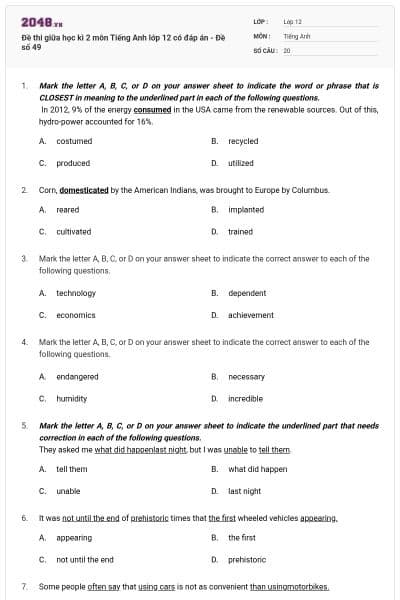
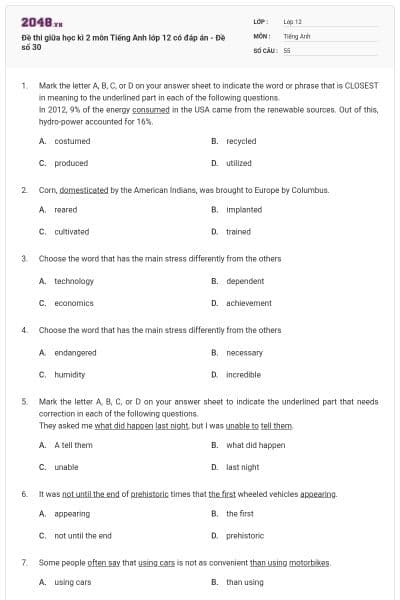
Mark the letter A, B, C, or D on your answer sheet to indicate the word or phrase that is CLOSEST in meaning to the underlined part in each of the following questions.
In 2012, 9% of the energy consumed in the USA came from the renewable sources. Out of this, hydro-power accounted for 16%.
costumed
recycled
produced
utilized
Đáp án đúng: D
Giải thích: consume = utilize: tiêu thụ, tiêu dùng
Dịch: Năm 2012, 9% năng lượng tiêu thụ ở Hoa Kỳ đến từ các nguồn tái tạo. Trong số này, thủy điện chiếm 16%.
Corn, domesticated by the American Indians, was brought to Europe by Columbus.
reared
implanted
cultivated
trained
Đáp án đúng: C
Giải thích: domesticated = cultivated: trồng trọt
Dịch: Ngô, được trồng trọt bởi thổ dân châu Mỹ, được Columbus đưa đến châu Âu.
technology
dependent
economics
achievement
Đáp án đúng: C
Giải thích: Đáp án C trọng âm rơi vào âm 3, còn lại trọng âm rơi vào âm 2
endangered
necessary
humidity
incredible
Đáp án đúng: B
Giải thích: Đáp án B trọng âm rơi vào âm 1, còn lại trọng âm rơi vào âm 2Mark the letter A, B, C, or D on your answer sheet to indicate the underlined part that needs correction in each of the following questions.
They asked me what did happen last night, but I was unable to tell them.
A tell them
what did happen
unable
last night
Đáp án đúng: B
Giải thích: Câu trần thuật bỏ trợ động từ: did happen => happened
Dịch: Họ hỏi tôi chuyện gì đã xảy ra đêm qua, nhưng tôi không thể nói với họ
It was not until the end of prehistoric times that the first wheeled vehicles appearing.
appearing
the first
not until the end
prehistoric
Đáp án đúng: A
Giải thích: Mệnh đề rút gọn thể bị động do chủ thể “vehicles” không tự thực hiện được hành động: appearing => appeared
Dịch: A
Some people often say that using cars is not as convenient than using motorbikes.
using cars
than using
often say
motorbikes
Đáp án đúng: B
Giải thích: Cấu trúc so sánh ngang bằng: S + be + as adj as + N nên than => as
Dịch: Một số người thường nói rằng sử dụng ô tô không tiện bằng sử dụng xe máy.
According to the passage, which of the following has contributed to the intense nature of twenty first century stress?
Our inability to control ourselves
An overabundance of special news
The degree to which stress affects our life
Our continual exposure to the media
Đáp án đúng: D
Giải thích: Dựa vào thông tin: “One of the factors contributing to the intense nature of twenty-first-century stress is our continual exposure to media”
Dịch:Một trong những yếu tố góp phần vào tính chất dữ dội của căng thẳng thế kỷ XXI là việc chúng ta liên tục tiếp xúc với các phương tiện truyền thông
Dịch bài đọc
Một trong những yếu tố góp phần vào bản chất căng thẳng dữ dội của thế kỷ 21 là việc chúng ta liên tục tiếp xúc với phương tiện truyền thông - đặc biệt là với quá nhiều tin tức. Nếu bạn cảm thấy căng thẳng vì tin tức, bạn không phải là người duy nhất. Tuy nhiên, bằng cách nào đó, nhiều người trong chúng ta dường như không thể ngăn mình không nghe tin tức ở mức độ cực đoan. Càng đi ngược về quá khứ trong lịch sử loài người, tin tức càng mất nhiều thời gian để truyền từ nơi này sang nơi khác và chúng ta càng ít tin tức về những người và vùng đất xa xôi. Rõ ràng là máy in đã thay đổi tất cả, cũng như mọi sự phát triển tiếp theo trong giao thông vận tải và viễn thông. Khi truyền hình xuất hiện, nó phát triển mạnh mẽ như một đàn thỏ. Năm 1950, có 100.000 chiếc tivi trong các hộ gia đình ở Bắc Mỹ; một năm sau, con số đó đã tăng lên hơn một triệu. Ngày nay, không có gì lạ khi một ngôi nhà có ba hoặc nhiều chiếc tivi, mỗi chiếc có thể truy cập cáp vào hơn một trăm kênh. Tin tức là chủ đề của nhiều kênh trong số đó và trên một số kênh, tin tức phát sóng 24 giờ một ngày. Hơn nữa, sau sự kiện đau thương ngày 11 tháng 9 năm 2001, các bản tin trực tiếp được kết hợp với các dòng chữ chạy dài ở cuối màn hình - để người xem có thể cập nhật mọi câu chuyện mọi lúc. Không cần phải nói, tin tức được đưa đến chúng ta không phải là tin tốt, mà là những hình ảnh và âm thanh đáng lo ngại ám chỉ đến thảm họa (thiên tai và nhân tạo), biến động, tội phạm, bê bối, chiến tranh, v.v. Làm trầm trọng thêm vấn đề là khi tin tức nóng hổi thực sự khan hiếm, hầu hết các chương trình phát sóng đều lấp đầy bằng vòng eo, đường chân tóc hoặc sự tồn tại trong tương lai. Sự đa dạng của câu chuyện này có xu hướng coi nhẹ một đợt bùng phát cúm có khả năng gây tử vong và những tuyên bố sai lầm về một loại kem chống nhăn hứa hẹn quá mức về làn da mịn màng. Liệu con người có thể xử lý quá nhiều chấn thương - chưa kể đến quá nhiều dự đoán quá mức về chấn thương tiềm ẩn - cùng một lúc không? Hãy nhớ rằng, bộ não con người được lập trình để chuyển sang chế độ báo động khi nguy hiểm rình rập. Nguy hiểm rình rập ai đó, ở đâu đó tại mọi thời điểm. Việc tiếp xúc với những thông tin như vậy mà không có sự nghỉ ngơi và góc nhìn đúng đắn không thể là gì khác ngoài nguồn gốc của căng thẳng mãn tính.
printing, transportation, and telecommunications were not developed
means of communication and transportation were not yet invented
the printing press changed the situation too slowly
most people lived in distant towns and villages
Đáp án đúng: A
Giải thích: Dựa vào thông tin: “the longer news took to travel from place to place, and the less news we had of distant people and lands altogether. The printing press obviously changed all that, as did every subsequent development in transportation and telecommunication”
Dịch: thời gian di chuyển tin tức từ nơi này sang nơi khác càng lâu thì chúng ta càng có ít tin tức về những người và vùng đất xa xôi. Báo chí in rõ ràng đã thay đổi tất cả những điều đó, cũng như mọi sự phát triển tiếp theo của ngành giao thông vận tải và viễn thông.
According to the passage, our continual exposure to bad news without perspective is obviously ___.
a source of defects in human brain
the result of human brain's switch to alarm mode
a source of chronic stress
the result of an overabundance of good news
Đáp án đúng: C
Giải thích: Dựa vào thông tin: “Exposing ourselves to such input without respite and without perspective cannot be anything other than a source of chronic stress”
Dịch: Tiếp xúc với đầu vào như vậy mà không có thời gian nghỉ ngơi và không có quan điểm không thể không là một nguồn gốc của căng thẳng mãn tính
According to the passage, when there is not enough actual breaking news, broadcasts ___.
are full of dangerous diseases such as flu
are forced to publicise an alarming increase in crime
send out frightening stories about potential dangers
send out live newscasts paired with text across the screen
Đáp án đúng: C
Giải thích: Dựa vào thông tin: “Compounding the problem is that when actual breaking news is scarce, most broadcasts fill in with waistline, hairline, or very existence in the future. This variety of story tends to treat with equal alarm a potentially lethal flu outbreak and the bogus claims of a wrinkle cream that overpromises smooth skin”
Dịch: Vấn đề phức tạp là khi các tin tức nóng hổi thực tế khan hiếm, hầu hết các chương trình phát sóng … kể nhiều câu chuyện có xu hướng báo động về một đợt bùng phát dịch cúm có khả năng gây chết người và những tuyên bố không có thật về một loại kem chống nhăn làm nổi trội làn da mịn màng
Many people are under stress caused by the media.
The only source of stress in our modern life is the media.
The news that is reported to us is not good news.
Many TV channels supply the public with breaking news.
Đáp án đúng: B
Giải thích: Dựa vào thông tin: “One of the factors contributing to the intense nature of twenty-first-century stress is our continual exposure to media - particularly to an overabundance of news.” => đây chỉ là một trong nhiều nguyên nhân khác
Dịch: Một trong những yếu tố góp phần vào tính chất dữ dội của căng thẳng thế kỷ XXI là việc chúng ta liên tục tiếp xúc với các phương tiện truyền thông - đặc biệt là với lượng tin tức dồi dào
release
fail
fall
bring
Đáp án đúng: C
Giải thích: slip = fall: trượt, ngãupsetting
boring
exciting
fascinating
Đáp án đúng: A
Giải thích: traumatic = upsetting: đau buồn, khó chịu
What is probably the best title for this passage?
The Media - A Major Cause of Stress
More Modern Life - More Stress
Developments in Telecommunications
Effective Ways to Beat Stress
Đáp án đúng: A
Giải thích: Dựa vào thông tin bài cung cấp
Mark the letter A, B, C, or D on your answer sheet to indicate the most suitable response to complete each of the following exchanges.
- Michel: "I failed my driving test again!" - Nick: “___”
Congratulations!
It's my pleasure.
I'm sorry to hear that.
Don't mention it.
Đáp án đúng: C
Giải thích: Dựa vào nghĩa của câu
Dịch:
- M: Tớ lại thi trượt bằng lái xe rồi
- N: Tiếc cho cậu
No, I don't like.
Yes, here you are.
I wouldn't say no.
Yes, not too bad.
Đáp án đúng: C
Giải thích: Dựa vào nghĩa của câu
Dịch:
- A: Uống bia không Emma?
- E: Tôi sẽ không từ chối đâu
In some countries, the disease burden could be prevented through environmental improvements.
something sad
something to entertain
something enjoyable
something to suffer
Đáp án đúng: C
Giải thích: burden: gánh nặng >< something enjoyable: tận hưởng
Dịch: Ở một số quốc gia, gánh nặng dịch bệnh có thể được ngăn chặn thông qua cải thiện môi trường.
Population growth rates vary among regions and even among countries within the same region
fluctuate
stay unchanged
remain unstable
restrain
Đáp án đúng: B
Giải thích: vary: đa dạng, thay đổi >< stay unchanged: không thay đổi, đơn điệu
Dịch: Tỷ lệ gia tăng dân số khác nhau giữa các vùng và thậm chí giữa các nước trong cùng khu vực
Mark the letter A, B, C, or D on your answer sheet to indicate the correct answer to each of the following questions.
My friend bought ___ from a shop on Tran Phu street.
a nice leather brown belt
a nice brown leather belt
a leather brown nice belt
a brown nice leather belt
Đáp án đúng: B
Giải thích: Trật tự tính từ: ý kiến (nice) – màu sắc (brown) – chất liệu (leather) + N
Dịch: Bạn tôi mua một chiếc thắt lưng da màu nâu rất đẹp ở một cửa hàng trên đường Trần Phú.
He was so mean that he couldn't bear to ___ the smallest sum of money for the charity appeal.
let out
pay off
give in
part with
Đáp án đúng: D
Giải thích: part with: cho ai cái gì
Dịch: Anh ta xấu tính đến mức không thể chịu đựng được khi góp số tiền nhỏ nhất cho việc kêu gọi từ thiện.
according to
in spite of
owing to
because
Đáp án đúng: B
Giải thích: in spite of + N: mặc dù, dù cho
Dịch: Hàng nghìn người đến xem Nữ hoàng dù trời mưa
interest
tendency
passion
involvement
Đáp án đúng: C
Giải thích: have a passion for: đam mê cái gì
Dịch: Từ nhỏ, Wolfgang đã có đam mê với ca nhạc
She was so tired last night that she slept like ___ until 10 o'clock this morning.
a log
death
a squirrel
a hill
Đáp án đúng: A
Giải thích: Idiom: sleep like a log: ngủ say như chết
Dịch: Tối qua cô mệt quá nên đến 10h sáng nay ngủ như khúc gỗ.
left
leaving
have left
to leave
Đáp án đúng: D
Giải thích: Cấu trúc: The first/last + N + to V: là người đầu tiên/cuối cùng làm gì
Dịch: Người cuối cùng rời đi sẽ phải tắt đèn.
I thought I saw water in the distance but it must have been an optical ___.
illusion
deception
delusion
error
Đáp án đúng: A
Giải thích: optical illusion: ảo ảnh quang học
Dịch: Tôi nghĩ rằng tôi đã nhìn thấy nước từ xa nhưng nó phải là một ảo ảnh quang học
the/ a
0/ a
the/ the
0/0
Đáp án đúng: D
Giải thích:
- Trước tên riêng “Philadelphia” không them a/an/the trừ một số trường hợp đặc biệt
- Cụm từ cố định: by train: bằng tàu
Dịch: Anh ấy thường tới Philadelphia bằng tàu
whose
where
that
which
Đáp án đúng: A
Giải thích: Mệnh đề quan hệ: người/động vật/vật + whose + mệnh đề = the town whose location …=> để nói về mối quan hệ sở hữu giữa “town” và “location”
Dịch: Họ mới tới thăm thị trấn ít người biết
I'm becoming increasingly ___. Last week I locked myself out of the house twice.
forgetful
absent
mindless
oblivious
Đáp án đúng: A
Giải thích:
- forgetful: đãng trí
- Các từ còn lại: mindless: thiếu suy nghĩ; oblivious: lãng quên; absent: vắng mặt
Dịch: Tôi ngày càng trở nên đãng trí. Tuần trước tôi đã nhốt mình ra khỏi nhà hai lần.Regular exercise and good diet will bring ___ fitness and health.
up
about
from
to
Đáp án đúng: B
Giải thích: bring about: mang lại
Dịch: Tập thể dục thường xuyên và chế độ ăn uống tốt sẽ mang lại thể chất và sức khỏeThis shirt is ___ that one.
not nearly as expensive as
a bit less expensive
as much expensive as
much far expensive than
Đáp án đúng: A
Giải thích: Cấu trúc so sánh ngang bằng: S + be(not) + nearly as adj as + N
Dịch: Cái áo này gần như không đắt bằng cái kia
Average temperature around the world have risen by 0.75°C (1.4°F) (32) ___ the last 100 years.
over
of
with
by
Đáp án đúng: A
Giải thích: over … year: hơn bao nhiêu năm
Dịch: Nhiệt độ trung bình của trái đất tăng 0.75% hơn 100 năm qua
behaviors
relationships
actions
activities
Đáp án đúng: D
Giải thích: human activies: hoạt động của con người
Dịch: Sự nóng lên được gây ra bởi sự tích tụ các khí nhà kính trong khí quyển do các hoạt động của con người tạo ra
possible
liable
likely
able
Đáp án đúng: A
Giải thích: make sth possible: làm gì đó có thể xảy ra, giúp
Dịch: Hiệu ứng nhà kính tự nhiên duy trì nhiệt độ Trái đất ở mức an toàn giúp con người và nhiều dạng sống khác có thể tồn tại
causing
making
made
caused
Đáp án đúng: A
Giải thích: causing: gây ra
Dịch: Tuy nhiên, kể từ cuộc Cách mạng Công nghiệp, những gì mang lại lợi ích cho con người đã tăng cường đáng kể hiệu ứng nhà kính khiến nhiệt độ trung bình của Trái đất tăng gần 1 ° C.
This is creating the global warming (36) ___ we see today.
which
what
who
where
Đáp án đúng: A
Giải thích: grobal warming là một hiện tượng (không phải người, địa điểm) => đại từ quan hệ “which”
Dịch: Điều này đang tạo ra sự nóng lên toàn cầu mà chúng ta thấy ngày nay
devise
promise
realise
surprise
Đáp án đúng: D
Giải thích: Đáp án D phát âm là /z/, còn lại phát âm là /s/
distinguished
developed
influenced
addicted
Đáp án đúng: B
Giải thích: Đáp án B phát âm là /d/, còn lại phát âm là /id/
Read the following passage and mark the letter A, B, C or D on your answer sheet to indicate the correct answer to each of the questions.
THE SAVANNAH
The tourist looking at the African savannah on a summer afternoon might be excused for thinking that the wide yellow grass plain was completely deserted of life, almost a desert. With only a few small thorn trees sticking out through the veldt, there seems to be almost no place for a living creature to hide. However, under those trees you might find small steenbok, sleeping in the shade, and waiting for the night to fall. There may even be a small group of lions somewhere, their bodies exactly the same as the tall grass around them. In the holes in the ground a host of tiny creatures, from rabbits and badgers to rats and' snakes are waiting for the heat to finish. The tall grass also hides the fact that there may be a small stream running across the middle of the plain. One clue that there may be water here is the sight of a majestic Marshall eagle circling slowly over the grassland. When he drops, he may come up with a small fish, or maybe a grass snake that has been waiting at the edge of a pool in the hope of catching a frog. The best time to see the animals then, is in the evening, just as the sun is setting. The best time of the year to come is in late September, or early August, just before the rains. Then the animals must come to the waterholes, as there is no other place for them to drink. And they like to come while it is still light; so they can see if any dangers are creeping up on them. So it is at sunset, and after the night falls, that the creatures of the African veld rise and go about their business.
Why do animals come to the waterholes while it is still light?
To avoid people watching them
To see their ways better
To be alert to the possibility of danger
To drink enough water before hunting
Đáp án đúng: C
Giải thích: Dựa vào thông tin: “the animals must come to the waterholes, as there is no other place for them to drink. And they like to come while it is still light; so they can see if any dangers are creeping up on them”
Dịch: các con vật phải đến các hố nước, vì không có nơi nào khác để chúng uống. Và họ thích đến khi trời còn sáng; để họ có thể xem liệu có bất kỳ mối nguy hiểm nào đang đến với họ hay không
The animals go to the river to drink
The animals go on with their normal activity
Tourism in Africa is big business
The animals are observed by naturalists
Đáp án đúng: B
Giải thích: Dựa vào thông tin: “So it is at sunset, and after the night falls, that the creatures of the African veld rise and go about their business”
Dịch: Vì vậy, chính vào lúc hoàng hôn, và sau khi màn đêm buông xuống, các sinh vật của châu Phi sẽ trỗi dậy và tiếp tục công việc của chúngA book for experts on wildlife
General non-fiction
A history of Africa
A fictional story
Đáp án đúng: B
Giải thích: Thông tin cung cấp xoay quanh môi trường, thói quen sống của động vật trên sa mạc, không có bất kì yếu tố viễn tưởng “fictional story”, lịch sử “history of Africa” hay lời khuyên nào “book for expert on wildlife”
A book for experts on wildlife
General non-fiction
A history of Africa
A fictional story
Đáp án đúng: B
Giải thích: Thông tin cung cấp xoay quanh môi trường, thói quen sống của động vật trên sa mạc, không có bất kì yếu tố viễn tưởng “fictional story”, lịch sử “history of Africa” hay lời khuyên nào “book for expert on wildlife”
A book for experts on wildlife
General non-fiction
A history of Africa
A fictional story
Đáp án đúng: B
Giải thích: Thông tin cung cấp xoay quanh môi trường, thói quen sống của động vật trên sa mạc, không có bất kì yếu tố viễn tưởng “fictional story”, lịch sử “history of Africa” hay lời khuyên nào “book for expert on wildlife”
a gang of
only a few
a large number of
a group of
Đáp án đúng: C
Giải thích: a host of = a large number of: rất nhiều cái gì
easily make a mistake of
be actually forgiven for
feel sorry for
be regretting for
Đáp án đúng: A
Giải thích: be excused for = easily make a mistake of: hiểu lầm, dễ mắc sai lầm
Dịch: Khách du lịch nhìn vào thảo nguyên châu Phi vào một buổi chiều mùa hè có thể hiểu lầm nghĩ rằng đồng bằng cỏ vàng rộng lớn hoàn toàn không có sự sống, gần như là một sa mạc.
The word "he" in paragraph 2 refers to ___.
a small fish
a person
the writer
a Marshall eagle
Đáp án đúng: D
Giải thích: “he” sẽ thay cho một danh từ chỉ người hoặc động vật xuất hiện ở câu trước: “One clue that there may be water here is the sight of a majestic Marshall eagle circling slowly over the grassland. When he drops, he may …”
Dịch: Một manh mối cho thấy có thể có nước ở đây là cảnh tượng một con đại bàng Marshall hùng vĩ đang bay chầm chậm trên đồng cỏ. Khi bay xuống, anh ta có thể …
The savannah appears to be empty because ___.
The animals are sleeping
They have been frightened by an eagle
The animals have gone about their business
The temperature prevents much activity
Đáp án đúng: D
Giải thích: Dựa vào thông tin: “In the holes in the ground a host of tiny creatures, from rabbits and badgers to rats and' snakes are waiting for the heat to finish “, “The best time to see the animals then, is in the evening, just as the sun is setting”
Dịch: Chúng đều chờ cho mặt trời tắt ở trong những hang, tán cây để có thể hoạt động
Mark the letter A, B, C, or D on your answer sheet to indicate the sentence that best combines each pair of sentences in the following questions.
We spend about one-third of our lives sleeping. We know relatively little about sleep
Despite spending about one-third of our lives sleeping, we know relatively little about sleep.
We know relatively little about sleep; as a result, we spend about one-third of our lives sleeping.
We spend about one-third of our lives sleeping so that we know relatively little about sleep.
We shall know more about sleep if we spend more than one-third of our lives sleeping.
Đáp án đúng: A
Giải thích: Despite + mệnh đề, mệnh đề: mặc dù …
Dịch: Mặc dù dành khoảng một phần ba cuộc đời để ngủ, nhưng chúng ta biết tương đối ít về giấc ngủ
Overeating is a cause of several deadly diseases. Physical inactivity is another cause of several deadly diseases.
Not only overeating but also physical inactivity may lead to several deadly diseases.
Apart from physical activities, eating too much also contributes to several deadly diseases
Overeating and physical inactivity are caused by several deadly diseases.
Both overeating and physical inactivity result from several deadly diseases
Đáp án đúng: A
Giải thích: Cấu trúc: not only … but also: không những … mà còn …
Dịch: Không chỉ ăn quá nhiều mà việc lười vận động cũng có thể dẫn đến một số bệnh chết người
People say that Mr. Goldman gave nearly a million pounds to charity last year.
Mr. Goldman is said to have given nearly a million pounds to charity last year.
Nearly a million pounds was said to have been given to charity by Mr. Goldman last year.
Nearly a million pounds is said to be given to charity by Mr. Goldman last year.
Mr. Goldman was said to have given nearly a million pounds to charity last year.
Đáp án đúng: A
Giải thích: Cấu trúc câu bị động:
- Chủ động: People/they/… + say/think/… that + S + V
- Bị động: S + is said + to V/ to have V3
Dịch: Ông Goldman được cho là đã quyên góp gần một triệu bảng Anh để làm từ thiện vào năm ngoái
"Why don't we wear sunglasses?" - our grandpa would say when we went out on bright sunny days.
Our grandpa asked us why we did not wear sunglasses when going out on bright sunny days.
Our grandpa reminded us of going out with sunglasses on bright sunny days.
Our grandpa used to suggest wearing sunglasses when we went out on bright sunny days.
Our grandpa would warn us against wearing sunglasses on bright sunny days
Đáp án đúng: C
Giải thích: “Why don’t we V?” mang ý đề xuất, đưa ra gợi ý = (to) suggest Ving
Dịch: Ông của chúng tôi thường đề nghị đeo kính râm khi chúng tôi ra ngoài vào những ngày nắng chói chang.
I am sure he did not know that his brother graduated with flying colors.
He cannot have known that his brother graduated with very high marks.
He may not know that his brother is flying gradually up in a colorful balloon.
He should not have been envious of his brother's achievement.
That his brother graduated with flying colors must have been appreciated by him.
Đáp án đúng: A
Giải thích:
- Câu cho sẵn mang nghĩa “Tôi chắc chắn anh ta không biết em mình tốt nghiệp với số điểm cao”
- Cách dùng hợp nghĩa: “cannot have + V3” chắc là đã không làm điều gì
Dịch: Anh không thể biết rằng anh trai mình đã tốt nghiệp với số điểm rất cao.
Bạn có thích hoạt động này không?